Category Archives: Amy Rasmussen

3 Ideas for Better Book Talks

I should have written this post yesterday. Yesterday was 9/11, and I always try to incorporate some lesson about the events, emotions, and effects of that day into whatever our focus is in class. It’s important we always remember.

My students are juniors and seniors. 9/11 is history to them, and few of my students like to read historical fiction. They choose YA off of my “Teen Angst,” “There Might Be Kissing,” and “You Just Can’t Get Over It” shelves most often. (I suppose most of the books I book talked today fit in that last category though. I’ll be moving a few later.)

Without really meaning to, I shared three books with students on Monday in three different ways. Thus, the idea for this post on engaging students in reading by mixing up our book talks.

  1. Read a poignant, exciting, or particularly intriguing passage from a book.

Over the weekend, I read The Memory of Things by Gae Polisner. I found this a touching story about love and loss and resilience — all topics my students can relate to. What does it mean to be responsible? How do we fight our fears and struggle through the tragedies that terrify us?

In my book talk, I spoke about the characters in the book:  a young man trying to prove his worth to his dad, and a young woman who we learn is in conflict with hers — both struggling with the realities in NYC on the tragic Tuesday of 9/11.

I read the first few paragraphs aloud:

“I move with the crowd, away from downtown Manhattan.

We travel swiftly but don’t run, panicked but steady, a molten lava flow of bodies across the bridge.

A crash of thunder erupts–another explosion?–and the flow startles and quickens. Someone near me starts to cry, a choked, gasping sound, soon muted by a new wail of sirens rising at my back.

I stop and turn, stare frozen. People rush past me:  faces twisted with shock and fear, mouths held open in O’s, others only eyes where their noses and mouths have been covered with knotted sleeves against the toxic, burning reek.

I search fro Kristen or Kelly, or Mr. Bell, but I lost them all as soon as we got to the bridge.

I don’t see anyone I know from school.

I don’t see anyone I know.

I press my sleeve to my nose– Don’t think, Kyle, just move!–but feel stuck gaping at the place where the city has vanished beyond the thick brown wall of smoke.

Two planes have hit, one building is down, and my dad is in their somewhere.”

There’s a lesson in imagery in there I may return to sometime. We are writing narratives right now, so I bookmarked this for later. For now, it’s a good teaser and an effective book talk.

2. Show a movie trailer — but play up on how the book is always better.

My students love videos. They admit to spending their entire lives on YouTube, so any chance I get to show a video clip I take.

If you’ve read Extremely Loud and Incredibly Close, maybe you feel like I do about the movie:  I loved it, but the book just gives us so much more detail, description, characters, and craft to love. Oh, how I love the craft in this book by Jonathan Safron Foer.

For my book talk, I first flipped through the book, showing student how Foer plays with white space, page markings, and photo essays — all which play into how he develops the plot and constructs meaning. I talked about the parallel plot line and how the movie makers diminish, change even, the important second storyline. I explained how this book taught me more about author’s craft than anything I’ve ever read. Then, I showed the movie trailer.

(Book trailers work as effective book talks, too. You’ll find a bunch here and here and here. We even have a few ideas about book trailers in our archives on this blog.)

  1. Use a passage as a quick write prompt or as a craft study. 

Have you read The Red Bandanna: A Life, a Choice, A Legacy by Tom Rinaldi? Just a few pages in, and your heart will swell.

As I read the books I know I will share with my readers, I mark passages that make me think and feel. Important moves for any reader. I model these moves as I share books and writing ideas with my students. This passage from The Red Bandanna tears me to shreds every time.

The Red Bandana

In my senior English classes, I talked about the heroics of Welles Crowther, the main character in the book, and then students wrote in response to the questions:  What do you carry, what truth could it possibly contain? What meaning could it hold?

In my AP Language class, we talked in our groups about the word choice, the interesting syntax, the tone, and then students wrote their answers to those questions, trying to imitate the writer’s rhythm and descriptive language.

In all my classes, we talked about 9/11, our thoughts, our feelings, and why they matter to the lives we live now. We made connections to texts and to one another as we shared our thinking and our writing. That to me is an added bonus of an effective book talk.

I know my students will read more the more I talk about books. I am the salesperson, and they are the often skeptical customer. I’ve learned that mixing up how I talk about books matters.

And getting students interested in reading pretty much anything these days matters most of all.

Do you have ideas on mixing up our book talks? Please leave your ideas in the comments.

Amy Rasmussen loves to read, watch movies with her husband, and tickle her five grandchildren. She’s in the market for a lake house and likes to shop thrift stores for books and bargain furniture. Someday she’ll be disciplined enough to write a book about teaching. For now, she teaches senior English and AP Lang and Comp at her favorite high school in North TX. Follow Amy on Twitter @amyrass, and please, go ahead and follow this blog.

Why We’ll Read More Than an Article of the Week in Senior English

I wish I were kidding. I am still laughing, but this is not funny.

Last week was my first week back to school. We had five days of shifting classes; schedule changes like shuffling cards with every student vying for their winning hand, or at least two out of four classes stacked with friends.

This is my first year to teach senior English (I still have one section of AP Lang), and I felt a mixture of excitement and dread all summer. Twelve years of reading, or not. Twelve years of playing the game of school, or not.

How do I get students to want to read, want to write, want to explore and question and challenge when it’s possible they just want to be done with school? I am pretty sure that’s how I felt senior year. Granted, that was a loooong time ago, but I do not remember any teachers’ names, any books I read for school, anything I learned the year before I graduated.

I wonder if that’s normal. Somehow I don’t think it should be.

But I do not want my seniors to remember me. I want them to remember learning something that adds value to their lives. I want them to remember learning something that adds value to my life as they vote beside me for elected officials, move into my neighborhood, become my doctor, or perhaps teach beside in the classroom next door.

I know the routines of a workshop pedagogy will help me do that, of this I am certain.

We’ll read and think and write and talk. We’ll share our thinking and our writing in small groups and as a class. We’ll talk about books and the themes that resonate and why that might be so. And we’ll write about the things that matter in our lives.

We started all of this in five short days.

I also got a little panicky.

If you are familiar with Kelly Gallagher’s work, you’ve probably heard him talk about why he started Article of the Week. He said he’d given his students, seniors, an article to read, and while circling the room and checking in with small groups, he asked a couple of kids how their reading was going. “Okay,” they said, “except we don’t know who this Al Quaeda guy is.”

Uh huh, seniors. Seniors who had no idea what was happening in their world.

I’m not too sure mine do either.

2017 Face Palm Experience #1:

We’d just looked at images of the destruction from Hurricane Harvey. We’d done some thinking in our notebooks about how these images made us feel and what we could do to help in the efforts to aide our fellow Texans. I walked the room, listening in as students read from their notebooks. Then, I heard this:

“Can a hurricane happen on a lake?” Student A said, “I mean like would a hurricane ever happen on Lake Lewisville?”

I stopped. Wouldn’t you?

Student B answered, “Uh, hurricanes happen on an ocean.”

“So what ocean is by Houston?” said Student A.

“That’s the Gulf of Mexico,” said Student B.

And Student A asks “So what ocean is that, the Pacific?” as she reaches for her cell phone.

I wish I were confident she planned on looking up information about hurricanes and oceans and weather patterns. Somehow I doubt it. I’ve asked her to put her phone away 47 times in five days. (So far phones have not been an issue except with this student.)

Now, I am left wondering:  Will whatever we do in room E111 be enough to prepare my students for the world beyond the halls of our high school? The responsibility is a lead weight on my shoulder.

I sure hope I can carry it.


Amy Rasmussen is the mother of six amazing young adults, grandmother of five smart and sassy little people, and wife to a brilliant marketer, sales exec, life coach, and dog lover. She teaches readers and writers in AP Language and English IV in North TX and facilitates professional development on the workshop model of instruction at every opportunity. She loves God, her family, the U.S.A., and all humans everywhere. Follow Amy on Twitter @amyrass

Our Day One Writing: Personal User Manuals

I’ll be honest. I’ve started this post three times. At first bemoaning why I can’t believe summer is over. Then whining that I didn’t get enough done, and finally, justifying why I can’t seem to get in a writing groove. None of it matters. I started back to school yesterday. Kids come next Monday.

I will be ready. And I’ll love it.

I’ve spent hours working on my new room. It’s almost done (I’ll post photos soon), and I classroom culturefigure if I can get my room perfect, everything else will fall into place. Misplaced priorities? Maybe, but that’s how I roll. The aesthetics in my classroom matter to me, and if you’ve visited (and many teachers and admin from around TX did last year), you know what I mean. Book shelves just right. Colors and furnishings that invite. Places to chart skills taught and showcase students’ thinking. All of this matters to the culture I work hard to cultivate in my classroom.

And while I’ve worked, I’ve thought about the students whose names rest on my rosters. Who are they as readers and writers? Who are they as individuals with needs and wants and passions? How can I help them know of their potential and of the possibilities that await them not just this year but beyond?

I’m teaching seniors for the first time this fall. Since my school is on an accelerated block schedule, I will have these students for one semester. Just one. One semester at the end of their high school experience. One semester to create a community, build a culture, bridge gaps, shape literacy identities as individuals about to face the big wide world — hopefully as citizens unafraid to face their fears, and the frightening things in our society.

One semester to read and write and think — together. One semester with a dream for a lifetime.

I’ve read a lot about the importance of building community lately, and I’ve talked a lot about the first day of school in most of the pd I’ve facilitated. I used to think, especially with my AP Lang classes, I had to knock ’em dead with my syllabus the first day, list my expectations, explain my grading policy, discuss my plan for how and what they would learn. Scare them into understanding the complexities of my AP class. I blew a lot of opportunities over the years. That “my” got in the way a lot.

How can it be “our” learning community if I am the one laying out all the learning plans? If I am the only one talking about what the learning must look like?

I wrote this post Talking about the First Day of School in 2015. Funny because I’m in the same canoe this year, wondering about how I will welcome students on Day One. The last thing I want is to ignite the fear, flight, freeze response, which so often happens with that same ole same ole flood of student expectations. Students are already experiencing high levels of stress the first day of school. I do not want to accelerate it

I’ve thought about reading the poem “Possibilities” by Wislawa Szymorzska. I wrote about how my students and I used this poem to begin our understanding of rhetorical analysis last year. I’ll do that again, but it’s probably better as a week two activity.

TeacherAuthorBio

author bio, Linda Sanchez, Wylie ISD

I’ve thought about reading author bios and asking students to write their own. Lisa and I wrote about our successes with students writing author bios last year and even modeled writing author bios with our teacher friends during pd this summer. So many talented teacher writers! Author bios are a new favorite, but they’re probably not for day one.

I’ve thought about jumping right in and setting up our writer’s notebooks. I stocked up

composition notebooks

I bought 170. The cashier at Walmart scanned them one by one.

and have one for each student ready at the bell. Now, I’m wondering if setting the notebook up is as important as just writing down some thinking on the first day of school.

Susan Barber wrote about her First Day of Class activity, and the idea of beginning with reflection resonates with me. I just don’t know about a trek to the football field — our students graduate at the UNT Coliseum miles away, and TX weather means it’s still hot hot hot. I can already hear whining. I love Susan’s idea though and want to think about this more.

I keep coming back to community. And culture.

My instruction works because of the community we build as readers, writers, listeners, and speakers. Or is it a culture we create as readers, writers, listeners, and speakers? Is it possible to have one without the other?

When Lisa was in town, we sat in my car in a parking lot and talked about this very thing. Lisa shared her wisdom: “Community is the classroom. It’s more immediate.” Mentioning her teaching before her move to workshop, she said,  “I built community to help us get through the things students didn’t like — like Huck Finn.”

Interesting. So community is good — sharing likes, dislikes, working toward a common goal, getting along, respecting one another.

We talked about get-to-know you games, icebreakers, we’ve all used on the first day of school. Many of them good ideas for building community. Then Lisa asked: “Do we get-to-know for the get-to-know — or the value of learning who are students are as readers and writers?”

Ah, the beginnings of building a culture.

“Culture is more pervasive,” Lisa said, “A culture of learning in an English class values reading, writing, talking, and thinking that goes on — that has demands beyond the classroom.”

And now I’m wondering:  On the first day of school, how do I build a community that begins creating a culture, a culture that validates, shapes, and inspires my students’ identities as thinkers, readers, writers, citizens, and humans that goes beyond the classroom?

Not an easy feat. But maybe there’s an easy start.

I don’t know why I clicked on this headline, but I think I’ve found my first day of school: “Completing this 30 minutes exercise makes teams less anxious and more productive.”

I think we will write personal user manuals. It’s a task business leaders are using to help

user_guide

I’d like a better name than “user.” Any ideas?

their teams work better. Why not try it in the classroom?

The article states, “The user manual aims to help people learn to adapt to one another by offering an explicit description of one’s personal values and how one works best with others. This shortens the learning curve for new employees, and helps everyone avoid misunderstandings.” Since student talk and collaboration is central to my instruction, I think writing one-page user manuals about ourselves might put us on the fast track to better communication and the culture that fosters better learning.

Abby Falik, founder and CEO of Global Citizen Year, states: “My User Manual is one of the ways I practice leading out loud. It’s a living document that describes my innate wiring and my growing edge, while putting it out to the world that I know I am – and aim to always be — a work-in-progress.” And the article includes the structure Abby used to write her manual and a link to the manual itself. Mentor text, y’all!

Abby’s user manual centers around these six topics:

  1. My style
  2. What I value
  3. What I don’t have patience for
  4. How to best communicate with me
  5. How to help me
  6. What people misunderstand about me

I’m thinking of including prompts that probe other topics more specific to what I need to know about my students literacy histories — kind of like a reading/writing territory — and topics that can jump start connections and trust between students. Maybe things like:

Describe yourself as a reader.

What is your favorite book? Who is your favorite author?

Write a simile about your writing life. 

When it comes to English class, where do you feel you want to grow the most?

List ten things you like to do in your spare time.

Of all your memories, which three are the most indelible?

What five adjectives describe your disposition?

I also like these questions I read regarding building trust in Adolescents on the Edge by Jimmy Santiago Baca and ReLeah Cossett Lent, a book I just started and am already loving for content, stories, and ideas:

Have you experienced fair treatment, either by family or by the system?

How do you express appreciation? Do you often receive appreciation for your acts?

How important is it for promises to be kept, either those made to you or those you make to others?

Do you feel that you are a part of decision making that affects your life?

Are you dependable? Do you feel others are dependable?

How do you generally resolve conflicts?

How important is truthfulness to you?

Too much? Maybe. But students will have choice in what they answer — and how. And like any time we write like this, we will talk first. Talk matters in a writing classroom.

Of course, I will write my own user manual. If I get my act together, I’ll have it ready on Day One as a way to introduce myself to my students. Hopefully, I can write it in a way that lets them know that while I am intense, passionate, and purposeful in helping them grow as readers and writers, I am also pretty vulnerable, and an introvert on a stage cast in the role of extrovert.

I’m thinking we will use our user manuals a lot. I’ll include a copy of each students’ in my conferring notebook for easy access and review when I meet with them. We’ll share with our table mates. We’ll share in our book clubs and in our writing groups. We’ll share when we do group projects or collaborate on writing.

We will use our manuals like leaders in business do because “the ability to share your thoughts and ideas openly, honestly, and without fear of judgment—has been repeatedly proven the key to innovative, happy teams. Whether you’re a manager or young employee, writing and sharing a user manual has a clear business payoff. The better a team knows one other, the easier it will be for them to navigate conflict, empathize with one another, and feel comfortable sharing, critiquing, and building upon one another’s ideas.”

What do you think? How will you (or did you, if you’ve already gone back) start building your classroom culture?


Amy Rasmussen is the mother of six amazing young adults, grandmother of five smart and sassy little people, and wife to a brilliant marketer, sales exec, life coach, and dog lover. She teaches readers and writers in AP Language and English IV in North TX and facilitates professional development on the workshop model of instruction at every opportunity. She loves God, her family, the U.S.A., and all humans everywhere. Follow Amy on Twitter @amyrass


Want to RENEW! Get the book by @ShawnaCoppola

I have never written a book review. (Okay, maybe that’s not true. I think I remember writing one in 4th grade over a biography of Marie Curie, the first biography I ever read.)

I have never written a review of a teaching book. But I am going to try.

I am a teaching book junkie. I have stacks of them, but I rarely read the whole of them. I cannot even tell you why, and I admit there is great irony here because as I write this, I am also trying to write my own book for teachers (I have been for four years, sigh.) If I ever get it written, I hope you’ll read it.

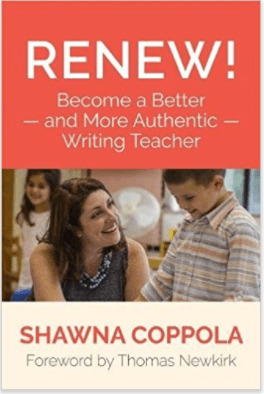
In the mean time, I have to tell you about Shawna Coppola’s new book RENEW!

I read the whole of this book in one afternoon! Thank you, Shawna, for writing so much of my own thinking about “Becoming a Better — and More Authentic — Writing Teacher.”

Shawna’s voice sings with passion and positivity. She paints the pages with possibilities! I know, I am gushing (and that’s probably too many p’s.) But here’s the thing —

I know so many ELA teachers who do know know how to teach writing. I know many more who are not confident teaching writing. I know even more who are not writers themselves, so it’s no wonder that teaching writing is difficult. Teaching writing is hard. A book like RENEW! not only gives us a starting place, it gives us desire.

desire-is-the-starting-point-of-all-achievement-not-a-hope-not-a-wish-but-a-keen-pulsating-desire-which-transcends-everything-napoleon-hill

I am doing a lot of thinking lately around the idea of transcending. How do we go beyond our limits into something more, something better, something real and sustaining?

Let me share with you some of the passages I marked in RENEW!. I think you’ll see why this book is a must read for any teacher who needs a bit, or a lot, of renewal when it comes to teaching students to write.

“. . . if we are truly willing to honor the individuality of our student writers, the RENEW!uniqueness of each community of learners, and the ever-changing nature of our global landscape, we must continually rethink, revise, and renew our practice. Otherwise — to paraphrase Dewey — we rob “today’s students of the tomorrow today’s students deserve” (10).
“Broadening our ideas about what writing “is” can be scary, as if we are opening up a Pandora’s box. But in all reality, continuing to teach our student writers through a narrow, outdated lens — one that, in overvaluing written composition, does not accurately tell a story about the world of writing beyond most schools and classrooms — harms their development as writers by limiting the kinds of composing they are exposed to and encouraged to practice” (51).

“Teaching our writers how to develop their own tools is infinitely more sustainable than using preexisting tools. Quick survey:  How many of you use the graphic organizer your sixth-grade teacher taught you to use to write a persuasive piece? That graphic organizer may have been helpful to you then (although I doubt it was helpful to 100 percent of your classmates), but how useful is it you now?” (62).

“What message or “story” are we sending our student writers with a single overall score? Not only does it imply that their worth as a writer can be whittled down to one letter or number (which itself can mean different things for different teachers and even within different units of study), but that the worth of writing itself can be whittled down this way” (73).

“. . . readers of writing are human, an done person’s response to a composition may not perfectly align with another’s (If it did, what a drab, boring world we’d be living in!)” (79).

“Which is more likely to help students learn:  offering them specific feedback about their work, behavior, or performance, or slapping a score on a piece of paper?” (82).

“. . .when we engage in a semi-regular habit of writing, we can much more genuinely speak to those incredibly fantastic moments that writers experience on occasion, like the amazing feeling of completing a particularly difficult draft or writing something that makes a reader spontaneously laugh out loud. Anyone who’s ever taught a group of students of any age knows that when we are faking our way through something, or at the very least “phoning it in” by only engaging on a superficial level with what we are purporting to teach, students can smell our lack of authenticity a mile away. They know, even subconsciously, that they are being sold a decidedly moldy bill of goods” (92).

That’s all well and good, right? But here’s the beauty of Shawna Coppola’s book — she gives us the research that supports each of her positions AND she gives charts and graphs and resources to help us rethink, revise, and renew our approach, instruction, and practice as we become better teachers of writing. This book is chock full of everything good when it comes to writing instruction. It is a book I will return to again and again.

I hope you’ll read it. I hope you’ll share it with every ELA teacher you know. Really, it is just that good.


Amy Rasmussen lives in north Texas and teaches AP English Language and English 4 (new prep in ’17.) She loves talking books, daughters’ weddings (two this year), and grandbabies (five). She also loves facilitating PD for other teachers making the move into a workshop pedagogy. Amy adheres to the words of Emerson: “We aim above the mark to hit the mark,” and Jesus: “Love one another.” Imagine a world if we all aim higher. Follow Amy on Twitter @amyrass. And she really hopes you will follow this blog!

Please respond: What do our students really need?

Dear Readers, would you help with something? I’d like to collect some informal data. All you need to do is read below, take the survey, and maybe leave a comment. Thanks in advance! (I #amwriting)


Sometimes when I conduct PD, we start with a discussion of the characteristics of the students we teach. I introduce this topic by discussing the differences between Millennials and Post-Millennials, also known as Generation Z. 

Of course, they are also called other names:  Homeland Generation, iGeneration, Gen Tech, Neo-Digital Natives, etc. (Wikipedia provides a good starting place for a bit of research with an impressive list of citations.)

What I think is even more interesting than the names marketers and researching are calling these young people are some of the descriptors used to define them:  cynical, private, entrepreneurial, multi-tasking, hyper aware, technology reliant; and the terms in which they self-identify: loyal, compassionate, thoughtful, open-minded, responsible, resourceful, determined.

What I really wonder though — based on our experiences with our students day in and day out — plus what we know about their tech savvy selves — what do our students really need from us as their educators?

Please take this poll and share it widely. I’d like to know what other educators, (actually all adults really) think. 

Also, if you have the time, I’d love to know you thoughts on the best ways to give our students what they need within our ELA classrooms. Please leave your thinking in the comments. (Maybe you’ll make it into this elusive book I’m trying to write.)

Thank you!

Amy


Defining Readers-Writers Workshop

“I need a visual of a ‘workshop.’ That word confuses me still.”

This is not the first time I’ve been part way through facilitating professional development and a participant has made a similar request. There’s a lot for me to learn here.

Before we can begin really sharing the excitement and benefits of a readers-writers workshop model of instruction, we must get on the same page as to what we mean by Workshop. I’ll try to do that here.

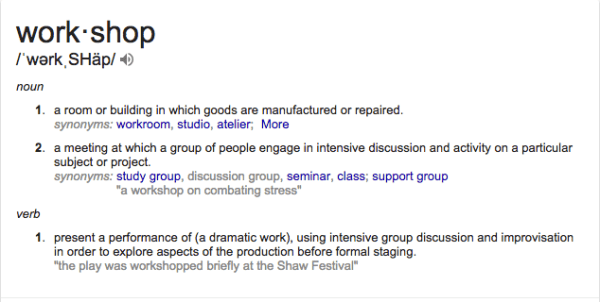
Let’s start with the dictionary definition of workshop and zero in on #2.

workshop definition

Based on this definition, let’s consider this essential question:

How do we create open spaces where the children we teach can grow as readers and writers?

To me “open spaces” equates to “workshop.” Open spaces means teachers let go of control, remove themselves from center stage as the holders of the knowledge, and invite students into a space of curiosity and discovery. It’s a space where students thrive in a community of trust and sharing, where they talk about their identities and experiences as readers and writers, where they play with language and take risks as they explore what it means to develop their comprehension and analysis skills — and their craft as writers.

Opening spaces requires planning. It is not willy-nilly choice in books or topics, or stations without specific guidelines and instructions, or seats moved from rows into small groups without modeling the thinking that makes it possible to “engage in intensive discussion and activity” around our content. Teachers must model what this looks like. And we must trust that our students will engage and learn in this model.

They will — if we let them.

Readers-writers workshop is a method of instruction that often requires a paradigm shift, a shift from the teacher making all the choices and telling students what to learn within a text, to students making choices, and through practice and application of skills-based lessons, learning as they read and write.

I’ll return to some definitions found online to help clarify:

“The Reading Workshop is a teaching method in which the goal is to teach students strategies for reading and comprehension. The workshop model allows teachers to differentiate and meet the needs of all their students.”

For our readers, we open the space for students to choose the books they read. By doing so, we meet students where they are in terms of their interests and abilities. The teacher becomes a coach, teaching skills specific to the needs of each learner. This requires time. We must reserve time for students to read when they are with us in class, and we must confer with students about what they are reading — and how they are reading it. This is reading instruction in a workshop model. We teach the reader, not the book. Readers must predict, visualize, infer, comprehend, analyze, and evaluate. These are all skills we model and teach in readers’ workshop.

What about writer’s workshop?

“As in a professional writer’s workshop, each student in the class is a working author. The teacher is a writing professional and peer coach, guiding authors as they explore their craft. … Teachers write with their students and share their own work as well.”

To teach our writers, we must be writers ourselves. We must model the moves writers make as they use language to craft meaning. We must validate our writers and help them recognize what professional writers do to think of ideas, organize those ideas, and convey those ideas in a way comprehensible to readers. In a workshop classroom, we use mentor texts:  sentences, paragraphs, passages, essays, poems, stories to teach writing skills that students apply to their own writing. We teach the writer, not the writing.

workshopquestion

So, what do I mean when I say “workshop”? I mean students doing the work of readers and writers, “engaged in intensive discussion and activity on a particular subject” — specifically related to growing as readers and writers. This work happens because teachers open the spaces in their classrooms which allow for it.

Questions about your move to a workshop model of instruction? Please ask in the comments.

Amy Rasmussen lives in north Texas and teaches AP English Language and English 4 (new prep in ’17. She loves talking books, daughters’ weddings (two this year), and grandbabies (five). She also loves facilitating PD for other teachers making the move into a workshop pedagogy. Amy adheres to the words of Emerson: “We aim above the mark to hit the mark,” and Jesus: “Love one another.” Imagine a world if we all aim higher. Follow Amy on Twitter @amyrass. And she really hopes you will follow this blog!


Every Teacher a Reader. Every Teacher a Writer.

Do any of you follow the Middle and High School Secondary ELA group on Facebook?

Now, I am not trying to pick any fights, but I’m just going to say it:  Some of the comments drive me straight over a rocky cliff. Honestly, I tend to get a little snarky if I spend too much time there. (Sorry, not sorry.)

Today an ELA teacher posted “Writing sucks.” What?! I sure hope a student never hears her say that. Yesterday a teacher posted this question:

“Silent reading…have you built it into your routine? For how long? Do you find your struggling readers or non-readers (at home) love this time? I currently have built it in for the first 15 minutes since I know many of my 6th grade sts do not read at home. I think it works, but just brainstorming other ways to do things for next year. Just curious what you all do! I would be curious if HS teachers still give time to silent read, too.”

I had a hard time reading the thread with comments like “They won’t read, or forget their books… It turns into wasted time.”

Of course it does, if teachers do not establish the all out importance of reading, the benefits of reading, the time commitment to grow as readers; if teachers do not walk the talk of readers, share their reading lives, promote books and match books to kids and beat the drum of reading. Every. Single Day. We have to help students value reading.

The same holds true for writing. We have to help students value writing. We have to help students value the struggle of writing well.

Are we teacher-writers who model the difficult task of writing? Do we share the struggle of getting thoughtful ideas on the page and revising and revising and revising to convey the meaning we intend to the audience we intend? Writing well means we make intentional choices and we develop the habits of writers. Read Donald Murray’s “Habits of Writing,” and then internalize his last line: “Consider my habits of writing, but develop your own by studying what you did when the writing went well, and make what you discover your own writing habits.” (If you really want to build your writer-mojo, I suggest Murray’s books, The Essential Don Murray:  Lessons from America’s Greatest Writing Teacher, and Learning by Teaching.)

We can learn to write well. We can learn to teach writing well as we discover our own writing habits and guide students into developing their own. But this will never happen if we do not write.

readerswriters

I’ve written about walking our talk before — and I believe it more every day. I think we owe it to our students to be actively engaged in the learning process the same way we ask them to be actively engaged. I can never be a good enough reader. I can never be a good enough writer.

So, this summer I commit to keep working on my craft. I will read. I will write.

If you are reading this post, I know I am preaching to the choir. I know you already share at least some of my beliefs about reading and writing. Thank you for that!

I invite you to share your reading and your writing, to amplify our collective voices as teachers who read and write, and walk our talk — even during the summer. Shana posted our summer posting plans yesterday. I hope you’ll join us on our Facebook page, our Instagram feed, and on Twitter. And as Austin Kleon famously asserts:  Show your Work!

Let’s spread it far and wide!

Amy Rasmussen lives in north Texas and teaches AP English Language and English 4 (new prep in ’17. She loves talking books, daughters’ weddings (two this year), and grandbabies (five). She also loves facilitating PD for other teachers making the move into a workshop pedagogy. Amy adheres to the words of Emerson: “We aim above the mark to hit the mark,” and Jesus: “Love one another.” Imagine a world if we all aim higher. Follow Amy on Twitter @amyrass. And she really hopes you will follow this blog!

We are Magnificently Confused and other names for book shelves

I have a lot of bookshelves and a lot of books. I have a relationship with my classroom

bookshelves

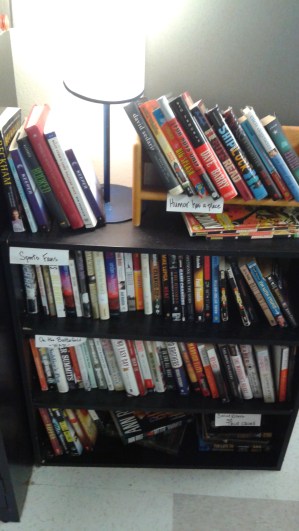
some of my current shelves

library like many drivers have with their cars. I shine it up and keep it running smoothly. I love the new book smell.

Quite often someone asks about how I organize my library. Very carefully. When I know which shelves hold which books, I can more easily match books to readers. Shelf labels matter.

The labels on my shelves do a couple of things:  They help me know what holds what, but more importantly, these labels serve to pique curiosity and press readers to explore.

When you get to know a lot of books, you realize that most books may sit comfortably on several shelves, especially if we sort them by topic or theme and not just genre.  Sometimes I group the same copies of specific books together, and sometimes I break the sets a part to put on separate shelves.

morebookshelves

sports and war books need a taller shelf

When school returns in August, I will be in a new classroom. A different classroom. That means that my hundreds of books had to move down the stairs and down the hall. Now those boxes wait for when I have time. I’m going to need a lot of time.

I am thinking about how I want to organize my shelves in this new learning space — maybe two reading nooks instead of one, fewer books on the lowest shelves? more intriguing labels on more shelves with the hope of inviting more readers?

I’m thinking for sure on that last one:  changing up the category labels on the shelves. I could use your help here. I think it would be fun to be clever, but clever is hard for me.

So far, I’ve read through a ton of quotes on books and reading, and pulled phrases for shelf labels I think will work for most of the books in my library.

Here’s what I have so far:

Born into Chaos

Clapping for the Wrong Reasons

Burning Bridges

Gracefully Insane (or Close to It)

Black Sheep Own the World

You Cant Just Get Over It

Holding Close My Secrets

Making Myself into a Hero

Stop Reminding Me I Need a Life

Do You Kiss with Eyes Open or Closed?

You Just Can’t Get Over It

The Present Hides the Past

History is Herstory, too

History:  Echoes Heard & Unheard

The Edge of Possibility

Foul Play (and other sports stories)

A Likely Story

Detecto Mysterioso

It’s Going to Break Your Heart

Using My Life as a Lesson

We are Magnificently Confused

What labels would you add?

And the question of the hour:  What high-interest books would you put on these shelves?


Amy Rasmussen lives in north Texas and teaches AP English Language and English 4 (new prep in the fall). She loves talking books, daughters’ weddings (two this year), and grandbabies. She also loves facilitating PD for other teachers making the move into a workshop pedagogy because it keeps her focused on her own improvement. Amy adheres to the words of Emerson: “We aim above the mark to hit the mark,” and Jesus: “Love one another.” Imagine a world if we all aim higher. Follow Amy on Twitter @amyrass. And she’d love it if you follow this blog!

A Call for Real Opportunities to Learn — Not More Test Prep

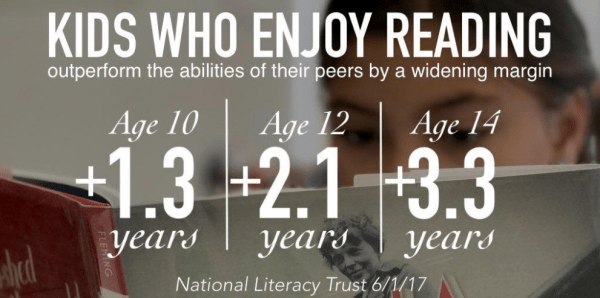
Natl Literacy Trust Survey 2016

Of course, this data caught my eye.

My friend Gary Anderson posted it on Facebook with this link to the National Literacy Trust Findings from their Annual Literacy Survey 2016: Celebrating Reading for Enjoyment.

I had just spent the day working with teachers in Clear Creek ISD as they launched their two week STAAR Academy, a series of summer school-like classes designed to immerse students in authentic reading and writing — not the typical mode of tutorials often offered in the hope of helping students pass their state mandated English exams.

Billy Eastman, Clear Creek ISD High School ELA and World Languages Coordinator, is a visionary who believes in his teachers and in the students they serve. He knows that when students choose books they want to read, experience learning in an environment that validates their personal lives and learning journeys, and are given space and instruction that allows them to write about the topics that matter to them, students grow. They grow in confidence, and they grow in ability.

Thirty-five teachers met with me in a two hour institute this morning. We read and talked and wrote and talked. We built a community of teacher-readers and writers. We engaged in learning — all with a central goal:  How can we create a space for all students to advance as readers and writers?

Then, teachers planned. In teams they designed lessons intent on engaging students as real readers and writers — not just students reading and writing for a test.

After lunch, teachers facilitated similar community building activities with the roughly 250 students attending the academy.

With generous funding by his district, Mr. Eastman was able to provide books, lots of new high-interest YA literature, in which students could choose a book they want to read. This is the first step in “celebrating reading for enjoyment” and all the benefits that come with it.

As I visited the 12 classrooms this afternoon, I witnessed students writing and talking about their reading lives.

“I like stories okay,” one boy said, “but I don’t like to read.”

“I’m not really into reading,” said another.

“Reading isn’t my thing,” another boy said.

I asked one young man if he liked to read, and he told me: “Yes, I read a lot.” He had just selected Scythe, the new book by Neil Shusterman, and I could tell he was eager to get started reading it. He’d already read Unwind and quickly told me how much he enjoyed that series. The other three students in this boy’s small group were less enthusiastic about reading anything, but they were willing to try. One chose Still Life with Tornado by A.S. King, another Boy 21 by Matthew Quick, and the other Out of Darkness by Ashley Hope Perez.

As I observed every classroom this afternoon, I noticed a few things:

  • The ratio of boys to girls in most every classroom was at least 4 to 1.
  • Boys want to read books that look “tough.” The cover has to captivate them.
  • Girls will choose books with male protagonists more often than boys will choose books with female protagonists.
  • Few students choose historical fiction — they seem drawn to realistic fiction and dystopian.
  • Many students chose books teachers might deem too difficult for them. (One of the most popular book choices offered today was All the Light We Cannot See, which won the Pulitzer Prize in 2015.)

For the next nine weekdays, students will read their chosen books and spend time engaged in their community of learners. They will practice the moves of real readers and writers as teachers practice the routines of readers-writers workshop and read and write beside their students. Besides the obvious benefit for students, teachers will engage in the kind of professional development that truly matters, the kind that gives hands-on experience with students as they practice the art and craft of teaching.

I am excited for the outcome. I am excited that teachers are excited. I am honored to be a part of Mr. Eastman’s vision for his district.

So what does this have to do with the National Literacy Trusts’ Annual Survey? A lot.

As I read through the report this evening, I found nothing startling or surprising. Of course, there are advantages to reading for enjoyment.

But then I shifted my thinking and began questioning the why and the what. Why does the data say what it does? Why are their gaps in enjoyment between boys and girls? Why are their gaps between age groups? What is happening in schools that might be causing these gaps? What is happening in students’ lives that might be causing these gaps? What can change if we approach reading and writing instruction differently? What should change?

I challenge you to read the report and ask yourself similar questions. Then, I challenge you to take the next step:  follow Billy Eastman’s lead. Whatever your sphere of influence, how can you allow a space for reading for enjoyment? And if you haven’t done so yet: How can you change the model of instruction in your classroom, in your school, or in your district so all students have the chance to become real readers and writers who enjoy what they read and write?

Don’t all students deserve similar opportunities to learn — not more test prep?

Amy Rasmussen lives in north Texas and teaches AP English Language and English 4 (new prep in the fall). She loves talking books, daughters’ weddings (two this year), and grandbabies. She also loves facilitating PD for other teachers making the move into a workshop pedagogy because it keeps her focused on her own improvement. Amy adheres to the words of Emerson: “We aim above the mark to hit the mark,” and Jesus: “Love one another.” Imagine a world if we all aim higher. Follow Amy on Twitter @amyrass. And she’d love it if you follow this blog!

Guest Post: A Different Take on News That Is Fake (It’s Not…It’s Manufactured Via a Profit-Making Monopoly)

A few days ago, my husband posted the following on his Facebook page. His message ties to my post yesterday, and it sparked even more of my thinking about the importance of critical thinking. You may find it does so, too.


“You can see the skies. They look like they’re upset about what mankind has been doing, and they’re threatening the Earth with storms. The clock says it’s daytime, but dark night is strangling the sun.”  No Fear Shakespeare, Macbeth, Act 2, scene 4.

All this fuss and vicious finger pointing about fake news. Sheesh. Let me suggest, my friends, without being too obnoxious, it isn’t fake at all, rather, it is manufactured.

Well, yes, manufactured.

It starts with a “mined” or “harvested” raw resource (supposedly the facts or the “truth” [air quotes]), then it goes through various refinement processes until finally there’s a “bombshell of the day” or “breaking news” or “blockbuster movie or TV series” product at the end of the value chain designed to get and hold our attention across multiple channels and media. But, when the news and/or entertainment finally hits the airwaves (the shelves of our eyes and ears) there are two things to try to keep in mind:

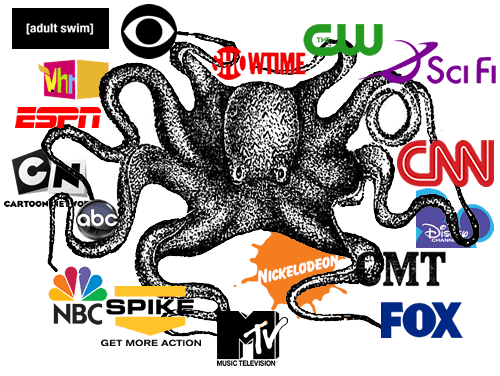
  1. The owners of the bulk of news and entertainment makers and distributors devolve into a VERY small group of companies–a monopoly of sorts–that are controlled by 20 to 30 so Billionaires, that make ALL the decisions on what/who gets reported and not reported, filmed and not filmed, bullied and not bullied, even elected and not elected, etc. (Please see the list of companies below.)

  2. The content of news and movie/TV entertainment is extremely curated and molded. Why? Because the goal no longer is to keep news and entertainment separated. It is unnecessary since there is no external moral code to dictate what is right and wrong, good and bad, virtuous or vice. Today, those considerations are dictated by who is in charge of controlling the minute by minute, hour by hour, daily, weekly, monthly and yearly newsfeed, entertainment and educational narrative in order to make . . . MONEY!

Manufactured news must be carefully designed to inform and entertain in order to fuel the “attention to profit” revenue engine.

Buying this?

If so, may I suggest to never forget the money trail IS the only thing that matters at the end of the month/quarter. It seems, today, that there are NO altruistic incentives in news or entertainment. Either the media outlet makes a profit or they’re gone. And, the political, moral views of those who control the content are intricately tied into the “profitable” audience that pays for a certain point of view or worldview to win or triumph.

And the battle lines are drawn very profitably by these news and entertainment media manufacturing monopolists.

The funny thing is that unless we are willing to see behind the curtains (there are multiple layers of curtains) there is a assembly line or “value chain” that narrows down ideas, slants perspectives, and cherry-picks management teams to promote, or hold to, a certain bias, then we are most unwittingly duped no matter what political or moral side we’re on. We’ll argue until we’re toxically bloated that we’re right, but there’s ALWAYS another story behind the story behind the story that may undo our “I’m right and you’re wrong” arguments.

Consider this:  All those thousands of TV channels we thought represented diversity and fairness, uh, no. . .

What I’m going to share is quite eye-opening (at least I think so). All we hear about is how horrible Rupert Murdoch and Fox News are, but let’s look at the top companies (unranked) that own 90% of the media (including News Corporation aka Rupert). It seems fair to me that any and all could read through this and be able to conclude that there’s more to the “facts” than we’re being told when it comes to who/what controls what we see, hear, and read every day in news and entertainment. And, all of which, today, in my opinion, are manufactured one and the same:

  1. Comcast ($55 billion…ish) owns or has it’s hands in . . .ready?

NBCUniversal; twenty-four television stations and the NBC television network; Telemundo; USA Network; SyFy; CNBC; MSNBC; Bravo; Oxygen; Chiller; CNBC World; E!; the Golf Channel; Sleuth; mun2; Universal HD; VERSUS; Style; G4; Comcast SportsNet (Philadelphia), Comcast SportsNet Mid-Atlantic (Baltimore/Washington, D.C.), Cable Sports Southeast, Comcast SportsNet Chicago, MountainWest Sports Network, Comcast SportsNet California (Sacramento), Comcast SportsNet New England (Boston), Comcast SportsNet Northwest (Portland, Ore.), Comcast Sports Southwest (Houston), Comcast SportsNet Bay Area (San Francisco), New England Cable News (Boston), Comcast Network Philadelphia, Comcast Network Mid-Atlantic (Baltimore/Washington, D.C.); the Weather Channel (25 percent stake); A&E (16 percent stake); the History Channel (16 percent stake); the Biography Channel (16 percent stake); Lifetime (16 percent stake); the Crime and Investigation Channel (16 percent stake); Pittsburgh Cable News Channel (30 percent stake); FEARnet (31 percent stake); PBS KIDS Sprout (40 percent stake); TV One (34 percent stake); Houston Regional Sports Network (23 percent stake); SportsNet New York (8 percent stake).

They also own: Comcast Interactive Media; Plaxo; Universal Studios Hollywood; Wet ‘n Wild theme park; Universal Studios Florida; Universal Islands of Adventure; Philadelphia 76ers; Philadelphia Flyers; Wells Fargo Center; iN DEMAND; Music Choice (12 percent stake); SpectrumCo (64 percent stake)

(Note: Some of these companies/titles have or will change hands, but no new hands have shown up during the past 20 years. It is still the same group of Billionaires and companies incestuously fleshing it out for profit.)

  1. Time Warner ($29 billion…ish)

One of the largest media holding company with the Warner Brothers Television Group; Warner Brothers Television; Warner Horizon Television; CW Network (50 percent stake); TBS; TNT; Cartoon Network; truTV; Turner Classic Movies; Boomerang; CNN; HLN; CNN International; HBO; Cinemax; Space; Infinito; I-Sat; Fashion TV; HTV; Much Music; Pogo; Mondo TV; Tabi; CNN Español the Cartoon Network, Adult Swim, Turner Classic Movies, CNN and Headline News and CW.

TW also owns: Warner Brothers (which owns DC Comics); Warner Brothers Pictures; New Line Cinema; Castle Rock; WB Studio Enterprises, Inc.; Telepictures Productions, Inc.; Warner Brothers Animation, Inc.; Warner Home Video; Warner Premiere; Warner Specialty Films, Inc.; Warner Brothers International Cinemas

  1. News Corporation (Rupert Murdoch) the largest market cap at $40 billion…ish

Owns Fox Broadcasting Company; television and cable networks such as Fox, Fox Business Channel, National Geographic and FX; print publications including the Wall Street Journal, the New York Post and TV Guide; the magazines Barron’s and SmartMoney; book publisher HarperCollins; film production companies 20th Century Fox, Fox Searchlight Pictures and Blue Sky Studios; numerous websites including MarketWatch.com; and non-media holdings including the National Rugby League. FX; SPEED; FUEL TV; Fox College Sports; Fox Movie Channel; Fox Soccer Channel; Fox Soccer Plus; Fox Pan American Sports; Fox Deportes; Big Ten Network; National Geographic U.S.; Nat Geo Adventure; Nat Geo Music; Nat Geo Wild; Fox International Channels; Utilisima; Fox Crime; NEXT; FOX History & Entertainment; the Voyage Channel; STAR World; STAR Movies; NGC Network International; NGC Network Latin America; LAPTV; Movie City; City Mix; City Family; City Stars; City Vibe; the Film Zone; Cinecanal; Elite Sports Limited; BabyTV; STAR India; STAR Taiwan; ESPN STAR Sports; Shine Limited. Hulu.com (32 percent minority share). HarperCollins Publishers; the New York Post; the Daily News; News International (the Times; the Sunday Times; the Sun); News Limited (146 newspapers in Australia); Dow Jones (Wall Street Journal, Barron’s, SmartMoney, Factiva, Dow Jones Newswires, Dow Jones Local Media, Dow Jones VentureSource). Fox Filmed Entertainment; Twentieth Century Fox Home Entertainment; Twentieth Century Fox Television; Twentieth Television; Fox Television Studios

  1. General Electric media holdings keep changing, but it sorta includes television networks NBC, MSNBC, NBC Sports, Telemundo, 27 television stations in the United States and many cable TV networks, including the History Channel, and Sci Fi Channel. It also owns the popular web-based TV website Hulu. (Sorta means they co-own a lot of things with other media behemoths)
  2. Disney ($55 Billion)

Owns the ABC television network; cable networks including ESPN, the Disney Channel, SOAPnet, A&E and Lifetime; 277 radio stations, music- and book-publishing companies; film-production companies Touchstone, Miramax and Walt Disney Pictures; Pixar Animation Studios; the cellular service Disney Mobile; and theme parks around the world. And, don’t forget they own Marvel Studios now!

They also own dozens of cable networks, and with the Disney channel they control millions of kids’ eyeballs — and moms’ pocket books.

  1. Viacom owns 160 cable channels including MTV, VH1, CMT, Logo, Nickelodeon, Comedy Central, TV Land, Spike TV, Tr3s, BET and CENTRIC

They also own numerous studio brands including Paramount Pictures, Insurge Pictures, MTV Films and Nickelodeon Movies.

  1. Bertelsmann ($20 billion…ish)

Owns Random House (with over 200 imprints in 15 countries, including the Ballantine Publishing Group, the Bantam Dell Publishing Group, Broadway, the Crown Publishing Group, the Doubleday Broadway Publishing Group, Pantheon, Random House U.K., Transworld, Sudamericana, C. Bertelsmann, Karl Blessing Verlag, Goldmann, Siedler Verlag, Wolf Jobst Siedler Verlag, Plaza & Janes (50 percent), Grijalbo Mondadori (50 percent), the Knopf Publishing Group, the RH Adult Trade Publishing Group, RH Audio, RH Children’s Books, RH Direct, Inc., the RH Information Group, RH International, RH Large Print, RH Value Publishing, and Waterbrook Press; Gruner + Jahr (285 print titles in 20 countries)

  1. We mustn’t forget Social Media:  Facebook with over 1.5 billion people who primarily get their news and entertainment from the Facebook feed they unwittingly created for themselves, warmly cocoons them within a pleasant “me, me, me” echo chamber.

(Source: Freepress)

Getting the picture (pun intended)?

I’m a Cinephile, lover of movies, and I’m going to share some stats on movie gross earnings vs product costs that provide some perspective on how what we see/hear is manufactured to keep our attention in order to make a profit.

This daily, highly-touted, data-set got underway in the mid ’70’s when the first summer Blockbuster hit the big screen. It went like this:

Da…dum

Daaaaa…dum

Da-dum, da-dum, da-dum (faster and faster)

It was Spielberg’s, Jaws, and it grossed $470 million on a production budget of $7 million; 67 times the initial investment.

Another more recent example:

Beauty and the Beast, the 2017 metaphor of love, sacrifice and atonement, grossed $900 million, but cost $300 million to make; a 300% return.

It used to be that we’d only hear about the “box office” earnings at certain times of the year, but now we hear about how big, or bad, the “weekend box office” will be, or was, year around. (WARNING: They’re just marketing to us, but now it’s designed to cocoon us in a world of news and entertainment that gets us hooked.)

Don’t believe me? Well, here is a stat to chew on:

Only 2 to 3% of us go to movies in theaters, but 90% of us watch them or TV series (we’ve heard about) in our own homes on DVD, network TV, or streamed TV.

Ready for some more hype that hooks us into the “manufactured media” consumption loop?

Manchester By The Sea grossed $72.6 million, but cost $8.5 million. (BTW, what in the heck was that Oscar-winning movie supposed to achieve???)

La La Land, an absolutely delightful look at the quest for fame and love, grossed $442 million worldwide on a production budget of $30 million.

Historical Hype? (no ranking order)

My Big Fat Greek Wedding (and who didn’t like this laugh fest?) is the highest gross earnings to cost movie: $369 million against $6 million.

Star Wars grossed $775 million against a $40 million budget.

Mrs. Doubtfire grossed $441 million against a $38 million budget.

Slumdog Millionaire grossed $378 million against a budget of $15 million.

There’s Something About Mary grossed $370 million against a $31 million budget

The Hangover grossed $467 million against a budget $36 million.

The Passion of Christ grossed $612 million against a budget of $35 million

The reality is that these movies, based on these numbers, are portrayed as making a profit at the Box Office.

They didn’t.

Movies, in MOST cases, only become profitable after they hit DVD and TV.

NOW, go back to that list of news and entertainment companies and note how many of them own the advertising networks, the movie studios, the news stations, and the TV networks and subscriber channels. And remember that without the TV outlets 2/3’s of their profits disappear.

See the cross-channel, total-immersion system?

Manufactured — end to end — news and entertainment designed to monopolize our eyes, ears, minds, hearts–and pocket books.

And the vast majority of it has NOTHING to do with facts or truth. Well, okay, the weather and sports seem to be based in truth most of the time (unless you think there’s a conspiracy in the NFL, NBA, MLB, NHL, MLS, etc. haha)

And on that sports analogy…from the Witches in Macbeth:

“Fair is foul and foul is fair.”

Sources: SLATE, Hollywood’s Profits Demystified; Freepress, Who Owns the Media?; CNBC, Entertainment, Most Profitable Movies of All Time

Curtis Rasmussen is a lover of great movies, great marketing, and people who don’t fit in. He practices reaching across the aisle to befriend people of the opposite persuasion, politics, or affiliations. Curtis is a marketing strategist and writer who lives in Dallas, Texas, with his wife, Amy, his dog Jag, and his youngest child of seven, Zach.