Category Archives: Amy Rasmussen

6 Ways to Confer in the Crowded Classroom

“My biggest struggle right now is that I have 36 students in each class (60 min periods). There’s not an empty seat in the room! Any ideas?”

Maybe this sounds like you. I’ve been there –trying everything to make workshop work in my over-flowing freshman and sophomore classes. Last year I had 38 sophomores in my 8th period. Talk about ending the day exhausted.

My principal said at the first of this year: “40 is the new 30” regarding class sizes. Most teachers I know deal with bulging class sizes every day. We have to adjust to the new normal.
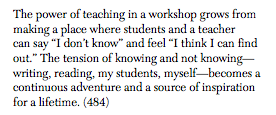
In the Middle: New Understandings about Writing, Reading, and Learning. 2nd ed. Portsmouth, NH: Heinemann, 1998.

Last week I read this English Journal article from 2000 (timely with Nancie Atwell recently winning that awesome teaching award), and I was reminded of how Atwell talks about the tension in a workshop classroom.

I’ve said it many times before:   readers and writers workshop is constant motion, and sometimes the tension becomes a tight rope under my feet as I try to provide my students with the best instruction possible.

I believe it’s student conferences that steady the bouncing rope, but how do we confer with all of our students regularly when our classes are so large?

A few weeks ago, I wrote this post about reading conferences in high school. Mrs. Thompson wrote that plea at the top of the page in the comments. I’ve thought about it ever since.

These are black board speech bubble brooches. How cool is that? See gadgetsin.com

These are black board speech bubble brooches. How cool is that?
See gadgetsin.com

I am fortunate to have small classes this year, but balancing the tension is still not easy. Below I share six ways I confer with students. I had to be inventive to confer with those rowdy 38 sophomores. Maybe some of these ideas will help my friend Mrs. Thompson.

1. Start before the Bell. Several of my students enter my room two or three minutes before the bell rings. When I am behind in my conferences, which is more often than I’d like, I can talk to a few more students a day when I begin before the bell.

2. Go to Them. My students sit in small groups with their desks clustered in fours and fives. When I want to speak to students individually, I go to them and kneel beside their desk. We talk in hushed tones for a maximum of two and a half minutes. If a student wants to talk longer, before the end of class I pass her a sticky note with an invitation to come in during my lunch. Sometimes she does.

3. Bundle Them Up. Instead of speaking in hushed tones, when I know the topic of the conference will benefit all students in a small group, we speak a little louder. This way I can easily turn to the other three or four students and invite them into the conversation. “You might want to try that, too.”  or “Do you have a question similar to Mark’s?”

4. Make it Voluntary. I know I am not the only one with students who need to talk before they’ve really even started. When I begin conferences with an invitation — “If you’re having trouble getting started, meet me at the sofa, and let’s talk” I can spend five minutes with five to six students, often clarifying ideas or validating their thinking. Once I model how to talk about their work, students learn to effectively give one another feedback. I can leave them talking and confer with a few other students. Five to ten minutes later, I return to the couch. More often than not, these students are now ready to work on their own. They just needed some talk to get them started.

5. Group Them through Feedback. I learned this one from Penny Kittle. Say you are reading through student drafts, and you see the same trouble spots over and over again. Make a note on the bottom right corner, maybe a code like TH if you’re seeing not-so-powerful thesis statements. Then during conference time, ask everyone with a TH on their paper to meet you at the center table. You save time by re-teaching or doing a mini-lesson on thesis statements only with those students who need the refresher. (This works for reading conferences with my most resistant readers, too.)

6. Keep it Silent. Sometimes I get more information about what my students need when they write it out instead of talk about it. I’ve learned to give some of my quiet students the option to confer most often in silent conversations. I leave them notes. They leave me notes back. This is similar to Chris Tovani’s conversation calendars, which when I tried to do with the whole class, challenged my ability to be consistent. When I make the notes optional, those students who want this type of conference take advantage of it — and I can read student notes and respond after the class period.

Do you have other ideas for conferring with students in large classes? Please leave a comment.

©Amy Rasmussen, 2011 – 2015

They Taught Me the Lesson Here: It’s About Time

Please tell me I am not the only one in a rush. Every spring I feel this pressure to teach more, do more, assign more. I know part of it is the AP exam date creeping closer and closer. I know my students are still not ready.

We still struggle with rhetorical analysis. Most students are getting better at recognizing devices in the texts of others, but when they try to analyze the effect? Well, the light bulb is still quite dim. And I have to practically beg to get students to add a device or two in their own writing. So many are afraid to take risks or to explore with words and sentences.

As a way to help students play with language, I turned to POETRY. (Yes, even in my primarily non-fiction AP Language class.)

We read Meg Kearney’s “Creed” poem together, and we talked through the moves she makes to craft it.

Students noticed the sound devices, the contradictions, the little story, the concrete details. They did a fine job of noticing.

But we have to do much more than notice. And that’s the hard part.

I found this “Creed” assignment by a Mrs. Rothbard online, which fit my hopes for my students exactly, and I asked students to read and study the poem themselves and then mirror the moves of our poet.

I still cannot believe how difficult this was for some of my students. Some simplified the assignment and just wrote their own lovely poems. Others made beautiful lists of their personal beliefs — but that was not the assignment. Others modeled Kearney’s first few lines and then rambled on about angst-filled beliefs that the student writers didn’t even care about when they read them to the class. (Note to self: Revision workshop must last much longer next year.)

But, some…some student writers took ownership of their own craft and composed lovely poems, modeled after our writing coach and poet Meg Kearney.

Here’s the links to JerashiaGuillermoNaWoon, Doreen, Josh, and Sydney-Marie‘s blogs where they posted their poems. They’d love it if you’d read them and maybe leave a comment (actually, they will probably die because they think publishing to the WWW makes them anonymous–so much scarier to read their poems aloud in class, which is a topic of another post I need to write.)

I learned some valuable things as a result of this writing task, and I am glad that my students talked to me about what worked and didn’t work for them. I am glad I took the time last week to let them talk.

The comment that will guide our learning the rest of the year came from a table in the back when one of my quiet ones said:

“Could we slow down? We need more time to write with you in the room to help us.”

Yes, I know that.

If I want to truly help my students grow as critical readers and writers, I must devote the time to letting them think, draft, read, write, revise, re-do, share, and all of this again and again with me in the room as their coach, their mentor, and their cheerleader.

My students need to talk to me and to their peers like I talk to my husband and my collaborators when I am writing.

I thought I had this down by now. But what I think is enough time is obviously not what my students think is enough time, so I’ll listen, and starting today.

Class time will be different.

©Amy Rasmussen, 2011 – 2015

I’m hosting #engchat March 23 7:00ET: We’re Talking Poetry as More Than a Unit

poetry answer-quote

Before I attended The Conference on Poetry and Teaching at The Frost Place last summer, I was a reluctant, resistant teacher of poetry. Sad to say, I never had a memorable experience with poetry until I was in my 50th year.

At The Frost Place, I listened and joined in conversations with working poets about language and their craft. My heart changed. I finally understood because I lived that language for a glorious week surrounded by these people with poetic souls and a view of the White Mountains smiling down on me. Oh, Franconia, NH. (Read about my experience here.)

By no means am I an expert when it comes to poetry in the classroom; however, nobody has to be! Our job as teachers is to help our students grow in literacy skills. Poetry helps us do that.

We bring a beauty into our classrooms, a peace that our world is so often lacking, when we allow poetry to be spoken, heard, shared, and felt.

#engchat is Monday March 21, 2015 at 7:00 ET. That’s 6:00 CT for me, which is why I forget and rarely make it to this chat. The family dinner hour for me in Texas. I’m eating out and early on the 21st though.

TOPIC: Immersing Poetry into ELA Instruction

Questions for Our Chat:

Q1: What are some ways, other than a poetry unit, that you use poetry in your class? #engchat

Q2: “Play is what we want to do. Work is what we have to do,” said W. H. Auden. Poetry is both of those things. How do we use poetry for work and play? #engchat

Q3: We can teach most any skill with poetry that we can w/ prose. Agree/disagree? If agree, what skills do you teach with which poems? #engchat

Q4: Last question. What resources can you share that will help us all immerse our students in beautiful language, daily? #engchat


Do you have any other questions you’d like us to talk about during #engchat? Please leave a comment.

©Amy Rasmussen, 2011 – 2015

The Modern PLC

Sometimes things stay with you. In December I got this message:

I have been working with three teachers this fall who have transformed their classrooms (all ranging from freshman level to AP Lit and AP Lang) from the traditional class to a readers/writers workshop approach.  Your blog posts always show up in my email box at the exact right time when they are in need of inspiration to keep going and figure out what to do in their classes.  They realized very quickly how fast they were able to get through “old curriculum” when they dropped the class novel approach and were then scrambling to find new and exciting mentor texts, books to share, and additional writing ideas. Their students have read thousands of pages and enormous amounts of books which never happened in their classes before.  Students were writing them thank you letters for inspiring them to become true readers and writers.  Penny Kittle’s books got them started on this path, but your real life teacher posts have helped them validate what they are doing.  So… thank you and keep those posts coming.  They are making a difference in our classrooms.

I could write a book about the value in that feedback (Probably will). Feedback should make writers want to write more. That is exactly what Melissa Sethna’s kind words did for me and my friends here at TTT.

Her simple thanks also made us want to follow her work, support her even more, watch how she helps other teachers. We’ve become colleagues with a united purpose. We’ve become friends.

And that is the beauty of the modern PLC.

A literacy specialist in Mundelein, IL sends a thank you to a teacher/blogger in Lewisville, TX, which makes the teacher/blogger want to become a better teacher so she becomes a better writer so she writes more inspiring and instructional blog posts for other teachers and so on.

Teachers supporting one another as we do our best to do right by the children that we teach. As ELA teachers the best way we know how to do that is through balanced literacy practices in readers and writers workshop.

That’s the foundation for the Three Teachers Talk blog, which started as three friends committing to stay in touch by sharing our work through our writing. We are four teachers now — writing, sharing, and growing. And participating in a Professional Learning Community that’s been redefined, refocused, and restructured by connected educators around the globe who are just like us.

Thank you, readers, for being part of the best PLC on the planet.


Note: Melissa Sethna posts as a guest blogger here tomorrow. Her work inspires us.

©Amy Rasmussen, 2011 – 2015

Five Steps to Fostering Balanced Literacy in Your American Lit Class

How does your district handle classes that are very content specific? For example, I teach Honors/Pre-AP American Literature. This is a sophomore (with accelerated freshmen course) that has a pretty traditional literary movement focus, which includes several of the classics (The Scarlet Letter, Huck Finn, Of Mice and Men, The Great Gatsby, The Things They Carried). And while I feel I have made great strides over the years in terms of student driven lessons, focus on discussion and annotation, skill vs. content based assessment, the one area I continue to struggle with as I look to workshop is how to facilitate the choice. 

This post is Part II of my response to those questions I received via email. See Part I here: Choose to Become a Classroom of Writers

I’ve thought about your query about your “content specific” American literature class a lot, and I keep getting stuck on one question:  Does the class have to revolve around full-length American novels?

I ask this for a couple of reasons. First, in my experience, many 11th grade teachers, in Texas at least, think that they have to teach English III as a survey of American literature; however, the  curriculum standards (Texas Essential Knowledge and Skills or TEKS) do not mandate that. Yes, there is a standard that requires students read American literature, plus another that says American drama, but there are 11 other reading standards (plus Fig.19, which is a whole other story) and at least that many writing standards.

All of these standards are classified as either readiness (they will be tested on state exams) or supporting (they may be tested). The standards mandating American literature are supporting — meaning perhaps that they might not carry as much weight as readiness. Yet many teachers design their whole year’s worth of reading around one American novel or play after another, at times ignoring all the other reading standards that state that students should read a variety of other texts — fiction and non-fiction. Seems to me that if we do a mash up of all the reading standards we’d come up with one overarching goal:  Create readers. All adults should take note

How can we create readers if students are not reading? More and more research proves this is so.

Many of the junior level teachers here teach the American literature survey because that is the way it has traditionally been done — prior to the changes in the standards, almost 10 years ago, and our new state tests, three. Most have not learned how to do anything differently — like facilitating readers and writers workshop.

So, I wonder about the standards that drive your class. Are they like the TX ones that require some American lit, or is the class designed by your campus and/or district to be one focused on a survey of American Lit?

If it’s the first, give yourself permission to let some of those whole class novels go. You can step right into allowing more student choice. You can select short texts to read together, conduct book clubs where students still get choice but with your parameters. Imagine the possibilities for short stories and passages where you can teach the same skills you focus on when you teach those full-length novels.

If it’s the second, I wonder what you can do to change the course design. Would your administration be atticus finchokay with you taking a more balanced literacy approach and only reading some of those whole-class texts? You will have more time for writing, and you’ll have a better chance of moving students as readers because odds are you’ve got many students who are not reading those books. We’ve all been there.

If you haven’t read the English Journal article Not Reading: The 800 Lb Mockingbird in the Classroom, it is a fantastic piece that reiterates the problems of students faking their way through their reading.

Another great article is this one by Tim Pruzinsky, an IB teacher at an international school in Thailand. IB mandates specific texts, but Tim still manages to get all of his students reading novels of their choice.

Here are some ideas that might help as you continue to transition your instruction. The moves you’ve already made are probably much harder than these:

Five Steps to Creating Balanced Literacy in your American Literature Class (in no particular order):

1. Intentionally decide which of your current novels are nonnegotiable. Which book do the majority of your students read? Which book adds the most to your reading community in terms of discussions that build relationships? Which book are you able to teach the most skills that students can apply to their own independent reading? Keep that novel (or a couple of novels) as your whole class texts.

2. Decide to read fewer whole class novels and increase your reading of shorter whole class texts. How can you teach some of the skills you normally do with novels with short stories, poems, and a variety of non-fiction pieces?

3. Decide what type of writing will benefit your students most. Choose mentor texts that relate thematically to the novel/s you let go. You can still have the rich discussions surrounding a text and teach annotation skills without mandating another whole class reading assignments.

4. Select a short stack of books and facilitate Book Clubs. Students choose a book from the list to read and discuss with their peers in small groups. Visit each group and briefly join the discussion to hold students accountable for their group time. You might conduct Book Clubs 2-4 times a year to allow for choice with parameters and to ensure that all students reach for books that meet your ideal of complexity.

5. Decide to promote reading in your classroom and take no excuses from students. Talk about books and reading daily. Devote 10-15 minutes of self-selected reading time at the beginning of every class period. Confer with students about their reading regularly. Read a lot, so you are able to match students with books that they will want to read.


Anyone have other ideas to help make the move to more balanced literacy? Please leave a comment.

©Amy Rasmussen, 2011 – 2015
Choose to Become a Classroom of Writers

Note:  I enjoy emails with questions about my teaching practice. They help me clarify my thinking, and they often lead to new posts here. This post is Part I of my response to this question:

How does your district handle classes that are very content specific? For example, I teach Honors/Pre-AP American Literature. This is a sophomore (with accelerated freshmen course) that has a pretty traditional literary movement focus, which includes several of the classics (The Scarlet Letter, Huck Finn, Of Mice and Men, The Great Gatsby, The Things They Carried). And while I feel I have made great strides over the years in terms of student driven lessons, focus on discussion and annotation, skill vs. content based assessment, the one area I continue to struggle with as I look to workshop is how to facilitate the choice. 

Do you have a similar class in your district? Are any of these texts still used as whole class works? As options within specific unit studies? Or is the year open to student choice throughout? 

First of all, while my district ELA coordinator would love for all teachers to move to readers/writers workshop, and he has introduced that idea through various means, many teachers are not there yet and some are determined not to budge. Like many other issues related to change in schools, they nod their heads and keep doing what they’ve always done. We know that sometimes this is best for kids (I’ve done the nodding and door closing, too), and sometimes it is not, which is the case when it comes to continuing to make all the choices in English classes at the expense of student readers.

My own department manager reminds me often that we have to take our movement one step at a time. This is my first year on this campus, and while most everyone is making positive and impacting change. It’s slow, and I get antsy. I’ve been doing readers/writers workshop with my students for seven years now, and I still work on refining plans, lessons, mentor text selections, mini-lessons, and more. Truly, workshop is constant motion, which I am sure, if you practice it, you already know.

Recently, I was asked, “What is the one step that will give us the most movement as we continue this transition?” I paused for a moment, and then the answer focused clearly:

Become classrooms of writers.

Many high school English classes are literature laden. All the lessons revolve around specific texts, mostly whole class novels, and sometimes teachers spend five, six or nine weeks reading and discussing that one text. Sure, they might include other instructional practices and activities, but the most common mode of writing taught is analytical (the least likely of all the modes of writing students will use in their lives after English class. Teachers, when was the last time you wrote an analytical essay for your job?).

When we move to becoming classrooms of writers, teachers realize that if we want to practice other modes, read mentor texts, model the writing process, lead revision workshops, publish our best work, and truly live the lives of writers, we simply do not have time to devote class after class time to the study of one particular book.

A mentor once told me:  “You choose to do this, which means you choose not to do that.”Faulkner on reading

Say I choose to create a unit where my students write narratives (I always start the year with narrative because it is builds community, and contributes so much weight to other modes of writing. See tom Newkirk’s book Minds Made for Stories.) I prepare by gathering a variety of narrative texts of various lengths. I can use passages from an assortment of books in my classroom library, or I can pull passages from popular short stories, or classic novels. [See note on this at the end.]

Some passages I will use to teach leads. Others I will use to teach how authors deal with time. I may pull out specific parts and teach effective use of dialogue or character development, setting, whatever. [Gathering a variety of texts in different genres around the same theme is another way to approach the same type of reading then writing task I describe here. I’ll write about this soon.]

First, we read like readers. We practice comprehension strategies and discuss the meaning of the text.

Next, we read like writers. We deconstruct the text and discuss how the author makes that meaning.

In my AP class, we almost always talk about these texts via a Harkness discussion. Students do the thinking and speaking after I’ve done mini-lessons and modeled answering focusing questions. I’ve learned to trust that students will discover the elements and devices that I hope they will. Sometimes I have to prod, but they rarely never get there.

The skill I need to teach determines the reading passages I select. That’s an opposite approach to how I used to plan when my teaching was driven by various pieces of literature.

And now, I have time to talk about books, allow students to select books they’d like to read, and confer with students about their reading. They read tons more than they ever did before, and they become much more effective writers. Win/Win.

cool quote memes from our friends at http://www.TeachMentorTexts.com

Watch for Part II of my response soon.
 ©Amy Rasmussen, 2011 – 2015
Yes, You Can Get Teens Reading: One Senior High Campus Proves It

My department manager is wise, and I admire her leadership skills. She often asks, “What is your temperature?” to see how I am adjusting, coping, feeling, managing, dealing, doing with all that I must at my new school. Thankfully, although it’s my first year here, it rarely feels new anymore.

I like that Rhonda asks me questions about my readers and writers workshop classroom. She asks me to participate in discussions and professional development sessions. She validates me as an individual and as an teacher. I trust her, and I know she trusts me.

Trust is the greatest gift in the life of an educator.

We are an 11th and 12th grade campus. We are moving to a workshop pedagogy. Our district has changed the model of intervention by bringing in local National Writing Project consultants to write curriculum and train teachers. (I write about that in part in this post.) The ELA coordinator also hosted trainings with Penny Kittle and Donalyn Miller, two of the brightest minds in workshop, last summer. Every time we meet as an English team, we talk about some aspect of reading, writing, and workshop in our classrooms.

Suggesting that we might like The Color of Law by a homegrown TX author

Suggesting that we might like The Color of Law by a homegrown TX author

Teachers are trusted to get their students reading. At LHS in every English class, visitors see students reading during the first 15 minutes of the period. Teachers have had training on giving book talks and conducting reading conferences, and we’ve started building classroom libraries.

I got an email message today: “What’s the title of that book, Story of Angel, or something. My copy has gone missing.”

The Book of Life by Angel,” I replied. It’s a hot title in my classroom, too. I have to replace it every year.

Our students are reading, and behaviors are changing for the better.

I heard one teacher say to another, “I like how reading at the beginning of class helps my students calm down. We get started with ease because they know to come in and get their books out.”

To build a culture of readers, we must trust that students will read when we give them time to so. We must model what that looks like.

Sharing a love for the work of R. A. Salvatore

Sharing a love for the work of R. A. Salvatore

We must trust our teachers to be readers themselves. How can we talk about books to kids if we are not reading them? Children of all ages revere authenticity.

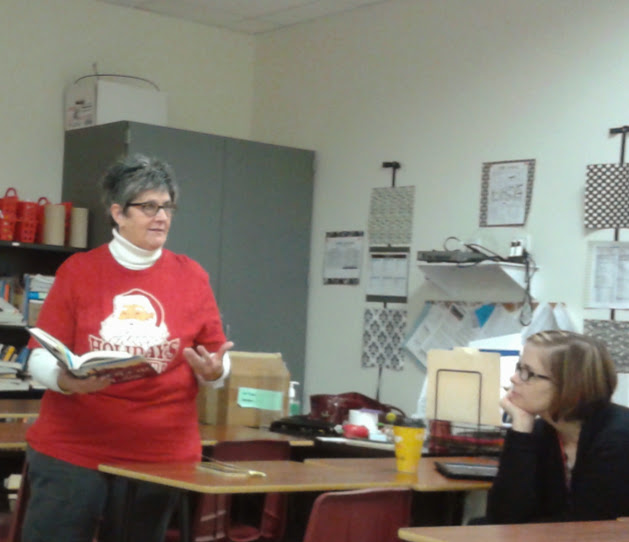
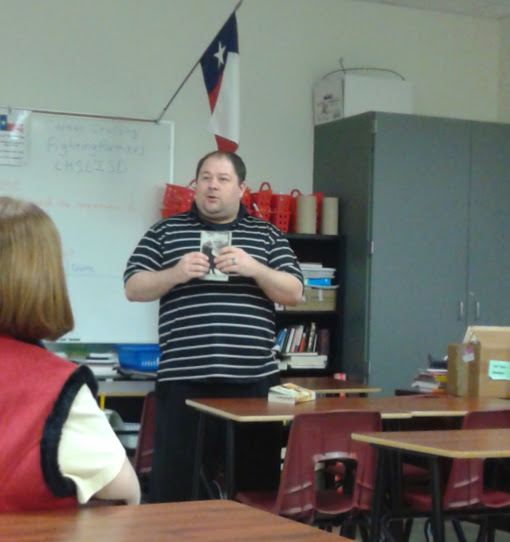
Each week when we meet in our department meeting, a teacher gives a book talk. They share a bit of the passion they have for an author or a book.

Jeremy shared his love of fantasy, and Jayne shared a bit of Dickens in her fun fake British accent then talked about a new book she enjoyed by a Texas author. Karen read from The Yellow Birds and The Things They Carried and talked about how they made a nice pairing, and, most recently, the baseball coach Mike talked about a book he loved. (I wish I could remember what it was, but I forgot to write it down.)

Administrators must trust that when visiting classrooms they will, and want, to see rooms of students silently reading. What better activity in a class designed to improve literacy skills than to see all students engaged in the practice of it?

Students come to trust that reading and books provide value to their lives because the adults in which they trust value it, talk about it, model it, and, if necessary, enforce it.

Too many teenagers claim to be non-readers. Ask them, if you haven’t. They will tell you truly.

They will also tell you when they experience a shift in that thinking. They are surprised — and grateful.

an excerpt from my student Joseph’s last independent-reading evaluation

©Amy Rasmussen, 2011 – 2015
Finding the Right Book for Growth in AP English

Several tiles similar to this one dot the ceiling in my classroom.

Sometimes I just want to say: “You are wrong.”

Of course, I try to be a little more diplomatic than that, but really, many critics of balanced literacy are that — wrong.

The argument I hear the most against allowing students to choose which books to read in AP English is that they will never choose to read anything other than Young Adult fiction and graphic novels. To that I want to say “So?” (For a great list of graphic novel titles, see Donalyn’ post Comic Book Girl.)

What I do tell those who assert this nonsensical claim is “I wish you could visit my classroom and talk with my students.”  Here’s what they would see:

Everyone in the class is reading. Everyone except Rebecca. She stands in front of the book shelf I’ve labeled “Literature at Its Finest.” Between bookends on the top are paperback classics; authors ranging from Ray Bradbury to H.G. Wells. The first shelf is stacked with anthologies from my university studies in literature: Homer, Sophocles, Chaucer, Milton –the Complete Works, and more texts from the canon: The A Tale of Two Cities, Adventures of Huckleberry Finn, The Awakening, To Kill a Mockingbird. And many I have never read: 1984, Lord of the Flies, Heart of Darkness, A Farewell to Arms, Brave New World.

I walk over and ask, “Whatcha looking for?”

“I want to read a romance,” she says.

“Why are you looking on this shelf?”

“I need a challenging book.”

“So you want a romance that’s a challenge?” I say.

“Yes, they make those, right?” she answers, and we both laugh.

I pull Pride and Prejudice, Jane Eyre, and Wuthering Heights. I hand Rebecca each book as I talk a bit about them. Why I love Jane Austen and a little about the Regency Era, a quick bio of the Bronte sisters, and a tad about Gothic literature.

She asks, “Which should I read?”

I answer, “You decide. Read the back covers and the first few pages of each. See which voice you like best, and go from there.”

A few minutes later, I see that she has the clipboard where students sign books out from our class library. Rebecca has decided to read Pride and Prejudice.

A week passes. I meet with Rebecca for a conference. She tells me that this book is hard. She has to re-read parts of it for it to make sense. We talk about her strategies for comprehension. She says she is not giving up.

Two weeks pass. I ask students to share out with the class what they are reading. Rebecca says P & P and smiles as she declares that she’s finally figured it out. “I get it now, and I am getting better at reading it.” When I get a chance, I walk over to her desk and ask her what she means.

“The characters, everything,” she says. “It was the language that was really throwing me, but I understand the story now. I like Jane — her attitudes and opinions.” I make a note to follow up on this conversation.

Critics may say: So, she’s reading Pride and Prejudice. She won’t understand the nuances, the humor, the satirical elements, or even the social commentary without guiding questions and class discussions to help her.

They are right. Rebecca probably won’t get all that. But she and I are fine with it.

We have learned how to look at language and deconstruct texts, analyzing as we go with short texts we read and study in class. If I asked Rebecca to select a page and analyze some aspect of Austen’s language, I know that she could do it. She is a a critical thinker and a competent writer.

And she has challenged herself into a beautifully written complex piece of literature. And she likes it.

We read, discuss, and work with other titles in book clubs to understand and be able to analyze the scope of a novel. (I facilitated #APLangchat on the topic of book clubs. Here’s the planning for that and the Storify. And I wrote about little about my class book clubs here and here.)

I want students to love literature. I want them to become readers. The best way I know how to accomplish both is to let them choose the books they read.

I surround my students with rich literature. I talk about books daily. They talk with one another about what they are reading regularly. We build a community where they know my expectations for them as readers, and they evaluate themselves — setting, reviewing, and adjusting expectations for their own reading lives often.

When we model the life of a reader, students will follow our lead. Like Chris who chose this National Book Award Finalist.

We are well into the school year, and more and more students have moved into more complex books, and they are thinking about their reading choices.

Chris:  Currently reading Station Eleven. Chris asked me recently to recommend a book. He said, “I’ve liked everything you suggested so far this year.” I asked him what he liked best, and he said The Curious Incident in the Nighttime, which was part of our first book club. Somehow the conversation turned to my book club with some colleagues at my last school. I showed him my copy of Station Eleven with the marked and dogeared pages. He asked to borrow it, and we’ve since talked about the multiple story lines and how the author eventually ties them all together. He gives me updates as he’s making sense of this story that is unlike anything he’s read in the past.

Jasmine:  Currently reading Let the Great World Spin. Jasmine asked me for recommendations for books with multiple story lines. She’d read Extremely Loud and Incredibly Close in our first book club and A Thousand Splendid Suns in our second. I mentioned Colum McCann’s Pulitzer Prize winner, and she noted the ceiling tile that decorates our classroom. Jasmine reads about 120 pages a week and told me in her last conference: “In the next two weeks, I plan to up that number to 200. I also want to find more books with intertwining story lines so I can be motivated to read each week.” Station Eleven is already on her To Be Read Next list.

When we talk about rich literature and use passages to teach skills, some students will choose to read the whole text.

Doreen: Currently reading The Goldfinch. Doreen is quiet, studious, sometimes even somber. I used a passage from The Goldfinch when I introduced rhetorical analysis. I wrote about it in the post Starting with the Ending. My copy sat in the front of the room under a potted plant until one day it was gone. Doreen had swiped it, and is currently about half way through. When we did a quick whip around the room to share out and rate our current reads today, she rated it a 9 out of 10. I’ll talk to her soon about why Donna Tartt doesn’t get a ten for her Pulitzer Prize winner.

Other students are reading just as complex and important books:  Nawoon/The Thirteenth Tale, Neydy/The Great Gatsby, Lillian/The Scarlet Letter, Pedro/Dracula.

Do I have other students reading YA fiction? Yes, and that is okay because they are reading.

Ivan finished Winger by Andrew Smith last week. He told me, holding out the book with tender care:  “This is the first time I have made a connection with a book. I get what you mean about literature now.” He is in an 11th grade AP English class!

Last summer at UNH Literacy Institute, I wrote a piece that references the reading theory of Louise Rosenblatt extensively. Below is an excerpt.

I believe this with all my heart:

What does it mean to experience literature? First, we must define “literature.” A text can only be considered such if the reader “responds to it in terms of sense and emotion and thought (106). If a book is “to be considered “literature” for any students, it must be experienced” by them (94), and it requires “a particular kind of reading process” (89).

All too often teachers of English and those who set the “critical theories dominating the college and university teaching of literature…” simply intensi[fy] the tendency to hurry the student away from any personal aesthetic experience” of it (102). We see this as teachers select the books students will read, usually in whole class settings, assigning reading homework with the expectation that students will read primarily complex literature outside of the classroom. These teachers often give reading quizzes as an assessment of their students’ reading lives, and make the only experience a non-reader has with the text punitive. This is detrimental to the growth of the individual. This is contrary to “our main responsibility” as the educator:  “to help the student to find the right book for growth” (67).

How are you, the expert in the room, helping students find the right book for growth?


©Amy Rasmussen, 2011 – 2015

Craft Study and a Book Club Addition: Billy Lynn’s Long Halftime Walk by Ben Fountain

I needed a book for my next student book club. I knew the book had to deal with war, literally or figuratively, in some way, so when I found Billy Lynn’s Long Halftime Walk by Ben Fountain, I had to crack the pages and give it a try.

I can see why Khaled Hosseini said this:  “Such a rich book. It’s angry, it’s moving, it’s compassionate, it’s dead serious, but it’s also really funny.” (I just finished re-reading A Thousand Splendid Suns as part of my students’ current book club. I trust this author.)

I’ve only read half of Fountain’s book, and I’ve marked almost every page.

Literature lover heaven.

Here’s a review in the NY Times in 2012. You can read how someone else likes this National Book Award Finalist, too.

Honestly, the last time I read something that struck me so emotionally was Yellow Birds, and I rave about it, too.

The story takes place at Dallas Cowboy Stadium on Thanksgiving Day. Bravo Squad is on a national tour “to reinvigorate interest in the war.” Billy Lynn, a specialist in Bravo, experiences moments of “pure love and bitter wisdom” as he meets the owner of the Cowboys, a born-again cheerleader, and various “supersized” players eager for a vicarious taste of war” (back cover).

Maybe I love this book so much because I’ve been there — sat in Cowboy’s Stadium and sort of thought similar things.

“The Goodyear Blimp is making labored passes overhead, bucking like a clipper ship in a storm. The Jumbotron is airing a video tribute to the late, great “Bullet” Bob Hayes, and displayed along the rim of the upper loge are the names and numbers of the Cowboys “Ring of Honor.” Staubach. Meredith. Dorsett. Lilly. This is the undeniable big-time, there is no greater sports event in the world today and Bravo is smack in the frothy middle of it. In two days they will redeploy for Iraq and the remaining eleven months of their extended tour, but for now they are deep within the sheltering womb of all things American — football, Thanksgiving, television, about eight different kinds of police and security personnel, plus three hundred million well-wishing fellow citizens. Or, as one trembly old guy in Cleveland put it, “Yew ARE America.”

They take the steps two at a time. A few people call out greetings from the stands, and Billy waves but won’t look up. He’s working hard. He’s climbing for his life, in fact, fighting the pull of all that huge hollow empty stadium space, which is trying to suck him backward like an undertow. In the past two weeks he’s found himself unnerved by immensities — water towers, skyscrapers, suspension bridges and the like. Just driving by the Washington Monument made him weak in the knees, the way that structure drew a high-pitched keening from all the soulless sky around it. So Billy keeps his head down and concentrates on moving forward, and once they reach the concourse he feels better” (21).

Not that I am in any way comparing my experience to a soldier’s. I just mean I’ve felt the hollowness of that place, and as I sat there in the leather seats of that stadium, I kept thinking: “Oh, the classroom libraries the money for this place could have filled.” Seriously. It’s huge. And frivolous in an embarrassing kind of way.

Maybe I love Fountain’s book because my four sons are football fans. My oldest son played on a state championship team. Huge deal. If you know Texas football, you know exactly what I mean. For almost two decades my husband I lived high school football — sometimes three games a week. That’s like nine hours on a bleacher.

Maybe I feel a tug into Billy Lynn’s story because two of my sons plan on joining the military. I’ve got about two years before that becomes a reality. (Right now they are serving missions. One in Puerto Rico and one about to leave for Taiwan. Missions then military. Both far from mom.)

I’m trying to show my students how literature can touch us, take us by surprise, raise our awareness, make us feel things we never imagined. That’s what is happening as I read Billy Lynn’s Long Halftime Walk.

That’s what I want to happen to them.

So I keep reading to find books for my student book clubs. Our next one starts after spring break. Students will choose to read one of the following. I am pretty confident everyone will find something that speaks to them (and we can practice analysis skills with pretty much anything.)

Billy Lynn’s Long Halftime Walk by Ben Fountain

The Yellow Birds by Kevin Powers

The Things They Carried by Tim O’Brien

Where Men Win Glory by Jon Krakauer

ROOM by Emma Donoghue

The Bell Jar by Sylvia Plath

Do you have any suggestions for books that have particularly moved you? I’ll add your suggestions to my TBR mountain.

©Amy Rasmussen, 2011 – 2015

Book Clubs to Move Readers is the topic of this week’s #APLangchat

I volunteered to host #APLangchat this week. My reason stemmed from these three things: 

1.  Some of the best PD I’ve experienced has come from Twitter chats.

2.  I am hit and miss when it comes to regularly engaging in chats. Being facilitator should make me show up.

3. Many of the questions left in the comments on my post a couple weeks ago, Aim Higher: A Case for Choice Reading and a Whole Lot More in AP English, can be answered in a chat about book clubs; however, by no means do I have all the answers. I need help, too, so a discussion with my PLN is the best place to turn.

If you are available Wednesday evening at 7:00 CT, join in. You do not have to teach Advanced Placement to contribute. Every educator’s voice matters. You do have to remember to use the hashtag #APLangchat.

Here’s the plan for a finger-flying, Twitter frenzy of idea sharing on Wednesday:

Topic:  Book Clubs to Move Readers in AP English

To spark some thinking, consider these texts:

Not Reading: The 800 Pound Mockingbird in the Classroom” by William Boz, English Journal (2011)

Boys and Reading” video interview with male students by Penny Kittle (2013)

Why Book Clubs Matter” English Language Teaching, University of Michigan Press

From a Classroom to a Community of Readers: The Power of Book Clubs” by Jessica Cuthbertson, Center for Teaching Quality Blog (2013)

Book Clubs: NYC Department of Education” Unit of Study

To ponder and prepare, consider these questions:

Warm Up:  What are your habits as a reader? What do you read? When do you read? Who do you talk with about the books you read? #APLangchat

Q1 MC on the exam =hard, esp for non-readers. Besides close reading activities in class, how do we move kids into complex texts? #APLangchat

Q2 Many teachers have moved to balanced literacy w/choice reading as core. How might book clubs engage this pedagogy in AP? #APLangchat

Q3 Logistically, what do book clubs look like in a class of 35? #APLangchat

Q4 What book club book choices lead to the most reading, insightful discussions, best growth in student readers? #APLangchat

Q5 What does assessment look like during and after book clubs? individual and/or collaborative assessments? #APLangchat

Q6 What else do you need to know to feel comfortable facilitating book clubs with your students? #APLangchat