Category Archives: Amy Rasmussen

Dumpster Diving for a Book Shelf

shelfieMy husband called, “Hey, there’s a book shelf by the dumpster. Do you want it?”

Funny that he asked. I know he knew I’d say yes.

I put the tall black shelf by the door to my room, which was pretty much the only open spot. But most of my classroom library sat cozy on the opposite side of the room. I did not know what books to put on this new shelf.

It sat empty waiting for three months.

There’s nothing quite so unsettling as an empty shelf in a bibliophile’s classroom, but my husband made me promise not to buy any more books. This is hard.

Finally, I got smart and labeled the shelves “1st period Suggests You Read,” “2nd Period Suggests You Read,” etc.

Slowly, I started moving books that students talked about, the ones they told me they liked. Then I Favorites book shelvesnoticed that a few students started returning their books to these shelves, and after we did Speed Dating with a Book a few weeks ago — we put all of our to-read-next titles on these shelves.

Now, instead of having most of our book choices on the bright green wall across the room, students walk past this shelf as they come and go.

Pretty good deal for a dumpster find.

©Amy Rasmussen, 2011 – 2015

Hey, Do You Want to Hear a Good Poem? #poeminyourpocket

What makes a good poem?

I like to ask my students this question. They usually fumble with an answer.

That is what makes reading poetry with students rewarding. Eventually, even the hardest teenage heart will come to at least appreciate the complexity of language — maybe she’ll never appreciate the beauty of it, but she will appreciate the craft of the poet.

Sharing good poems with students on a regular basis proved a hard goal for me this year. (Better than last; not as well as I wanted.)

One go-to book is Garrison Keillor’s collection of Good Poems, as Heard on the Writer’s Almanac. It is a must for every English classroom. My wish list includes two other volumes:  Good Poems for Hard Times and Good Poems: American Places. 

I especially like how Keillor sets the tone of the selection with poetic lines in the introduction that describe what makes a good poem:

Stickiness, memorability, is one sign of a good poem. You hear it and a day later some of it is still there in the brainpan.

What makes a poem memorable is its narrative line. A story is easier to remember than a puzzle.

[Poems] surprise us with clear pictures of the familiar.

And this beautiful paragraph, an epigraph for Emily Dickinson, really:

To see poetry finding an existence that its maker never imagined, visit Emily Dickinson’s grave in Amherst. Here lies the white-gowned virgin goddess, in a cluster of Dickinsons, under a stone that says “Called Back,” and here, weekly, strangers come as grieving family, placing pebbles on her big stone, leaving notes to her folded into tiny squares, under small stones. Dickinson was a famous recluse who camped in the shadows in the upstairs hall and eavesdropped on visitors, and now there are few graves in America so venerated as hers. She is mourned continually because the quickness and vitality of her poems maker her contemporary, and when you make flies buzz and horses turn their heads and you declaim Wild Nights! Wild Nights! and give hope some feathers, you are going to have friends in this world for as long as English is read.

I just love that, and Dickinson isn’t even my favorite.

I am finding favorites though. So far, my favorites are the poets I know in person: Dawn Potter, and  Meg Kearney.

My students need the chance to find favorites, and that is why I must expose them to good poems. Reading aloud poems on a regular basis has the same effect as talking about books regularly.

Today is Poem in Your Pocket Day.  Will you participate?

Because I know I need to be more consistent with poetry, and even though we are in the middle of a giant writing project, my students and I paused this week and talked poetry. We read and questioned and laughed and loved being immersed in beautiful language.

We pulled the poetry books off the shelves, (I only have about 15, so far, so we had to share) and we wrote out poems on pretty paper to put in our pockets. I challenged students to share their poems throughout the day.

Some balked.

Some said sure

but meant no way.

Others will follow my lead:

“Hey, do you want to hear a good poem?”

©Amy Rasmussen, 2011 – 2015

Not Your Same AP English Summer Reading List

I started counting Mondays. I try not to get overly excited for summer but I cannot seem to help it. I have so many grand plans. I’m lucky that way. I get to travel to conferences I want to go to and see friends I want to see.

My students are not so fortunate. Most of their summer will be spent within a few miles of their homes. That’s usually how it goes for kids in less affluent areas. They hang out. Do nothing. At least that’s what they tell me.

I want them to read. The summer slide goes right on sliding right into high school.

Some of my students will read because they’ve come to identify themselves as readers this year. They’ve crafted lists of books that interest them, and they’ll make their way to the library and check out books that look intriguing. Some will make their way to the book store. Several of my students have spent their part-time paychecks on books we’ve talked about in class.

They are learning what it means to value books. Of course, I’m pleased.

Summer reading is a tricky thing. I know many students will not read if they do not have an assignment that requires it. That is what we’ve taught them to expect. Expectations engrained like this are hard to change.

Change is possible though.

We can change the books we put on our ‘required’ reading lists (I like the word recommended or suggested so much better.)

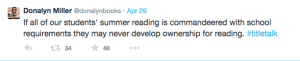
We can allow choice of titles instead of Screen Shot 2015-04-28 at 9.43.41 PMmandating one specific book.

If we want our students to want to read, we have to make it easy for them. The article Those Tired Summer Reading Lists. Here’s What to Do offers more to this argument. (And it’s got some nice alternatives for reading logs, too.)

I wonder how you are prepping your students for summer reading?

Me? I have already started the pep talk: The senior AP English teachers on my campus are mandating A Brave New World and Beowulf.

I’ll just leave that right there.

I am proud of my AP English Language team. We’re providing an annotated list of paired texts for our incoming juniors: Summer Reading with a Challenge and a Choice. This is not your same AP English summer reading list. I am confident we will win over more readers this way.

Choice always does.

Maybe we can help more teachers remember:  Is summer reading about the reader or about the book?

In the next few weeks, I’ll talk up books with my students. I’ll remind them of the choices they had in our book clubs. Maybe they’ll remember how hard it was to choose just one title at the time and read another this summer. I’ll show some book trailers and encourage students to grow their TBR lists. We talk a lot about readers having reading plans.

I lose a lot of books throughout the year, but I’ve also got a lot of books on my shelves that never move. I’m thinking of having some kind of check out system, maybe a $2 sale (if I can do that). I’d rather have books in student hands than sitting all alone on shelves all summer. Anyone have ideas here?

What are your plans to encourage readers to read this summer?

©Amy Rasmussen, 2011 – 2015

Launching an Official Monthly #poetrychat

Screen Shot 2015-04-23 at 2.49.34 PM

Evidently, there is not an official #poetrychat, but isn’t it a sweet idea?

Poetry serves as an important and beautiful lens into the literary world, and it deserves more than a hurrah during National Poetry Month.

I find that the more I talk about poetry the more I use poems in my classroom. Not like that’s a big surprise. The more I talk about books the more my students read.

So, I’ve been giving this a ton of thought. Do I want one more grape on my plate? And the answer has to be yes.

Today @JasonCarney5 artistic director of Young DFW Writers gave a pitch to my English department. Would we like to be a school that takes advantage of the Louder Than a Bomb program?

Um, yeah.

Meeting Jason and hearing about how his introduction to poetry changed the trajectory of his life was another testament to the power of poetry and what reading and writing it can do for a young person.

Aren’t we as literacy educators always looking for ways to engage and empower our young people and give them opportunities to grow as readers and writers?

So, yes, even if I get YDFW at my school next year (which I’m pretty sure is a done deal), I still feel the need to join other educators who are passionate about the “art” in language arts for a monthly poetry chat.

The teacher-writers at Three Teachers Talk are starting a monthly poetry chat. We hope to connect educators and poets, and work to infuse poetry into the year-long curriculum of ELA classrooms.

“A Poem about Topics for a Poetry Chat”

Spoken-word poems,

prose poems

found poems

spine poems


Ways to share student-written poems


Poetry to teach allusion,

imagery

syntax

grammar

self-respect


Books in verse

Verses for book talks


We will meet the first Monday of each month at 8:00ET, directly following #engchat at 7. Remember to use the hashtag #poetrychat — and to have links ready to your favorite poems and lesson ideas.

Mark your calendar for Monday, May 4 at 7:00 pm Central Time.

Leave your ideas for topics in the comments. Thanks!

An Invitation: Are You Walking the Talk in Your Content?

Now, that is the way to walk the talk.

knowyourphrase.com

knowyourphrase.com

I attended a Vocal Majority concert Saturday. This is one awesome men’s chorus. When the emcee introduced a quartet, I sat up a bit. There, singing with The Essentials was the choir director from my high school. Wow, what a voice.

As he sang, I kept thinking: There is a teacher who walks the walk. His presence on the stage, singing first in a group, then in a quartet, and later even as a soloist, shows that he knows exactly what his students must do — and feel — when they engage in activities and performances in the LHS choir.

Credibility is huge.

I think about this as I talk with other English teachers. I should stop being surprised when I learn that they do not read — “unless it’s a book I’m about to teach, of course.”

I’ve heard that more than once.

Perhaps even a bigger concern than not reading:  many English teachers are not writers.

The thing that has helped me be a better writing instructor — not attending conferences or classes, not reading pedagogy books — the single most thing that’s improved my ability to teach writing:  Becoming a writer myself.

I understand the struggle to think of ideas, the headache of revision, the joy of finally getting something right. My students need to know that I know what all of this feels like.

Like my colleague the choir teacher, I try to walk the walk of my content. I am an individual intent on improving my literacy skills, just like I want my students to be. I talk about my reading life, and I share my writing life with my students, regularly.

I think they trust me more because they know I read as much as I ask them to read. I write as much as I ask them to write, and every major assignment I give to them I write myself (plus this blog and a book I’ve been working on for awhile now.) I even write blog posts about improving my writing: 5 Ways to Meet Your Writing Goals.

It is not hard to have credibility. But it does take commitment.

The Best Writing Teachers are Writers Themselves.

A couple of weeks ago, i joined in a #litlead chat. The topic turned to teacher-bloggers and why and how to become one. A few participants in that discussion spoke out and said they were nervous about starting their own blogs, but they know it is a good idea. I’m sure their reasons for wanting to blog are varied, but there are three possible truths:

Teachers who blog are more likely to 1) reflect on their practices, 2) seek out new ideas for topics to write about, 3) show their students that they practice the craft of writing — like they hope their students will do.

I offered to let those nervous about blogging to wade it a little and publish a piece here at Three Teachers Talk. One stipulation: You have to be an advocate for readers and writers workshop. (That is the main topic of this blog after all.)

So think about it:  Do you walk the talk and walk the walk? Do your students see you as an adult with passion for your content outside the classroom walls?

Would you like to write a guest post? Send me an email with your idea, and I’ll respond and set up a date. (amyprasmussen@yahoo.com)

I’d like to help you walk a better walk.

©Amy Rasmussen, 2011 – 2015

Craft Study for a Monday: Billy Lynn’s Long Halftime Walk, again

For now, my new favorite book is Billy Lynn’s Long Halftime Walk by Ben Fountain. 

This surprises me. Maybe it’s the setting — Dallas Cowboys’ Stadium. Maybe it’s the protagonist — Billy, a 19 year-old-soldier. (I have twenty-year-old twin sons who want to join the military in a few years.)

Maybe it’s Fountain’s poetic language. It startles and soothes. It makes my mother’s heart shake.

I’ve dog-eared pages and underlined lines. I’ve even posted about this book in February.

Here’s the part I will share in class this week. My students are working on a major writing project. They chose their own topics. They’ll write in a variety of forms. But, even with only a few weeks left in the school year, I still need to show them beautiful language. I still want them to work on their craft.

“Look at Fountain’s style,” I’ll say. “What do you notice just on this one page?”

And we’ll talk about word choice and repetition. We’ll talk about lists and mood. We’ll talk about intentional fragments and why an author might make that kind of choice when writing a sentence.

My students will notice many things in this short passage. There are so many things to notice.

That’s probably why I am in love with this book. Thank you, Mr. Fountain.

excerpt from Billy Lynn’s Long Halftime Walk 

Don’t be scared, Shroom said. Because you’re going to be scared. So when you start to get scared, don’t be scared. Billy has thought about this a lot, not just the Zen teaser of it but what exactly does it mean to be scared out of your mind. Shroom, again. Fear is the mother of all emotion. Before love, hate, spite, grief, rage, and all the rest, there was fear, and fear gave birth to them all, and as every combat soldier knows there are as many incarnations and species of fear as the Eskimo language has words for snow. Spend any amount of time in the realms of deadly force and you will witness certain of its fraught and terrible forms. Billy has seen men shrieking with the burden of it, others can’t stop cursing, still others lose their powers of speech altogether. Lots of sphincter or bladder control, classic. Giggling, weeping, trembling, numbing out, classic. One day he saw an officer roll under his Humvee during a rocket attack, then flatly refuse to come out when it was over. Or Captain Tripp, a pretty good man in the clutch, but when they’re really getting whacked his brow flaps up and down like a loose tarp in a high wind. His soldiers might feel embarrassed for him, but no one actually thinks the worse of him for it, for this is pure motor reflex, the body rebels. Certain combat stress reactions are coded in the genes just as surely as cowlicks or flat feet, while for a golden few fear seems not to register at all. Sergeant Dim, for example, an awesome soldier who Billy has seen walking around calmly eating Skittles while mortars rained down mere meters away. Or a man will be fearless one day and freak the next, as fickle and spooky as that, as pointless, as dumb. Works on your mind, all that. The randomness. He gets so tired of living with the daily beat down of it, not just the normal animal fear of pain and death but the uniquely human fear of fear itself like a CD stuck on skip-repeat, an ever-narrowing self-referential loop that may well be a form of madness. Thus all our other emotions evolved as coping mechanisms for the purpose of possibly keeping us sane? And so you start to sense the humanity even in feelings of hate. Sometimes your body feels dead with weariness of it, other times it’s like a migraine you think you can reason with, you bend your mind to the pain, analyze it, break it down into ions and atoms, go deeper and deeper into the theory of it until the pain dissolves in a flatus of logic, and yet after all that your head still hurts (114-115).

Note: The book is being made into a movie with a Veteran’s Day 2016 release date. Rarely, do I like the movie as well as the book, but I still go see them.

©Amy Rasmussen, 2011 – 2015

The Modern PLC

1. Send out a Doodle for easy scheduling.

2. Receive Doodle responses and confirm date/time that works for four educators in four different states in two time zones.

3. Wait a week or so.

4. Sign into Google and click on hangout.

5. Invite friends.

6. Wait for Jackie, who when she finally connects calls herself “the 90 year old collaborator” although she is the youngest of the group by close to a decade.

7. Catch up. Chat. Plan. Collaborate on this blog for a good three hours on a Saturday morning.

Screen Shot 2015-04-18 at 6.02.01 PM

Erika, where are you?

We shared struggles and successes. We laughed. And we planned how we can write and share and learn and grow — a lot of it right here at Three Teachers Talk.

This, my friends, is the Modern Professional Learning Community.

Not long ago I read Live From Small Town America: Teachers Who Blog to Stay in Touch.

Well, I can tell you — it’s not just teachers in small towns.

Erika in NYC and me in Dallas both make the nation’s Top 10 for largest cities. (Of course, I am in a suburb north of Dallas but still..)

Educators are making connections all over the world. Blogging, Twitter chats, Facebook Groups, and more. And most of the educators who make these connections will tell you that the professional development they engage in online gives them more engagement, more information, more ideas, more solutions than most of what they receive on their home campuses.

If you are reading this blog, you already know this.

So, I am wondering:  How do we get more of our colleagues to engage in online PD? How do we change the model of PD in our schools to reflect the kind of sharing and growth we experience online?

Maybe most importantly, how can we model the kind of collaborative work we do online for our own professional growth for our students, so they can do it, too? Is that even possible?

©Amy Rasmussen, 2011 – 2015

Keeping Them Reading: Speed Dating with a Book

Confession:  I have never been speed dating.

I just love the idea of it.

In 2012 I wrote about an activity we did in my AP English class that got everyone talking as we prepared for the AP exam. I hadn’t even thought about that, until I started to write about our latest foray into the talkative world of speed dating with books.

Neydy and LauraI know many teachers have tried some version of this activity. I want to add my voice to theirs:  this is a F.U.N. way to get students talking about what they have read and what they might want to read — both important factors in helping students of all ages develop their identities as readers.

How to Speed Date with a Book

As students entered my classroom, I asked them to

1) find a book from the shelves that they had read and liked enough to share with another person,

2) find a second book that they thought they might like to read — maybe they liked the cover or the title; maybe they had heard someone talk about this book. Didn’t matter.

Everyone needed two book.

Then, we tried this “speed dating” thing.

First, we formed two circles, one inside the other. One circle faced outward. The other faced inward.
Students stood in front of one another, and I with the easy job stood with the timer and the camera.

“One minute,” I said, “You’ve got to stay on topic, and talk about one or both of the books in your hand for one minute. Your goal is to ‘sell’ the other person on why they want to read these books.”

GO!

 We talked books for as many minutes as it took for every student to talk one-on-one with every other student. It was exhausting. And wonderful.

After we completed all our rounds, we set all of the books out on one table, and students picked up their writer’s notebooks and turned to their “What Shall I Read Next?” lists, adding any titles they might want to read during the last two months of school. Every student wrote down at least one book. Some wrote down several.

Why Talking About Books Must Be a Constant

I teach juniors in high school. Before this year, most of my students did not consider themselves readers. They have had to learn what it means to

a. like books,

b. like to read books,

c. like to talk about books,

d. know how to find books they like.

The moment I stop holding up books at the beginning of class, reading a bit, and encouraging them to give it a try, many they stop reading.

They are one year and a couple of months away from graduating high school, and they are Baby Readers, fledglings not ready to leave the roost and fly off on their own. (In more ways than one, I know.)

I don’t know if my readers will be strong enough to keep reading when they leave me the first week in June.

I hope so.

In the mean time, I will keep up the talk and keep up the expectations:

You must read if you are a student in my class.

You are a reader who reads every single day.


What are some activities you do to keep your babies reading?


©Amy Rasmussen, 2011 – 2015

Hoping to See Some Damn Good Sentences

I am thinking about sentences.

For a few days now, I’ve been scoring stacks of essays. (If you teach English, I know you’ve been right here with me. Shana wrote about her disdain for grading and some solutions here.)

Reading student essays can be a joy or a chore. A really long never-ending chore. This time around, it’s like scrubbing the tub with a cotton ball after a team mud race.

With almost every essay, I’m scratching my head wondering how a student gets to be in 10th or 11th grade without learning how to write a clear, concise, complete sentence. Just give me one I want to say.

We could work with that.

So today, I am thinking about sentences and how to help students think about what they want to say before they ever lift their pens. And how talking about their thinking will help with their writing.

I am reminded of the importance of reading. Students must read and read a lot. We must teach them to notice how writers construct meaning by linking words into sentences. We must encourage them to talk about what they notice.

I’m thinking there’s more than one meaning here.

I am reminded of the value of mentor sentences. We must expose students to a variety of single sentences and help them talk through what moves the writer makes in each of them. Word choice, structure, details, figurative language: we must help our students understand how and why writers make intentional choices as they craft meaning.

Then, we must encourage them — and give them time — to practice crafting with intention on their own.

I am reminded of the need for conferences. We must make it a habit to talk with our writers one-on-one, regularly. The more we speak with them as writers, the more they will develop the identities of writers.

Writers take time to craft their sentences.

I recently read this post “5 Ways to Write a Damn Good Sentence,” and I am going to work these tips into my instruction the next few weeks as my students work on their final writing project. I am also going to find some mentor sentences that model each of the first four tips. We’ll practice the fifth one.

Next fall, I will not wait so long.

1. Insert facts.

2. Create images.

3. Evoke emotion.

4. Make promises.

5. Practice, practice, practice.

©Amy Rasmussen, 2011 – 2015

On Annotations and Assessment in Readers Workshop

If you’ve read this blog for a while, you know that I advocate for self-selected reading in all English classes. My students read stacks of books each year that they choose for themselves, and they read four titles for in-class book clubs that they select from my short stack of complex (mostly) contemporary titles.

The question I get the most from teachers who do not practice this choice pedagogy is “How do you know your students are reading?”

My initial response is usually:  “I ask them.”

But if you practice readers and writers workshop in your classroom, you know that it takes a bit more than that to know that students are developing as critical readers.

We do still have to teach.

Shana wrote a post recently about the value of talk in her workshop classroom, and I was intrigued by one of the comments:

I think we should consider what would be the best balance between between teacher and student talk. As the literacy expert in the classroom, I think the reading/language arts teacher’s voice needs to be heard often. While we all can be our own teachers, we will probably learn more with the wise guidance of a teacher.” 

But, of course.

Balance is key. So is authenticity.

These two ideals drive the choices I make in my workshop classroom.

My new friend, Lisa, sent me a question that got me thinking about both as I composed a response. I share her question here and how I replied to this dedicated teacher who is moving herself as she moves her readers.

Question:  Do you assess any annotations the students do with their reading? I’ve included a rubric we have been using to give students some feedback on their annotation of fiction. Their annotations in the text, and thereby their discussions about the texts, has greatly improved!! However, providing feedback on their annotations takes FOREVER. Just curious how you handle any sort of assessment related to students reading their chosen texts.” 

Response: Initially, when I read your question about annotations, I thought of these two questions:

1) Why do you need to leave feedback on the annotations in their books?

2) You said your discussions on the texts have improved. Are those discussions not enough of an assessment on their annotations?

Then I read your rubric, and it got me thinking.

I love the simplicity of the rubric, and I can see how students would notice more and be able to contribute to discussions more thoroughly and completely if they mark their books accordingly; however, I always use caution when it comes to interrupting a student’s reading flow — you know, reading for the sake of enjoyment.

In my own reading life, I rarely mark up a piece of fiction, unless it is for my own book club and I want to remember a significant passage that I loved, or didn’t understand, or a moment in the text that shocked or saddened me so much that I want to bring up in the discussion.

When I have my students engage in book clubs or self-selected reading, I want them to have authentic experiences and discussions about their books. (I quote Louise Rosenblatt on experiential reading at the end of this post.) That hope for authenticity is what drives what I have students do while they read.

And it is hard, and I have to trust that students notice the nuances and the complexities in the language and all the important literary aspects of their books. Sometimes they just don’t.  Sometimes they need to focus just on comprehension. I have to be okay with that.

Here’s how I try to facilitate learning:

1. Model my reading. I show students the books I’ve read for my book clubs and the kinds of passages I’ve marked so I can remember them for discussion. I encourage my students to mark their books in similar ways. Some will, and others never will. Some show me that they can think about their books without ever marking them. I have to let them learn the habits of readers that work for each of them individually, and I have to trust that they will.

This goes for writing, too. Every major writing task I ask my students to do, I do it first. I show them my process and later my product. For my ESL students, this is the single most effective strategy I do. I’ve asked them, and they’ve told me. I know that if this modeling helps my students who struggle with language, I know it helps all of my students.

2. Teach mini-lessons. Say I want students to focus on literary devices. I show them a variety of “beautiful sentences” from various texts; 51 Of The Most Beautiful Sentences In Literature was a perfect resource for this. I pulled several of these pretty slides and put them on a presentation in Drive. I projected them in the front of the room, and students and I talked through what we noticed in these sentences.

We discussed the craft in the sentence and why the author might have made the moves he or she did. This focus on the writing in a text often leads to greater critical reading of a text just as critical reading should lead to better writing.

Next, I asked students to go into their books and look for beautiful sentences. I gave them each a note card, and they had to find two sentences — one for each side of the card — where they could tell where the author did something interesting with language. I instructed them to write the sentence and the page number at the top, and then they were to identify the device/s, interpret the meaning of the sentence, and analyze the meaning, based on what they’d read in the book and what they believed the author was doing there as it related to the meaning as a whole.

What does this assess? A lot.

  • I know immediately if students know how to identify literary and rhetorical devices.
  • I know if students understand what they are reading, especially if the activity is during book clubs, and I’ve read all the titles in which students choose.
  • I know if students can analyze the author’s use of the device versus just summarizing the meaning of the sentence.
  • I know if students are reading their books. They are not going to choose a sentence on page 195, if they haven not read that far. They will not know how to tie their analysis into overall meaning

(The sentences I used for this mini-lesson lead to book talks, too, and I had one girl come in the next day with a copy of Anna Karenina that she’d bought for herself. Hooyah!)

Mini-lessons like this can be done over and over again — perhaps with a different skills focus each time, and the more students see that we are going to ask them to go into their books to focus on a skills, the more likely they are to start marking significant sentences and passages as they read. It becomes a natural move on the reader’s part instead of a mandate by the teacher.

3. Teach Notice & Note signposts. If you are not familiar with Notice & Note, Kyleen Beers and Bob Probst researched the patterns in story arcs and crafted six signposts around the moments in the text that appear the most often in a vast number of fictional pieces — short stories and novels. Students at all levels can apply the signposts as they learn to ask themselves questions as they read. In my experience, their understanding of theme improves dramatically.  If you Google Notice & Note signposts, or join the Facebook group, you’ll find many teachers who share their resources.

My students and I learn the signposts with short stories, and then throughout the year, we practice applying them to our full-length novels. Best thing I’ve done to help students analyze theme, which is SO HARD for some of them. I don’t quite understand why, but it is singularly the thing my students year after year struggle with the most.

For assessment, again, I do a lot with note cards. Quick, short writing snapshots where students can talk to me about what they know. I can grade these easily and leave feedback in the form of questions to direct students to look deeper, or closer, or whatever. I usually score these with check plus, check, or check minus and leave feedback in the form of one thing the student did well and one thing that might need improvement.

4. Write reader’s response. I have 35 composition notebooks that I labeled with thematic topics. I learned this strategy from Penny Kittle (Here’s a handout from 2013 that has a list of topics for notebooks in it.) I morphed her idea with Notice & Note, and it works well for reader’s response, another piece in holding students accountable for their reading and assessing their acquisition of skills.

At the beginning of the year, when composition notebooks are .50, I buy 35, and I label them with a variety of topics like Penny has on her list, plus some. I glue a handout of the signposts inside each one. Then, every once in a while, I’ll pull the notebooks out and set a handful on each table.

Students know to find a notebook that they can tie the thematic elements of their independent reading book to. We write for about 10- 20 minutes, depending on how in-depth I want students to go with their thinking, and then they share out what they wrote with their table mates. (This works as book talks, too, because students hear about what their friends are reading.) I wander the room and listen in. This is formative assessment. If a student has written about theme, shown that he is reading and understands how the book relates to that thematic topic, I know he is learning. Of course, the reverse is also true. I use check marks for grades of this kind of assessment, too.

Now, having told you all of this, I am not saying to ditch your rubric. I am just always trying to figure out how to put more of the responsibly for the learning (and the work) on the students, and probably most important to my sanity — the need to cut my grading time.

Regarding your rubric, I wonder:

A. How can you ask students to practice annotations with short stories?Then when you go to leave feedback on what they have marked, zero in on one or two slices of the rubric — never the whole thing. And be sure your feedback is something that will resonate. All too often students do not care about what we write, they only want to see their grade. I saw this great reminder in a tweet today:  “Put comments on my paper that begin conversations, not end them.”

B. Instead of trying to leave feedback on every students’ annotations for their whole books, how can you ask students to apply what they have learned from annotating?

For example, choose a slice of the rubric. Give students a half sheet of paper (or a notecard) and have them synthesize their annotations into a paragraph or two that answers a question. Something like :  Think about the things you’ve annotated about the characters in your book, how have the behaviors of the protagonist advanced the plot in the story?  Explain how any single or series of choices by the protagonist has surprised, unsettled, or shocked you.

C. How can you use the rubric to guide your conferences?Instead of checking their annotations, ask students to use their annotations as they talk with you about their books.

For example, choose a slice of the rubric. In a one-on-one conference, or in a small group conference if students are reading the same book, ask:  In regard to your annotations about literary elements, what have you noticed about how the author uses them? How do these elements help the author craft the story? Talk to me about some passages or sentences in the book that you’ve been particularly moved by.

You will know if students are paying attention as they read., and you’ll know so much more because your assessment shoots over the annotation itself and gets to the thinking behind why we want students to annotate in the first place.

Lisa and I would love to know your thoughts on annotations and assessment? Please leave a comment


©Amy Rasmussen, 2011 – 2015