Category Archives: Talk

Try it Tuesday: Partnering Up for Reading Conferences

Sometimes inspiration strikes at the most opportune times.

One day last week I had the honor of hosting two small groups of teachers from a different high school as they observed my classroom, one class period in the morning and another in the afternoon. Many of the teachers on their campus have been exploring and practicing with the workshop model for a while now, and they wanted to see my workshop classroom in action.

After each lesson, we met to debrief and hold a kind of question and answer session. Talk about an awesome experience (except for the voice in my head that kept saying “When did you become the expert on workshop? Yikes.)

I think one of the best things we can do as teachers is invite others into our rooms to watch us teach. Talk about keeping on the A Game. That’s a Try it Tuesday suggestion all in itself.

Here’s another one:

During one of those debriefs, one teacher asked about the conferences I conducted as my students read for the first 15 minutes of class. “What questions did you ask?

I explained that it depends on the student.

If I go with “How’s it going?”

My students answer, “Fine.”

If I go with “What are you thinking?”

My students answer, “Nothing.”

So I usually lead with “Tell me a little something about …will ya?” And then I listen to see what direction the conference might take.

That’s pretty much the genesis of every conference with my readers.

Another teacher mentioned that she and a colleague had been thinking about asking students to bring a question, thought, or problem to their reading conferences. You know, kind of like we ask students to do when we meet with them about writing. I’d never thought about it for a quick reading conference though. She wanted to know if I thought it was a good idea.

The image of this book came into my head. I found this copy of The Fault in Our Stars at a thrift store. It looked just like this:  plastered with sticky notes that reflect the student’s thinking. Now, I have no idea why this book is tattooed with notes, but I can imagine a not-so-great idea.
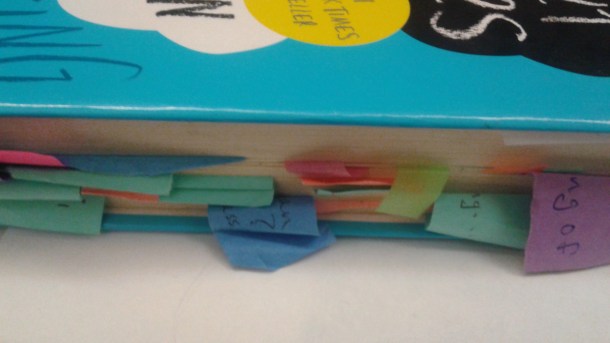
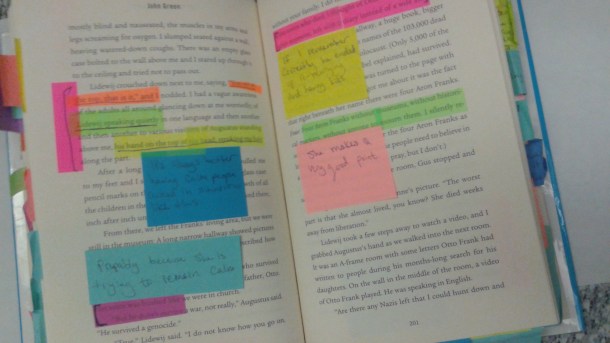
tfiosmarkup2tfiosmarkup

I hope a teacher didn’t assign this book and ask students to bring ideas to a reading conference. If that happened, I doubt this student got into reading flow. I doubt this student enjoyed this lovely, heart-wrenching book. I doubt she felt the beauty of the language and felt the loss of a beloved character. Maybe all that happened, but it wouldn’t have happened for me.

I want my students to love to read. I think we have to be careful with what we ask them to do with their independent reading books besides fall in love with the story and the language. Sure, they may recognize craft, they may recognize characterization. But the important thing is that they recognize that they are liking to read. That is so important to so many of my readers. They have to realize they like reading.

I do believe we can, and should, ask students to revisit passages — and maybe even the whole of a book — from time to time, even quite often. We can teach many important reading and writing skills that way, but we have to temper our desire to teach a book to death, even the books students choose to read themselves.

What I told my inquiring friend:  What if before independent reading time, on any given day, we ask students to read for a specific purpose.

Read to find interesting figurative language. Read to notice clever imagery. Read to discover how the writer shares an insight about a character. Read to find a beautiful or startling sentence. Or maybe a sentence that’s not really a sentence.
fabian

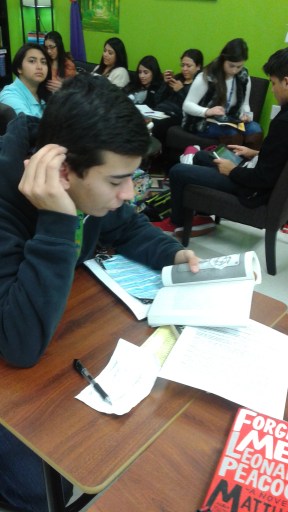
Fabian before class sharing his awe at the writing style of Jonathan Safron Foer in Extremely Loud & Incredibly Close

Isn’t this what readers do? I do. When I read a passage that strikes me in some way I want to share it. And let me tell you:  When my students start to do this on their own? That’s celebration time.

“What about the student who cannot find anything to share?” you might ask.

Well, that’s important information, isn’t it? I don’t know, maybe like the kind we might discover in a one-on-one reading conference.

Right?

I’d love to know your thoughts on this. What ideas do you have that work for your reading conferences? Please share in the comments.

Big thanks and shout out to @Sean_G_Hood and @mrs_friend and the inspiring teachers at Hebron High School!


Why We Should Challenge Our Students–And Ourselves

I’ve recently found myself in a learning situation I’ve rarely experienced before–a classroom where I am the slowest, lowest, and neediest learner.  The one whose work is nowhere near the level of everyone else’s.  The one who asks the dumbest questions.  The one who is silent and stricken after asking the dumb question.

IMG_9356

My own messy attempt at a poetry exercise

Those of us who grow up to become English teachers are skilled readers and writers, for the most part, and we were generally successful in educational settings.  We loved reading, we enjoyed writing papers, we received positive feedback from our teachers about our work, and we got good grades.  This is eminently true of my own educational experience, so I’ve never been able to truly empathize with how my struggling students might feel about our class time together.

The work of learning is tough in general, but standing out as the worst learner is a pretty unsettling feeling, I’m finding out.

The poetry workshop I’m involved in, which has shattered my confidence as a writer (while simultaneously strengthening my writing skills) is taught by award-winning poet Mary Ann Samyn.  This Bolton Professor for Teaching and Mentoring is the leader of our little band of misfit poets, and has been “poem-ing it up” for decades.

Mary Ann’s resulting ease with the language of writing and teaching poetry is obvious to witness.  She has clearly internalized and automatized much of the vocabulary of poetry–she tosses out phrases about meter and iambs and syllables and line breaks with such grace that I can tell she’s been thinking and talking about poetry for years.  “A line of poetry is a unit of measure,” she said.  I hastened to write down that line, marveling at its simple wisdom.

IMG_9355

My classmate, an MFA student, scrawls her own messy poem

It occurred to me, as I jotted down that poetic utterance of Mary Ann’s, that this is how I must sound to some of my students–as though I’m speaking another language.

As I sit in the workshop on Thursdays, surrounded by MFA students who have years of experience as real writers of fiction, nonfiction, and poetry, as well as teacher-poets who have published their own verse, I feel so lost.  I am in a world I don’t feel I belong to–I do not yet identify as a poet, but I feel surrounded by them, trying to do the work of writing poetry and reading poetry and thinking about teaching poetry.  I wonder if I’ll ever get to their level as they gently question me about my writing, trying to make sense of my meaning, and give me suggestions about my work.

Regardless of how I view myself in the group, one thing is clear during the workshop–I am part of the community of poets, for 90 minutes every other Thursday.  I give and receive feedback in the same way the other writers do.  I participate in the exercises everyone else does.  I write poetry within the same time constraints as the others.  I am treated as a poet, even if I don’t think I am one.

Being part of a writing community with such rigor is hard, but it’s valuable.  I would never use the word “fun” to describe my time in the Bolton workshop, but I would argue that perhaps the best learning is not fun.  I find myself determined to write poetry alongside those real poets, even as I dread reading my words aloud to them moments later.  In Drive: The Surprising Truth About What Motivates Us, Daniel Pink argues that my drive to do this is innate to all learners:

“We have three innate psychological needs—competence, autonomy, and relatedness. When those needs are satisfied, we’re motivated, productive, and happy.”

I make an effort to improve as a poet because I need to feel competent, much like our students work to improve as readers and writers because they desire competence, too.  In all educational situations, learners perform not because of the dangling promise of a grade, the threat of failure, or the pressure to comply with a controlling teacher.  They perform because they want to prove competence to themselves.

I asked a few students about this topic.  This summer, Shailyn read the Pulitzer-winning All the Light We Cannot See by Anthony Doerr.  She said the vocabulary was difficult, the book was long, and the writing style was strange–it was one of the toughest books she’s read.  “Why did you have the confidence you could read it?” I asked her.  “When you encountered those challenges, what made you say, ‘I don’t care.  I’m gonna read this anyway.’?”

“Because I have goals.  I like to feel challenged, and when I finally figured out how [the protagonists’] stories came together, I felt satisfied.  And I felt like I learned a lot from that book when I finished it,” she said.  Shailyn wanted to know that she was a competent reader–comprehending that book showed her she was.

Hunter, too, recently finished a book that challenged him.  “I hate this book,” he told me in the midst of Lone Survivor.  “You can abandon it,” I reminded him.  “No!” he said, forcefully.  “I’ve gotten two-thirds of the way through it.  I’m not giving up now.”  Hunter finished the book of his own accord, exercising his autonomy.

Lakynn agreed that learning is intrinsically motivated.  “You feel better about yourself when you’re more educated about a topic,” she told me.  “If you’re not knowledgeable about something, you can’t relate to someone more educated.  You want to learn about things so you can have those conversations with people about them,” she explained.  The social aspect of a learning community is evident and powerful here–Lakynn sought information about the Republican presidential candidates to fulfill her relatedness needs.

The more I talked with students, the more I discovered that what I thought was frustration with my difficult learning experience was actually profound satisfaction.  Yes, my confidence was crushed–I thought I was a good writer.  But knowing that I had so much room to grow created a hunger for more knowledge–I needed to learn, to belong, to feel competent again.  And so, I leave the Bolton workshop energized, confused, and with my mental wheels turning, every time.  The rigor of that learning–the toughness of it–is what makes it so satisfying.  I’ll remember that the next time I sit down beside the accomplished poets in my class, and every day I design lessons for my students.

Our students flourish when we create an authentic, rigorous learning community for them to be part of.  Difficult books, intimidating writing pieces, and high expectations combine to create an ideal situation in which autonomous learning can occur.  The beauty–and the learning–lie in the challenge.

I’ll leave you with a gem from one of Mary Ann Samyn’s collections of poetry, Beauty Breaks In:

Beauty breaks in everywhere.
Welcome to the wind-powered poem.
Like the ocean or the woodcut of the ocean.
I heard the hardest thing and listened.
Syntax says, you first. Shimmer half-scolds.
I said, I am loved. Sometimes a correction happens.
Fear made it one full week. A human action.
I stopped making it worse than it was.

A Yearlong Community

The sense of camaraderie and fellowship in our workshop classroom has ebbed and flowed this year.  Some days, I watch with pride as the readers and writers in the room help guide each other to a higher level of understanding, appreciation, or excitement.  Other days, I see disengaged students annoyed with one another’s antics.

Getting this community established at the beginning of the year takes time, but once the foundation is laid, it’s easy to keep it in place.

…Until you have 15 snow days in a row.

Or a student teacher.

Or a six-day block of testing.

Or 75-degree weather with sunshine, just out the window.

All of those common interruptions can derail a classroom community.  This year, though, I feel as close to my students as ever, and they are as tight-knit a group as can be.  Here are four reasons why.

Passion.  I’ve written before about how fangirling helps create a community of readers.  But it’s not just being excited about books that helps a classroom community develop–it’s passion about the work we do here as a whole.

Jordan, a student who joined our class in September, told me yesterday, “I still remember the first time I came to this school.  Yours was the first class I came into.  You were yelling and all excited and stuff.  I thought, ‘Wow, is this how this school is?’  Then I went to the rest of my classes and I was like, awww, where’s the excitement at?”

The passion I brought to teaching stuck with Jordan for nine months, especially when he contrasted it to his other teachers’. Communicating our genuine excitement to our students models for them the lasting value of our content.  Without that enthusiasm, a classroom community may not seem worth building.  With it, students come to class ready to learn, which creates the first condition for a strong community.

Vulnerability.  Around my birthday in early September of each year, I share with my students a song my friend Joey wrote and recorded for me.  About a month after he gave it to me, he passed away.  I play the song for the students and we write, then, the soundtrack of our lives–which song it would be and why.  I write about Joey, my guilt and sadness over his suicide, how I slept with the lights on for months after his death.

Chelsea recently told me that at first, she wasn’t quite sure about me.  “Then you wrote that piece with us about your friend Joey, and that’s when I started to think differently about you.”  Modeling my vulnerability with my students encouraged them to do the same–they began to write about topics they once considered very private, and to share their writing in small groups, which I rotate monthly.

Sharing this story with my students, crafting and refining it alongside them, modeled for them not just vulnerability, but the writing process when it relates to a difficult subject.  I became, in their eyes, not just a model writer–but a model thinker, with emotions and difficult memories just like them.  Shifting from not just an English geek to a real human is the second condition for a strong community.

Guts.  This spring, I had a student teacher for eight weeks.  When she left, state testing began almost immediately.  After those two lengthy periods of disruption to our established routine, my students were sluggish and disinterested–frequently unprepared for class, slacking off on their reading, unenthused about their final multigenre projects.

Then, I shared with them my own multigenre piece for this year, about the miscarriage I suffered on Mother’s Day.  As I showed them my writing, the classroom became eerily quiet.  The stillness and silence was deafening.  After lots of hugging and passing around of tissues, the students worked with energy and reverence on their own writing once again.  Their enthusiasm was back.

“I thought it was cool that you would put that out there for the students to know,” Madison told me the next morning. “I was shocked that you wrote about it.”  The fact that I not only shared such a tough subject with them, but had the guts to write about it, was powerful.  This gave many students the boost of confidence they needed to confront a difficult issue and create beautiful writing about it–the third condition for keeping that sense of community strong right up to June.

DSC_7929

Two of my funniest students, Troy and Logan, smirk at me over lunch.

Humor.  We’re not morose all the time–we have lots of fun.  Whether it’s a humorous booktalk, a funny poem, or just a celebration of a student’s silliness, there is lots of laughter in our classroom.

A small whiteboard on one wall of our classroom is full of quotes that have made us laugh.  A word like “clementime” can crack us all up, remembering when Troy bemoaned the book Columbine‘s length but accidentally said, “Oh boy, Clementine, here we go.”  Or “overalls,” which calls to mind Kristen’s claim that “I woke up, put on my overalls, and everything just got really weird.”  These simple one-word phrases memorialized on the whiteboard can bring a smile to our faces when we need a lift, and remind me that my students aren’t just learners–they’re people, and pretty darn cool ones, too.

Talk.  Talk is such a foundation of workshop, but it’s important to talk outside of conferences, small groups, or minilessons.  Isaac, a student who has struggled with academic success in the past, has been sitting in my room during his lunch period all this month, working on his multigenre paper.  He chats at me as he writes, asking whatever questions come to mind, writing-related or not.  As a result, he is soaring.

“This is probably the first project in school I’ve ever worked this hard on,” Isaac keeps telling me. “This project is so awesome.”  I told our principal how hard he’d been working lately, and he complimented Isaac when he saw him in the hall.

“Oh my god, I can’t believe teachers talk about students outside of class!” Isaac exclaimed later.  I could tell by his little smile that he was secretly pleased that we had said nice things about him.  Talk has an impact far beyond its transient initial utterance.

Passion, vulnerability, guts, humor, and talk–all year long–make for a beautiful classroom community I’ll enjoy ending this year with.  What do you do to keep your learners unified?

What I Didn’t Teach This Year

The end of the year is upon us (finally!), and I’ve been reflecting as I always do.  This year, though, I’m thinking about something I’ve rarely considered before–not just what I taught, what worked, or what I want to do next year.  I’m thinking about all the things I didn’t teach this year.

There are 180 precious days in a school year, and the way my school is structured means I spend 90 days with each set of students.  That seems so fast.  There was no time to waste, so here’s what I didn’t fill that time with:

FullSizeRender

As Sabra stepped up for her reading ladder picture, she said, “This is pretty good for someone who didn’t finish a book until your class!”

Whole class novels.  This was a controversial choice for me, given that I love so many authors of American literature–Mark Twain, Walt Whitman, Nathaniel Hawthorne, etc.  But, no matter what novels I’ve chosen in the past, there’s always a student that book isn’t right for.  Fahrenheit 451, The Absolutely True Diary of a Part Time Indian, The Glass Castle, Maus–none of them is a perfect match for every child.  I’ve used a wide variety of strategies to get students to be able to read those books, and every ounce of passion I can muster to get them to want to read those books, but still–students have been conditioned to not read, to just get on SparkNotes, or ask an older sibling, or use Wikipedia.  When the stacks of matching novels come out, groans abound and engagement tangibly disappears.  I’ve seen this.  I’ve battled it.  No more.

So, I scratched whole class novels altogether.  Students worked in book club groups twice, and engaged in independent reading challenges two other times.  We read tons of short stories, articles, essays, and middle-length writings together.  But we didn’t read a single whole-class novel, and my readers still thrived.

IMG_8294

“I found myself as a reader this year,” Jordan writes.

Did my students grow as readers this year?  Yes.  I watched students who hated reading come to love it.  I watched students who couldn’t read well at all increase their stamina, passion, and skills related to reading.  I watched students who were good readers but bored with books fall in love with nonfiction, poetry, graphic novels, or award winners as they discovered new genres.  I watched students who loved to read flourish and challenge themselves with complex texts and childhood favorites alike.  Most of all, I watched a community of real readers spring up in my classroom–students recommending books to one another, self-selecting books and keeping long to-read lists, telling me all about their finds at Barnes & Noble.  These readers have become truly independent.  “Now,” Taylor writes, “I think I can read anything that’s put in front of me…and enjoy it.”

FullSizeRender

Isaac performs a poem for Nathan on poem-in-your-pocket day.

A movie.  As I’ve walked the halls this last week or so, I hear the unmistakeable sounds of cinema from behind closed classroom doors and darkened rooms.  I have no doubt that students are watching relevant films–movie adaptations of Romeo and Juliet in English, Forrest Gump in History, etc.  But this year, I felt I had absolutely no extra time…there was SO MUCH I wanted to do!  I used to love showing O Brother Where Art Thou with The Odyssey, and my students really delved into the symbolism of both texts.  But this year, my SmartBoard was full of YouTube videos, slam poets, or the still, quiet images of a document camera showing some writing.

I didn’t have time to show a movie, but I also wasn’t pressured by the crush of hours of grading that usually prompted me to show films in the past.  I’ve taken Kelly Gallagher’s rule about student work to heart–students should be doing four times as much reading and writing as we could ever grade.  So, I’ve read and responded to about a quarter of my students’ work, and let self-evaluations, peer conferences, and notebook passes do the rest.

Most of what I taught last year.  Last year was great, don’t get me wrong–but this year, my students were a new batch.  They’re different kids than last year’s group, so the same things won’t work for them.  After seven years in teaching, I know that.  I didn’t waste time trying to figure that out…I just started fresh.  I know I’ll do the same thing next year…out with the old, and in with the new.

IMG_0054

Shailyn read almost all of my YA fiction, and wrote reviews about nearly every book for our school newspaper.

Tests or formal essays.  Tom Romano likes to call the typical English essay a “five-paragraph you-know-what,” and it truly is a dirty little assignment.  At an NWP workshop I attended, each teacher was asked to bring some samples of student writing.  All around me emerged typed, double-spaced, Times New Roman, size 12, thesis-at-the-end-of-the-first-paragraph essays.  From my own bag came photocopies of messy scrawls in notebooks, multimedia This I Believes, strongly-voiced commentaries, poetic musings developed from quickwrites, and lengthy, involved, multigenre research papers.  No two pieces looked alike, and they certainly looked nothing like most other teachers’ samples.

I’d be lying if I said I didn’t feel a faint nostalgia for my own high school days, when I took pride in being able to punch out a perfectly formatted five paragraph essay in just under an hour, and which made absolutely no sense but looked great, and which constantly netted me As.  But I listened to my neighbors rant about poorly integrated in-text citations and incoherent thesis statements, I dismissed that nostalgia and read my own students’ work for what truly matters–good writing, heart and soul on a page, and authenticity at work.  As my husband said when he saw me dwarfed behind a pile of multigenre papers to grade, “I could read some of those for you.” “You wouldn’t know what to look for,” I said.

“Good writing is just good writing,” he replied, and he is right.  As the year ends, my students are good writers and good readers–not all of them are great, and there are kids I feel I could’ve pushed harder, but all are certainly better than they were when the year began.  I’ll look forward to our last day of class, when I’ll gift them each a new composition notebook and a pile of classroom library books to read over summer…and to months beyond, when I get to hear their stories of summer literacy in the fall.

Book Clubs in AP English: Just let them talk

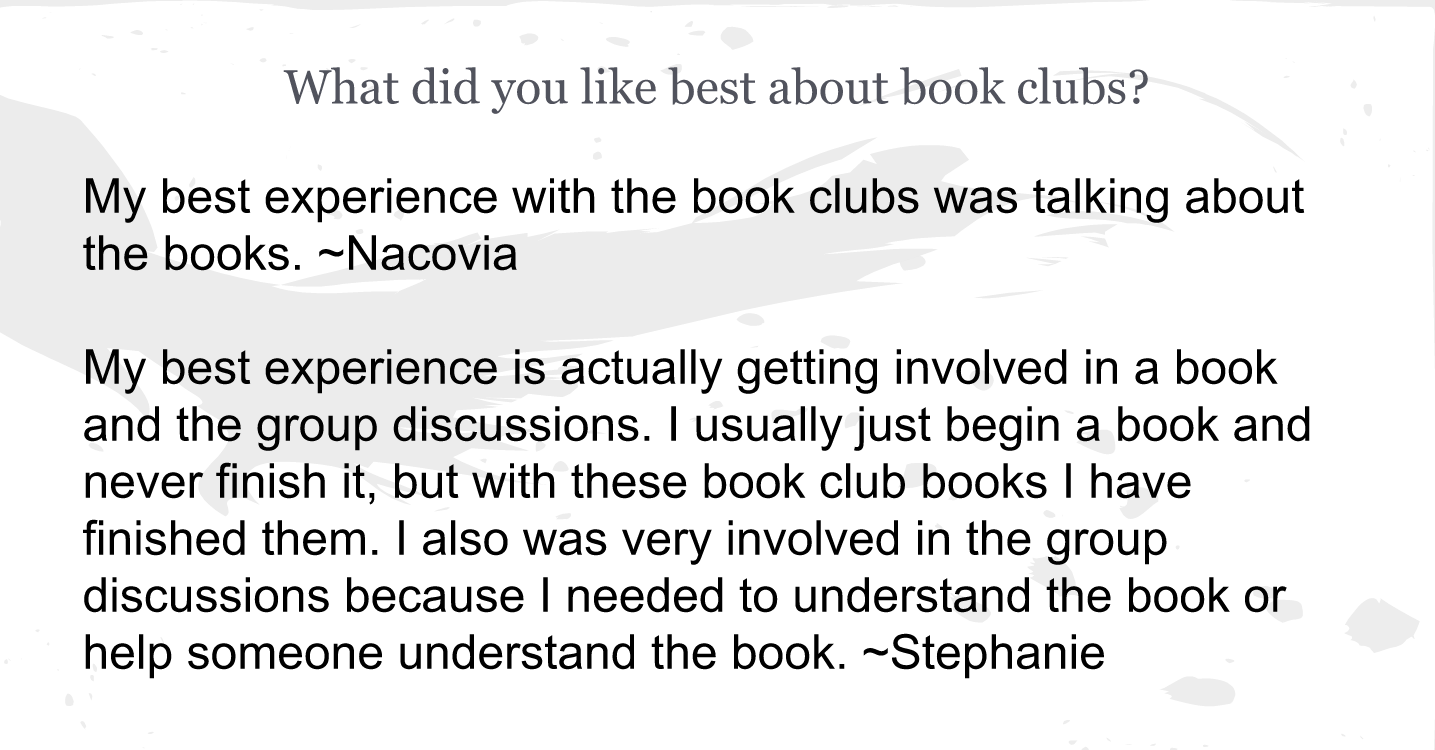
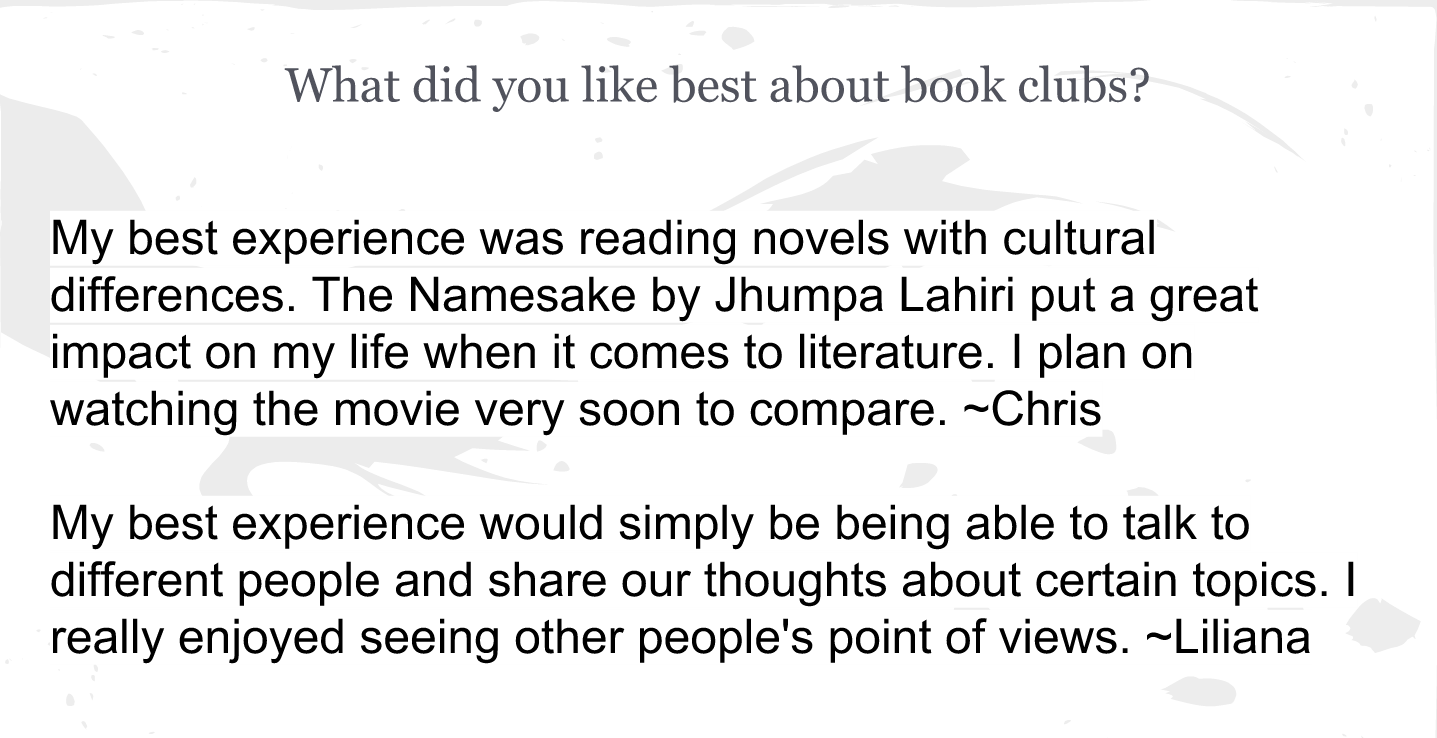
Some of it was great. Some of it not so much. I’m talking about the book clubs in my classroom this Screen Shot 2015-05-02 at 5.42.03 PMyear. The great was actually my students reading and talking to one another about that reading. The not so much — the way I did assessment.

This is what I learned and what I will change for next year:

Book Clubs serve as a way to challenge my readers into the more complex books that many of my students would never choose for themselves. Book Clubs also allow my readers to talk about books in an authentic way without the strictures of guided reading questions or anything else that might lead to Readicide. (‘Read-i-cide: noun, the systematic killing of the love of reading, often exacerbated by the inane, mind-numbing practices found in schools” –Kelly Gallagher) I wrote about the importance of balance literacy and how book clubs fit into that in this post.

I provide a short list of titles that I know contain fantastic stories of resilience, survival, hope, courage, and any other trait that prods readers to relate to the human experience. I introduce the books, usually with book trailers or video interviews of the author’s, and I include either on paper or a projected slide the synopsis and ratings from Goodreads or Amazon.

Students select their books, often talking with one another and making selections together. I ask students to purchase their own books, so they can annotate anything “interesting, intriguing, puzzling, contradictory, or you just plain do not understand.” Since most of my students come from less affluent families, we talk about the importance of libraries and surrounding ourselves with texts that can inform and influence our thinking. Often, students will purchase more than one of the books I introduce for book clubs. I also have a few copies of the texts in my room that students may check out if they cannot purchase their own. I always think my copies will be used more than they are, but I’ve learned that my readers like to buy books. Most feel the sense of ownership that I want them to feel.

Our first book club this year, I gave students a choice of the following titles, all centered around themes of family and parents and how they influence our upbringing and our choices:

Extremely Loud and Incredibly Close by Jonathan Safron Foer

Swamplandia by Karen Russell

The Curious Incident of the Dog in the Night Time by Mark Haddon

Girlchild by Tupelo Hassman

The Glass Castle by Jeanette Walls (literary non-fiction)

More students read The Glass Castle than any of the others, but every book was represented in at least one book club of three to six students. Students loved The Glass Castle, and they told me that they could relate to much of Walls’ upbringing.

Screen Shot 2015-05-02 at 5.42.19 PMAssessment:  For this first book club, I asked students to read with an eye looking for theme. They would work with their book clubs to craft a mind map that included numerous quotes from the book that contributed to the theme, and they would analyze these quotes as part of the mind map. They could create the mind map as a paper poster or online. As they read the book, they were to mark the text like I had taught with the short passages of text we’d read together in class, and they were to also look for sentences and phrases and passage that pointed to theme.

My students did not have a clue how to do that. Most did not mark their books, so when the project time rolled around, they ended up scouring through the book or searching for quotes on Goodreads or elsewhere to find enough quotes that they could plop into their mind maps. I needed to provide more guidance in annotating, and in reading for beautiful sentences, and in making thematic connections, and so much more.

Also, I allowed students to work in groups to create their mind maps. This did not work because no one in the group would rise up and be the leader. They were new in the class and new in their friendships with one another. Group work is a topic for another post, really. This time it failed, and I’ll need to do a lot more prep work before I spend as much class time on this kind of project ever again (if I ever do).

Our second book club, students choice a title from this short list, all centered around themes of culture and how these cultures influence us:

The Namesake by Jhumpa Lahiri

Little Bee by Chris Cleeve

Sarah’s Key by Tatiana de Rosnay

The Kite Runner by Khaled Hosseini

A Thousand Splendid Suns by Klaled Hosseini

More readers chose Sarah’s Key than any of the others. Students find stories of the Holocaust fascinating, and that shelf is a popular one in my classroom library. (Erika’s, too.)  Many students read The Namesake, and at least one book club read each of the others.

Assessment:  This one was even more lame than the first. Sometimes I feel the pull to get back to a Screen Shot 2015-05-02 at 5.42.33 PMmore traditional pedagogy. I am the only one on my campus who fully implements readers and writers workshop, so I listen in often to what other teachers have their students do. If you teach AP English, at some point, you have probably had students write a hexagonal writing over a piece of literature. (Hexagonal because student write thinking about their knowledge, comprehension, application, analysis, synthesis, and evaluation as it relates to the book. It sounds like a great assignment.)

It was the worst writing my students completed this year — if they completed it at all.

I know why. There was no authenticity in it. Follow the structure I gave you. Each paragraph should be about this… No wonder they didn’t care about writing well. I was their only audience, and I was making them write something worse than a book report.

We wasted a lot of time. (The grading policy in my district requires that I reassess major grades. Hey, let’s write this paper again since you cared so much about it the first time. Right.)

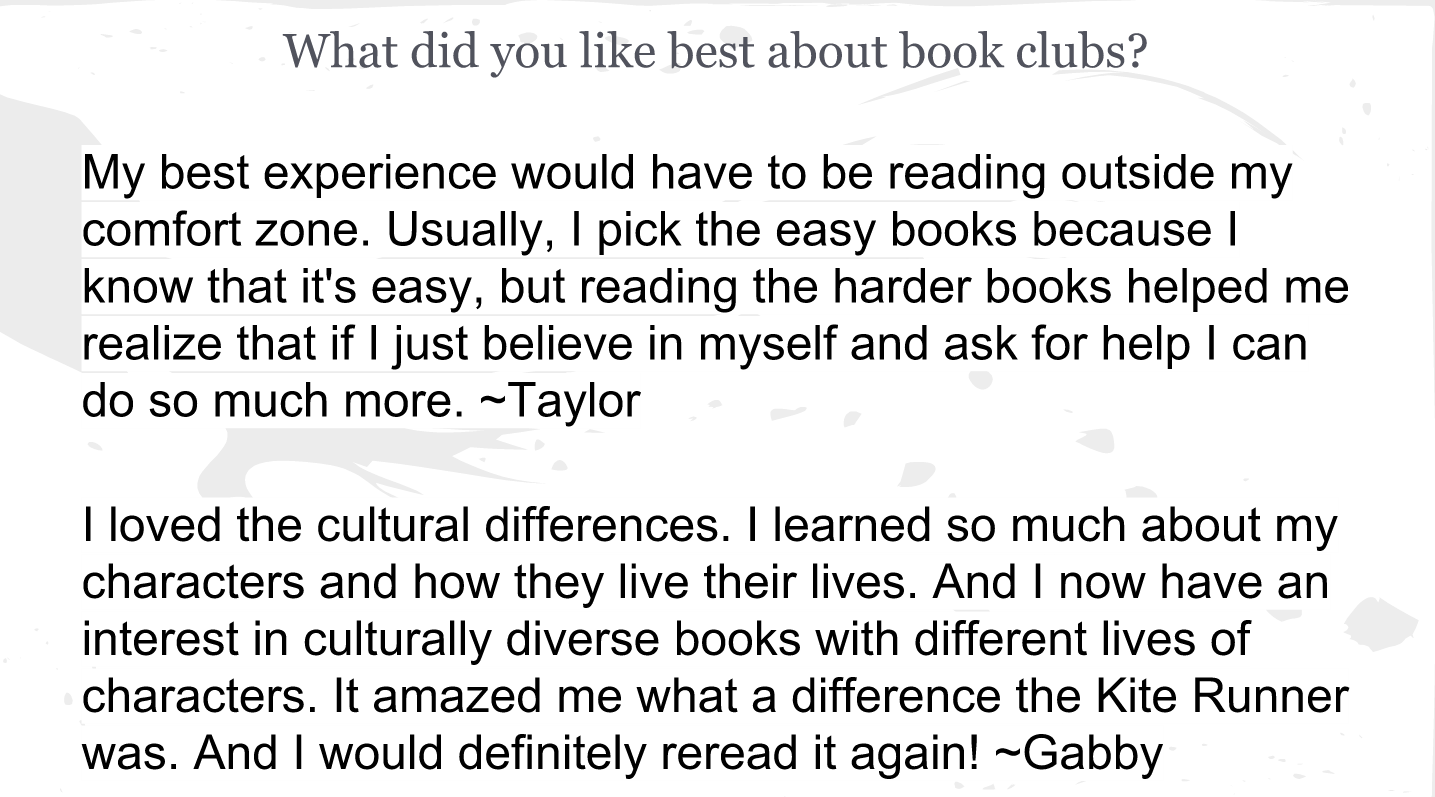
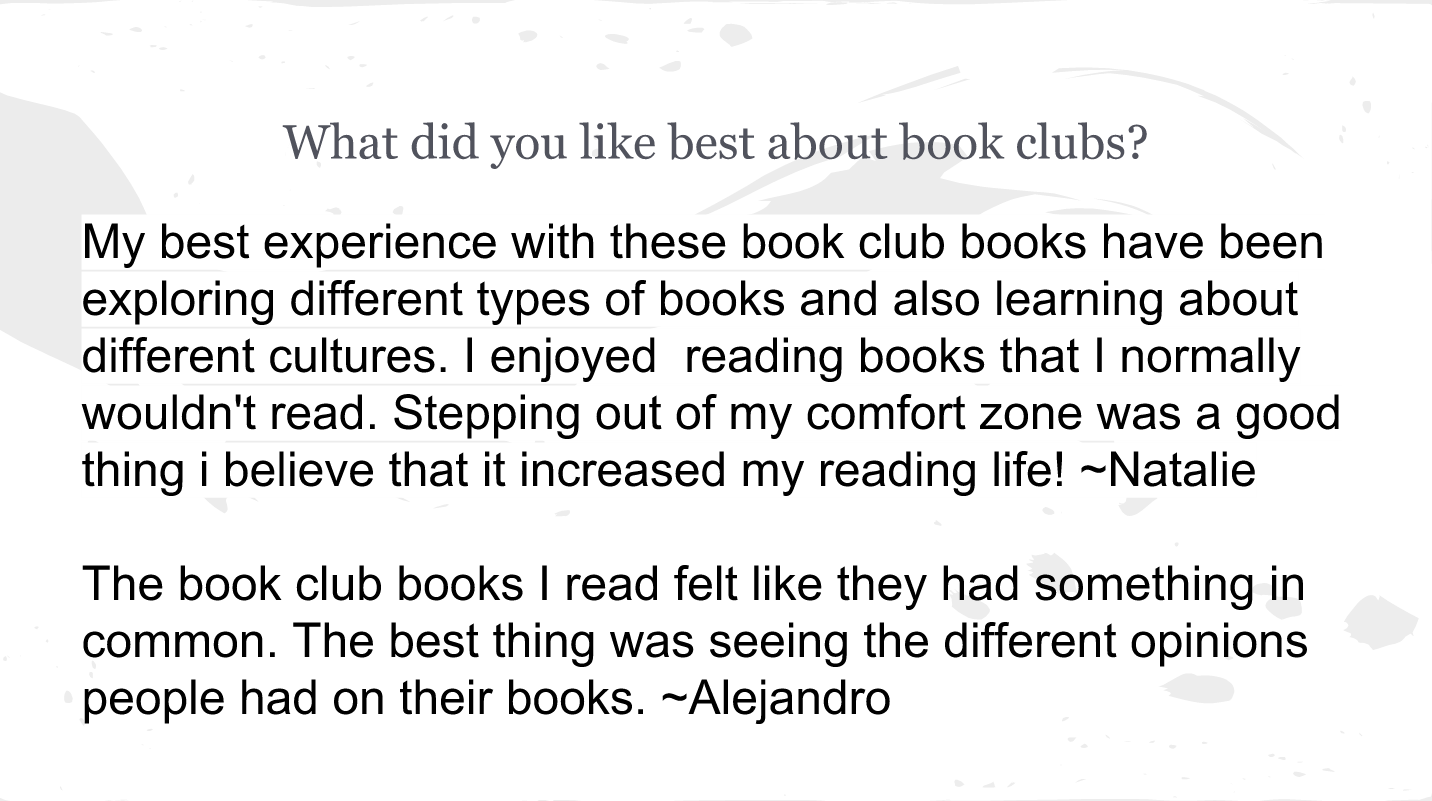
Screen Shot 2015-05-02 at 5.42.45 PMMy readers would have benefitted more from a gift of time to talk about the books more. Shana posted about the value of book clubs for talk earlier this year, and after two subpar experiences I began to agree:  “asking students to keep the conversation [about their books] going for 20 straight minutes provides valuable time for students to build relationships [around conversations about their reading.]”

I would just let them talk.

Our third book club students selected titles from this short list, all centered on war (or internal war) and its influences on individuals and humanity:

The Yellow Birds by Kevin Powers

Room by Emma Donoghue

Where Men Win Glory by Jon Krakauer (literary non-fiction)

The Bell Jar by Sylvia Plath

The Things They Carried by Tim O’Brien

The majority of my readers chose to read ROOM or The Bell Jar. They loved Room, and didn’t think The Bell Jar lived up to its hype.

I scheduled more opportunities for students to talk about their books. I wandered the room, sitting at Screen Shot 2015-05-02 at 5.42.57 PMgroups and listening in as conversations circled in and out and back again. Often, I placed a stack of TableTopic cards for book clubs in the center of their table, and students used these to guide their discussions. (Looks like the book clubs version of TableTopics is no longer available. Sad.)

Next year, I will do this again. I might ask students to look for significant passages so they can practice analysis on a page they select for themselves. Here’s a post that I’ll probably show them with a sample passage for craft study.

I might have them create a found poem or a black out poem.

Or I might just let them read and talk and read and talk some more.

That’s what I do in my own book club.


If you have your own suggestions for improvement, please share them in the comments.


©Amy Rasmussen, 2011 – 2015

7 Moves in My Workshop Schedule

Quite often teachers ask me what the daily schedule looks like in my workshop classroom.

This is a hard one. I think mainly because it is not about the schedule as much as it is about the routines, or manners, we start putting into place at the beginning of the school year.

I’ve had a lot of adapting to do this year. Moving to a new school and adjusting my lessons to fit 85 minute class periods where I see my students twice a week for sure and every other Friday — sometimes. This is quite a change from 50 minute class periods where I saw my students five days a week.

Our normal routines  — and these are non-negotiables that make workshop work — consist of reading, conferring with readers, talking about books, writing in our notebooks, revising in our notebooks, sharing a bit of our writing, and learning or reinforcing a skill, then….it all depends on our workshop task. That’s why writing about my daily schedule is hard.

Here’s the best I can do without going into a long explanation — that has to wait for my book (Penny keeps telling me that my book will never get written if I keep writing on this blog, and I know she is right. Only so much time.)

READ — 10 to 15 minutes. This is sacred and silent reading time. Students choose books that interest them. I CONFER with my readers, always with a specific focus, depending on my reader.

TALK about books. Sometimes I do a book talk, reading a few pages of the book, or holding a book interview like Erika does. Sometimes a student does a book talk, if I’ve talked to her first and know she’s passionate about the book she’s just read. Sometimes I ask my students to just talk about the books they are reading. Shana wrote about the Value of Talk, and I agree completely: “Talk is one of the most valuable tools at work in my classroom.”

WRITE in our writer’s notebooks. Everyday we need to have our students thinking on paper. When I forget, or think we do not have time, to open our notebooks and write — in response to a poem, or a video, or a story, or about the book students are reading, or about whatever — I regret it. Discussions are richer when we write first. Discoveries are more insightful when we write first. Writing is better when we write, just thinking about our ideas, first.

Then, something I learned from Penny Kittle, we always read what we wrote and REVISE. Penny modeled revising with a different color, and I ask my writers to do the same. I simply say, “Read over what you just wrote. How can you make your writing better? Maybe add a phrase or two that develops your thinking more. Maybe change a word or two that adds a punch. Maybe you can remove some words and make your thinking more concise. Where can you add figurative language or a list or an interesting style move?” (When I check writer’s notebooks, I always look for evidence of revision. We work on establishing the habit of revision, daily.)

SHARE some of our thinking. Sometimes we pair up and read our writing to a shoulder partners. Sometimes I ask for volunteers to share out their writing. Sometimes I randomly call on someone (and I usually allow them to opt out at least once if they are uncomfortable reading aloud). Sharing is an important part of our community, and from the first day of school we work on establishing a safe and respectful environment where we can all grow as readers and writers.

Learn or reinforce a skill via MINI-LESSON. (If I introduce something totally new, like one of the AP English Language exam prompts, obviously the mini-lesson will not be so mini. On these days, the mini-lesson time and the workshop time allotment swap places. Sometimes I need the focused direct instruction time because it saves time in the long run.)

Our routines usually take about 35 to 45 minutes. That leaves us about half the class period to hold a workshop. This might be a readers workshop if we are practicing close reading or if we are preparing for a Harkness discussion. This might be a writers workshop if we are composing a piece of writing or studying the moves of a favorite author.

Of course, if we are writing, I change my hat and confer with my writers.

I would love to know the workshop routines you establish with your readers and writers. Please share in the comments.

©Amy Rasmussen, 2011 – 2015


Reflection, Rejuvenation, Rebirth

May and June always bring sunnier skies, feistier students, and more hopeful days.  Like Amy, I enjoy the last weeks of school, and often spend many of them feeling proud of my students, making big plans for the next year, and reading a ton in order to ramp up my booktalks.  This time of year is my time for reflection, rejuvenation, and rebirth.

ReflectionFullSizeRender

This spring, I’m excited that I have the opportunity to participate in a National Writing Project course, which is uniting me with other English teachers from my area.  Talking with them has helped to energize me even more so than usual at this time of the year, and some of their words have really helped me reflect.

First, my notebook musings during our first class led me to a powerful play on words–listening is at the heart of our teaching.  I’ve written before about the value of talk, but I’m thinking long and hard now about the power of listening…truly hearing our students’ hopes and strengths and worries and wonders.  I’ve paid special attention to emphasizing listening in my lessons these past few weeks, because I know I won’t get to hear these wonderful students’ words after the year ends.

Later in the NWP class, while assessing some of our students’ written products, we were asked to identify the skill we had been aiming to teach, and then evaluate how well our students internalized that lesson.  Claire, an elementary teacher, said that it was impossible to look for just one thing–“Writing is so…big,” she said.  I couldn’t agree with her more.  As I read my own students’ work, I saw themes of my own pedagogical beliefs running through their writing.  They were using beautiful language, inspired by our daily poem or craft-study quickwrites, in all of their writing–nonfiction too.  They were writing strong pieces thanks to the risks they felt safe taking in their choice of topic, genre, and style.  They were producing prolifically, writing long, short, funny, serious, sad, exciting, fiction, nonfiction, poetry, prose–everything.  Their portfolios are thick with creation.  Writing is big, indeed.

IMG_8049Rejuvenation

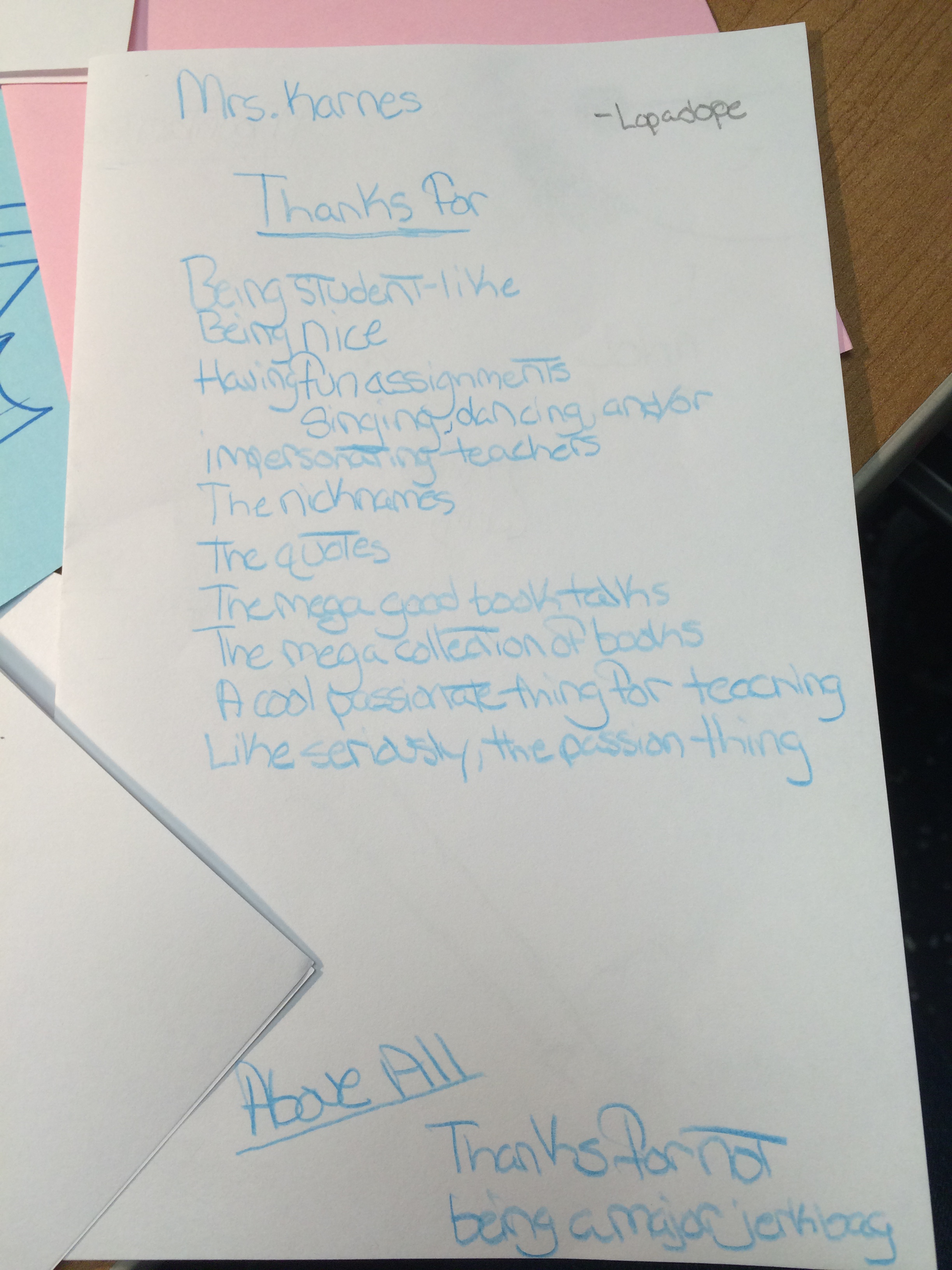
It’s Teacher Appreciation Week, and with that came some delightful thank-you notes from my students.  One student made a list of things he was thankful I did, and he repeated how thankful he was for my “cool passionate thing for teaching…like seriously, the passion thing.”  I recently read an article in the Chronicle of Higher Education that claimed the four properties of powerful teachers were personality, presence, preparation, and passion.  I like to think of passion as fangirling, which I do on a daily basis about books, student writing, authors, and all things bookish.  I’m never sure how much of that passion reaches students, but since this one specifically noted the “mega good booktalks,” I think it gets through to at least some kids.  This thank-you note really rejuvenated me, and now that I know my booktalks are working, I’ll keep at them with new gusto until June 12.

IMG_8027Rebirth

Continuing to revise and change my curriculum doesn’t stop because the year is nearly over.  I’m still wildly out of control on Amazon, buying titles as I get ideas for new units, themes, or genres (like the huge list of novels in verse I jotted down during our #poetrychat Monday night).  A new focus on science fiction, poetry, and nonfiction has been what I’ve noticed in my cart of late.  I am changing as a reader and a teacher, valuing those genres more than I once did, making a strong effort to transfer that new passion to my students.

My teaching philosophy is constantly shifting, evolving, being reborn.  Its biggest shift this year, I think, can be best summed up with a quote from another NWPer from my class last week.  While talking about meeting and learning from great teachers at NCTE, he said he felt like they were “the Wizards of Oz, but they were inviting me to peek behind the curtain.”  I love this analogy, because while great teaching may seem like unattainable magic, I now feel like I understand how to be effective.  I’ve studied living, breathing mentor texts like Penny Kittle, Tom Romano, Amy Rasmussen, Jackie Catcher, and Erika Bogdany, and am looking forward to learning from Tom Newkirk at UNH this summer.  In the past two years, I’ve been reborn as a teacher, whose confidence has grown as I’ve continued to strengthen my practice by dissecting and imitating the successes of others, just like my students do when we analyze mentor texts in class.

Springtime is a time for reflection, rejuvenation, and rebirth.  Nature is no different from my teaching as I think about this year and next, and about the beauty of its constant blossoming and change.  I know our last six weeks will fly by, so I’ll enjoy every moment of them before the luxurious summer begins!

What are you reflecting on this spring?  What has rejuvenated you as the year comes to a close?  What elements of your teaching will be reborn this year or next?  Share in the comments!

5 Ways to Enjoy the Last Month of School

Today we start a fun two weeks. Texas state exams and AP exams dual for the attention and time of most every student and teacher in the building.

Two weeks of juggling tests with students in and out of classrooms. Teachers putting on hats as proctors and hall monitors, shuffling to teach in different rooms so students can test in theirs. Stress can make cranky even the calmest souls.

Two weeks until the end of school after that. June 6 is our last day. Some days that sounds like the equivalent of enduring 12 long winters.

smart-goals1I must make the choice daily to be optimistic, to see the possible in all the end-of-year chaos.

5 Ways to Enjoy the Last Month of School:

1. Talk about Books. I will double the amount of time my students and I talk about books and reading. Summer slide is real, even for students in high school and AP English classes. I wrote some thoughts about summer reading here. I want my students to enjoy the reading they do this summer. Most have read double, some even triple, the number of books they read last year. I cringe thinking that many may not read even one book this summer. (The AP English Literature required summer reading holds little promise with Brave New World and Beowulf.) If we talk about books enough, and if my students write down titles that sound interesting enough, and if maybe I allow them to take enough books from my classroom library home for the summer — maybe even my most reluctant readers will read at least one book before they come back to school in August.

2. Sit and Listen. Last week a student tapped on my door during my conference period. “Mrs. Rasmussen, are you busy?” I was but I waved her inside. I shut my laptop and turned my chair, and Mikaila began to talk. She told me that she’d been in her business class when an idea for her writing project “burst in my brain, and I started writing it down, and the more I wrote the more I imagined and the more I began to cry, and then the teacher looked over my shoulder and got worried about what I was writing. I told her, ‘I’m okay, I just need to go see my English teacher.'” Grinning, she finally took a breath. Mikaila stood and talked with me for the rest of the period. She’s got a lot of hurt in her, and she needed someone to hear it. That is all I did. I listened. I still had essays to read and leave feedback on, but that afternoon with this sweet young woman was the best I have had in weeks. I felt needed. During the next few weeks I will try to be still, open my door, and listen. I doubt Mikaila is the only one who needs to talk.

3. Allow Students to Self-Assess. When my students care about their topics, their writing is always better, but after 11 years of school, so many of my writers care more about the grade they’ll get than about the quality of their writing. I’ve tried to change that all year. For the next few weeks, my students will read and revise their own work again and again. They will read one another’s writing and offer feedback, and then they will revise again. We have done two rounds of this already, and with the exception of just a few kids who put forth little effort and scored their work high, most everyone wrote an honest assessment of their writing process. They are thinking about the thinking they do as they write on the page. That’s the best kind of assessment possible.

4. Begin Planning for Next Year. Not full-on planning, mind you. That would make me crazy, but I have started a list of things I will change. I know I need to do a better job with organizing writer’s notebooks and teaching vocabulary. I know I want to read more poetry, although I added a lot in my primarily non-fiction AP English Language class this year. I know I need to do the lessons we did just last week early in the fall. I’ll add tabs in a writer’s notebook that I can use as a sample with my new students in the fall, and I’ll tinker in Drive as I make notes in my lesson plans. Planning gives me energy, so it makes sense to note changes I want to make now instead of hoping I remember them later.

5. Confer and confer and confer. Like you and your students, the relationships my students and I have built all year are strong and trustworthy. I want to utilize this trust and push my students further in their reading and writing than I would have been able to do earlier. The only way to do this is to talk with them more one-on-one. Every day as students read their self-selected books and write their self-selected projects, I will pull up a chair and we will talk. “What are you thinking?” I’ll ask, and they will open up and tell me. They know I will listen and offer feedback that they can take, or not. That’s the beauty of teaching students to take ownership of their learning.

©Amy Rasmussen, 2011 – 2015

Keeping Them Reading: Speed Dating with a Book

Confession:  I have never been speed dating.

I just love the idea of it.

In 2012 I wrote about an activity we did in my AP English class that got everyone talking as we prepared for the AP exam. I hadn’t even thought about that, until I started to write about our latest foray into the talkative world of speed dating with books.

Neydy and LauraI know many teachers have tried some version of this activity. I want to add my voice to theirs:  this is a F.U.N. way to get students talking about what they have read and what they might want to read — both important factors in helping students of all ages develop their identities as readers.

How to Speed Date with a Book

As students entered my classroom, I asked them to

1) find a book from the shelves that they had read and liked enough to share with another person,

2) find a second book that they thought they might like to read — maybe they liked the cover or the title; maybe they had heard someone talk about this book. Didn’t matter.

Everyone needed two book.

Then, we tried this “speed dating” thing.

First, we formed two circles, one inside the other. One circle faced outward. The other faced inward.
Students stood in front of one another, and I with the easy job stood with the timer and the camera.

“One minute,” I said, “You’ve got to stay on topic, and talk about one or both of the books in your hand for one minute. Your goal is to ‘sell’ the other person on why they want to read these books.”

GO!

 We talked books for as many minutes as it took for every student to talk one-on-one with every other student. It was exhausting. And wonderful.

After we completed all our rounds, we set all of the books out on one table, and students picked up their writer’s notebooks and turned to their “What Shall I Read Next?” lists, adding any titles they might want to read during the last two months of school. Every student wrote down at least one book. Some wrote down several.

Why Talking About Books Must Be a Constant

I teach juniors in high school. Before this year, most of my students did not consider themselves readers. They have had to learn what it means to

a. like books,

b. like to read books,

c. like to talk about books,

d. know how to find books they like.

The moment I stop holding up books at the beginning of class, reading a bit, and encouraging them to give it a try, many they stop reading.

They are one year and a couple of months away from graduating high school, and they are Baby Readers, fledglings not ready to leave the roost and fly off on their own. (In more ways than one, I know.)

I don’t know if my readers will be strong enough to keep reading when they leave me the first week in June.

I hope so.

In the mean time, I will keep up the talk and keep up the expectations:

You must read if you are a student in my class.

You are a reader who reads every single day.


What are some activities you do to keep your babies reading?


©Amy Rasmussen, 2011 – 2015

Hoping to See Some Damn Good Sentences

I am thinking about sentences.

For a few days now, I’ve been scoring stacks of essays. (If you teach English, I know you’ve been right here with me. Shana wrote about her disdain for grading and some solutions here.)

Reading student essays can be a joy or a chore. A really long never-ending chore. This time around, it’s like scrubbing the tub with a cotton ball after a team mud race.

With almost every essay, I’m scratching my head wondering how a student gets to be in 10th or 11th grade without learning how to write a clear, concise, complete sentence. Just give me one I want to say.

We could work with that.

So today, I am thinking about sentences and how to help students think about what they want to say before they ever lift their pens. And how talking about their thinking will help with their writing.

I am reminded of the importance of reading. Students must read and read a lot. We must teach them to notice how writers construct meaning by linking words into sentences. We must encourage them to talk about what they notice.

I’m thinking there’s more than one meaning here.

I am reminded of the value of mentor sentences. We must expose students to a variety of single sentences and help them talk through what moves the writer makes in each of them. Word choice, structure, details, figurative language: we must help our students understand how and why writers make intentional choices as they craft meaning.

Then, we must encourage them — and give them time — to practice crafting with intention on their own.

I am reminded of the need for conferences. We must make it a habit to talk with our writers one-on-one, regularly. The more we speak with them as writers, the more they will develop the identities of writers.

Writers take time to craft their sentences.

I recently read this post “5 Ways to Write a Damn Good Sentence,” and I am going to work these tips into my instruction the next few weeks as my students work on their final writing project. I am also going to find some mentor sentences that model each of the first four tips. We’ll practice the fifth one.

Next fall, I will not wait so long.

1. Insert facts.

2. Create images.

3. Evoke emotion.

4. Make promises.

5. Practice, practice, practice.

©Amy Rasmussen, 2011 – 2015