Category Archives: Strategies to Add Some Zip

Today We Draw

A Five Day Checklist:

Chancellor visit. (Check!)

Superintendent visit. (Check!)

A posse of outside principals observing. (Check!)

Our CBO (community based organization) pulled out = no counseling…or any other services…for students.  Teachers are now ALL of that. (Continual check!)

End of the Cycle (think semester) and the accompanied wildness. (Checking…all week long!)

*THIS WEEK.  Yes, in one week.  And, it’s Wednesday only.

 —–

The above is an email I composed to Amy, Jackie, and Shana in one of our most recent communications. In response, Amy wrote:  You’ve got the world on your shoulders this week, E!  And, it wasn’t until I was greeted with this affirmation that I realized it most definitely felt that way.  I was too busy moving through it to take a moment’s pause and acknowledge the intensity of it all.   The. Weight. Of. The. World.

It got me thinking.  If I felt this way, I couldn’t imagine how students were feeling as they were the reason for all of the visits.  They were the ones ‘on display’.  I just kept it business as usual with our Readers Writers Workshop flow; rigorous expectations, Writer’s Notebooks being utilized, Independent Reading occurring, questions being raised; chuckles here and there.  Yet, it felt off.  As I looked around the room, it occurred to me that students have taken on the weight of the world too.

They’ve been trying to articulate their thoughts wrapped around their chosen literature when the Chancellor asked them about their favorite books.  They’ve tried to be loyal to our collective work and answer the Superintendent’s question about rubrics (aside from the thought provoking work they’ve been creating) knowing that we are currently exploring with our pens and ideas sans a rubric.  They have tried to find comfort in their movement over the last six months, but these pressures have made them second guess themselves.  And the reason I know?  They’ve told me.

Yet, their resilience astounds me.  So, I dug deep.

We needed a collective breath.  With all of the tension and uncertainty swirling about Room 382, we needed a class period full of calming zen.  I channelled my extraordinary experience at #UNHLIT13, as I was guided by Penny Kittle in sketching an already created piece of art.  Aside from my internal voices loudly telling me that there was no way I was going to be successful at this; I tried.  And regardless of how my sketch came out I knew the most important lesson is that I didn’t give up.
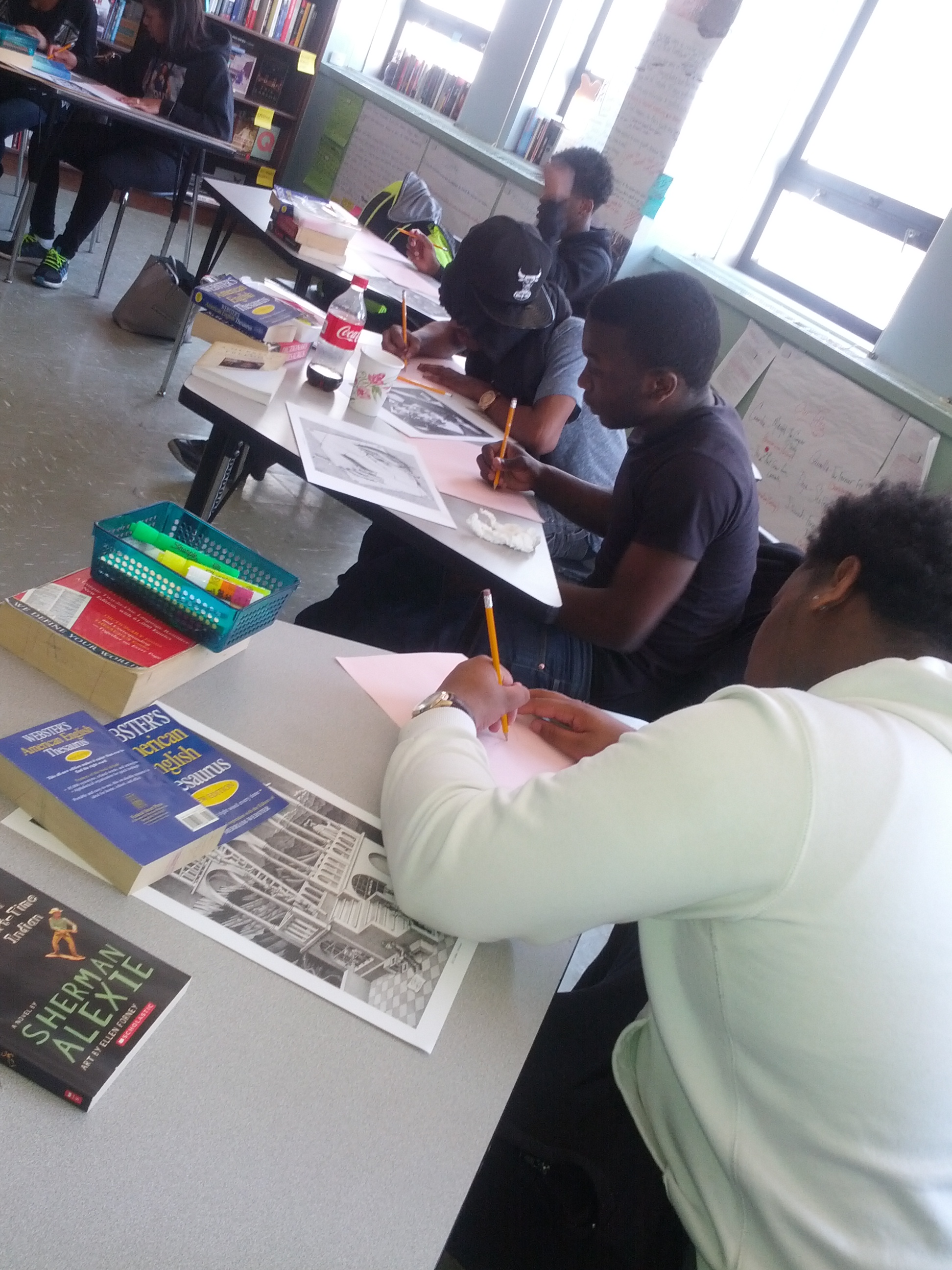
Calmly, yet intensely, sketching.

Calmly, yet intensely, sketching.

So, today we draw.

The weight lifted immediately and you could feel the energetic life seeping back into 382.  Students were riddled with questions: Wait.  We’re just going to draw today?  You mean, no writing?  We can do that?!  

And, while some questions made me laugh and others prompted me to reflect, students were back.  So, everyone grabbed their newly sharpened pencils, chose the drawing that spoke to them most, and got to it.  I mean, really got to it.
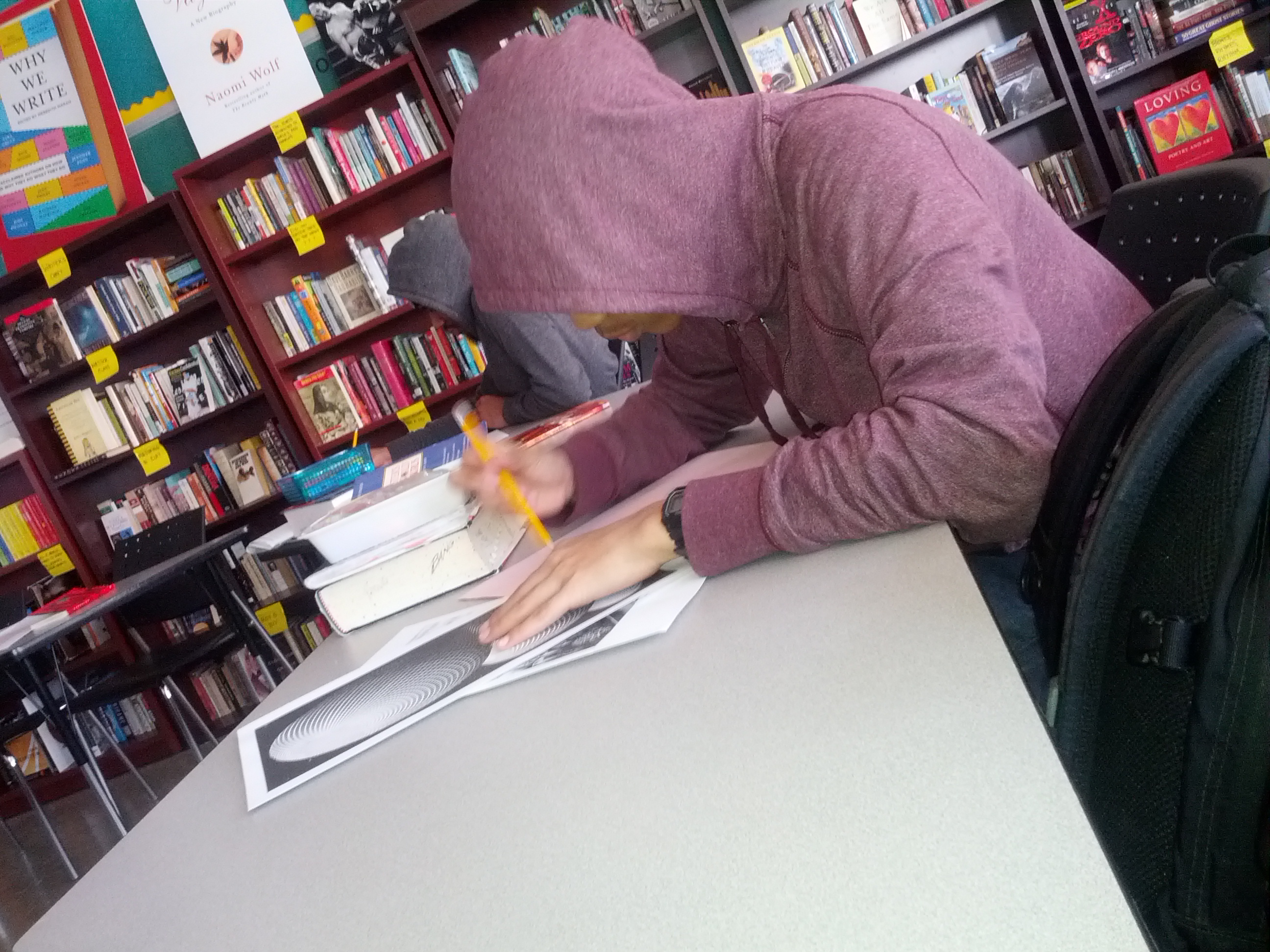
Hoodies up.  Concentration in full effect.

Hoodies up. Concentration in full effect.


It was important for me to voice my intention: Folks as we partake in this together, I need you to know that I am wildly uncomfortable with all things drawing!  For the last six months I have asked you to find strength and courage in reading and writing that has challenged you to the core.  Today, I do the same.  (Deep breath)  Here I go…

While students zoned in, I followed their lead.  I sketched under the document camera so students could watch me struggle…and I mean struggle.  Yet, while drawing/sketching isn’t my forte, I needed students to watch me play with a level of discomfort they are not used to observing.  Students engaged in non-literacy conversation (as Shana brilliantly suggests here) while honing in on their focus.  Students approached me to lend their expertise on how to curve lines or align measurements or see the artist’s sketch with a different perspective.  It was exhilarating being the student!

Some of our masterpieces!  My attempt at creating a balcony.

Some of our masterpieces! My attempt at creating a balcony.

All said and done, here’s what I know.  The RWW is about so much more than always reading and writing; it allows the space to explore, mess up, build community, redefine rigor, and just enjoy.  On this given day, the latter is my favorite.

How do you find ways to calm the tension within your learning environment using the Readers Writers Workshop model?


Embedding Poetry in Core Literacy Instruction

TCTELA2015

Selfie at our session. –“The Sound of Sense: Putting Poetry at the Core of Literacy Instruction”

Saturday Heather and I presented a session on poetry at the Texas Council of Teachers of English Language Arts. When I wrote the proposal last year, I had been accepted but had not attended The Frost Place Conference on Poetry and Teaching, and I had hope that my life would be transformed through poetry after my stay in Franconia at the end of June. I knew I’d have ideas to share with other teachers at this conference. I was right.

That’s how faith works.

I shared the strategies that have shaped my teaching into fine points for skills acquisition since I learned them at the

Frost Place:

Dictation. When we dictate a poem, slowly, speaking each word and each line with care; when our students write each word, each phrase, each metaphor and simile, they take ownership of the language and see into the craft of the poet. In this ever-moving world, our students need to s-l-o-w-d-o-w-n and feel the beauty of the print on the page. Words become tangible and approachable. Comprehension improves. Analysis advances.

Arguing a Tone. My friend Margaret shared this strategy:  Choose a poem that begins with “how” or “why” or one that you know can be read in opposing tones. (Dickinson’s “How gentle is the little brook” works well.) Divide the class into two teams, and ask one side to read the poem with a tone of anger. Ask the other side to read the poem with a tone of happiness. Instruct students to find text evidence that supports their given tone then hold a debate. After discussing, students can then take their thinking to paper and write paragraphs that show analysis of the tone.

I Wonder for Revision. At the Frost Place, I loved being in the company of working poets. They inspired me with their thinking and their calm. I learned as I listened to their language. One afternoon we sat in a circle as a poet shared his work. We listened and offered feedback in the form of “I wonder…” He listened and took notes. And he left with a page of possibilities that he might have wanted to play with as he revised his poem. I’ve used this strategy with my students and had great success. I wrote about it here: A Feedback Protocol for Revision Workshop.

At the end of our session on Saturday, I read my poem I wrote modeled after Meg Kearney’s poem “Creed.” Just like at the Frost Place, I cried when I read about my mother. Poetry is emotion. And it’s an emotion that we need to help our students see and feel and play with. Sure, we can reserve a unit in our curricular year to devote to poetry, but our students will love it, understand it, and appreciate the wonders of language when we embed poetry in every unit throughout the year.

It is possible, I know, because I do it.

What are some of your ideas for embedding poetry in your core instruction? or, what are some of your favorite poems to share with students?

All it Takes is a Tutu and Some Focus

iballep002p1

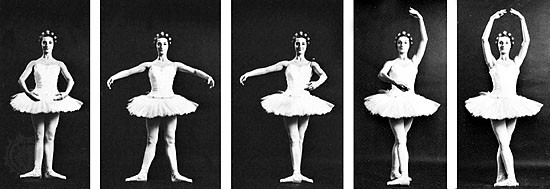
It’s been a month since I realized that my 2014-2015 school year was going to throw me for loops, spins, twists and twirls.  And while I am by no means a self-proclaimed ballerina; I’m smiling, pointing my toes, and pirouetting with the best of ’em.  Because when the music starts the core needs to be strong, the back straight, muscles tight, and breath steady.

As I stretch daily, as all practicing and proficient ballerinas do, I prepare to move in ways that are brand new; ways in which I never thought my body knew how to.  Legs outstretched, arms over extended, and of course…hair tightly wrapped in a bun – not one hair out of place.  Grace and elegance: the aspiration of all ballerinas.

Ballerinas and educators.

And while ballerinas make their every move seem effortless, the reality is that every motion is executed with deep thought and delivered with exact precision.  The bar is set wildly high and only the best of the best can gently thrust their leg onto that bar as fingertips reach for and surpass beautifully pointed toes while bodies align with a diagonally extended leg.

But, what about the ballerinas who approach the bar with a “Hrmph!” and a stubborn knee that won’t align with the rest of the leg and an unmaintained balance as a ‘steady’ foot is anything but?  And that sleek bun?  That bun has come undone and wisps of hair are continually getting caught on eye lashes and tickling cheekbones refusing to cooperate.  And no, you cannot move your hands from First Position for a moment’s reprieve.

Focus.

When we continue to throw on our tutus and ballet slippers and head straight into the studio before the sun has risen from its slumber: We are not giving up.  We are wrapping our bruised and bleeding toes accompanied by “Ouch!” and “Arghh!” but, we are not giving up.  We are placing even more bobby pins in our hair in hopes that today will be the day we are not tempted to twitch out of First Position.  Today, we stretch just a wee bit further in reaching for our little nubby toes.

As we wiggle and wobble…biting our lower lip oblivious to this false stability…we realize that our calloused hands are resting on those little nubs we’ve so desperately been trying to reach for weeks.  Yes, we are now touching our toes.  Wait.  What?  We did it?

I want to show you something.

Amazing isn’t it?  A young man in my Social Justice and Student Voice course was not willing to explore his 35-60 word biography (modeled after Visa Go World commercials) as it applied to his life.  But, he was willing to explore a puzzling injustice that he firmly believes has a feasible solution.  And his questions.  I could most definitely learn how to shape Essential Questions by conversing with this young man.

I’m still aiming for balance.

My knees are still a little bent.  My tutu is sometimes on backwards.  But, there’s hope!  While the majority of students were actively engaged in chronicling a moment in their lives, one student decided he needed to do things his way: focused, dedicated, and with a little pizzazz.  Is that not what the art of ballet truly encompasses?

As I continue to learn the intricacies of this art form, I take pleasure in exposing students to it as well.  We dance together…sometimes in beautiful unison and well, let’s face it, other times as if we’re all petit sauting to a different tune.  That day, this tenacious student decided to wear sneakers to ballet practice.  And, I’m so glad he did.


Getting Students Hooked on Poetry

“Poetry is boring.”

“What does poetry have to do with anything?”

“What does poetry even mean!?”

“I hate poetry.”

Poetry is a timeless form of writing, yet students struggle to see its relevance to their lives.  Further, they struggle to understand the themes and messages poetry attempts to communicate.  After weeks of asking them to read like writers, my students did begin to find some value in poetry, but they still didn’t like it.

Thus began my endeavor to present poetry as exciting, interesting, and most of all–fun.  What follows are three poetry activities my students were engaged and challenged by.

IMG_5382Spine Poetry

Creating book spine poetry is not a new concept–it can be found all over the internet.  I first got the idea to do this activity in last year’s UNH Literacy class with Penny Kittle.  Not only does creating spine poetry get students playing with language, it also exposes them to a wide variety of titles.

I modeled the creation of a spine poem for my students, stacking and re-stacking titles by John Green, Max Brooks, Jon Krakauer, Malcolm Gladwell, and more.  I modeled, with their input, until we had a poem that satisfied us.  I also showed examples of a variety of spine poems on the projector.  Then, students worked in groups to create their own spine poems, eventually writing their finished products in their writer’s notebooks after adding punctuation and a creative title.  I noticed many of them adding new titles to their what-to-read lists, too.

IMG_5332Cemetery Poetry

Edgar Lee Masters’ Spoon River Anthology is a wonderful collection of poems inspired by graveyard epitaphs.  Lives and legacies are explored in Masters’ work in a variety of styles.

I wanted to have students practice imitating this poet’s craft, as he is a master (pun intended!) of showing, not telling.  We have a beautiful old cemetery quite close to our school, and it was a gorgeous September day for a walk.  My students toted their writer’s notebooks to the graveyard and we read three of Masters’ poems together.  I asked students to wander the cemetery and find a gravestone that appealed to them, then imitate one of the poems we’d read, using that headstone as a subject.  My boy students especially loved this assignment–they were drawn in by the quiet atmosphere of the cemetery and its prevalence of Civil War graves.

IMG_5125Spoken Word Poetry

Shane Koyczan, Taylor Mali, and Saul Williams have soared to YouTube fame with their spoken word and slam poetry performances.  They are forceful presences on stage, and their-in-your-face styles often hook my students.

Sarah Kay provides a lovely contrast with her soft-spoken performances, her clear voice spinning tales of love, motherhood, and femininity.  We read “Point B”, pulled out its richest lines, and hung them around the room.  There were eight in total, and students responded freely to these beautiful words on post-it notes in a silent discussion.  They wandered the room, sticking their responses onto their favorite lines, and then responded to one another.  Their close readings gave way to analysis as they challenged each other, left questions, and cheered classmates on.  Weeks later, a student quoted a line from “Point B” in a discussion–this activity had seared “this life will hit you hard in the face” into her memory.

Stacking books into spine poetry, imitating poems about gravestones in a cemetery, and silently discussing spoken word poems transformed my students’ perceptions of poetry.  Words that were once lifeless on the page came alive.  This week, they reshape their own identities and wear new hats as poets and writers–hats that, thanks to our poetry fun, are not as unappealing as they once seemed.

A Feedback Protocol for Revision Workshop

I didn’t mean to make them cry, but that’s what soul writing can do to a person. (Soul writing is what my students and I coined as the type of writing that rips at our guts, makes pools fall from our eyes, and leaves us lurching toward the door to “take a little break.”) We are only into the third week of school, and I tried a new protocol for feedback; something I learned at The Frost Place Conference on Poetry and Teaching, directed by Dawn Potter.

Giving honest and critical feedback to one another is difficult for many of my students. So afraid of offering offense, they either do not say anything, or they do the proverbial pat-on-the-back and mutter “good job.” I tell  them that when they refuse to be honest in their feedback, it’s cheating. They cheat their friends out of ideas that can help them grow. And that is what we want in a community of writers — we want everyone to experience opportunities to grow.

The tears today watered some tender little seeds. All afternoon I gushed about it to anyone who who listen.

We sat in a circle around the large table in the center of my classroom. Many students came to class without their drafts*, so I sentenced them to the outer edges and advised them to get their brains and their pens working. I told them to write silently, but they might want to keep an ear tuned to the conversations happening in the middle. If they did, they learned more than they could have from any one-on-one conference with me.

First, I explained that giving feedback can be a bit tricky. We want to be honest, but if we do not deliver that honesty well, we can cripple our writer. (I use the word cripple because that was my own experience. I’d spent months drafting a chapter for my book. I’d finally finished what I thought proved to be a powerful piece of writing. Then I asked a friend, someone I trust, for feedback. She gave it to me: honesty cloaked in sweet little daggers. When I read her comments, all my ideas crumpled, and my focus limped right out the door. I didn’t write another word for six months.)

The “I wonder ____” protocol is really very simple:

Those who offer feedback:

  • Listen carefully as a classmate reads her piece.
  • Think about ideas that might help her improve it.
  • Offer feedback that allows for the writer to “play with the possibilities” (Dawn Potter) by putting the ideas you have that might help the writer revise the piece into statements that begin with “I wonder ___”.

Those who receive feedback:

  • Read the piece loudly and with clarity. (Repeat if necessary.)
  • Listen to the “I wonder” statements made by peers and write yourself notes.
  • Try to just listen (This is hard because we tend to want to justify why we wrote certain things).
  • Play with these various possibilities while revising.


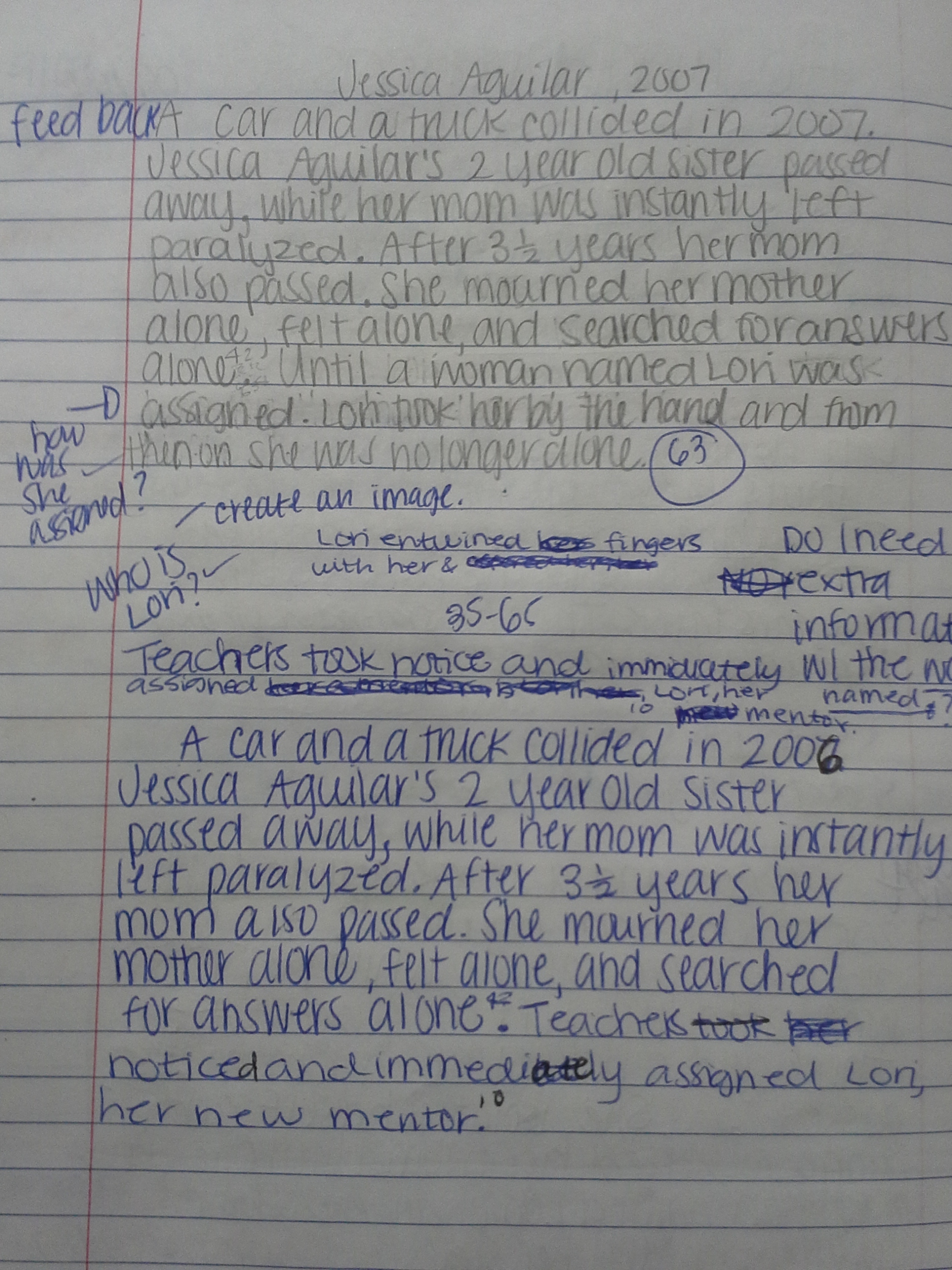
I asked for a volunteer to read her writing. Eyes darted all around the table until Jessica read her draft.

Jessica went first:

Jessica GoWorld story

Wow, right? She punched us right in the stomach, and we sat in silence. Finally, I said, “Okay, we’ve got some amazingly powerful stuff right here. How can we improve it?” and they looked at me like I had hornets on my head. I knew I better go first, or this feedback thing wasn’t going to work.

“I wonder if you need to tell us that Lori’s a woman,” I said.

Long pause.

“I wonder who ‘assigned’ her to you,” Mikaila spoke up.

“I wonder what she did that was so helpful,” Mariam said.

“I wonder how you survived,” said Daissy.

Jessica listened, answering a few questions, and taking a few notes on the comments her friends gave her.


And we were off . .


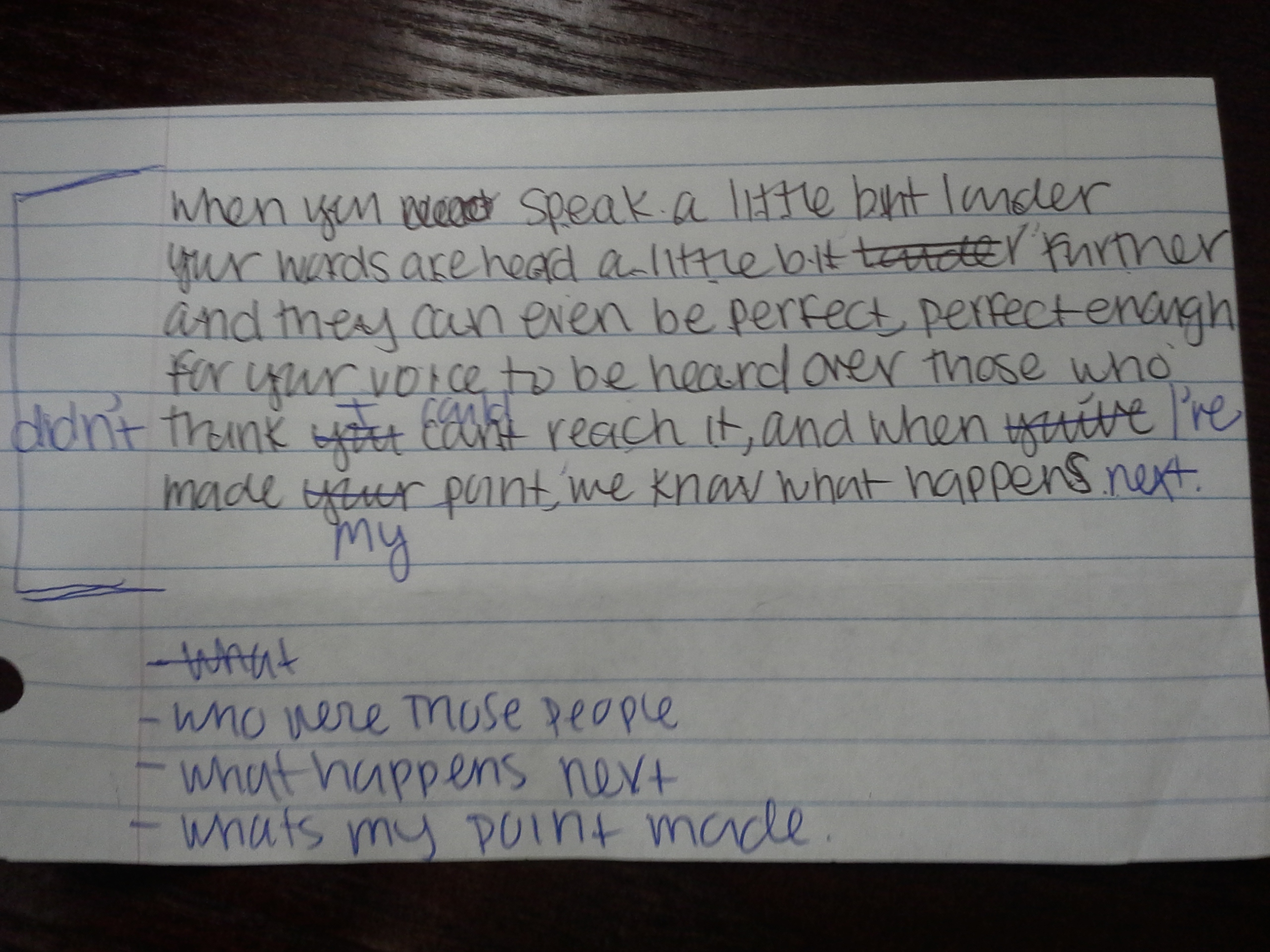
Daissy read next:

Daissy GoWorld story


“I wonder who ‘those’ are.”

“I wonder what the problem was.”

“I wonder what happens next.”

“I wonder what happened that made you change.”

And then Daissy could not remain silent any longer. She had to explain her stuttering, and how she’s worked so hard to overcome it, and how now wants to major in broadcast journalism and speak on live TV.

We forgot to preface our comments with “I wonder” when we all told her THAT is the story she needs to write.

revision corrections 2-7-12Feedback Magic happened with this “I wonder” protocol. And it happened in every class period, and so did the tears.

Students shared the honest writing from their hearts, and students gave honest feedback with tender and caring insight. Writing improved.

Even better? Imagine being in this kind of classroom with this kind of community of writers.

Heaven.


*Our mentor texts were VISA Go World commercials. I got this idea from an assignment I did at a class taught by Penny Kittle at the University of New Hampshire Literacy Institute. We watched several of the videos in class and discussed and analyzed the various structures of these very short, yet poignant, stories. Students were to watch and analyze a few more examples, transcribing the words to use as models for their own writing. Then they were to write their own, playing with word choice and syntax.

My Life Is My Message

ocs

Mahatma Gandhi once said, “My life…”  

Nope.  Run-of-the-mill.  Try again.

“My life is my message” is a phrase many hear…

Oh absolutely not!

The pacifist we have come to know as Mahatma Gandhi has eloquently proclaimed, “My life is my message.”

Hmm…getting there…


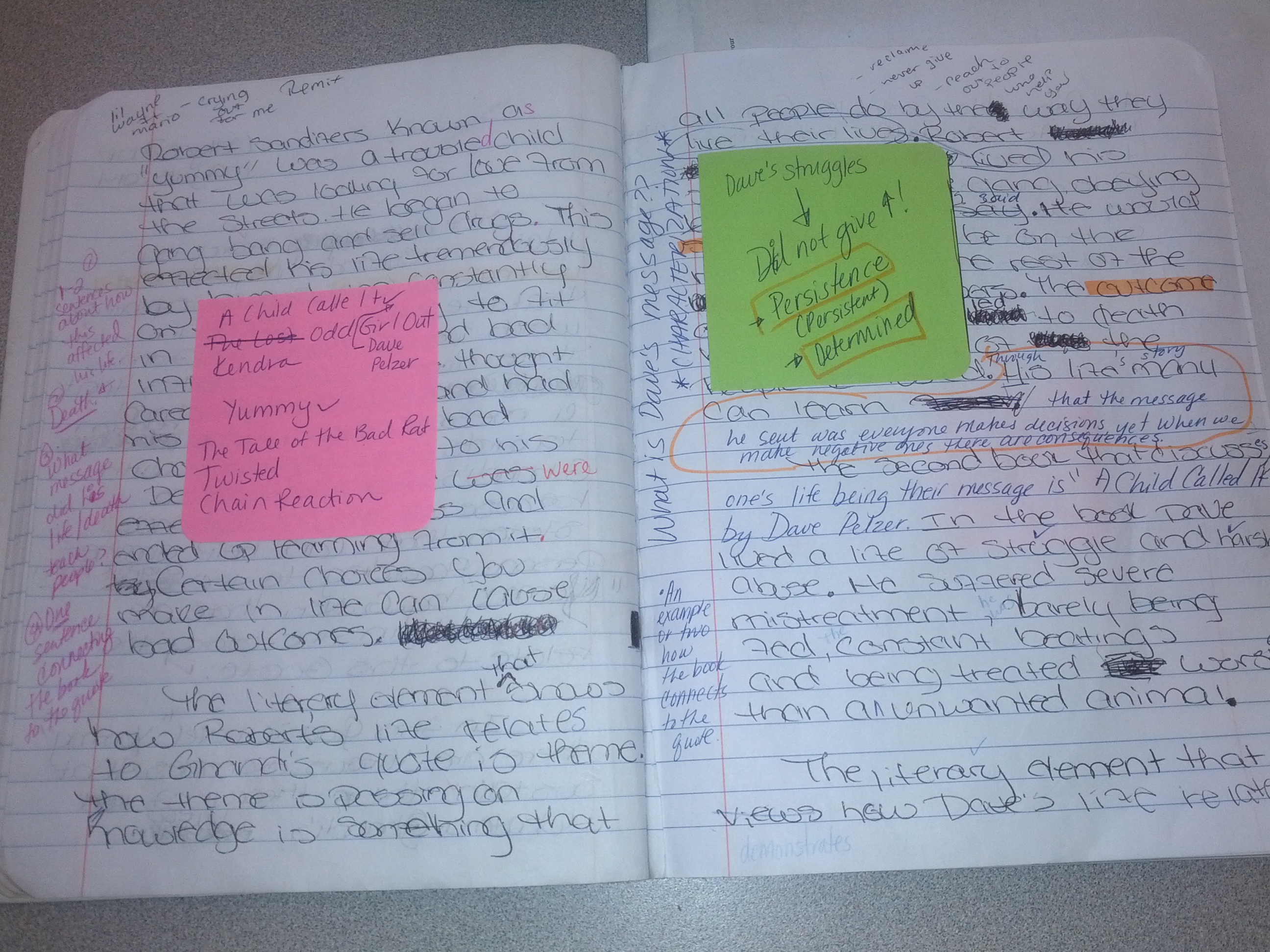
Welcome to the most recent Writing Workshop’s task taking shape in room 382.  As we gear up to wind down as the end of the year approaches, we have taken hold of a striking quote and are playing with it with fervor and inquiry.  Students know, in under a month’s time, they will inevitably be greeted by the New York State ELA Regents.  Yet, we’re operating as though it’s not about to happen; you know…it’s going to happen to everyone else, and of course we wish them all well, but us testing?  Nope.  Not going to happen.

We are exempt.

We are not preparing for an exam.  We are not losing sleep over this literary element or that grammatical rule.  We are not counting the supposed seven sentences assigned to every paragraph or where to locate the anxiety-ridden answer to #23. We don’t care if our pencils aren’t sharpened to perfection or how 33.7 seconds should be allotted for each multiple choice question.

Instead.  We are writing.

We are researching, connecting, analyzing, and sharing our insights.  We are using Gandhi’s autobiography and other written works that were created solely for us; for us to explore Gandhi’s magnificent brilliance.  We are using other pieces of literature that connect to this sentiment that yes, “My life is my message”.  We are using literature that we’ve highlighted and annotated (to the point where the next reader is going to have to try to find space on these pages to do the same – good luck!).

A student said this looks like a 'piano of ideas'.  I couldn't agree more.

A student said this looks like piano keys full with ideas. A tune we enjoy playing.

We are not allowing ourselves to get caught up in the ardency of the testing hoopla.  Instead we are reworking introductions, continuing to fill our door of completed literature, laughing a lot about students renaming book titles we’re enjoying (gone is The Freedom Writer’s Diary, to stay is The Freedom Writer’s Craft)…  I am sure, at this point, those who have fully emerged in test prep have started biting their nails, twisting and tugging at their hair, and maybe even pacing as they continue to read this piece through the slant of a squinted eye.  I understand.

I do.  Really.

It wasn’t until this year that I shifted a vast majority of everything I do in my classroom…with my students…in my own head as I reflect.  I was the educator who believed in preparing students, even if it meant solely for an exam because it’s always been rooted in support and wanting students to be successful.  I am still that educator that believes students deserve success on exams.  Yet, this year I want them feeling success on their exams because they feel creative freedom while still being locked into the three-hour time constraint.  I want them to smirk while exploring their craft as they connect literary elements to the exam’s text; and not feel as though they need to lose a sense of who they have become as beautiful readers and writers.  Mostly, I want them feeling confident that this year’s dedication to enhanced reading and writing is shaping how they look at the world; exam days not exempt.

Naturally, students’ anxiety about testing still surfaces, but this year, it remains there – on the surface.  Students still have test specific questions, ones I acknowledge briefly and then move on…(deciding between four topic sentences is way more fun!)  We still game plan so students know what sections they are going to attempt first…or last.  We talk timing.  We do all of that.  We just don’t let it consume us.

And because we don’t, I have thrown away all structured writing graphic organizers that I used to believe supported students in elevated writing.  Students are approaching their writing in ways that provide us all moments of pulchritudinous pause.

Every inch utilized with ideas..thoughts...movement.

Every inch utilized with ideas..thoughts…movement.

Students use varying angles in which to deliver a quote’s message and are demonstrating alternate ways on how to enter into that analysis with a fresh perspective.  It is through this exploration that students have challenged me to educate with new insight.  Our commitment to the process; pushing ourselves beyond boundaries; and most importantly, our collective energy still provides each new day with an exhilirating thrill.

From our classroom to yours, we wish everyone the best as the end of the year exams approach.  We wish you continued laughter, reading, and much writing.  And don’t forget to have a tremendous amount of fun along the way.  We are.

What ways are you fostering the joy of reading and writing with your students during this stress-inducing time of year?


Final Days, Final Products: End-of-Year Assessments

This week, the first of the fourth quarter, has flown by for me–has it for you all?  Perhaps I’m feeling the passage of time because of making end-of-year lesson plans.  Maybe it’s because of the spring sunshine and storms.  Or, it could be because I’m looking into summer course offerings at UNH, the NWP, and our nearest university, WVU.  Whatever the case may be, I am acutely aware that I don’t have much time left with my fabulous students this school year.

Since that is the case, I want to give them opportunities to showcase what they have learned and how they have grown.  Of course, I want a unique, rigorous way for them to show me this, so I’ve been designing some workshop-appropriate final assessments for my students.  The abilities I am curious about are their independent reading, their informal writing, their reading of difficult literature critically and deeply, and their crafting of excellent, time-intensive writing.

My goal at the end of the year is that students can read a variety of texts independently, can think and speak critically about those texts, and can choose and recommend a variety of books for themselves and others.  To see whether they can do this, students will complete an independent reading project that includes a craft analysis of the writing itself, a creative portion in which students show their comprehension of deep layers of the text, and a presentation of the project overall in which other students and I ask questions about the book.  Additionally, students will do their own booktalks, in which they recommend a text to the class, perform a fluent read of a short bit of the book, and discuss their own reading experience with it.

IMG_2769In terms of quickwrites, or the informal, fluency-building writing we do at the beginning of every class, I want students to be able to understand and show their own growth with this type of writing over the course of the year.  I do this by having them do a final “Journal Harvest,” an excellent idea I got from NWP mentor Sally Lundgren, which we’ve also done once or twice a quarter thus far.  In this harvest, they read over all of their writing from the year and write a formal reflection about its growth, content, and style.  Additionally, they choose three pieces to revise and draft into formal, typed pieces.  Lastly, they share their notebooks, reflections, and revised final pieces with their writing groups in order to give and get feedback.

mikeyburton-bookcoversWe’ve read two class novels so far this year, and for the final part of the year, students have chosen from a variety of books to read in literature circles.  Being American Literature, I booktalked the standards Fahrenheit 451, Huck Finn, The Scarlet Letter, and A Separate Peace.  Students chose which of those they wanted to read and have been collaboratively discussing, interpreting, and completing tasks related to their reading in groups.  To share their understanding with the class and me, they will complete creative projects in groups, as well as write a formal book review they’ll publish on the wonderful GoodReads.

IMG_0799Finally, the Multigenre Project will show off my students’ abilities to write, revise, and refine formal, coherent writing.  I have already discussed the way I teach the MGP extensively elsewhere, so I’ll be brief here.  The MGP allows for student choice, curiosity- and question-driven research, frequent talk in writing groups and through final presentations, and rigor.  To my mind, it’s a perfect culmination to a year of workshop, and I can’t wait to see what my students produce with it.

In true teacher-participant form, I will be doing all of this beside my students, and I am quite looking forward to the reflection time this quarter’s modeling will allow.  I’ve already begun the process we all go through at the end of the year, in which we start to wonder what we’ll change in the future and what worked wonderfully that we’ll hang onto.  In reflecting, I find my thoughts and writing returning again and again to the power of talk.  Its deliberate addition into my curriculum this year has been the biggest change from previous years, in which student talk used to be in a space reserved for group work, presentations, etc.  This year, though, student talk is at the center of my teaching, and I think it’s made an incredible difference in my students’ ability and willingness to learn.  I’ve consciously included it in all of my final assessments as a result, as it’s been where I’ve learned the most from my students.

As you can see, there is a lot of grading, planning, and facilitating in my future, but I think it will be well worth the effort…and enjoyable to boot!  Here’s hoping that my students will learn as much from each other in these final weeks as I’ve learned from them all year.  Cheers to the fourth quarter, all!


bandz Remember these? Silly Bandz. A few years ago they were all the rage with my middle school students. They simply couldn’t get enough of them. I remember one student that proudly displayed hers, coordinated by color, from wrist to elbow. One day at school I was called down to the office and asked to cover someone’s after school tutoring class. Of course I obliged, but when I showed up to a room full of less than eager writing students I immediately knew that six page packet of worksheets I was left to work with was NOT going to cut it. I began scanning the room for a plan B. There always has to be a plan B somewhere, and sure enough I found my alternate plan on the very arms of the students in front of me. I ask the students to pull off one of the millions of bands they had on their arm, and kindly requested several to share with the students in the room whose arms were not enslaved by the bands. I asked them to then find a partner who didn’t know what band they had picked. The pair then had to start describing the band they had selected to their partner using enough details that their parter would be able to guess what they were describing.

Without the students knowing it they were having a conversation about descriptive details.

From there we continued doing a number of activities with their beloved bands. We concluded by writing stories where they had to incorporate the band’s object into their stories.

Students had a great time. They were laughing, and talking about not only their prized Silly Bandz, but also the craft of writing. In fact, they were having conversations about the same things they would have been doing mindlessly in the packets I was left with. The only difference between my activity and the packet was that my activity capitalized on something that was near and dear to those kids, the Silly Bandz, and connected it to back to what they needed to learn.arm

As quickly as they rose to fame, the Silly Bandz craze was relatively short-lived, so I’m not advocating that you start digging around and try to replicate this activity in your classroom – it probably won’t work. Kids these days have moved on to something else, but it is the idea that we all need to capture. How can we take something that is important and on the fore font of our students minds and bring it into the classroom? By doing so teachers send a simple message: “I care about your life outside of this classroom and I want you to share it in here.” When students hear this message they are much more apt to taking the time to learn whatever it is that you want to teach them. I leave you with this: What is currently the craze for your learners? What might you be able to capitalize on in order to have your own Silly Bandz moment with your students?

Tu Eres Mi Otro Yo

ocs While recently in the throws of February break rejuvenating away from the hubbub of the city in the quaint beach town of Montauk; Malcolm X and I were becoming intimate acquaintances.  We had been for quite some time, actually.  But it was here that I really started questioning him, his motives, and his overall sense of dedication to any cause he finds justified.  As I was making direct connections to my own beliefs and passions, my pen went haywire.  There was, by no means, enough blank space on the pages of this autobiography for my own thinking.  Out came the post-its.  The power button on the iPad came alive and my inquisition and deep thought went ablaze.  While X and I could not be more different human beings the ideal of commonality among passion elated me.

Later that very same day, I was introduced to Dr. Jeff Duncan-Andrade’s invigorating message that immediately added even more fuel to my already-burning fire.  From the moment I pressed play (thank you, Apple TV) I was captivated.  Jeff is an outstanding educator who believes there are three kinds of hope: material, critical and audacious.  He believes that our [urban] students are roses growing in concrete.  I mean, the city has always been referred to as the concrete jungle!  In order to really grasp the intensity and genuine love Jeff exudes with his message, you’ll have to watch for yourself.

There I was, hours away from the city and my students, yet never have I felt so connected.  X’s passion exudes from his autobiography; Jeff’s passion seeps through his pores as his care is so loudly presented; and my passion was turning up the waves in the ocean right outside my window.

On my drive back to work that first Monday morning after break, I made a promise to myself.  I promised to stay true to my passion and invite the new found passions I discovered to reside within me as well.  My focus was by no means on the road, it was zoomed in on Jeff’s mantra: Tu eres mi otro yo! (You are the other me!)  How could it not be?  How could I not be heading back to room 382 thinking, “Students, you are my reflection…you are what I see when I look in the mirror.  We are one.”?

As I headed into our building, my mind automatically trained itself on a female student that I have been working with for six months, but have yet to authentically connect with.  Today was the day that was going to happen.  The day had not begun, but I was sure of it.  I was sure of it because I was going to channel all of the passion, intensity, and love I gathered over the break and pour it all over this student.  I only hoped she wouldn’t mind!

As independent reading commenced I asked this student to join me with her new book, highlighter and pen.  It was a piece well below her reading level (as is typical of her reading selections), but the premise captured her attention immediately: females making decisions based on their desperate need for belonging among other female peers.  There’s no wonder.

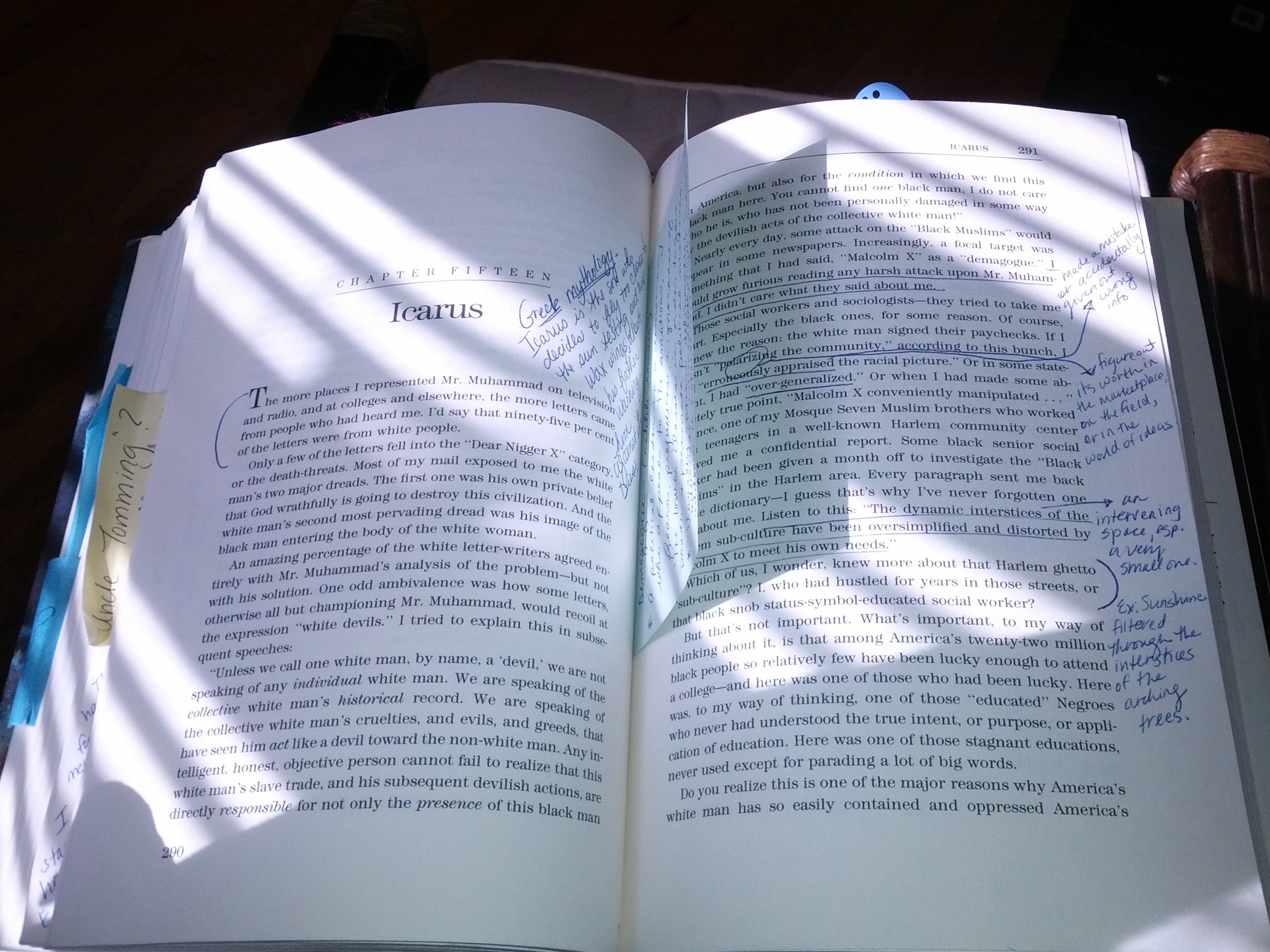
X followed me to class that day, in many regards.  As I put my chosen piece of literature on the table, a ‘huh’ surfaced from this female student.  I opened to the chapter titled Icarus.  IcarusI asked her if she knew what the title meant and the following is the dialogue that surfaced:

B: Nope.

Ms. B.: Neither did I.  I decided I wasn’t going to go any further into this chapter until I understood what this name resembled.

B:  Huh.

Ms. B.: So, I took to the internet and realized Icarus is the name of a Greek mythical figure whose father warned him of not flying too close to the sun with the wax wings in which he created for him.  But, he did.  And he fell straight out of the sky.  Can you imagine?

B: Wow.  Huh.  That’s interesting.

Ms. B.: Isn’t it?  Then, check this out…(I flipped to the last page of the chapter.)  Read this last sentence.  (B does.) Do you see it?

B:  Whoa.  It connects to the title.  It explains what you just did.  (Smile)

And it was at this moment, that the gathered passion, intensity and love I poured all over this student started to work its magic.  Because here’s what happened next:

B: Ms. Bogdany, how do you know what to highlight though?  I never know what to say — I mean annotate.

This may seem like a simple (and potentially expected response) but after working with this student since September, this was the very first time she was confident enough to be vocal with her inquiry.  From there we opened her book (with much fervor) and highlighted a portion that she noted.  I asked her what it meant, and she started to explain it…and, in her book, I wrote down her thoughts.  I then asked her about her own ideas regarding this concept, and (with the longest response to date) she explained her insights about the decisions the main character is making.  So, again…I scribed.  We discussed.  I annotated.  She smiled.

Ms. B.: Do you see it now?

B: Hahah.  I do.  It…it makes you understand more.  Thank you.

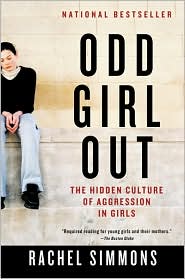
Before she left to resume this process solo, I pointed her in the direction of another female student who had just started reading:                                                                          Odd Girl Out

I explained the premise of this piece.  She raised an eyebrow.  I mentioned that when the other student was done, she may want to engage with it as it’s the same concept that envelopes her piece, yet it’s an informational, non-fiction piece.  This piece is more level appropriate for her.  Same concept, different genre, enhanced level.  We’ll see.

In the meantime, I noticed during the rest of our two hours together that day, B’s book kept finding it’s way back onto her desk; her highlighter was incredibly busy; and her pen was relaying her inner voice on those very pages that previously would have remained untouched.  And instead of refocusing her on the day’s lesson and activity; I whispered internally, “Tu eres mi otro yo.”

haLfwaY tHerE

ocs

The buzzing alarm clock that startles you out of sweet, sweet dreams into the darkness of your frazzled morning is by no means friendly.  (BUZZZZZ…)  Open your eyes.  Quickly!  The abnormally freezing cold of winter; the unimaginable storms that continue to blanket our front lawns and backyard swing sets; the must to have snow boots handy at any given moment accompanied by a shovel and ice brush are in need of your attention – immediately.  The closed-eyed shower.  Fumbling and bumbling around while simultaneously getting dressed, blow drying your hair, making coffee all the while trying your darndest to remain quiet as to not wake other household members is…

Well…quite frankly…getting old; quickly.

The harried morning commute – windshield wipers flailing against the hail and tires shifting in the opposite direction to protect you from skidding– allows you to greet your students (with a smile, but of course!) on yet another cold and unpredictable winter morning.

You made it.

I made it.

We made it.

We have all made it to the half way point of our school year.  Students have pushed themselves in ways we could not have anticipated.  Educators have moved through obstacles with grace and poise.  Administration is pushing harder than ever.  Mother Nature has joined the club.

In the vein of reflection, doesn’t this seem like an integral point to stop…reflect…plan…and dig deep to find our reasons for trailblazing forth?  I think so.  So, here’s what I’ve been doing to keep warm during a brutally chilling winter:

To warm my HEART: I stop planning.  Aside from lesson plans, I have no plan.  I realize that when I stop planning every minute of my day, the most beautiful of moments surface.

From a quick drop in (“Just checking in, Ms. Bogdany.  You good?”) to a first-time-independent-reader so engrossed in Hill Harper’s Letters to an Incarcerated Brother he insists on marking pages to share with me as he passes by during the day.

From a very simple high-five in celebration of a special moment to a poet sky writing his inner most thoughts regarding his hometown.

Sky Writing

See the island of Manhattan, smaller borough
Back on Staten
Cross the county of the kings, then you make your way
to Queens…..

From a post-Regents philosophical discussion about Malcolm X’s beliefs and convictions to a colleague swinging by with, “Your previous Multi-Genre Writing students insisted that Ashlee, whom you didn’t have, show you her creative writing piece because it’s astounding.  They wanted you to see it.  Here it is.”

If my door was closed and my agenda had continued to take control of my day, these beautiful moments that inspire me, would be lost.

To warm my SOUL: I read voraciouslyI live in a sea of literature.  From gathering books from the laundry room’s shared library to the continually growing Francis Gittens Lending Library; I am never sans a book.  Often, I am juggling a few and that includes my new found interest with audio books.  From Room 382 to Apt. 2 (whether themed by topic or color) my soul sings in the presence of literature.

Books Everywhere

New books on display. Students love working among literature…lots and lots of literature.

Rainbow Library

Welcome to my rainbow library. It continues to grow with pieces I’d never imagined would find their home here.
(Feel free to click on the picture to take a peek at the titles.)

And really, what better way to keep warm (during this winter full of icicles) than with a book of choice; pomegranate spice scented candles; and blackberry-vanilla decaf tea?

To warm my MIND: I ask for help when I know I need it.  Yup, pride aside.  Wild, I know.  While I try to be all things for my students, there’s a reality.  And that reality is simple – no one educator can be all things for his/her students.  So, we must find those we trust, branch out, ask for a helping hand and push forward together.  It would be an injustice to not bring them into my ‘teaching loop’ to help motivate and encourage each student they’ve built trust with.  I need them to show me the way.

I also reach out to my PLN, no matter how far, they are always there to help guide, attempt humor, and support in soulful ways.  Their insight and guidance is always a surefire way to refocus my attention to the authenticity of educating.  Of this I could not be more grateful.

So, while we are all bundling up this winter and trying our very best to remain focused in-spite of the blistery weather – which does not seem to be going anywhere, anytime soon – we have much to celebrate.  We’re halfway there!  And instead of looking toward the finish line, let’s all take a moment to enjoy the snow filled scenery and the halfway mark.  It really is a warm place to be.

snow

It’s warm in here! And so beautiful out there!