Category Archives: Writers Workshop

Say it Ain’t So! Poetry Can’t Help Readers with Non-fiction!

I know, I know. I write about poetry ad nausem.  Poetry has been a focus for me this year I’m constantly finding ways to fold poetry into my instruction all the time. I wrote about it here.

Don’t single me out; Amy included her own poetry thoughts in this post.

I’ve noticed that my students don’t connect their emotions to non-fiction pieces as well as they do with poetry.  That’s unfortunate because real world issues should elicit an emotional response…but in most cases they just don’t.  I think its important, in literacy instruction, that we try to bridge that gap.

Recently, I found an opportunity to integrate a little poetry with some non-fiction.

One of several non-fiction pieces that I brought into the classroom was this one from the New York Times written by Carl Wilson. The piece talks about Rupi Kaur and her popularity compared to those who published poetry before the avalanche of social media.

Our focus was not only to look at these non-fiction pieces in order to see the moves that authors make, but also read with the thought that we could respond to the articles in the form of a Letter to the Editor.

I chose this response format because I saw that it might facilitate and opportunity for us to talk about citations, embedding quotes, and responding to nonfiction in a way that might appeal to my students.  Not only did the student struggle to connect to the pieces, they struggled to keep their eyes open the first time they read through.

Not coincidentally, the poem of the day was by Rupi Kaur herself.  It was about how when we let go of someone to whom we are connected, it can be cathartic. At least thats what it means to me.
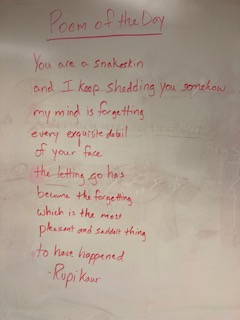
 poem

(I know its hard to read, but I hand write the poem on the board every day.)

I invited the students to respond to the poem in one of two ways: either by using the poem as a mentor text that could engage their poetic thoughts and help them write a poem of their own, or by responding to the poem about how it makes them feel or think.

We group talked our emotional reactions and shared how so many of us could relate to the poem.  Most of us connected with it in some way, but we discovered that those connection vary widely from person to person.

The next day, we came back, read the articles, began our letters to the editor, and completely failed to connect with the pieces on an emotional level.

There had to be a way to show them that we can have an emotional response to non-fiction. So, in a move stolen directly from Kelly Gallagher, I wrote a model Letter to the Editor in which I roasted the author and his article for being wrong-headed and totally missing the point of Rupi’s poetry.  The students perked up as we went through my example noticing elements like formatting, structure, embedded quotes and properly cited sources. Most importantly, they saw how I was able to show an emotional engagement with another author’s non-fiction piece.

We brainstormed some reasons that they struggled to make the same connections to non-fiction and talked about how they can have the same kind of emotional reaction across genres.

By the time we ended our discussion, they blasted off on the trajectory of writing their own letters to the editor, providing blistering commentary or thankful praise to writers they’d never even heard of before.

The writing I read was authentic, heartfelt, and emotional.  Something about weaving the poem and the article about the author of the poem allowed them to carry that connection to other pieces and release their feelings in a way that showed a real connection to something they otherwise would not have paid a second glance.

What I was reminded of once again, was that this isn’t about non-fiction texts or thoughtful poems.  It was about the students embracing their potential as writers and having the confidence to express their voice. This is a lesson that I’m sure I’ll have to learn over and over, but I won’t stop treating students as writers, even when they don’t believe that they are. 

 Charles Moore fell in love with Sing, Unburied, Sing by Jesmyn Ward and no one has seen him since.  Rumors persist of sightings out in Phoenix and even San Francisco. Please visit his hourly musings @ctcoach or visit his instagram account @mooreliteracy1.

Three Ways of Looking at a YouTube Video

If your kids are anything like the ones in my life, both at home and at school, then they love YouTube. When I ask them what they watch, they list names of YouTubers.

At first, I scoffed at this medium that seems to absorb all their energy. Then I started noticing something.

IDEAS

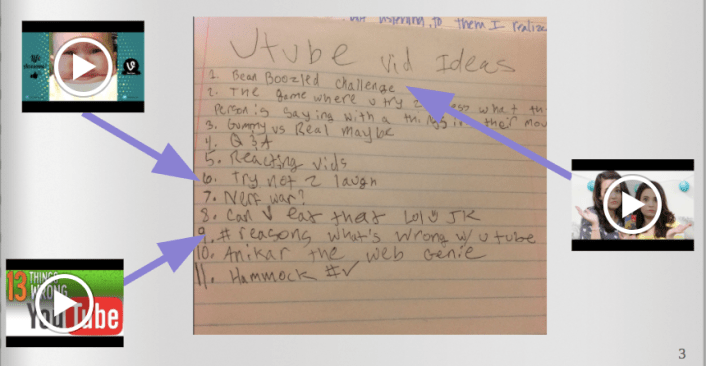
It started last summer after I kicked my three kids outside to play. They were writing in their notebooks furiously. Being my nosy self, I peered over their shoulders.

My kids, who are wonderfully, beautifully average, were planning their upcoming YouTube “projects”. They’d found an old digital camera and had been making videos (but not yet posting them anywhere). Upon further inspection, I noticed that many of these videos ideas were inspired by ones they watched endlessly on YouTube. They were using the texts they love as a way to generate ideas for their own composing. Further, they were using YouTube as a mentor text.

Screen Shot 2018-03-07 at 10.59.29 PM

They reminded me that often when I use mentor texts in my own instruction, I want students to use the mentors to generate their own ideas. Whether we read The Important Book by Margaret Wise Brown, or an essay about Hermione Granger in The New York Times, I want student writers to use those texts as launching pads for their own thinking around topics. I know that one of the most important things that writers do is choose topics that inspire them. I also know that doesn’t happen by accident or chance or magic. We have to teach students how to find their ideas and mentor texts can help us do that.

STRUCTURE

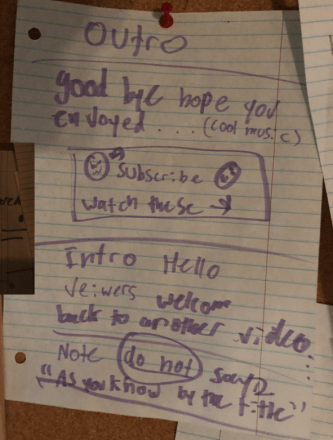
A few months later, my 10-year-old son started his own YouTube channel. One day I walked into his bedroom where I saw his bulletin board covered in notes. He had created a vision board about his channel where he posted a criteria list focused on what Screen Shot 2018-03-07 at 10.58.07 PMhe had been noticing in other videos. Upon further inspection, I noticed he had also created a template for a video. He was making note of the patterns in the videos, his mentor texts. He paying attention to the structure of a video, to the introduction (the intro) as well as the conclusion (the outro). He also made notes about what not to do.
Jacob’s work around structure reminds us that another way of looking at mentor texts is through the eyes of organizational patterns. When we ask students to notice how something is built, we invite them to create possibilities for their own writing. I want my students to read like writers and to make choices about the way they might structure a piece of writing. Mentor texts help us create a vision for doing that and they empower students to uncover those possibilities themselves.

CRAFT

As Jacob’s gotten better at making these videos, I’ve noticed that he’s also gotten better at the craft within the videos. He and his younger brother Justin decided to launch a series together (of which they’ve only made one episode). When I watch just the first minute of the video, I notice the way they use their voices and gestures. I notice the way they set the stage, displaying the title. I notice how they have clearly rehearsed what they’re going to say. These are all things they’ve picked up from watching their favorite videos, from studying the mentor texts. They identified nuances that add voice and flavor to the text, and then they tried it

Their attempts at incorporating these moves reminds me that another way to consider using mentor texts is to think about the ways we can teach students to read like writers. When we teach students to hone in on the craft moves a writer makes and to think about the purpose of the moves, they can start to think on a granular level about their own writing. The next step is to try those moves out in our own writing.

WHAT DOES THIS MEAN FOR OUR TEACHING?

As I notice the way my own kids have become immersed in these texts, I can’t help but think about how this relates to my own teaching using mentor texts. It’s not enough to show students a text and say, “Okay, now do this in your own writing.” We know that doesn’t work. Instead of becoming frustrated that kids don’t “get it,” I want to instead use  mentor texts with intention.

Using mentor texts is also a process. I can’t expect for students to be able to look at a text and consider ideas, structure and craft all at once. I have to carve out time for students to be able to work through the different ways mentor texts can support them as writers. I have to teach with intention so they can write with intention.

When I consider immersing students in the kinds of writing that will help them grow as writers, I want them to have the same kind of authentic experience as my kids did. As a teacher, I also want to lean in to exploring all the ways mentor texts can look in my classroom — anything from YouTube videos to essays to infographics can help nudge writers to think about how to generate ideas, how to make choices about structure and how to develop their craft.

If you’d like to learn more about finding mentor texts, you can check out this smart Mentor Texts Are Everywhere.


Research In Search of a Claim

Why do high schools feel compelled to create their own “headings” for how students should format their papers, in spite of an English curriculum that calls for teaching MLA style? Oh, never mind. Put like that, I can see that this contradiction is in line with what we are tasked with every day in our classrooms: to machete through convoluted curriculum standards so we can lead our students to some real learning. This particular contradiction usually preempts any teaching energy I might have at the beginning of “The Research Unit.” As I plan, I am haunted by images of students typing their research questions word-for-word into Google, scrolling aimlessly through search results based on what they are most likely to click through to infinity, and finally just quoting from Wikipedia or that first Google blurb (attributed to “Google” and a 400-character URL in a triple-spaced Works Cited page presented in a hodgepodge of fonts from the cutting and pasting). Sigh.

It’s not their fault. This work can be rather uninspiring. Last year I tried to shake things up by offering another option to the traditional research argument: Students could compose a “research narrative” by using story form to trace their process of developing a claim. I spent hours developing model texts and elaborate instructions, devoted precious class time to comparing the two forms and creating anchor charts. Students dutifully complied with this. They complied again by completing a traditional research paper filled with information they mostly already knew or will have quickly forgotten. I dutifully (and wearily) returned papers filled with equally uninspired feedback they may or may not read and a grade that left me feeling morally compromised. Sigh.

So … no. How can we get away from Google as a first-resort and turn instead to our own minds — and each other — as we develop topics? And how can we make use of all the writing work we have already done and blend it with the research “unit” so that it feels less like a “unit” at all? Where can we look for topics that might inspire some meaningful, lasting learning?

Instead of starting from scratch, I had students turn back to their “Writing Territories,” the areas in their lives and in the world they identified earlier this year as potential writing topics. (Nancie Atwell is a continued inspiration–“Writing Territories” comes from Lessons that Change Writers). I modeled using my own territories to extract 1-2 potential research topics, and students did the same. I wanted to develop a sense of community and investment in each other’s topics, so I adapted an activity from Kelly Gallagher’s Teaching Adolescent Writers: 

  1. Students write their topics at the top of a piece of lined paper and pass the paper to the person on their left.
  2. This person reads the topic and writes one open-ended question about it.
  3. Papers continue around the room until each student receives their own paper back.

Even just this movement was energizing. After some initial fumbling, papers began moving through the room (almost) smoothly. Even better, students began talking to each other about whose topic was whose, and competing to write obscure and original questions to “stump” each other. Students took their own papers home, and were tasked with thinking through the questions and deciding on a few focus points within their topic in order to move forward.

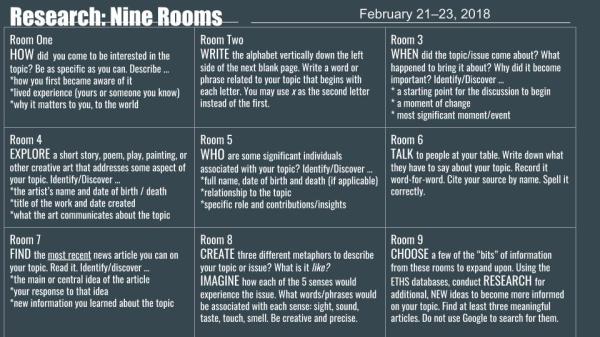
So, this was fun and students had a bunch of interesting questions to explore. But that vision of students typing those interesting questions into Google still loomed large. I felt they still needed more of their own entryways into their topics, entryways into authentic thinking beyond search engine results. And as usual, I borrowed. This time, I adapted a poetry exercise from Georgia Heard: the 9-Room poem. I asked students to move through “9 rooms” of preliminary research that I hoped would lead them to consider their topic in terms of themselves and their own worlds.

Research_NotebookPrompts

My intention was for students to move through the rooms to establish a basic foundation of information (rooms 1, 3, 5, 7) and to explore their topic through a more creative lens (rooms 2, 4, 6, 8). As with the question swaps, perhaps the most valuable outcome of this exercise was the conversation it generated around the room. Students are talking about their topics with each other, even excited about being quoted in each other’s work!

So, here’s where we landed for now. Stay tuned for student examples as we move through this process toward formulating a claim. And, of course, proper MLA format.

Why It Matters

An enormous part of my teaching philosophy is centered around teaching students to question the “why” of what we learn. Not necessarily why are we learning, but why does what we learn matter? How does what we do in our classroom apply to their lives? I sincerely believe that if students cannot walk away from my class each day able to answer those questions, then I need regroup and question the purpose of my lessons.


pasted image 0Kelly Gallagher, a high school teacher in California, is an advocate for getting students to think critically, read deeper into various texts, and along with several other educational rockstars, structures his classroom according to the workshop model.

In his book, Deeper Reading, he discusses the “Say/Mean/Matter” chart as a way to make any text relevant to students in addition to helping them become critical readers and thinkers.

 I regularly use this strategy in several ways in my classroom which consistently provides me with opportunities to keep my lessons meaningful to my students. What I love most about using it is that it provides students with an opportunity to focus on what they are learning and why/how it matters. This also shows them that EVERYTHING we read, write, discuss, etc., has a purpose.


I recently completed novel studies with my students and was able to implement the “Say/Mean/Matter” concept with all 3 of my grade levels. In my experience,  I learned that I needed to provide more scaffolding for my younger students versus my Juniors who were more equipped to take the concept and run with it. It seems like the older they get, the more eager they are to share their opinions and challenge what they read.

For my Freshmen

Earlier this school year, I was fortunate to have the opportunity to attend a professional development session that centered around Kelly Gallagher’s Say/Mean/Matter strategy. I was able to scaffold this lesson by targeting specific pieces of the novel, To Kill a Mockingbird, a few at a time in order for students to focus on examples of social injustice. Over a series of impromptu class discussions and informal reading/writing responses to various texts about inequity, I broke each section of Say/Mean/Matter down so that students were familiar with applying this idea to various forms of literature. Once we reached the pivotal point in the novel, we completed this with partners they chose (and some they didn’t), using sticky notes to frame discussion.

This slideshow requires JavaScript.

From there, we completed our graphic organizer together using our stickies from the day before. Students were asked to expand on the ideas they came up with together. After modeling my discussion notes and conferencing with students, their responses clearly showed that these examples of social injustice meant something to them. It became more than just an assignment to them, it was a chance for them to safely explore, discuss, and write about opinions that mattered to them.

This slideshow requires JavaScript.

Eventually, this led to a Socratic Seminar that took us 2 full class periods to complete. Every student was engaged and ready to share their ideas and ask questions because it was relevant to them. Not only was this a chance for their voices to be heard, but they truly cared about what each student had to say and remained open-minded throughout the process.

A Small Snapshot

This was just one of the incalculable ways to foster relevance and meaning to students that perfectly aligns with the benefits of teaching through the workshop model. Now more than ever, what we do as educators is of the utmost importance. By building these moments of discovery into our lessons, we allow students to create and develop meaning for themselves. The students are our purpose. Our profession centers around helping them develop and unleash their potential. Once students realize what we teach has applicability and value, there is no limit to what they can accomplish.

I would love to know other ways you make your lessons meaningful and relevant to students in your classroom in the comments!

Gena Mendoza currently teaches Freshmen, Sophomore PreAP, and Junior English in Texas. She is passionate about teaching her students to use their powers for good and not evil in her classroom. When not pouring over any written or spoken word by Jason Reynolds, or preparing her family for their next Disney adventure, you can catch her Tweeting/Retweeting at @Mrs_Mendoza3 on Twitter. 

What Does it Mean to Read like a Writer?

It’s a startling reality, but many of my seniors do not know how to read like writers. I spend a good part of the beginning of a semester helping students look at how an author crafts a text.

This still surprises me.

The seniors I have in class this spring have all passed their state mandated English exams. A big chunk of these Texas state exams, both English I and English II, ask questions in the reading portion about author’s craft. (I haven’t explicitly studied the question stems in a few years, but I am guessing at least half.) In trying to get students to talk about the writer’s moves, most of my students get stuck talking about meaning.

Of course, meaning is important — but not when we are using a text to help us move as writers. In workshop lingo, we call this using mentor texts.

How do we learn to write anything well if we don’t study the work of writers who write well?

When I was first asked to write recommendation letters, I studied well-written recommendation letters. When I begin to write a grant proposal, I study how to write an effective grant proposal. When I need to write a speech, I study well-written inspiring speeches. There are solid examples for every kind of writing.

I want my students to know this. If they learn anything from me this spring, I hope it is this:

We learn how to write well by studying effective writing. To quote Kelly Gallagher: “Before you can film a dogfight, you have to know what one looks like. Before our students can write well in a given discourse, they need to see good writing in that discourse”. (Read Gallagher’s “Making the Most of Mentor Texts” for an excellent detailing of how.)


Yesterday Charles wrote about scaffolding a reading lesson. The same type of lesson, but with an eye toward reading like a writer, worked recently with my seniors.

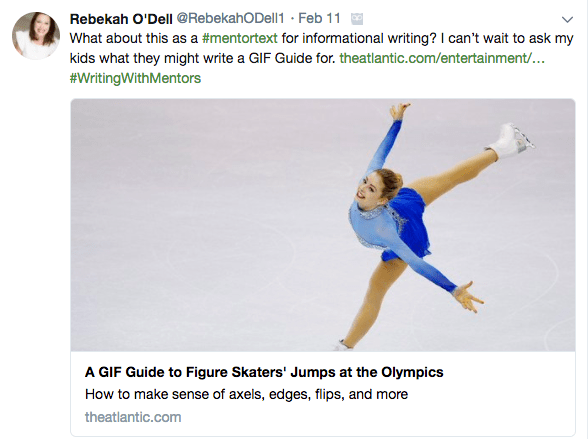
It all started when I saw this tweet: TweetofGIFGuide

I thought: “Okay, this may be a relatively painless way to get my writers into writing. We will use this text as a mentor and write our own GIF guides.” (Quick change in lesson plans on the drive to work.)

First, we started with a conversation about GIFs. This NY Times Learning Lesson has some good questions. We wrote our thinking in our notebooks and shared in table groups. Then, not quite as planned, the conversation shifted to how to pronounce GIF. “Um, it’s JIFF, Mrs. Rass, the creator of them said so.”

In case you are wondering:  I think the creator is wrong. But, does it really matter? I just wanted my students to use GIFs as an entry point into writing using mentors.

To help students understand how to study a text for a writer’s moves, I copied the text into a document, and removed the images, so students would focus on the language. Then I crafted a list of questions. Taking a cue from Talk Read Talk Write by Nancy Motley, I cut the questions up and gave a set to each small group. They spent the better part of a class period studying the text and using the questions as a guide.

Later, we brainstormed topics we thought would work, eliminating some that were too broad, and discussing ones that would lend well to a how-to or informational type of writing. Students then completed this document, so they could see my expectations for the writing task, and I could approve their topics.

Students talked. They wrote. I taught mini-lessons on introductions and sentence structure. Students revised. Some taught themselves how to make GIFS.

Most surprised me with their finished GIF guides. Here’s a sampling of a few. (Disregard the citing of sources — that’s still on the Need-to-Learn list.)


Students, no matter their age, will write when we give them the tools and the time they need to be successful writers.

Sure, not all of my students produced solid writing — yet. But I am hopeful. We are only a about a month into the course, and most students now have a writing success story.

That confidence matters.

For a great read on helping students write, read “Children Can Write Authentically if We Help Them” by Donald Graves.

I’d love to know the fun or interesting mentor texts you use to get your students to take a chance on writing. Please share in the comments.

Amy Rasmussen teaches English IV and AP Language at a large senior high school in North Texas. Go, Farmers! When she’s not skimming the news or her Twitter feed for mentor texts, she’s reading books to match with her readers or thinking about the rest she might get during spring break. Eight days, but who’s counting? Follow Amy @amyrass and @3TeachersTalk, and she invites you to follow this blog if you aren’t already.


Making the Leap: How one text supports another.

cactus2

This past summer I took advantage of an extraordinary opportunity. I mentioned it in my first ever blog post and my thoughts about that experience are unwavering.  The Summer Institute reinforced some of my already held readers/writers workshop beliefs and clarified many others.

One experience was particularly profound.  Meggie Willner and I found it so evocative that we based an entire professional learning presentation around it that we presented at our district  Profession Learning Day in August and even submitted a similar presentation for consideration at TCTELA this year.  Unfortunately, we weren’t selected for TCTELA, but Meggie and I still talk about how much this lesson taught us and how we still reach back to that lesson as this year moves forward.

On Day 7 of the institute, Amy presented us with a piece called “The Cactus,” by O’Henry.  I’m not intimately familiar with O’Henry’s works, but Meggie is and her opinion is a favorable one.  Amy took us through the exercise of discovering the beautiful language and writer’s moves that exist in the piece and we shared our thoughts and “workshopped” the text the way we should with our students.

At some point, Amy stated that this was a text we needed to present to our STAAR Camp students and Meggie and I simultaneously turned to each other in fear.

Meggie 2

Our initial thoughts were identical.  We knew our students very well and we knew that this text was far too difficult for them to conquer.  Meggie and I weren’t sure that we could shepherd them through this text and as soon as the session ended, we hustled up to our classroom to find something with which we were more comfortable and something we felt would engage the kids.

We quickly found a story called “Checkouts,” that was both easier to dig through and thematically similar to “The Cactus,” and away we went.  The lesson went beautifully, the students engaged with the story and we were able to guide them through discovering the writer’s moves and the thematic ideas in the text.  Meggie and I both agreed that we made the right decision for our kids.

Early on Day 8 Amy said something to the effect of: “I noticed many of our teacher teams chose not to use “The Cactus” in their lessons yesterday and went with texts that were less complex.” (I’m paraphrasing this because I don’t remember the exact words Amy used, but I remember feeling my face turn red and Meggie and I slow-turning to each other with matching looks of horror.)

Meggie1

Amy continued her thought by telling us how important the complexity of the text was to our readers and how texts that our kids would encounter on the STAAR test would match the complexity of “The Cactus.”

As soon as that morning’s session ended, we scurried up to our classroom with our tails between our legs and sat down to develop a plan to present “The Cactus” to our students.

We planned the activities that are typical of workshop to go with this piece. We drafted  questions that we thought might prompt their thinking and help them engage the text.  We looked at the text with an eye towards anticipating the places they would struggle with the language.  Looking back, we prepared well for this lesson.

Our preparation paid off when the students dug into the text. If you haven’t read “The Cactus,” please take my word for it that there are many difficult to understand words and this is what made us feel apprehensive. To our great joy, a piece that we thought would stump them turned out to be accessible and engaging and they found insight and nuance in its words. They floored us!!!

We discovered something too: our idea to present them first with “Checkouts” provided a scaffold to “The Cactus.”  They were able to digest the complexity of the more difficult text because they were comfortable and familiar with its thoughts and themes.  They trusted us because we built that relationship with the more easily accessible text. They learned that they don’t have to have understanding of every single word in the text to experience mastery of the text.  They can still engage in the nuance of theme and voice and other important skills. Once they found success engaging “The Cactus,” we could see their confidence build and they were able to enjoy the text in the same way as the adults in the room; as readers.

This is such an important lesson for me to learn.  Often, I take for granted that the students will engage with a text or just assume that they won’t.  My thinking, instead, should be about I can move them into a text by using what they already know or what they are interested in.  This may be obvious to other teachers, but I’m not a trained reading and writing teacher and I still have many lessons to learn.

Charles Moore still can’t figure out how to stay off of Amazon.com on snow days.  He is currently reading Warcross by Marie Lu and Truly Devious by Maureen Johnson and keeps his eyes open for suggestive cacti. His almost daily musing can be found on his twitter page @ctcoach

Creating Community One Story at a Time

My son started Grade 6 this year at a brand new school. This was a nerve-wracking shift for us as he had been attending his previous school since preschool. His fears were largely centered around finding new friends and fitting in, but as a teacher/parent my fears centered more around the learning environment and if his new teacher would conduct the class in a way that fostered inquiry and creativity.

After the first few weeks of school, it became clear that this teacher had a different style of teaching than the ones at my son’s previous school and  I fretted that he wasn’t learning enough and that he was going to be bored with this new style of instruction. In one of my particular moments of panic and after just finishing a lengthy text to rant to a teacher friend of mine about my fears in regards to the way my son was learning, my wise sage of a friend responded with a simple response – yeah, but how much do you really remember what you learned in Grade 6 content wise anyways? What you should really be asking yourself is what type of classroom community is being fostered.

Just that one simple question quelled the storm of concerns and made me reflect. What was my son’s new classroom community like? So, when he came home from school each day, I stopped listening for what he learned and focused more on the tidbits he shared with me about how he is learning. Once I started listening for the how, I realized the gift that his new teacher was sharing with him was the gift of story. I soon saw that my son who so often answered questions of “what did you do at school today?” with a shrug and an “I don’t remember” was now answering the question by sharing the stories he learned.  You see, his new teacher has created a classroom steeped in story and story is a powerful community builder. Every day he tells the students stories of his life, stories of the past, and stories of his hopes for the future. He also surrounds the students with stories with a huge classroom library that the students are free to access at any time. Most importantly, however, is the culture he has created by one simple habit- everyday he reads aloud to his Grade 6 class. I soon began to realize that my son was excited to tell me the stories that were being read to him and his classmates and recounted them with a verve and detail he has never had before when talking about school. Will my son remember the content of his Grade 6 Social Studies lessons? Maybe not, but he will remember the power of those stories being read aloud to him and what they made him feel.

In her blog and in her book Passionate Readers: The Art of Reaching and Engaging Every Child, Pernille Ripp discusses the importance of reading aloud to our students and the importance of providing joyful reading experiences. When we read aloud to our students, we model our own enjoyment of reading, tap into the inherent human love of story, and provide a joyful reading experience for our students. Why then do we stop reading aloud to our students as they get older? This was the question that came to mind when I thought about my own teaching practice. Do I read aloud to my students? In reflection, I realized I do read the practice sample reading paragraphs to prepare for the Provincial Exams to my Honours English 11 class and I occasionally read out samples of strong essays, but this would hardly count as joyful reading. I quickly realized that I had fallen into the mindset of the senior English teacher – the one that does not see reading aloud to her senior English students as a valuable use of time.

For more detail on techniques to bring read alouds alive in your senior classes, please read Amy’s post on the topic.

Once this realization hit, I went straight to my senior English department colleagues and started to brainstorm ways that we can bring the joy of storytelling into our senior classes and these are the first steps we took.

Besides integrating daily reading time to each class, we also focused on how we can bring storytelling into their lives. Our school is a K-12 school and our senior students are fortunate enough to have many connections with the junior students. One program we have is a Kindergarten/Grade 12 buddy program where our Kindergarten students and our Grade 12 students meet once a month. Right away, I knew this was a perfect opportunity to allow my Grade 12 students to share stories. Prior to our next buddy meeting, I took the Grade 12 students down to the library and set them free in the picture book section with one simple task – find a story to read to your buddy. Off they went and magic quickly happened. As they were searching the shelves, stories started to present themselves to them. They found their favorite picture books they read as a child or ones that were tied to special reading memories. These were the books they choose to share with their buddies – the stories of their childhood. As they read the stories to their buddies the pride and the joy of sharing stories was evident.

IMG_0458

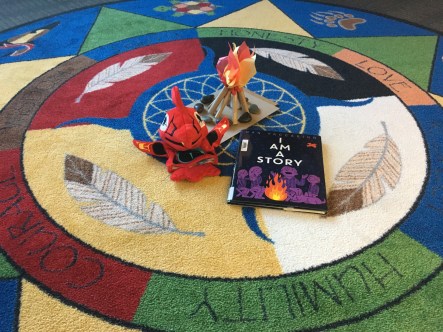
Before starting our living library, I read my Honours English 11 students the amazing picture book I Am A Story by Dan Yaccarino to get them in the story telling mood. We also made little campfires to tell the stories around to further create the atmosphere of sharing stories around a campfire. Some of my Grade 11 students were a little shy to tell their stories, so they enlisted the help of our school library puppet collection.

Another storytelling initiative I took on was having my Honours English 11 students create a living library for the Grade 3 and 5 students at our school. A living library is where students become living books with a story to tell. The Grade 3 and 5 students circulate around the library and “check out” an Honours 11 student and listen to the story the Grade 11 has prepared to tell. The purpose of the living library is not to ask questions or to engage in conversation with your audience, but simply to share your story. My Honours students have recently been studying how authors create voice in their writing and what better way to study voice than to create story using our own voices. When I first proposed the idea to my Honours students, I presented it as an exciting opportunity in storytelling and I was met with less than enthusiastic groans. They wanted to know if they really had to do this (the answer being yes, I want you to try) and “are we being marked on this” (the answer being no, but it will help you develop voice in your storytelling). Despite their reservations, they all actually showed up on the living library day and ended up having a blast. Upon reflecting on the experience afterwards, my students talked about how they had to change their stories to suit the different audiences that were listening to them. In some cases it was because they had an older or a younger audience, but in many cases it was because of the way the audience was reacting to the story. At the end of the experience, all of the Grade 11 Honours English students could agree on one thing – they loved telling their stories and they wished they could do this every class.

While running a living library every class is not really possible, this experience reminded me how I need to weave story into my daily classes more because story is a powerful tool. By reading aloud to my senior students, by giving them opportunites to read aloud, by sharing my stories, and by allowing them to share theirs I can help foster a class community that is steeped in the joy of story and storytelling.


Pam McMartin teaches Senior English, is the English Department Head, and the Senior School Teacher Librarian at a school in Tsawwassen, British Columbia Canada. When not trying to balance her many teaching roles, she loves sharing stories with her students, her son, her dogs, or anyone who will listen. She tweets at @psmcmartin.


Hope is the Thing with Feathers – Teaching in a Time of Overwhelming Tragedy

How does one process news like that of the school shooting in Broward County yesterday? What do we do when the classroom bell rings for us today, but a school just like ours will instead be dealing with the loss, hurt, pain, fear, emptiness, and uncertainty of another mass shooting? What can we say to adolescents whose educational experiences are littered with pox far beyond even the terribly usual trials young people can and must endure?

Painfully, we’ve all had more than enough practice at wrestling with such questions, but attempting to digest the senseless slaughter of innocent school children within the walls of our professional workplaces is never easy. Blessedly, it feels far from normalized. Horrifically, by the sheer number of circumstances we’ve been presented with over the past few years, it does, in fact, become almost routine.

Basically, the haunting normalcy of these events leaves in its wake a sense of utter helplessness, despair, and at times, hopelessness.

As a teacher, as a mother, as a wife, as a daughter, as an educator who teaches next door to her very best friend and works with people she considers family, I am close to lost. The what if of such a scenario playing out at yet another school, let alone my own, is something beyond terrifying. It rips into the realm of disorienting, numbing, paralyzing.

My own daughter starts kindergarten next year. While a completely idealized reflection of my personal experience would only be partially true, I know for certain my teachers and parents did not need to explain to me what I should do, at the tender age of five (or ten, or eighteen), if someone should enter our place of learning, intent on carrying out an act of chaos that would put my life in danger.

That I might not come home from school because of the actions of someone with a gun, was not my reality.

It is now the reality of our students, our colleagues, and our own children.

To say I am disappointed by inaction is an understatement. Pointedly, I’m terrified to imagine the scale of an event it will take for change to occur. I’m disheartened by the unending cycle of condolences, followed by outrage, followed by a seemingly patient and quiet resignation to our circumstances as we wait for the next special report to interrupt our regularly scheduled hand-wringing and begin the cycle all over again.

Our students, sadly,  have little choice but to see these events as a part of their education. While the events at Columbine, an event we could not know and would shutter to imagine as a prelude to so many more school shootings, were a deeply disturbing occurrence in only the last two months of my own high school experience, our students already count this most recent tragedy as one among many.

As educators, we have little choice but to wish fervently, speak passionately, and push daily against such vile intrusion into our schools, all the while preparing solemnly for the possibility that our communities could see just such a tragedy.

So what do we do today?

The normalcy of routine can be reassuring to some. I could go about my way of logical fallacy presentations and book club discussions on modern nonfiction texts today. And most likely we will. But I feel like we all might need something more.

In reading Tricia Ebarvia’s post on Moving Writers this morning, I felt her searching in much the same way I am. Her initial list of possibilities is recognizable to many of us and a place to start:  “hug your kids a little tighter, tell them they’re valued, be a little kinder, read to them, remind them that they’re safe but to look out for one another, urge them to reach out to adults, and so on.”

Her beautiful post goes on to suggest a variety of approaches from classroom discussion, to the analysis of political cartoons, to reflecting on the words of our nation’s leaders in the wake of yesterday’s events.

A few months back, in the days after another mass shooting, this time in a church, Shana reflected on Kylene Beers’ piece “Once Again,” suggesting we really consider the purpose for which we teach in order to best move ourselves and our students forward with purpose and passion. I love Shana’s heart in this piece and her wrestling with the raw emotion of such events by asking teachers to reflect on whether making meaning or making life meaningful should be our goal. 

So with a lot of options, I think today, I am going to write with my students. The thrust of Ebarvia’s post today is the avenue we can take that will most likely feel familiar, as both embedded workshop practice and proven activity to handle stress. I am going to give my students space to write.

A few minutes. An extended session. Whatever the class needs.

The writing can be open response. It can be prompt related if we think our students need it. It can also be response to beautiful words. Poetry saves souls, I am convinced, and Ebarvia must have been thinking along the same lines. Several of the poems Tricia shares are powerful reminders of the depth of the human spirit, how we cope with tragedy, and what it means to be human. Student reflection on these will bring wondering, questions, hope, fear, pain, and maybe unexpected release.

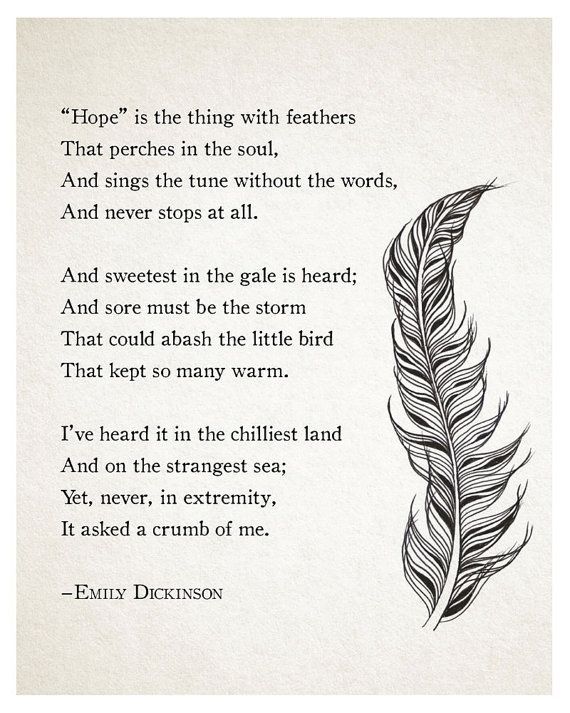
I’ll humbly add the following piece. I think this is what my classes will reflect on today : hope2

We are going to use our writer’s notebooks to pour out some emotion and let it linger on the page. Coping and healing can begin in our classrooms. We need not be counselors, but we can do what we’ve always done…provide the safest emotional space possible for all of us to deal with the increasing lack of safety that surrounds us.

As educators, we share common challenges, but thankfully we also share a common purpose. Together we can move our students and thereby the world to a better place. I’m glad to be wrestling with all that it means to be human with you.

Be well today, friends.


Lisa Dennis teaches English and leads a department of incredible English educators at Franklin High School near Milwaukee. Follow Lisa on Twitter @LDennibaum. 

Research in These Times

We all love those days when everything goes perfectly.  I’m not talking about getting your grading done and entered, sending all the emails you meant to send, or making sure you’ve made the requisite parent contacts.

I’m talking about days where your lesson planning paid off and the students engaged in a meaningful learning opportunity. Think about those days where the kids work bell to bell and it feels like all you did was confer with as many writers as possible (Amy wrote about the importance of conferences here). I’m slowing building toward a place where this happens more and more and it’s both exciting and rewarding.

Teacher Book Talk:

Maja Wilson’s book,  Reimagining Writing Assessment: From Scales to Stories, is introducing me the ideas of John Dewey, someone who’s thinking I need to know more about. Its also a well-written book with some amazing insight.

When talking about Dewey’s phrase, “growth in the right direction,” Maja suggests, “I have to be transparent about my primary aim: the healthy and sustainable growth of young writers within an inclusive and equal democracy.”

meme

….Um, wow.


Growing young writers….within an inclusive and equal…democracy.

 Lesson Talk:

Our English IV classes are investigating research through several modes this year.  We’ve read, talked about, and written: Letters to the Editor, Op Eds, Infographics, and now we are looking at TED Talks.

I wanted this exploration to be as pure to the workshop pedagogy as possible.  Instead of giving them an anchor chart or watching a TED Talk as a whole class, I asked them what they already knew about the medium and invited them to create a list of traits they looked for when consuming media.  Each class period was slightly different in what appealed to them and what they wanted to see in a TED Talk. Of course I guided them through this process of discovery, but one way I formatively assess them is by noticing what they already know and planning my lessons around filling in the blanks or extending their experience.

We laid the ground work of noticing by accessing our schema and I set them loose to seek out TED talks that appealed to their thinking.  The students engaged themselves in media that appealed to them.  They wrote about what they saw in their self-selected TED Talks that engaged the media as learners. I gave up control and gave them choice.

Of course, our forward looking thoughts aren’t just towards making us more savvy consumers of digital media.  Our thoughts should guide us toward being savvy producers of media as well.

 Growing young writers….within an inclusive and equal…democracy.

By late February, the seniors at my campus will produce a research project.  The fun part is that they will have choice in how they publish it.

I think the choices that we made as teachers are facilitating the, “sustainable growth of young writers within an inclusive and equal democracy.”  I’m proud of this work.  I’m also thankful for the teachers I have the pleasure of working with every single day.

How have others set free their students to explore their place in our democracy? What are other modes within which we can explore the research process?  Please share your successes; they are powerful.

Charles Moore has now totally lost control over his book spending habits. So much so that the cashiers at Barnes and Nobles don’t even ask for his teacher discount card and Amazon chose his house for their newest headquarters.  He loves the sound of a classroom full of readers and he likes to imagine word counts ticking higher as they hover above the students’ heads during reading time. His sometimes humourous musing can be viewed on his twitter page @ctcoach and his embarrasing short form poetry and, eventually, book recommendations are on instagram @mooreliteracy1

Finding Teaching Inspiration in the Dark of Winter

I love to spend big chunks of my summer planning ways to revise and improve my practice.  The season is always so full of hope, with opportunities to reframe my thinking and help my students be more successful.

But when the school year actually begins, it can be overwhelming to attempt anything from a major overhaul of your teaching to a few key shifts in practice.  Every year, I read books, take classes, and obsessively jot ideas that never see the light of day when I’m faced with the reality of a fall full of fresh faces, administrative initiatives, and new courses to teach.

And now, in the dead of winter, I’m exhausted. It feels like I have no ideas. I’m looking for inspiration in my teaching, my reading, and my writing–inspiration I never seem to be able to come up with on my own. So I’m going back into my notebook and re-reading my summer entries, where I was full of ideas and energy.

This summer, I worked with a group of amazing teachers in Pipestem, WV during a National Writing Project summer institute.  As we read and wrote and thought and planned about argument writing, I jotted down two things in my notebook I could do that would withstand the crush of the reality of our profession and inspire me all year long.

Embrace the Wobble

Ounnamed_origne of our central texts for the institute was Pose, Wobble, Flow by Antero Garcia and Cindy O’Donnell-Allen.  This text makes lots of wonderful arguments for teachers to inhabit “poses” as more thoughtful, authentic practitioners through the metaphor of yoga.  The idea is that when we try new things as teachers, we are trying to get into a pose.  We inevitably wobble as we try to master this new stance, but eventually attain the flow characterized by doing this pose without thinking.

GODA (as one of our teachers refers to Garcia and O’Donnell-Allen)’s key argument is that the wobble part of this process is not only a necessary part of becoming a better teacher, but a desirable one–we must live in the gray area, a zone of proximal development, disequilibrium, or whatever else we might call it.  “The P/W/F model is not about an endpoint,” GODA vehemently asserts; “it is a framework to help acknowledge how one’s practice changes over time and requires constant adaptation” (4).  It’s only by being uncomfortable, by trying new things day or week or year in and out, that we can improve as teachers.

What this looked like in terms of our theme of teaching argument writing was revising the way we think about the writing process to start from an inquiry-based place of research, then claim development, then argument articulation.  This new mindset required all of us to “wobble” as we tried to conceive of it, and we wobbled in even our understandings of its many moving parts–what revision is, or what an argument can look like, or how we can use argument as a genre for developing our opinionated writing voices.  As we were flooded with unconventional ideas, mentor texts, thought processes, and assessment measures, we all wobbled with the confidence we’d eventually reach flow.

This semester, as I wrestle with finding energy and inspiration in the wake of having two small children, the new pose I’m trying out is going gradeless. It’s reshaping the way my students and I dialogue about their work, but it’s still an uphill battle to wrestle them away from the temptation to wonder what their grade is…or my own inclination to compulsively give my opinion on their work in the form of a letter or number. I’m definitely in the midst of the wobble, but I’m hopeful that by the end of the semester, I’ll get closer and closer to the state of flow.

But whenever things do start to (finally) go smoothly, I’ll need to yank myself out of my newly-found comfort zone and get into a new pose, embracing the wobble of new learning once more.

This constant revision of our teaching is a simple way we can always strive to be better teachers–just embrace the wobble of continuous improvement.

fullsizerender

Become a Writer

Garcia and O’Donnell-Allen strongly advocate for the many student-centered benefits of writing beside our learners, but there are so many benefits beyond the classroom that become possible when we simply write.

Outside the classroom, GODA suggest that teachers might become more engaged in improvement by:

  • Sharing articles with colleagues
  • Commenting on education blogs
  • Participating in Twitter chats about educational issues
  • Joining organizations like the National Council of Teachers of English
  • Participating in local workshops

Taking one or more of these eminently doable steps can help teachers “enact agency and make an impact on the profession” (27).  These simple activities will not only expose you to ideas to keep you in the “wobble,” but they’ll let you meet and engage with like-minded colleagues as interested in improvement as you.

Within your classroom, becoming a writer is equally valuable.  If you read nothing else of Pose Wobble Flow, I encourage you to read the chapter on “Embracing Your Inner Writer:  What It Means to Teach as a Writer.”  These pages are chock full of suggestions for not only reasons to write, but ways to do it.  From a survey designed to help you find your identity as a writer, to practical methods for joining writing communities on Twitter, Facebook, and even NaNoWriMo, to the ways the act of writing beside our students changes our teaching, this chapter is awesome:

fullsizerender-1

Because “the changes that come about within our classrooms and with our students start with ourselves,” (80), writing is a necessary first step to becoming a better teacher.  It is a fight, with two kids under two plus a job and a household to keep up with, to find time to write, to read, to engage. I can’t even count the number of times I’ve missed a Twitter chat or skipped notebook time to tend to a crying child, fold some laundry, or cook a meal. But I find that whenever I can eke out 10 minutes of writing time, meaningful Twitter conversation, or professional reading, I feel better. I feel inspired.

I hope, like me, you’ll make an effort to keep a writer’s notebook, blog regularly, and write beside your students every time you see them in class.  Beginning to inhabit the pose of a writer–although I experience wobble within this identity almost daily–is doubtless the most helpful thing I’ve done to improve my practice as a teacher.

As you find yourself wondering, in the dark of winter, how to get excited and inspired once again, try these two things: wobble and write. Here’s hoping for a speedy end to winter and all the joy and optimism the spring always brings…as we work to become better teachers every day.

Shana Karnes teaches in the College of Education at West Virginia University, writes in her notebook whenever she can squeeze in the time, mothers two daughters under the age of two, and reads voraciously at the oddest moments–at the gym, during middle-of-the-night feedings, and at stoplights. Find Shana on Twitter at @litreader, or read more of her writing at the WVCTE Best Practices Blog, where a version of this post originally appeared.