Category Archives: Writers Workshop

Every Child Matters and Sharing the Stories that Matter

residential-school-books-display_origEarlier this week we observed Orange Shirt Day at my school. Orange Shirt day is a day to recognize, remember, and reflect on the many Indigenous children who were taken away from their homes to live in residential schools. The residential school system has a dark legacy in Canada and the United States and the after effects still ripple through Indigenous communities today. In fact, the last residential school located in Saskatchewan did not close its doors until 1996 – a fact that is always shocking to my students when I share it with them.

The tagline of Orange Shirt Day is Every Child Matters and it is a tagline that has resonated with me as I participated in Orange Shirt Day, as we ran in the Terry Fox run as a school to raise money for cancer research, and as I plan with my student council for National Coming Out day on October 11th. While we promote the message that Every Child Matters and we hope our students feel that way as they leave our classrooms, the reality is that in the current world political climate and with the news stories our students are surrounded with each day, it is so easy for our female students, our LGBTQ students, our minority students, our refugee students, or any of our students who feel a little different to feel like they do not matter.

Last year I had the privilege of seeing author Thomas King speak at a conference. Thomas King is an American-Canadian First Nations author who has written numerous novels dealing with the First Nations experience. In his session, King was asked if he believed that story has the power to enact change in the world and his answer resonated with me. King answered that if you had asked him that question years ago, he would have answered with a firm yes, but now that he is older, he can not answer the same way. He was, like so many First Nations people, angry and fed up with the government’s inaction to follow through with promises they had made during the last election. He said that story is powerful, but often not enough and sometimes you just need to get angry and speak your mind. His final point was that if you are going to use story to change the world, you better find those voices that are strong, angry, and give voice to the voiceless because those are the stories with power.

King’s answer has stuck with me as I feel like too often I have used the empty platitude that “stories can change the world” with my students, but then I look at the stories they are being shared and the voices are often so heterogenous and not reflective of their voices and their concerns.

So, I have started a quest to diversify the stories I introduce to my students and to find those angry voices, those suppressed voices, and the voices that speak for them. In this post I will introduce you to a few of these powerful stories and will share others I discover in later blog posts.

The Inconvenient Indian: Thomas King

This powerful work is King’s reflection on what it means to be Native in modern North American. He discusses the historical events that have so impacted his people, but also ruminates on how popular culture has served to frame the narrative that many First Nations people are stuck in. King does not shy away from exploring the darker parts of history in this work, so it would be most suitable for Grades 10-12 students.

We Should All Be Feminists: Chimamanda Ngozi Adichie

Ngozi Adichie’s name may sound familiar. Perhaps you have seen her powerful TED Talk The Danger of a Single Story  (I love to use this TED talk to spark discussion about the missing voices), or have read her beautiful novel Half a Yellow Sun. Her work We Should All Be Feminists is a short piece, an extended essay, but it is an important exploration of the need for Feminism in the 21st century and how 21st century feminism must be one of inclusion and awareness. In fact, the Swedish government felt that this book held such an important voice for today’s youth that in 2015 they decided to give every 16 year old in their country a copy. We have used this book with Grades 8-12 students at our school and how found content accessible to all age levels in the range.

These are just two of many amazing books that share the voices and stories of people with powerful and important messages. Over the next few months, I will share some more I have come across and I would love it if you could share some of your own suggested titles in the comments below!

To read more about harnessing student voice in a time of political unrest and fear, check out Lisa Dennis’ powerful post.

Pam McMartin is a Senior English Teacher and Senior School Teacher Librarian in Tsawwassen, British Columbia, Canada. She is currently on a quest to help empower student voice through reading and writing and welcomes any suggestions you may have in regards to either.  Find Pam on Twitter @psmcmartin.

Utilizing Every Square Meter

We’ve got them in every class… those students who love to sit in the back of the room or in the corner that’s difficult to get into once chairs are out, backpacks are on the floor, and drawers have been opened, etc. The corners and spaces that present challenges to navigate, and without being aware of it, make it so we let things slide. Maybe we don’t check in as often during notebook work, maybe we don’t see what’s on the computer screen as much during our writing work time, maybe we don’t always see what page they are on during independent reading time.

Maybe you all have figured out how to prevent these “dead spaces” from being a thing in your classrooms, but I was still working on it at the beginning of my twentieth year of teaching.

Screen Shot 2018-10-03 at 4.58.58 PM

It was a concept I had first started thinking about when reading Doug Lemov’s Teach Like a Champion a number of years ago (the updated version can be found here).

teachlikeachampioncover

I remember having a conversation with colleagues about “owning the room” based on what we had read in the book. I knew then that I had dead spaces, and I’ve worked on eliminating those spaces ever since.

This year I wanted to think about my classroom differently. I didn’t want to “eliminate dead spaces” as much as I decided I wanted to utilize the space to its fullest potential. I wanted each student to have a front row seat for at least part of the class time every day. I feel that this is inclusive; the students who often stay under the radar in the quieter spaces of my classroom can still find the spotlight, and the students whose personalities require constant attention sometimes find that they aren’t in the limelight for a little while. I want to spread my attention evenly and fairly, and I think that utilizing our space deliberately is one of the answers to this issue.

While nothing is every perfect, I think I’ve stumbled upon some good solutions.

I started by figuring out where the traditional problem areas are. I’m sure many teachers can relate: it’s primarily the corners and the walls. So I first focused on the perimeter of my classroom.

I looked at the corners and made sure that each of the four corners has a specific purpose.

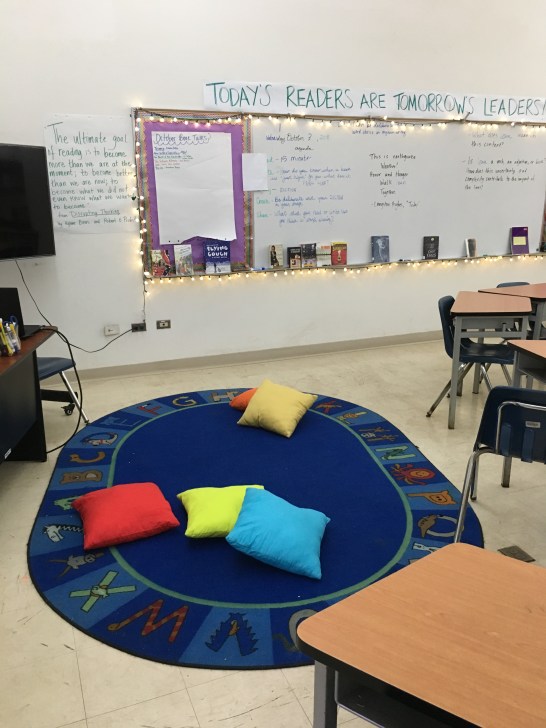
  • One corner has the TV screen and rug so that students can come up to participate in mini-lessons.
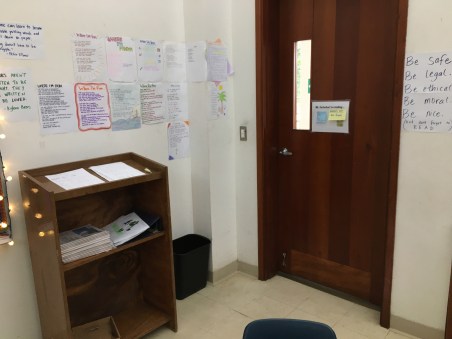
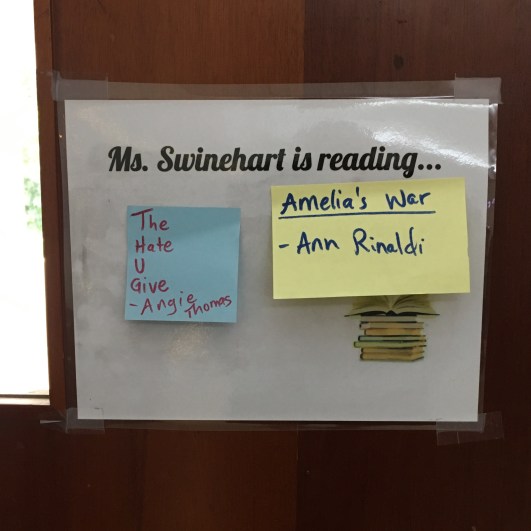
  • One corner is where students enter and exit, so I used the wall space for student work and my currently reading notice. I also re-purposed my podium — I turned the front of it to the wall and am using it as a place for students to sign in when they leave class or come in tardy. There are also handouts for students on the lower shelf.
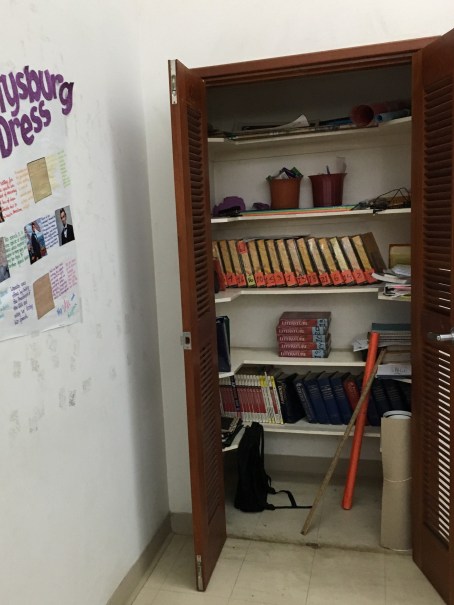
  • Another corner has a cupboard in it, which is always accessible. It’s for students — they can find extra supplies as well as their textbooks (we use them more as anthologies, to be honest).
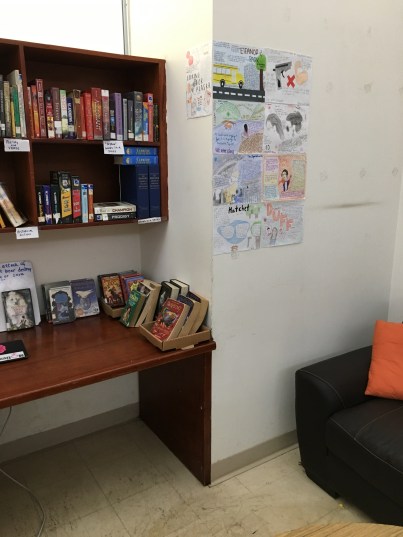
  • The last corner is the most popular. It’s the reading corner. It’s next to the classroom library, has the comfy couch, and also showcases student work as well as our reading agreements.
img_1142.jpg

This corner has the TV/computer set up for mini-lessons.

IMG_1147

The corner with my door showcases student work, has a spot for handouts and the bathroom/tardy sheets, and has my “currently reading” notice on the door.

img_1151.jpg

The corner with the closet isn’t off-limits to students. Extra supplies and textbooks (we’re calling them anthologies this year) are accessible to students at any time.

IMG_1150

Student work is displayed in the reading corner. Currently on the walls are some grade eleven one-pagers. These also provide ideas for what other students might want to read next.

IMG_1160

The reading corner is a popular spot; it’s right next to the classroom library and has the comfortable furniture.

IMG_1164

Mrs. Swinehart is currently reading…

IMG_1149

Students come to the rug for mini-lessons in this corner of the room.

After looking at the corners, I examined the purpose of each of the four walls.

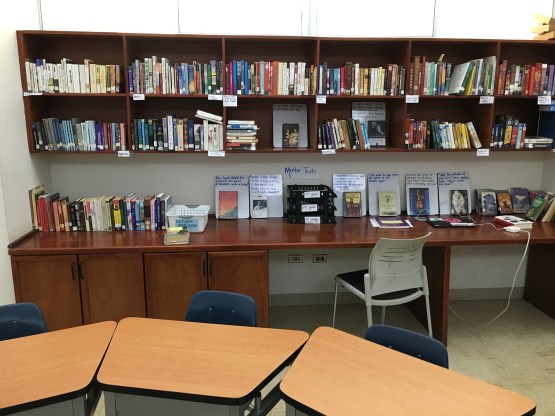
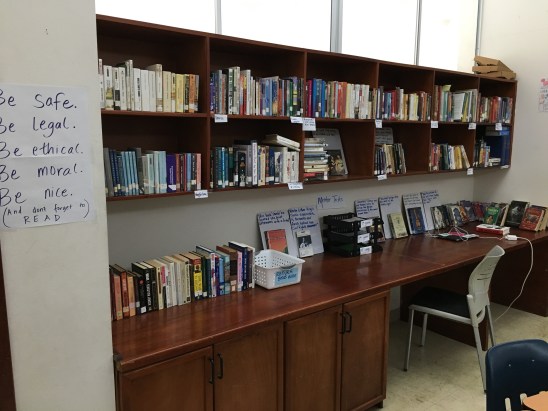
  • One wall is our classroom library, which is always a popular place to be. We use it and love it every day, in every class. It’s organized, at eye level, has a rotating display, and most importantly, includes titles that will appeal to my students.
  • Another wall is what would traditionally be the back of the room. It already had bulletin boards on it, so I hung anchor charts that are relevant on a daily basis. I refer to them, I walk to and through the space, and kids actively turn their bodies to look at them.
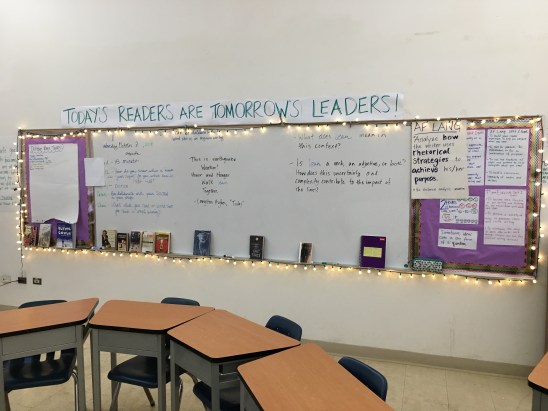
  • The next wall is what would traditionally be the front of the room. It’s where the white boards are, so it’s naturally where I put our daily agenda, and where I write the things that don’t need to be digital or saved on a chart. Books are displayed on the marker tray, monthly book talk lists are on one of the bulletin boards to the side of the white board, and it’s where we can go for “spur of the moment” lessons that aren’t created digitally in advance and don’t use the document camera.
  • The last wall is a wall of windows, and where a teacher might put a desk. My “desk” is there, but it’s pushed up against the wall and serves as a supply table. Next to it is our conferring space, which is used when I’m not circulating the room, and is even as a space for completing our Running Records. When I’m circulating the room, it’s another space for students to complete the learning in our classroom.


IMG_1143

Our classroom library is constantly in use.

IMG_1145


IMG_1148

The white board wall is also used for book displays, a daily agenda, and unit goals.

IMG_1165

The “teacher desk” is also a supply table. I’ve reserved a student desk behind it for the “teacher stuff” – including the obligatory year-round-use Christmas coffee mug, stack of loose papers, and Norton Reader. (I’m assuming every teacher has something like this?)

IMG_1152

The conferring space/extra space for student learning


Lastly, I had to look to the inside of the room. The perimeter is important, but the students tend to “live” towards the center of the room. I’ve tried to make it so the desks aren’t pointed in one particular direction so that each space feels important. I’ve moved desks so students have partners, I’ve had arcs facing different directions in different parts of the room, and sometimes the desk arrangement feels random or messy. I think that’s okay. The point isn’t to have orderly desks. It’s to have students who are engaged in their learning.

IMG_1155

While I’m sure I’ll still have days when I don’t visit every square foot in each and every class period, I think it’s an improvement on what my classroom set up once was. I don’t think there are any spots for students to “hide” and I feel comfortable walking around in each corner and cranny of the classroom. Because I circulate throughout more of the room, and because my students get up and move more often to the spots where they need to be, I interact with my students on an individual level more often than before. It helps to build relationships, which leads to trust, which leads to learning. This makes for a more inclusive, learning-focused classroom, and that’s our ultimate goal.

IMG_1159

A panoramic view from one of the conferring chairs. On the right side of the photo, behind the fan controls, is the closet. The rest, I think, is self-explanatory.

What do you do that ensures that every corner in your classroom is used for the power of learning?


Julie has been teaching secondary language arts for twenty years, spending the first fifteen in rural Central Oregon, and the last four in Amman, Jordan. She’s thrilled to report that she and her family have moved across the world to Managua, Nicaragua this year, where a new adventure has begun.

Follow her on twitter @SwinehartJulie

Nothing New Under the Sun?

So many thoughts came up as I read Maggie’s post last week, the same day the American people, indeed the whole world, had a chance to witness our judicial process unfold in TheCrucible_940x470-678x381real time. My very first thought was, “I’m going to read The Crucible aloud with my AP students, too.” Miller’s play is one of the core texts of the junior English curriculum. Having promised myself that this year, I intended to provide my AP students with as much of the RWW as I could while still “covering” everything, this idea was perfect.
the-crucible-3360718-59ac57cf0d327a0011aa0fe9My next thought … politics. In the play, Reverend Hale is one of the few characters who exhibits any change in thinking. He observes. He listens. He struggles to negotiate his worldview when what he sees and hears doesn’t fit. Reverend Hale — indeed the whole village — experiences the crucible of accusation, doubt, and disintegration.

By definition, a crucible is “a situation of severe trial, or in which different elements interact, leading to the creation of something new.” The “something new” in Salem? Miller concludes, “To all intents and purposes, the power of theocracy in Massachusetts was broken.”

My hope is that our study of this play will evoke conversation about our current democracy, about whose voices are heard, about whose voices are (at the risk of further mixing david-butow-brett-kavanaugh-senate-vote-friday-1literary allusions) a little more “equal” than others. And how can this “interaction of elements,” lead to the creation of something new, perhaps some power structures that need to be broken? 

So, what to do with this as teachers of writing, and to glean something practical from our own real-time crucible? My students will write an “Open Letter” essay as we study The Crucible to explore concepts of voice and audience. (McSweeney’s is a great source for open letter examples of all kinds. I want to provide an opportunity for them to give voice — their own — to what matters to them, directed to the audience that most needs to listen.

Writing Conferences: Stories, Schemes, and Strategies

Conferring is hard brain work. When do I listen? How do I listen? When do I talk? How much? How do I anticipate what a student needs? When do I step back and let them problem solve? Am I even conferring right? (Maybe not. So put your Judge-y McJudgers pants away while you read this.). As Shana explained in this post back in January, there’s so much value in talk, in engaging our students in conversation, in encouraging them–as Amy framed here— to tell the story of how their writing is going.

Because (as Tom Newkirk suggests) we have minds made for stories, over the years I’ve begun to recognize some common schemes while conferring. Recognizing these patterns frees me to listen and to respond. Perhaps you’ll recognize the stories of your own students in the stories I share. Perhaps you’ll pick up a strategy or two. 

The What-Did-I-Do-to-Myself Conference

This conference may typically begin from a position of fear–mine because my student’s eyes have suddenly become two daggers, piercing my helpful, loving heart. This occurred in a recent conference, where my student who chose ice cream as her multi genre research project topic hurled at me these words: “I don’t know how I’m supposed to write an argument about ice cream.” Was she complaining about lack of direction? Instruction? I took a deep breath to let go of any defensiveness I felt. Then I reflected on her question. Oh. Oh! The fear was not mine to have.

My student needed:

  1. to hear that to write about this is, indeed, possible.
  2. to understand the possibilities for executing the writing.

Conference next steps:

  1. I confirmed the correctness of my reflection by paraphrasing (So, what I think you’re saying is that you’re feeling pretty uncertain if you can, and if you can, what it looks like?).
  2. Once confirmed, I chose another seemingly tiny and narrow topic like tacos and verbally processed some options for how I could craft an argument for an audience on tacos. I did not do any written modeling or reach for any mentors at this point. My role in this early phase conference was to dispel fear, to affirm possibility, and to confirm faith in my student’s ability.

Student next steps:

Following this verbal modeling, my student disarmed with affirmation and a smile, she continued working in her notebook, mapping her argument and the rest of the multi genre.

The I-Need-to-Change-My-Topic Conference

This conference may typically begin from a declarative statement: “Just so you know, I’m changing my topic.” I’m being put on notice here.  But I delight in these William Carlos Williams “this is just to say” moments almost as much as ripe-n-ready plums. So, curious now, I say, “Tell me about why you abandoned the old topic” (I’m always thinking we can learn something from discarding topics) and “Tell me about the new topic.” That’s when my student in this case explains that the topic is music but that’s all he has. Hmm.

My student needed:

  1. To narrow his topic by sinking his teeth into the best tidbits of it.
  2. To get moving. And fast. IMG_2711.JPG

Conference next steps:

  1. With the topic so broad, I asked the student to tell me a story that shows his relationship with music.
  2. Once the student shared his story–one that involved him writing his own music and performing several songs at a local concert venue (Our students do amazing things!)–we mapped out a plan for the different parts of his multi genre text.

Student next steps:

With a story in his head (and probably a song) and a general plan mapped out, this student left for the day, ready to focus on more specific planning.

The So-Can-I? Conference

This conference may typically begin and end within a very short burst of time; a meteor shower during the Perseids, this conference starts with a short burst of light from the student, a recognition of how to apply a resource. In a recent case, the student examined a resource on possible argument structures I shared with the class, and ingenuity bursting forth, queried, “So, I can use the pro/con structure? And, can I make this modification to it?”

My student needed:

  1. To know that he has more freedom than he’s using.
  2. To have the affirmation necessary to keep burning bright.

Conference next steps:

  1. I replied,” Tell me a little more about that” and followed that with paraphrasing, “So, what you want to do is . . .?”
  2. Then I simply said, “Yes.” 

Student next steps:

Following this all-of-sixty-seconds-conference, the student returned to mapping out writing, synthesizing his own ideas with the resource. And, I spent five minutes with the next person instead of three.

The I-Know-I-Need-to ______ , But . . . Conference

This conference may typically begin with candor from the student. Like the first sip of lemonade on a hot summer’s day, it’s so refreshing to hear in response to my opening questions (How’s the writing going? What roadblocks are you running into?), “I know I need to _______, but I’m having a little trouble.” Ah. This can become an opportunity to model for the student or offer a micro-lesson; sometimes–like in a recent conference where my student wanted to build a more humorous tone–I help the student find or use mentors. **Note to self–I should probably start asking my students to tell me about mentor texts they’ve turned to when they’re tackling challenges. 

My student needed:

  1. To resolve gaps in skill level (impressively, one’s the student recognized).
  2. To access additional resources  for strategies.

Conference next steps:

  1. For this student working on narrative writing, I pulled David Sedaris’ “Let It Snow” and a couple of others.
  2. Then we talked through typical strategies a writer uses to develop humor.

Student next steps:  

Time well-spent, smiling now, my student worked on reading and studying the mentors.

 
The I’m-Avoiding-Letting-You-Read-My-Writing Conference. May also sometimes appear as the I-Don’t Have-Any-Writing-to-Show-You-Yet Conference

This conference may typically begin, well, haltingly–like a first time driver slowly circling around the empty high school parking lot. I’ll ask, “How is the writing going? What roadblocks are you hitting?” “Doin’ fine. No roadblocks.” Okay. Next approach. “Why don’t we look at a section together? Show me a section you feel really good about. Let’s celebrate what’s working!” Sometimes that gets us turned in the right direction (a smile and an oh, sure and we’re underway); sometimes we skid (uh, so, um, I don’t really have much yet. Uh-oh.). When I most recently tried this approach, my student offered, “Well, I really like this paragraph; but I’m not sure about how to develop it more.” 

My student needed:

  1. to feel safe enough–safe enough to embrace the opportunity or safe enough to admit to lack of progress.
  2. to have re-direction for what conferring might look and sound like. Sometimes they just don’t have the mechanisms down.

Conference next steps:

  1. In the first situation, I generally point out the parts that are really working in the section the student chose to share. I thank them. Then I ask if there’s anything else they want to share or questions they have. And, sometimes I get to look at more writing. I did in this particular case. And, had I not pressed gently, I don’t think I would have (I was kind of impressed that it actually worked!).
  2. In the second situation, I paraphrase what they might be feeling. I might say, “I imagine you might be feeling ___________ (stressed for not having more done; frustrated by how to begin; confused about the direction of your writing; etc.). They typically correct me if I’m wrong and we work together to plan next steps, even if it’s breaking down the process further.

Student next steps:

In the first situation, the student began applying feedback; in situation two, the student typically articulates what’s getting in the way and what resources are needed and then begins tackling a small goal (drafting a paragraph versus drafting the whole thing).

When I’m conferring, I’m listening, paraphrasing, questioning, re-teaching, modeling, affirming, finding resources, building possibility, and showing my students that what they write matters. No wonder my brain hurts.

Kristin Jeschke remembers with fondness the many teachers that encouraged her writing but especially Greg Leitner who always listened more than talked. And who always inspired her to keep writing. Now as an AP Language and Composition teacher and senior English teacher, Kristin appreciates the gift of moments spent conferring. Follow Kristin on Twitter @kajeschke.  


Better Feedback Better Me

When I first attended Penny Kittle’s class at the University of New Hampshire Literacy Institute, and really learned what authentic writing instruction looked like, I thought I had to do everything like she did. I remember even saying to her at one point, “I want to be you when I grow up.” She quickly said, “No, you want to be you.” What I heard was –“You want to be the best you.” I know that’s what she meant.

My biggest failure in trying to be Penny instead of myself was reading and giving feedback on students’ writing in their writer’s notebooks. I just could not keep up with the volume of it all. And the volume of writing was important. I knew that.

dmitry-ratushny-412448-unsplash

Photo by Dmitry Ratushny on Unsplash

I also knew that volume serves its own purpose, and coaching writers to improve required a different focus that just getting students to write more. (When I first started workshop, I was really good at getting students to write more. I was lousy at helping them improve as writers.)  When I made the conscious effort to provide better and more continual feedback, I started to see a change in myself as writing coach — and a change in my students’ writing ability and confidence.

I started a better rotation system of collecting student notebooks, and I worked on planning student activities that allowed for me to read and comment on at least part of a class stack during a class period while students worked on something independently or in small groups, so I wasn’t doing it during planning time or after school. And I limited my comments to this simple method:

  • Two things that struck me about the writing (validating ideas, language, images…)
  • One suggestion for taking the thinking further or some aspect of improvement.

This feedback method has worked for me for a long while now, and I use it on pretty much every draft of writing I read. Lately, I’ve been working on giving more feedforward than feedback, which I think will make an even better impact. For more on that, read this. (And maybe buy this book.)

I’d love to know how you manage giving feedback on your students’ writing. Please share in the comments.


Amy Rasmussen lives in North Texas where she’s been enjoying lots of rain. Lately, she’s spent a lot of time reading about becoming a better writer (See this and this) and trying to break through the wall of her writer’s block. Follow Amy on Twitter @amyrass


Quickwrite Mentor Texts for Writer’s Notebooks

img_6062I love going back to school for so many reasons, but one of the frontrunners is definitely that “second chance new year” feeling it provides. Teachers and students have the unique opportunity to have not just one fresh start at the beginning of a calendar year, but a second shot at goal-setting, changes, and achievements that the fall offers.
We all have our back-to-school rituals, and they are sacred: fresh notebooks, pens in all the colors of the rainbow (because we haven’t lost any yet), a well-organized classroom library that will be pilfered and picked through soon enough. One of the most important parts of establishing a workshop community is the routine that comes with setting up a writer’s notebook each fall: personalizing notebooks to make them our own, modeling a notebook’s possibilities, the establishment of quickwrite practices.

But now that the year has begun, and your notebooks are ready to go…what should you begin to fill them with? The writing in the beginning of my notebook always guides and inspires me as I continue to fill it, so I never want it to be uninspired, dull, or colorless. I crave fresh, exciting, dynamic things to fill up the first several pages of my notebook every time I start a new one, which is usually in the fall.

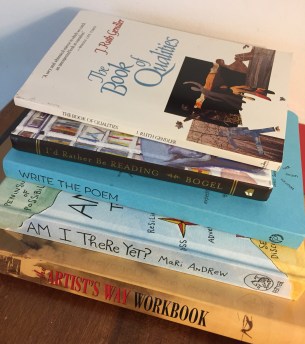
Here are my five favorite mentor texts that give me ideas and inspiration galore for those important start-of-the-year quickwrites–the first in a routine of creativity, agency, freedom, vulnerability, and engagement as a writer.

The Artist’s Way Workbook by Julia Cameron

This workbook is full of writing prompts for real writers: short exercises that encourage reflection, fluency, and the habit of writing vulnerably often.

img_6055.jpg

I love this workbook and its series of prompts, and use them often when I start my day with the #5amwritersclub each morning. They would be wonderful prompts for students to ease into vulnerable, personal writing in September.

img_6056

I’d Rather Be Reading by Anne Bogel

I first discovered Anne Bogel thanks to her “What Should I Read Next?” podcast, but she is also a writer and blogger, and just released a beautiful book yesterday. It’s a book about our reading lives, and provides a wonderful mentor text for writing about our reading without writing about a specific text.

img_6051

In addition to the lovely writing, I am obsessed with the illustrations: they would be wonderful to recreate in students’ notebooks with scraps of old magazines or dusty dictionaries.

img_6048

I visualize this mentor text as a wonderful one for helping students find a voice for writing about their reading lives during quarterly reflections, reading ladders, and self-assessments.

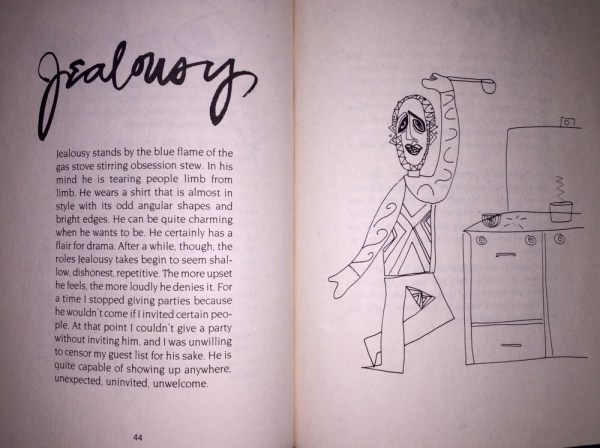
The Book of Qualities by J. Ruth Gendler

Writing about our own emotions is hard for all of us, but it’s especially hard for teens. I’ve found that writing about emotions in general, rather than our own, is a wonderful gateway for personal writing.

img_6049

In addition to being an amazing lesson in personification, this book provides gorgeous mentors for doodling, metaphors, and multigenre possibilities.

img_6050

Write the Poem

Poetry can be intimidating, but a little guidance goes a long way, and this book provides just that.

img_6052

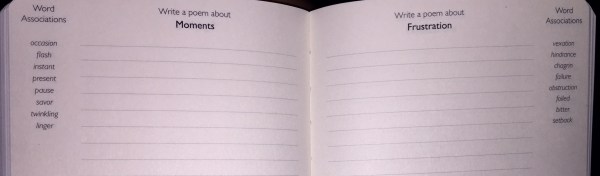
The combination of a prompt and keywords to incorporate takes some of the guesswork out of choosing a structure, a rhyme scheme, a title, and the myriad other decisions that go into crafting poetry.

Am I There Yet? by Mari Andrew

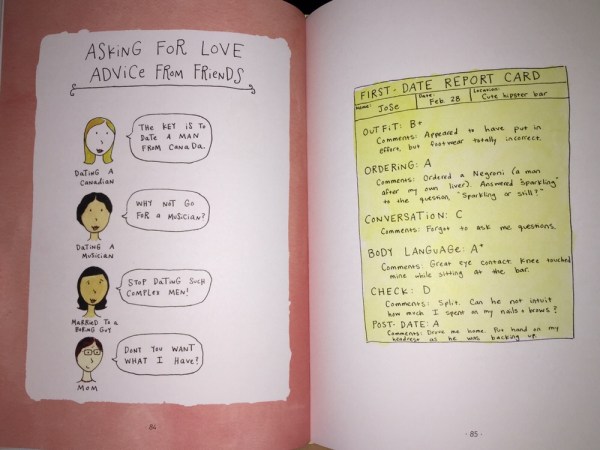
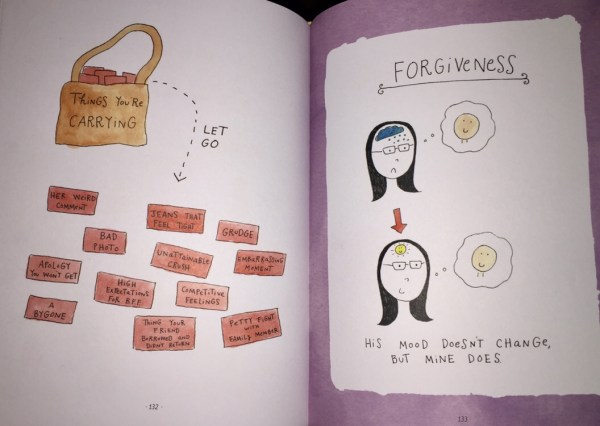
Sometimes words are hard. They just are. Those days call for doodles, and this book is full of plenty of them–in addition to pages of plain old writing. I love this text because it tells stories beyond what we see on Mari’s Instagram and Twitter feeds, giving students a mentor text not just for writing but for the thinking and living behind it.

img_6053

Mari Andrew has long been a favorite of mine, but this book shows me how to play with writing and thinking in genres I wouldn’t have considered, and is super teen-friendly.

img_6054


I hope you’ll utilize one or more of these beautiful texts–many excerpts of which you can view on the Amazon preview pages linked above–with your students this fall. Their possibilities as entry points for writing topics and genres are powerful, and will lead to composition possibilities for the duration of your school year.

Happy writing! We’d love to know how you and your students utilize these ideas, or what others help you kick off your writer’s notebooks. Please share other quickwrite possibilities and ideas in the comments, on Twitter, or on Facebook!

Shana Karnes is a mom to two daughters, a daily reader and writer, and a forever educator. Her work with teachers in West Virginia is through the National Writing Project, West Virginia University, and the West Virginia Council of Teachers of English. Connect with Shana on Twitter at @litreader. 

Saying Yes

Over the last several months, I’ve been learning how to say yes. I know, I know. I should be learning to say no, right? When I run a Google search for articles about just that, it returns 571,000,000 results. Pressure, amiright? But I’m not talking about the kind of yes that over-commits me and zaps my time and energy. I’m talking about the kind of yes that disrupts the status quo, altering the time space continuum of my classroom. Here’s the snapshot of HOW I’ll be saying yes. 

Day Structure Notes
Mon. Deep Dive (1) with Reading: 40 minutes free reading, 40 minutes deep reading instruction Maybe start with a thinking puzzle or something that gets their brains going for a Monday.
Tues.-

Thurs.

Typical: Individual Writing Goal Work; Notebook Time (2); Reading Instruction; Writing ML; Independent Writing (3)

Special: Watch/discuss Othello, reading assessments, etc.

This is flexible.
Fri. Deep Dive with Writing: 40 minutes of writing, 40 minutes of collaboration (4) and reflection, 10 minutes of celebration (5) Maybe start with a class meeting or something that sets the tone of reflection and looking ahead.

Specific Ways to Say Yes

(1). Independent reading is important in my classroom: student reflections indicate the time dedicated to this reading helps some of my seniors (and my AP Lang. and Comp. students!) fall into books again. Recently, though, my students have clamored for more time. While ten minutes daily can significantly impact students’ reading skills, it is difficult for students (for a variety of reasons) to get into a state of flow with their books.

The yes: So, this fall my colleague and I are saying yes to Deep Dive Reading Monday’s, where students read independently selected books while we confer with them. We believe this may help us improve reading conferences as well (where I’ll continue to practice yes by not looking for correctness but rather conveying openness. Tell me more about that, I’ll say.). Deep study of reading skills–like closing reading a text or looking for dissonance in the text–follows. We want their thinking to flow

(2). Since we teach on the block schedule, too many transitions in a block prevent students from reaching a state of flow on anything. It’s a reason why I’ve struggled to integrate notebook time meaningfully and consistently. Embarrassment and the Emotional Underlife of Learning by Tom Newkirk along with Gallagher and Kittle’s 180 Days and Linda Reif’s Quickwrite Handbook challenged us to invent a schedule that allows for both deep flow and quick bursts. In particular, Newkirk notes the importance of thresholds, moments where we can invite our students to enter into writing without worry. If we want our students to build writing and thinking skills, we need to write– sometimes quickly and without censor.  

The yes: consistently integrating notebook time into our class schedules (I’m trying this for the first time, too, in AP Lang. Maybe it will help them generate ideas for Question #3 on the AP exam.).

(3). Of course there’s extended time for writers to write and for us to confer. Of course! Typically, I feel satisfied with the nature of conferences. An early stage conference this past spring gave me pause, however. When conferring on this student’s topic, I challenged the student to demonstrate his authority and knowledge on the topic, wanting only for him to successfully grapple with it, but mostly thinking to myself NO, NO, NO. He pushed back (NO, NO, NO.). I relented and said yes. Conferring a few days later, the student confessed he was in over his head and began a more open dialogue with me about next steps.

The yes: saying try it, try it and see what happens. In this case, the student discovered for himself, testing for himself whether or not his idea would work. There’s so much more power in that.

(4) Feedback is a critical part of empowering my writers. Yet with class sizes swelling, providing that nourishment becomes a greater challenge. I need to help my students improve the quality of the feedback they provide one another.

The yes: Friday Feedback groups. I’ll place my students into writing groups where students will choose some work from the week to share, critique, and ultimately celebrate. Yes, my students will receive feedback from others and from me, yet I’m optimistic that this consistency of the grouping will lead to feedback that truly feeds writers.

(5). In my last post, I wrote about ways to celebrate writing and reflected that I needed to regularly celebrate the progress of student writers, especially in the small moments. I intend to verbal high-five my way through conferring with students this year, yet I also want them to celebrate each other. We’re a family of writers, after all.

The yes: celebration. On Friday’s we’ll have students celebrate their writing–their words, phrases, moments. We’ll recognize the power and beauty and vulnerability in what they share, appreciating their progress, hearing how it starts to come together, in concert. 

The biggest yes, though, isn’t visible in this framework. This year we’re asking our seniors to create a multi genre research project. That in itself isn’t novel, not a new way to saying yes to possibilities for our writers. What we are saying yes to is time on the calendar that is only loosely planned by us, time for us–as Allison Marchetti notes in this post–to listen to our students. This is time to help them ideate, to help them plan, to help them read, to help them write, to help them think, to help them grow. How could we say no to that?

Kristin Jeschke actually says yes a lot, too much, in fact. She’s working on that. In between, she teaches College Prep English to seniors (soon to be re-named English 4) and AP Language and Composition. Follow her on Twitter @kajeschke.  

Writer’s Notebooks and other Little Big Things

I have a collection of writer’s notebooks I’ve filled since 2009 when I attended the a National Writing Project summer institute, and my life changed. It’s been a long while since I explored the thinking I penned there. I don’t know why. There’s some real gems.

my notebooks

In the front cover of a purple notebook I starting in the fall 2013, a couple months before my mother died, I found four quotes I’d written in different colored pens.

“If I waited until I felt like writing, I’d never write at all.”

Anne Tyler

“Start writing, no matter what. The water does not flow until the faucet is turned on.”

Louis L’Amour

“Write to the one or two people who would git it, not to “readers” or “the market.”

Avery Chenoweth

“Do not wait to strike till the iron is hot; but make it hot by striking.”

William Butler Yeats

You’d think I was planning on (and hesitating) writing a book or something. Guess I still am.

The first mentor text idea I noted as an idea to use with students is “Little Things are Big.” I couldn’t remember why I liked it but had written a question to the side: Why is this event important to the author? I looked up the title, and found this fantastic personal narrative by Jesus Colon. Watch the story here.

Then, I flipped a little further and found my own Little Things are Big. It’s ragged and pretty raw, but you’ll get the idea.

“Quick as a bunny.” It was written on a scrap of paper, tucked in the antique secretary my mother got from her grandmother. We found it the last evening I ever laughed with my mother.

My father slept in intensive care with a machine keeping him breathing, and every day I’d drive my mother to the hospital, so she could stay with him throughout the day. This was harder than it sounds.

My dad had covered my mother’s illness in platitudes. She was not doing “fine.” Her dementia had advanced to the point that she was often angry and unreasonable — so unlike my mother.

Alzheimer’s is a wrecking ball, leaving chaos and confusion, not just on the person who suffers from this illness but on entire families. So many days, trying to drive to the hospital, as she tried to open the door “to get there faster.” So many days, trying to coax a meal, a bath, or even sleep. My dad was the calming balm, the light in Mother’s darkness. And I became the enemy.

Then, one evening I wasn’t. For a hopeful moment, I saw my mother happy. Without prelude she walked to that old secretary, and then walked the sore hearts of my sisters and me through a journey of loving memories. She pulled out pictures and trinkets and old church magazines — all things that represented little parts of my mother’s huge and loving life. And we laughed as she laughed deep girlish giggles.

The funny thing? This silly, rambunctious, talkative woman — she wasn’t like my mother either. No, my mother was mostly demure — a lady in every sense of the word. Sure, she’d pitch in the occasional pithy line. She’d toy with her grandchildren, even tossing one or two in jest into the backyard pool, but she was never like this brash, loud, gregarious woman who laughed with us for a few precious hours.

When Mother passed away several months later, that disease had corrupted everything. Her language. Her love for those who loved her.

And I still grieve.

But I have this tiny note tucked away in the jewelry box my mother gave me, written in my mother’s hand, and that evening sealed in memory.

She held that scrap of paper in her soft papery hand and said, “My mother used to say that to Jody and me when it was our turn to do dishes:  ‘Get them done. Quick as a bunny.’ And we did. Mostly.”


What little big things do you have to write about? How will you invite students to write their little big things?

Note:  I think I will be revisiting my notebooks for awhile. More to come…

Amy Rasmussen just finished refinishing the perfect desk, and now she thinks she may have solved the problem of her writer’s block. She is the daughter of incredible parents and the mother of six incredible children. She loves sharing ideas that help move readers and writers, and she’s grateful to you for reading this blog. Follow Amy on Twitter @amyrass 

How We Built our First 3 Weeks of Workshop

Picture1

Look at Sarah’s room!

A classroom built around flexible seating is amazing for kids building their literacy.  Comfy chairs, tall stools, and bean bags take a student out of a “classroom” mindset and into a creative work space that encourages ideas to flow across boundaries that might have been impermeable with rows and rows of sterile desks.

It works just as well for teachers building a workshop from thin air. You can imagine how comfortable that tan couch felt on the last Friday morning before the start of school.

Sitting in that room for this much anticipated planning session felt as comfortable as if I’d been there for a decade.  Five teachers with a singular focus gathered their resources and experience to put together a plan that was student focused and built on the foundation of workshop.   I got to know this group well at the Literacy Institute but I’m still trying to learn the full extent of their individual and collective power.

It is important, on our team, to be intentional and explicit with our lesson design.  The kids should know exactly what we are doing and why we are doing it.  They should recognize the moves their teachers make and take comfort that those moves were selected specifically for them. There is no reason to keep the “why” and the “how” a secret.

On this team, we typically build lessons with an eye towards a learning focus that starts with something like: I want you to know that readers/writers ….. do something. (Thanks Amy, Billy, and the Lit Institute.)

For the first three weeks, though, we talked about using: I want you to know that members of a Reader/Writer Workshop….do…one of the six pillars.  You get it.

Our curriculum documents, designed by teachers, contain a section devoted to the six routines of workshop instruction and the following are the routines around which we built lessons:

The Reader’s/Writer’s Notebook

Lesson Focus: I want you to know that members of this Reader’s/Writer’s workshop use a notebook to explore thier literacy.

Our “notebooks” look very different teacher-to-teacher.  Some of our classes will use traditional composition notebooks and some will use Microsoft OneNote in our explorations.  Either way, the point of having a safe and personal place to plan, draft, revise, reflect, etc. remains consistent across our classes.  Its not enough for us to ask the kids to have a notebook, they need to know the importance of having it.  Some of the kids struggled with following my set-up instructions because they were intentionally vague.

Student: “Mr. Moore, what categories do you want us to use to track our reading this year?”

Me: “That’s up to you.  Its your notebook.”

Self-Selected Independent Reading:

Lesson Focus: I want you to know that members of this Reader’s/Writer’s workshop take ownership of their reading and writing experiences.

I remember back to last year, and how much the kids struggled genuinely connecting to a book. Maybe it was the hurricane sitting out in the Gulf or that they really only had one year of workshop leading up to their senior year.  What ever it was, we worked hard to take ownership of our reading, so much so that I wrote about it here and here. (Looking back at those words is like seeing the words of a different writer, but I digress…)

Mentor Texts:

Lesson Focus: I want you to know that members of this Reader’s/Writer’s workshop use mentor texts to guide their learning.

We use mentor texts to teach kids how to read and write like a writer. The students need to know that we looking at the writing of others with specific intentions in mind. Its important to delineate the separate lenses of craft and content and constantly reinforce the importance and interconnection of both.

We planned for ways to write beside them.  When I write in front of my students it invites them to connect to a writer from their community.  This connection is between a student and a person that shakes their hand every day and smiles when they make eye contact. That’s an incredibly deep connection and one that I’ll leverage every chance I get.

Mini-Lessons:

Lesson Focus: I want you to know that members of this Reader’s/Writer’s workshop look at specific skills that we want to learn and then apply those skills to their reading and writing.

The skills we choose to highlight are intentional and our students need to understand that they aren’t chosen at random.  Not only that, but we aren’t going to spend more than a few minutes in our mini-lessons before we move back into reading and writing, with an emphasis on those specific skills.

Collaboration:

Lesson Focus: I want you to know that members of this Reader’s/Writer’s workshop listen to others share and provide feedback that supports their growth.

I can’t teach all 30 of them all the time and maintain any level of effectiveness.  We have to build a supportive community that  allows me to widen the feedback cycle from one, typically confident student, to 30 who are confident to share with their confidants. They need to know that the days of me asking a question and calling on one person for the answer are far behind us.  We practice the routine over and over. Ask a question, discuss in group.  Ask a question, practice their thinking through written response. Rinse/Repeat.

Oh, and they have to be trained not to shoot up their hands or shout out an answer when they are asked to notice something.  Instead, they will learn to sit in the silence and let their thinking wash over them in waves. Or maybe the metaphor is to peel back the layers of their thinking like an onion. Whichever you prefer.

Conferring:

Lesson Focus: I want you to know that members of this Reader’s/Writer’s workshop take advantage of opportunities to talk one-on-one with the expert in the room.

The importance of regular one-on-one conferences can not be understated. I’m not just “checking-in” on them while they read and write.  I’m digging into their thinking for places I can provide support.  We will explain to our students how important it is for them to be honest and open when we confer.  They can’t hold back due to nervousness or fear. Like Jerry Maquire said, “Help me, help you!!!” with that typically creepy look on his face.


Based on our planning sessions, impromptu secret meetings, and the genuine happiness in which we approach each other, I know this year will be my best ever and it is because of the work this team will do together to move our freshman class forward in their literacy.

Now, in all seriousness, lets cross our fingers and hope nature and fate don’t hit us with the same intensity as last year.  We all need time to heal a little more.  Let’s do it together.

Charles Moore had a quiet Friday night and went to all four of his son’s soccer games this weekend.  He passed El Deafo by Cece Miller back and forth with his daughter this weekend.  He put more than two thousand words to the page this weekend between his grad classes and this blog post; a new record.  He can’t wait to get back into the classroom Monday morning and learn alongside the students.  And he wishes you the same happiness he’s enjoying right now. Visit him on twitter or instagram.


Poetry Matters (and not just in April)

Screen Shot 2018-08-23 at 5.10.47 PMPoetry is alive. It surrounds us, breathing life into our Instagram feeds, popping up as videos on Facebook, nestling into our daily lives. If you follow the conversation on Twitter around #teachlivingpoets you’ve likely been introduced to poems from writers like Sarah Kay, Clint Smith, and Rupi Kaur. According to a study released from the National Endowment for the Arts, 28 million adults said they read poetry last year — a 5% increase from just four years ago. According to the market research firm The NPD Group, poetry book sales are one of the fastest growing categories in publishing. Library shelves are full of novels in verse — Jason Reynolds’ Long Way Down, Elizabeth Acevedo’s Poet X are two of my recent favorites. Poetry is not just alive; indeed, it is thriving.

Too often, though, poetry in our curriculum continues to be relegated to a unit during National Poetry Month in April, after state-testing has passed and teachers feel like we can have “fun.” We must expand the space poetry occupies in our classrooms. In fact, Nancie Atwell, in her introductory letter in Lessons That Change Writers, explains that she uses poetry as one of the first units of her year, because “my students showed me that no genre can match poetry in teaching about the writer’s craft.”

Here are some of my favorite ways to use poetry in the writing workshop throughout the year:

“Rambling Autobiography” by Linda Rief

In the pantheon of “getting-to-know-you” poems, Linda Rief’s poem “Rambling Screen Shot 2018-08-23 at 4.56.03 PM.pngAutobiography” is one of my favorites. Students are captivated (and sometimes surprised) by how Rief jumps from idea to idea, creating rhythm and flow. They like that it doesn’t have to all “make sense.” Some of our best writing all year comes from this piece. Sometimes we write the poems towards the middle of the year. Sometimes we go back and write from a sentence. Sometimes we go back and mine the poem for other writing ideas. After writing from their own perspective, students could later try to write from someone else’s perspective. (note: please create space for students to write about themselves first! It builds confidence, fluency, and buy-in.)

You can find “Rambling Autobiography” along with other quickwrite possibilities in Linda’s latest book The Quickwrite Handbook (a quick google search turns up lots of poems written by students using Linda’s as a model).

“The Truth About Why I Love Potatoes” by Mekeel McBride

Reading like a writer, as Shana wrote about yesterday, is a powerful part of the work of a writer. Poems give us wonderful touchstones for being able to do this.

One of my favorite poems to share with students as we examine author’s craft is “The Truth About Why I Love Potatoes” by Mekeel McBride. I was first introduced to this poem when teaching with Tom Romano (he wrote about it how he uses it in his book Fearless Writing).

After drafting their own poems, I often invite students to gather research about their topic and add a layer of information to the piece. It’s great practice for weaving research among your own words. I also love how Amy Ludwig VanDerwater reminds us that poems reside within the world of informational writing.

“Possibilities” by Wislawa Szymborksa

Ever since I first saw Beth Rimer, co-director at the Ohio Writing Project, share this poem with teachers a few years ago, I’ve been amazed at how effectively it can be used as a launch pad for argument writing. We examine the way each line flows together, but also stands alone. Imagine having students create a list of things they prefer, then going back and revisiting for the claims that live in their lives. We can then infuse that writing with research, or even practice adding hyperlinked citations as evidence for a line. There are so many possibilities (groan…pun!).

So here are a few ways you might add poetry to your classroom. Maybe you already use these — we’d love to hear about it. Or we’d love to know about all the other ways we know you’re using poetry. Share your ideas (be sure to tag @threeteacherstalk). Together we can fill our rooms with poetry all year long.

Angela Faulhaber lives in Loveland, Ohio and is gearing up for another year of literacy coaching and teaching pre-service educators at Miami University. A version of this post appeared in the Ohio Journal of English Language Arts Summer/Fall 2018 issue in the Editor’s Note, where Angela has just finished up as editor.