Category Archives: Readers Workshop

Reel Reading for Real Readers: Columbine by Dave Cullen

20130207-190708By far the best book I read this summer was Columbine by Dave Cullen. As part of my class at #UNHLit13, I chose to read this book and study it for craft with three other teachers. Maybe that’s why it’s my favorite.

I’ve been in book clubs before, and I’ve had my students conducting literature circles for a long while now, but I’ve never experienced the power of studying a book like this one.  Maybe it was the subject matter. Maybe it was the amazing group of professionals who were invested in the process as much as I was. Whatever it was, Dave Cullen has crafted a masterful piece that moved me.

I want my students to experience this kind of emotion when they read a book. I also want them to see the art in crafting language. (I’ll use excerpts in mini-lessons throughout the year.)

These are the first clips I will show my students this year, and I guarantee my copy of Columbine will land in a student’s hand, and the waiting list will start out long. I better prep the school library to get their copy ready, too.

What’s in Your Teaching Soul?

Our Compass Shifts 2-1I am an idea machine. Really, it’s like Boom! This might be cool–or this–or this. How about this? It relates to that and that and that. Sounds like a pretty great machine, right?

Not even. It’s a problem.

I get so many ideas spinning that I get dizzy with possibilities, and inevitably, I get frustrated. You know what happens next. Do you hear that crashing?

So, as the days of summer disappear, and I start thinking about school starting up again and what I want to do differently with my students this year, the idea machine hums at high speed. And there is just no room on the planning calendar to do every idea that I think is a cool one. And really, why would I want to?

I do this to myself every year:  I try to do too much, so my students rarely get the chance to do some things really well. We’re in too much of a hurry to move on to the next great thing. No wonder I am a stressed out, headache prone, insomniac from August until June.

At the University of New Hampshire Literacy Institute learning from Penny Kittle, she asked us at the beginning of the course and then again at the end:  What is your teaching soul?

The first day of class my answer went something like this:

I’ve lost it. That’s a lot of the reason I am here. My passion for teaching has taken a beating–a lot of it influences from outside of school, (It’s been a hard year personally)– a lot of it the choices I made within the classroom.  I’m here to get my passion back.

The last day of class, and it’s really no surprise, since, you know, I was learning from Penny Kittle, my response was something entirely different. The discussions about writing, the experiences with reading–mostly analyzing author’s craft, and my own writing practice all helped redefine who I am as an educator and as an individual.

And that is what I want for my students. I want them to know who they are and what they have to offer.

So, what is my teaching soul? What are the non-negotiables that matter, the things that will help me keep the passion and help my students define themselves as readers and writers and individuals of tremendous worth? I know in my soul the following things matter:

Community Matters. My students must trust me to establish and maintain a classroom community that allows for risk and creativity. I must encourage conversations that allow students to be their authentic selves so they can find their authentic voices in their writing. Every discussion and every activity can help us feel at ease as we grow to know and appreciate one another as developing readers and writers. Keeping writer’s notebooks, talking about books, sharing our writing–every single day–will help my students feel safe so they are willing to speak up and let me see glimpses into their lives and how they think.

Reading, Writing, and Thinking Matter–a lot. If it’s true that to develop fluency in reading and in writing, students must read and write, then it only makes sense that to develop fluency of thought, students must think. Asking students to analyze, synthesize, revise, create, etc  on a daily basis is the only way to build this fluency. I can start with asking good questions, but more importantly, I want students asking good questions. A student-centered, student-driven inquiry cycle will lead to thinking that involves and engages every learner.

Modeling and Mentoring Matter. I’ve learned the difference between showing students something I’ve written and writing something in front of them. In front of them–so they see the thinking and the struggle–works so much better. If they see me as a writer, and I talk to them as writers, our writing community helps us all grow in our craft and experience. The same holds true for reading. Students have to see me as a reader. Mentor texts that we study for craft act as professional coaches to show us the moves and stylistic devices published authors use to create meaning. My job is to ‘hire’ good coaches and make sure my students know that we can learn from them.

Authenticity matters. I’ve thought about this a lot:  How can students be their authentic selves if we never let them make choices? I read something once that compared high school to a dystopian society: wear a certain thing, eat at a certain time, respond to the bells throughout the day, come and go when they tell you, talk when they let you. All that control. I get that schools must function a certain way, but can’t we give students some control? Allowing them to choose the books they read and allowing them to select topics that interest them to write about gives students a little freedom. The more freedom we give students, the more interest they’ll have in their learning. The more interest they have, the more commitment they will have. Isn’t that what we want–students committed to their own learning? This is where blogging comes in for me, too. By encouraging students to create and post on their blogs, I learn who they are as individuals. I read about the topics that matter to them, and they find their authentic voices as they publish to a world of potential readers far beyond me as their teacher.

Dialogue matters. In a training last spring, Kylene Beers reminded me that “the smartest person in the room is the room.” I needed this reminder because I often shut down conversation when I could explode it. Rich classroom discussion can lead to intense learning. I must trust that when students engage in conversation surrounding a topic, they may learn more from one another than from me. They can learn from me in the dialogue we share during our one-on-one conferences. Talking to students about their reading lives and their writing processes is the best teaching tool I have as an educator–and the best use of my teacher voice.

As I use the last of my summer days to plan the best learning I can for the students I will serve this fall, I pledge to remember how my heart healed in July. I know the power of a student-centered workshop classroom, and I will remember to allow my students the opportunities to learn the way Penny allowed me to learn at #UNHLit13.

I met some awesome educators who will help me remember, and they will help you, too. We bonded over books, breakfasts, love for PK, and zen. In an effort to focus our teaching this year around the things we learned in NH, we devised a plan to 20130713_193936keep us connected and accountable. Once a week we’ll write about our experiences, practicing in our classrooms the things we learned this summer.
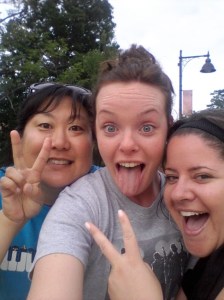
We’re calling our reflections Our Compass Shifts because it has and it does, depending on the needs of our students. From Texas to West Virginia to California to New York, we are four high school teachers with different backgrounds, teaching experience, and student demographics, who believe in the genius of our students.

Please meet my new colleagues:  Shana Karnes (WV), Emily Kim (CA), and Erika Bogdany (NY). You’ll find their bios on our About page, but I’ll let them introduce themselves and their students as they take turns posting each week. They’ve got teaching soul that makes me shiver. Oh, and see? They are walking talking FUN.

Think about what swells in the heart of your teaching. I hope you’ll share the answer: What is in your teaching soul?

OMG! Do You Think You Have Enough Books?

photo-1Last August, as I started in my new role of instructional coach for my district, people often said that I would go through a grieving process as I left behind what I once knew to embrace the unknown. Throughout the year, many have asked if I have missed the classroom, and of course, to some degree the answer is always yes, but there is one specific thing that I miss the most… MY BOOKS!

Walk into my room and more likely you would have asked me, “Jeez, Heather, do you think you have enough books?” Of course, my answer was always, “Uh, NO! How would that ever be possible?” No doubt, the best part about my classroom was my extensive library. If I spent a day and counted, I’d probably total close to 1,500 or more books, all cramped on shelves, waiting to spring into the hands of an unsuspecting reader.

Kids need easy access to books, just like they need easy access to their cell phones. The library can be too intimidating; the book stores are too far away, and often the shelves in their homes are void of books. As the teacher, if I wanted to send the message that books are important, there is no better way than to fill my room with books – good books, colorful books, books that students want to read.

Where I Find Books
* scooped up from a retiring teacher (Why won’t more teachers take early retirement?)
* freebies at conferences (Yes, I lurk in the corners of exhibit halls, executing a flawless freeloader innocence. Note to self: ask Amy to write about her stealing from a vendor experience.)
* purchased at the Scholastic Book Warehouse clearance event (Watch the calendar and pay attention to the Scholastic website)
* given to me by a students – (Please, no more Starbuck’s giftcards and scented candles… I NEED BOOKS!)
* Half Price Books (If near a warehouse, the free give-a-way for teachers is worth it. Otherwise watch for coupons. I just used a $15 off of $50 purchase that meant 21 new books.)

Why I’ll Never Have Enough Books
It’s more effective to walk over to the shelf and hand a student a book than it is to tell her to go to the library or to the bookstore and get it herself. Ever had this happen: a friend tells you about a book, and you think “Oh, I want to read that.” Unless you write it down or make a stop at the bookstore on the way home, you’re not likely to get that title any time soon. Magnify that by 20, and you’ve got what happens with a student. Most often you have to put the book in the child’s hand. Is she guaranteed to read it? No, but I increase the chances exponentially when I grab a book, chat about it, and hand it to a student. And with some students I place one book and another and another, until the student finds the one she wants to read. That’s why my shelves scream with diversity.

In my classroom, I arranged my bookshelves by genre because students may not know what they like to read, but they know what they like. A girl may not know she likes Sarah Dessen novels, but she knows she likes romance. A boy fascinated by the Civil War may search my shelf of war-themed books and discover the writing of James L. Swanson. By placing the books by genre I am able to create a type of comfort zone where my students feel free to explore. Just like no two students are alike, no two readers are alike. The more books on my shelves, the more opportunities I have to get students to read.

How I Kept Track of My Books
I didn’t. I literally have a love relationship with my books. My students know of my affinity, and they quickly understand that the books on my shelves are my personal friends. Friends that will break my heart if I lose the connection. Many a time when a student lost one of my books, he’s replaced it because he knows I care about each of my books. The real deal though– if a book doesn’t make it home to my shelf, I’m okay with it. Maybe it’s altruistic, but I hope she’s happily getting read somewhere by someone. As teachers and librarians we must remember that we cannot be the keeper of the books and the stories they hold (even if they do end up at Half Price Books with your name clearly stamped on them.)

Last May, at the end of the year I carefully selected my most treasured friends, but then I, like someone had once done with me, passed them on to another teacher to share the love of reading with her students. I can only hope her students have found as much pleasure in them as mine once did.

How do you build your classroom library? How do you prevent your books from never returning? (or do you?)

It’s Monday What are You Reading? Me? Starting Summer Reads

Mon Reading Button PB to YAEarlier in the year I shared some data on literacy rates with my students. Some of the numbers made them mad; they called them “racist” because white readers by and large have higher literacy rates than Latinos. We had a decent discussion about why that might be the case, but I could tell my students still didn’t really “get it.”

Then, I came across this blog post at Literacy Learning Zone, and I knew I had a useful tool to help my students understand why their reading levels might be lower than some of their peers’ at the high school across town. We watched the YouTube video that explains the gaps created by a lack of reading during the summer. The timing was perfect. All morning administrators were busy calling individual students into the hall to discuss their recent STAAR EOC scores and summer school options. Kids were sad.

I’ve encouraged, begged, pleaded with students all year: “The single most importance thing you can do for your education is READ. Read books, magazines, newspapers. Read anything for extended periods of time.”

If only they would believe me!

So, today after watched the video linked inside that blog, I gave my soon-to-be sophomores their summer reading assignments. It’s pretty simple: Read any book of your choice that has some literary merit (we talked about what this means) and make a note of 5 significant quotes. [I suggested they look for the Notice and Note signposts. Thank you Kylene Beers and Bob Probst.]

I will read this summer, too. I am excited to be back in the classroom full-time. That district instructional coach job just didn’t line up with my passion– a lesson I learned from reading Ken Robinson’s book The Element. I miss the students, and I miss learning with my students. My schedule is heavy with three preps, but the trade-off will be worth it. I’m already excited about the reading I need to do to get back into the groove of an AP Language class.

Here’s a shot of what I start reading, and/or re-reading this week.  Lucky me!

My 2013 summer reading


Reel Reading for Real Readers: Summer YA Book Trailers

20130207-190708Pinterest, I love thee!

I didn’t think I would, but when my daughter told me that people were refurbishing and painting “old and ugly furniture like you have in the house, and you can learn how to do it on Pinterest,” I took a peek.

Yeah, ideas galore. (I even took my daughter’s advice, and who knew I could paint such beautiful furniture?)

But, here’s the thing:  There are boards for almost Everything. Even Summer Reading ideas for YA.

Oh, yes, please!

So, #ReelReading will take a break until school starts up next fall, and in the mean time– go check out this awesome board. I’m sharing it with my students next week.

Pinterest

Reel Reading: A Child Called ‘It’

20130207-190708.jpgI’d love to get my students to do some of this cool typography. Since they will be making their book trailers this week, I wanted to show them this option for their creations.

I’ve had great success getting even the most reluctant readers to read A Child Called ‘It’ by Dave Pelzer.

See? Isn’t all that letter and word movement cool?

If students like the topic of abuse (which I don’t quite understand), they might also like Ellen Foster by Kaye Gibbons. I haven’t seen the movie, but this trailer looks like it’s pretty well done.

Maybe next time I’ll look for happy topics.

Sheesh, Amy. This is depressing stuff.

Reel Reading: The House of the Scorpion

20130207-190708I love to watch student-made book trailers, especially when the students are not mine, and I’ve already read the book. I guess I see with a teacher’s eye:  Did the student get the gist of the book? Did she love it and want others to read it as much as I did?

I felt a thrill when I watched this trailer for Nancy Farmer’s The House of the Scorpion. The images and music parallel one another nicely, adding that touch of intrigue, which parallels the adventures in the book. The few errors in writing make me smile– my students will do that, too.

My kids will soon start creating their own book trailers. They got to choose the books they read. They get to figure out how to format and create a trailer that will get others to want to read that book. Should be interesting to see what they come up with.

I cannot wait.

Reel Reading: If I Stay by Gayle Forman

20130207-190708For their final project my English I students are to create their own book trailers. We’ve watched enough of them this year that they should have a pretty good idea of what an effective trailer should do:  compel someone to read the book.

In a last ditch effort to get my kids to understand the task, we are watching student-made book trailers for the next little while. These are a couple that are done very well about the book IF I STAY by Gayle Forman.

In my experience, if you can get a kid to read just one of Forman’s books, she will read them all.


It’s Monday. What Are You Reading?

Mon Reading Button PB to YAToday I am reading something for me. All me.

I’m tired.

I’m tired of school and kids and teaching. I’m tired of testing (and my students’ tests has been over for a while now.)

I’m tired of reading YA novels about punk kids, drugs, gangs, and so much angst.

Get it? I’m tired.

So, this Monday? What am I reading? This inspiring book that has helped me see some things clearly for the first time in a very long time. I’ve written inside the front cover: “Stop trying to be God.”

It’s a start.

Prior Knowledge: Helping our Struggling Readers

book depository

Every day we must make decisions, and somehow, whether we realize it or not, we are accessing our prior knowledge to make these decisions.  For example, there is a restaurant that I will never eat at again. 15 years later, I still remember the time I got violently ill after consuming one of their calzones. Now, someone brings up that restaurant–I cringe.

Sometimes my prior knowledge doesn’t come from real life. Sometimes it comes straight out of a book. A few weeks ago I had to make a really tough decision. As I sat weighing the pros and cons of my choices, Beatrice, from the book Divergent, and the struggle she had making a difficult choice came to mind. I found myself relying on her experience because that in fact was exactly how I felt.

Prior knowledge can come from a multitude of places, but it is the experiences I have had–along with the books I have read– that fill my storehouse of prior knowledge.  So what about prior knowledge and our struggling readers? Their storehouse of prior knowledge is barren. In talking specifically about early literacy, Nancy Lee Cecil explains that, “What readers bring to the activity in terms of prior knowledge … determines how well they will be able to derive a rich meaning from the text,” (Cecil, 2003). So, what about our students who do not have a rich background of prior knowledge? Whether it be a lack of experiences or a lack of reading–my question is:

What are we doing as educators to support students creating a bountiful array of prior knowledge experiences?


The most important thing teachers can do to help equip their students with a wealth of prior knowledge is provide opportunities for them to read–and read a lot. It isn’t about assigning book after book as a whole-class novel. It is about Independent reading. “Independent reading is all about capacity building,” (Kittle, 2012). By allowing students the time to vicariously live through the lives of characters in books, we in turn are allowing them to store up experiences. As teachers it is our responsibility to, “pay attention to the quantity as well as the quality in their reading lives (Kittle, 2012).” If students are to truly live culturally rich lives, then we must be more intentional about how we are making this happen in our classrooms.

Cecil, N. L. (2003). Striking a balance: best practices for early literacy (2nd ed.). Scottsdale, Ariz.: Holcomb Hathaway, Publishers.

Kittle, P. (2013). Book love: developing depth, stamina, and passion in adolescent readers. Portsmouth, NH: Heinemann.

Photo credit: TunnelBug / Foter.com / CC BY-NC