Category Archives: Readers Workshop

Thinking about my Reading Roots: a Response

Sometimes others write my thoughts. Shana did that this week in her post about Reading Resolutions.

Well, not the part about traveling to England and visiting all the awe-inspiring places she mentions. (“Someday,” I tell my self daily.) But the part about losing her way as a reader, and the part about needing to “read my roots.” This is so me.

When we run a readers and writers workshop classroom, we read so we can encourage our students to read. Sure, we can book talk titles that we’ve only heard of — there is a little art to that though. Sure, we can have students book talk to one another — this works well when we’ve modeled talking books enough times. And while most of the YA literature I have read over the past several years has held my attention and given me insights into the minds and hearts of my students, it is still not my roots. (Honestly, I get a little tired of all the teen angst that my students love to read.)

Like Shana, my roots run deep into literature. I love the classics. I mean the real old classics — a little Homer, Greek tragedy, a comedy or two, definitely a book of Will’s plays, maybe some Milton, and more.

I teach none of it. And I’m okay with that.

In AP Language, our focus in non-fiction:  speeches, essays, op-ed pieces, arguments, and I have managed to include literature in our book clubs and poetry into our writing workshops. This works great for the purposes of my course design and my teaching. I just sometimes miss the me kind of reads.

Right now I need to think about me.

Here’s three things I’m doing to focus on the Reader who responded to Shana’s post with a “Yes, yes, yes, a thousand times yes”:

1. Participate in a Book Club.  We’ve only met twice, but we’ve read two interesting texts: State of Wonder by Ann Patchett and Unbroken by Laura Hildebrand, and our next book is Station Eleven by Emily St. John Mandel. Grown up talk about books we read for pleasure. That’s about my favorite thing.

2. Challenge myself to read author’s I’ve never read: James Joyce, Kurt Vonnegut (ok, I read “Harris Bergeron”), J.K. Rowling. I have many more, but these are the first three that came to mind.

3. Attend an event at the Dallas Institute of Humanities. A new colleague filled me in on the offerings here. I had no idea. On-going classes, and then in the summer a Teacher’s Institute to study Tragedy/Comedy and Epic Tradition.

What are you doing to reach your roots?

©Amy Rasmussen, 2011 – 2015

Reading Resolutions

For the past few years, all of my reading has been for the purpose of research.  I read pedagogical teaching texts or young adult lit almost exclusively, and when I branched out from that, it was to read complex books that I thought I might use to challenge my students to use for craft examples in class.  I read only as a teacher, and not as a reader.  In 2015, I’m determined not to do that.

pc

Poet’s Corner

Ten days ago, I was in London, England.  Pretty much every moment of every day since then has been spent either reliving a magical moment there, or frantically trying to catch up with everything I fell behind on here in real life.

Much of that trip of a lifetime was spent flitting around different literary sights in London.  My husband and I had a beer at The Plough, the famed pub of Dickens, Woolf, and Darwin.  We visited Poet’s Corner in Westminster Abbey and saw graves of and memorials to my heroes Jane Austen, William Shakespeare, C.S. Lewis, and more.  We enjoyed a visit to the home of the most famous fictional character in England, Sherlock Holmes.  The Globe Theatre, The British Library, Southbank Book Market…we saw it all.  Awash in the history of English literature, my trip made me desperately want to revisit much of it.  I can’t think of the last time I read a classic for pleasure.  So, I made my first reading resolution for 2015: read my roots.  My degree is in literature, but I’ve missed out on a lot of its classics–probably because they were assigned as boring whole-class novels and I knew about SparkNotes, but I digress.

NYT-list---11---Cropped-761259So, I knew I wanted to read some classics for fun.  But I also wanted to make sure I read lighter, easier things too, for a different kind of escapist fun.  I got curious about bestsellers I’d never bothered exploring…Janet Evanovich. James Patterson. Sue Grafton.  I’ve never read any of their books, but millions of others have. So, that’s another resolution–read my age.  I’m a 27-year-old female lover of mysteries, and I’ve never cracked the spine of an Agatha Christie! So much of my reading life is focused on the 11th graders in my classroom, but I need to read my age, too.  I want to read what everyone is reading and talking about–all of the New York Times bestsellers, not just the Young Adult list.

FullSizeRender

Heaven in Outer Banks

My last resolution is to relax and read.  I recently read an article about a woman deciding not to participate in the GoodReads Reading Challenge because she felt like it stressed her out and diminished her intrinsic love of reading.  The comments were overwhelmingly negative and unsympathetic, but I found myself in complete agreement with her!  I was always “behind schedule” on the challenge, always feeling like I couldn’t take the time to read anything massive like The Goldfinch or pondering like The Poisonwood Bible or immersive like Will in the World.  Those books would take me way too long to read, and how was I supposed to find new things to booktalk for my students then?!  Well, I’m done with that.  I want to return to the days of my vacation in North Carolina last summer, where it rained for seven days straight and all I did was read.   It was the perfect beach vacation.

FullSizeRender (1)

My selfish to-read list

2015 is my year to stop feeling guilt, obligation, or stress about books.  Yes, reading saves lives, changes the world, and creates empowered, literate citizens, but that’s not why people read.  And that’s not why I try to get kids to become readers.  Reading is an exercise in imagination, in escape, in adventure.  It’s joy and pleasure and heartbreak.  It’s empathy and knowledge and understanding.  I’ve been so busy trying to teach that that I’ve forgotten it myself.  This year, my resolution is to remember that.  What’s yours?

Share your #readingresolutions and see others’ on Twitter.

Cliché No More

Yes, I’m going there.  I’m making it wildly obvious and apparent that we have made it to the end of yet another year.  Cliché, I know.

cli·ché – klēˈSHā/ noun –a phrase or opinion that is overused and betrays a lack of original thought.

As if we haven’t been counting down the days for sometime now or looking forward to a fresh start as 2015 rolls around in less than 24 hours; this is a time when we allow ourselves the luxury to think about everything we’d like to leave in the past (and slip into the belief that we actually can leave whatever it is we don’t want anymore in 2014 – simply because the clock strikes twelve).  We’ve been detailing and tweaking our New Year’s resolutions to complete and utter perfection (because in these euphoric (some would argue – desperate) moments we believe perfection actually exists).  We’re ready for a change.

But, should we be?

I’ll be the first to admit that my 2014 was as tumultuous as tumultuous can be.  No, really.  Room 382 has been turned up, shifted around, marked, bruised, taken advantage of, and sadly (at moments) not utilized to its fullest potential.  Yet, every morning with the heat blasting (awaiting student complaint) there’s an essence that is viscerally undeniable.  I walk into a space, a quiet and waiting space, that invites risk, mistakes, setbacks, and quite frankly – the undeniable ugly.  Yet, there is no judgement, discerning undertone, nor slight anticipation that today there will be no progress.

Why would I want to leave all of that in 2014?!

I want these feelings, these realities, these quiet moments of hope to stay tightly tucked in my pocket as I make the invisible leap into 2015.  I don’t want to leave the struggle, nor the beauty, behind – it has become a part of who I am (as an educator, woman, thinker, problem solver, learner…).

can’t forget those moments when students found their way through pieces of literature that sparked their love for reading.  And I’m talking: “we’re-so-thirsty-we-can’t-get-enough”esque love of reading!

won’t allow myself to pretend none of this happened – because it did.  I know it.  Students know it.  It’s been what we’ve all held onto when it seemed there wasn’t anything else to keep us grounded, or stable, or…moving forward.

But, we have moved forward, right into the New Year.IMG_20141223_083315

And, while we are half way through our 2014-2015 winter break, I hold tightly to this: Our Reading Plan for Winter Break.

Students have committed, willingly, to really think through which books they want to explore during our hiatus.  Every student’s list is vastly different than the next, yet their pride in taking on this challenge (an hour of reading per day) is evident.  They are playing with genres; being honest about time constraints and the length of specific books; some wildly ambitious, others playing it safe.  Regardless, this is the tangible that will be welcoming us all into the New Year.

This will be the first thing we talk about upon re-entering room 382 and our time together on January 5, 2015.  We will be exploring all we learned about reading in 2014 and see how we all (myself included) challenged ourselves independently.  How did we fly?  When did we feel our wings getting clipped? What did we learn?  What do we want to share?  And so on and so on.

So, as the New Year always brings new promise and a sense of intrigue, I challenge us all to not lose sight of the beauty of the year past.  Bring with you the moments that challenged you the most. Capture, in vivid detail, the time you (and students) felt alive and connected.  Take a moment to massage the inner strength you know has become dormant sitting right below the surface and embrace it.

We owe it to ourselves and our students to relish in the relaxation, adventure, and exploration that this break offers, yet continue to embrace the challenges of late and invite the unforeseen new ones in.  This year, I am shouting loudly and proudly,”Cliché No More!” because with every year comes a newness balanced with a familiarity of knowing.

Here’s to a happy and healthy to you and yours!

A Book About Food?

IMG_20141216_210906You better believe that when Steven Spielberg and Oprah Winfrey collide (behind the big screen) an emulsion of magic erupts.  The One Hundred Foot Journey written by Richard C. Morais turned film was two hours and four minutes of robust richness, immaculate vastness, and intense human connection.  So, no…this book is not solely about food.  Although food, most of the time, tends to be the main character.  I love when authors and film makers do that!

Immediately following my trip to the theatre, was (obviously!) a trip to the bookstore.  Yes, at 9 p.m.  I wasn’t worried about the bookstore not being open but I hadn’t even thought to think that they would be out of the book.  I should have!

An immediate login to Amazon.com and my book was on its way — to be delivered a quick two days later (Thank you, Amazon Prime).  And it wasn’t long into the book when I came across this:

But this you must know:  the violent murder of a mother – when a boy is at that tender age, when he isIMG_20141216_205952 just discovering girls – it is a terrible thing.  Confusingly mixed up with all things feminine, it leaves a charred residue on the soul, like the black marks found at the bottom of a burned pot.  No matter how much you scrub and scrub the pot bottom with steel wool and cleansers, the scars, they remain permanent.

Did anyone else just witness the intense power of Morais’s carefully chosen craft?  Imagery, word
choice, symbolism…shall I continue?  When students ask me what I’m reading or why I’m even reading it; I turn to this page and let them read it for themselves…it’s already tagged.  Most times students’ responses start with a sigh followed by a “Wow” or “Whoa”.  Then the conversation begins.  And, just like what Spielberg and Winfrey have created, our conversations chronicle the richness of this sentiment, immaculate precision and craft of Morais, and the intensity of this reality.

What books have you stumbled upon that have hidden gems in them that you love to share with your students?

An Important Invitation


“WHAT THE [insert expletive]?!”

I do not move.

“NO WAY!  I can’t believe it!  How the [insert expletive #2]?!  Miss Bogdany, come here!”

I’ve been invited.

As I slowly walk toward Christian, both legs extended and perched atop his desk; he need not move. His eyes are bulging.  Is his look one of momentary panic?  Complete disbelief?  A moment of sadness? Regardless, the look on his face is all the body language needed to understand; this young man has just experienced the beauty of literature.  (Although I bet he would beg to differ that ‘beauty’ may not be the appropriate word choice.)

————

This year has been remarkably challenging in ways that I have had yet to experience.

All gritty yet beautiful.

After three and a half months of trying to persuade…breathing (deeply!) through rejected book recommendations…buckling up for the daily roller coaster ride of never really knowing what opinion will be formed about reading that particular day; this invitation could not have come packaged anymore suiting.

While there have been constant shifts, differentiated activities, mentor texts, book talks (on countless genres), writing topics, unsuccessful attempts at captivating student interest…(we all know how long the list gets); one thing has remained constant.  I committed, at the very beginning of the year, that no matter how many changes are made to our learning community, the Reading Writing Workshop goes nowhere!  Student choice has remained constant…and thank goodness it has because the expletives, the lounging student…this is exactly how today’s position on reading needs to be explored; gritty yet beautiful.

 ————

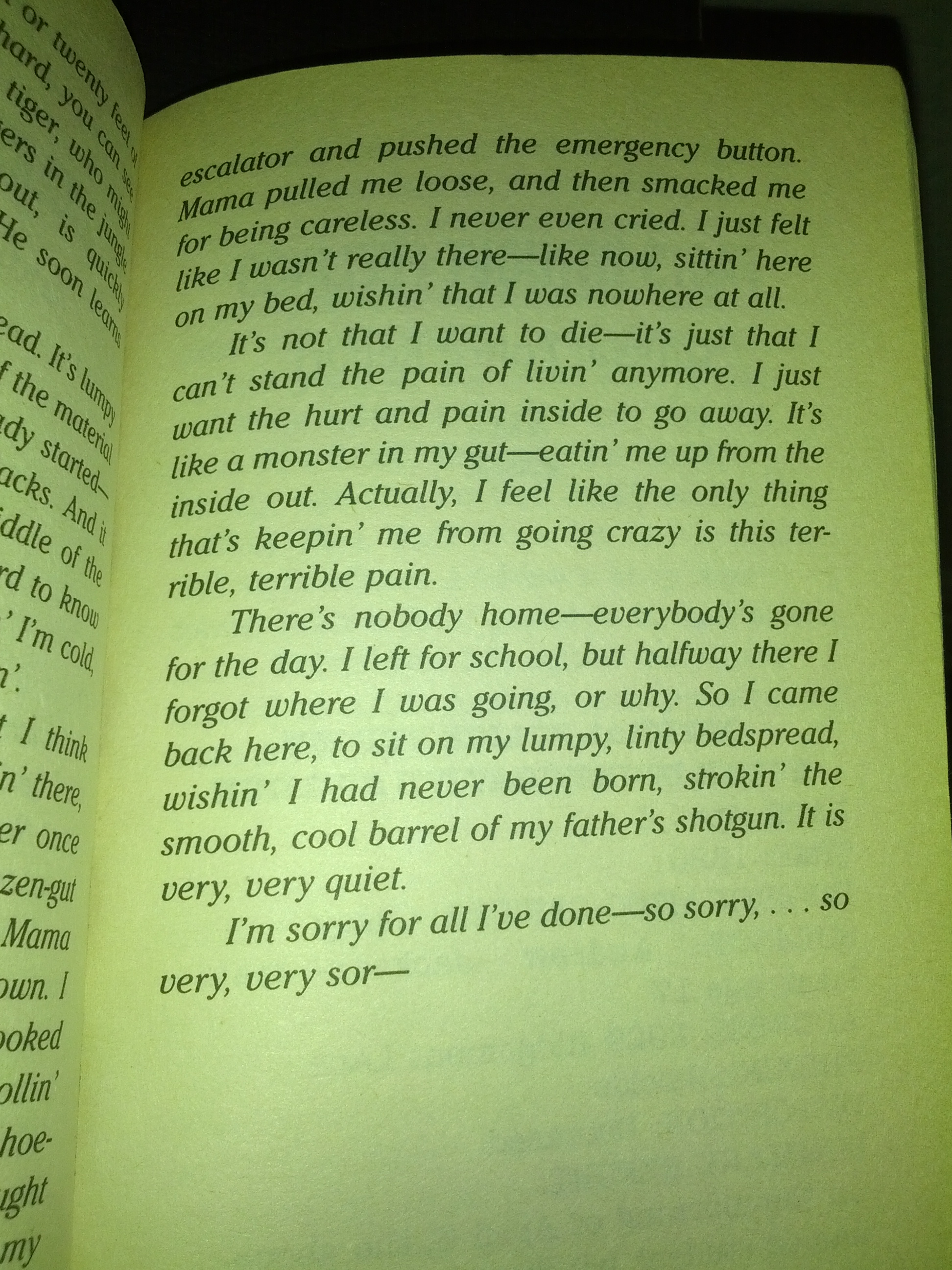
As ChrisIMG_20141215_175627tian holds tight to Tears of a Tiger by Sharon M. Draper (a popular read among students and the first book in the Hazelwood High trilogy), he points to this passage and invisibly underlines each word as he flies through the paragraph that starts “There’s nobody home – 

He then pauses.   His finger moves to the last line, lingers there as he looks up at me, and continues…”I’m sorry for all I’ve done – so sorry, …so very, very sor-

“Ms. Bogdany, did you SEE that?!  He kills himself!  He doesn’t even finish his sentence!”

I am most definitely taken aback.  First by Christian’s intense grasp on the craft of the writer and secondly by the wild intensity of a young man taking his own life.  My eyes bulge too.

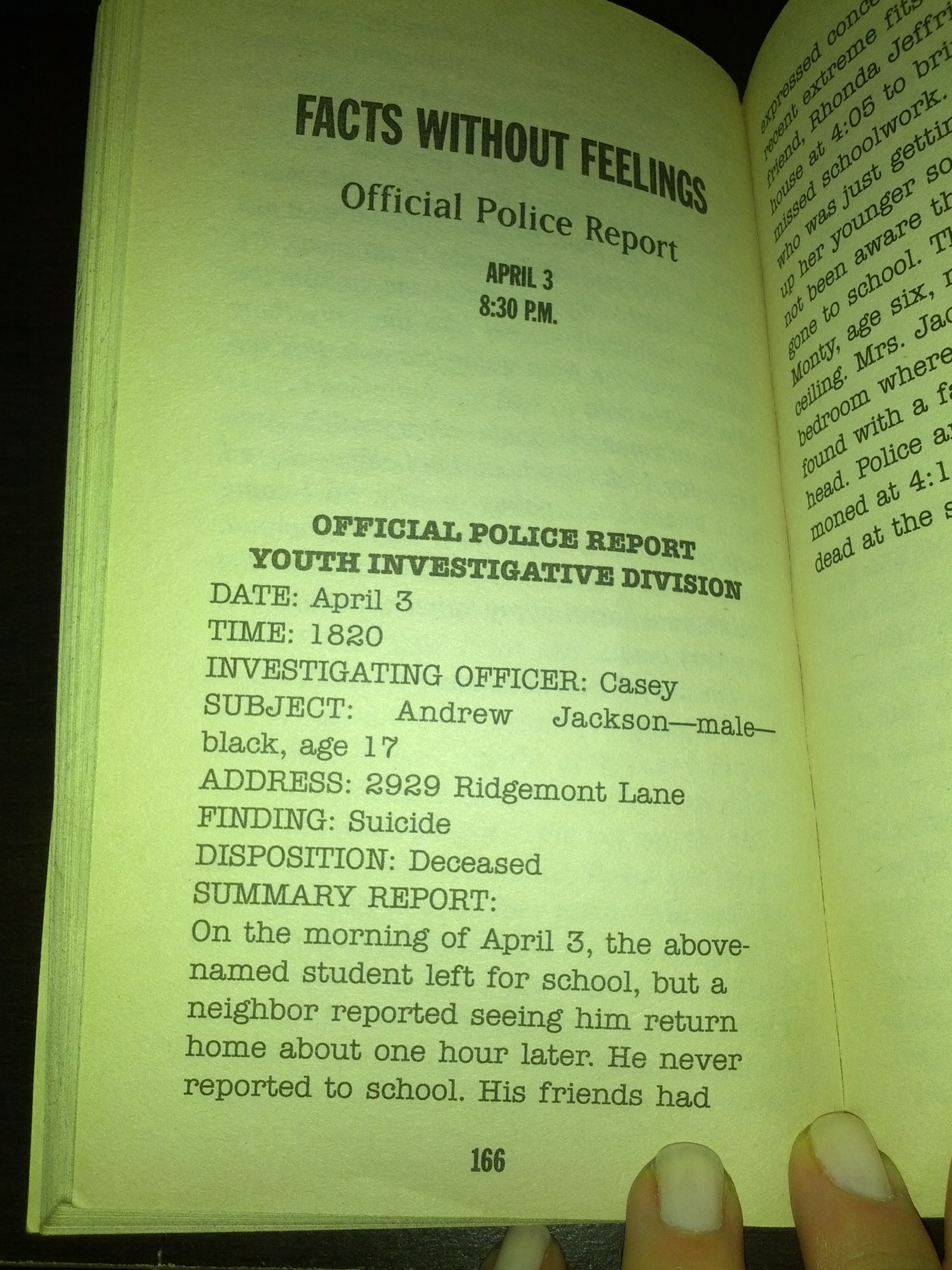
Then Christian continues.  Again, his finger leading the way…

IMG_20141215_175604

“Suicide!  This is the police report.  He killed himself.”

We both pause.  The weight of the word.  We both feel it.

“Ms. Bogdany, I just can’t believe it.  I knew it on the page before, but here it’s confirmed.  I had no idea this would happen.”

————

Christian has chosen many-a-piece that deals with Post Traumatic Stress Disorder (PTSD) and this piece is no different.  Here you have the main character who deals with survivor’s guilt after accidentally killing his best friend in a car accident.  You can only imagine how difficult life, for Andy Jackson, must be.  While attempting to ask for help throughout the piece, Andy feels as though he is alone.  Very alone.

This piece chronicle’s Andy’s journey and the fatality in which it brings.  Please note that students may want (and actually need) to talk about their feelings regarding this heavy issue.  Christian did, albeit the way in which he initially hinted.  Through the expletives I realized that Christian couldn’t be silent about the tragedy he just witnessed.  He needed to voice (in whatever way that surfaced) his knee-jerk reaction to the shock of Andy’s decision.

This piece has connected Christian and I.  It has given us the opportunity to chronicle his study on PTSD…and the real consequences that are associated with it.  He was able to walk me  through the craft of Sharon M. Draper.  This book will remain important for Christian for very specific reasons as it may very well be the piece that is forever etched in his mind.  This piece will also remain incredibly important for me, but for very different reasons.  Regardless of the reason, we are both grateful to Ms. Draper for her dedication to addressing real issues that touch the lives of our youth.

We Learn Facts from Fiction

NCTE is always so magical, isn’t it?  It’s a five-day frenzy of learning and teaching and connecting and wondering and writing, which should be exhausting.  But it’s not.  Somehow, I come back to school every year with so much energy, revitalized by the conference and its plethora of ideas and inspiration.

This year at NCTE, as the words and wisdom of my teacher heroes washed over me, I was drawn in by one theme that kept recurring–the role of narrative in informational text.  Given that the theme of the conference was “Story as the Landscape of Knowing,” this wasn’t surprising.  What did surprise me, though, was that almost everyone I heard speak discussed how narrative helped learners in the context of nonfiction.  I began to wonder–what about narrative in its most accepted place–fiction?  What information do readers learn from reading fiction?

ptiIn addition to hearing from many teacher-researchers, I also got to hear from many authors.  David Levithan, e. lockhart, Libba Bray, Lester Laminack, Paul Janeczko, Georgia Heard, and more spoke about their writing processes.  Every one of them mentioned research at length, and I jotted a note–“research processes are as multigenre as its products.”  All of those writers had a unique research process, but they were all strong.  These authors put work into making their fiction as fact-based as possible.  Others discussed putting their own lives into their fictional works–Sherman Alexie has too many parallels with the narrator of Part-Time Indian for it to be a coincidence.  What’s more authentic and research-based than a lived experience?

bsogMy brain was whirling.  How many fictional novels have helped me fill gaps in my understanding?  Between Shades of Gray enlightened me to the fact that there was a Baltic genocide.  The Absolutely True Diary of a Part-Time Indian taught me about culture on a reservation.  Extremely Loud and Incredibly Close brought 9/11 to life for me.  Peak showed me the world of Mt. Everest in a new light.

Fiction transports us to other worlds…it lets us know we’re not alone…and it saves our lives.  But it also teaches us a great many facts.  We don’t ask our students to read in order to just make them better readers.  We ask them to read because we know it will improve their lives…help them attack the “idea poverty” they suffer from, in Kelly Gallagher’s words.  Fiction, especially the YA fiction that is so popular in my classroom, is educational at an informational level.  Readers acquire knowledge of topics they had limited prior knowledge about by reading fiction.  They also gain understandings of universal themes and grand ideas, but they also learn facts.

Forgetting this is a grave oversight, and perhaps is at the root of why YA lit isn’t always considered “serious” literature.  Kelly Gallagher also said that “there is wisdom in Hamlet that is not found in Gone Girl,” and he’s right.  But there’s also factual information in Elizabeth Peters’ Amelia Peabody series about Egypt and archaeology that I did not get out of Antony and Cleopatra.  We do a disservice to authors when we discount their research processes just because they write in a genre called fiction.

All that we learn, and that our students learn, may best be processed in narrative form…but information doesn’t just have to come from nonfiction.  This is an important lesson–it’s why reading needs to be a schoolwide, nationwide, worldwide focus–not just the job of English teachers.  Reading EVERYTHING helps us acquire knowledge, expand our schema, make sense of the world, and become productive, intelligent, informed, democratic citizens.  And it also makes us pretty damn happy.

What fiction are you and your students reading that helps you acquire knowledge?

Building My Library Around My Students

My first time at NCTE, I played supermarket sweep alongside the other teachers. I didn’t have one of those grandma-rolling-carts to gather my goods in, but the victory was still sweet as I tossed book after book into my free bags. But lo and behold, as I returned home with my goods, I realized that some of the books were middle grade, a tad too young looking to impress my high schoolers, while others were sequels to books I didn’t own. My humble pile was quickly halved as I weeded out and gave away the books that just wouldn’t fit into my classroom library.

This year I took a different approach; I arrived at NCTE with certain students and issues in mind. Suddenly my mission to collect free and heavily discounted books turned into a mission to fill the holes in my classroom library. This not only narrowed my search but also made it easier to discuss potential titles with booksellers. The following are some of the gems I scored at NCTE 2014:

What I needed…Books that help students cope with a friend’s suicide

20726924Sadly, suicide is a tragedy that has touched my school a few times over the past few years. I am reminded of this at the beginning of every year when I receive personal narratives relaying the stories of students’ past friends or relatives. The wounds are deep and raw and fresh, which is why my students need literature to help them cope with such atrocities. This year, I left NCTE with two books that filled this niche: Rumble by Ellen Hopkins and The Last Time We Say Goodbye by Cynthia Hand. I have a growing group of Ellen Hopkins devotees who bask in the poetic prose of her books as well as the gritty subjects. Rumble attacks heavy issues through the story of Matt Turner, whose younger brother commits suicide 17285330after being bullied for being gay. The Last Time We Say Goodbye, which is due for publication in February 2015, tackles similar themes, only in this book, the female protagonist Lex loses her brother. Lex struggles to cope with her brother’s death and can’t let go of a text message she received from her brother the night he died.

This is unfortunately a topic that will continue to ripple through and impact my students as I receive students who are impacted by the deaths of friends and family members they have lost to suicide. There are no answers to such a devastating event, but I do hope that these books will help show students that they are not alone.

What I needed…Books that are low level but high interest

I fervently believe that students need a dose of success to give into reading. Too often my students 8011arrive turned off to reading simply because they haven’t been exposed to books that interest them. Furthermore, the students who are most resistant tend to be those who are not proficient or only partially proficient in reading and can’t seem to find books that are at a lower reading level yet a high interest level for their age group. My greatest find was a small bookstall towards the back of the convention room that included books from the Sidestreets and Real Justice Series. These books involve gritty stories with heavy hitting topics such as drug abuse, mental health issues, and social problems. While the books I received were between third to fifth grade reading levels, the sepia and black and white photo covers leant a more mature tone to the story—a strong selling point for low level, reluctant readers. I walked away with Jailed for Life for Being Black by Bill Swan, Blow by Jodi Lundgren, and Off Limits by Robert Rayner, all books I’m looking forward to introducing to my reluctant readers.

What I needed…Books that discuss LGBTQ Issues

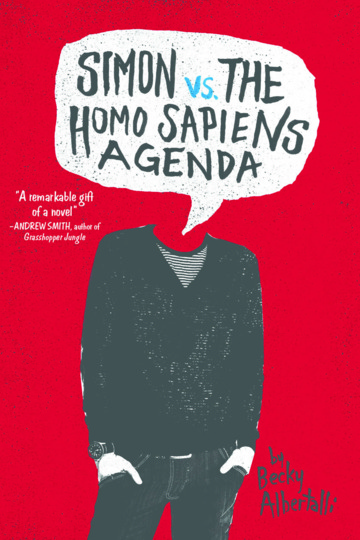
openlystraight_cvThis is the first year I have had openly gay students who have written either personal narratives or stories about homosexual relationships. The more I read their papers, the more I began to evaluate what sorts of LGBTQ mentor texts I had available. While I had a modest collection of book including Shine by Lauren Myracle, Everyday by David Levithan, and Will Grayson, Will Grayson by John Green and David Levithan, I needed more. That’s when I stumbled upon Openly Straight by Bill Konigsberg in which Rafe, an openly gay teenager, transfers to a New England boarding school where he decides to keep his sexuality a secret. A funny read, this book forces Rafe to question who he is and what it means to fit in. 10015384In a similar vein, I also procured an advanced reader’s copy of Simon vs. The Homo Sapiens by Becky Albertalli, which is due for publication in April 2015. This book follows 16-year-old Simon who is not openly gay. Simon is blackmailed after one of his flirty e-mails to a boy he has been talking with falls into the wrong hands. These books diversify my library and address issues that many of my students are both facing and writing about.

These are only a few samples from the stacks of books I received, but as I returned to the classroom on Monday, I told all my students about the exciting run-ins I had with famous authors like James Dashner and David Levithan and Ally Condie. I spoke with the students I had “shopped” for, letting them know what books I had bought and how I had them in mind when I purchased them. While I hope the books leave an indelible mark on my students, I know that ultimately my students leave an indelible mark on the growth and construction of my library.

What books did you bring home from NCTE? Are there any holes that need filling in your classroom library? What might you be searching for?

#NCTE14 J.44 A Reader’s Workshop Starter Kit to Jumpstart the Process

Erika, Amy, Shana, and I are presenting at the NCTE conference today at 2:45pm! Penny Kittle is our Chair, so please join us to discuss the landscape of workshop. We are session J.44.

Think back to your first day of teaching on your first year of teaching. What were you feeling? Happy, nervous, excited, afraid?IMG_1776 Fear. Fear was the first thing I experienced when I stood in my classroom on the first day of school. That and enthusiasm, excitement, eagerness, and hope, but ultimately, I was afraid, knee shaking, stomach churning nervous as I stood in front of my new class. Fear comes with the unknown, which is why my nerves of being a new teacher were compounded by my entry into the workshop model. The concept of the workshop model is simple, yet it’s a structure that so few of us grew up with. In turn, as I transitioned my classroom, I found my nerves could be categorized into the fear of breaking tradition, the fear of parents, the fear of students not reading, and the fear of proving rigor. I was not alone though. Interns and teachers who were new to workshop model faced many of the same fears. In turn, I created a reader’s workshop starter kit to provide my colleagues with concrete documents that helped them establish the workshop model in their classroom. The starter kit includes the following documents:

  • Elements of a Reading Workshop by Penny Kittle
  • Reading Letter for parents
  • Calculating Reading Rates & Reading Rates Log Sheet
  • Weekly Reading Recording Sheet
  • Excel Sheet Weekly Reading Recording Sheet
  • Book Conference Log
  • Questions to Ask While Conferencing
  • Book Talk Outline
  • Resources for Helping Students to Find New Books

Whether you are a new teacher or simply new to the reader’s workshop, I hope this starter kit will make your journey a bit easier. Enjoy every step and savor even the smallest successes. If you have any questions or comments about starter kit, please feel free to contact me at Jackie.catcher@gmail.com.

Click Here to Download the Reader’s Workshop Starter Kit

Two Wes Moores?

Here’s what I love about literature; when there’s not one but two options that propel me through the exploration of a writer’s story.  It gives me options, varied yet similar journeys, and choice.  I love choice.

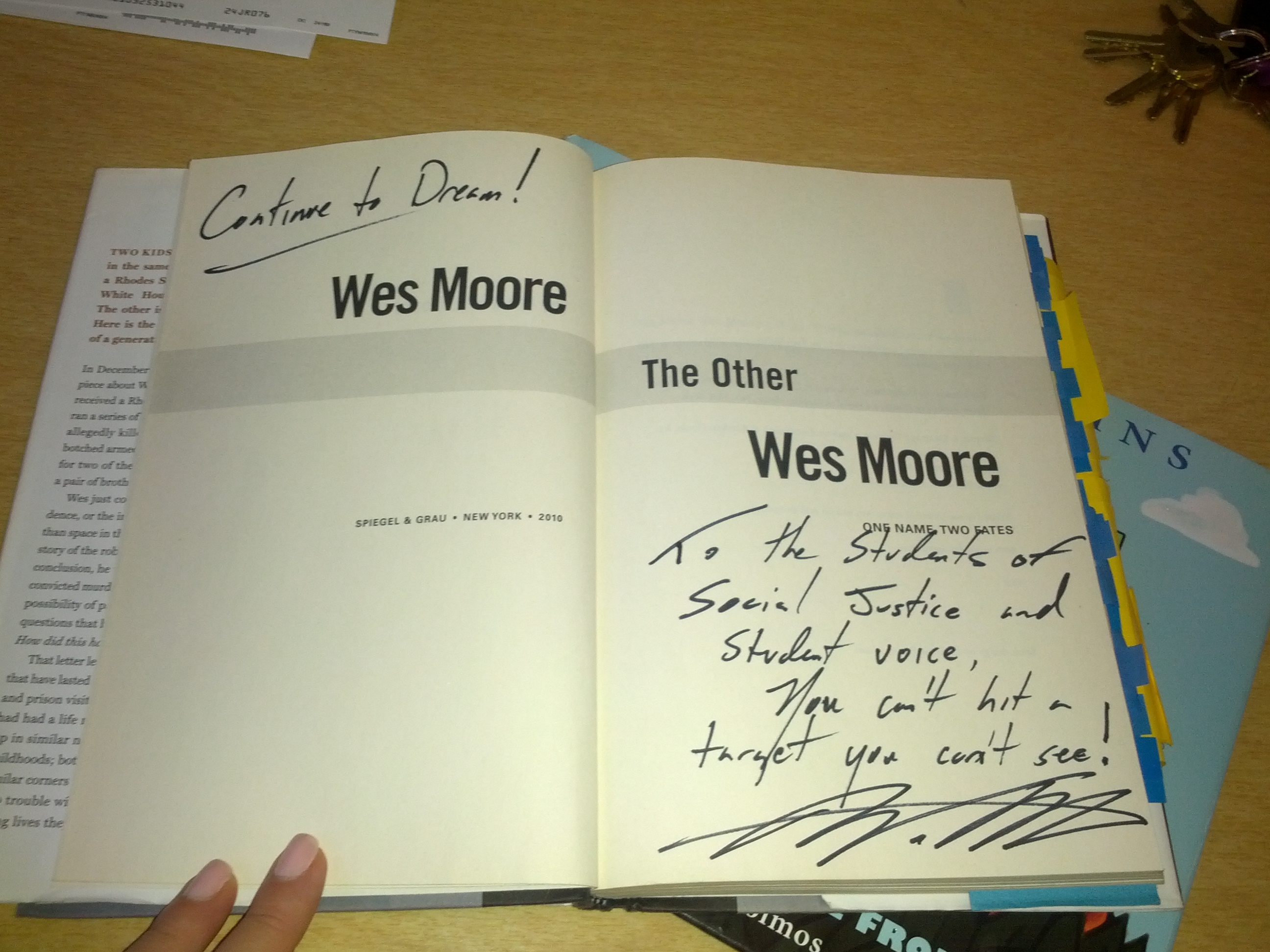
IMG_20141105_162445

To the students of Social Justice and Student Voice, You can’t hit a target you can’t see. Continue to dream! -Wes Moore

I also love when I get to meet an author and hear him speak about his story; both in the writing and in his account of the events.  What better way to be introduced to another’s extraordinary life?

And, an extraordinary life it is.

In The Other Wes Moore by Wes Moore, upon realizing that Wes was not the only Wes Moore residing (as a youth) on the streets of Baltimore, he felt compelled to connect with the other man sharing extraordinary similarities; the same name, fatherlessness, and navigation through the world the best way they knew how.

And, so the story begins.

By taking a leap of faith and contacting the other Wes Moore (while jailed for a crime that put him behind bars for a lifetime without parole) Wes opens the door for connection, dialogue, and an unbreakable bond.  Human connection at its core.

I introduce students to the significance of the dividing gray line - the shift from Wes Moore to the Other Wes Moore (and vice versa).

In The Other Wes Moore, I introduce students to the significance of the dividing gray line – the shift from Wes Moore to the Other Wes Moore (and vice versa).

That’s all I share with students when introducing them to this piece.  And then the questions swirl: Wait!  What do you mean they have the same name but live such different lives?  Does the other Wes answer Wes’s request to communicate?  Wes visits the other Wes in jail, huh?  What does he mean when he says (compliments of the cover), “The chilling truth is that his story could have been mine.  The tragedy is that my story could have been his.”?  If he’s not in jail, how could it be a tragedy for the other Wes Moore to live Wes’s life?   This is wild!

And now, Discovering Wes Moore (the Young Adult adaptation) provides access to readers who are intrigued by (as the title suggests) discovering Wes Moore, the author.  This piece brings readers through the linear journey of the author’s life, struggles, ah-has, life choices, and incredible realizations.

Both Wes Moores on display in room 382

Both Wes Moores on display in room 382

Here’s what I love about this piece, students do not enter into the potential complexity of following two stories interwoven; they simply get to focus on one story line.  For readers who are interested in autobiographical narratives, this provides them access to a story not to be missed.

Some students enjoy reading both pieces simultaneously by the means of an author study; while others enjoy choosing only one piece to explore.  Students of all reading levels and interests find themselves consumed by these pieces – the craft, reality, and unbelievable story that is oh-so-honest.

The Other Wes Moore and Discovering Wes Moore are continually transient. They don’t stay on our shelves for any extended period of time. As soon as students realize they’re back and available for the taking, they do just that while others’ Next-To-Read lists grow.

I love that both Wes Moores find themselves in the hands of inquisitive learners because, to date, not one student reader has been untouched by their story.

Painting With Words: Sold

c_soldPatricia McCormick is a painter. Not literally, but she might as well be given the way she writes. Her vivid imagery and poetic prose paired with her short vignettes make Sold a must-read.

Somehow, Patricia makes the heavy subject of sexual slavery both approachable and manageable. Whereas many of my heavier books on women’s rights or international affairs sit dormant in my classroom library, Sold has made it through many hands. I believe there are multiple reasons for this: first, Sold isn’t intimidating in length or size. It feels manageable for many students. Second, Sold is written in short vignettes with wide spacing between the lines. Students can find themselves ten or twenty pages into the book with minimal effort.

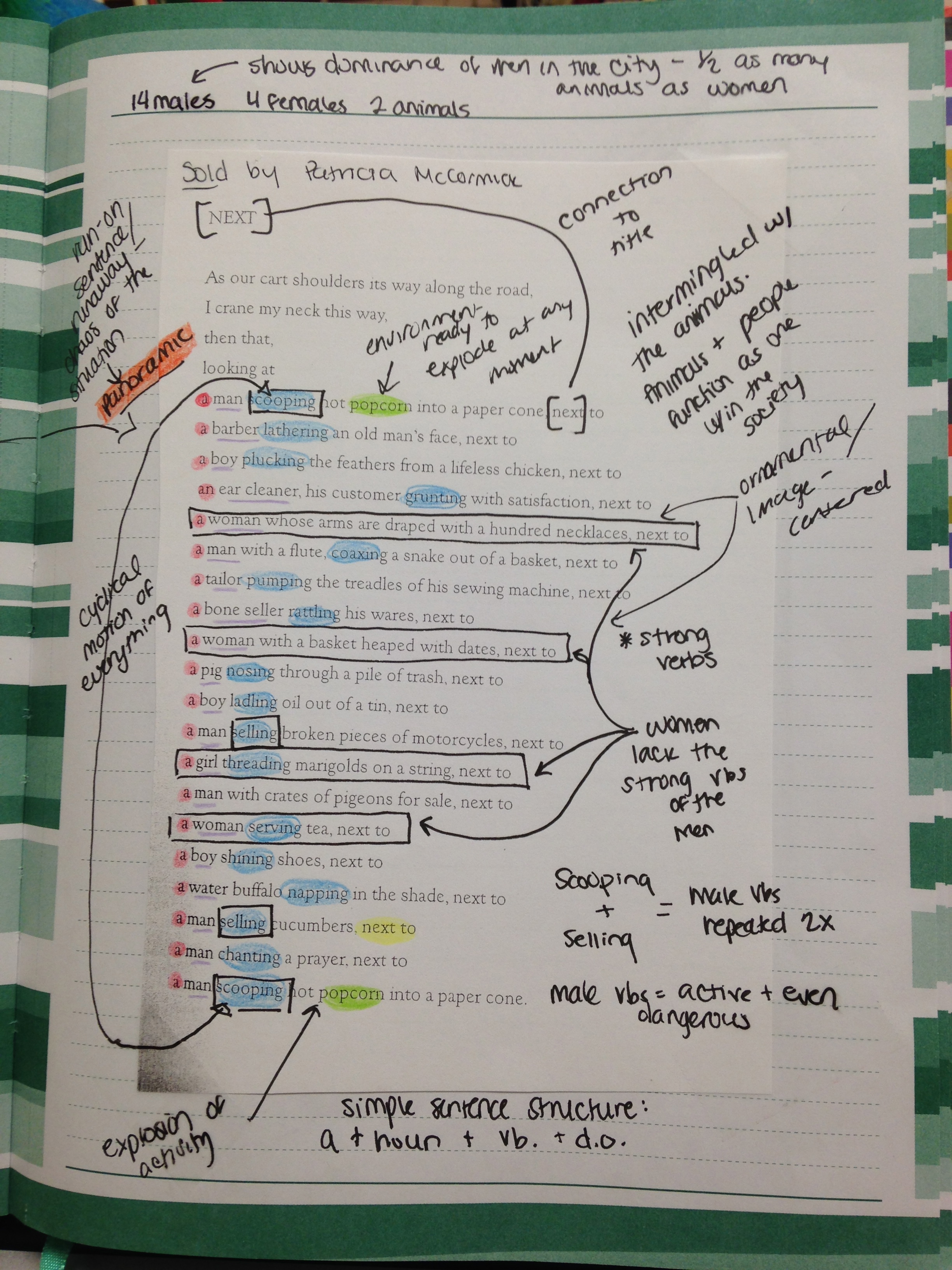
Furthermore, the book lends itself to close reading and craft study. Each vignette is chock full of exceptional writing as Patricia McCormick plays with diction, descriptions, repetition, and a wide variety of craft marks. In turn, I can’t pick only one example, so bear with me as I walk you through two of the many passages with which I am obsessed:

Everyday, students walk into my classroom burdened by mammoth backpacks and equally sized worries. It’s tough to be a teenager, which is why I love the vignette “What I Carry.” I hope to use this as a quickwrite to find out what students carry with them throughout the

One of the many passages I have photocopied and dissected in my writer's notebook.

One of the many passages I have photocopied and dissected in my writer’s notebook.

day.

WHAT I CARRY

Inside the bundle Ama packed for me are:

my bowl,

my hairbrush,

the notebook my teacher gave me for being the number one

girl in school,

and my bedroll.

Inside my head I carry

my baby goat,

my baby brother,

my ama’s face,

our family’s future.

My bundle is light.

My burden is heavy.

In the second passage, “Between Twilights,” I love McCormick’s use of sensory details. This is an excellent passage to model the concept of “show don’t tell” in writing.

BETWEEN TWILIGHTS

Sometimes, between the twilights.

I unwrap my bundle from home

and bury my face in the fabric of my old skirt.

I inhale deeply,

drinking in the scent of mountain sunshine,

a warmth that smells of freshly turned soil and clean laundry

baking in the sun.

I breathe in a cool Himalayan breeze,

and the woodsy tang of a cooking fire,

a smell that crackles with the promise of warm tea

and fresh roti.

Then I can get by.

Until the next twilight.