Category Archives: Readers Workshop

On Annotations and Assessment in Readers Workshop

If you’ve read this blog for a while, you know that I advocate for self-selected reading in all English classes. My students read stacks of books each year that they choose for themselves, and they read four titles for in-class book clubs that they select from my short stack of complex (mostly) contemporary titles.

The question I get the most from teachers who do not practice this choice pedagogy is “How do you know your students are reading?”

My initial response is usually:  “I ask them.”

But if you practice readers and writers workshop in your classroom, you know that it takes a bit more than that to know that students are developing as critical readers.

We do still have to teach.

Shana wrote a post recently about the value of talk in her workshop classroom, and I was intrigued by one of the comments:

I think we should consider what would be the best balance between between teacher and student talk. As the literacy expert in the classroom, I think the reading/language arts teacher’s voice needs to be heard often. While we all can be our own teachers, we will probably learn more with the wise guidance of a teacher.” 

But, of course.

Balance is key. So is authenticity.

These two ideals drive the choices I make in my workshop classroom.

My new friend, Lisa, sent me a question that got me thinking about both as I composed a response. I share her question here and how I replied to this dedicated teacher who is moving herself as she moves her readers.

Question:  Do you assess any annotations the students do with their reading? I’ve included a rubric we have been using to give students some feedback on their annotation of fiction. Their annotations in the text, and thereby their discussions about the texts, has greatly improved!! However, providing feedback on their annotations takes FOREVER. Just curious how you handle any sort of assessment related to students reading their chosen texts.” 

Response: Initially, when I read your question about annotations, I thought of these two questions:

1) Why do you need to leave feedback on the annotations in their books?

2) You said your discussions on the texts have improved. Are those discussions not enough of an assessment on their annotations?

Then I read your rubric, and it got me thinking.

I love the simplicity of the rubric, and I can see how students would notice more and be able to contribute to discussions more thoroughly and completely if they mark their books accordingly; however, I always use caution when it comes to interrupting a student’s reading flow — you know, reading for the sake of enjoyment.

In my own reading life, I rarely mark up a piece of fiction, unless it is for my own book club and I want to remember a significant passage that I loved, or didn’t understand, or a moment in the text that shocked or saddened me so much that I want to bring up in the discussion.

When I have my students engage in book clubs or self-selected reading, I want them to have authentic experiences and discussions about their books. (I quote Louise Rosenblatt on experiential reading at the end of this post.) That hope for authenticity is what drives what I have students do while they read.

And it is hard, and I have to trust that students notice the nuances and the complexities in the language and all the important literary aspects of their books. Sometimes they just don’t.  Sometimes they need to focus just on comprehension. I have to be okay with that.

Here’s how I try to facilitate learning:

1. Model my reading. I show students the books I’ve read for my book clubs and the kinds of passages I’ve marked so I can remember them for discussion. I encourage my students to mark their books in similar ways. Some will, and others never will. Some show me that they can think about their books without ever marking them. I have to let them learn the habits of readers that work for each of them individually, and I have to trust that they will.

This goes for writing, too. Every major writing task I ask my students to do, I do it first. I show them my process and later my product. For my ESL students, this is the single most effective strategy I do. I’ve asked them, and they’ve told me. I know that if this modeling helps my students who struggle with language, I know it helps all of my students.

2. Teach mini-lessons. Say I want students to focus on literary devices. I show them a variety of “beautiful sentences” from various texts; 51 Of The Most Beautiful Sentences In Literature was a perfect resource for this. I pulled several of these pretty slides and put them on a presentation in Drive. I projected them in the front of the room, and students and I talked through what we noticed in these sentences.

We discussed the craft in the sentence and why the author might have made the moves he or she did. This focus on the writing in a text often leads to greater critical reading of a text just as critical reading should lead to better writing.

Next, I asked students to go into their books and look for beautiful sentences. I gave them each a note card, and they had to find two sentences — one for each side of the card — where they could tell where the author did something interesting with language. I instructed them to write the sentence and the page number at the top, and then they were to identify the device/s, interpret the meaning of the sentence, and analyze the meaning, based on what they’d read in the book and what they believed the author was doing there as it related to the meaning as a whole.

What does this assess? A lot.

  • I know immediately if students know how to identify literary and rhetorical devices.
  • I know if students understand what they are reading, especially if the activity is during book clubs, and I’ve read all the titles in which students choose.
  • I know if students can analyze the author’s use of the device versus just summarizing the meaning of the sentence.
  • I know if students are reading their books. They are not going to choose a sentence on page 195, if they haven not read that far. They will not know how to tie their analysis into overall meaning

(The sentences I used for this mini-lesson lead to book talks, too, and I had one girl come in the next day with a copy of Anna Karenina that she’d bought for herself. Hooyah!)

Mini-lessons like this can be done over and over again — perhaps with a different skills focus each time, and the more students see that we are going to ask them to go into their books to focus on a skills, the more likely they are to start marking significant sentences and passages as they read. It becomes a natural move on the reader’s part instead of a mandate by the teacher.

3. Teach Notice & Note signposts. If you are not familiar with Notice & Note, Kyleen Beers and Bob Probst researched the patterns in story arcs and crafted six signposts around the moments in the text that appear the most often in a vast number of fictional pieces — short stories and novels. Students at all levels can apply the signposts as they learn to ask themselves questions as they read. In my experience, their understanding of theme improves dramatically.  If you Google Notice & Note signposts, or join the Facebook group, you’ll find many teachers who share their resources.

My students and I learn the signposts with short stories, and then throughout the year, we practice applying them to our full-length novels. Best thing I’ve done to help students analyze theme, which is SO HARD for some of them. I don’t quite understand why, but it is singularly the thing my students year after year struggle with the most.

For assessment, again, I do a lot with note cards. Quick, short writing snapshots where students can talk to me about what they know. I can grade these easily and leave feedback in the form of questions to direct students to look deeper, or closer, or whatever. I usually score these with check plus, check, or check minus and leave feedback in the form of one thing the student did well and one thing that might need improvement.

4. Write reader’s response. I have 35 composition notebooks that I labeled with thematic topics. I learned this strategy from Penny Kittle (Here’s a handout from 2013 that has a list of topics for notebooks in it.) I morphed her idea with Notice & Note, and it works well for reader’s response, another piece in holding students accountable for their reading and assessing their acquisition of skills.

At the beginning of the year, when composition notebooks are .50, I buy 35, and I label them with a variety of topics like Penny has on her list, plus some. I glue a handout of the signposts inside each one. Then, every once in a while, I’ll pull the notebooks out and set a handful on each table.

Students know to find a notebook that they can tie the thematic elements of their independent reading book to. We write for about 10- 20 minutes, depending on how in-depth I want students to go with their thinking, and then they share out what they wrote with their table mates. (This works as book talks, too, because students hear about what their friends are reading.) I wander the room and listen in. This is formative assessment. If a student has written about theme, shown that he is reading and understands how the book relates to that thematic topic, I know he is learning. Of course, the reverse is also true. I use check marks for grades of this kind of assessment, too.

Now, having told you all of this, I am not saying to ditch your rubric. I am just always trying to figure out how to put more of the responsibly for the learning (and the work) on the students, and probably most important to my sanity — the need to cut my grading time.

Regarding your rubric, I wonder:

A. How can you ask students to practice annotations with short stories?Then when you go to leave feedback on what they have marked, zero in on one or two slices of the rubric — never the whole thing. And be sure your feedback is something that will resonate. All too often students do not care about what we write, they only want to see their grade. I saw this great reminder in a tweet today:  “Put comments on my paper that begin conversations, not end them.”

B. Instead of trying to leave feedback on every students’ annotations for their whole books, how can you ask students to apply what they have learned from annotating?

For example, choose a slice of the rubric. Give students a half sheet of paper (or a notecard) and have them synthesize their annotations into a paragraph or two that answers a question. Something like :  Think about the things you’ve annotated about the characters in your book, how have the behaviors of the protagonist advanced the plot in the story?  Explain how any single or series of choices by the protagonist has surprised, unsettled, or shocked you.

C. How can you use the rubric to guide your conferences?Instead of checking their annotations, ask students to use their annotations as they talk with you about their books.

For example, choose a slice of the rubric. In a one-on-one conference, or in a small group conference if students are reading the same book, ask:  In regard to your annotations about literary elements, what have you noticed about how the author uses them? How do these elements help the author craft the story? Talk to me about some passages or sentences in the book that you’ve been particularly moved by.

You will know if students are paying attention as they read., and you’ll know so much more because your assessment shoots over the annotation itself and gets to the thinking behind why we want students to annotate in the first place.

Lisa and I would love to know your thoughts on annotations and assessment? Please leave a comment


©Amy Rasmussen, 2011 – 2015

Oh, the Learning in One Well-Chosen Sentence

51 Most Beautiful Sentences -- Buzzfeed

First, we read like readers. We talk about meaning. We talk about the story if any students have read the book. Many have. The Perks of Being a Wallflower never stays on the shelf for long.

I see several students flip to the back of their writer’s notebooks and write the title on their To Read Next lists.

Next, we read like writers. “The writer does a few things interesting in this sentence. What do you notice?” I ask.

We talk about starting a sentence with and, which leads to a discussion about sentence structure. We talk about the word infinite, which leads to a discussion about the word moment.

“What? That’s a contradiction,” someone says.

“Uh huh,” I nod and listen as little conversations bubble up around the room.

Then, from the back, a student says, “Do you see the three we’s in that sentence? Do you?”

I cannot help but grin.

You see it, don’t you?

Oh, sentences. Lovely sentences. Oh, the learning in one well-chosen sentence.

I cannot even imagine how much I would have learned TALKING about sentences all those years ago instead of diagramming them.

Do you have a favorite sentence you like to talk about with your students?

This Buzzfeed article has 51 Beautiful Sentences. I mention this piece in my post tomorrow, too. And if you haven’t visited Notable Sentences for Imitation and Creation, you’ll want to find some time to read it.


©Amy Rasmussen, 2011 – 2015

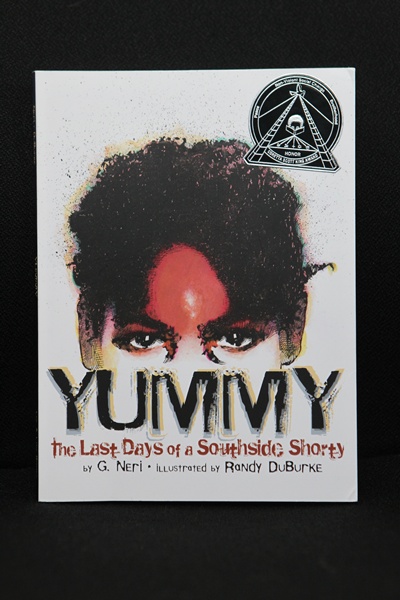
G. Neri’s Yummy


yummy

Synopsis

In this award-winning graphic novel, Robert “Yummy” Sandifer’s life becomes interwoven with other true events from a period in time where Chicago’s south side was running rampant with gang activity and violence. The year: 1994. Yet, its relevance still holds weight today in urban communities throughout our country. Unfortunately.

Narration and Writer’s Craft

Through third person narration, eleven year old Roger, guides us through the ongoings, thoughts, chaos, family ties, brotherhood, fears, ponderings, love, realities and insecurities most young adolescent males experience.

Roger lives on Normal Street.  He addresses what many readers are already thinking:  But I guess “normal” is different to different folks.

In studying craft, this one liner opens up dialogue, the use of language and repetition, and the importance of quotation marks in varying situations.  Throughout the entire story, you are greeted with on-point vernacular, literary devices, and a storyline that pulls at the heart strings.  (Just ask my students.)

Additionally, the incredible illustrations allow us the luxury of experiencing Yummy’s journey through his eyes, Roger’s eyes, and the eyes of all of those that take part in the journey.

It’s pretty loaded.

 Essential Ideas and ThemesYummy: The Last Days of a Southside Short

This gritty exploration of Yummy’s life forces readers (of all ages) to question their own understandings of good and bad, right or wrong, yes vs. no.

It searches for truth.

It provides us with the inner-workings of [the downfall of] self-worth and naturally asks us to question it.

Ultimately, we are challenged to think on a macro level about society; why are so many of our youth feeling forced into a life where statistics are alarmingly glaring?


Yummy is a piece that everyone needs to read.  It’s important.  It’s relevant.  It affords us a window into the lives of so many of our youth.  No wonder it has won just under 30 honors and awards.  This is one piece of literature you cannot afford to miss.

For more books by G. Neri feel free to visit his website: http://www.gregneri.com

——-

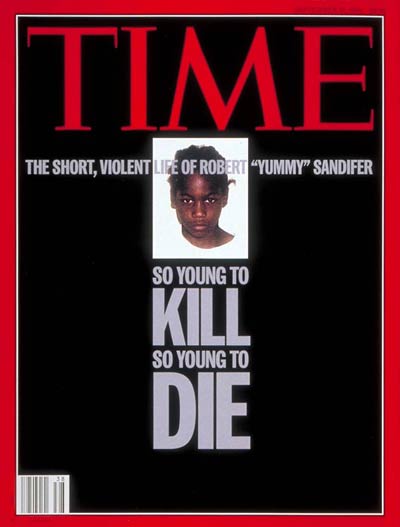
Yummy Time

Here is the cover of TIME Magazine’s issue detailing the story of Robert “Yummy” Sandifer.  Tragic and important.

Four Ways to Formatively Assess in Workshop

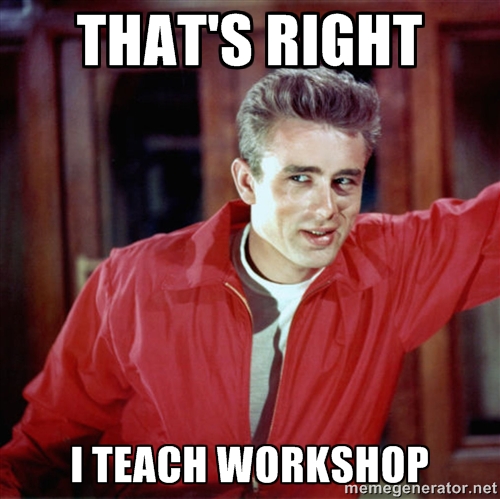
dtrfyguhujSometimes I wake up in the morning, thinking about what I’ll be teaching and learning that day, and feel like a rebel.  That’s right–I think to myself, feeling inexplicably cool–I teach workshop. Yeahhhhh.  Even though this is the most research-based, data-driven form of instruction I’ve encountered in my teaching career, a successful workshop is still such a rarity that I feel like I’m breaking all the rules by employing it every day.  I’m a rebel with a cause.

Still, when I stop feeling like James Dean and reality bites me in the butt, I know I need to be practical and follow the rules by putting some grades in the gradebook–once per week is the suggestion at our school.  If I had it my way, I’d go gradeless and celebrate the myriad acts of literacy within the confines of a classroom.  That’s not possible right now.  I needed another solution, and I think I found it in Amy, right here on this blog.  She writes powerfully about formative assessments in this post.  Her thinking mirrors mine:

I know when I am learning a new skill, I want to be able to practice–free from judgment–so that I might build some confidence before I am formally evaluated.  The same is true for kids.  We should give them opportunities to practice and build confidence.

One grade per week, when I’m grading to evaluate, is impossible.  We don’t master a different skill every single week.  Mastery requires practice.  So, I’ve focused lately on formative assessment for eight out of the nine-week grading periods, and summative for just one.  Here are the four categories I see formative assessment broken down into, and how I put them in the gradebook.

IMG_5605

Un-gradeable, amazing writing

1. Writer’s notebooks – I collect writer’s notebooks every two weeks, and students can receive up to 20 points per collection.  If all of our prompts and exercises are present, and I can see the student’s effort, he or she gets the full 20/20.  I also ask students to mark for me anything they’d like feedback on.  I check to see the status of their to-read, wondrous words (vocab), and cool craft (quotes) sections, but I also look for a telltale pink sticky note.  If I see one, I read the marked piece and write back–just feedback.

2.  Reading logs – Our reading logs are quite messy; you can see one example here.  There are arrows everywhere, new reading rates scribbled in, and tons of titles being read every week.  When students complete their reading goal of two hours per week–determined by individual reading rates–they get 10 points, every week.  Reading logs show me the big picture of a class’s progress, while conferences help me go deeper.  The reading log lets me know, at a glance, who’s soaring and who’s not–helping to give my conferences direction.

IMG_6904

Word play

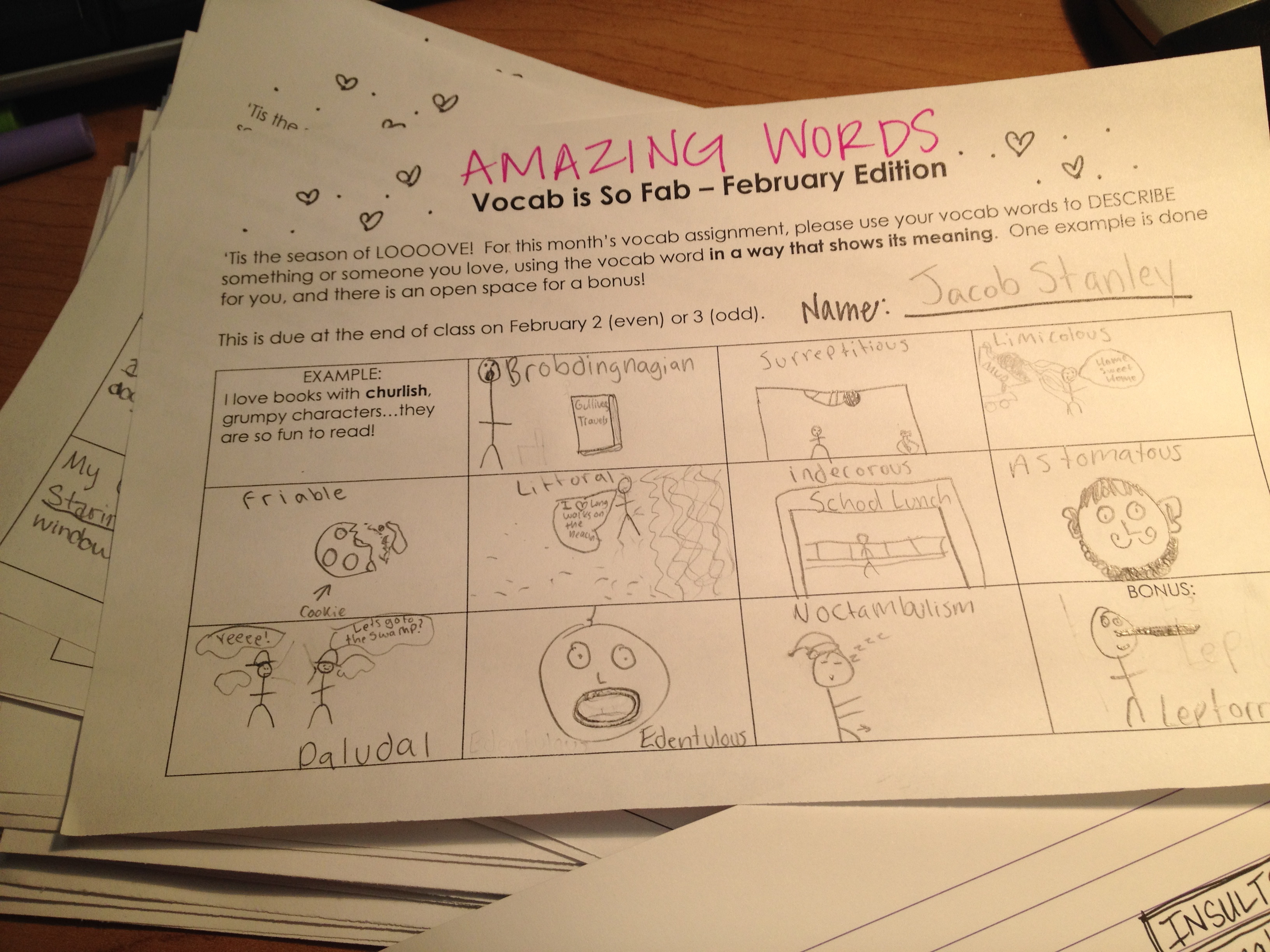
3.  Vocabulary – I still remember my orange Sadlier-Oxford vocab books from high school.  Those well-worn paperbacks were the source of many a cramped hand and a frantic fifteen minutes of homeroom before English class.  I know from personal experience that I don’t retain new words by completing fill-in-the-blank exercises–I learn by reading widely.  So, I ask my students to maintain a “wondrous words” section in their notebooks, writing down unfamiliar or unknown words as they read.  Then, I give them a different activity to complete with those words every two weeks.  The activities are worth 10 points each, and run the gamut from writing stories using the words to drawing pictures illustrating their meanings.

4. Honest self-assessments – When we finish a unit of any kind, usually about once a month–a writing unit, a reading unit, a book club, a challenge–I pass out a half-sheet with self-assessment questions on it.  I begin each half-sheet with a disclaimer:  “Be honest.  There’s no judgment here.  I just want to know why you were as successful as you were with this unit, and to know how I can help others be successful in the future.”  Students answer very truthfully, sometimes humorously so.  If their answers are thorough, they receive 15 points.

These four formative assessments total about 115 points per month.  With 9-week grading periods, students’ grades therefore are made up of about 2/3 formative assessments (230 points or so) and 1/3 summative assessments (100 points or so).  Well over half of the formative assessments are credit for the simple acts of doing the assigned reading and writing–no evaluation of those acts, just credit for the effort.  I value practice and process over product–and this grading system reflects that.

How do you handle grading, formative assessment, evaluation, etc.? Please share in the comments!

Why I Applaud The Student Who Reads Only Two Books

imageedit_5_2583117499Author, teacher, and reading-writing workshop guru Nancie Atwell recently won the $1 million Global Teacher Prize. I have been a fan of Atwell’s work since I read her book In the Middle during my first year of graduate school. In fact, I was star struck two years ago when Atwell sat on the floor next to me during an NCTE workshop (note my shoulder proudly photo bombing Shana’s picture of the goddess herself). While I have subscribed to Atwell’s philosophy since I began my career in education, I was shocked to read in the media coverage that her students on average read 40 books per year.

My students do not.

Don’t get me wrong; the majority of my students read a large amount, yet while I could calculate the average, it would grossly misrepresent the true value of their accomplishments. I have some students who breathe books and complete them at breakneck speed. They add leaves to our book tree at an astonishing rate, yet admittedly not all my students are like that. By the end of the year, some have only completed two or three independent books in total. As a first year teacher (last year), I felt like I had failed these students. As far as I was concerned, the good teachers didn’t run into this problem. They only spoke about the record-breaking kids, not the ones that kept me wracking my brain for a solution. It felt like I was the only teacher who had the two-book-reader.

Last year, mine was TJ. TJ couldn’t seem to make it through a book. Many of my hesitant readers have learning disabilities or attention deficit disorders; in past classes, they have felt little success in reading whole class novels. When they arrive in my classroom they are resistant to choosing their own independent reading books. TJ was no exception; he had ADHD and struggled to focus on his reading both in and out of class. I’d watch him stare at a page for five minutes straight without being able to settle his mind and read a line. During conferences TJ discussed his book and claimed he was interested in it, yet he moved at a snail’s pace. By the end of his foray with Jarhead, I couldn’t imagine him undergoing the same tedious process with another book. I thought he’d quit. But he didn’t. Through reading conferences, daily reading time, and check-ins with his parents, I was able to help TJ develop a routine and gradually become a reader. Yet the greatest influence was TJ’s friends. Seeing so many of his peers reading on a daily basis motivated TJ to continue working towards his goals.

By the end of the year, TJ had read two independent reading books and three whole class reads, “more books than [he] had ever read before.” This was a feat arguably equal to if not mightier than some of my students who read 80 or more books. TJ developed persistence and stamina even if he couldn’t keep up with many of his peers. He was proud of his accomplishments and determined to become a better reader the following year. As a teacher, that’s what I want for my students—to push them to succeed and accomplish more than they thought they were capable of.

We all have those students (or maybe it’s still just me) but we must praise and hold these students in high esteem. We must brag about their successes and triumphs just as much as we praise the work of our highly motivated readers. After all, every book is a learning experience and an accomplishment.

Do you have a “two-book reader”? What is your story, and how did you work to motivate that student?

The Value of Talk

Talk is one of the most powerful tools at work in my classroom.  Now, I’m talking about talknot discussion, sharing, peer editing, Socratic seminars, think-pair-share, or any other structured form of communication that might occur.  The simple act of letting our students just talk is invaluable, and we must create spaces in our curriculum for it to take place.  Here are three ways I encourage talk in my classroom.

Conferences – Reading and writing conferences aren’t just about assessment.  They’re also a valuable time for teachers and students to just talk to one another, getting to know each other as the humans that we are.  Creating a space for talk breaks down the teacher-student barrier, humanizes both parties, and by and large erases discipline problems in my classroom.  I begin every conference with a simple, “How are you today?”, and after genuinely listening for the child’s answer, direct the conference from there.  Some conferences, we don’t talk about books or writing–we just talk, because the student needs to.

IMG_6441

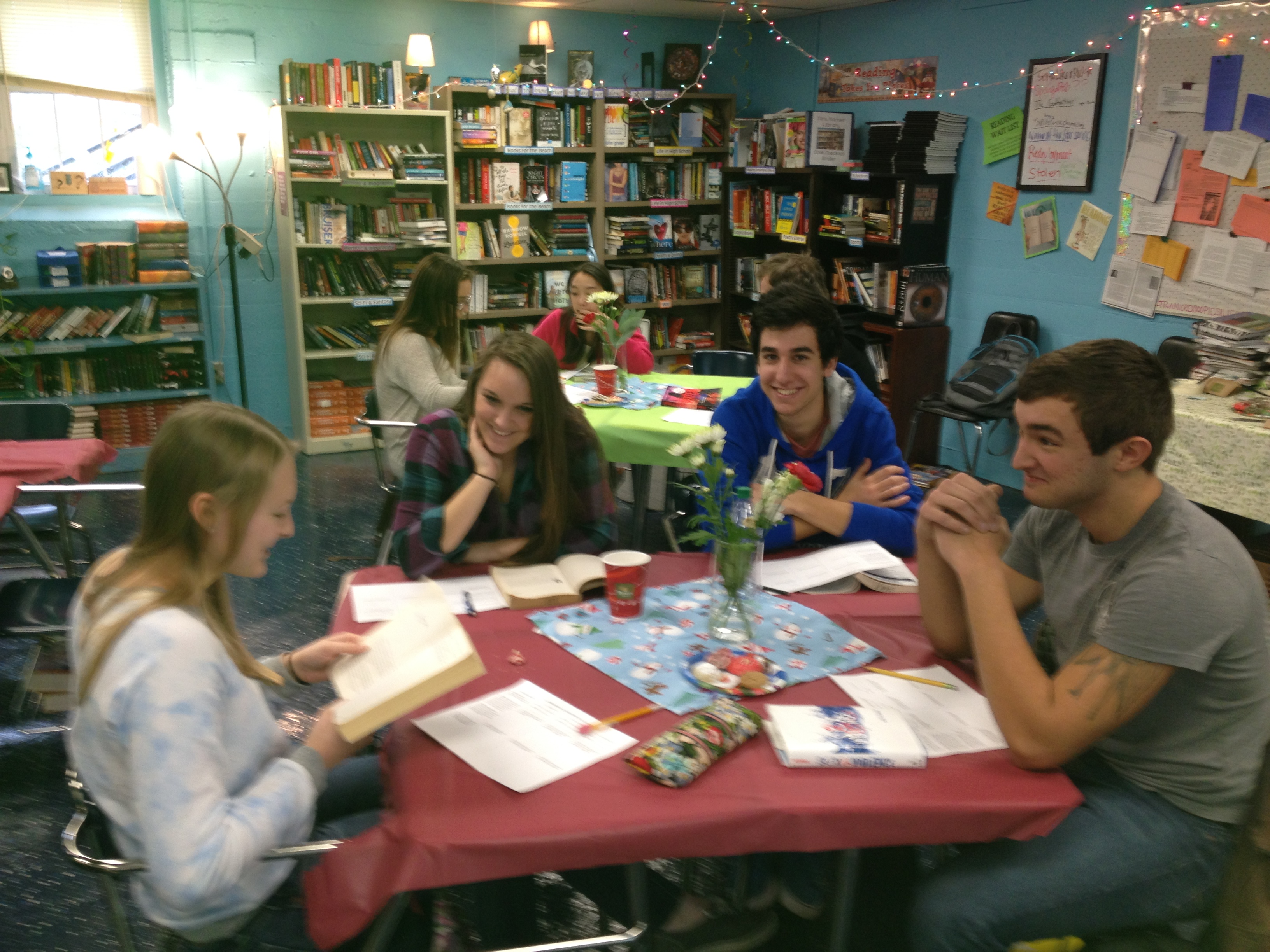
Students chat during the ‘Book Bistro’

Book Clubs – Not every book club meeting requires structure or an agenda to be valuable.  During this most recent unit, I simply asked students to keep the conversation going for 20 straight minutes.  They sometimes had to cast about for topics, but they always found something to discuss–mostly their books, but often text-to-text/self/world connections they’d made, which spun off into generalized, real-life conversations between kids who wouldn’t ordinarily find themselves chatting.  After finishing book clubs, Ana wrote, “I loved our book clubs because I felt like I got to know everyone better.”  She wrote other things about how she grew as a reader and writer…but she LOVED the unit because of the TALK that happened.

Root of the Writing Process – My journalism students consistently talk out their ideas at the very beginning of the writing process.  They chat in groups, usually starting with, “so what should I write about?”  It takes a few minutes, but enlightenment inevitably follows–the other day, Shay threw a few silly ideas out for Kenleigh about bathroom graffiti, but then they got serious about that as a story idea.  “You could call your piece ‘Signs from the Stalls,'” Shay said.  “AHHHH, that’s a great idea!!” Kenleigh enthused.  What kids like to talk about is often what they’d like to write about, and they need to talk to get to the heart of those topic ideas.

Talk builds community.  Talk is the tool that made my former student Emily say, “I felt like by the end of the year, everyone in the class became my best friend, including you.”

How do you see talk improving your classroom and its community?  What spaces do you create for talk in your classes?

March Book Madness for Choice Reading Books

Can you believe it’s already the middle of March!?  This school year is flying by…and so is the list of titles I’ve booktalked so far.  I’ve exhausted the bestsellers of YA, dystopian sci-fi, classics, books for the beach, war books, and sports books.  At this point in the year, I’m starting to booktalk new purchases, which means I’ve often not yet read them–which means that sometimes, the quality of my booktalk decreases.

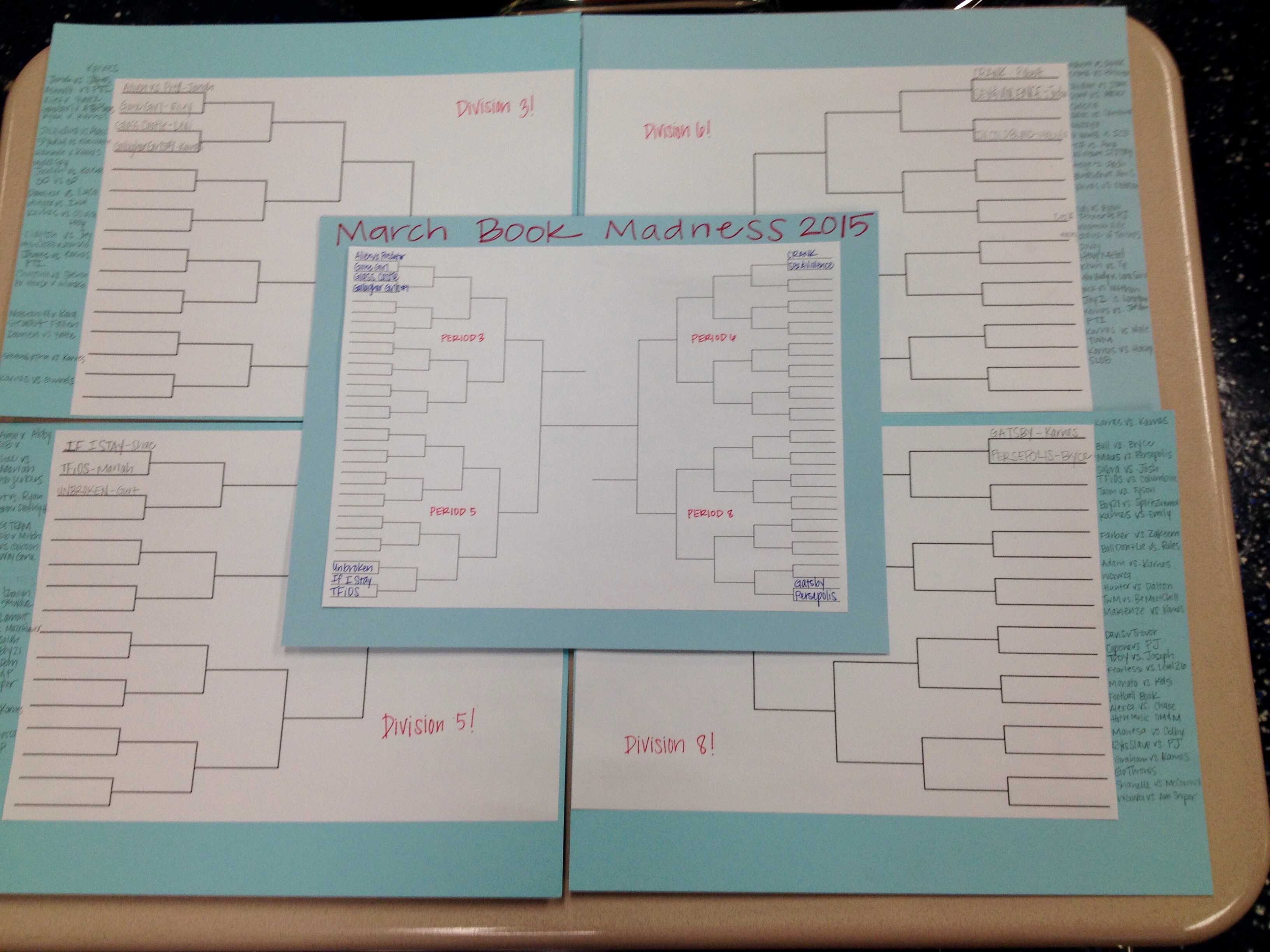
FullSizeRenderSo, because I want to shift the balance of not just grading from myself to my students, but also some of the teaching, I’ve turned to my own version of March Book Madness.  I heard about this competition from Tony Keefer’s Nerdy Book Club post, and I pitched it to kids, but they wanted to choose their own titles for the bracket.

So, blank brackets were printed, and to fill them, the guidelines were broad:  in each of my four English classes (which worked out well because they each get one corner of the bracket), students could choose a book and a partner to face off against.  Simple.

That was all I said, but as students began penciling in round one of the brackets, I was impressed mightily–they intuitively paired related books together, much like I do during booktalks.  Two boys in 8th period paired the excellent graphic novels Persepolis by Marjane Satrapi and Maus by Art Spiegelman.  Two girls in fifth period paired John Green’s The Fault in Our Stars and Gayle Forman’s If I Stay–two viral tearjerkers.  The Absolutely True Diary of a Part-Time Indian by Sherman Alexie will face off against Mexican White Boy by Matt de la Pena in sixth period.  And so on.

FullSizeRender (1)

Shae vs. Mariah in the Battle of the Tearjerkers…TFiOS vs. If I Stay

As book battles began, I laid out equally simple guidelines for voting.  Each student in a faceoff would give a short (1 minute) booktalk about their chosen text, and audience members could vote for one title based on any criteria–their own experience reading that book, the person’s booktalk, the presenter’s enthusiasm, the book’s stats on GoodReads behind the presenters, etc.

This modification to our daily routine–which is that students begin with reading, then hear my booktalks–has accomplished several wonderful things in our classroom.

First, students’ what to read lists, which had recently plateaued, are lengthening rapidly once more.  The sheer social capital of having a kid share his or her own reading experience of a book makes certain titles more tantalizing than I ever could.  Matthew Quick’s Sorta Like a Rock Star, for example, never quite flies off the shelves after I booktalk it.  It’s only after one or two kids read it and enthusiastically share it that it goes viral–and it does–year after year.  I see the same thing happening now during March Book Madness with lots of other books.  Kids are clamoring, suddenly, for several of the same titles.

FullSizeRender[1]Second, students are learning more about one another’s reading tastes.  They look at the brackets from other classes every day to see which books are advancing, and are sometimes surprised by who’s booktalking what.  “Huh…I didn’t know Jordan loved A.S. King too!”, I heard Hannah say yesterday.  “You read that book too!?  Wasn’t it awesome?!” Tyler said to Hunter, as he stood up with Ned Vizzini’s Be More Chill.  Despite my efforts to make their reading lives transparent with reading groups and notebook passes of book blogs, some of my larger classes haven’t quite unearthed the darkest corners of one another’s reading preferences.  MBM is fixing that quickly.

Third, this is not for a grade.  This is just a semi-structured celebration of books, with bragging rights as the purely intrinsic reward of the whole endeavor.  The five or so minutes we spend on this in class daily are a worthy time investment for the revelatory feel they bring to the start of our learning.  Kids are excited and upbeat after the two daily faceoffs, and excited to often add one or more of the four daily books discussed to their to-read lists.  The post-winter doldrums are quickly lifting…and the sunshine certainly isn’t hurting, either.

Is anyone else doing a version of March Book Madness?  How’s it going?  Please share in the comments!

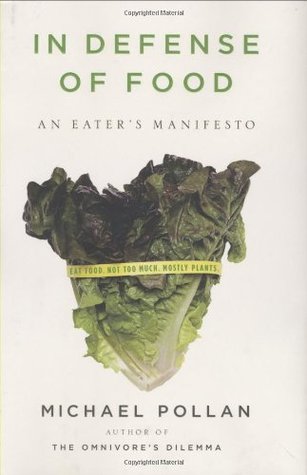
In Defense of Food: An Eater’s Manifesto

315425I grew up as a reader, but I was a steadfast reader of fiction only–especially series.  I remember receiving my PSAT score report in high school, which strongly suggested that I begin reading more nonfiction in order to improve my vocabulary and reading comprehension.

So, not being informed about the wonderful nonfiction tomes I now know about, I began to read the newspaper.  That probably contributed to my majoring in journalism, and now teaching that subject in addition to English.

But it wasn’t until I took Penny Kittle’s class at the UNH Literacy Institute in 2013 that I fell in love with nonfiction (pardon me, Mr. Lehman and Ms. Roberts!).  I read Malcolm Gladwell’s Outliers and was enamored of his use of narrative to help me understand seemingly disparate facts.  I quickly read all of Gladwell’s other books, then devoured the rest of the booklist from Penny’s class–The Emperor of All Maladies by Siddhartha Mukherjee, The Immortal Life of Henrietta Lacks by Rebecca Skloot, Behind the Beautiful Forevers by Katherine Boo, Zeitoun by Dave Eggers, and plenty more.

However, it’s not since Gladwell that I’ve found another nonfiction author whose collected works I’m dying to devour…until now.

I recently asked my students to brainstorm as many nonfiction genres as they could, then select three for us to focus on for this quarter.  One of their selections was a recipe.  I wanted to show my students lots of examples of writing about food, so I purchased Michael Pollan’s In Defense of Food: An Eater’s Manifesto and The Omnivore’s Dilemma: A Natural History of Four Meals.  I picked up In Defense of Food first, and was left defenseless.

This book rocked my world, and my worldview.  It’s a book about the food we eat, where it comes from, how it’s different than other cultures’ foods, and how it’s good and bad for us.  I learned about the wild inaccuracies of food science, the nutrient-depleting process of processing food, and the government’s allowance of all this because of their dependence on food marketers’ money.  I also learned about the evolution of America’s food culture–from farm fresh to TV dinner to fast food–and its deleterious health effects on our population.

So, after Pollan sufficiently freaked me out and made me swear to myself that I’d never eat any processed food again in my life, he presented a clear solution to my fretting and outlined some rules for eating healthily (the subtitled Eater’s Manifesto).  I learned how to shop smart, defy the American diet’s unhealthy customs, and consider my foods in the contexts of their meals, which can completely transform their nutritional value.

It wasn’t just the topic that fascinated me (admittedly, I love to cook)…it was the writing.  From knee-slappingly incredible food puns like “let them eat Twinkies” and “the silence of the yams” to his deft skill at citing other writing to support his own arguments, I was convinced.  The clear organization of the book mirrors his three basic rules about eating well, which he states in sentence number one:  “Eat food.  Not too much.  Mostly plants.”  The complex narrative he weaves makes perfect sense, but is incredibly layered.  Through it all, Pollan made his claims and supported them sturdily, leaving me not only swept up in a great story, but thoroughly knowledgeable about what real food is and isn’t in America today.

I can’t wait to bring this book to my students through book clubs, a reading challenge, or a craft study mini-lesson…so I’ll booktalk it tomorrow to my Funyun-munching students with as much fire and brimstone as I can manage, and hope they hop on the Pollan diet with me.

Five Steps to Fostering Balanced Literacy in Your American Lit Class

How does your district handle classes that are very content specific? For example, I teach Honors/Pre-AP American Literature. This is a sophomore (with accelerated freshmen course) that has a pretty traditional literary movement focus, which includes several of the classics (The Scarlet Letter, Huck Finn, Of Mice and Men, The Great Gatsby, The Things They Carried). And while I feel I have made great strides over the years in terms of student driven lessons, focus on discussion and annotation, skill vs. content based assessment, the one area I continue to struggle with as I look to workshop is how to facilitate the choice. 

This post is Part II of my response to those questions I received via email. See Part I here: Choose to Become a Classroom of Writers

I’ve thought about your query about your “content specific” American literature class a lot, and I keep getting stuck on one question:  Does the class have to revolve around full-length American novels?

I ask this for a couple of reasons. First, in my experience, many 11th grade teachers, in Texas at least, think that they have to teach English III as a survey of American literature; however, the  curriculum standards (Texas Essential Knowledge and Skills or TEKS) do not mandate that. Yes, there is a standard that requires students read American literature, plus another that says American drama, but there are 11 other reading standards (plus Fig.19, which is a whole other story) and at least that many writing standards.

All of these standards are classified as either readiness (they will be tested on state exams) or supporting (they may be tested). The standards mandating American literature are supporting — meaning perhaps that they might not carry as much weight as readiness. Yet many teachers design their whole year’s worth of reading around one American novel or play after another, at times ignoring all the other reading standards that state that students should read a variety of other texts — fiction and non-fiction. Seems to me that if we do a mash up of all the reading standards we’d come up with one overarching goal:  Create readers. All adults should take note

How can we create readers if students are not reading? More and more research proves this is so.

Many of the junior level teachers here teach the American literature survey because that is the way it has traditionally been done — prior to the changes in the standards, almost 10 years ago, and our new state tests, three. Most have not learned how to do anything differently — like facilitating readers and writers workshop.

So, I wonder about the standards that drive your class. Are they like the TX ones that require some American lit, or is the class designed by your campus and/or district to be one focused on a survey of American Lit?

If it’s the first, give yourself permission to let some of those whole class novels go. You can step right into allowing more student choice. You can select short texts to read together, conduct book clubs where students still get choice but with your parameters. Imagine the possibilities for short stories and passages where you can teach the same skills you focus on when you teach those full-length novels.

If it’s the second, I wonder what you can do to change the course design. Would your administration be atticus finchokay with you taking a more balanced literacy approach and only reading some of those whole-class texts? You will have more time for writing, and you’ll have a better chance of moving students as readers because odds are you’ve got many students who are not reading those books. We’ve all been there.

If you haven’t read the English Journal article Not Reading: The 800 Lb Mockingbird in the Classroom, it is a fantastic piece that reiterates the problems of students faking their way through their reading.

Another great article is this one by Tim Pruzinsky, an IB teacher at an international school in Thailand. IB mandates specific texts, but Tim still manages to get all of his students reading novels of their choice.

Here are some ideas that might help as you continue to transition your instruction. The moves you’ve already made are probably much harder than these:

Five Steps to Creating Balanced Literacy in your American Literature Class (in no particular order):

1. Intentionally decide which of your current novels are nonnegotiable. Which book do the majority of your students read? Which book adds the most to your reading community in terms of discussions that build relationships? Which book are you able to teach the most skills that students can apply to their own independent reading? Keep that novel (or a couple of novels) as your whole class texts.

2. Decide to read fewer whole class novels and increase your reading of shorter whole class texts. How can you teach some of the skills you normally do with novels with short stories, poems, and a variety of non-fiction pieces?

3. Decide what type of writing will benefit your students most. Choose mentor texts that relate thematically to the novel/s you let go. You can still have the rich discussions surrounding a text and teach annotation skills without mandating another whole class reading assignments.

4. Select a short stack of books and facilitate Book Clubs. Students choose a book from the list to read and discuss with their peers in small groups. Visit each group and briefly join the discussion to hold students accountable for their group time. You might conduct Book Clubs 2-4 times a year to allow for choice with parameters and to ensure that all students reach for books that meet your ideal of complexity.

5. Decide to promote reading in your classroom and take no excuses from students. Talk about books and reading daily. Devote 10-15 minutes of self-selected reading time at the beginning of every class period. Confer with students about their reading regularly. Read a lot, so you are able to match students with books that they will want to read.


Anyone have other ideas to help make the move to more balanced literacy? Please leave a comment.

©Amy Rasmussen, 2011 – 2015

Choose to Become a Classroom of Writers

Note:  I enjoy emails with questions about my teaching practice. They help me clarify my thinking, and they often lead to new posts here. This post is Part I of my response to this question:

How does your district handle classes that are very content specific? For example, I teach Honors/Pre-AP American Literature. This is a sophomore (with accelerated freshmen course) that has a pretty traditional literary movement focus, which includes several of the classics (The Scarlet Letter, Huck Finn, Of Mice and Men, The Great Gatsby, The Things They Carried). And while I feel I have made great strides over the years in terms of student driven lessons, focus on discussion and annotation, skill vs. content based assessment, the one area I continue to struggle with as I look to workshop is how to facilitate the choice. 

Do you have a similar class in your district? Are any of these texts still used as whole class works? As options within specific unit studies? Or is the year open to student choice throughout? 

First of all, while my district ELA coordinator would love for all teachers to move to readers/writers workshop, and he has introduced that idea through various means, many teachers are not there yet and some are determined not to budge. Like many other issues related to change in schools, they nod their heads and keep doing what they’ve always done. We know that sometimes this is best for kids (I’ve done the nodding and door closing, too), and sometimes it is not, which is the case when it comes to continuing to make all the choices in English classes at the expense of student readers.

My own department manager reminds me often that we have to take our movement one step at a time. This is my first year on this campus, and while most everyone is making positive and impacting change. It’s slow, and I get antsy. I’ve been doing readers/writers workshop with my students for seven years now, and I still work on refining plans, lessons, mentor text selections, mini-lessons, and more. Truly, workshop is constant motion, which I am sure, if you practice it, you already know.

Recently, I was asked, “What is the one step that will give us the most movement as we continue this transition?” I paused for a moment, and then the answer focused clearly:

Become classrooms of writers.

Many high school English classes are literature laden. All the lessons revolve around specific texts, mostly whole class novels, and sometimes teachers spend five, six or nine weeks reading and discussing that one text. Sure, they might include other instructional practices and activities, but the most common mode of writing taught is analytical (the least likely of all the modes of writing students will use in their lives after English class. Teachers, when was the last time you wrote an analytical essay for your job?).

When we move to becoming classrooms of writers, teachers realize that if we want to practice other modes, read mentor texts, model the writing process, lead revision workshops, publish our best work, and truly live the lives of writers, we simply do not have time to devote class after class time to the study of one particular book.

A mentor once told me:  “You choose to do this, which means you choose not to do that.”Faulkner on reading

Say I choose to create a unit where my students write narratives (I always start the year with narrative because it is builds community, and contributes so much weight to other modes of writing. See tom Newkirk’s book Minds Made for Stories.) I prepare by gathering a variety of narrative texts of various lengths. I can use passages from an assortment of books in my classroom library, or I can pull passages from popular short stories, or classic novels. [See note on this at the end.]

Some passages I will use to teach leads. Others I will use to teach how authors deal with time. I may pull out specific parts and teach effective use of dialogue or character development, setting, whatever. [Gathering a variety of texts in different genres around the same theme is another way to approach the same type of reading then writing task I describe here. I’ll write about this soon.]

First, we read like readers. We practice comprehension strategies and discuss the meaning of the text.

Next, we read like writers. We deconstruct the text and discuss how the author makes that meaning.

In my AP class, we almost always talk about these texts via a Harkness discussion. Students do the thinking and speaking after I’ve done mini-lessons and modeled answering focusing questions. I’ve learned to trust that students will discover the elements and devices that I hope they will. Sometimes I have to prod, but they rarely never get there.

The skill I need to teach determines the reading passages I select. That’s an opposite approach to how I used to plan when my teaching was driven by various pieces of literature.

And now, I have time to talk about books, allow students to select books they’d like to read, and confer with students about their reading. They read tons more than they ever did before, and they become much more effective writers. Win/Win.

cool quote memes from our friends at http://www.TeachMentorTexts.com

Watch for Part II of my response soon.
 ©Amy Rasmussen, 2011 – 2015