Category Archives: Readers Workshop

#FridayReads: Whole-Class Novels to Teach, and How to Frame Them

This past summer Shana and Jackie found that we’d both taken on a unique experiment within some of our classes–we had decided to strip them of whole class novels and instead focus on independent reading, book clubs, and smaller whole-class texts.  As workshop teachers confident in the power of choice reading, we each felt that this shift would be both empowering and inspiring within our classrooms.  After our year of experimentation, we both left our classrooms with unique perspectives on the power of whole-class novels as well as how we would incorporate them moving forward.

Today is the third and final installment of our week-long discussion using Google Docs.  Please, join the conversation in the comments!

41Cx8mY2UNL._SY344_BO1,204,203,200_Question 6: How is it different to be forced to teach a certain novel versus to be able to choose the ones you teach?

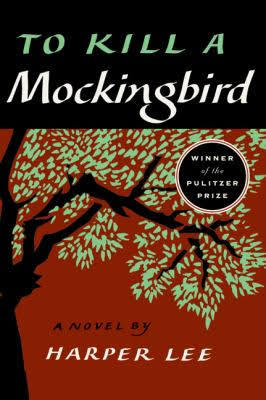
Jackie: I will readily admit that I am “forced” to teach To Kill A Mockingbird and Macbeth at the freshman level.  That being said, I love teaching both of them and am fortunate that my students respond well to both pieces.  The challenges are certainly different though.  I must create student buy-in or else my students will drag through the next four to six weeks of our unit.  I frame each lesson to fit their needs and I make sure to fit the book into a workshop structure the best I can to create consistency.

I do believe that teachers must have a choice in what they teach, though.  We must be allowed to tailor our lessons to fit the needs of our students.  Independent reading allows us to understand our students as readers and individuals, which in turn, allows us to further assess what books our students might connect with best.  Fortunately for me, the freshman team I work on is progressive and forward-thinking.  They’re always willing to try new things, which oftentimes involves integrating contemporary works.

Shana:  This summer in Tom Newkirk’s class, he innocently posed this question to our class:  “Why is the defining novel about race in our country written by a white woman?”  He was referring to To Kill a Mockingbird, of course, as many of us were discussing its lately-released sequel.  That question, so casually tossed into our midst, made me think about why the canonized novels taught in schools are often so heavily prescripted.  Why does Harper Lee have a voice of authority about being black in America?  Why do my rural students need to read a particular story about race?  I know why it’s important to read stories about people different than us–I would argue that it’s essential to building empathy and a broader worldview to read widely–but why does Harper Lee hold the monopoly on that topic, and not someone like Toni Morrison or Zora Neale Hurston?

As usual, I have raised more questions than I’ve even attempted to answer, but I’m still not sure of the correct solutions.  I think it’s preposterous to have a rote schedule of “books to teach” for all teachers in a school when it’s blatantly obvious that the community of every classroom is different, which means the culture of its students is always unique, which means that no child ever needs the same book at the same time.

Jackie: It’s funny that you bring up Tom Newkirk’s question.  As I was sitting next to you, I had one of those hide-your-face-moments when I thought, “Oh geez, I teach To Kill A Mockingbird!”  As I said earlier, I am required to teach this book, and while I love it, it does not meet the needs of all of my students.  Teaching in New Hampshire, I have a predominantly white population.  This means that their understanding of race relations and their exposure to diverse literature is rather whitewashed.  We desperately need new, diverse voices to help our students understand and empathize with a variety of individuals.  The precious few books we read together should be based on the needs and interests of our students instead of being dictated by a one-size-fits-all approach.

Question 4: What is the most effective way to frame a whole-class novel and create student buy-in?

Jackie: At the beginning of the school year I discuss the different types of reading we encounter as lifelong students.  I explain that, as a reader, I read for pleasure as well as for knowledge.  Oftentimes those two paths can and may cross, but typically my personal reading life looks drastically different from my professional reading life.  I love pouring through popular YA lit, but in the same breath, I can’t get enough of dissecting poetry with my AP Literature class.

This same pattern applies to my students’ reading within our classroom.  As a class we must learn to maintain a fruitful and engaging personal reading life that allows us to not only learn from our literature but to also explore our own interests and passions.  That being said, we mustn’t overlook the power of dissecting and discussing language and craft as a class.  Reading whole class novels reinforces the fact that no two people read a book the same way.

Shana:  If choice is the golden guide to teaching of reading, then I think the culture of a classroom must dictate the novel we read.  While A Raisin in the Sun was immensely popular in my inner-city Cincinnati classroom, it completely flopped here in West Virginia when I tried to teach it.  The inverse is true of Huck Finn; wildly successful in WV, but a total fail in Ohio.  Thus, I seek to hear the themes my students return to again and in again in their writing and conversations–this year, we are engaged in many discussions about political rhetoric, the origin of power, and the struggle that class/social/financial/ethnic differences create.  Thus, I’ll seek out novels that explore those themes to help us engage with them more fully.

In closing, we leave you with a list of the most successful whole class novels we have taught as well as a list of the books we would teach our current students if given the opportunity.

Most successful novels I taught, from Shana:28c4d1f2e8d048f702c3dbf0990aca8c

A Separate Peace by John Knowles

The Absolutely True Diary of a Part-Time Indian by Sherman Alexie

Macbeth by William Shakespeare

Fahrenheit 451 by Ray Bradbury

What I’d love to teach, based on my current students, from Shana:

Peace Like a River by Leif Enger

Boy21 by Matthew Quick

Poisonwood Bible by Barbara Kingsolver

Into the Wild by Jon Krakauer

Most successful novels I taught, from Jackie…(you’ll notice some repeats):51BWES5VL2L

Of Mice and Men by John Steinbeck (read aloud and performed as a play)

On Writing by Stephen King

The Absolutely True Diary of a Part-Time Indian by Sherman Alexie

The Glass Castle by Jeannette Walls

Macbeth by William Shakespeare

Fahrenheit 451 by Ray Bradbury

What I’d love to teach, based on my current students, from Jackie:

Sold by Patricia McCormick

Here, Bullet by Brian Turner

One Flew Over the Cuckoo’s Nest by Ken Kesey

All the Light We Cannot See by Anthony Doerr

Be sure to join the conversation today in the comments! We would love to hear your perspective on whole class novels and how you incorporate them into your classroom.

Click here to read day two of our conversation.

Click here to read day one of our conversation.

Whole-Class Novels: Why Do We Teach Them, Anyway?

This past summer Shana and Jackie found that we’d both taken on a unique experiment within some of our classes–we had decided to strip them of whole class novels and instead focus on independent reading, book clubs, and smaller whole-class texts.  As workshop teachers confident in the power of choice reading, we each felt that this shift would be both empowering and inspiring within our classrooms.  After our year of experimentation, we both left our classrooms with unique perspectives on the power of whole-class novels as well as how we would incorporate them moving forward.

Here is day two of our insights and discussion we’ve had over the past week using Google Docs (click here for day one).  Please, join the conversation in the comments!

Question 3: After a year without whole-class novels, how did you feel?MTI5MzY0OTk4NTM0MjQwNzM0

Jackie: At the beginning of the year, I felt like a rebel.  The thought of not only allowing but also empowering students through independent reading went against the entire curriculum within our department.  All of my colleagues taught whole class novels, which meant that none of my students had experienced the pure freedom of choice.  That being said, three-quarters of the way through the year, I missed whole class novels.  Despite having unique successes with the independent reading, my classes lacked the communal experiences of reading, discussing, and simply just enjoying (or sometimes hating) a novel together.  By the end of the year, I found that both my students and I missed some components of reading whole class novels.

Shana:  I reflected on my teaching after a year without whole-class novels (mind you, many novels were read through book clubs, literature circles, reading challenges, and independent reading), but I felt like the one thing that was lacking in all of my instruction was the idea of sustenance.  I wasn’t seeing my students sustain an idea for an extended period, or grapple with an issue over time, or try to live with a topic for more than two drafts and three weeks.  The case was the same in their reading and writing–I wanted them to have more length in their thought processes and I wanted us to engage in those long thought processes together.

Question 4: Why is teaching a whole-class novel valuable?  More specifically, why do we do it, and what skills are taught?

brave-new-world-bookShana:  I am not sure why I used to teach whole class novels, or, specifically, why I taught the novels I taught.  I know that there were valuable instructional methods behind the way I taught them (thematic units, Socratic circles, exploratory essays), but I don’t know if I had a sound rationale behind the obligation I felt to actually teach multiple novels to all of my students.

After a year without them, though, I find that the collective classroom experience of reading, interpreting, and discussing a novel produces a route for a unique connection to a text that cannot be achieved without reading as a group.  I missed the experience of coming to a new, shared understanding of a text as a whole class, and I felt that my students missed out on that experience as well.  I don’t believe that when I read plays independently in my undergraduate Shakespeare capstone that I would have comprehended, connected to, or engaged as passionately with those plays alone as much as I did through our frequent in-class discussions, activities, and writings.  I don’t want my students to miss out on that experience either.

Jackie: This year I am teaching AP Literature for the first time.  I took the challenge believing that this new course would be somewhat of a paradigm shift for me compared to my contemporary-lit based freshman English class.  The more I prepared, the more I yearned to discuss my thoughts, questions, and analyses of texts.  I went so far as to ask everyone around me to read these canonical classics and discuss them with me.  Preparing to teach AP Lit reinforced the social significance of reading literature.  At its base, dissecting stories as a group is interesting and engaging.  Beating the crap out of them is not.  I agree with you, Shana, in that the experience of sharing a text is one of the blessings of being in an English classroom.  Once students graduate from high school, they rarely have the opportunity to interact with texts in a classroom setting.

Shana: I love that the way you prepared to teach was to ask friends to read books with you, then discuss them.  You engaged in an authentic book club there, as I know you have your students do now.

More of our discussion will follow tomorrow.  Be sure to join the conversation today in the comments!

Whole-Class Novels: To Teach, Or Not to Teach?

This past summer Shana and Jackie found that we’d both taken on a unique experiment within some of our classes–we had decided to strip them of whole class novels and instead focus on independent reading, book clubs, and smaller whole-class texts.  As workshop teachers confident in the power of choice reading, we each felt that this shift would be both empowering and inspiring within our classrooms.  After our year of experimentation, we both left our classrooms with unique perspectives on the power of whole-class novels as well as how we would incorporate them moving forward.

Over the next three days, we will post our insights and discussion we’ve had over the past week using Google Docs.  Please, join the conversation in the comments!

imagesQuestion 1: How did you decide to get rid of of whole class novels?

Jackie: Last year I was faced with a unique opportunity: the English Department voted to end popular College Preparatory Advanced Composition course.  Despite the well established curriculum, I tossed aside the typical whole class novels in favor of independent reading. As a primarily freshman English teacher, I am required to teach one Shakespeare play and To Kill A Mockingbird.  Advanced Composition gave me the opportunity to focus on smaller whole class reads and mentor texts within daily writing workshops without devoting whole units to one book.

Shana:  After six years of teaching, I wasn’t really sure why I felt compelled to teach whole-class novels.  Every year, when I picked up Catcher in the Rye, I dreaded my job.  I hated that book, and I had no idea how to get my students to love it or connect with it.  It felt like a chore to drag my students through “reading” that text (mostly they were SparkNoting it, sometimes with the assistance of their football coaches–true story).  I knew that not every student loved every novel that I did (particularly Their Eyes Were Watching God), and I knew that I didn’t love every novel my students read on their own (particularly everything by Nicholas Sparks).  I started to wonder–what would my teaching be like if I didn’t feel compelled to teach a whole-class novel…merely because I should?

Jackie: The eye opening experience for me was definitely during my first year of teaching.  I began integrating independent reading into my curriculum and I suddenly found out how many voracious readers I had in class.  My teaching was getting in the way of these students’ education! I like how Shana puts it–I also knew that my students didn’t love the novels I did (Speak by Laurie Halse Anderson) and in the end, if I gave them freedom, I too would learn much more about literature, reading, and teenagers.

Shana:  I like that Jackie mentions the issue of devoting whole units to a book–I loved having the freedom to design units of study that weren’t anchored around a novel, but rather a different genre.

Rye_catcherQuestion 2: What were the positives of having no whole class novels and what were the negatives?

Jackie:  After a year, I have found both positives and negatives to removing whole class novels.  Getting rid of whole class novels allowed me more time to focus on the positive aspects of the workshop model.  Naturally student choice led to easier student buy-in, and I spent less time convincing students of the value of reading.  As a result, we spent more time cracking apart smaller whole class reads like essays, poems, and articles and truly contemplating the author’s choices and craft.  Additionally, I liked that I could assess students and discuss their growth based on their own reading goals and progress.  

I have yet to find a solution to the “be on this page by this day” debacle that comes with teaching whole class novels.  Too often whole class novels lead to less differentiation and more stress, which can lead to the “gotcha” feel that comes with discussing larger, longer texts.  

That being said, there was a lot that I missed about having whole class novels.  Losing a longer common text meant that students didn’t have the common classroom experience of connecting over both the successes and frustrations of working through a complex text together.  I was surprised by how much students want to discuss their reading with classmates.  While reading can at times feel solitary and maybe even isolating during the actual act, in reality, reading complex texts is a communal activity that unites groups through a variety of perspectives, opinions, and interpretations.

Shana:  The positives were that I felt like my curriculum map was much more relaxed and flexible, in contrast to the years where I felt like I had to teach a minimum number of novels and “fit them in.”  I also loved seeing my students’ love of reading skyrocket as they engaged in choice and challenges on only an independent or small-group basis.

The negatives were more nebulous–I just felt like something was missing.  Our learners crave a challenge, and navigating a difficult novel is a challenge all readers relish if they have autonomy in their reading of that novel.  Reading a novel together provides an opportunity for me to create instruction that scaffolds a student’s reading skills up to the level of that novel, allowing them to participate in a reading experience they may not have been able to enjoy otherwise.

I also really missed being able to ascertain the barometer of a class’s feelings on a certain theme or issue through discussions of a complex text.  Crime and Punishment explores issues of morality, regret, and psychology in a far more complex way than “The Tell-Tale Heart” ever could, and although both stories have very similar themes, the novel lends itself to the sustenance of thought, evolution of a character, and length of a reading experience that I so craved for my students.  I also think that some reading skills specific to stamina, fluency, and automaticity cannot be practiced or taught effectively without a lengthy text, so I felt that last year, my students missed out on practicing those skills.

Jackie: While we both feel similar in the value of whole class novels , I know that neither of us would return to a set list of novels.  Whole class novels allow us to engage in common discussions but independent reading lays the groundwork for students’ stamina and confidence.  I don’t start my first round of literature circles until the second quarter because of this.  As much as students need a communal reading experience, I believe they first need a taste of independence and success.
Shana:  I still haven’t figured out the whole reading schedule thing either, nor how to create buy-in for every single student so that they autonomously, independently want to read a novel.  I struggle with the this-page-by-this-day conundrum, too, mostly because I feel like that creates a certain accountability that kids get hung up on, because it relates to the dreaded word GRADES. 

More of our discussion will follow tomorrow.  Be sure to join the conversation today in the comments!

Click here to read day two of our discussion.

Top Books for Reluctant High School Readers

IMG_2877“I’m not a reader.” I hear this multiple times during my first weeks of conferencing. The non-readers are easily identifiable; their body language alone speaks volumes of their disdain for books.

“You just haven’t found the right book,” I tell them, and they smirk, knowing they’ve heard that statement before.

The first week of school is a vital week of matching students with books, and while I itch to recommend titles, I hold back, giving my freshmen the independence and freedom they so desperately crave in high school. Too often students blindly accept recommendations without so much as a thought to the contents. They lack self-awareness when it comes to their reading interests or style, which is why those first two weeks are essential to not only organizing but also empowering them through choice.

Throughout the week, I book talk popular titles, engage in “speed dating” with books, and provide ample free time for students to explore our classroom library, but I also get out of their way. Instead of telling them what to read, I model ways to find a strong candidate, considering reviews, awards, contents, genres, and summaries.

While the majority of the class tends to quickly settle into their books, there are always stragglers who remain convinced they’ll never enjoy reading. These students sometimes grab the first book they see off the shelf, and oftentimes these books are too dense, difficult, or in some cases “boring.” That is okay! I settle into conferences with these students, getting to know their hobbies and eventually handing them two or three books that might pique their interest. In the end, they still choose what to read, but in the process they might require some initial guidance.

IMG_2870Regardless of who picks the book, the end result remains the same—to find a plot that envelops and consumes students, forcing them into the story. Here are some of my number one titles that tend to break down the shell of even the most reluctant readers.

Ready Player One by Ernest Cline

I’ve already had three students read this book, one of which is Leah, a gamer and self-identified non-reader. When I asked if she has ever had a favorite book, she thought for a second then said, “I think this one might be the only book I’ve ever really liked.”

The Compound by S.A. Bodeen

Adrian initially picked a sequel to a book he read last year. “You must have liked the first one then?” I asked.

“Not really,” he replied. “I just didn’t know what else to read.” The next day he picked up The Compound, which is full of the fast-paced suspense he craves.

Paper Towns and Looking for Alaskaand basically everything by John Green.

I chased Emily up the stairs for this recommendation. When I asked her which one sparked her interest in reading, she said she couldn’t remember which had sucked her in. She just knew that despite her protestations at the beginning of the year, by the end she “loved them both.”

The Eleventh Plague by Jeff Hirsch

Damion had only ever loved one book and he was bound and determined not to like any in my classroom; that is until he came across this futuristic, survival story. Upon sitting down beside him for a mini-conference last year, he looked away from his book briefly to say, “Ms. Catcher, I’m at a really good part and I can’t talk right now.”

Gone Girl by Gillian Flynn

“I’ve had people give me ‘dark’ books before, but they aren’t dark at all,” Sarah tells me. I hand her three options, one of which is Gone Girl. Three days later she tells me, “I’ve spent my whole life hating books, and you’re the first teacher who ever found one I actually liked.”

Unwind by Neal Shusterman

I book talked Unwind second this year. It’s a given crowd pleaser because of its twisted plot and graphic scenes. The fact that I only have one copy of my four originals is a testament to its popularity.

The Perks of Being a Wallflower by Stephen Chbosky

Carter claims he hasn’t read a book cover-to-cover since third grade, but he has fallen in love with Chbosky’s classic on teenage life. He said to me today, “Ms. Catcher, I love that this book talks about real things, things that are actually happening to us.”

“That book is only the beginning, Carter,” I said

What books do you recommend for reluctant readers?  Which titles are most popular in your classroom?

Mini-Lesson Monday: Self-Monitoring Reading Homework

It’s the fourth week of school, and some students are starting to panic as their weekly reading homework grades are showing up in our online gradebook.  When they come to me, concerned, I ask, “Have you been doing your reading homework?”

Sheepish grins, embarrassed blushes, and nervous giggles follow.  I know I need to give my students some tangible reminder of why they need to be reading two hours per week.

Objectives — Using the language of the Depth of Knowledge Levels:  Calculate how much you can read in two hours; Estimate how your reading rate will change over a two-hour time period; Assess your own reading fluency and growth.  Or, from the Common Core: Read and comprehend complex literary and informational texts independently and proficiently.

IMG_9336

Shailyn, Justin, and Mrs. Karnes’ paint strip bookmarks

Lesson — We begin class, as always, with independent reading.  I ask students to pay attention to what page they’re starting on and start a timer for 15 minutes on the board.

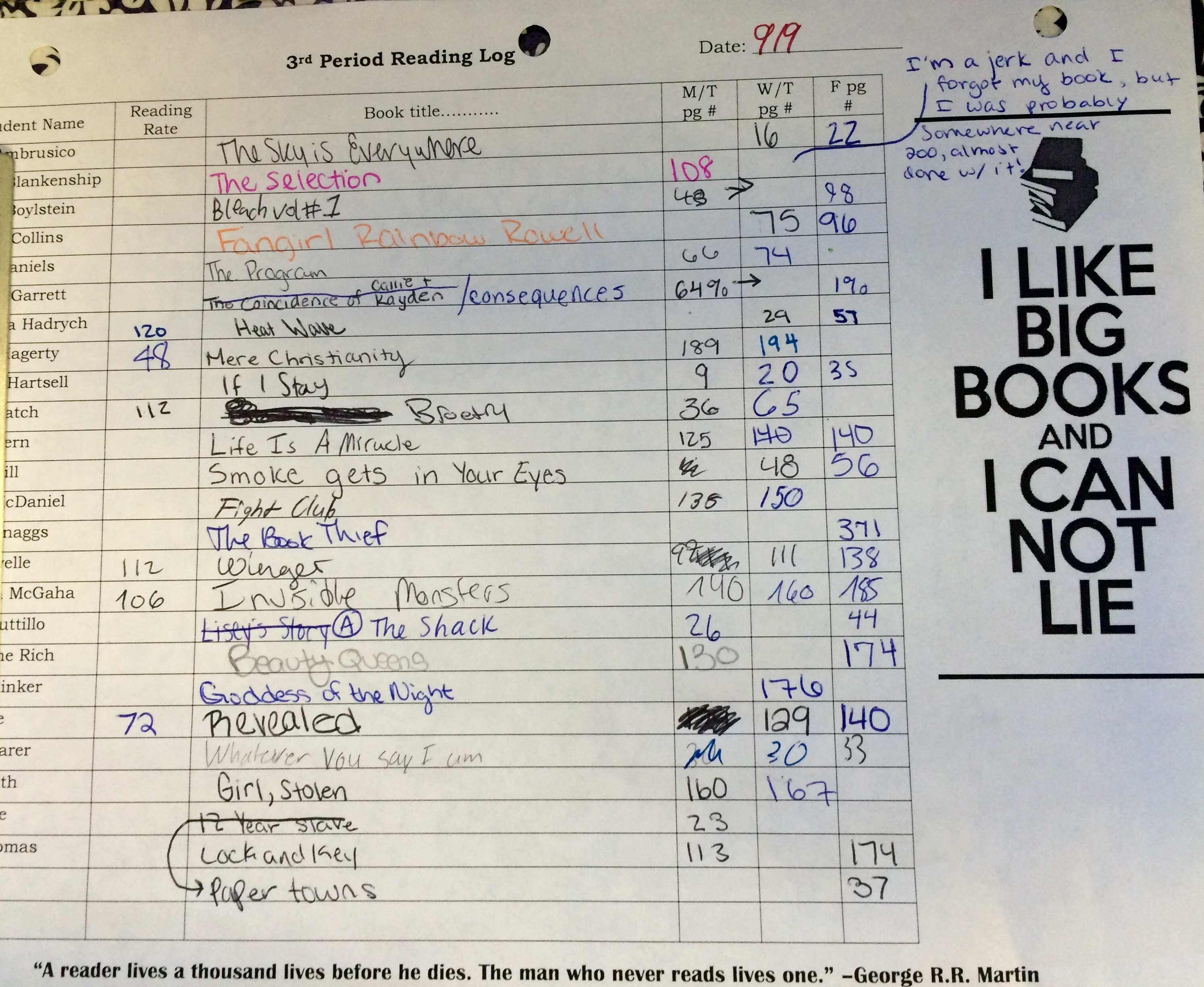
At the end of the 15-minute reading period, I ask students to count the number of pages read and multiply that number by eight to calculate their reading rate.  They complete their calculations and jot down their reading rates as I pass out paint strips and Sharpies.

“Today I want to remind one another about the importance of frequent reading.  We can’t become better readers without lots of practice reading, which is why your weekly homework is to read for two hours.  So, we’re going to make some bookmarks reminding us why we read, and also reminding us how much we should be reading.”

I ask students to take out their phones and look up a quote about reading.  Once we all choose quotes, I model on the document camera, writing my chosen quote on my own paint strip.  Students grab some Sharpies and a paint strip in their favorite color and doodle their quotes on their paint strip bookmarks.

IMG_9335

Students modify their reading rates in the Reading Rate column

“Once you’ve gotten your quote down, add your reading rate to your paint strip, nice and small.  You’ll want to change your reading rate whenever you switch books, and you’ll also want to note your new reading rates on the log sheet as it goes around each day.”

Then, I ask students to think about what might happen to their reading rates over time.  Jared predicts, “I think if I sit down for a solid two hours and read, I might read more than my reading rate.  When I really get going I can read pretty fast.”  Shailyn predicts, “My reading rate will increase…majorly!”

“What about if you read a harder book?” I ask.

“Um, I think I’d probably start out slow at the beginning, but as I get into the book, I’ll read it faster,” Shailyn adds.

“Awesome,” I say.  “We’ll have to see what happens.  So, as you use your bookmarks in the coming weeks, keep an eye on how your reading rate changes week to week, and how quickly or slowly you read your required number of pages.  I’ll check in with you in reading conferences soon.”

Follow-Up — Now that students have a tangible reminder of their reading homework to use as a bookmark, they can hold themselves more accountable.  The quotes give them a rationale for reading, and the written reading rates give them a reminder of their reading goals.  By self-monitoring both, students can assess their own reading progress far better than I can, and we’ll confer about that self-assessment during class for weeks to come.

#FridayReads: Matching Reluctant Readers to the Classics

IMG_9287On Tuesday, during a lull in class, Tyler was staring at the ceiling.

This isn’t unusual, or even discouraged, as our ceiling is covered with tiles that represent books.

“What’s that book up there?” he asked, pointing. “The one with the fire?”

“That’s Fahrenheit 451, by Ray Bradbury,” I replied.  I know that Tyler is a volunteer for our fire department.  I also know that he hasn’t had a lot of positive experiences with reading, so I tailored my impromptu booktalk to my knowledge of him specifically.

Fahrenheit 451 is a book about a fireman.  But he’s not an ordinary fireman–instead of putting out fires, he starts them.”

Tyler looked incredulous, and a bit offended.  “So he’s an arsonist?”

“He is, but that’s the job of the whole fire department in this book. Their job is to start fires to burn books and maintain censorship. Anyone whose house has books in it is the target of the department–they burn the house, and the books inside.”

“That’s messed up!” Tyler said, eyebrows raised.

“Right?!?” I agree, equally outraged for his benefit.  I tell Tyler some more of the plot–the corrupt fire chief, the terrifying mechanical hound, the strange professor that Guy happens upon.  “But eventually the main character–his name is Guy–gets curious.  He’s never read a book.  He starts to wonder, do they really need to be burned?  So, one day, at one house, he takes one.”

“The hound goes after him, don’t he?” Tyler predicts.

IMG_9289“He does.  And a lot of other crazy stuff happens.  I love that book so much…the way that Guy changes is so cool.  I really grew to love him by the end.”

Then, he asks the best question:  “Do you have that book?”  We cross to the bookshelf and I thank the gods–it’s there.

I give it to him, and he starts reading right away.

Tyler has abandoned a lot of books, but I think he’ll finish this one.  This was a case of matching the right book with the right reader at the right time, as Teri Lesesne says.

Tyler wants to read this book, despite its difficulty–he has reading strategies to cope with the challenges in vocabulary, sentence structure, and chronology that he’ll encounter.  I have faith that he will employ those strategies and grow as a reader and a thinker, as I have seen many a student do before, with greats like The Poisonwood BibleTheir Eyes Were Watching GodPride and Prejudice, and Brave New World.

We don’t need every single student to read all of those books.  They are gorgeous works of art that I hope everyone will discover, but thinking the only way to expose students to those books is to make everyone read them isn’t the way to do that.  Our student readers will find the classics on their own, if we give them the tools and the hunger to do so.  Tyler has the tools, and the hunger, so he found Fahrenheit–all because of a simple desire to know more, to find out why firemen would act so radically, sparked by the depiction of a flame on our classroom’s ceiling.

How do you match your readers with classic texts?

#FridayReads I Want All My Students to Experience This Kind of Reading

I’m always a bit nervous about how to introduce the volume of reading we will do in my AP Language class. Although students have heard that AP is “hard,” they don’t really know what that means until they start to see some of the texts they must read, understand, unpack, and analyze.

The biggest problem with all this reading:  most 16-year-olds are not readers. At least not when they come to me. (They do change.) Somewhere along their educational journey, the love of reading has gone by the wayside. Most tell me in our very first conference that they used to love to read. Few can tell with any specificity why they stopped. (I have my own theories.)

I’m constantly thinking of ways to help my readers fall in love again. If students are not reading, they are not growing as readers. It’s pretty simple logic.

And frankly, I want to live in a community of people who read. My current students will live on my street, work in the shops I patron, send their kids to my new grandson’s school. I want to be surrounded by families who enjoy literate lives because their lives will rub shoulders with mine.

Literature could change the world if we let it — if more people read it.

If we encourage what Louise Rosenblatt calls a sense of emotion, an aesthetic experience, in our young people, more of them would read. Rosenblatt explains how our readers need transactional experiences with the books they read:

“The transaction involving a reader and a printed text … can be viewed as an event occurring at a particular time in a particular environment at a particular moment in the life history of the reader. The transaction will involve not only the past experience but also the present state and present interests or preoccupations of the reader.” It’s like the letters on the page come to life, and the meaning of the words dance into the reader’s mind and heart. She has an experience with the text that remains long after she closes the book.

I want all of my students to experience this kind of reading.

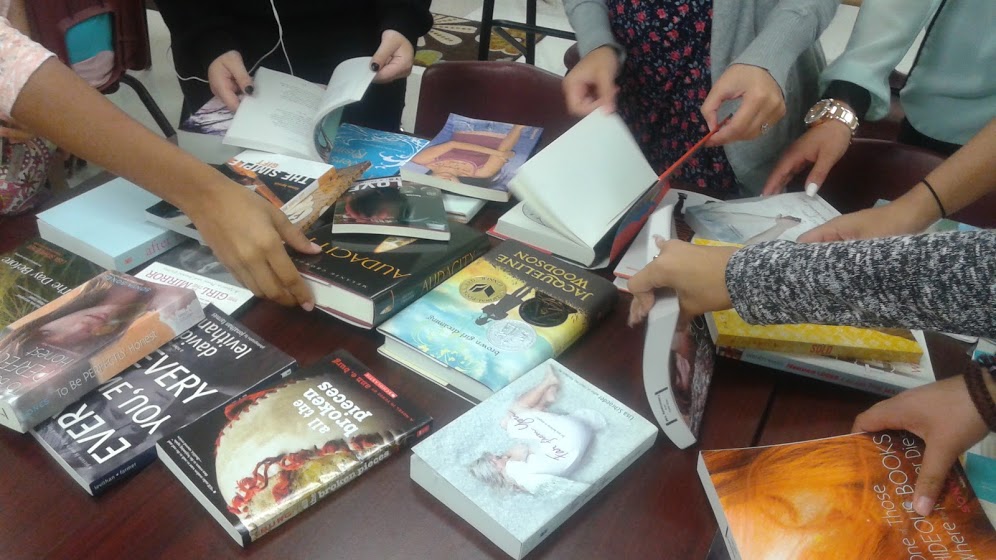
novels in verse 1So the first week of school I opened packages. Thanks to Donors Choose I had package after package arrive at my classroom. Each packaged filled with brand new novels for my brand new students. Most of them novels in verse — a powerful gateway back into reading with next to no stress. Few words on the page, and engaging story, vivid word choice, and a storyline brimming with emotion.

I book talked Chasing Brooklyn. It found a home in eager hands, as did To Be Perfectly Honest, The Crossover, Like Water on Stone,  My Book of Life by Angel, and many more.

If you’d like to build your Poetry shelf, or just add novels in verse to your classroom library, here’s a sampling of the books sweet donors gifted our classroom with this fall:

Like Water on Stone

The girl in the Mirror: A Novel

Audacity

Two Girls Staring at the Ceiling

The Red Pencil

The Vigilante Poets of Selwyn Academy

Perfect

October Mourning: A Song for Matthew Shepard

To Be Perfectly Honest: A Novel Based on an Untrue Story

What My Mother Doesn’t Know

The Simple Gift

The Secret of Me: A Novel in Verse

The Crossover

One of Those Hideous Books Where the Mother Dies

Every You, Every Me

Brown Girl Dreaming

I Heart You, You Haunt Me

Sold

Heaven Looks a Lot Like the Mall

Love, Ghosts, and Facial Hair

All the Broken Pieces

Geography of a Girl

Who Killed Mr. Chippendale?

(Note:  Shana’s the expert on building a classroom library by getting donations. Read about how she does it here. She’s got more ideas than just Donor’s Choose for books.)

Share your ideas on helping students have personal and meaningful experiences while reading…

©Amy Rasmussen, 2011 – 2015

A What-to-Read Conference: Books on Bullying

Many of my reading conferences happen at the bookshelf, as students finish one book and begin the search for another.  Here’s one example I just can’t stop thinking about.

Yesterday, a former student of mine came down to my room to borrow a book.  This particular student didn’t start out as a reader, so I was really excited to see him seeking reading material independently a year later.

“Do you have Winger?” he asked me.  We walked to the bookshelf and looked for it–all my copies were checked out.

“Why are you interested in Winger?” I asked him.

“Christina told me about it this summer,” he explained.  I smiled–books were still going viral, beyond our classroom community and into the summer months.

“Well, they’re all checked out.  What is it about that book that interested you?”

“The bullying,” he said, looking away.  Bullying?  I was surprised for a moment that this particular student was curious about bullying–he was a popular kid.  He drove a cool car, had a boisterous and charismatic personality, and had a trail of lovesick girls whose eyes followed his every move.  But then my surprise faded–all high school students, no matter how popular, confident, or smart they seem, struggle with their peers’ meanness.

I had to decide–what do I teach into here?  This student as a reader, or as a vulnerable teen?  I am no longer his teacher–so I don’t have to teach him as a reader, right?

Wrong.  I chose to treat this as a reading conference…but in doing so, I knew I was giving this student the tools to deal with the issue of bullying.

411MJMpTseL._SY344_BO1,204,203,200_I began to suggest alternate books about bullying, and I promised him that I’d set Winger aside for him when it was returned.  He ended up leaving with Thirteen Reasons Why, but I also suggested Nineteen MinutesYaqui Delgado Wants to Kick Your Ass, Simon vs. the Homo Sapiens Agenda, The Truth About Alice, Speak, Wonder, Aristotle and Dante Discover the Universe, and By the Time You Read This, I’ll Be Dead. 

I knew that when that student finished Thirteen Reasons Why, he’d be back.  I knew that I could guide him toward more books about this issue he was curious about, and that our future conferences could help him climb a reading ladder about bullying.

“Reading ladders take students from one level of reading to the next logical level…We can help them stretch as readers by showing them books that mirror what they already like but that…will challenge them more,” says Teri Lesesne in Reading Ladders.  By continuing to guide this student toward more complex books about the same issue, not only would I be helping him to grow as a reader, I would be offering him more titles that could help shed more light on the difficult issue of bullying.

Penny Kittle is fond of saying “reading saves lives.”  My own classroom library is emblazoned with the quote “We read to know that we are not alone.”  This student was seeking salvation, solace, and information in books.  He wanted to know that he wasn’t the only one feeling the way he felt, and he hoped to find a story that showed him a triumph over bullying was possible.  That he sought this guidance in a library shows the power of teaching readers…not books.

#FridayReads: Some of the Classics

IMG_20150729_181804

Alice in Wonderland pop-up book – full with rich colors, adventure, and 3D visuals.

“Oh, one of your students is reading Alice in Wonderland?!  I love that.  Are they captivated by it?  I wrote my entire master’s thesis on that piece.”

Last year, a colleague of mine was through the roof to hear about some of the children’s classics that my students were engaging in:  E.B. White’s pieces, Peter Pan, The Secret Garden, The Tao of Pooh, Alice in Wonderland – which holds a very special place in her heart.  But, for some reason students across the board have been guided away from these treasures.  Why are we steering them away from the simplicity of tapping into their inner nostalgia, re-entering times in their lives where there was quiet innocence and a simplicity that innately dissipates as we mature?

IMG_20141208_121037

In between reading The Classroom and The Cell and I Am Malala, this young man enjoyed the layered themes of a charming classic.

Charlotte’s Web was just as powerful for me as a thirty-something adult as it was as a seven-year-old little girl.  The latter was an opportunity to finish a chapter book full with robust (animal) characters and an opportunity to connect with Fern, the moralist. The former was a rich experience as I explored the theme of love, relationships, sacrifice, and an understanding of death (as I had recently lost my grandmother).

One of the important elements of the Readers Writers Workshop model is the idea of roller coaster reading. As Penny Kittle adequately puts it; adults read books on all different levels based on interest – students deserve the same.

I couldn’t agree more.

Think back to a time you dedicated your reading to a piece that was difficult – for you – for whatever reasons affiliated with that experience.  Often times, we decide to ‘take it easy’ once we’ve conquered a book of that caliber.  We’ll play with levels and genres and graphic novels and page numbers…and any other factors that play into our decision making.  But, we typically veer from the intensity.

Until we’re ready to try again.  And, we typically are ready at some point because we experienced the pride that comes with such a challenge.  It just may not be our next book…or the one after that…  But, we will find ourselves back there because it’s important to do so.  Students will too.

Roller Coaster Reading : All readers should have the luxury to go on such a ride!

Roller Coaster Reading : All readers should have the luxury to go on such a ride!

And while there is the push for lexile reading, and all of the other ways to monitor student reading, we must let students read what their souls ache for.  Whether it be luxuriating in a time of childhood innocence or challenging their vocabulary with a much more difficult piece.  When we provide space for students to explore (and yes, children’s books included) students find the roller coaster that suits them – a bit of scare and intrigue balanced with comfort and adventure.

A wonderful way to provide students the opportunity to monitor such reading is through the creation of a Reading Ladder.  (Scroll down to Q1 and Q3 to find information on how to create ladders and see examples.)  Simply, by reading various books on differing levels, students have the opportunity to review their learning, progress, fluency, and stamina…all the while having choice.

This year, I intend to watch our I’ll Always Be A Kid shelf grow as more and more students find themselves drawn to some of the classics from their childhood.  A handful of students love this shelf because they reminisce about reading (or having that book read to them) while others are exploring children’s literature for the first time.  Our adolescent parents are intrigued as they scope for titles that they want to bring home to read to their own little ones – because passing on the gift of literacy is priceless.  Regardless of the rationale, students end up falling in love with the magic.

What hesitations or fears surface when thinking about high school students reading children’s literature?

Simplify, Simplify: An Invitation

We’re six days deep into the school year here in West Virginia, and I am so happy, fulfilled, and content.  The start of this year has been the smoothest of my seven years, and our readers and writers workshop is coming together more quickly than it ever has.  I think it’s because of all of the invitations and welcomes that have been flying around our classroom, rather than the commands and directives of years past.

Amy’s post on inviting students to just talk helped me simplify the structure of my first week of lessons.  I strove to make our first days together as inviting as possible–as laid back, relaxed, and caring as I could.  Students were drawn to our classroom library with an invitation to check out whatever book they’d likethoreau-simplify.  They were intrigued by an invitation to write daily–nulla dia sine linea, in the words of the inimitable Donald Murray–as we set up our writer’s notebooks.  I invited students to just read for pleasure, to just listen to a poem to enjoy it, and to just write for fun.

My invitations all centered around simplicity.

I want to slow down my thinking this year.  It seems my brain is always flying at a hundred miles a minute, and I bet my students’ minds are too.  I will invite my students to simplify their thinking–to streamline their thought processes, open their minds, and just write.  Just read.  Just talk.

This year, I’m inviting everyone in our classroom–adults and students–to put away their phones.  We read this article to understand why that may be necessary, as our devices can distract us without our consent.  Part of this conviction came after I read M.T. Anderson’s Feed, an award-winning YA novel about the mindlessness technology can fill our lives with.

I’m inviting learners to resist letting their lives be frittered away by detail, to simplify, simplify.  We will do more with less, and we will do all of our reading, writing, and thinking more deliberately.  These first six days have been marked by that simplicity, and I hope to continue that trend all school year long.

What are your goals this school year?  What do you hope to achieve with your learners?