You know what I could use? A bookmark.
Actually, I could use five bookmarks right now.
I’m not proud and it’s not pretty, but I’m suffering from tented book syndrome these days. On my desk at school. My nightstand at home. The corner of the couch. The kitchen counter.
A vast field of tented texts. Books in progress. I know Amy can relate.
We share this affliction.
It always starts innocently enough. I’m between books. In the market for another. Speed dating texts to book talk, but not really committing myself yet. Then, I get sucked in.
It’s just one book to start. One book I want to come back to, so I’ll just leave it…here.
This time I blame Alyssa, one of my AP Language students. She enthusiastically book talked Anita Diamant’s The Red Tent. I immediately ordered it and it’s now flipped open on the coffee table as I type. Shortly after, Errin, an inquisitive sophomore, asked me to read Kafka’s Metamorphosis and that (to keep the creature in) is flipped upside down under a stack of papers. Don Quixote has been languishing on my desk at school since the start of the year. I will finish it this time; I’ve just been distracted by about twenty-seven other amazing books since I started (I did read six whole pages today. That leaves 788 pages to go. So, I’m really cruising).
Penny Kittle’s Write Beside Them is eternally tented on the shelf behind my desk. And I’ve been flying through another ‘I can’t believe I haven’t read this text,’ The House on Mango Street by Sandra Cisneros. Esperanza was actually flipped open on the front seat of my car last week. I started it during an oil change.
So…I have a problem. For a bibliophile, this is a good problem to have. It is both damaging to my books and a testament to my deteriorating organizational skills, but it does keep those books at my fingertips. It’s super nerdy, but I love to see them, open and waiting for my return.
However, while having a good book close at hand might excite those of us already full of passion for reading, it takes a little something more to get our students geared up to keep turning the pages day after day. Just ask the local library. If merely having the books available led to literacy, I might be out of a job. I bet librarians would be willing to open and tent books if they thought it would get kids reading, but shockingly enough, few students are as willing to be as visually nerdy as the average English teacher.
What we need is to not only get the texts in front of kids, but keep them there in a meaningful way.
Bright. Catchy. Student-centered.
So, here are two very easy ways to appeal to our students’ goal oriented nature, if not their occasional tendency to let their eyes wander around the room during class. If we can’t hook them with tented texts, these approaches just might catch their eye.
1. Reading Goal Bookmarks
This is a hybrid of a number of measures I’ve seen and read about for helping hold students accountable for their reading. While I certainly want to keep track of what they are reading and how they are progressing, I wanted to try and incorporate a visual reminder of their reading goals into the experience.
In the rare occasions I get into an exercise regiment (regiment may be a strong word…spurt, perhaps?), I stay accountable, in part, because I make the routine visible and harder to ignore. I set alerts on my phone, schedule time on the calendar, and put my workout clothes out where I can see them. In short, I make it so I can’t avoid seeing what I know I should be doing.

The sample card I made for my classes. Fiction start to finish, but it showed how things should be organized. Without the example a few weeks ago, it was a big mess.
In that same way, I decided to purchase neon colored index cards for students to record their goals and progress. I’ve marked my own calendar for the days when we should be setting a weekly reading goal, and ask students to record their current book, the date, the page they are starting on, a weekly goal based on reading for two hours per week, and reflection the following week as to whether or not they met their goals.
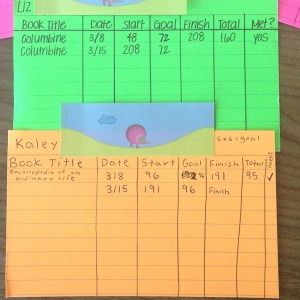
We just started this new system, but I like what I see so far!
Students keep track of their reading, I use the cards to help guide conferences, and even more wonderfully, I have them put their cards in the book not where they are currently in their reading, but where they want to be by week’s end. The bright neon cards stand all week as visual reminders of where students are aiming for the week.
2. Recommendation Walls
Sometimes, it just takes the support of one’s peers to keep texts fresh. In the same way that a book talk from students allows kids a glimpse into the texts their peers are enjoying, visually displaying recommendations and books completed, by both teacher and students, keeps suggestions fresh for everyone. Get those suggestions up on the wall and let kids take a peek.

Erin Doucette’s wall is adorned with her hand painted sign and book suggestions from texts she and her students have enjoyed this year.
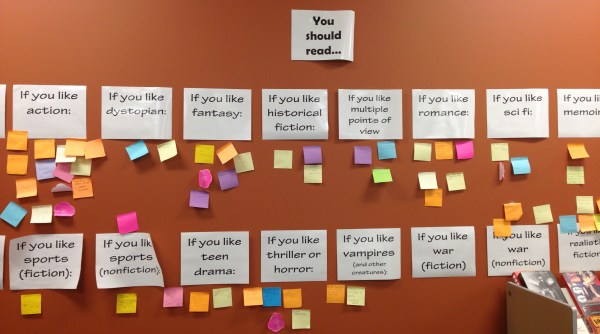
Catherine Hepworth has her students populate the recommendation wall based on genre.

Brandon Wasemiller has students recommend books by creating their own analytical book covers.
How do you keep recommended texts at the forefront of your readers workshop? Please leave your ideas in the comments below!




 We’ve all been there. The conference room is crowded. It’s too hot. Every third person is clicking away on their laptop, answering emails or checking their phone, answering their kid’s plea to bring their forgotten gym socks to school. The presenters drone on, flipping through slide after slide on a fairly average power point. At the front of our minds, a constant throbbing pulse: how will I ever use this in my classroom?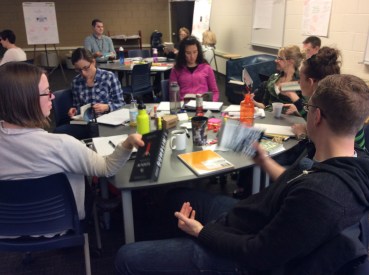


 Lesson: We’ll pass out copies of the article for students to read and annotate, and they’ll also have their writer’s notebooks out.

 The plan? Spend the hour and a half between the end of the school day and kiddo pick up time entering my students’ midterm grades, doing some lesson planning for “Hamlet” and cleaning and organizing my room in preparation for third quarter.
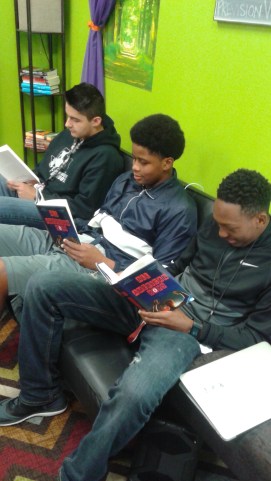 ow characters and plot lines develop and how they mirror their lives. She challenges students to consume pages, develop stamina, and grow in fluency. She gives them opportunities to read more and read harder because she knows the value of reading in building confidence and competency. She introduces different genres, authors, themes. She surrounds them with shelves weighed down by high-interest books and gives them time to read in class. To this teacher, it is not about the book — or the six books of lofty literary merit — it is about the reader. Readers who read 12 books in a year instead of just six. This teacher knows if she makes a reader she can make a life. And the skills gained through reading extensively transfer to their writing and permeate like energetic friends into the reading they must do in other classes.
 piled a variety of reading challenge lists that I’ll be printing out on bookmarks to provide to my students.
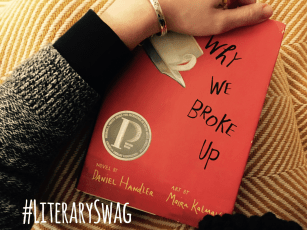 exhibit their reading lives outside of school. Students will e-mail a Twitter or Instagram class account with literary images that include the following hashtags:


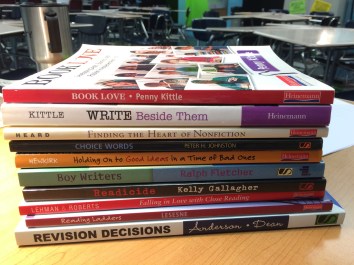 I met with my new student teacher a few weeks ago, and he asked me to borrow any books that might help him get going on the readers-writers workshop–the “theory” version of


 Three Teachers Talk