Category Archives: Boys & Literacy

#FridayReads: Books Boys Love

Bedtime_readingAt the conclusion of our course with Tom Newkirk at the University of New Hampshire Literacy Institutes, our class collaboratively created a list of books that boys love.

Please add your own suggestions for your male students’ favorite books in the comments!

  1. Into Thin Air, Into the Wild, and Where Men Win Glory by Jon Krakauer
  2. Peace Like a River by Leif Enger
  3. Unwind and others by Neal Shusterman
  4. Absolutely True Diary of a Part-Time Indian by Sherman Alexie
  5. Sleepers by Lorenzo Carcaterra
  6. Hellhound on His Trail by Hampton Sides
  7. Maze Runner by James Dashner
  8. Forgive Me, Leonard Peacock and BOY21 by Matthew Quick
  9. Mexican Whiteboy and others by Matt de la Pena
  10. I am the Messenger by Markus Zusak
  11. Start Something That Matters, Little Princes, and other inspiring memoirs
  12. Winger and 100 Sideways Miles by Andrew Smith
  13. Unbroken by Laura Hillenbrand
  14. A Child Called It by Dave Pelzer
  15. American Sniper, The Things They Carried, Ghost Soldiers, The Good Soldiers, No Easy Day, and other war books in general
  16. City of Thieves by David Benioff
  17. Boot Camp and others by Todd Strasser
  18. Stiff, Spook, etc. by Mary Roach
  19. Fight Club by Chuck Palahniuk
  20. Anything by Gary Paulsen or Jack Gantos
  21. Iron Man, Deadline, and others by Chris Crutcher
  22. The Discworld series by Terry Pratchett
  23. Warhammer novels by Ian Watson
  24. The First Stone, Running on Empty, and other books by Don Aker
  25. GRAPHIC NOVELS:
    • Walking Dead
    • Maus
    • Watchmen
    • A Dozen Demons
    • V for Vendetta
    • American Born Chinese
    • Chew 
    • Naruto
    • Pride
    • Persepolis
    • Burma Chronicles
    • My Friend Dahmer
    • Stitches
    • The Photographer: Into War-Torn Afghanistan With Doctors Without Borders
  26. Ice Time by Jay Atkinson
  27. Everything by Walter Dean Myers
  28. An Invisible Thread by Laura Schroff
  29. Crank, Rumble, and more by Ellen Hopkins
  30. 4021A by Joe Hill (Stephen King’s son)

Takeaways: Boys & Literacy

arts-graphics-2008_1128618aAt the conclusion of our course with Tom Newkirk at the University of New Hampshire Literacy Institutes, our class collaboratively created a list of implications from our learning.  Following a reading of Misreading Masculinity, a viewing of the documentary Raising Cain, and more, we used Google Docs to list the implications of our course for application in our classrooms.

Please add your own wisdom about boys and literacy in the comments!

  1. Provide choice: lots of options in topic, genre, etc. – Allow for different styles of storytelling
  2. Incorporate more visual literacy – Using mentor texts like Knucklehead, comics, etc.
  3. Encourage the writing of fiction as a fantasy outlet
  4. Acceptance of the content they bring/the choices
  5. Conversation: Ask about choices that seem uncomfortable – build trust
  6. Teachers: Recognize the difference between uncomfortable and threatening
  7. Respect that students can differentiate between fantasy and reality.
  8. Pay attention to the context of the violence in boys’ writing
  9. Encourage collaboration in writing and reading
  10. Make space for movement and conversation – too often, boys must sit and listen; reverse that
  11. Incorporate humor in the classroom and content/curriculum
  12. Grant students more autonomy in the classroom
  13. Use the note response method we used to have students respond to each other’s work
  14. Support social interactions between boys around literacy
  15. Question our own motives, preferences, and restrictions as we teach
  16. Create a place for non-fiction – demonstrate that non-fiction does not have to be boring
  17. Use technology as an alternative medium for both expression and sharing
  18. Learn the identities and passions of your students
  19. Recognize the importance of listening to students
  20. Realize that posturing is okay – it is “trying on a personality” in order to discover one’s own
  21. Provide positive role models of masculinity so male students don’t get caught in a bad one
  22. Encourage nurturing responsibilities in (ie, provide opportunities for) boys
  23. Have a wide diversity of types of male protagonists in available literature – celebrate the same strengths we applaud in female characters when we see them in male characters
  24. Be aware of the gender implications of language
  25. Open up the genre of analysis beyond literature, eg, new video game
  26. Allow and encourage drawing at all levels
  27. Expand your repertoire – having a team helps
  28. Encourage positive competition occasionally

Fart Jokes in 12th Grade

photo 2-2Three minutes into silent reading, someone farted. I have the band-aid colored desk-chair combos, which meant that one vibrating toot was magnified against the metal frame of the guilty student’s seat. The room stayed silent for half-a-minute and then erupted in laughter. The girls quietly chuckled, but there was no way the boys could settle back into their books, so we moved on to our minilesson and called it quits.

My boys can’t get enough of lowbrow humor. Their writer’s notebooks and fictional stories are full of crass humor—farts, sexual innuendo, embarrassing stories, and offensive humor. For years, I chalked up their obsession with these topics to immaturity. I love a good fart joke or sarcastic paper, but I never truly understand the point.

Newkirk argues that humor is a mode of exploration for students, particularly boys. Instead of chastising them for vulgar or lowbrow humor, teachers should capitalize on boys’ love for the weird, gross, and funny. He pointed out that classic literature is full of crass humor, citing Beowulf and Shakespeare as examples. Boys, he noted are inclined to read humorous literature and use these as mentors for their own writing.

Too often though, teachers either don’t understand boys’ humor or they fear that the silliness somehow undermines the assignment. This shouldn’t be the case. Just as we give girls the room to explore emotionally charged pieces about self-confidence or dating, we must also give boys the opportunity to investigate their own questions, which may very well include both humor and violence, as Shana discusses. In an excerpt Newkirk gave us from Boy Writers, author Ralph Fletcher notes that “some of the crass humor in their writing (burping, farting, dirty diapers) tries our patience, but many boys are simply making ‘text-to-text’ connections between their writing and the kind of humor they read in books.” These connections are invaluable when it comes to capturing the attention of our male students.

IMG_2367In turn, we must allow our boys a space to explore humor. Sometimes jokes are just funny, but other times, they soften heavy themes in literature. They open up deeper discussions that are otherwise inaccessible or uncomfortable. As Newkirk writes in Misreading Masculinity, “[Humor] provides a forum for negotiating and sustaining male friendships, and of making overtures to girls. It allows us all to laugh at the peculiarities of our bodies, as we escape, if only briefly, from our embarrassment at the sounds they involuntarily make and the smells they produce” (Newkirk 167). Will students toe the line between inappropriate and appropriate humor? Most likely. Will they take their jokes too far? Potentially. But learning is about testing our surroundings and studying voices to find our own. At the end of the day, I’d much rather my students explore their world through laughter than not, fart jokes and all.

The Consciousness of the Child: Another Thought on Conferring

Much has been written about conferring with younger students, but in the current professional literature, I find little that addresses the needs I have in my secondary classroom. I know when I talk to my students in one on one conferences, they grow more as individuals who engage in reading and writing more critically. I believe that if teachers will talk to their students more, teaching them as individuals instead of the collective, students will respond in ways that delight and surprise us (and often surprise themselves as well).

Teenager with parent

Teenager with parent

The topic of conferring consumes my reading life of late, and I find myself reading Misreading Masculinity with this guiding question:  How does this relate to my study and work on talking to students about their thinking?

The following lines from Newkirk’s book relate directly to what I believe must be our first step in helping our teenage readers and writers develop the sense of self needed to engage meaningfully with the material and skills we need them to in high school English:

“…the ability to think beyond the “logic” of normal school performance in order to inhabit the “logic” of the student (Newkirk, 12).”

. . . The linguist Basil Bernstein elegantly points out the centrality of this ethnographic stance for teaching:

If the culture of the teacher is to be part of the consciousness of the child, then the culture of the child must first be in the consciousness of the teacher…We should start knowing that the social experience the child already possesses is valid, and that this social experience should be reflected back to him as being valid and significant. (1966, 120)

As a credo for education in a multicultural society, I don’t think we can do better than that (Newkirk, 13).

Educators must relate to students as individuals with a variety of interests, passions, backgrounds, and literary histories. We must try to think like they do if we are ever going to develop relationships that engage the teenager in reading and writing experiences that invite them to take on the qualities of readers and writers. Our goal should reach far beyond the idea of school. It must reach into a student’s future life.

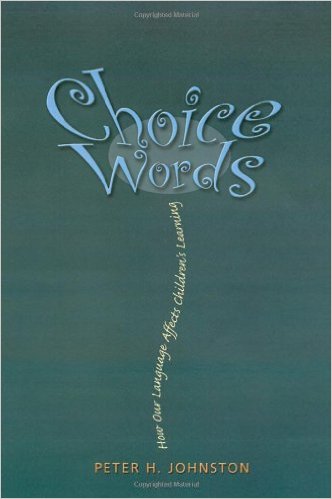
In the book Choice Words,  Peter Johnston discusses the importance of tapping into students’ literary Choice Wordshistories in order to give them a literary future. What experiences has the child had with reading and writing that have formed her belief about herself as a reader and a writer? We must learn of these experiences and then validate them if we ever expect to move our students from the starting places at which they come to us.

Regularly conferring with students is a vital part of getting into the “consciousness of the child.” However, many high school English teachers instruct their students as if they all experience the same culture and the same consciousness. No wonder groupthink is so prevalent in our communities and in our politics. It is a reflection of how students receive instruction. This whole class, one-size-fits-all, standardized teaching (not to mention the tests) is detrimental, not just to boys, but to all students who deserve to be instructed at an individual and personal level.

What are your thoughts?

©Amy Rasmussen, 2011 – 2015

Just Let Them Write: Boys and Autonomy

“Just let them be boys.”

This aphorism about dealing with boys is a long-standing one, but I learned last week in Tom Newkirk’s class on boys and literacy that it’s much easier said than done.

First, after reading a pretty fascinating article in The Atlantic, I realized that modern society doesn’t often let our boys be boys.  The economy, family structures, and workplaces of America have changed drastically in the past twenty years, and the traits and skills that used to make men successful and fulfilled have gone away.

Second, I listened to my fellow teachers discuss their classrooms this week at UNH, and I was struck by the language of control prevalent in teaching narratives:  “I make them;” “I let them;” “I shoot down their ideas;” “They have to;”…these were the words teachers used to describe their students’ activities.

These are phrases of division, of separation, of a differentiation of teacher and student, expert and learner, master and subject.  Having just read Daniel Pink’s Drive, the phrase “The opposite of autonomy is control” has been stuck in my mind.  It seems that even in the academically enlightened setting of the New Hampshire Literacy Institutes, many teachers still practice a teaching philosophy of control and compliance, rather than one of equity and autonomy.  Further, many of these speakers were women–so this was an issue not just of control, but of furthering the claims of the Atlantic article mentioned above regarding emasculation.

Our class talked about violence a lot, and whether it was acceptable in writing.  Ralph Fletcher’s Boy Writers taught me that violence in boys’ writing was as natural as the sunrise.  Newkirk addresses this issue as well, defining violence in general as “the intentional infliction of pain…on another,” and specifying that “writing would be a violent act if it caused pain to others…for example, if it caused readers to feel threatened or humiliated.”  Too many teachers in our class had a strict no-kill, no violence, etc. rule about writing topics–the opposite of autonomy.

Most reading and writing boys do doesn’t involve intention to inflict physical pain or harm.  Their topics may be provocative, but most of the time, it’s just boys working out things that are on their minds–huge issues like death, love, violence, and sexuality.  Adults do this all the time too–these are issues many of us haven’t quite worked out, so why should we deny children an opportunity to explore them through writing or other means?

Thanks to reading texts like Boy Writers, Misreading Masculinity, and Peter Johnston’s excellent Choice Words, I feel like I understand and enjoy many themes in my boy students’ writing. In fact, the first time I met my husband was in my freshman English class, where I wrote a story about a serial killer who stole college students’ identities and test scores by ripping off their faces and stitches them over his own. My professor asked me to share it in front of the class and I still recall the nervous giggling that followed my sharing, including Jon’s wide eyes. As a writer, I was just proud of creating a fictional voice so creepy and plausible, but the embarrassment of that experience shamed me to a degree that I’ve shied away from all fictional writing since.

As a teacher, I don’t want to quash a student’s creativity, violent or not. I love my boy writers and respect the sanctity of their writer’s notebooks, in which their fantasy lives can be explored and reflected upon in private. For them to grant me access to those fantasy lives through writing is a sign of respect and trust, and I wouldn’t want to violate that by censoring their thoughts, showing them to administrators, or asking them to share with the class.

But most of all, I want to distinguish between feeling “uncomfortable” and feeling threatened or unsafe.  Hearing me read my serial killer story probably made some of my freshman English students feel uncomfortable, but no one felt scared–I did not threaten anyone in the room, nor did my fictional narrator.  In fact, the end of the story revealed that the killer’s actions were mostly motivated by justice, revenge for his victims’ pervasive academic dishonesty.

Feeling uncomfortable, though, is something I believe is essential to learning.  Disequilibrium is the space in which our worldviews are challenged, where we achieve the Vygotskyan zone of proximal development.  We are confronted with new knowledge and are close enough to it to assimilate it into our existing schema.  An open, unfettered workshop classroom is one place where this kind of development can (and should) occur.  Rules like no violence, no swear words, no sex, no freedom, prohibit the opportunity for disequilibrium–and real social learning–to occur.  We cannot fear our students’ inner minds.  We must acknowledge the distinction between fantasy and reality in books, in writing, and in our kids.

Further, we must value that chasm, and respect our students’ varied and important processing strategies.  Writing these issues out is a way to come to understand them, so we must forsake this antiquated notion of creating control and compliance in classrooms.  Given choice, given autonomy, our students will read and write their ways toward understanding beyond our classes and into their adulthood, as we do.  We are the same as our students, grappling with concepts in writing (like I am here, now) and are no better than or superior to them.  Eliminate authority, cultivate autonomy, and just let them write.

#PoetryChat – Boys & Poetry – Monday, August 3 8ET

IMG_8888This week, the writers of Three Teachers Talk are together in Durham, New Hampshire at the UNH Literacy Institutes.  For five days now, we’ve learned with Penny Kittle and Tom Newkirk about strengthening our practice and our thinking.

Newkirk’s class, centered around his Misreading Masculinity (2001), is focused on boys and literacy.  We’ve read and discussed issues of violence, humor, personality, sexuality, power, and more–all surrounding boy readers and writers.

Join us to continue this conversation on the topic of poetry.  The four of us will be together in Portsmouth, ready to chat on Monday at 8ET.

1. How do you notice your boys responding to poetry in your classroom?

2. Should boys write poetry in an English class?

3. How is poetry uniquely valuable for boys?

4. How do you hook boys into poetry?

5. What are your best poems, poets, or poetry resources to engage your boys?

Poetry Chat August 3