Category Archives: Pedagogy

What do fingernails have to do with data?

We all feel it, don’t we? That time of the year when teaching gets tough:  skies get darker, holidays come looming, and students look out windows more than they look to learn. I have 2.5 days until the break, and, like you, I am ready.

This is the time of year I start to question myself. Have I taught the way my students need me to teach? Have I made them feel special, valued, a part of our learning community? Have they learned anything?

These were my musings last week when I got a special gift in my inbox:  three photos of a former student’s fingernails.

With this message:

This is totally random, but I thought you might like to know that aside from all of the English, reading and writing skills that you taught me. . .our end of the year project (the How-To), has actually helped me in real life! If you remember, I did my project over biting nails because I desperately wanted to stop. After that project, it was so easy to, and I haven’t bitten them since the end of the year in your class 6 months ago! I’ve attached some pictures… Like I said, this is super random & weird, but if you’ve ever wanted proof of that project actually working, here is my successful end product.

Does this count as hard data?

Yesterday I answered questions about student data in a phone interview. One question went something like this:  If a cynic questions your methods, what do you do to win her over?

The exchange left me unsettled. I said I would show the cynic student work and let her read students’ self-reflections on their learning. I spoke about how the data I care about is the qualitative type that comes from my observations, conferences, and interactions with students. I value process over product.

I think my response fell flat with my interviewer. Maybe she wanted numbers. What would she think of Micaela’s nails as proof of my instructional methods?

Later in the day I twittered upon these tweets:
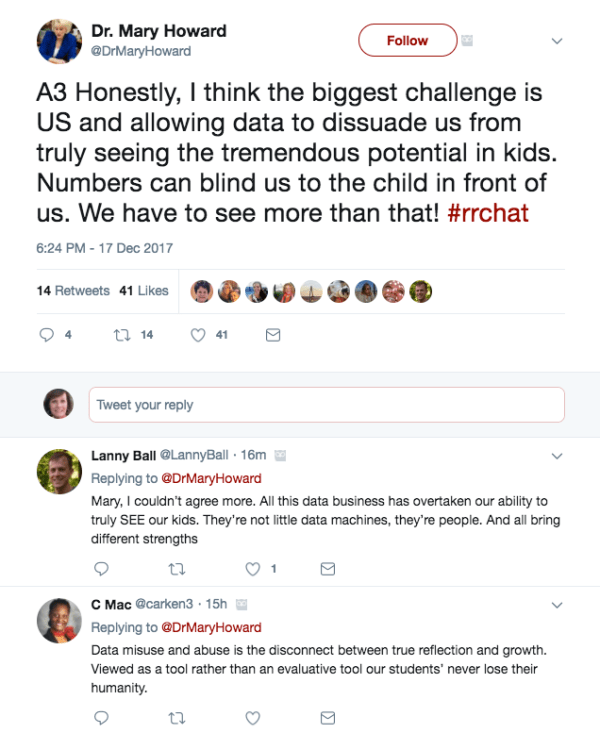
Screen Shot 2017-12-18 at 8.06.56 PM

The whole thread rings true.  And I’ll add this:  Numbers mean nothing if we do not add value to a child’s life and help her learn to thrive, achieve, and find herself within it.

I’ll be honest:  I thought Micaela chose an easy topic last spring as her final writing piece:  a multi-genre project that was more than a how-to but a comprehensive argument for or against an issue; I didn’t think she could write enough about breaking her habit. But I got out of her way, and she composed a multi-layered piece about the shame and the struggle and her desperate desire to leave her nails alone.

I’ll go on break this Thursday. But when I get back to work in 2018, I’ll remember Micaela. What do my students need beyond my ELA curriculum? What motivates their thinking? What will my students choose to do this spring if I remember to get out of their way?

Amy Rasmussen shares a classroom with juniors and seniors at Lewisville High School in North TX where she learns as much from them as they ever do from her. She was once a nail-biter herself. Writing a paper about her habit at 16 might have helped her kick it a lot sooner. She was 21. Amy wishes you a joyful holiday and a Happy New Year, and sincerely thanks you for following and sharing Three Teachers Talk.

Story, Self-Generosity, & Student Success: #3TTchat with Tom Newkirk

For our inaugural #3TTchat last night, we were privileged to be joined by the great Tom Newkirk. This bright light of literacy scholarship talked with us about reading, writing, and assessment in the context of two of his most recent books: Minds Made for Stories: How We Really Read and Write Informational Texts and Embarrassment: and the Emotional Underlife of Learning.

Just as his books are, Tom’s tweets were full of one-liners of wisdom and wordplay as he engaged in the chat with teachers, instructional specialists, and writers:

Many of us, in thinking about this question, highlighted the importance of identity in our reading lives–how do I see myself in books? How do I find myself in books?

Our next question asked how we taught students to do this very thing: make connections between people’s stories and their stances and beliefs:

As we pondered this question, many of us offered up the value of having students read books that they couldn’t see themselves in–moving from mirrors to windows. We connected this to moving from recognition to empathy.

Q3 focused on specific reading practices to help students view their reading lives dynamically; Tom encourages his readers to hone in on beginnings:

Book clubs, multigenre projects, studying mentor texts, modeling our reading lives, and crafting reading and writing autobiographies were all journey-focused practices chat participants offered up.

As we shifted toward talk about writing, we wondered how we might best help students read like writers in order to strengthen their own written products. Tom offered his view that variety is key:

Avoiding becoming stuck in one genre was a theme of the night–mixing narrative with nonfiction, blending story and poetry, lab reports and literary devices, all through studying provocative, unconventional mentor texts and practice, practice, practicing imitating their craft moves.

Q5 wondered specifically about genres of writing that might help students do this, and Tom replied that any genre containing “trouble” was a good place to start:

Ideas included memoir, commentary, op-eds, origin poems, author bios, annotated lists, letters, and straightforward exposition and essays. In short, the opportunities for emphasizing narrative are endless!

We shifted toward thinking about assessment, and our conversation focused on celebrating student successes rather than emphasizing shortcomings:

We railed against grades, but honed in on emphasizing process over product, using student work as mentor texts, and teaching students to have a growth mindset when it comes to goal-setting and their reading and writing lives.

Finally, we wondered about takeaways, and Tom’s just about made us weep:

His ideal teacher voice is one of kindness and encouragement, as were so many of our chat participants’: “writing is a living process;” “your voice matters;” “everyone has something to say that matters;” “there is no one correct way to write.”

Together, #3TTchat told a story of leading students to success in reading and writing through encouragement, patience, and self-generosity.

All we can say is thank you to Tom and our many participants for helping us write that story.

We are so looking forward to talking more about the role of narrative in informational reading and writing at NCTE this year. This topic has been a long time in the making–starting with some thinking at NCTE in 2014, then growing with our reading of Minds Made for Stories, and growing some more when we took a class with Tom Newkirk at the UNH Literacy Institute. We hope you’ll join us in St. Louis for more thinking about this important topic!

Shana Karnes, unfortunately, will NOT be able to attend NCTE this year, breaking her 8-year attendance streak for the important reason of having her second baby. While waiting impatiently to meet Baby Jane, Shana teaches preservice teachers at West Virginia University, works with practicing teachers through NWP@WVU, and participates in Halloween festivities strictly for the candy. Follow Shana on Twitter at @litreader or find more of her writing on the WVCTE Best Practices Blog.

What if We Teach as if Teaching is a Story?

Sometimes I feel like a fraud. I spend all this time thinking, talking, teaching, and writing about workshop, and I love it, honestly– but sometimes teaching beats me up. You know?

Students ignore my feedback on their writing. They refuse to capitalize their i’s. They grab a random book off the shelf during reading time, thinking I won’t notice. They lie.

And usually I shake it off, tighten up the gloves, push off the ropes, and go for another round. But sometimes I don’t wanna.

When I get like this, and thankfully, it’s not too often, I have to stop and remind myself I possibleam teaching children. Teenagers, yes, but still kids who are not intentionally trying to drive me to an early retirement. They just don’t feel the passion for books, reading, writing, and language like I do — yet. Many have played the game of school so long they don’t see that they could actually like it if they’d play a different way.

Teaching is a puzzle, isn’t it? That’s what makes responsive teaching so important. We have to keep trying so all students have the learning experiences they need to grow, to change, to become.

Last week I attended a professional development meeting with George Couros, author of the Innovator’s Mindset. I jotted tons of Couros’ quotes in my notebook, all important to the kind of teacher I keep striving to become:

“How do you cultivate questions of curiosity and not compliance?”

“Data driven is the stupidest term in education.”

“Your childhood is not their childhood. Nostalgia is what gets us stuck.”

“Relationships matter! Nobody in this room is as interesting as YouTube. If you are all about the content, you are already irrelevant.”

“You need to make the positives so loud that the negatives are hard to hear.”

“Would you want to spend the whole day learning in your own classroom?”

“Every day is where your legacy is created.”


I think the workshop classroom IS the innovator’s classroom. It’s process over product and the whole kit ‘n caboodle.

8-characteristics-of-the-innovators-mindset

We are the risk takers in Secondary ELA. We advocate for choice and challenge. We confer with students, reflecting on their needs and on our practice — maybe more than those teachers who reuse lesson packets with their novel studies. We improve our instruction by networking and sharing ideas on mentor texts (check out this thread), assessments, mini-lessons, and how to match students with the just right books. We start with questions and often end with them as well.

No wonder it is hard.

Lately, I’ve been rereading Tom Newkirk’s book Minds Made for Stories (3TT is presenting at #NCTE17 on narrative with Tom as our chair.), and I keep coming back to this little bit on page 43:

Two Absurdly Simple Rules for Reading and Writing

If we had to pass on advice, under the limitation of twitter characters, here would be my advice for writers and readers:

  1. Read as if it is a story.
  2. Write as if it is a story.

More than ninety characters to spare.

Now, what does that have to do with this post on one teacher’s weariness, some student attitudes, and workshop as innovator’s mindset? Maybe everything.

What if we teach as if teaching is a story?

Newkirk asserts, “Reading. . . is not a treasure hunt for the main idea; it is a journey we take with a writer.” He explains that in reading we seek patterns of anticipation, tension, and resolution. We seek experiences.  He states, “. . . it makes basic sense to read dramatically, even when what we read does not easily fall into any dramatic genre… we can dramatize just about any text. We can ask what is at stake. What problem, issue, “trouble” is prompting the writing? What needs to be solved? What are the contending positions or alternatives?” In reading we take action as we link ideas. “Good writing has a sense of motion, pace, anticipation, and . . . “plot.” Critical reading is all about friction–trouble” (44).

Newkirk asserts that this provocation is equally valuable in our own writing: “What situation . . .calls for explanation? What problem [will] my writing solve?” These questions imply “a need to have our say” in response to the “tension, a friction, a puzzle, and incompleteness” our questions provoke. He writes, “If we’re only saying, “Me, too” or “I agree,” endorsing what everyone believes, arguing for the obvious, making no “news,” there would be no call to continue the conversation. Nothing is caused” (44-45).

There’s so much more in this book by Newkirk, and maybe it’s a stretch to think of teaching as if teaching is a story, but try this little exercise:  read that bit from Tom’s book again through the lens of teaching instead of reading or writing. Do you see it?

Workshop teacher-friends, we are on a journey. Many of us take risks on our campuses, going against the norms of traditional practices, feeling the tension when we offer ideas in planning meetings. We feel the friction from students set in routines that have left them weak in literacy skill and lacking in desire. We cause friction. We generate energy. We dramatize everything we love about books and authors and reading. We foster stories of change as young people begin their own journeys into more robust reading and writing lives.

And when we think it’s not working, we must remember we asked for it. (I asked for it.) We “caused” because we care enough to take the path that leads to student growth. I’ll end with this by Newkirk:

“Our best chance to grow, perhaps our only chance, is to travel.”

Amy Rasmussen teaches AP Lang and senior English at Lewisville High School just north of Dallas. She loves to cause a bit of trouble, share her love of books (Have you read John Green’s new one yet? Sooo good!), go on long drives with her handsome husband, hug her grandkids, and share her passion for workshop instruction. Follow Amy on Twitter @amyrass and @3TeachersTalk — and if you’d like to contribute to Three Teachers Talk, send her an email, amyrasmussen7@gmail.com. We are looking for regular contributors.

Why We’ll Read More Than an Article of the Week in Senior English

I wish I were kidding. I am still laughing, but this is not funny.

Last week was my first week back to school. We had five days of shifting classes; schedule changes like shuffling cards with every student vying for their winning hand, or at least two out of four classes stacked with friends.

This is my first year to teach senior English (I still have one section of AP Lang), and I felt a mixture of excitement and dread all summer. Twelve years of reading, or not. Twelve years of playing the game of school, or not.

How do I get students to want to read, want to write, want to explore and question and challenge when it’s possible they just want to be done with school? I am pretty sure that’s how I felt senior year. Granted, that was a loooong time ago, but I do not remember any teachers’ names, any books I read for school, anything I learned the year before I graduated.

I wonder if that’s normal. Somehow I don’t think it should be.

But I do not want my seniors to remember me. I want them to remember learning something that adds value to their lives. I want them to remember learning something that adds value to my life as they vote beside me for elected officials, move into my neighborhood, become my doctor, or perhaps teach beside in the classroom next door.

I know the routines of a workshop pedagogy will help me do that, of this I am certain.

We’ll read and think and write and talk. We’ll share our thinking and our writing in small groups and as a class. We’ll talk about books and the themes that resonate and why that might be so. And we’ll write about the things that matter in our lives.

We started all of this in five short days.

I also got a little panicky.

If you are familiar with Kelly Gallagher’s work, you’ve probably heard him talk about why he started Article of the Week. He said he’d given his students, seniors, an article to read, and while circling the room and checking in with small groups, he asked a couple of kids how their reading was going. “Okay,” they said, “except we don’t know who this Al Quaeda guy is.”

Uh huh, seniors. Seniors who had no idea what was happening in their world.

I’m not too sure mine do either.

2017 Face Palm Experience #1:

We’d just looked at images of the destruction from Hurricane Harvey. We’d done some thinking in our notebooks about how these images made us feel and what we could do to help in the efforts to aide our fellow Texans. I walked the room, listening in as students read from their notebooks. Then, I heard this:

“Can a hurricane happen on a lake?” Student A said, “I mean like would a hurricane ever happen on Lake Lewisville?”

I stopped. Wouldn’t you?

Student B answered, “Uh, hurricanes happen on an ocean.”

“So what ocean is by Houston?” said Student A.

“That’s the Gulf of Mexico,” said Student B.

And Student A asks “So what ocean is that, the Pacific?” as she reaches for her cell phone.

I wish I were confident she planned on looking up information about hurricanes and oceans and weather patterns. Somehow I doubt it. I’ve asked her to put her phone away 47 times in five days. (So far phones have not been an issue except with this student.)

Now, I am left wondering:  Will whatever we do in room E111 be enough to prepare my students for the world beyond the halls of our high school? The responsibility is a lead weight on my shoulder.

I sure hope I can carry it.


Amy Rasmussen is the mother of six amazing young adults, grandmother of five smart and sassy little people, and wife to a brilliant marketer, sales exec, life coach, and dog lover. She teaches readers and writers in AP Language and English IV in North TX and facilitates professional development on the workshop model of instruction at every opportunity. She loves God, her family, the U.S.A., and all humans everywhere. Follow Amy on Twitter @amyrass

A Reader’s Manifesto

After a hectic summer of being well behind my fellow Book Love Book Club readers, I finally finished Kylene Beers and Bob Probst’s latest book, Disrupting Thinking.

giphy.gif

Yay for me!

Its ideas had been disrupting my thinking since page one.  I loved its premise, which centered around two questions the authors returned to again and again–what needs to change?  And in order to make those changes, what assumptions need to be challenged?

These questions are as good an acid test for our teaching as Louise Rosenblatt’s 1956 article of the same name.  Too much of education today rests on the status quo.  To disrupt that status quo, “good teaching sometimes feels like a rebellion,” as Penny Kittle wrote in our book club chat this summer.

img_1952

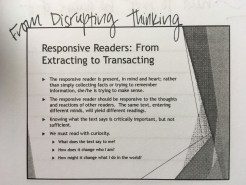
Sharon’s slide on transactional reading

Rebelling has always come naturally to me in teaching.  It’s no different now that I teach at the college level, but I’m lucky to have many like-minded peers to work alongside at WVU.

In our collaborative planning meeting last week, my friend Sharon shared her thinking about a different kind of reading and writing she really wanted our preservice teachers doing–the work of transacting.

448bf2b22af9be31dbc183a082a3f9fb.jpg

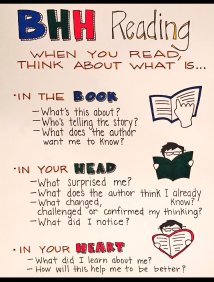
The BHH framework from Disrupting Thinking

“It’s from a book I read this summer,” she explained, and I exclaimed, “Yes!  I read it too!  I was just wondering how we could bring Book, Head, Heart into our weekly readings!”

Our students are proficient readers and writers, and it’s easy to assume that they don’t “need” a technique like BHH to help them interact with a text.  But to me, helping students of all skill levels become responsible, responsive, compassionate readers is the point of teaching reading.  Who cares about comprehension without understanding?  What’s the point of decoding if we don’t connect to the ink on the page?

Sometimes my college students forget that reading is more than a means to an end.  During my whole reading of Disrupting Thinking, I wondered how I could remind them about the aesthetic rather than the efferent purposes of reading from Rosenblatt’s transactional theory.

Because the truth is, the book, head, heart framework–or the aesthetic stance, or helping readers become responsible, responsive, and compassionate, or whatever you’d like to call it–is more than a guideline for students just learning to be strong readers.  It’s a manifesto for all readers.

img_1951

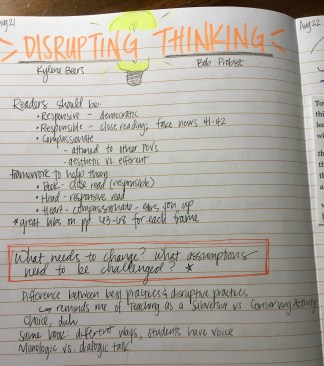
My notebook jots on the book

We’ve gotten away from teaching kids WHY we read and focus too often on simply HOW to read.

And that’s the problem–how to read is too simple a standard.  Yes, learning how to read is difficult.  Teaching kids how to read is hard, too.  But how to read, like so many standards we must adhere to, can be measured.  There’s a formula, an algorithm, a process:  first you decode, then you do the mental work of meaning-making, and sometimes in there you need some fix-up strategies to help you scaffold the story into your schema.  Just employ all those buzzwords and voila!  You’re a reader!

But when I shirk a pile of grading on a Sunday afternoon to finish a book, it’s not because I’m all about practicing my phonemic awareness.  And I didn’t spend an hour googling “Hurricane Harvey” at 4:00 this morning because I wanted to try out my word recognition skills, either.

Our highest standard is to help our students become real readers and writers.

It’s a standard that’s difficult to measure, but so are all of our most important, difficult goals–and it’s scary to teach all day, all week, all year, and feel like you can’t prove on paper that you’re making a difference.  The fear that we might be asked to offer evidence of our effectiveness might be what keeps teachers teaching novels and prevents them from teaching readers.  It might be why teachers persist in teaching essays instead of teaching writers.

Any good self-assessment will give you all the data in the world about how important and effective your instruction is, so if that’s what you need, again I say voila.  But if you’re searching for a way to make reading meaningful and engaging for your students, check out Disrupting Thinking, the book-head-heart framework, and their roots in Louise Rosenblatt’s work.  You’ll find a reader’s manifesto that truly shows you that why we read matters most–at every level, in every grade, across every content area.

How will you frame reading in your classroom this year?  Please share your strategies and ideas for helping students become engaged, authentic readers in the comments, on our Facebook page, or on Twitter!

Shana Karnes is mom to 1.5 spunky little girls and wife to a somehow-energetic surgical resident.  She teaches practicing and preservice English teachers at West Virginia University and is fueled by coffee, sugar, and a real obsession with all things reading and writing.  Follow Shana on Twitter at @litreader or read more of her writing on the WVCTE Best Practices blog.

Rewriting Our Definition of Writing

9780874216424I really don’t think there’s anything more invigorating than learning with other teachers, and this week, I’m doing just that.

I’m feeling lucky to be encamped in the mountains of southern West Virginia at Pipestem State Park, working with National Writing Project teachers on the College Ready Writers Program.  This isn’t my first NWP workshop, but it’s my first time leading one, and the thinking and planning and writing that have surrounded our work has been absolutely energizing.

(“You’re like a wind-up toy,” my co-leader remarked yesterday as we planned over dinner.  “You just never stop!”)

It’s true–all week, I haven’t stopped thinking, connecting, writing, reading, and wondering about our course topic, which is argument writing.  One of our central reads, Joseph Harris’ Rewriting: How to do Things with Texts, has been inspiring and informative.  Harris has gotten me to revise how I think of writing and its purpose in a classroom.

Writing, in my experience, is a process of discovery.  We write to learn, to help us grow into ways of thinking.

When we frame writing this way for our students, the entire writing process as we usually approach it must be revised.  There can be no more, “brainstorm an idea, then write a draft, then revise it, then turn in a final draft.

download.jpg

Make sure you show me you can do ______ throughout.”

Instead, the process needs to become one of starts and stops, of constant learning and revision of thinking, and a process that is never completely independent of other learning.  What I mean by this is that we can never just write for writing’s sake–we will always be writing to learn about our topic: the reading we’re writing about, the questions we’re asking, or the craft moves we’re making.

Writing is never separate from its subject.  It is always both art and craft, both structure and content, both phrasing and approach.  When we rewrite our notions of what writing is, we see that the way we approach, assess, and value the writing process must reflect those beliefs.

Harris asserts that students are often asked to assume the roles of disciples as they write, adopting the moves and beliefs of another thinker (often the teacher or the author of whatever text they’re studying) rather than adapting them.  “Little new knowledge is created.  Instead the disciple simply shows that the master is correct,” (74) in this type of teaching.  I’ve seen, and experienced, this kind of writing in classrooms.

How many of our students’ writing experiences have stifled their voices?

Just one is too many.  Our students do enough of this posturing.  They’re teens, for crying out loud, constantly adopting the moves and beliefs of others.  We need to help them find their voices, and not just their writing voices–a voice in which to sing a song of themselves.

All this thinking only reaffirms my belief in a writers workshop approach:  one in which a community of students can safely take risks, engage in high volumes of low-stakes, choice-driven, mentor-text-rich, craft-study-laden writing, confer with a practiced writer about their growth, and take on the identity of a writer themselves.

If you’re interested in working toward a classroom that values this kind of writing, I highly recommend reading Joseph Harris’ Rewriting, and continuing along with us on our readers-writers workshop journey here at Three Teachers Talk.

How might your classroom look this fall if you rewrite your definition of writing to match Harris’?  Please leave us a comment and share!

Shana Karnes teaches sophomore, junior, and senior preservice teachers at West Virginia University.  She finds joy in all things learning, love, and literature as she teaches, mothers, and sings her way through life.  Follow Shana on Twitter at @litreader or read more of her writing on the WVCTE Best Practices blog.

Want to RENEW! Get the book by @ShawnaCoppola

I have never written a book review. (Okay, maybe that’s not true. I think I remember writing one in 4th grade over a biography of Marie Curie, the first biography I ever read.)

I have never written a review of a teaching book. But I am going to try.

I am a teaching book junkie. I have stacks of them, but I rarely read the whole of them. I cannot even tell you why, and I admit there is great irony here because as I write this, I am also trying to write my own book for teachers (I have been for four years, sigh.) If I ever get it written, I hope you’ll read it.

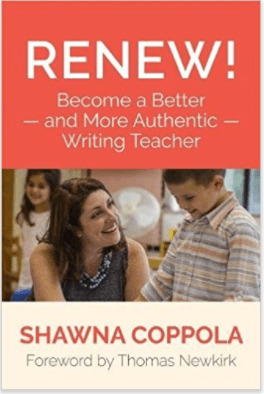
In the mean time, I have to tell you about Shawna Coppola’s new book RENEW!

I read the whole of this book in one afternoon! Thank you, Shawna, for writing so much of my own thinking about “Becoming a Better — and More Authentic — Writing Teacher.”

Shawna’s voice sings with passion and positivity. She paints the pages with possibilities! I know, I am gushing (and that’s probably too many p’s.) But here’s the thing —

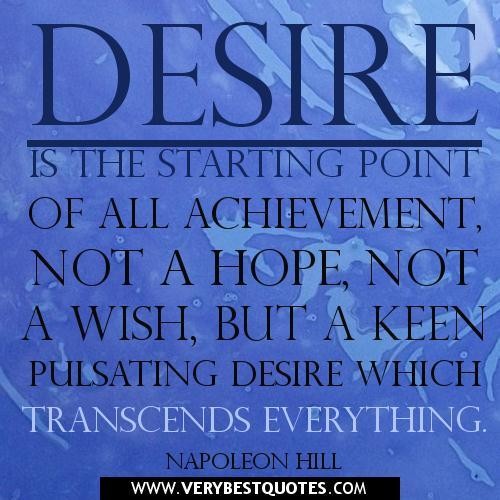
I know so many ELA teachers who do know know how to teach writing. I know many more who are not confident teaching writing. I know even more who are not writers themselves, so it’s no wonder that teaching writing is difficult. Teaching writing is hard. A book like RENEW! not only gives us a starting place, it gives us desire.

desire-is-the-starting-point-of-all-achievement-not-a-hope-not-a-wish-but-a-keen-pulsating-desire-which-transcends-everything-napoleon-hill

I am doing a lot of thinking lately around the idea of transcending. How do we go beyond our limits into something more, something better, something real and sustaining?

Let me share with you some of the passages I marked in RENEW!. I think you’ll see why this book is a must read for any teacher who needs a bit, or a lot, of renewal when it comes to teaching students to write.

“. . . if we are truly willing to honor the individuality of our student writers, the RENEW!uniqueness of each community of learners, and the ever-changing nature of our global landscape, we must continually rethink, revise, and renew our practice. Otherwise — to paraphrase Dewey — we rob “today’s students of the tomorrow today’s students deserve” (10).
“Broadening our ideas about what writing “is” can be scary, as if we are opening up a Pandora’s box. But in all reality, continuing to teach our student writers through a narrow, outdated lens — one that, in overvaluing written composition, does not accurately tell a story about the world of writing beyond most schools and classrooms — harms their development as writers by limiting the kinds of composing they are exposed to and encouraged to practice” (51).

“Teaching our writers how to develop their own tools is infinitely more sustainable than using preexisting tools. Quick survey:  How many of you use the graphic organizer your sixth-grade teacher taught you to use to write a persuasive piece? That graphic organizer may have been helpful to you then (although I doubt it was helpful to 100 percent of your classmates), but how useful is it you now?” (62).

“What message or “story” are we sending our student writers with a single overall score? Not only does it imply that their worth as a writer can be whittled down to one letter or number (which itself can mean different things for different teachers and even within different units of study), but that the worth of writing itself can be whittled down this way” (73).

“. . . readers of writing are human, an done person’s response to a composition may not perfectly align with another’s (If it did, what a drab, boring world we’d be living in!)” (79).

“Which is more likely to help students learn:  offering them specific feedback about their work, behavior, or performance, or slapping a score on a piece of paper?” (82).

“. . .when we engage in a semi-regular habit of writing, we can much more genuinely speak to those incredibly fantastic moments that writers experience on occasion, like the amazing feeling of completing a particularly difficult draft or writing something that makes a reader spontaneously laugh out loud. Anyone who’s ever taught a group of students of any age knows that when we are faking our way through something, or at the very least “phoning it in” by only engaging on a superficial level with what we are purporting to teach, students can smell our lack of authenticity a mile away. They know, even subconsciously, that they are being sold a decidedly moldy bill of goods” (92).

That’s all well and good, right? But here’s the beauty of Shawna Coppola’s book — she gives us the research that supports each of her positions AND she gives charts and graphs and resources to help us rethink, revise, and renew our approach, instruction, and practice as we become better teachers of writing. This book is chock full of everything good when it comes to writing instruction. It is a book I will return to again and again.

I hope you’ll read it. I hope you’ll share it with every ELA teacher you know. Really, it is just that good.


Amy Rasmussen lives in north Texas and teaches AP English Language and English 4 (new prep in ’17.) She loves talking books, daughters’ weddings (two this year), and grandbabies (five). She also loves facilitating PD for other teachers making the move into a workshop pedagogy. Amy adheres to the words of Emerson: “We aim above the mark to hit the mark,” and Jesus: “Love one another.” Imagine a world if we all aim higher. Follow Amy on Twitter @amyrass. And she really hopes you will follow this blog!

Defining Readers-Writers Workshop

“I need a visual of a ‘workshop.’ That word confuses me still.”

This is not the first time I’ve been part way through facilitating professional development and a participant has made a similar request. There’s a lot for me to learn here.

Before we can begin really sharing the excitement and benefits of a readers-writers workshop model of instruction, we must get on the same page as to what we mean by Workshop. I’ll try to do that here.

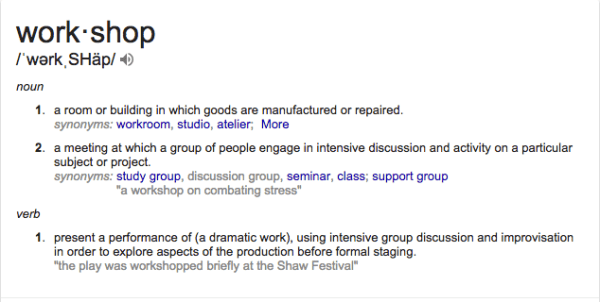
Let’s start with the dictionary definition of workshop and zero in on #2.

workshop definition

Based on this definition, let’s consider this essential question:

How do we create open spaces where the children we teach can grow as readers and writers?

To me “open spaces” equates to “workshop.” Open spaces means teachers let go of control, remove themselves from center stage as the holders of the knowledge, and invite students into a space of curiosity and discovery. It’s a space where students thrive in a community of trust and sharing, where they talk about their identities and experiences as readers and writers, where they play with language and take risks as they explore what it means to develop their comprehension and analysis skills — and their craft as writers.

Opening spaces requires planning. It is not willy-nilly choice in books or topics, or stations without specific guidelines and instructions, or seats moved from rows into small groups without modeling the thinking that makes it possible to “engage in intensive discussion and activity” around our content. Teachers must model what this looks like. And we must trust that our students will engage and learn in this model.

They will — if we let them.

Readers-writers workshop is a method of instruction that often requires a paradigm shift, a shift from the teacher making all the choices and telling students what to learn within a text, to students making choices, and through practice and application of skills-based lessons, learning as they read and write.

I’ll return to some definitions found online to help clarify:

“The Reading Workshop is a teaching method in which the goal is to teach students strategies for reading and comprehension. The workshop model allows teachers to differentiate and meet the needs of all their students.”

For our readers, we open the space for students to choose the books they read. By doing so, we meet students where they are in terms of their interests and abilities. The teacher becomes a coach, teaching skills specific to the needs of each learner. This requires time. We must reserve time for students to read when they are with us in class, and we must confer with students about what they are reading — and how they are reading it. This is reading instruction in a workshop model. We teach the reader, not the book. Readers must predict, visualize, infer, comprehend, analyze, and evaluate. These are all skills we model and teach in readers’ workshop.

What about writer’s workshop?

“As in a professional writer’s workshop, each student in the class is a working author. The teacher is a writing professional and peer coach, guiding authors as they explore their craft. … Teachers write with their students and share their own work as well.”

To teach our writers, we must be writers ourselves. We must model the moves writers make as they use language to craft meaning. We must validate our writers and help them recognize what professional writers do to think of ideas, organize those ideas, and convey those ideas in a way comprehensible to readers. In a workshop classroom, we use mentor texts:  sentences, paragraphs, passages, essays, poems, stories to teach writing skills that students apply to their own writing. We teach the writer, not the writing.

workshopquestion

So, what do I mean when I say “workshop”? I mean students doing the work of readers and writers, “engaged in intensive discussion and activity on a particular subject” — specifically related to growing as readers and writers. This work happens because teachers open the spaces in their classrooms which allow for it.

Questions about your move to a workshop model of instruction? Please ask in the comments.

Amy Rasmussen lives in north Texas and teaches AP English Language and English 4 (new prep in ’17. She loves talking books, daughters’ weddings (two this year), and grandbabies (five). She also loves facilitating PD for other teachers making the move into a workshop pedagogy. Amy adheres to the words of Emerson: “We aim above the mark to hit the mark,” and Jesus: “Love one another.” Imagine a world if we all aim higher. Follow Amy on Twitter @amyrass. And she really hopes you will follow this blog!


Summer Snapshots

Happy Summer, teachers!

teacher-humor-quotes-meme69.jpg

We’re looking forward to a season of rest, rejuvenation, inspiration, and ideas just as much as you are!

We hope to start a conversation this summer about ideas and best practices and inspiration through posts here, on the Facebook page, our Instagram feed, and on Twitter about a variety of topics:

  • What’s in our notebooks
  • What we’re reading
  • A shelfie from our home or school library
  • Favorite poems
  • Professional literature we’re reading
  • Plans we’re making for classes in the fall
  • Summer learning/teaching/PD that we’re doing

To put a bit of a multigenre spin on our writing, we’re hoping to just share photos and short written snapshots of these pieces of our summer thinking–and we’d love to see yours, too!

We hope you’ll let us know what you’re engaging in for a reflective summer, and how you might use what we all share to inform your practice beginning in the fall.

Until then, please ENJOY a wonderful season of hitting the pause button so we’re all ready to start strong in August!

Our best,

The Three Teachers Talk Summer Team
Amy Rasmussen, Lisa Dennis, Shana Karnes, & Jessica Paxson

Student Gratitude – A Guest Post by Margaret Lopez

I didn’t teach last year because I resigned.  I still feel guilty.

When I moved back to my hometown of Chicago, I accepted a position with a well-known, controversial charter school network in the city.  I quickly found it was not the right fit for me.  It wasn’t the students–they were full of hope and sweet in spite of the adverse circumstances they dealt with outside of school.  It was the system.  

If the ACT was king, a strict demerit system was the reigning queen.  Students were part of a system that didn’t see them as individuals, but cogs in a wheel that kept churning out “College and Career Ready” students, as measured only by a test, and using strictScreen Shot 2017-05-01 at 8.44.22 PM rules to keep the wheels turning.  There was no student choice, just multiple choice.  No discussions, just lectures.  No collaboration, just eyes tracking the teacher.

It was horrible.  So horrible that I made the choice to leave.   I felt like teaching to the school’s standards made me compromise non-negotiable parts of my teaching philosophy.  I tried to break the mold, but received teacher demerits (seriously..teacher demerits).   I couldn’t find my way in the system and struggled to officially make the choice to put myself before students.

I made a choice to leave.  But I didn’t realize how many repercussions that choice would have.  There was so much about teaching I missed and what I, admittedly, didn’t take the time to appreciate when I was in the classroom.   I missed students most of all.

I missed the little things, like greeting them at my door, ready to embark on a 50 minute odyssey into the literary world.  I missed wishing them a happy, safe weekend, then anxiously awaiting their return on Monday.  I missed seeing their homecoming pictures and watching them in the school play.  I missed having class jokes and saying hello in the hallways.  I missed reminding every class, every day about an upcoming assignment and the student who had the best excuse when it isn’t completed on time.  I missed waving to students as we each got into our cars to head home.  I missed reminding them to relax, just take it easy for a night.  I missed the chaotic moments in the classroom just as much as I missed the moments when all the fates in the world conspired and each child was rapt in their learning.

I missed transforming the protesting non-reader into a book worm. I missed adding recommendations to my book list from all types of readers.  I missed students asking me what I was reading and why, did I like the book or the movie better , or which John Green book is the best.  I missed the excitement I felt when a student genuinely loved a book or returned a book that I thought had been lost to a locker or car trunk forever.  I missed being moved by a student’s connection to a character.  I missed seeing my bookshelf fluctuate depending on what topic or genre was trending.

I missed reading their timed essays, the writing in their notebooks, the personal annotations in the margins of their books.  As an English teacher, taking home 180 essays over your weekend doesn’t always feel like one of the perks of the job.  Grading becomes tiresome halfway through the first stack of essays, and builds to a mundane, tedious task quickly thereafter.  Until that one essay…the one from a shy student.  The one from the athlete who no one takes seriously.  The one from the student who actually managed to turn something in on the deadline.  The one that yanks you from your near slumber and makes you re-read it because it is so insightful, poignant, and refreshing.  These essays can be few and far between, but when they are uncovered in my stack of loose-leaf paper, they stir up my teacher soul.  These golden essays remind us of the humanity and intelligence high schoolers have within them.

Can students be whiny?  Sure.  Can they be inconsistent?  Consistently, it seems, some weeks.  Can they be forgetful, even with a school-issued agenda and text-message reminders sent to their phones?  Yep.  But they can also be generous, helpful, and shockingly perceptive about the world.  They can be innovative and resilient.  In fact, they usually are every day.

thank

As teachers, I think we often see the best of our students, the qualities their parents miss and their peers don’t notice.  We notice their compassion when they offer to help a struggling student.  We enjoy their passion when they light up on the field.  We see their curiosity through the books they select and the choices they make in their own learning.  I missed learning about each student as a member of my classroom community, and uncovering their beliefs, habits, and ideas slowly throughout the school year.  I missed noticing their growth, as English students and young adults, from August to December to May.  What is more rewarding than taking a step back and admiring an individual’s progress?  We are so fortunate that nurturing and acknowledging individual progress is a routine component of our jobs.

I still think about those kids, the ones I chose to leave behind, and I still feel guilty.  I wonder how they’ve fared as seniors, how they performed on the ACT, if they’re itching to break out of the mold and be free in a few short weeks.  I wonder what they have been reading and writing.  I wonder how I could have stayed and made it work.

There is magic that happens in a classroom.  Sometimes we don’t notice it in the moment or it looks messy.  It isn’t graded on our appraisals or summatively assessed, but it happens, in little moments and big “ah ha” moments.  It happens because of our students.  

thank2

As these weeks get more stressful the closer we get to summer break, I want to challenge all of us to remember the good in our students and try to have gratitude for what they bring to us each day.  To be proud of the relationships you’ve worked to forge with your young readers and writers.  To remember student achievements and how you have supported that growth.  To recall, during arguably the most hectic, patience-testing time of the school year, the young adults that make this noble profession so demanding and rewarding.

Maggie Lopez has six years of teaching experience at large public high schools in Louisville, Houston, and now Chicago.  A graduate of Miami University, she had the pleasure of learning from the workshop masters and is on a continual quest to challenge, inspire, and learn from her hilariously compassionate juniors and seniors. 


Screen Shot 2017-05-01 at 8.44.22 PM

Care to join the conversation? We’d love to add your voice! Please email guest post ideas to Lisadennibaum@gmail.com.