Category Archives: Pedagogy

Conferring: On the Lookout for Gifts

“I think parents should read this book — these kinds of books, too,” Monica said as we chatted about the book she just finished, Impulse by Ellen Hopkins. “They need to know what we go through and how we think about things. It would help so much.”

I listened as she shared her feelings. She needed me to hear her disappointment at the ending. The characters mattered to her, so I knew they needed to matter to me.

The relationship between student and teacher changed in that moment. We gave each other a gift in that brief conversation about a book.

When we consider our conferring moments with students, do we give enough gifts? Do we allow our students to?

Think about the origin of confer:  Latin conferre to bring together, from com- + ferre to carry.

At the end of that three-minute conference with Monica, I carried a bit of the burden she had on her heart, and she carried the knowledge that one more adult cares about what she thinks. A conversation about a book brought us together.

I love that.

At NCTE I asked a room of teachers what part of their workshop classroom they struggle with the most. They all said student conferences.

Finding the time, being consistent, knowing how to prod students into thinking, allowing students to do most of the talking —  these concerns all emerged as trouble spots that we’d like to overcome.

In a perfect classroom with perfect students it would be easy. What’s the big deal? Just talk to your students. Yeah, right.

I asked one colleague how she conducts her reading conferences. She replied quickly, “Oh, I don’t do those. I cannot talk to one kid without the other 35 talking.”

Yes, that can be a problem.

I don’t think we stop trying though.

One-on-one conversations with students create the heart of my workshop classroom. Our relationships grow and change as we gift one another with ideas and information. We learn and change together as individuals who are trying to make sense of our world. Regular conversations make this happen.

I’m reminded of a line I boxed in bold when reading Choice Words by Peter Johnston: “Talk is the central tool of their trade.” Their meaning teachers who create environments wherein through language they help students “make sense of learning, literacy, life, and themselves” (4).

Talk is central

That’s what I want as I create opportunities to confer with the students in my classroom. I want to help my students make sense of all it:  what happens in the classroom, what they read in books, what they’ll face in the future, and what they see in themselves. That’s a tall order, and the only way I know how to do it is to talk to more of my kids more often.

My burning question now circles on student conferences. How can I improve the precious moments of time I have with each of my students?

I am paying a lot more attention to the gifts we give as we converse with one another.

What about you? What are your ideas, concerns, questions about student conferences?

©Amy Rasmussen, 2011 – 2015

Talking Choice Reading, NPR Radio

When Highland Park ISD banned (suspended, officially–then reinstated w/parent permission required) some books during Banned Books Week, my students and I paid attention.  Of course, I pulled the books in question from my shelves — and book talked them right then and there.

The True Story of a Part-time Indian is one of the hottest titles in my classroom library year after year. I know it gets raw in places. I know that it’s the grit that makes kids want to read it. I get that this book is not for everyone.

Few books are.

And that is why choice is so important.

I had the chance to share my thoughts on this in an interview for KERA,  NPR nor the Texas. You can read/hear the news article here.

In a few days I will return to my classroom, fresh from NCTE and ALAN with boxes of new books for my students to read.

image

My box of books at ALAN

We talk a lot in my class about books being windows and mirrors. Windows help us see outside ourselves into the lives of others. We grow in empathy. Mirrors help us see ourselves so we know we aren’t alone. We read literature to learn what it means to be human afterall.

It would be hard to learn the truth if we never read the raw and the grit that makes humanity humanity.

Landscape of Workshop: We have arrived!

Nine years in. I know what certain murmuring really means. We all do. The murmuring of students when they are conferring about their writing. The kind that surfaces when boredom is creeping into our classrooms. The murmuring of confusion and frustration. The one that starts to get louder and louder as passion starts taking shape. Today, is that kind of murmuring day.

Christian: Why? No, really. Why? Why is it that all we do is read and write in here allllll day, Ms. Bogdany? Ev-er-y-day. (Yes, with that level of emphasis.)

Swallowing my smirk, I calmly start explaining the reasons, rationales, and importance again to Christian. Yes, we’ve had this conversation many–a-time. And clearly others’ patience with this subject has become depleted.

Norris: Man, why are you even asking that? We’re in English! It’s what we do!

Christian: No, but I mean seriously. It’s all we do. In my previous high school we used to watch movies and relax. This is crazy.

Norris: That’s why you’re not there anymore! You chose to be educated here. We’re at a transfer school. Here it’s more focused and we’re learning.

Deja: Oh, listen to you, Norris. Telling Christian all about what’s right…you always think you’re better than everyone!  We breathe the same air you breathe!

Hakeem: Norris, you haven’t walked in my shoes! You don’t know! Last period, you were the one that lied and got caught! Now you’re acting like Christian’s father.

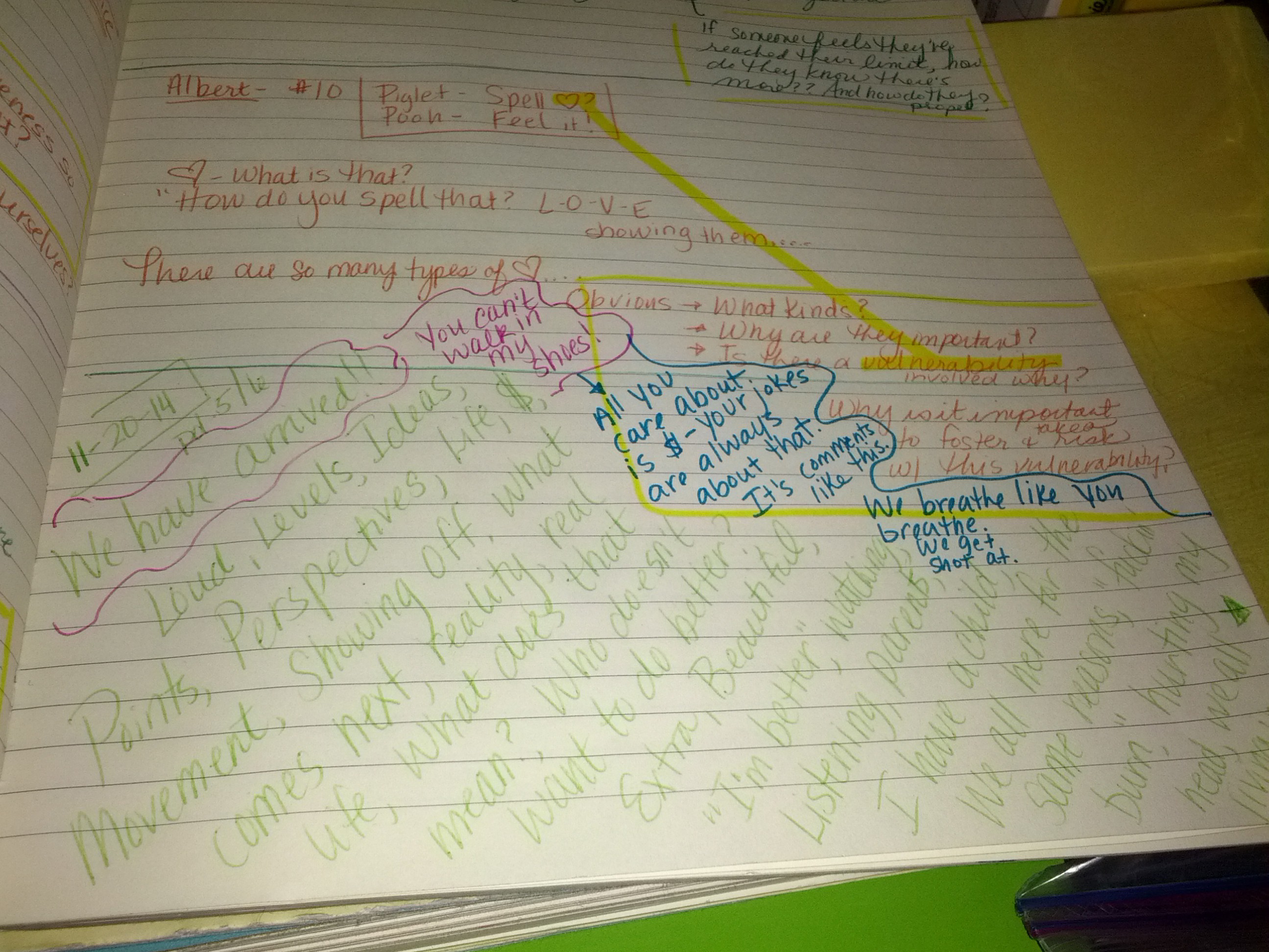
Here, in my Writer's Notebook, I capture voices speaking their truth.

Here, in my Writer’s Notebook, I capture voices speaking their truth.

Here is where I sit back and start listening; very intently. I am becoming quieter and quieter as the room gets more and more animated. (I was hoping to become invisible, truth be told.) Because, this is what happens when students are invested. They challenge each other. They hold each other accountable. They start discussing their level of comfort or lack there of.   They express their inner feelings. They question motives. And yes, sometimes their word choices can be a bit crass, but isn’t that authenticity at its best?

They give me exactly what I need as their educator.

I need to understand who they are, what fuels their fire, how they feel about injustice. How safe are they feeling in our learning community? Well, I can’t always answer all of the questions swirling around in my mind, but today I was able to answer this one confidently: students are feeling wildly comfortable in our shared space. Because when students are brave enough to confront their peers (those that are their roughest critics) I know we’ve arrived. We’ve arrived as an evolving community of learners; as a team not willing to silence our voices when they need to be heard; and we are most definitely letting our guards down as we are emerging ourselves even more deeply in the work of the Reading Writing Workshop (RWW).

I also know that while Christian is literally shifting around in his seat, stretching all of his 5 feet 9 inches; he is moving – physically and as a writer. He doesn’t necessarily see or appreciate it just yet, but it’s there. I see it. I know. And, just like the murmuring that propelled this dialogue in room 382, Christian is pushing boundaries and uncomfortable. Yet, I believe Christian is more resilient than he even recognizes. And that resiliency pushes me to continually find ways to engage Christian in this work. Even, if it means having the same conversation again — because it will resurface.

As I head down to the nation’s capitol to be reunited with my PLN – my nationwide pedagogical lifeline – I take this experience with me. Regardless of how much traffic I may encounter on the trip from Brooklyn, this tipping point (as Malcolm Gladwell would argue) is buckled tightly in my back seat and promising to remind me what I am bringing with me to #NCTE14 – the moments that the RWW affords us when we listen to our learners, their needs, and previously dormant desires.

I cannot wait to further this conversation on Saturday at J.44 starting at 2:45pm. I hope you join us for an hour full of deep thinking, classroom anecdotals, and the energy that attendees from across the country bring to the conversation. See you there!

#NCTE14 J.44 Nonnegotiables Across the Landscape of Workshop

Jackie, Erika, Amy and I are excited to present at NCTE in Washington, D.C. on Saturday at 2:45 pm. Penny Kittle is our Chair. We are session J.44. Join us!

“I am the sum of my mentors,” writes Meenoo Rami in Thrive.  As a student at Miami University in 2005, I had no idea how fortunate I was to have Tom Romano as one of my mentors.  As a leader in educational writing, a teacher with his thumb on the pulse of research, and the giant who first introduced me to NCTE, Romano has always been my single biggest mentor.

As I thought for months about what I wanted to share with teachers regarding the readers-writers workshop at NCTE, I was reminded of an assignment I’d done in Romano’s class–to find the “red thread” of my teaching…my nonnegotiables regarding our profession.  I dug for it in the depths of my hard drive.

Re-reading it, I laughed as I always do at my older writing, but then I smiled.  Many of my nonnegotiables remain unchanged: sustained silent reading.  Craft informed by research.  Authenticity.  Engagement is central.  Model, model, model.

Tom Romano obviously did a damn good job as a mentor.

IMG_5031Those simple principles–plus my genuine passion for reading, and writing, and the joy I believe they can bring everyone–inform my practice day in and day out.  They are supported by the research of Penny Kittle, Katie Wood Ray, Tom Newkirk, Kelly Gallagher, Donalyn Miller, Linda Rief, and more.  I am the sum of those mentors, and in this season of giving thanks, I’m so grateful that I am.  My students have found incredible success because I stand on the shoulders of those giants, and I can’t wait to share their stories at our session in Washington, D.C.

Writing as Punishment? Oh, the Nerve!

“As punishment I have my students write a response to an ethical question when they are done with their social studies test,” a colleague said during a recent professional development session.

I’d been asked to lead a discussion on writing in disciplines other than English, and I’d asked the attendees to share out the various types of writing they have students practice in their classes.

“That’s pretty much the only kind of writing I do in my class,” he said, “That’s why I’m here.”

I might have stuttered a bit as I caught myself from falling down. I guarantee my neck turned red as it does when I am frustrated.

PUNISHMENT?! Did I hear that right?

What does a writing teacher do with that?

Imagine if I sat in his history classroom and boasted that I punished students by making them learn the historical context of a text prior to reading it. Imagine if I made a disparaging remark about his content at all. The nerve.

Therein lies a big part of the problem with student writers. Many people, teachers included, think writing is boring, or too much work, or punishment.

Then, it’s left up to English teachers with a passion for the craft to push and prod and plead with students to put at least a tiny thought on the plain white page. Somewhere someone ruined that child for the written word, and we have to undo some damaging false notion.

Don Graves reminds us that children want to write before they want to read. I know this is true. My own children reached for their dad’s pen or the random crayon before they ever sat still long enough to read a book. The two-foot-tall art on the clean white walls of my brand new house was evident often enough.

Children want to write. We must protect that desire. Nurture it with freedom and ideas and time.

Shame on the teacher who ever makes writing a punishment.

And yes, in case you are wondering, I spoke my mind.

“I challenge you to never call writing a punishment again,” I said as he squirmed just a bit, “Students will write, and they’ll love writing. You have to be the model of what that means in your own classroom.”

I believe that with all my heart.

Professional Development Doesn’t Have to Be Painful

We all know–and perhaps fear–the Disrespectfully Disengaged Learner.  You know the one I mean:  rolling his eyes, muttering under his breath.  Asking to recharge her phone so she can keep playing games instead of listening.  Sometimes, that learner is even you or me.

IMG_5737

Materials for our workshop are ready!

They say teachers are the worst students, so maybe that’s why I’m so nervous about the workshop I’m helping to lead today.  My colleague and I will present to 20 of our fellow teachers, and we have worked incredibly hard, for many hours, on our presentation and materials.  Even if 19 leave our classroom with smiles on their faces and a new spring in their steps, there will almost certainly be one person we can’t reach.  Sadly, that one person is the one I’ll obsess over for weeks to come.

The phrase “professional development” has somehow become synonymous with “eyeball gouging”, at least in all the schools I’ve taught.  But professional development doesn’t have to be painful.  Its purpose (like so many other well-intentioned ideas) is a positive one–to advance a person’s career or personal development through learning.

That doesn’t sound so bad, right?

IMG_5610

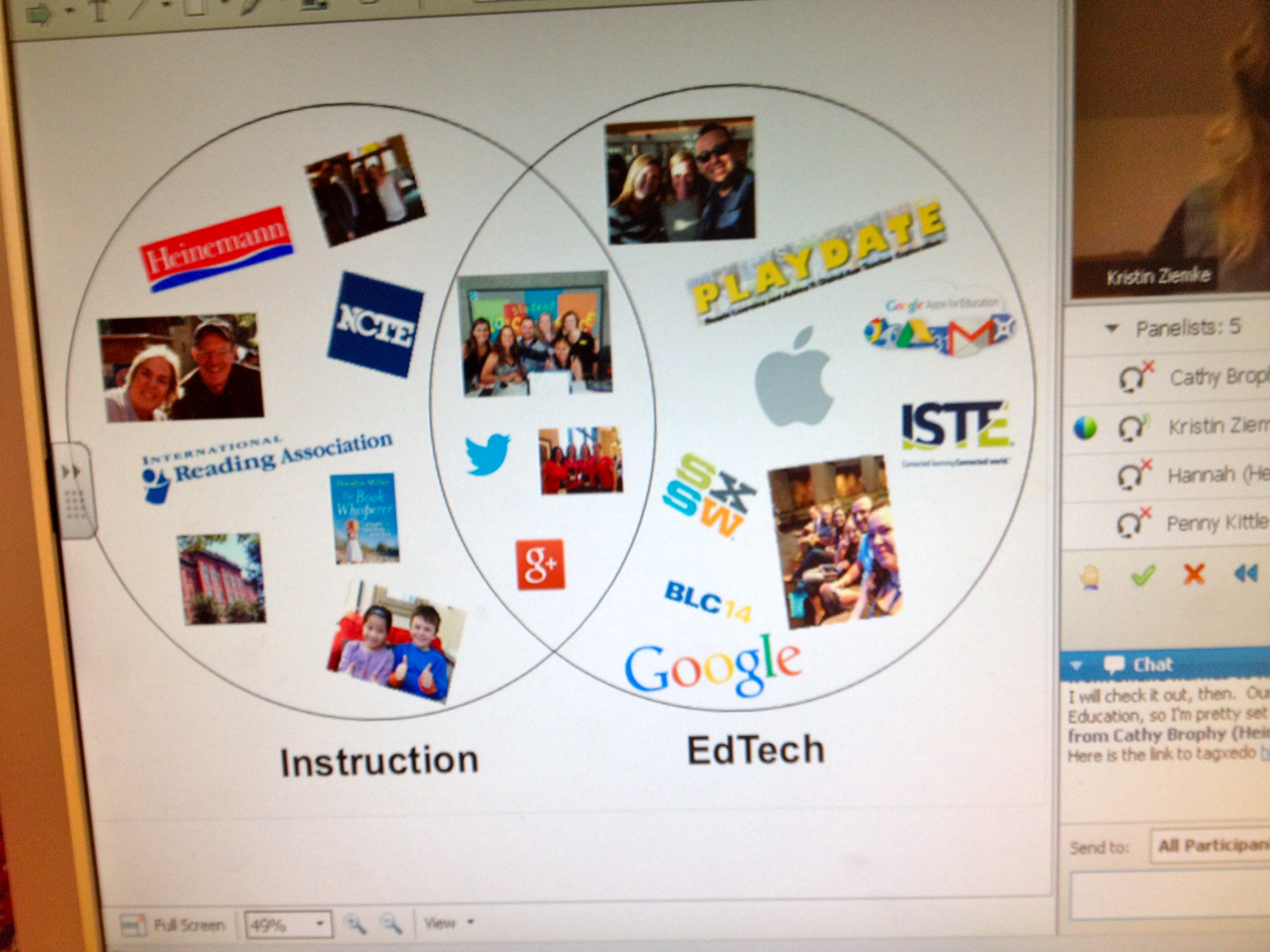
Kristin Ziemke presents during “Notebooks, Pens, and Pixels”

Don’t get me wrong:  horror stories abound.  I recently sat through eight straight hours of lecture at a “training”, zero hours of which were relevant to my classroom, and ended up lying in the hallway of a hotel conference center with a very pregnant colleague, who simply couldn’t sit in her chair any longer.

But, even more recently, I sat on the edge of my seat as I listened to Penny Kittle, Troy Hicks, and Kristin Ziemke present on using technology in language arts education.  This free Heinemann webinar lasted a little over an hour, but it felt like only a moment had passed as I listened to those teacher-leaders share their mind’s inner workings.  That amazing webinar, which also granted me insight into Kelly Gallagher and Tom Romano’s thinking-through-writing processes, falls under the same umbrella that torturous eight-hour lecture did.

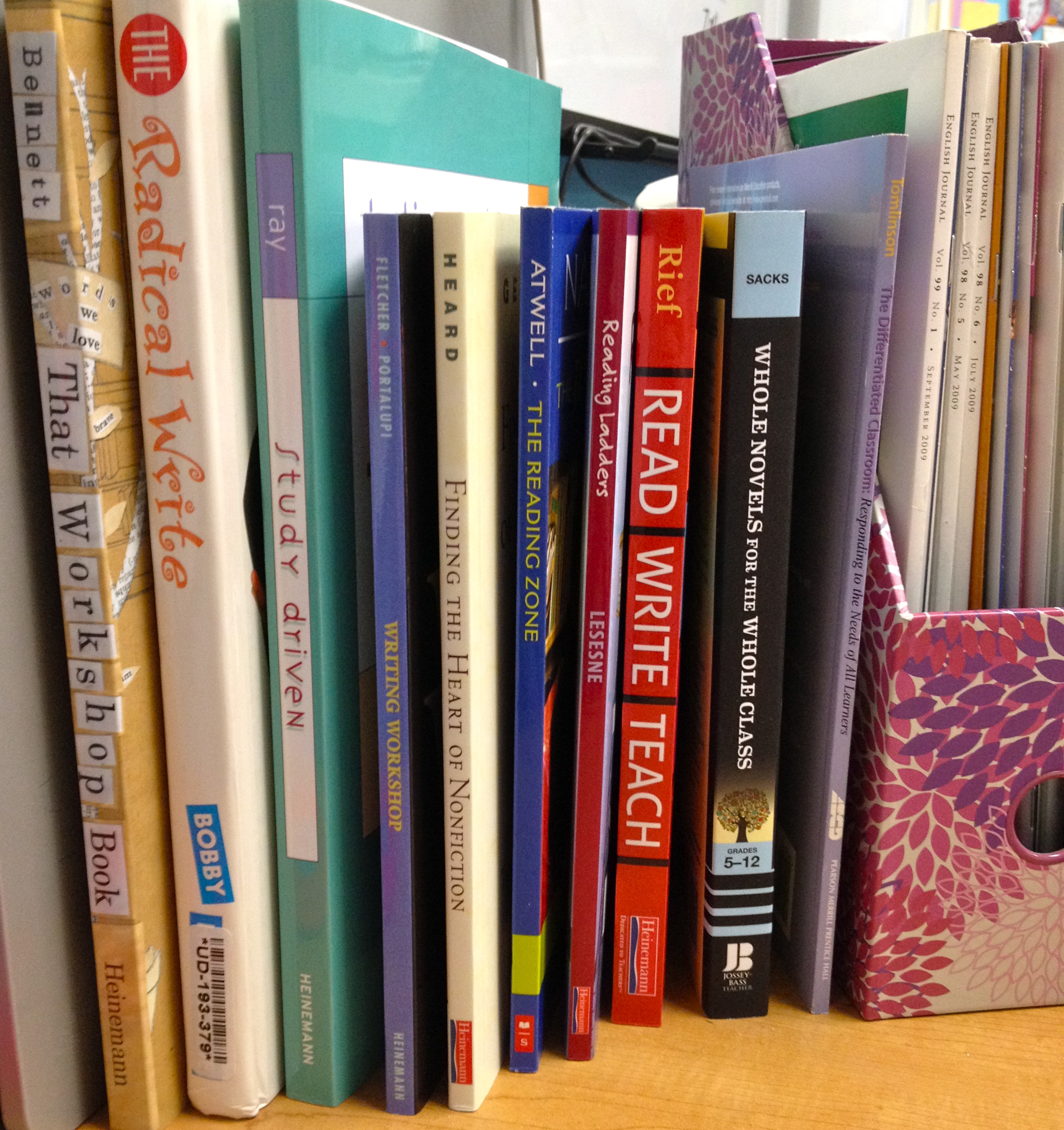
My professional to-be-read shelf

My professional to-be-read (and re-read) shelf

Presentations and lectures aren’t all there is to professional development.  Simply reading the latest research is PD–sharing ideas over lunch with a colleague is PD–sitting down to write and reflect in the mornings is PD, too.

I’d argue that professional development is a teacher’s duty.  Teachers really shouldn’t be the worst students–we should be the best.  As professors of knowledge, shouldn’t we crave knowledge?  Hunger for new ideas?  Salivate over scholarship?  If we seek to inspire a thirst for learning in our students, we must have it in ourselves.  There are too many ways to grow in our profession–Twitter, online journals, NCTE, the National Writing Project–for us to not take advantage of the many opportunities for growth that come our way.

Professional development is something to aspire to, not to dread.  Seek it out.  Savor it.  Lead it.  It will make you a better teacher, and a more richly knowledgeable professional–and there’s nothing painful about that.

All it Takes is a Tutu and Some Focus

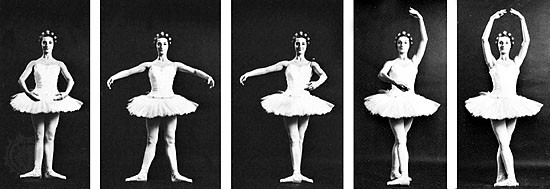
iballep002p1

It’s been a month since I realized that my 2014-2015 school year was going to throw me for loops, spins, twists and twirls.  And while I am by no means a self-proclaimed ballerina; I’m smiling, pointing my toes, and pirouetting with the best of ’em.  Because when the music starts the core needs to be strong, the back straight, muscles tight, and breath steady.

As I stretch daily, as all practicing and proficient ballerinas do, I prepare to move in ways that are brand new; ways in which I never thought my body knew how to.  Legs outstretched, arms over extended, and of course…hair tightly wrapped in a bun – not one hair out of place.  Grace and elegance: the aspiration of all ballerinas.

Ballerinas and educators.

And while ballerinas make their every move seem effortless, the reality is that every motion is executed with deep thought and delivered with exact precision.  The bar is set wildly high and only the best of the best can gently thrust their leg onto that bar as fingertips reach for and surpass beautifully pointed toes while bodies align with a diagonally extended leg.

But, what about the ballerinas who approach the bar with a “Hrmph!” and a stubborn knee that won’t align with the rest of the leg and an unmaintained balance as a ‘steady’ foot is anything but?  And that sleek bun?  That bun has come undone and wisps of hair are continually getting caught on eye lashes and tickling cheekbones refusing to cooperate.  And no, you cannot move your hands from First Position for a moment’s reprieve.

Focus.

When we continue to throw on our tutus and ballet slippers and head straight into the studio before the sun has risen from its slumber: We are not giving up.  We are wrapping our bruised and bleeding toes accompanied by “Ouch!” and “Arghh!” but, we are not giving up.  We are placing even more bobby pins in our hair in hopes that today will be the day we are not tempted to twitch out of First Position.  Today, we stretch just a wee bit further in reaching for our little nubby toes.

As we wiggle and wobble…biting our lower lip oblivious to this false stability…we realize that our calloused hands are resting on those little nubs we’ve so desperately been trying to reach for weeks.  Yes, we are now touching our toes.  Wait.  What?  We did it?

I want to show you something.

Amazing isn’t it?  A young man in my Social Justice and Student Voice course was not willing to explore his 35-60 word biography (modeled after Visa Go World commercials) as it applied to his life.  But, he was willing to explore a puzzling injustice that he firmly believes has a feasible solution.  And his questions.  I could most definitely learn how to shape Essential Questions by conversing with this young man.

I’m still aiming for balance.

My knees are still a little bent.  My tutu is sometimes on backwards.  But, there’s hope!  While the majority of students were actively engaged in chronicling a moment in their lives, one student decided he needed to do things his way: focused, dedicated, and with a little pizzazz.  Is that not what the art of ballet truly encompasses?

As I continue to learn the intricacies of this art form, I take pleasure in exposing students to it as well.  We dance together…sometimes in beautiful unison and well, let’s face it, other times as if we’re all petit sauting to a different tune.  That day, this tenacious student decided to wear sneakers to ballet practice.  And, I’m so glad he did.


A Feedback Protocol for Revision Workshop

I didn’t mean to make them cry, but that’s what soul writing can do to a person. (Soul writing is what my students and I coined as the type of writing that rips at our guts, makes pools fall from our eyes, and leaves us lurching toward the door to “take a little break.”) We are only into the third week of school, and I tried a new protocol for feedback; something I learned at The Frost Place Conference on Poetry and Teaching, directed by Dawn Potter.

Giving honest and critical feedback to one another is difficult for many of my students. So afraid of offering offense, they either do not say anything, or they do the proverbial pat-on-the-back and mutter “good job.” I tell  them that when they refuse to be honest in their feedback, it’s cheating. They cheat their friends out of ideas that can help them grow. And that is what we want in a community of writers — we want everyone to experience opportunities to grow.

The tears today watered some tender little seeds. All afternoon I gushed about it to anyone who who listen.

We sat in a circle around the large table in the center of my classroom. Many students came to class without their drafts*, so I sentenced them to the outer edges and advised them to get their brains and their pens working. I told them to write silently, but they might want to keep an ear tuned to the conversations happening in the middle. If they did, they learned more than they could have from any one-on-one conference with me.

First, I explained that giving feedback can be a bit tricky. We want to be honest, but if we do not deliver that honesty well, we can cripple our writer. (I use the word cripple because that was my own experience. I’d spent months drafting a chapter for my book. I’d finally finished what I thought proved to be a powerful piece of writing. Then I asked a friend, someone I trust, for feedback. She gave it to me: honesty cloaked in sweet little daggers. When I read her comments, all my ideas crumpled, and my focus limped right out the door. I didn’t write another word for six months.)

The “I wonder ____” protocol is really very simple:

Those who offer feedback:

  • Listen carefully as a classmate reads her piece.
  • Think about ideas that might help her improve it.
  • Offer feedback that allows for the writer to “play with the possibilities” (Dawn Potter) by putting the ideas you have that might help the writer revise the piece into statements that begin with “I wonder ___”.

Those who receive feedback:

  • Read the piece loudly and with clarity. (Repeat if necessary.)
  • Listen to the “I wonder” statements made by peers and write yourself notes.
  • Try to just listen (This is hard because we tend to want to justify why we wrote certain things).
  • Play with these various possibilities while revising.


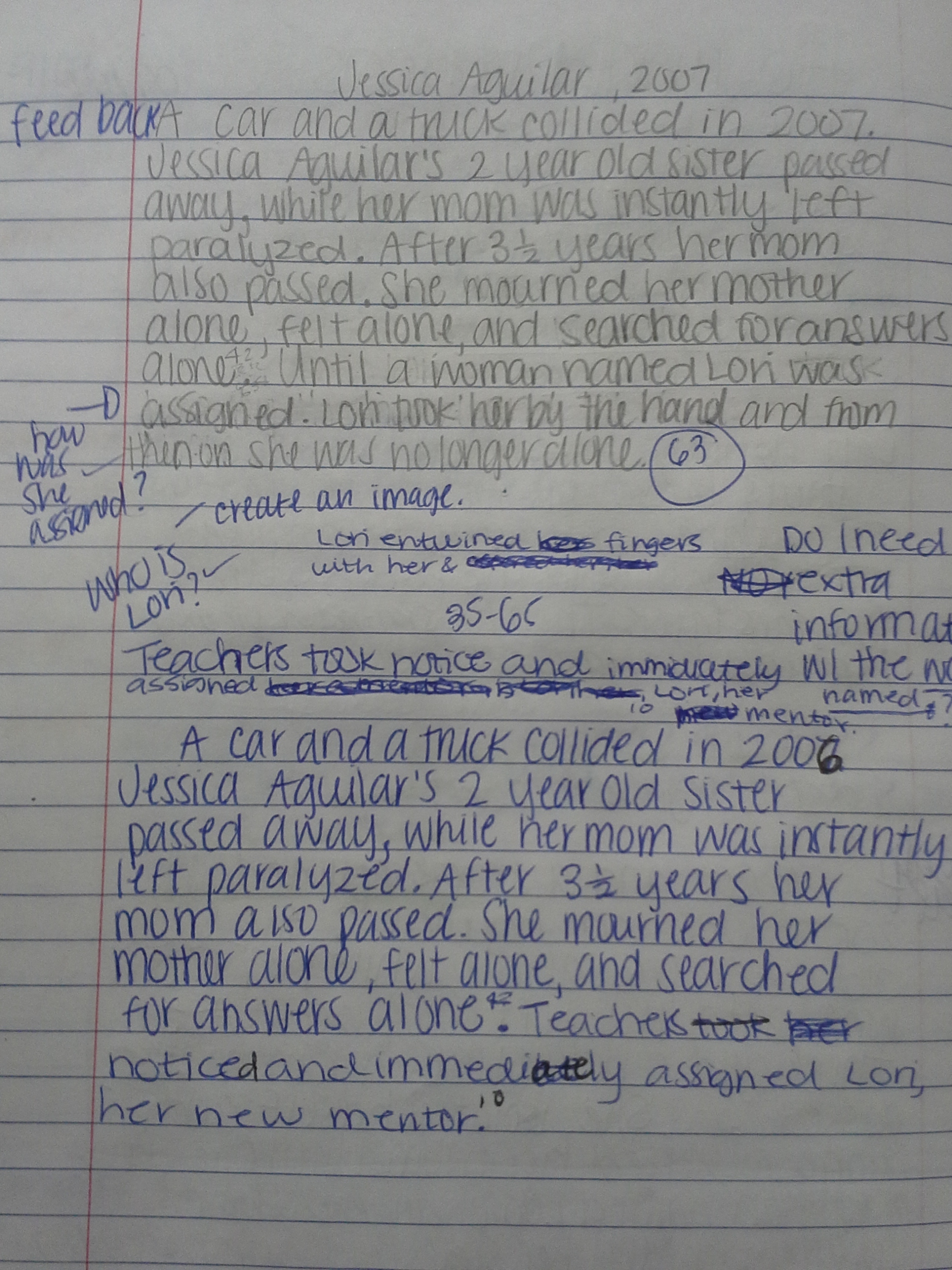
I asked for a volunteer to read her writing. Eyes darted all around the table until Jessica read her draft.

Jessica went first:

Jessica GoWorld story

Wow, right? She punched us right in the stomach, and we sat in silence. Finally, I said, “Okay, we’ve got some amazingly powerful stuff right here. How can we improve it?” and they looked at me like I had hornets on my head. I knew I better go first, or this feedback thing wasn’t going to work.

“I wonder if you need to tell us that Lori’s a woman,” I said.

Long pause.

“I wonder who ‘assigned’ her to you,” Mikaila spoke up.

“I wonder what she did that was so helpful,” Mariam said.

“I wonder how you survived,” said Daissy.

Jessica listened, answering a few questions, and taking a few notes on the comments her friends gave her.


And we were off . .


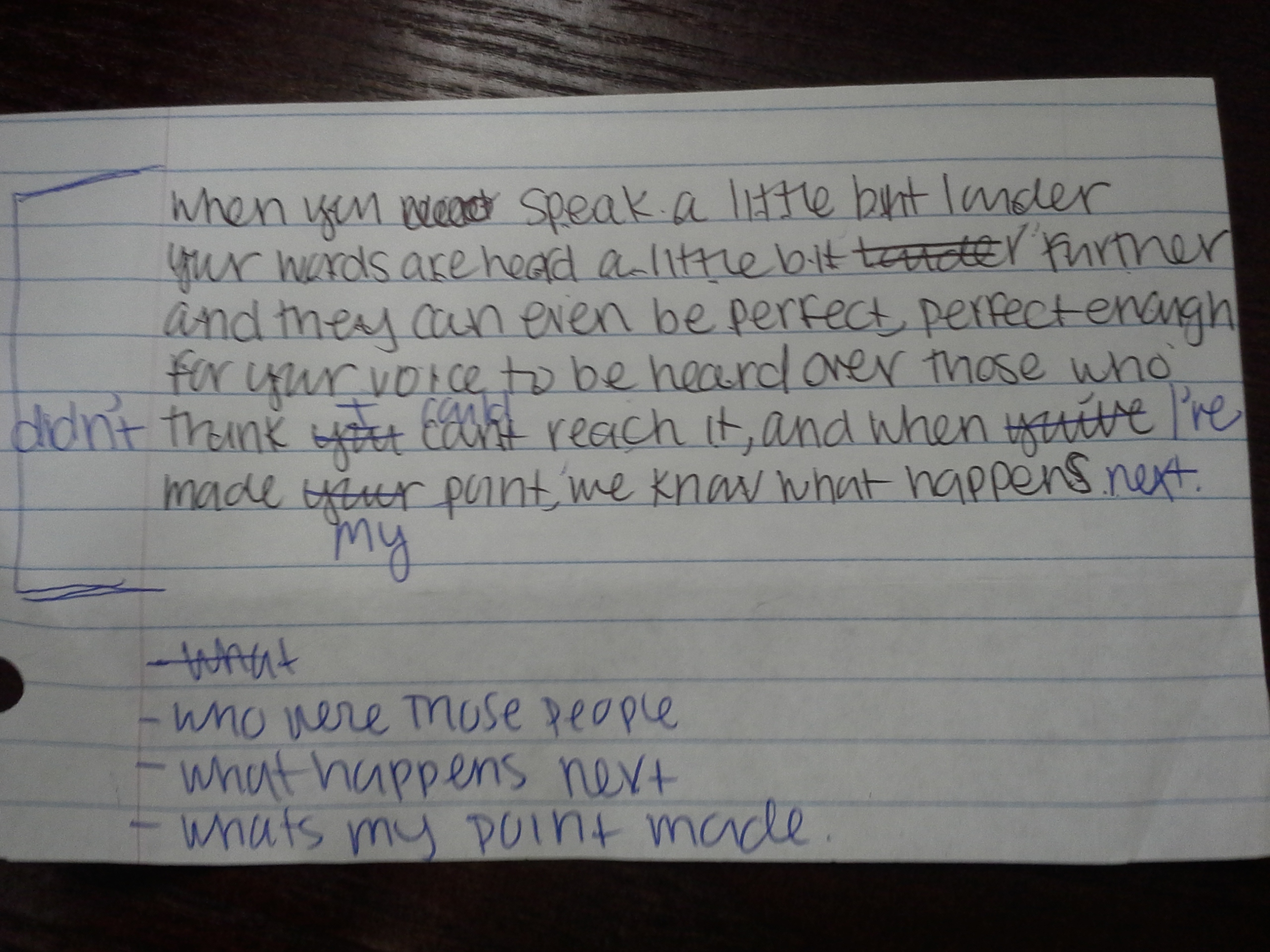
Daissy read next:

Daissy GoWorld story


“I wonder who ‘those’ are.”

“I wonder what the problem was.”

“I wonder what happens next.”

“I wonder what happened that made you change.”

And then Daissy could not remain silent any longer. She had to explain her stuttering, and how she’s worked so hard to overcome it, and how now wants to major in broadcast journalism and speak on live TV.

We forgot to preface our comments with “I wonder” when we all told her THAT is the story she needs to write.

revision corrections 2-7-12Feedback Magic happened with this “I wonder” protocol. And it happened in every class period, and so did the tears.

Students shared the honest writing from their hearts, and students gave honest feedback with tender and caring insight. Writing improved.

Even better? Imagine being in this kind of classroom with this kind of community of writers.

Heaven.


*Our mentor texts were VISA Go World commercials. I got this idea from an assignment I did at a class taught by Penny Kittle at the University of New Hampshire Literacy Institute. We watched several of the videos in class and discussed and analyzed the various structures of these very short, yet poignant, stories. Students were to watch and analyze a few more examples, transcribing the words to use as models for their own writing. Then they were to write their own, playing with word choice and syntax.

Chaos

The beginning of each school year is always chaotic.  Sometimes it’s the overwhelming chaos that can feel debilitating.  Other times it’s that quiet chaos that only you know ensues.  At times it creeps up on us in silence, yet we know it’s found its way into our spiraling minds.  But always, it lives within our being because, quite simply, we are so wildly passionate about upping the ante with each and every group of students that crosses our threshold.  This year, I welcome the chaos.

I have complete and utter belief that the Reading Writing Workshop (RWW) is exactly what my students need.  Better yet, I know in my soul, that it’s exactly what they deserve for their lives; both inside and outside of room 382.

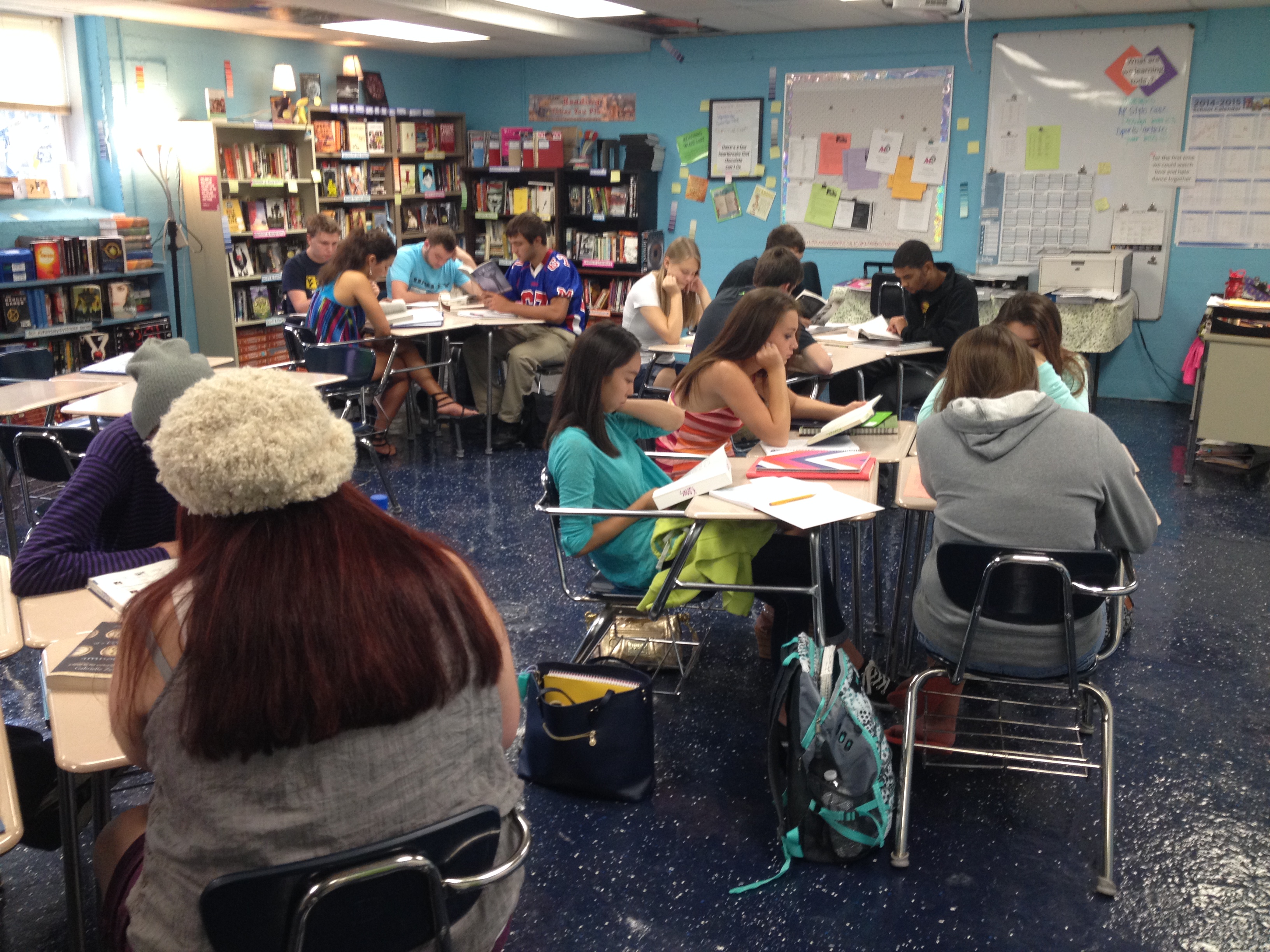
Both inside and outside room 382 students are starting their journeys through the RWW.

Students are starting to journey through the RWW: Inside and outside of room 382.

We have a promising year ahead full with mentor texts, writer’s craft, brilliant student generated ideas, ‘aha’ moments, and all of the unknown that we are willingly going to dive into – together.  But, I would be remiss if I pretended that chaos and uncertainty were not eagerly awaiting our arrival.

Between rolling out the RWW in its entirety last year, more summer classes at the lovely campus of UNH’s Literacy Institute, and a month in the Bronx writing with the NYC National Writing Project; I have been planning.  Incessantly.  Yet, I very quickly realized that all of my planning may be better utilized at some other time, in some far off distance, or at the very least, later in the year.

My plans are fantastic.  I feel it in my gut.

Yet I know they will be utilized and enjoyed when the time is…right.

You see, the beauty within the RWW is that the authentic and natural flow is magical.  Straight up, hands down – magic.  The luxurious task of choosing which piece of literature to start with when oh-so-many are enticing.  The creation of one’s Writer’s Notebook.  The roller coaster writing that sheds light on our own movement and development as writers.  The organic inquiry that surfaces.  All of it.  Every piece is essential.

So you can imagine that after rounding day three of educating, fully engulfed by a feeling of unease, I knew that all of my planning was by no means an effort to be mourned but most definitely an effort that needed reshaping.  As to not let the chaos (starting its crawl toward my vulnerability) completely immobilize me, I made a decision right then and there.  I was by no means going to shift my expectations.  Instead, I had decided to rework all ideas I had about what my students would find engaging.  Because the reality is, my new students are not the same students as last year.

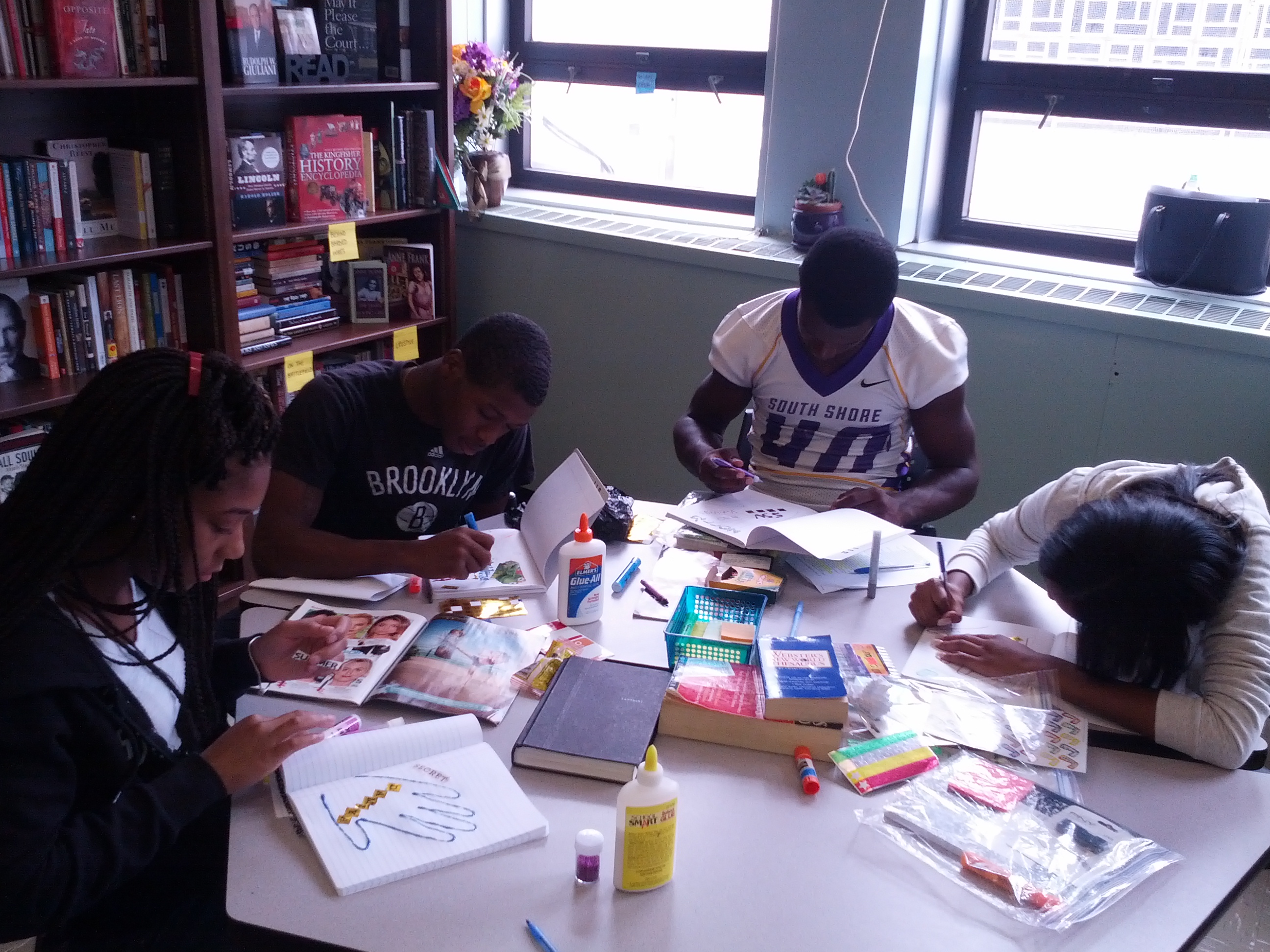
Students creating their Writer's Notebooks in ways that feel most authentic.

Students creating their Writer’s Notebooks in ways that feel most authentic.

Mystery books have flown off the shelves – for the first time ever!  Color is most often preferred when expressing themselves vs. the written word.  There is an untapped intellectual power among every young adult occupying each individual seat that is awaiting its own explosion.  Their passions have yet to be discovered within the context of our learning community.  And, not unlike years worth of previous students, they are incredibly focused and hardworking.

When students are not meshing with the material; when the sparkle does not twinkle in the corner of their eyes as they try to explore new found interests; or they have absolutely no questions…something’s wrong.  Very, very wrong.

I am responsible for guiding students through the beauty of the RWW to foster their own strength, perseverance, and dedication toward the development and growth that is inevitable to happen.  I feel the promise and hope.  I am no longer vulnerable nor am I even remotely entertaining the potentially consuming chaos.  Instead I am enjoying the exploration of new mentor texts while listening intently to the views and beliefs of my wildly intelligent learners.

Here’s to an invigorating year full of unforeseeable experiences, ideas reworked, and chaos debunked.


Confession: I’m dating a “non-reader”

“I don’t like to read.”

These words slipped off the tongue of my date as he sat across from me digging into a burger. I could’ve excused myself to the bathroom then slipped out the restaurant’s back door. Instead, I sat, paralyzed by his open admission.

Does he not realize I teach English? My quaint dreams of cozy dates at used book shops and Sunday mornings curled around novels dissipated. I couldn’t possibly share my life with a non-reader. I spent months fostering a love for literature in my students. I handpicked books for my teens, stocked my shelves with the latest releases, and inhaled literature in my free time. Dating a non-reader was like sleeping with the enemy.

The date was dead.

Or so I thought.

Two years later, we are still together, and Eric has proven to be one of my most valuable assets in understanding self-identified non-readers. Just as I had pigeon-holed Eric into an archetype of resistant male readers, he had categorized me into the antiquated outline of his high school English teachers—the ones who made him hate reading in the first place.

Eric’s teachers were staunch traditionalists. They assigned classics then tested, quizzed, and sucked any joy or personal exploration out of the books, leaving a pulpy mess of literary repulsion. Eric didn’t identify as a reader because his teachers had given him every reason to not identify as one: he struggled with literary analysis and didn’t enjoy fiction. Like many of my students, he skated through English relying on online cheat sheets to get around reading the required books.

This same resistance to identify as a reader plagues many students who step into my classroom. They have fixed perceptions of what a reader is or should be— a person who reads fast, favors classics and fiction, and enjoys literary analysis. Self-identified non-readers see no room in reading for personal growth, gratification, interest, exploration, and pleasure. Ultimately, they see no room for who they are as a person when they recognize that the only celebrated books within English classrooms are those that fit a set standard of literary merit.

Eric's "to read" shelf

Eric is drawn to informational books. Here are some of the books on his “to read” shelf.

Eric was a self-identified non-reader simply because he did not favor traditional literary classics that his teachers drilled in high school. Yet when I first met him, he voraciously read online articles. Gradually he found his niche in books that dealt with scientific theories and particle physics. Recently, Eric completed The Quantum Story: A History in 40 Moments by Jim Baggott, a 410 page book, and he is halfway through A Short History of Nearly Everything by Bill Bryson, which is 478 pages. Furthermore, he listens to audiobooks on his commute to and from work and our bookshelves are packed with volumes on his to-read list, including On the Origin of Species by Charles Darwin and Discoveries and Opinions of Galileo.

If Eric is a “non-reader,” he is exactly the type of student I want in my classroom—the type who has a personal, vested interest in his or her reading and seeks to learn from the material. Gradually, I

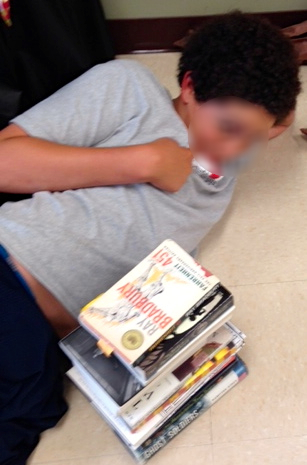
Trevor's Reading

Trevor poses with his stack of books read throughout the year.

have come to find Eric’s reading patterns in my own students. Trevor who hated reading found his niche amongst non-fiction books like Ghost Soldiers by Hampton Sides and Into the Wild by Jon Krakauer while Ben, who was rarely interested in whole class reads, challenged himself with diverse genres ranging from science (Stiff by Mary Roach and The Double Helix by James D. Watson) to historical fiction (The Book Thief by Markus Zusak). These students need the time and space to not only figure out how to define themselves as readers but to also establish a sustainable reading pattern.

By definition, readers are individuals who “look at and understand the meaning of letters, words, symbols, etc.” (Merriam-Webster Dictionary). Thus, as long as a student can read, they are readers—classics, fiction, and stereotypes aside. But as English teachers, we must not only show them that this is the case, but also we must help them to foster reading lives that reach beyond the classroom. A generation

of apathetic teen readers doesn’t have to lead to a generation of

Ben's reading

Ben with this stack of twelve books.

apathetic adult readers.

This past weekend while winding the back roads of a coastal Maine town, Eric and I spotted a library book sale. I would usually be the one to erratically swerve to the side of the road and park on a sidewalk if it meant gathering additional books for my classroom library, but this time, it was Eric. As I sorted through the stacks of books, I looked up to find Eric with a stack equal to my own. This was exactly the type of person I could spend my life with.