Category Archives: Readers Writers Workshop

Landscape of Workshop: We have arrived!

Nine years in. I know what certain murmuring really means. We all do. The murmuring of students when they are conferring about their writing. The kind that surfaces when boredom is creeping into our classrooms. The murmuring of confusion and frustration. The one that starts to get louder and louder as passion starts taking shape. Today, is that kind of murmuring day.

Christian: Why? No, really. Why? Why is it that all we do is read and write in here allllll day, Ms. Bogdany? Ev-er-y-day. (Yes, with that level of emphasis.)

Swallowing my smirk, I calmly start explaining the reasons, rationales, and importance again to Christian. Yes, we’ve had this conversation many–a-time. And clearly others’ patience with this subject has become depleted.

Norris: Man, why are you even asking that? We’re in English! It’s what we do!

Christian: No, but I mean seriously. It’s all we do. In my previous high school we used to watch movies and relax. This is crazy.

Norris: That’s why you’re not there anymore! You chose to be educated here. We’re at a transfer school. Here it’s more focused and we’re learning.

Deja: Oh, listen to you, Norris. Telling Christian all about what’s right…you always think you’re better than everyone!  We breathe the same air you breathe!

Hakeem: Norris, you haven’t walked in my shoes! You don’t know! Last period, you were the one that lied and got caught! Now you’re acting like Christian’s father.
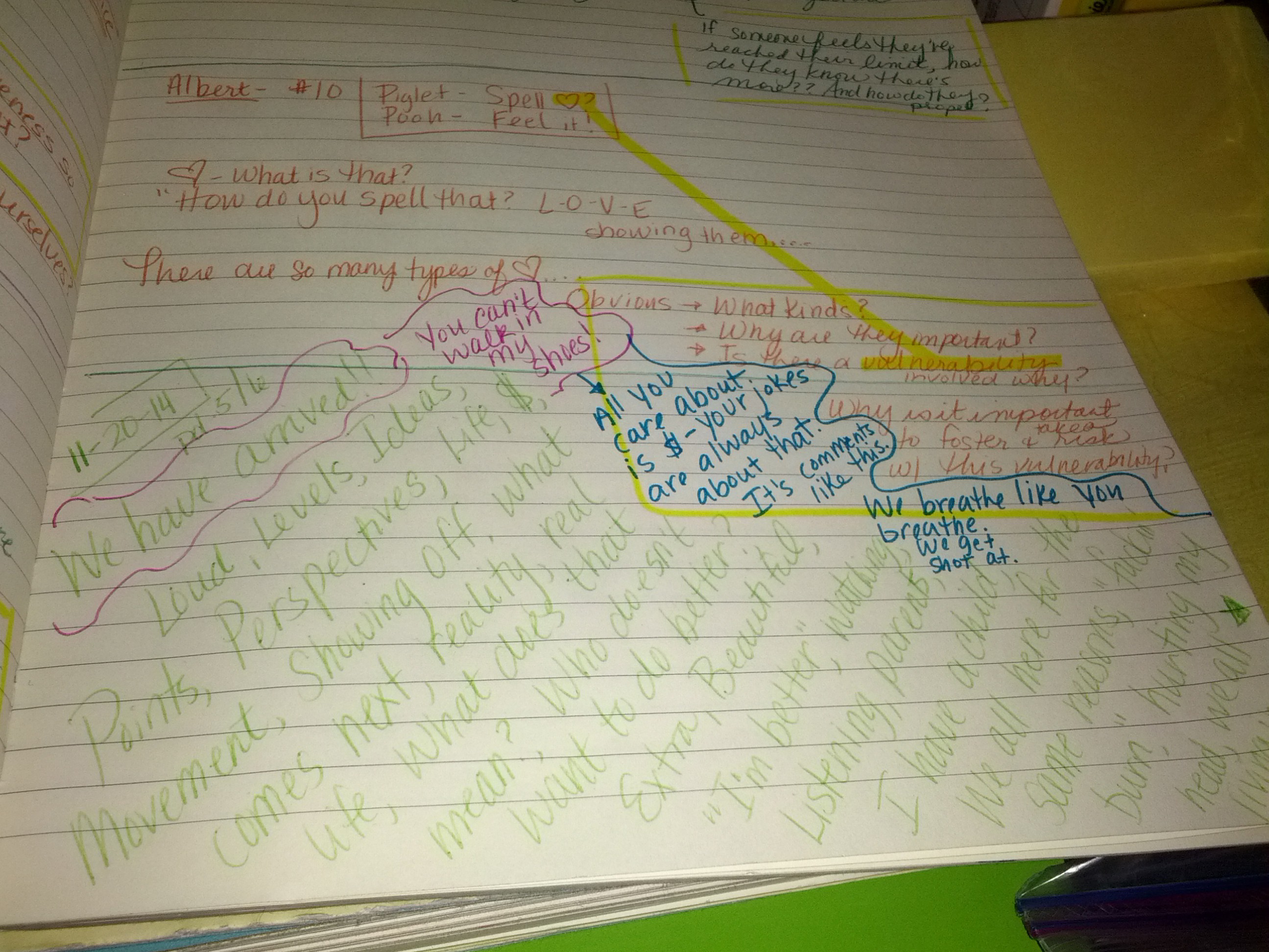
Here, in my Writer's Notebook, I capture voices speaking their truth.

Here, in my Writer’s Notebook, I capture voices speaking their truth.

Here is where I sit back and start listening; very intently. I am becoming quieter and quieter as the room gets more and more animated. (I was hoping to become invisible, truth be told.) Because, this is what happens when students are invested. They challenge each other. They hold each other accountable. They start discussing their level of comfort or lack there of.   They express their inner feelings. They question motives. And yes, sometimes their word choices can be a bit crass, but isn’t that authenticity at its best?

They give me exactly what I need as their educator.

I need to understand who they are, what fuels their fire, how they feel about injustice. How safe are they feeling in our learning community? Well, I can’t always answer all of the questions swirling around in my mind, but today I was able to answer this one confidently: students are feeling wildly comfortable in our shared space. Because when students are brave enough to confront their peers (those that are their roughest critics) I know we’ve arrived. We’ve arrived as an evolving community of learners; as a team not willing to silence our voices when they need to be heard; and we are most definitely letting our guards down as we are emerging ourselves even more deeply in the work of the Reading Writing Workshop (RWW).

I also know that while Christian is literally shifting around in his seat, stretching all of his 5 feet 9 inches; he is moving – physically and as a writer. He doesn’t necessarily see or appreciate it just yet, but it’s there. I see it. I know. And, just like the murmuring that propelled this dialogue in room 382, Christian is pushing boundaries and uncomfortable. Yet, I believe Christian is more resilient than he even recognizes. And that resiliency pushes me to continually find ways to engage Christian in this work. Even, if it means having the same conversation again — because it will resurface.

As I head down to the nation’s capitol to be reunited with my PLN – my nationwide pedagogical lifeline – I take this experience with me. Regardless of how much traffic I may encounter on the trip from Brooklyn, this tipping point (as Malcolm Gladwell would argue) is buckled tightly in my back seat and promising to remind me what I am bringing with me to #NCTE14 – the moments that the RWW affords us when we listen to our learners, their needs, and previously dormant desires.

I cannot wait to further this conversation on Saturday at J.44 starting at 2:45pm. I hope you join us for an hour full of deep thinking, classroom anecdotals, and the energy that attendees from across the country bring to the conversation. See you there!

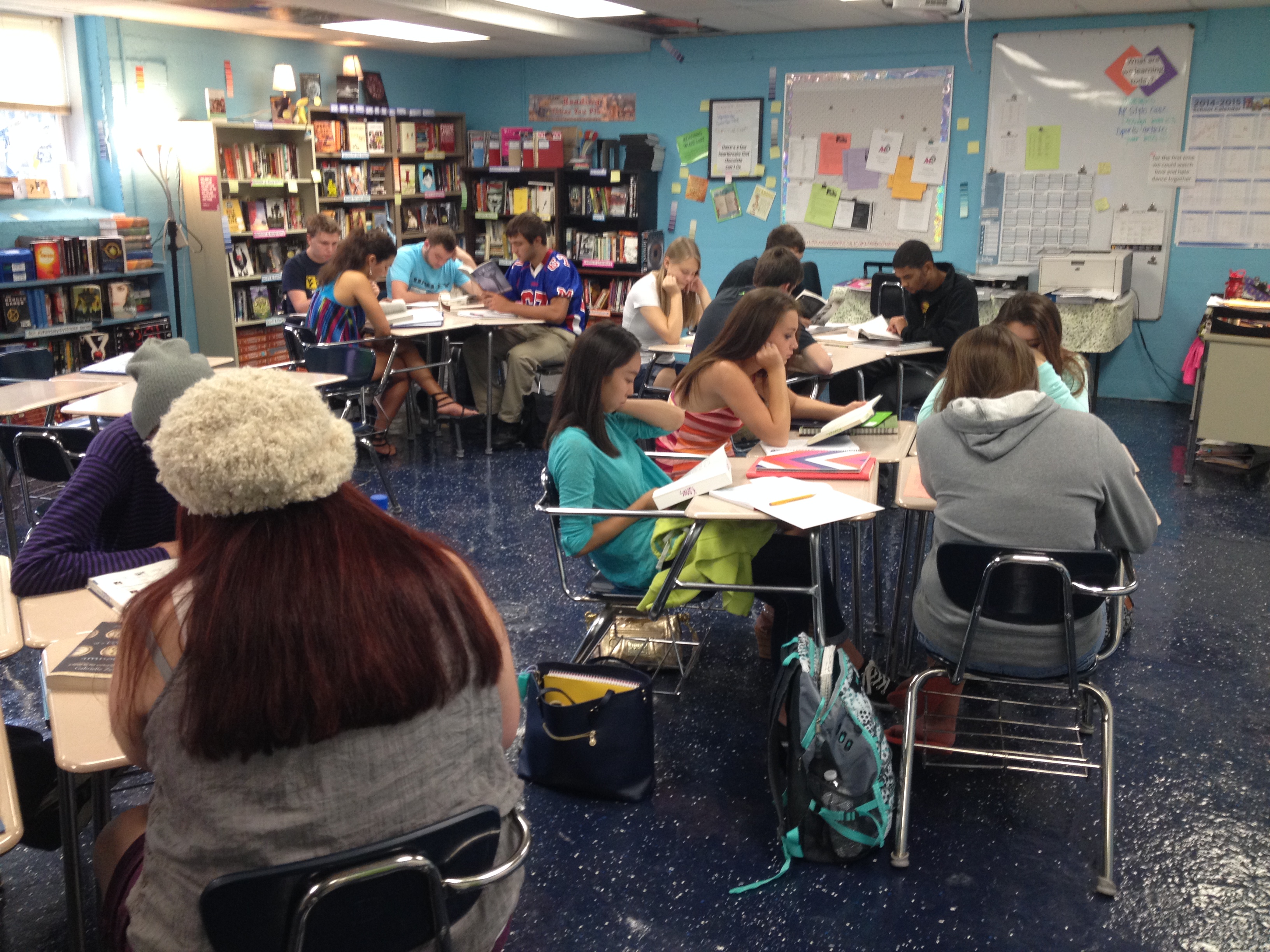
#NCTE14 J.44 Nonnegotiables Across the Landscape of Workshop

Jackie, Erika, Amy and I are excited to present at NCTE in Washington, D.C. on Saturday at 2:45 pm. Penny Kittle is our Chair. We are session J.44. Join us!

“I am the sum of my mentors,” writes Meenoo Rami in Thrive.  As a student at Miami University in 2005, I had no idea how fortunate I was to have Tom Romano as one of my mentors.  As a leader in educational writing, a teacher with his thumb on the pulse of research, and the giant who first introduced me to NCTE, Romano has always been my single biggest mentor.

As I thought for months about what I wanted to share with teachers regarding the readers-writers workshop at NCTE, I was reminded of an assignment I’d done in Romano’s class–to find the “red thread” of my teaching…my nonnegotiables regarding our profession.  I dug for it in the depths of my hard drive.

Re-reading it, I laughed as I always do at my older writing, but then I smiled.  Many of my nonnegotiables remain unchanged: sustained silent reading.  Craft informed by research.  Authenticity.  Engagement is central.  Model, model, model.

Tom Romano obviously did a damn good job as a mentor.

IMG_5031Those simple principles–plus my genuine passion for reading, and writing, and the joy I believe they can bring everyone–inform my practice day in and day out.  They are supported by the research of Penny Kittle, Katie Wood Ray, Tom Newkirk, Kelly Gallagher, Donalyn Miller, Linda Rief, and more.  I am the sum of those mentors, and in this season of giving thanks, I’m so grateful that I am.  My students have found incredible success because I stand on the shoulders of those giants, and I can’t wait to share their stories at our session in Washington, D.C.

A Mini-lesson on Extended Metaphor

The Good Luck of Right Now is the first book by Matthew Quick that I read. It is a good book. I love the quirkiness of the narrator’s voice. It reminds me a little of the narrator in The Curious Incident of the Dog in the Night Time. I don’t know which I like better.
I am not sure this is a book that my students will want to read, although I will share it with them with my high praise. I do know that there are several passages that I can use for mini-lessons. I especially like this one with an extended metaphor. I think students will be able to write their own, and maybe add it into their narratives, once we take a close look at the way Quick uses this one here:


The Good Luck of Right Now by Matthew Quick, p111

(I have to say that everything seems to be unraveling lately. Or maybe it seems as though I am a flower myself, opening up to the world for the first time. I don’t know why this is, and I’m not really in control of it either. Flowers do not think. Okay, it is now May, so I will reach up toward the sun and relax my fist of petals into an open hand. They do not think at all. Flowers just grow, and when it is time, they shoot colors out of their stems and become beautiful. I am no more beautiful than I was when Mom was alive, but I feel as though I am a fist opening, a flower blooming, a match ignited, a beautiful mane of hair loosened from a bun –that so many things previously impossible are now possible. And I have been wondering if that is the reason I did not cry and become upset when Mom died. Do the colorful flower petals cry and mourn when they are no longer contained within a green stem? I wonder if the first thirty-eight years of my life were spent within the stem of me — myself. I have been wondering a lot about a lot of things, Richard Gere, and when I read about your life I get to thinking that you also have similar thoughts, which is why you dropped out of college and did not become a farmer like your grandfather or an insurance salesman like your father. And it’s also why so many people thought you were aloof, when you were only trying to be you. I read that you used to go to the movies by yourself when you were in college and you’d stay at the movie house for hours and hours studying the craft of acting and storytelling and moviemaking. You did all of this alone. This way maybe when you were in the stem–before you exploded into the bloom of internationally famous movie star Richard Gere. Such vivid colors you boast now! But it wasn’t easy for you. I have been learning by researching your life. So much time spent acting on the stage. You lived in a New York City apartment without heat or water, one book reported. And then you made many movies before you became famous –always trying to beat out John Travolta for roles, and being paid so much less than him. But now you are Richard Gere. Richard Gere!)


Do you have other passages that work well to teach extended metaphor?

Two Wes Moores?

Here’s what I love about literature; when there’s not one but two options that propel me through the exploration of a writer’s story.  It gives me options, varied yet similar journeys, and choice.  I love choice.

IMG_20141105_162445

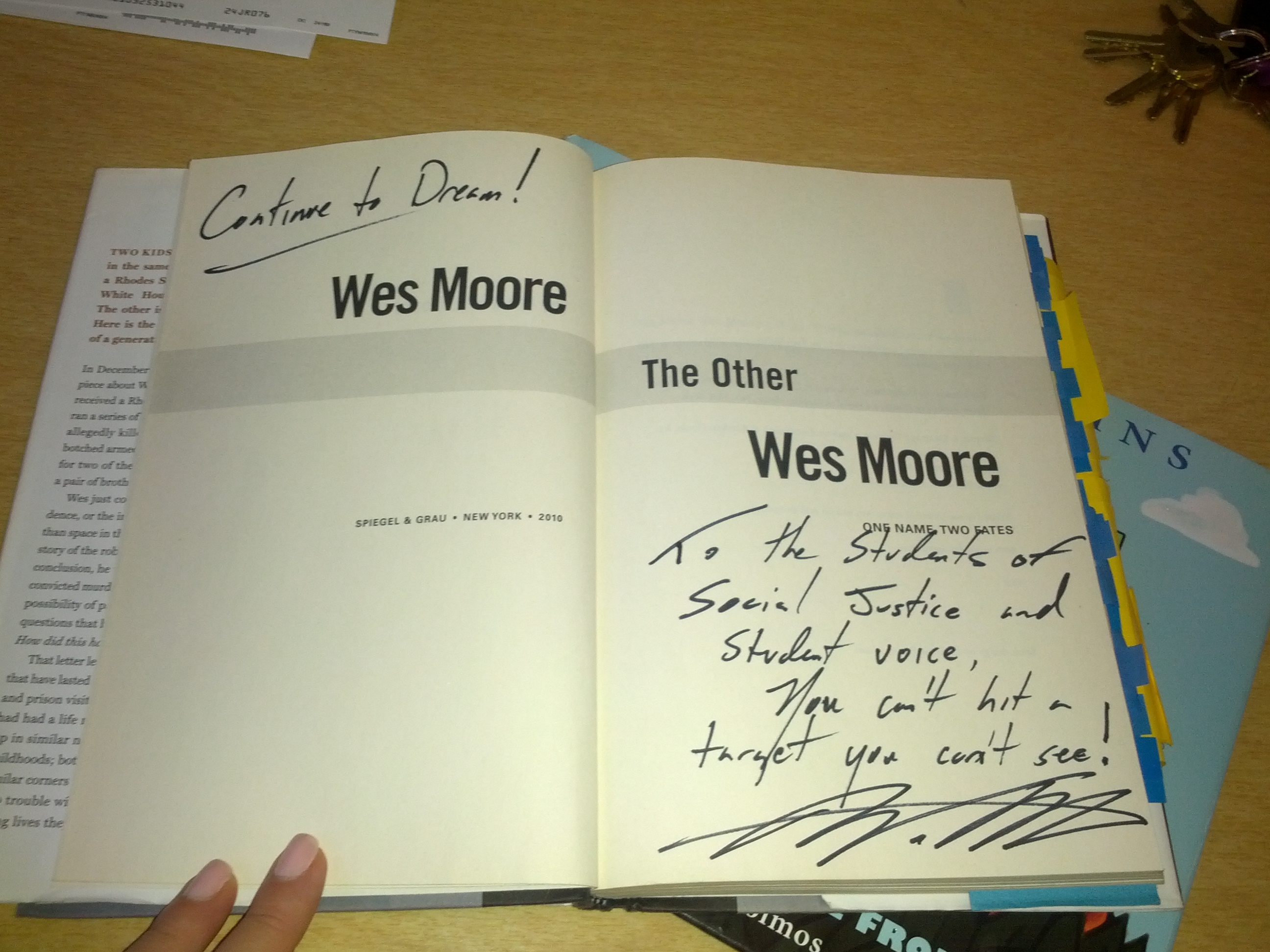
To the students of Social Justice and Student Voice, You can’t hit a target you can’t see. Continue to dream! -Wes Moore

I also love when I get to meet an author and hear him speak about his story; both in the writing and in his account of the events.  What better way to be introduced to another’s extraordinary life?

And, an extraordinary life it is.

In The Other Wes Moore by Wes Moore, upon realizing that Wes was not the only Wes Moore residing (as a youth) on the streets of Baltimore, he felt compelled to connect with the other man sharing extraordinary similarities; the same name, fatherlessness, and navigation through the world the best way they knew how.

And, so the story begins.

By taking a leap of faith and contacting the other Wes Moore (while jailed for a crime that put him behind bars for a lifetime without parole) Wes opens the door for connection, dialogue, and an unbreakable bond.  Human connection at its core.

I introduce students to the significance of the dividing gray line - the shift from Wes Moore to the Other Wes Moore (and vice versa).

In The Other Wes Moore, I introduce students to the significance of the dividing gray line – the shift from Wes Moore to the Other Wes Moore (and vice versa).

That’s all I share with students when introducing them to this piece.  And then the questions swirl: Wait!  What do you mean they have the same name but live such different lives?  Does the other Wes answer Wes’s request to communicate?  Wes visits the other Wes in jail, huh?  What does he mean when he says (compliments of the cover), “The chilling truth is that his story could have been mine.  The tragedy is that my story could have been his.”?  If he’s not in jail, how could it be a tragedy for the other Wes Moore to live Wes’s life?   This is wild!

And now, Discovering Wes Moore (the Young Adult adaptation) provides access to readers who are intrigued by (as the title suggests) discovering Wes Moore, the author.  This piece brings readers through the linear journey of the author’s life, struggles, ah-has, life choices, and incredible realizations.

Both Wes Moores on display in room 382

Both Wes Moores on display in room 382

Here’s what I love about this piece, students do not enter into the potential complexity of following two stories interwoven; they simply get to focus on one story line.  For readers who are interested in autobiographical narratives, this provides them access to a story not to be missed.

Some students enjoy reading both pieces simultaneously by the means of an author study; while others enjoy choosing only one piece to explore.  Students of all reading levels and interests find themselves consumed by these pieces – the craft, reality, and unbelievable story that is oh-so-honest.

The Other Wes Moore and Discovering Wes Moore are continually transient. They don’t stay on our shelves for any extended period of time. As soon as students realize they’re back and available for the taking, they do just that while others’ Next-To-Read lists grow.

I love that both Wes Moores find themselves in the hands of inquisitive learners because, to date, not one student reader has been untouched by their story.

Writing as Punishment? Oh, the Nerve!

“As punishment I have my students write a response to an ethical question when they are done with their social studies test,” a colleague said during a recent professional development session.

I’d been asked to lead a discussion on writing in disciplines other than English, and I’d asked the attendees to share out the various types of writing they have students practice in their classes.

“That’s pretty much the only kind of writing I do in my class,” he said, “That’s why I’m here.”

I might have stuttered a bit as I caught myself from falling down. I guarantee my neck turned red as it does when I am frustrated.

PUNISHMENT?! Did I hear that right?

What does a writing teacher do with that?

Imagine if I sat in his history classroom and boasted that I punished students by making them learn the historical context of a text prior to reading it. Imagine if I made a disparaging remark about his content at all. The nerve.

Therein lies a big part of the problem with student writers. Many people, teachers included, think writing is boring, or too much work, or punishment.

Then, it’s left up to English teachers with a passion for the craft to push and prod and plead with students to put at least a tiny thought on the plain white page. Somewhere someone ruined that child for the written word, and we have to undo some damaging false notion.

Don Graves reminds us that children want to write before they want to read. I know this is true. My own children reached for their dad’s pen or the random crayon before they ever sat still long enough to read a book. The two-foot-tall art on the clean white walls of my brand new house was evident often enough.

Children want to write. We must protect that desire. Nurture it with freedom and ideas and time.

Shame on the teacher who ever makes writing a punishment.

And yes, in case you are wondering, I spoke my mind.

“I challenge you to never call writing a punishment again,” I said as he squirmed just a bit, “Students will write, and they’ll love writing. You have to be the model of what that means in your own classroom.”

I believe that with all my heart.

It goes far beyond your Everyday story

51i318LHixL._SY344_BO1,204,203,200_If you doubt, question, or undermine the complexity or rigor of young adult literature, read Everyday by David Levithan. Despite the book’s bland beige and gray cover, there is nothing dull or colorless about this story. It is a philosophical and, in my opinion, a political statement that calls into question what it means to be an individual in today’s world.

In the book, A is a genderless soul that inhabits a different body everyday (hence the title). The conflict is that A, in the first chapter, falls in love with Rhiannon, the girlfriend of a boy whose body A currently inhabits. Don’t worry; it isn’t as confusing as it sounds. This simple love story leads its readers to question what defines gender and even love as A inhabits different bodies throughout the book. Furthermore, A questions what the difference is between the soul and the body and how they can function as one or even two distinct beings.

David Levithan captures the beauty and innocence of being human through the simple yet straight forward perspective of A, an old soul with deep knowledge: “If there’s one thing I’ve learned, it’s this: We all want everything to be okay. We don’t even wish so much for fantastic or marvelous or outstanding. We will happily settle for okay, because most of the time, okay is enough.” A goes on to one of my favorite passages of the book, a passage that is great for book talking and providing a brief teaser without giving anything away.

I am a drifter, and as lonely as that can be, it is also remarkably freeing. I will never define myself in terms of anyone else. I will never feel the pressure of peers or the burden of parental expectation. I can view everyone as pieces of a whole, and focus on the whole, not the pieces. I have learned how to observe, far better than most people observe. I am not blinded by the past or motivated by the future. I focus on the present, because that is where I am destined to live.

“I learn. Sometimes I am taught something I have already been taught in dozens of others classrooms. Sometimes I am taught something completely new. I have to access the body, access the mind and see what information it’s retained. And when I do, I learn. Knowledge is the only thing I take with me when I go” (Levithan 6).

As a teacher, it is easy to love this passage. After all, it ends with the value of learning, but beyond that, this page (the entirety of page 6) shows A’s struggle with defining him/herself as an individual. Not only is there minimal diversification in the sentence starters, but A uses the personal pronoun “I” 25 times in just one page: “I would,” “I took,” “I felt,” “I am,” etc. This practice goes against the rule of what we oftentimes teach to young writers—stray away from using I at the beginning of every sentence. Levithan’s willingness to break the rules and question the norm is what makes this piece both a masterful mentor text and thought provoking must-read.

Running Away From Grading My Students’ Problems

when-i-runWhen we had to run the mile in elementary school, I was always at the back of the pack, inhaler in hand, slowly walking my way across the finish line. I have never been a runner; believe me, I’ve tried. So on Saturday afternoon, when I got the urge to hit the pavement in a light, albeit slow, jog, I was running away from more than my problems—the heaps of papers, laundry, meetings, assignments, and work I had waiting at home. I was running away from grading the problems of my students.

In the beginning of the year I always find that students are hesitant with their writing, cautious to share with one another, eager to find personal stories that are interesting yet not too revealing. I don’t blame them—after all, as much as we want to believe high school is a safe space to share our feelings and experiences, it isn’t. Bit by bit though, students unravel, some sooner than others, and slowly I begin receiving stories that are raw and honest. This last set of personal narratives I received included stories about the deaths of parents and grandparents and the suicide of a close friend. Students spoke about dealing with anorexia, suicidal ideations, and clinical depression. At 16 and 17 years old, many of these students have lived more life than some adults.

Part of this process has to do with the fact that my students peer review each other’s work. I find that as they are exposed to one another’s writing they tend to open up further. In addition, I share my own writing with them, in particular one piece on the complications that happened after my father had open heart surgery two years ago. I pick and choose what classes I share this piece with. Some classes are ready to hear that their teacher is capable of fear, anger, anxiety, and hurt; some classes aren’t. The piece is revealing of who I am as a daughter and sister instead of pigeon holing me into the role of a leader and teacher.

The problem with this dynamic is that it doesn’t fit into the traditional education system. While I am not an advocate of grades, I am also not anti-grades. Still, I find that no number can adequately convey the power of writing or the strength and guts of these students. As a teacher, I have to look at the structure, craft, mechangrade-620x425ics, and formatting of a paper, but no matter how much I observe the concrete aspects of a piece, I cannot help but remember that my job isn’t just about correcting punctuation or spelling; my job is to do justice to the stories of my students, to help them tell these stories in the most compelling way possible, which is what led me to my run on this fall day.

Unfortunately, my tromping across scattered leaves with heavy breathing and a stitch in my side didn’t bring any clarity, and when I returned to my kitchen table, the same stories sat underneath my pen, covered in blue ink that praised their bravery, their craft, their story. But still, these stories were gradeless, waiting for a number, waiting for the end of the quarter, waiting to be put into my online gradebook. So my question for all of you teachers, those of you who have been teaching and grading for far more many years than I, how do you tackle these difficult papers? How do you tack on a number to something that has so much more value?

A Novel in Verse to Study Craft

I recently read my first Ellen Hopkin’s novel in verse — all 666 pages. I’d often wondered why some of my most reluctant readers, girls mostly, would stick with and finish Hopkin’s books. Now I know.

While the thickness of the book is intimidating, the number of words on each page is not. The poems are short and beautifully worded, using language that makes the storyline pop like a 3D movie.

Impulse is the story of three characters, all with distinct voices, portrayed in their own series of poems. The point of view shifts from character to character, which I love because that adds to the complex thinking students must do to understand what is happening in the story.

All three characters suffer from some of the worst abuses that can happen in the lives of individuals. All are in a facility trying to figure out themselves and their horrid lives — primarily as result of the actions of adults.

This morning while checking my Twitter feed I was reminded of the need to introduce students to books as mirrors and windows. Students should be able to see themselves within the characters they read about, and they should be able to see into the lives of others that they may never know. Sometimes books allow students to do both. Impulse is one of those books.

I think it would be interesting to use this poem from page 2 as an exercise in imitation. What four verbs might students choose to write into their four sentence poem?

The Thread

Wish

you could turn off

the questions, turn

the voices,

turn off all sound.

Yearn

to close out

the ugliness, close

out the filthiness,

close out all light.

Long

to cast away

yesterday, cast

away memory,

cast away all jeopardy.

Pray

you could somehow stop

the uncertainty, somehow

stop the loathing,

somehow stop the pain.

Why Are So Many Adults Threatened by Students Choosing Books?

The teacher-readers at Three Teachers Talk agree. The only way to promote, encourage, foster, nourish, and engage readers is to let them read. We thank The Reading Zone for this post. Our thoughts exactly.

thereadingzone's avatarThe Reading Zone

  • Flowers in the Attic
  • A Wrinkle in Time
  • As I Lay Dying
  • Mists of Avalon
  • Harry Potter and the Sorcerer’s Stone
  • The Hobbit
  • Little Women
  • Anne of Avonlea
  • the Bible
  • Cold Mountain
  • Angela’s Ashes
  • The Celestine Prophecy
  • Dreamland
  • Speak
  • The Hot Zone

A list of books you can find at garage sales or friends of the library sales?  Probably.  But the above-named books are also just some of the books I chose to read in high school.  They weren’t assigned books but instead were books that friends and I passed around.  Of course we read Hemingway, Salinger, Achebe, and Shakespeare in school.  Well, we “read” those.  I can tell you exactly which assigned books I read and which ones I “read”.  But the books I picked on my own and the ones my friends were all talking about?  Those I didn’t put down until I turned that last page.

I…

View original post 830 more words

PTSA Reflections: The World Would Be A Better Place If…

I love this line: “As I try to do with all assignments, I did the writing along with them.” This is a teacher who knows what her task is as an English educator and honors her students by walking the talk. If we expect our students to learn to write, take time to write, be willing to write — WE must write. We must write so they see our thinking, our struggle, our process. Because it’s in the process that all the learning happens. Thanks for sharing a slice of your pedagogy with us Mrs. Kelley.

Whitney Kelley's avatarAlong for the Write

The theme for this year’s PTSA Reflections competition is “The World Would Be A Better Place If…,” and I have assigned my students to write an original work for a ReadAround in class tomorrow.  As I try to do with all assignments, I did the writing along with them.  Below is my response to the prompt.

If “ifs” and “buts” were candy and nuts, oh what a Christmas it’d be.

My brother and I always said that when we were growing up, and it’s been running through my mind since we began the Reflections writing.  I think about the truth behind that little chant, and I have to shake my head that we had no idea what truth we were actually speaking in our naïve youth.  Quite honestly, at the time we liked being able to say the word “buts” without getting in trouble, and we also liked to taunt…

View original post 286 more words