Category Archives: Readers Writers Workshop

Mini-Lesson: The Simultaneity of Instants by Jessica Paxson

I am an anti-bandwagon jumper.  I tend to think if everyone is flocking toward something, I’m likely too cool for it.  I attribute that to my father, and I’ve discussed it before, but that’s beside the point.  

18143977.jpgThis year, as I made the venture to RWW, I knew I would need to read lots of buzz-worthy books, simply for the purpose of recommending.  Needless to say, I have slowly been broken down from my rigid ways. It’s because of this anti-bandwagon mentality that I am so late to the Anthony Doerr party, particularly in respect to All the Light We Cannot See.  

I decided to tackle this novel over Christmas break because of how many people had recommended it to me.  I was reluctant, but of course, Doerr drew me in with his utterly gorgeous descriptions of difficult cultural situations, the relationships between characters, and the flawless knitting together of a nonlinear storyline.  

So.  I’m a fan.  Likely at least two years after everyone else, but better late than never, right?

I was specifically intrigued by one of the chapters near to the end, entitled, “The Simultaneity of Instants.”  This chapter reminds me a little bit of the montages that occur at the end of a movie or a season finale in which all characters come together for a final appearance.  The only difference with this chapter is that they did not come together in the same place, but simply in the same moment.  I thought this would be a great way to coach my students through describing an important moment with a bird’s eye view.  

Objective: Students will describe an important moment in their life by also providing a glimpse into that same moment for other “characters” in their story.

Mentor Text

Lesson: First, students will begin by writing about a specific moment that they remember vividly.  You could draw from many different forms of pre-writing for writing about memories, but a few of my favorites are Writing Territories and Blueprinting.  After students decide on a moment that was important to them, we will do a quick draft for about 10 minutes.  

Next, students will begin to brainstorm about what other people might have been up to at that very moment.  The key here is for students not to get hung up on what actually happened, but to simply imagine that moment in time from a broader scope.  

Finally, after brainstorming simultaneous instants, it’s time to weave them together.  This is the moment in which Doerr’s writing as a mentor text will be unequivocally valuable.  Students will ask, “Well, how do I know which moment to put where?”  And I’ll say, “What does the mentor text do?”  And on and on until we have pieces of writing of which the students never imagined they would be capable.

I hope to do this along with my students, and I’m particularly imagining a Simultaneity of Instants starting with the Presidential Inauguration, or Obama’s farewell wave, or something to that effect.  I may already be blubbering as I brainstorm.  

Follow Up:

I teach Seniors and Creative Writers.  While my CWers will work on this concept soon, I may save this for my Seniors until their end of year MGPs (anyone want to help me plan?).  I think an imaginary Simultaneity of Instants as they walk across the stage.  This will end up resembling an end-of-an-era-montage, and I can’t wait to see what they come up with!

Jessica Paxson is an English IV and Creative Writing teacher in Arlington, TX. She also attempts to grapple with life and all of its complexities and hilarities over at www.jessicajordana.com. Follow her on Twitter or Instagram @jessjordana.

Nothing Compares to an Email Like This #WhyITeach

In the future, whenever I question myself, my pedagogy, my lessons, my reasons for teaching, I will revisit this email I found in my inbox this morning. This is why I teach. This is why I advocate for choice. This is why I advocate for readers-writers workshop every chance I get:

Hello Mrs. Rasmussen,

There’s a good chance you won’t remember me, but it’s NK from your AP English class…two years ago. I’m now in my second semester of UT Austin as a biochemistry major, but I continue to find myself thinking about how deeply indebted I am. Your class got me excited to read and discover new books. I lose track of time while studying until the sun comes up, and I forget to eat as often as I forget to water my plants, but I still find comfort in books– I look forward to reading even on an unforgiving schedule. I’m grateful for the freedom of choice you allowed us, and I’m grateful for how understanding you were as a passionate teacher and book enthusiast. Your passion for getting students to read at their own interest was so intense and pure that it inspired me to soak myself longer and deeper in this vast sea of literature. Both your willingness to give us the chance to grow as readers and your swelling collection of books played massive roles in my newfound appreciation, and I just wanted to tell you, 

Thank you.

I have an essay due in a few hours, but while I was reading an article on middle eastern warfare, my mind wandered and started to reminisce about The House in the Sky (I think I finished it in three days over winter break), and of course, that reminded me to finally write to you about my overflowing admiration, appreciation, and gratitude. Thank you for inspiring and encouraging me as a student and reader. I have no doubt your current and future students will feel the same. Again, thank you, thank you, and thank you.

~NK

Book Talk in a Blog Post: Scar Island by Dan Gemeinhart

Too often book reviews focus on personal opinions of a book, but as teachers of readers, it’s not all about us.  This post is one of some in an occasional series in which I review  and recommend books for student readers.


Scar Island by Dan Gemeinhart belongs in a middle school teacher’s literature repertoire for “what’s hot.”  My students come in to my classroom familiar with Gemeinhart’s first book, The Honest Truth, so it’s easy to get them reading a book by an author they already know and love.   


This book takes a darker turn, as it takes place on a prison island for teen boy detainees.  All of the adults are conveniently killed off, and what results is a Lord of The Flies-like scenario.  Gemeinhart is not the first to write about teens surviving in a world without adults, but he’s one of the first to do it in under 250 pages.  This is the kind of book that’s perfect for a reader who wants a plot-heavy adventure, but isn’t patient enough to read through the 400+ pages of some teen books.

scar-island

How to booktalk it:


Jonathan has been sentenced to Slabhenge, a prison reform school for teens.  At Slabhenge, the adults get to eat bacon and eggs for breakfast while the prisoners eat oatmeal and a common punishment is kneeling on the Sinner’s Sorrow, a device that’s designed to cut into your knees.   


One day, at roll call, lightning strikes a puddle that all of the adults are standing in.  The adults are dead; the prisoners are alive.


[Read out loud from page 53 to the break on page 55]


Cheering and Steering Readers:


Some readers might find the early pages a little slow, particularly because there are a lot of character introductions.  Readers have to wait 50 pages for the adults to die off, which might be frustrating for the reader who wants to get to the “real” story right away.


Kids who have background knowledge in escape stories and who can visualize gloomy prison-y settings from movies and TV shows will have a much easier time reading this book than students who don’t have that kind of knowledge.  


Encourage students to draw out scenes from this book and to make character lists.  Some characters are important and pronounced;  others pop up only once or twice.


Supporting Conference Questions


What are some of the problems these characters are facing?  How would you like to see these problems resolved?  (Note: this is a great book for exploring conflict/resolution, as there are some very obvious problems and others that are a little more subtle.)

Do you think this book realistically shows off teen behavior?  Why or why not?


What lessons do you think the author wants you to take away from this book?  


Where to get it:


Scar Island is available through Scholastic Reading Club (https://clubs.scholastic.com/), so if you would like a deeply discounted classroom copy, you can purchase one here.


Amy Estersohn is a middle school English teacher, comic book reviewer, former admissions officer, and a recipient of the NCTE/ALAN Gallo Grant.

Clickbate Goes to College: Challenging Readers Daily

With my daughter Ellie fast approaching the age of four (when did that happen?), we watch a fair amount of Sesame Street these days and we are working on letter sounds (“N, nah, Narwhal” makes me smile every time), so at our house, C is for cookie. However in my classroom, with the start of the new semester, I’ve been telling my students that C is for Challenge.

Choice has been at the forefront for most of the year so far, and while it’s a workshop non-negotiable I have personally seen the power of, we need to step up the challenge portion of our programming.

For some, this means simply getting through a text. Yes, workshop breeds excitement around reading and an increase in the number of students consuming books is sure to follow, but there are always holdouts (Shana has a list of books to hook those holdouts, so have at it). I have several holdouts this year. Some are too busy, some are too easily distracted, and some are too downright stubborn. As a result, their reading has stalled.

Other students are entrenched:
Dystopian novels or bust.
Jodi Picoult or nothing.
Nicholas Sparks is the only one who can speak to my soul.
John Green is my God. 
I’m allergic to nonfiction.
This book has more than 300 pages…so, yeah…that’s a no.

Now, don’t get me wrong. These kids are reading, but even though my book talks are riveting (I’m sure) and full of variety, and we explore countless texts together through mini lessons, and, and, and…they are still reading only what they know already. For this group, and for all, I’m going to try Amy’s Personal Reading Challenge. 

However, if you are anything like me, sometimes the long game is…long. To maintain momentum for all, I am constantly on the lookout for pieces that will both interest and challenge each and every day. Sometimes the successes need to be a bit more bite sized. Thought provoking essays and articles, as opposed to entire novels.

al-daily

Enter: Arts and Letters Daily.

My AP Literature colleague Kevin Nettesheim shared this resource with me a few weeks back and I love it, love him, love it all.

Much like Amy’s post about using The Skimm as an easy way for kids to stay informed about major current events (and as she puts it, to just be smarter), Arts and Letters Daily is a one stop shop for pieces from, as the website states, the “Chronicles of Higher Education.” Started in New Zealand in 1998 by  Denis Dutton (university philosopher…sounds like a thought provoking post), the website was created as a place for people to go for a “daily for a dose of intellectual stimulation.”

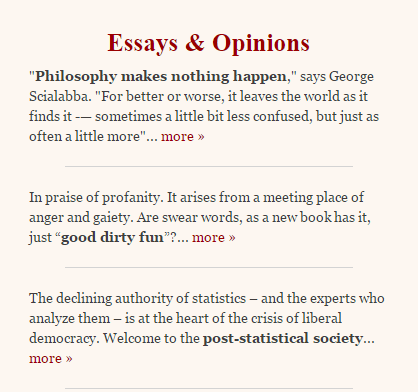
al-daily-2

A quick glance across the homepage, proves to be a feast for the intellectually curious (or those we hope will be). Articles, reviews, and essays from all over the web are organized by Articles of Note, New Books, and Essays & Opinions.

al-daily-3

Beneath each of those three headings is an extensive collection of recently published works, each summed up in about 20 words meant to pique your interest:

  • Fake news is not a new phenomenon. Indeed, fake news is older than real news. As facts recede, the power of concocted stories will only grow
  • What’s to blame for the death of the Western artistic tradition and the beginning of something entirely new? The dangerous idea of creative genius
  • How did Wallace Stevens, who lived an excruciatingly mundane and superficial life, write some of the most inventive poetry of the 20th century?
  • Science’s biggest dilemma isn’t funding, replicability, or lack of public respect. It’s language. Science has an English problem, and that means a lot of lost knowledge
  • The power of “yuck!” and “ew!”. Disgust, which comes from our evolutionary fear of germs, goes a surprisingly long way toward explaining our manners, morals, and religion

As for research opportunities, just glance down the lefthand side of the page. Links to:

  • 26 world newspapers
  • 16 television news websites
  • 107 major magazines
  • 52 book reviews
  • 54 links to other collections of content specific media, blogs, and ideaspaces

So far this year, I have used ALDaily in several ways:

  • Quick Write response – I asked my AP students to spend a few minutes searching the site for an article that intrigued them. I gave them several minutes to read the piece, reflect on it in their notebooks, talk at their tables about what they found, and then share out some of the interesting topics. We ended up talking briefly about procrastination, Arthur Miller, stem cell controversies, and Freud.
  • One Pager – Students needed to chose an article from ALDaily, read it, select a quote that struck them, and write about their expanded thinking related to the selection.
  • Article of the Week – I’m not as faithful to this practice as the name would indicate, or as Kelly Gallagher would likely advocate, but we do study information texts and practice skills involving main idea and word choice analysis, summary skills, and bias identification. My most recent article of study was with my sophomores. We read and discussed “Shame on You,” a piece with a hook that asked “What would Plato tweet?” We discussed the perceived freedom and catharsis of social media against the dangers it poses to honest reflection and conformity.
  • Beefing up my own quippy wit – This week, I’ve already talked with various groups of kids about science, poetry, an obscure language of the Amazon, and Emily Dickinson. I’ve also been able to share with kids that I am practicing what I preach : “Spend some of your time reading what matters. What matters to you and what matters to those around you.” 

The motto at Arts and Letters Daily is “Veritas odit moras.”
It means “Truth hates delay.”

Challenge your readers without delay, every day.

Arts and Letters Daily can be found at aldaily.com

Have you used Arts and Letters Daily? How might you use a collection of intriguing works to challenge your readers? Please comment below.


Lisa Dennis spends her school days teaching AP Language and Honors/Pre-AP Sophomores, while also leading the fearless English department at Franklin High School, just outside Milwaukee, Wisconsin where she lives with her husband Nick, daughter Ellie, and beagle Scout.  She is a firm believer that a youthful spirit, a kind heart, a big smile, and a good book can ease most of life’s more troublesome quarrels. Follow Lisa on Twitter @LDennibaum.

How Can I Create a Culture of Reading?

Guest Post by Alex Murphy. I’m sure Shana, Lisa, and I have a ton of ideas for this new teacher, but we’d like to know your ideas. Dear TTT Reader, please read Alex’s post and share your thinking:

We have a chant in my English I classroom.  Every class before we begin our day’s work, I summon my best Nick Saban bellow and ask my students, “What’s our theme?”

“Stories have power!” they respond, sometimes with gusto, other times a bit more sluggishly.

Regardless of the level of enthusiasm, I have taught the kids to respond this way because I believe it to be deeply, potently true.  Drawing on the teaching of my all-time favorite author, J.R.R. Tolkien, I believe that stories indeed have more power to communicate truth and combat lies than even the best-structured arguments our expositors have to offer.  As Tolkien said in “Mythopoeia”:

In Paradise perchance the eye may stray

from gazing upon everlasting Day

to see the day-illumined, and renew

from mirrored truth the likeness of the True.

As Shana Peeples reminded us in her keynote speech at the Texas Council of Teachers of English Language Arts Annual Conference [this weekend], stories—“mirrored truth,” as Tolkien calls them—indeed have power to combat the Doublespeak we hear so often from the halls of power.  “Stories are political tools,” she reminded us.  It is a lesson well worth remembering.

But dearly as I hold these principles about the unmatched power of stories, the Friday afternoon workshop hosted by Holly Genova and Amy Rasmussen convicted me that I have not yet created a culture of reading in my room—a community of readers in which students devour books with purpose and swap stories with joy.  As I listened to Holly and Amy discuss the power that reading choice has in their classrooms, the desire to cultivate a similar culture in my own classroom washed over me.  Indeed, I was inspired to start right away.

It took about seven seconds for my inspiration to dissolve into fear.  I froze, half-way through tossing Monday’s lesson plans off the balcony, as the scenarios hit me one after the other:  What if I can’t convince my students that reading is important?  What if I don’t have time to encourage independent reading and also teach the standards sufficiently?  What if my administrators don’t get on board? What if my own inadequacies as a reader start to show through?   What if I fail?

This is my first year teaching; I don’t even have a decent classroom library.  It feels like an awful risk to undertake a paradigm-shift from assigned reading and direct instruction to instructing through independent reading, especially when the English I STAAR test is seven instructional weeks away. However, if my mission is to convince my students that stories have power, nothing could be more important.  So, to the wonderful educators at Three Teachers Talk, I have several pressing questions:

  1. How should I start the work of creating a culture of reading in my classroom this deep into the year? What should be my first step in the transition?
  2. How can I undertake this shift and still ensure my scholars are equipped to perform well on the skills-based assessments they will take in so short a time?
  3. I want to show my administrators the benefits of this shift while also acknowledging the risks. How should I communicate this plan to them?

Amy and Holly put together a career-altering professional development session this weekend, and now it’s time to capitalize.  Any thoughts you have on the best way to do this will help me.

Sincerely,

Alex M.G. Murphy

Alex M.G. Murphy teaches English I and U.S. History in the beautiful community of southeast Fort Worth, where he lives with his wife Rebekah and pit bull Sullivan. He is a graduate of Rice University.


Writing Heals. Writing Assignments Do Not

Last week I learned a valuable truth:  Even when we think they are not listening, sometimes students get it.

Let me back up.

The week before last I attended a department meeting where our district ELA coordinator shared the National Writing Project’s Case for Good Instruction, information I learned at my National Writing Project Summer Institute in ’09. It details the differences between When Writing is Assigned and When Writing is Taught. The discussion around me was interesting and peppered with excuses. I left wondering how teachers would answer these questions if they were on a quiz. How would you?

In your ELA class, do students:

  • have opportunities to create topics that matter to them?
  • understand audience and purpose for papers because they are specifically identified in assignments?
  • see you spending time teaching writing skills and strategies?
  • get writing models, assignments, and strategies to guide each of the different writing tasks?
  • reflect on significant growth — or lack of it — in specific writing skills?
  • hear words of encouragement cheering them on to revise, edit, and improve — and to correct drafts and then resubmit?
  • think about what they write through brainstorming, free writing, role-playing, discussion, or other prewriting activities?
  • celebrate what they, and you, write and make efforts to display and publish it?

I think the biggest excuse we give for leaning on assignments rather than acting on instruction is TIME.

“I can’t let students choose topics because they don’t know what to choose.”

“I can’t teach this novel if it takes so long to write a paper.”

“I can’t do my research paper if I give them time to resubmit. It already takes so long to grade the finished product.”

Maybe you are right. Maybe we have to give up things that we think are best practices for things that are better practices.

Student choice in writing topics is better practice.

Writing instruction with effective models, strategies, time to talk, and time to write are better practices.

Helping students revise, edit, and improve their writing during the writing process with a keen sense of audience and purpose are better practices.

conferringwithjulyssaOur students need time. They need our time. They need our attention and our careful consideration about the things that matter to them. We may have to let some things go in order to give our students what they need.

We learn valuable truths when we do. Last week my students performed (or presented) their poetic arguments. We spent weeks choosing topics, watching video performances, analyzing lyrics for structure and craft, thinking, drafting, talking, revising, studying models, reading each other’s writing, giving feedback, practicing mini-lessons on concrete details and using abstract language to create jaw-dropping imagery.

We were a community of writers, united in a task uniquely our own.

And that is the difference between When Writing is Assigned and When Writing is Taught.

During all that time, I didn’t think Stephanie was listening. She sat at her table, barely talking, sometimes writing, always sad. Then right before Christmas break I sat down and we talked. She showed me her draft, and it scared me. I knew she’d been depressed — her grandmother died at the beginning of the year, and the light left Stephanie’s eyes. I listened to her share her sorrow, her anxiety, the weight of her world , and I gave her my cell phone number with the promise she would call if her boots got too heavy. Thankfully, they didn’t.

Every one of my students who presented their poems sparkled with pride as they faced their classmates, even the ones whose knees knocked in fear. They wrote from their hearts about issues that matter to them personally. They wrote the most important arguments about mistaken perceptionholding grudges, self-hate and self-love, parental control and uncontrolled parents, lying and how we’re programmed to labelBlack Lives Matter and dying white privilege. They wrote about better education and the stress of getting educated, absent fathers, loving fathers, and parentless children and alcoholics who should have put down that drink at 21.

They wrote about sticking together.

And they wrote about self-destruction and depression and monsters. So many of them wore grooves in the floor with the spikes that hold them in place until the sadness drags them down under. They broke my heart.

writing-heals-quote

Writing to heal is better practice.

Please enjoy Stephanie’s poem. She calls it “Smile.”


Many students chose video presentations over live performances. I published several this morning on the 3TT Facebook page. Take a look.

Please share your thoughts on teaching writing. Leave a comment.


Amy Rasmussen lives in north Texas and teaches AP English Language and English 3 to the Fighting Farmers at Lewisville High School. She adheres to the words of Emerson: “We aim above the mark to hit the mark,” and Jesus Christ: “Love one another.” Imagine a world if we all love higher and harder than we think we can. Follow Amy on Twitter @amyrass.


Remembering Why We Become Teachers

Last week, when I met with my new crop of Spring semester students for the first time, I asked them to write one sentence that told me how they’d come to teaching.

Do you know what almost every single student wrote?

“Because I love working with kids.”

It was a reminder, for me:  these young, idealistic, preservice teachers, on the very cusps of their careers…were here because of LOVE.  For children, for learners.

We will spend the next three years with them working on their teaching craft, their pedagogy, their educational philosophy.  We will offer classes in professional inquiry, classroom management, instructional design, content area methods, technology integration, special education, and more.

But we do not offer a class on why most of these students become teachers:  a class on caring for kids.

We cannot offer such a class, because what would we put in the syllabus?  It’s very simple:  just remember to love and care for each of your students, day in and day out.

And that, for me, is the key.  To remember we care for kids.  To keep our students at the center of our classrooms.

I don’t believe anyone can be a good teacher if they merely love their students.  Good teachers must, in addition to caring for their students, have mastery of content, pedagogy, and methods.

67685151d15291cb47b599262f7625a8Whether or not our instructional practices show our care for our students is a good acid test for teaching reading and writing.  Does assigning a book and then creating fifteen “gotcha” pop quizzes make students feel competent and confident as readers?  No.  Not a good practice.  Nor are so many of the worksheets, textbook curricula, or 1990s-designed unit plans I’ve seen employed by some teachers.

But those are boring, you say.  Well, what about something more fun?  When teaching high school English, does assigning a reading project of tracing your hand and making it a turkey on which you list five books you’ve read make students feel competent and confident as readers?  No.  Not a good practice, either.

You’ll notice I’m measuring good teaching and good learning by student competence and confidence, and not by some other measure of “students are having fun,” or “students enjoy themselves.”

There are five core human drives that apply across all societies, all classes, all ethnicities, all ages, all genders.  One of them is the drive to learn.  All students want to learn, to satisfy curiosity, to demonstrate mastery–both to themselves and to others.  Offering them learning opportunities to achieve and demonstrate this mastery show our love and respect for students, not our supreme wisdom or sublime control or smart strategies as teachers.

I’ve been troubled, lately, by how much talk there is in education about “fun” in the classroom, about how “students wouldn’t need grit if we made learning more fun,” and so on.  When we make things too easy on our students (and too hard, or too meaningless), we aren’t showing our love and respect for our students.

Teaching and learning are difficult, complex things.  They can rarely be boiled down to an algorithm, a strategy, or a single method.  Carol Dweck, coiner of the phrase “growth mindset” (the foundational principle behind books I’ve loved like Peter Johnston’s Opening Minds and Choice Words), recently gave an interview in which she expressed heartfelt regret that her work was being turned into an easy and fun strategy for teaching.  This “false growth mindset” essentially says that all you have to do to foster learning is praise kids for effort, whether or not that effort was successful.

When we focus too much on praise, or effort, or one simple strategy that will solve everything!!, we run the risk of teaching the strategy rather than the student.  Amy recently shared with me a piece that it took me about four reads to unpack:  “On Writing Workshop, Cognitive Overload, and Creative Writing.”   This excellent blog post reminded me that when we do something like book clubs, if we spend too much time teaching students how to do book clubs, we aren’t spending enough time getting kids to actually do the work of literacy.

That’s not to say I don’t find value in book clubs, or the multigenre project, or any other lens through which kids might read or write.  There is great value in using a few core strategies, again and again, to help students make sense of what they’re trying to understand.  The key word is a few–so that students keep their focus on literacy, not the strategy or the project or the assignment.  Keep it simple:  quickwrites, book talks, constant revision, constant talk, and a high volume of diverse reading and writing.  Period.

When we keep our classrooms simple, doing more with less and simplifying our instruction to include mostly reading, writing, and talk about reading and writing, we are keeping our care for our students at the forefront of our work.

As we launch into 2017, let’s remember why we became teachers in the first place:  because we care about our students.  Keep that love for learning at the heart of your work, and growth, competence, and confidence will be your rewards.


Shana Karnes lives in West Virginia and teaches sophomore, junior, and senior preservice teachers at West Virginia University.  She finds joy in all things learning, love, and literature as she teaches, mothers, and sings her way through life.  Follow Shana on Twitter at @litreader.

disclosure

10 Things We Did That Invited Initiative — and Growth

It is 6:00 am. I stayed up all night playing with this blog and our Facebook page and Pinterest and Instagram and exploring this app and that extension and whatever else called on me to click on it. I didn’t even realize I’d blown the night up until my Fitbit buzzed telling me to get up and workout. Thank God it is a holiday!

I cannot help but think (besides about how tired I will be all day) about engagement. I remember a while ago I read Danial Pink’s book Drive and then watched the RSA Animate video on motivation. We really will spend time, lots of time, doing the things we want to do be it reading, writing, learning a new skill, climbing a mountain, or sinking into the social-media–abyss. We just have to want to.

So how do we get our students to WANT TO do the things we know will make a difference in their lives, namely, read more, write more, communicate better, think more critically?

We keep trying.

i just finished a semester with my students. I wish I could say that every child read more than he ever has in his life, wrote better than she ever has since she held a pencil, learned to speak with ‘proper’ English and clear eye contact, and thought like a rocket scientist trying to get a man to the moon.

Some did. Some did, and honestly, the first few days of school, I didn’t think they would. But I kept trying.

Here’s a list of the top 10 things I kept doing, even when I was tired, even when I thought they weren’t listening, even when we all wanted to hide behind dark curtains and ring a bell for a cup of tea. (That will be me later today.)

We read at the beginning of class every day (almost — we had about six days throughout the semester when something somehow got in the way of that, i.e., fire drills, assemblies, wonky bell schedules, my car dying on the way to school).

We talked about books A LOT. Book talks, reading challenges, reading goals, tweeting book selfies, and more.

We wrote about our books enough to practice writing about our books. Theme statements, mirroring sentences, analyzing characters and conflict and plot — just enough to keep our minds learning and practicing the art of noticing an author’s craft.

We wrote about topics we care about. With the exception of the first essay students wrote, which was all the junior English teachers committed to as a pre-assessment, students chose their own topics or wrote their own prompts. Donald Murray in Learning by Teaching says the hardest part of writing is deciding on what to write about, yet we so often take that hard thinking from our writers. The worst essays my students wrote was the only one in which I gave a prompt, and before you think it’s just because that was their first essay, nope, I asked them. They just didn’t care — and that is the worst way to start off the year in a writing class.

feedback-on-prompts

feedback-on-owning-topics

feedback-on-self-selected-topics

We read mentor texts and learned comprehension skills and studied author’s craft. I chose highly engaging texts about current events in our society:  police shootings and being shot, taking a knee during the national anthem, race relations, our prison system, immigration issues — all topics that make us ask as many questions as the writers answer. Inquiry lived in our discussions.

feedback-on-writing-as-a-writer

We talked one-on-one about our reading and our writing. I conferred more than I have in the past, taking notes so I wouldn’t forget as students told me about their reading lives and their writing woes. We spoke to one another as readers and writers. We grew to like each other as individuals with a variety of interests, backgrounds, ideas, and dreams.

We shared a bit of ourselves — mostly in our writing — than we ever thought we would. Abusive mothers, alcoholic fathers, hurtful and harrowing pasts and how we grow up out of them. We talked about respect within families and how we can hurt the people we love the best when we ignore their love because it’s masked in fear and strict parenting.

a slice of Daniel’s semester exam essay

We celebrated our writing by sharing what we wrote, by performing spoken word poems, reading our narratives, or reading our quickwrites. We left feedback on sticky notes and flooded our writers.

We grew in confidence and that showed in our work. I held students accountable with high expectations — and lots of mercy. Most rose to the challenge, even those in their first AP class and those far behind who needed to catch up. Most exceeded their own expectations.

feedback-on-high-expectations

feedback-on-writing-as-a-writer

feedback-on-writing-confidently

We joined communities of readers and writers on social media, building a positive digital footprint that shows we are scholars, students who care about their literacy and want to go to college. We wrote 140 character book reviews and explored Goodreads and shared covers of the books we were reading. #IMWAYR #readersunite #FridayREADS #FarmersREAD

martina

rozlin

I will miss the juniors in my block class who are done with English for the year. They were a joy, although a challenge, pretty much every day. And my AP kiddos, they are ready for the kind of learning we will do to face down that exam come May.

We will keep doing what we do: Whatever it Takes to Grow as Readers and Writers (even if it means a lack of sleep.)

What do you do to motivate your learners? Please share your ideas in the comments.


Amy Rasmussen lives in north Texas and teaches AP English Language and English 3 to the Fighting Farmers at Lewisville High School. She adheres to the words of Emerson: “We aim above the mark to hit the mark,” and Jesus Christ: “Love one another.” Imagine a world if we all love more than we think we can. Follow Amy on Twitter @amyrass.

disclosure

On In Defense of Read Alouds. Please, do.

At the end of a post I wrote last August called “My Classes are Only 45 Minutes — How Do I Do Workshop?” a reader named Andy left this comment:  I am at kind of a roadblock mentally and could use a push…I teach 8th grade reading in a building that still has both “reading” and “language” classes. While I am slowly transitioning to more of a workshop approach, I am still getting stuck on a few things. For our second semester, we have always read a whole class novel, but I would love to get away from that. Have any of you done read-alouds in your classes? I am beginning to think that maybe a better option would be to have students vote on a novel with a certain theme and do a read aloud and work on certain aspects of reading. My one concern that I can hear being brought up by administration is making sure I have enough assessments and grades…

First of all, I love that Andy asks this question and recognizes his need for “a push” as he wants to do more to engage his students than just another whole class novel. Not that whole class novels are necessarily bad, but those of us who have seen what choice can do in our students’ reading lives know:   if we only choose whole class novels, we lose valuable time developing readers. Giving students a choice as to a book to read aloud might just be a good idea.

I heard Steven Layne, author of In Defense of Read Alouds speak at the Illinois Reading Council Conference this past fall. He quoted the research and the position statements from scholars of various grade levels on the benefits of read alouds:

  • Positive attitudes are fostered towards books.
  • Imagination is exercised.
  • Background knowledge is built.
  • Reading skills are improved and reinforced.
  • A model of prosody and fluency is provided.
  • Reading independence is promoted.
  • Interests in genres are broadened.
  • Cultural sensitivity is increased.
  • Listening skills are improved.
  • Exposure to a variety of text types is provided.
  • Reading maturity develops.
  • Reading happens.

Based on these statements, Andy, what do you have to lose?

stephenlaynequote

I offer a few suggestions though:  HOW you read aloud to children is as important as WHAT you read aloud. Layne suggests five key elements the teacher-reader must employ as he conveys an awareness of phrasing and word color:  diction, volume, pace, tone, and pitch.

To read aloud effectively, as to engage all listeners, the reader must be a performer.

Of course, what you read aloud matters, too. Offering students several choices and letting them vote is one way to foster trust in your classroom community. Students want to know we value their opinions. I’ve found with my AP English students, when I provide several choices for their Book Clubs, many students will choose to read the books not selected for their independent reading.

I would also suggest that you offer a choice of books that are not too long. I learned a few years ago when I read aloud with my 10th graders that even when they choose the book, attention spans are short. A full-length novel read aloud can cause the same negatives that a whole class novel study can. For this reason, I think it’s important to consider your main objective first and then plan backwards.

If I were doing a read aloud with those same 10th graders this spring, I would plan differently than I did before.

  1. I’d select several books with the same theme I want to build a unit around, and I’d plan to introduce the books by reading aloud from each of them.
  2. I’d think about the goals I can accomplish as we focus on the theme, and I’d think of several summative-type assessments in which students can choose to show they’ve accomplished these goals. Or I’d think about how I might invite students to create their own major assessments.
  3. I’d think about the skills my students need to master, and I’d pair mini-lessons with the ones I know will emerge through the reading. (These can serve as formative assessments.)
  4. I’d think about how I will get my students to apply these skills to their independent reading books, which could all be centered on the same theme (if I planned that well enough). (These can also serve as formative assessments.)

One of my goals with my AP students this spring is to do more read alouds. I’ve learned this fall that many of my students do not understand the different forms and structures stories can take. We are going to use children’s books to help with our understanding. The book Writers ARE Readers by Lester Laminack and Reba M. Wadsworth offers several suggestions on titles that will work with students of all grade levels.

So while I will not be reading aloud a whole novel, I will be performing read alouds and thinking through 1-4 above as I plan this unit.

Best wishes to you, Andy, as you read aloud with your students. I believe this poem by Steven Layne is an important reminder to all of us who work with children:

Read to them
Before the time is gone and stillness fills the room again.
Read to them.

What if it were meant to be that you were the one, the only one,
who could unlock the doors and share the magic with them?
What if others had been daunted by scheduling demands,
district objectives, or one hundred other obstacles?

Read to them
Be confident Charlotte has been able to teach them about friendship,
and Horton about self-worth:
Be sure the Skin Horse has been able to deliver his message.

Read to them
Let them meet Tigger, Homer Price, Aslan, and Corduroy;
Take them to Oz, Prydain, and Camazotz;
Show them a Truffula Tree.

Read to them
Laugh with them at Soup and Rob,
and cry with them when the Queen of Terabithia is forever lost;

Allow the Meeker Family to turn loyalty, injustice, and war
into something much more than a vocabulary lesson.

What if you were the one, the only one, with the chance to do it?
What if this is the critical year for even one child?

Read to them
Before the time, before the chance, is gone.

– Steven L. Layne, from The Reading Teacher Vol 48, No. 2 October 1994

Do any of you have other suggestions for Andy about how he might structure and/or craft assessments for his read aloud? Please leave your ideas in the comments.

Amy Rasmussen lives in north Texas and teaches AP English Language and English 3 to the Fighting Farmers at Lewisville High School. She adheres to the words of Emerson: “We aim above the mark to hit the mark,” and Jesus Christ: “Love one another.” Imagine a world if we all love more than we think we can. Follow Amy on Twitter @amyrass.


disclosure

The Seemingly Small by Jessica Paxson

url.jpgSometimes, in teaching, you just need a day.  You know what I’m talking about, right?  You have all of these beautifully planned lessons, but there are always scraps and pieces that don’t seem to quite fit perfectly into any single day.  Sometimes these tiny scraps need to get done, but cannot be just tossed anywhere for fear of interrupting that creative flow.  Creativity ebbs and flows, and so should lesson plans.  

It was the week before Thanksgiving and I needed a little of that ebb, so I planned a station day.  We began the day just like any other, with SSR followed by writing in our notebooks.  The rest of the period was intended to be spent tying up loose ends.  Here’s what I had on the docket:

  • Find a reading quote from the pile that speaks to you.  Glue in notebook and “write-around.”
  • Recommend titles for the Library of Paxsonia (classroom library).  Enter titles in the Google Form along with why this book stuck out to you.
  • Confer with Mrs. P./Reading Reflection: Mrs. P. will call you up individually.  Complete the reading reflection as you wait.
  • Writing Folders: Find graded work and organize neatly in your writing folder.
  • Reading Accomplishment Poster and Photo Booth: Make a page-sized poster detailing your accomplishment and growth as a reader this semester.  What makes you proud?  
  • Take a photo at the photo booth and send it to Mrs. P. for our Thank You Package.

As I began to circulate and chat with students, the conversations I heard were incredible.

Student 1: I’ve read an entire book for the first time in 4 years!

Student 2: I finally found a book I didn’t have to lie about reading.

Student 3: I finished a book in one weekend and asked for another one.

The day went on, and the students, of course, needed a bit of clarification.

Student: Mrs. Pax, if I haven’t finished a book, but I’m close, can I put that I finished a whole book?

Me: Remember, not what are you GOING to accomplish, but what HAVE YOU accomplished?

Student: Okay, can I put that I’m not finished yet, but can’t wait to get to the end?

Me: There you go!

Here are a few more of my favorites:

“I finished one and a half books in one semester!” -Sydney

“This is the first time I’ve finished a book and actually enjoyed it.  Thank you for such amazing books to read!” -Lacey

“I’ve finished one book in this semester and I’m proud!” -Dipo

“I finally finished the last three pages of a book.” -Edgar

“5 books down!” -Lauryn

“Mrs. Paxson helped me rediscover my love for reading.” -Zoe

In developing readers, it’s absolutely essential to remind them that it certainly doesn’t happen overnight.  Becoming a reader is a lifelong pursuit–as is becoming a writer, a leader, or someone who stands up for what she believes, for that matter.  

Unfortunately, there’s no TEK or Common Core Standard that says: Students will be able to celebrate the seemingly small accomplishments on the journey to becoming a better reader or writer, and recognize them as the big stinkin’ deals they truly are. (Disclaimer: If I wrote Standards, they’d have a bit more sass and spice.)

If we have to take a break from the “real stuff” to recognize the REAL STUFF–our growth as readers and learners–so be it.

This day turned out to be one of the most productive in all the ways that are not reflected in our daily objectives, but that are essential to building a reading culture in the classroom.

Jessica Paxson is an English IV and Creative Writing teacher in Arlington, TX. She also attempts to grapple with life and all of its complexities and hilarities over at www.jessicajordana.com. Follow her on Twitter or Instagram @jessjordana.

screen-shot-2016-11-29-at-7-46-57-am