Category Archives: Readers Writers Workshop

A Word About Test Prep

If you are like every teacher I know, you are feeling … stressed. It results from many things: stacks of papers to grade, reading responses to catch up on, blog posts to comment on, your own life to organize, spring break taking too long to get here.

And, probably, The Test.

Whether it’s the AP test, the state test, the SAT test, I’m noticing that the words most on everyone’s lips right now are “but what about the test?”

Usually, I say, “Don’t worry about the test.”

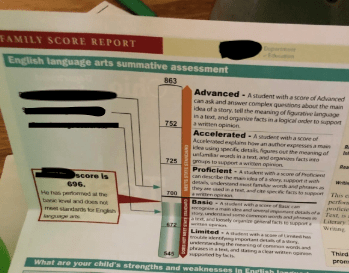
Screen Shot 2019-03-20 at 11.06.29 AM.pngToday I say, “I get it.” Because a few weeks ago I received fall test results on my third grader. The state labeled him “Basic.” This kid who at 9 earned a black belt in martial arts. Who competed in a chess tournament for the first time, who carries a Big Nate book with him everywhere he goes. The state was telling me, a mother who is also a teacher, he barely met the 3rd grade benchmark. Well, I freaked out.

Even though I work with teachers and reminding them that their students are more than those test scores …when I saw these numbers, I forgot myself for a moment. And so I called his teacher. And she so beautifully, gently, and wisely reminded me: “He’s is more than a test. He’s doing great.”

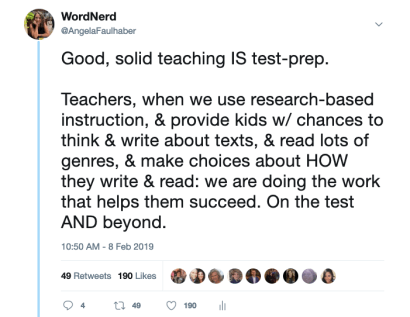
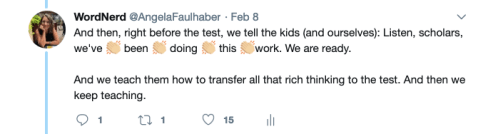
I share this to say that even though I am not currently in a classroom, I get how these numbers can make us forget ourselves. I know we’re going to worry about the test. But, also, can we stop? Can we please remember that we’ve been doing the dang thing all year?

Screen Shot 2019-03-20 at 11.15.56 AMScreen Shot 2019-03-20 at 11.16.07 AM

Today, this week, next week it’s not the time for “test prep”. We’ve been prepping. Perhaps we should rename this window of time Test Transfer?

What does this Test Transfer look like in action? I love the ideas Lisa Dennis writes about in her post 5 Ways To Avoid the Trap of Test Prep. These are excellent routines to put into place all year to help you feel more prepared.

I love too how Nancie Atwell suggests treating test writing as its own genre (see Lesson 56 in Lessons That Change Writers for a great example).

Standing on the shoulders of these folks, along with work started at the Ohio Writing Project with my colleagues Beth Rimer and Megan Rodney, we have been approaching these weeks as a chance to show students how to transfer their learning to the test:

Demystifying The Prompts

Using chart paper, we print out the writing prompts only, allowing students to walk amongst the prompts and think about what they notice (these are easy to grab in a screen shot from your state’s student practice test site). We ask: What do you notice a writer has to do when they show up at this writing? We outline the steps together, even making a game plan. First, we do this. Next we do this. Then we write.

Then we practice just the planning part. We project another writing prompt, and we again practice the planning. We get faster and more fluid. It becomes no big deal because the students see, “oh, we’ve been doing all these steps. Now I get to show it off.”

Thinking About Our Thinking

One of the things my colleague Kelly Taylor started to notice is that her 6th graders weren’t necessarily missing questions because they didn’t know the answers. They just weren’t reading the questions correctly. Duh, right? But once she began showing just questions and talking about how she would go about thinking about how to answer it, kids slowed down. She pulled the curtain back and helped kids develop a vocabulary for thinking about their thinking. We often assume they know how to do that. They didn’t.

We don’t want to send students blindy into a testing situation. That’s not fair to them, and it doesn’t set them up for maximum success. Instead of just giving them a bunch of practice tests, I like how Kelly is taking apart those tests, just like we do with any genre, and holding it up to the light.

Relaxing, Kind Of

We are trying to remember that in every core class, in every grade, we are up against a “BIG TEST.” And the kids are picking up on that tension. What we don’t want to do is do so much test-prep that by the test comes along, kids are completely burnt out. So, we’re reading more poetry. We’re looking at picture books. We’re collecting novels in verse for a book club that will take place during testing. We’re remembering that for six months we’ve been hard at work teaching these kids how to read, how to think, how to write.

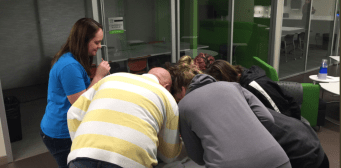
Last week we played Minute to Win It games as we reviewed questions. In between questions, we played games. We laughed. We worked hard. We transferred learning.

Screen Shot 2019-03-20 at 11.44.21 AM.png

a group of teachers playing Minute to Win It games as a form of Test Transfer


Take a moment to look back at the post I wrote last year about teachers. Our students are as ready as they’re going to be. Trust yourself that you’ve done the work. Cheer them on as they head into the testing season.

And remember the words of my son’s third grade teacher: You are more than a test. You are doing great.

Angela Faulhaber is a literacy coach in the Cincinnati, OH area. She is on her first day of spring break today and reserving all the books from the library to devour. 


No Accountability Book Clubs

Prior to starting a round of Book Clubs with my AP Lit students, I questioned what would be a “just right” accountability fit for my very different first and fourth periods.  Third quarter always hits juniors hard.  It is a reality check that changes are ahead.  It seems to be the time students are in full swing with clubs, theater, sports, and other projects.  My students are invested in their independent reading, with many switching between texts they can use on the exam and fun YA selections, and developing reading identities.  My students are also chatty and friendly–Book Clubs seemed like a perfect fit at this point in the year.

But how to keep students accountable in a non-punitive way when they’re already overbooked.  I thought about my goals for the Book Clubs, which extended far beyond adding another text of literary merit to their tool belts for question three.  I wanted them to read, to engage, to think.  For students to have fun meeting together to discuss books like adult readers do.

For some, a bit of accountability helps spur their reading and processing.  I have many students who like to document their thinking with annotations or dialectical journals and be rewarded for their visual thinking.  I understand that. For others, a bit of accountability becomes a chore that interferes with their engagement. Students have reflected that tasks associated with reading pull their focus away from the text and onto the assignment.  I get that, too.

I have been ruminating over my grading practices this year, taking notes on what is helpful and what can change next year as we progress, seeking practices which keep students accountable in non-intrusive, authentic ways.  Letter grades in the English classroom can be tricky. Our content lends to subjectivity when grading. Add in the pressure for college-acceptable GPAs and authentic learning can be lost in the quest for an “A.” It can be difficult to accurately measure understanding, as well as the more essential habits for success beyond our classrooms–effort, improvement, depth of thought and questioning–with five letters.  I am trying to shift from grades and points to accountability, effort, revision, second-laps, and reflection as tools for building skills and taking risks. I want anything I evaluate to have meaning and to be balanced by a lot of low stakes participation, effort, and reflection.

Book Clubs are like independent reading, just a bit more social.  Why grade it with check-listy parameters?  I wanted students to read, engage, and think with one another.  To come to the table with questions, thoughts, and connections, like a college student would.  To process challenging books together, like an adult book club would.

So I decided I would assign no accountability checks.  Nothing. I only asked students to be accountable to one another, as adults would be in a “real” book club each week, with the schedule they set.

Knowing they wouldn’t be receiving a tangible grade or reward, I was concerned students would see this as an invitation not to read deeply, or that some wouldn’t feel invested in the payoff. However, my hope that our months of community building and sharing in reading experiences as readers outweighed my tinges of fear.  Why not step aside and set them free?

I gave Thursday’s class period over to the Book Clubs and student-driven conversations with the ask that students use the class period to process together.

Students owned it.  

There wasn’t a lull in conversation on Thursdays.  Student groups chatted with each other while I circulated and enjoyed their voices and insights.  I wasn’t roaming the classroom with a clipboard or checking an assignment in while half listening. I was a floating member of each club (hence why there are no pictures accompanying this post!).

I noticed there were discussions about the gray areas of the books, like what is the Combine Chief Bromden references and what the heck happened to Nurse Ratched to make her the adult she is in One Flew Over the Cuckoo’s Nest.  I noticed the crew reading Ceremony worked to make sense of the non-linear structure and researched the myths of the Laguna Pueblo people. Readers of Brave New World connected the text to Oryx and Crake, a summer read, as well as our world.  Readers of The Road hypothesized on the events before the book begins.  Many students annotated their books, kept a notecard of questions to ask one another, took notes during the meetings, and referenced the text throughout their discussions.

There was no need to dangle a carrot in front of their noses or keep track of data to issue a grade.  Students did the work because the elements were there:  choice, time, conversation.  They made meaning together, employing the habits developed throughout the year while practicing being adult readers–readers who read, engage, and think in a realm where there isn’t official accountability to turn in.

I’m not sure what my digital gradebook categories will look like next year, what practices and procedures I will put into place to promote authentic accountability, but I know I will challenge myself to step aside more often, to trust students will do the work if the environment is right.


Maggie Lopez is entering the fourth quarter in Salt Lake City upon returning from spring break.  She is currently reading Hitler’s Furies by Wendy Lower. You can find her at @meg_lopez0.

A Happy Little Lesson

Screen Shot 2019-03-11 at 2.12.33 PMOkay, I stole the inspiration for this post’s title from the late, great Bob Ross, but if the tree (or daffodil) fits, then I’m good with sappy wordplay. AP Literature can feel dark at times because many of the texts we read deal with death, loss, and desire. That’s why I look forward to the beauty and humor found in our texts and with each other in our class. The Romantic literary era provides wonderfully rich, dark, gothic themes, but it also provides opportunities for students to think about how they connect with nature and beauty. Often, it reminds them that they’re not taking time to relax, reflect on beauty, or enjoy some downtime away from small screens.

  1. We began by reading William Wordsworth’s “I Wandered Lonely as a Cloud” – a wonderful poem for traditional analysis. More importantly, it serves as a great mentor text to think about those places upon which we reflect when we’re feeling down. Here’s Wordsworth’s poem:

I Wandered Lonely as a Cloud,” by William Wordsworth:

I wandered lonely as a cloud

That floats on high o’er vales and hills,

When all at once I saw a crowd,

A host, of golden daffodils;

Beside the lake, beneath the trees,

Fluttering and dancing in the breeze.

Continuous as the stars that shine

And twinkle on the milky way,

They stretched in never-ending line

Along the margin of a bay:

Ten thousand saw I at a glance,

Tossing their heads in sprightly dance.

The waves beside them danced; but they

Out-did the sparkling waves in glee:

A poet could not but be gay,

In such a jocund company:

I gazed—and gazed—but little thought

What wealth the show to me had brought:

For oft, when on my couch I lie

In vacant or in pensive mood,

They flash upon that inward eye

Which is the bliss of solitude;

And then my heart with pleasure fills,

And dances with the daffodils.

  1. We analyzed the poem together, noting its craft and themes. We discussed a variety of ideas: the few visible stars in our city’s night sky compared the multitude of stars that can be seen in the country, how the simple experiences in life can be the most profound, and the importance of having a “happy” or safe place.
  2. We talked about the genre of poetry as a vessel for this beautiful message, and we discussed how we might capture the same beauty in prose. The word “prose” still scares many of my students, so we talked about what that meant. One student asked if prose is similar to the personal narratives they wrote for standardized tests when they were younger, so we also talked about the test-genre and its relationship to more authentic writing. (Incidentally, there’s an idea for a whole other blog post!)
  3. I shared two prose pieces about happy places of my own, and the students analyzed the craft in those. We discussed the literary devices present and their effects in the piece. They talked about the song lyrics woven into “Funkytown” and how the diction becomes darker as I leave my “happy place” – the roller rink. They talked about the sibilance in “Whither Thou Goest” that correlates with the river that winds like a snake below the mountain, the color imagery, and biblical allusions. It is always magical when we write with our students, and the fact that I shared myself with them made them feel more comfortable to write honest pieces of their own.
  4. Ultimately, I challenged them to write about a literal or figurative “happy place” of their own. It could be a physical place or a state of mind. I challenged them to play with language. There was no length requirement, but they were to label 5 different literary devices they employed.
  5. Just as I weaved song lyrics through one of my pieces, some students incorporated poetry, lyrics from a musical, and even lines from a movie into theirs. Others preferred more straight-forward, concise prose. Some wrote very poetic prose. In every case, however, their voices shone! The results were some of the best writing I’ve read from them all semester.
  6. The next step is to discuss how they can use their voice and their writing strengths in their academic writing. I once heard an AP Literature teacher say that there was “no time to have students write their own poetry in the course” and that worse yet, he’d “have to read it.” I have always felt sorry for that man. In my experience, it is the best way for students to find and hone their writing voices, learn about literary devices in an authentic way, and for teachers to foster a love of writing in their students. With the next mentor-inspired text, I will have them analyze their own writing.

Here are a couple of student samples from this assignment, unaltered by me, used with their consent:

By Jake (3/3/2019)

            I do not feel at home in Texas. The land is flat, the weather is tourettic; these gargantuan skies transmogrify from benevolent baker to dekiltered, frenetic assailant mile by mile, hour by hour, even. I take it back: I appreciate the tumult above the flats of Texas. It compensates for the, well, flatness. I could go on and on about how I would rather adore the rapturous peaks of my birth state, Colorado, how each and every inch stirs within a kindred connection that I experience nowhere else in the country. I could go on and on about how the saltine winds along the coasts of Washington corrode my worries into a whelming paste, yet these are, regrettably, far away places. I frequent these happy places, sure, but my memories elapse more time than that which I have spent in these places. Music allows me to carry these places around with me, wherever I may roam.

          “Bat Out Of Hell” by Meat Loaf forever holds a motorcycle to Colorado, as I was truly deafened by Meat’s foghorn vocals and personality for the first time in a balmy summer night’s drive through some valley whose name escapes me. Led Zeppelin’s “D’yer Mak’er” speaks to me of foot-slicing clamshell beachfronts, Dad trying his damndest to deafen me with Led Zeppelin in the rental car, and whiling hours drowned on that driftwood deck. I find the King in me whenever I pick up that there hairbrush in the bathroom and belt, belt as freely as the mighty Mississippi River flows. “Patch It Up,” “Blue Suede Shoes,” “Steamroller Blues,” and “Fever” purr and yelp around the room, terminally ill with suave, when I’m feeling up. “If I Can Dream,” “Bridge Over Troubled Water,” “American Trilogy,” and “You’ve Lost That Lovin’ Feelin’” croon and boom through the hallways when I’m feeling like the sky above. I am as much myself while belting Elvis to pictures on the wall and motes of dust as I am writing poetry to no one in particular.

            However, if my musical mind is a mountain, Elvis Presley makes up little more than the babbling brook rushing between the rocks that I scrub off my worries in. Meat Loaf is the foothills, the base upon which rests my musical perspective. Sturgill Simpson is the renegade wind that whistles through the hills, tossing me hither and thither as I make my merry way up the mountain path. In the forest of rock n’ roll, the wind takes on more of a Led Zeppelin flavor, rustling the Beatle pine needles. The rocks upon which I scrape my hiking boots are the bones of the bands that built the tastes I enjoy today. Bands like Nirvana, Styx, and Deep Purple, which once shone me the colors with which I view the forest today, yet get trampled nowadays in my search for the more exotic indie elixirs. If my musical mind is truly a mountain, then surely for every stone this metaphor turns over lie another taunting ten.

            Then music, unlike any physical happy place, must surely forever evolve, must be at the whim of the beholder and drive the behest of the spirit, must sculpt the mountains of the mind and scythe paths for one to meander, to sprint, to cower, praise, sleep upon, to stray from. Well, it holds this precedent to me, at least. Music has also upheld the standard upon which I interact with other people. What sets music apart from any happy place is that music builds the places into the palaces of peace that they are in my mind.

By Lung (3/4/2019) *Lung is an English-language Learner!

          On Jan. 20th, 2019, I experienced a phenomenon when the world stopped spinning, and the universe halted to a finite. I have had many perfect memories in my life, but not as unrivaled as this one. I’ve never felt more desperate for time to stand still and for picture-perfect moments to last. I lived only in that moment: cherished and content and peaceful.

            It was my two year anniversary with my boyfriend who is more like my partner in crime than a lover. He took me to Gussie Field Watterworth Park in Farmers Branch, Texas to share a “treasure” that he found. Although I was skeptical about going to a park on an evening when the weather dropped as low as 32 degrees, I still followed him, ready for an adventure. When we arrived at our destination, I opened the passenger door only for the harsh wintry breeze to slap me into regret. I scanned the scenery to recognize that we were the only people insane enough to occupy a park when the weather could freeze a person whole. The flowers have wilted into brown garments, and even sheets of ice were floating lazily on the pond. I was soon disrupted of my thoughts, when he grabbed my hand and pulled me into the middle of one of the many trails toward what looked like a box from afar. As he stopped and let go of my hand, I was face to face with a tiny wooden cabinet covered in a peeling paint of baby blue. It contained many books of different genres on its mini shelves, and I looked up at him in surprise. Knowing he wasn’t one to read but to kick soccer balls, I was even more astonished when I saw how his eyes twinkled like stars by the sight of books. After we both grabbed a book, we sat down on one of the wooden benches to enjoy each other’s presence and read silently as I drowned in peace.

            Soon after, when the sun began to set, the sky was tinted with an array of pink, orange, and yellow. The clouds boasted with mystical colors and the pale glow of the moon was beginning to show. Hand in hand, we walked back to the wooden box to return the books to their shelter. As we placed them onto a shelf, he pulled my shivering body into his jacket and wrapped his arms around me. As I placed my head onto his chest, from deep inside my chest, through every cell of my body, the warmth welcomed me like an old friend. There we stood, under the glorious paint, two kids ready to face the world. Then I realized, it really was a treasure.

Polysyndeton

Personification

Hyperbole

Imagery

Simile

Amber Counts teaches AP English Literature & Composition and Academic Decathlon at Lewisville High School. She believes in the power of choice and promotes thinking at every opportunity. She is married to her high school sweetheart and knows love is what makes the world go around. Someday she will write her story. Follow Amber @mrscounts.
No More American Dream Essays, Please.

Qualifier for this post: It is not about RWW per se. Through my own fault, my AP Language & Comp students rarely have any choice about what they read and write (next year. sigh.) But I think what I describe in this post could be adapted pretty easily for the RWW classroom.

I’m teaching The Great Gatsby for the 17th time. Over the years, I’ve gone the route of color imagery analysis, character analysis, stylistic analysis, and yes, the novel’s commentary on the American Dream. The latter option, this year, fills me with nothing but dread for political reasons I probably don’t have to explain to anyone reading this blog. But my dread is also based in an ongoing (and growing) sense of complex arguments becoming grossly oversimplified: We either “Like” something, or we “Unfollow” it. Ceither-or-fallacy-with-examplesharacters are either “normal” (Nick), or they are psychopaths (George Wilson). You’re either with us, or you’re with the terrorists. Me Tarzan, You Jane.
Most ideas or issues are more complicated than simply “either” one thing “or” another. Obv, right? My AP students are learning the importance of making complex meaning from what they read and expressing their understanding of an issue in complex ways by qualifying their own or their understanding of others’ arguments. To that end, I’d like to recommend the process of “iterative collaging,” which I learned about at NCTE last fall from a session given by Andrea Avery, Nishta Mehra, and Courtney Rath.

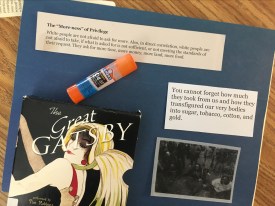
As we’re reading, we’re discussing themes of capitalism and class structure, freedom and collage_stage1oppression, and the omnipresent concept of the American Dream. We’ve examined images from media as well as the writing of Ta-Nehisi Coates surrounding these issues. Right now, ideas are plentiful and scattered. Ultimately, though, by arranging these images and passages in certain ways, students will compose a visual argument about the interaction of these issues in the America they know. But here’s the cool part — and the iterative part: Using some magic in the form of repositionable glue sticks (yes, those are a thing — see photo!), students can arrange and rearrange the items in their collage to explore the ways various juxtapositions can reveal new understandings.  AND — Maguire hopes — discover complex meanings beyond the reductive arguments that plague so much of our current discourse.
We’re in the early stages of this work — hence, the in-progress photo — but I will surely let you know how it goes. Has anyone out there ever used collage for argument (or, any other fun reason)?

Guest Post by Bridget Kirby: On Calling Myself a Writer

For the third year in a row, I have been challenged (in the best possible way) by Amy Rasmussen to get out there and write. For the third year in a row, I have started this submission to the Three Teachers Talk Blog. Maybe this is the year I will be brave enough to submit.

In her sessions at TCTELA, she has challenged her attendees with this question, “How many of you consider yourselves writers?” That first year, I lowered my hand. She followed up with, “How can we truly appreciate the difficulty our students face when we don’t struggle through writing?” This was something I had been working on as a teacher.

Like many, during my first years as a teacher, I would go and pour over my own essay to show as a sample to the students on the following day. “See students, this is what it should look like.” Until—one day—Tre’ came to my desk and said some of the most difficult words I’d ever have to swallow as a teacher, “Sure, miss. You can write like that. It’s easy for you because you went to college for it. For me, it’s not so easy.” You see, I had robbed my students of the opportunity to watch me struggle through the writing. I robbed them of the very nature of writing—it’s not easy; it’s supposed to be hard. And writing, for me, was very hard.

So, I changed. I started writing in front of my students. I modeled the vulnerability I wanted to see in them. I let them watch as I failed (sometimes miserably) to pull the best words from my brain, to spell words correctly, to begin and end a piece of writing powerfully. I let them help me try and try and try again. In conjunction with this process, I began implementing Writers Workshop. I watched students as they began to blossom in their own writing. Through workshop, they began to raise their voice through writing. Through workshop, I became an English teacher.

Fast forward to TCTELA and that first session with Amy Rasmussen.

Despite my improvements through teaching with the workshop approach, I still lowered my hand when she asked that question, “How many of you consider yourselves writers?” I still had trouble calling myself a writer. Sure, I was an English teacher, but I wasn’t so sure I was a writer. As someone who was not brought up through a “workshop” learning environment, I still battle with the enormity of perfection, with the fact that an essay does not have to be five paragraphs to be great. That when writing well, writers break sentence rules and essay rules and society’s rules. As a writer, my focus is still very much on the product, not the process. The 5-paragraph essay from my youth has pigeon-holed my very identity as an adult writer—even while telling my kids that they are all writers.

For this reason—and for many others—workshop isn’t just one way to do it, it is the ONLY way to do it! I never want my students to feel the crippling fear of the blank page or the fear of raising their voices in front of their peers.

This year, Amy challenged us again. She asked, “How many of you have heard of Three Teachers Talk?” Of course I have! I use this blog’s words on a daily basis to inform my practice. She followed up with, “How many of you have written for Three Teachers Talk?” Once again, I had to lower my hand.

So, this is me. Stepping WAY out of my comfort zone. Ensuring that I never have to lower my hand again. Writing a final paragraph with fragments. Breaking the rules.   

Maybe this is the year I will hit “submit.”

Bridget Kirby is the Secondary ELAR Instructional Coordinator for Silsbee ISD, and she has Bridget Kirbybeen in love with all things literacy and education for as long as she can remember. She believes to share that love with students and teachers has been the greatest of honors. She says, “I am proof that literacy and education can change a person’s destiny in the best ways.” Along with being an instructional coach and teacher, Bridget is also the mother of one adorable book-loving little boy and the wife of one giant man-child. Her life goal is to love like Lizzy Bennet, fight like Harry Potter, and live like Atticus Finch.  Follow her on Twitter @beekay928

Of Bugs, Boils, and Bards

There are few tasks in this life that I both do well, and love doing well.  For instance, I love extracting, from a pot, a basket of crawfish, stuffed to the brim. I struggle to lift the forty, or more, pounds — shoulders creaking, eyes squinting from the pungent spices, mouth watering as those bright red mud bugs slowly drain off.

There is a moment, basket balanced precariously on the edge of the large stainless steel pot, where I can’t bear to hold back my insatiable desire to sample. And yet, I have no choice but to wait, for the crawfish are far too hot to eat as they sit steaming.

Even a few moments later, as I spread the bounty from that stainless steel cornucopia across the table, I have to hold back, the little critters far too toasty to consume. And then, after another few moments pass, finally, I get that payoff; that sweet meat, seasoned perfectly, carefully separated from its shell. Cooking, then eating, crawfish can be an exercise in self control.

But, at least for me, cooking crawfish for my friends, family, and myself, is not about the result, but about the process. While I love the colors and flavors, the wooden paddle swirling the rue in the stainless steel pot, it’s the approving grunts, the crack that the shells make when they pop perfectly, that keep me cooking. I boil crawfish for myself, and also for others, kind of like writing.

Indeed, the audience must be considered.  My wife likes her bugs somewhat spicy.  My mother-in-law, maybe a little less so.  My sister-in-law, wants the seasoning so heavy it melts off your face.  I can’t hit all those marks, but I can try.

In mud bugs, like in writing, I don’t have a recipe.   I don’t have a thermometer. I don’t use measuring cups or scales.  To get that perfect crawfish consuming experience, I play it by heart.  How much seasoning should I add to the boiling water before the crawdads cry? A lot.  How many lemons should go in? A few.  How long should I wait to cut the heat after they come back to a boil? Not long.   While there is only a little toil and a pinch of trouble, bringing together a dozen ingredients to build this brew requires some magic and a little bit of instinct. Nothing is absolute, nothing written down, nothing is the same from one boil to the next.

Where did I learn to write, er…boil? From the best boilers I know.  Fellow crawfish connoisseurs let me watch them work, ask questions, pushed me to try new things and constantly discussed ideas that might make our boils even better.  Mentors, in other words…

I’ve learned to love the process of boiling, uh…writing.  I’m trying to get better at sharing that process with my students.  That’s kind of my point.  I don’t think I can “teach writing.” I can share my process and invite the kids to explore theirs. I can share mentor texts and moves, encourage their own search, but writing is different for each of us.  My writer’s voice is constantly changing and evolving, staying out, just a little, past the reach of my finger tips, making me work for each word.

That struggle is one I want to continue to capture, whether in crawfish or in writing.


Charles Moore spent Sunday morning traveling from Lafayette back to League City.  On the way he passed acres and acres of crawfish farms and his mind couldn’t help but wonder at the deliciousness, crackling like potential energy, yet to be unleashed. He’s wondering if it’s too early in the year to decide if this is his greatest year ever in this profession.  He’s pretty sure that’s how the jury will vote. Check out his twitter @ctcoach, which wavers between pie-in-the-sky idealism and passive aggressive suggestions.

Reading on a Snowy Monday and Canada Reads

We had a snow day last Monday. For those of you that know anything about Vancouver, Canada and the surrounding suburbs, a snow day is incredibly rare. I also know that those of you who live in more wintery climates may have been inclined to laugh at the amount of snow that constituted a snow day as I am sure it would have been considered a light dusting in many other areas of the world. In British Columbia’s Lower Mainland, however, a dumping of snow is a rare event and a school closure due to snow an even rarer event.

For my Monday snow day, I decided to take advantage of the unanticipated day off to do some reading. There is something to be said about being able to immerse yourself in a book and read it cover to cover in one sitting as snow softly falls outside your window.

marrow thievesThe book I ended up reading was The Marrow Thieves by Cherie Dimaline, which is a powerful modern dystopian novel where the world has nearly been destroyed by climate change. The majority of the people who have survived the natural disasters that comes with climate change have lost the ability to dream with the exception of the indigenous people of North America who can still dream. Because of this, the indigenous people of North America are being hunted for their bone marrow because their bone marrow carries the key to recovering the ability to dream.

I picked up this book on that snowy Monday because I wanted the time to read it more closely. I had actually first encountered the book a few years ago when it was part of the CBC Canada Reads competition and have since added it to the rotation in my dystopian literature circle unit. Canada Reads is a yearly competition where several Canadian novels are nominated (each year the nominated books all centre around a theme). The Canada Reads website describes the competition as being like a “literary survivor” where each book is read and championed by a Canadian celebrity. Each week the champion of each book will debate the merits of their book and one book a week is voted off until the remaining book is declared champion.

While I have followed Canada Reads for many years, a few years ago I introduced it to my Honours English 11 class and had the students participate in their own version of Canada Reads. In groups, they each choose one of the Canada Reads novels to champion and they participate in our own “literary survivor” in class at the same time as the Canadian celebrities. Using the “literary survivor” model in my class has had a huge impact on my students. They have been introduced to some great Canadian reads, but have also become excited and analytical readers of their novels as they are debating for the survival of their chosen book each week. They love to see how their arguments stand up to the celebrity arguments (and I find my students’ arguments are often much better than the celebrity ones) and to see if the book that survives the longest in our class is the same one that survives in the Canada Reads competition. At the end of the class competition, the students have closely read a novel, analyzed it and debated it without feeling like they have done any work at all.

Pam McMartin is English department head and Senior School teacher librarian at a school in Tsawwassen, British Columbia. She is currently thawing out after our short burst of unusual winter weather and is looking forward to the return of more mild temperatures.

Follow her on twitter @psmcmartin

Developing Common Language between Disciplines

I work with some great people. We are usually on the same page: we all want what’s best for kids, we respect and support each other, and do our best to communicate with each other. Even with all of theses good intentions and practices, we sometimes are reading different words off of the that same page.

Our school has set us up to meet as small groups every week in the form of PLCs. In my 7th grade PLC, we talk about students and curriculum, about days of service and classroom environment. Through these conversations we realized that we ask students to write similar types of texts in many of our disciplines.

While students are asked to write similar types of text, we were all using different language when describing and teaching it. While none of us felt that we needed to use the exact same language all of the time, we realized should at least make it clear to students that these writing tasks are related, and that they should transfer their new skills from one class to the next.

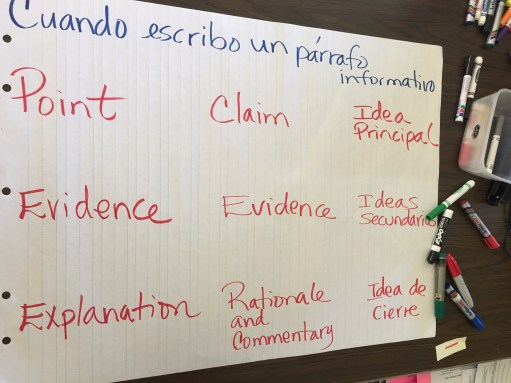
So today we created anchor charts for each of our classrooms. We gained new understanding from one another through the task, and our students will benefit with new clarity and understanding of vocabulary and writing strategies.

IMG_2996


IMG_2995

We brainstormed ideas on the whiteboard before deciding what to put on our anchor charts.

Our group represents four disciplines: electives, science, English, and Spanish. Many of our students speak Spanish as their first language, so between the fact that we have Spanish speakers and students taking Spanish classes, we were sure to include vocabulary not just in English, but also in Spanish.

img_2997.jpg

Our final product looked like this:

img_2998.jpg

We feel as though now we teachers, and soon the students, will soon be reading the same words off of the same pages, and we will have common language between our classes. It’s a simple anchor chart to hang in all of our classrooms, but it will be a valuable tool for our young writers.

How do you ensure that your students understand the relationships between writing tasks in different disciplines?

Julie has been teaching secondary language arts for twenty years, spending the first fifteen in rural Central Oregon, and the last four in Amman, Jordan. She’s thrilled to report that she and her family have moved across the world to Managua, Nicaragua this year, where a new adventure has begun.

Follow her on twitter @SwinehartJulie

Wrapping Up: A Look at Conclusions in the Workshop

What do you think is the hardest part about teaching writing? I’ve always had strong lessons on introductions and felt confident in supporting writers to explore genre and style. But, man, teaching emerging writers how to close a piece…that has always felt extra hard.

I was encouraged to know I’m not alone when a 5th grade teacher emailed me earlier this month:

Screen Shot 2019-02-20 at 1.27.47 PM

If you’re like me, you’ve maybe said to students, “Just sum up your big idea. But don’t say it exactly the same. And try to leave the writer with something to think about.”

Huh. Not helpful, let alone instructive.

For a long time I felt frustrated. When I looked at real writing, I couldn’t find any examples of the kinds of conclusions I thought my students were supposed to be writing. Then I had a lightbulb moment. If those kinds of conclusions didn’t live in the real world, then maybe I needed to shift my thinking.

I know, I know. Duh.

So I let go of “should” and embraced more of the “could.” The lessons were in the mentor texts I was using to introduce writing to students. Instead of going on a Sunday night Google goose chase, I went back to the mentor texts. I asked myself, “What do I notice these writers doing? Could my students try this?”

That’s exactly what we did earlier this month in that 5th grade classroom. The students were working on informational reports and we talked about how important it is to “wrap it up.”

Conclusions in the Real World

Screen Shot 2019-02-20 at 1.31.57 PMProjecting a picture of Collins Key, we started by talking about texts they’re familiar with. I asked them to consider how the youtubers they love wrap up their videos.
“Sometimes they tell you to subscribe to their channel,” one student volunteered.

“Ah, I like that. Sometimes they give you a next step or something to do,” I said.

The kids nodded and shared other examples of how they’d seen that.

“You know, that’s something we can do in our own writing,” I told them. The student helper wrote that on chart paper as the kids copied it in their notebooks. “Sometimes when you’re wrapping up your writing, you can give the reader a next step.”

Unpacking Mentor Texts

Then we looked at articles from NewsELA. We focused just on the conclusions, thinking about what we noticed the writer doing. Together we came up with a list.

When wrapping it up, writers sometimes:

  • Tell the reader a next step
  • Describe a little story related to the topic
  • Give some new, interesting information
  • Circle back to the beginning

That’s a pretty good list, right? With little nudging, the kids noticed and named these moves.

“Writers,” I looked at them, “if we can notice it, you know what else we can do? We can write it.”

Practicing in Small Chunks

I passed out post-its to each student, instructing them to think about the big Screen Shot 2019-02-20 at 1.39.27 PMidea of their writing. What did they most want readers to take away? That helps us figure out what to write about in the conclusion. They turned and talked to a partner, verbally rehearsing what a conclusion might sound like about that big idea.

I noticed the kids were unsure at first, so I pulled them back together, modeling how each conclusion might work about tsunamis, their teacher’s topic. They nodded and turned back to their conversations.

Then it was time to write. We invited the students to go back to their work spaces and in either their notebooks or drafts, to try out two different conclusions, using our list as a guide. For about ten minutes students revised, drafted, and collaborated with their writing partners. At the end their teacher asked students to share. It was incredible to hear how these 5th graders were able to craft new conclusions that raised the quality of their writing. And they knew it. You could see it on their faces as they read their writing.

My favorite moment of the whole experience didn’t actually happen that day, though. It happened a week later, when I received this email from the teacher:

Screen Shot 2019-02-20 at 1.56.02 PM

Really, isn’t this what we want for ourselves and for our writers? To begin to read the world like a writer, and notice how writing exists all around us. That’s the power of a workshop approach to writing instruction.

Angela Faulhaber is a literacy coach in the Cincinnati, OH area. She’s currently reading Dare to Lead by Brene Brown with the #cleartheair community, and a cheesy romance novel whose title shall remain a mystery. 


Jack Be Nimble

black ball point pen with brown spiral notebook

Photo by Tirachard Kumtanom on Pexels.com

“Jack be nimble, Jack be quick…”

Simple words to a simple rhyme for children, but they came back to me again and again this weekend. My husband and I traveled to San Antonio for the long weekend. Outside of a desire to see the Spurs (who weren’t playing), we didn’t really have a game plan in mind. We knew that we wanted to see the Alamo, tour the Missions, wall the Riverwalk. Beyond those roughly sketched out goals, we didn’t have anything set into stone.

And friends, I rarely don’t have a plan. I love my planner; I love the comfort and security, and let’s be honest, frankly illusory sense of control that having a plan brings to my life. This weekend had precious little order to it, and while this chafed against my very soul, the trip was still a rousing success, one we will look back on with smiles and laughter for a long time.

See, instead of knowing the six planned activities we wanted to do when we woke up Saturday morning, we just went where the wind (and the Riverwalk) took us. Remaining open to new experiences allowed us to experience and enjoy what we stumbled upon. Even though it was difficult for me to just go full Elsa and let it go, I enjoyed the end results of our experiment.  

This nimbleness and flexibility  reminded me of teaching workshop, writing workshop specifically and a recent conversation with a pre-service teacher who has been observing in my room for about two weeks. After a class where we workshopped a recent timed essay using a station rotation model in which I modeled semi-colon usage, in text citations and warrant development back to back to back in response to individual questions, he was brimming with questions. I LOVE the pre-service teachers with questions. I love that they’re watching and they’re thinking and they want to know more. That curiosity will serve them well as they pursue their practices in their own classrooms.

Several of these questions, though, have stuck with me in the week since that lesson:

“How do you know if your students are learning?”

  -the writing will show me. I mean, that sounds like a super Zen- the answer to life and everything is 42- kind of answer but it’s true. He was looking for a multiple choice, kill and drill type of assessment with these skills all taught in lockstep to the whole group. Workshop doesn’t work like that; the English class shouldn’t work like that; honestly, education shouldn’t work like that. Such a focus on testing and formative assessment from a pre-service teacher makes me sad. There’s so much more to this profession than choosing the right bubble on one day of the year- so much more to the relationships we build with our students and the passions and interests and parts of themselves that they choose to share with us.

“But how would this look on the lesson plan?”

  -well, my first thought was ‘who cares?’ But then I remembered that I have some privileges at my school that a new teacher or a teacher at another school may not have, so wondering about how admin might perceive the workshop was a valid questions. We quickly shifted, though, to how this question was placing the emphasis on the wrong portion of the class. Sure, I could type a five page lesson plan up that looked great on paper but didn’t really deliver a lot to the students in class. Eventually, we drilled down to the idea that it might be uncomfortable to let the students take the lead in their learning. I found myself saying over and over that this was a collaborative effort, referencing the Zone of Proximal Development multiple times. Until they’re ready to learn it, they aren’t ready to hear it. We also talked some about how powerful silences on the teachers part can be. Just letting the students sit with a question until another student jumped in or the asking student offers a starting place answer of her own keeps conversations, conferences and small group mini-lessons student focused. It’s so easy for the teacher to jump in with the right answer (and I understand everynew teacher’s desire to show off their knowledge, to prove that they know the content), but what does the student learn in this moment? Where is the student agency? In instances like these, I might argue that the ‘sage on the stage’ is about as personalized as the google search bar and that sometimes our students are best served when we allow them some space to think.

“How can you just teach those lessons that quickly?”

  -years of practice. This is the question that’s haunted me over the past few days. I can offer individual mini-lessons in a workshop setting NOW, thirteen years into my practice. I don’t know if I knew my content this well when I first started out. I don’t think I had the tools to deliver strong content in my early years of teaching. It was just survival. Workshop requires a kind of nimbleness and agility that only comes with practice and time and a willingness to be uncomfortable with knowing what’s next. I’m not sure how many early teachers could adopt workshop without strong support from their communities- in real life or online. I DO know, however, that workshop is an effective, student focused, student oriented way to teach English. But it can be scary to start alone.

So I encourage you to reach out to teachers who are just dipping their toes into the waters of workshop and remind them, that just like Jack in the nursery rhyme, they too can be nimble and quick.

Sarah Morris teaches in Murfreesboro, Tn and is glad to be back home and back to the classroom. She tweets at @marahsorris_cms.