Category Archives: Readers Writers Workshop

Q & A: How does workshop work to prepare students for college? (Or I love teaching these books) #3TTWorkshop


Questions Answered (1)I’ve been asked this question in several different ways:  How do we do this for college prep courses? How does workshop work in an AP English class? If I’m not teaching books from the canon, how am I preparing students for college? And we’ve written about it a lot on this blog. (See here and here and here and here and here and here for starters.)

Sometimes I think we have misplaced ideas about what is expected of students in college — especially if we were English majors, and our students may not be —  and perhaps some skewed ideas of what rigor looks like when it comes to high school English classes.

I first clued in when I read Readicide by Kelly Gallagher. No doubt, I killed the love of reading — and the love of the literature I loved — the way I “taught” the books I expected my students to read. (Most didn’t.) Since then, I’ve studied, practiced, implemented, revised, and stayed up late thinking about how I need to revise my instruction in order to best meet the needs of my students. All of my students — not just those in a college prep or AP English or those going to college — but every student in every English class in preparation for the rest of their lives. I want them to be fully confident in their literacy and all the gifts that will give them in whatever future they choose.

My students, not just those in advanced classes, or on a college-bound track, need to know how–

  • to think critically about their ideas and the ideas of others
  • to articulate their thoughts in writing (in multiple modes) and orally (with clarity and confidence)
  • to support their thinking with valid sources
  • to revisit their ideas and revise them when they encounter viewpoints that require them to extend, modify, or change their thinking
  • to verify sources, and identify and analyze bias

There’s power in these skills, opportunity and freedom — for our students and for ourselves. We do not need a list of “AP suggested novels” to teach them.

What we need is to build communities in our classrooms where students feel safe to engage in inquiry, share their thoughts, receive feedback, and give themselves to the learning process. Study guides, worksheets, TpT lesson plans, and the same ol’ same ol’ approach to teaching the same ol’ books will not cut it. Just because a book is considered of literary merit does not make the learning around it rigorous. Rigor is not in the text but in what students do with the text. (For more on this, see Jeff Wilhelm’s article “Teaching Texts to Somebody! A Case for Interpretive Complexity“)

What we need is to to know our state ELA standards or the AP English Course and Exam Description as provided by College Board. (I think the AP English Course descriptions scream “workshop.”) Then, begin thinking about and hunting for mentor texts, written in a variety of modes, that 1) prompt students to think in different ways about a different topics, 2) engage students in inquiry and class discussion, 3) spark ideas for research, and all along the way, invite students to write beside these mentors:  What do you think? What do you notice? What do you wonder?

At least this is the genesis of answering the question:  How does workshop work to prepare students for college? There’s so much more to it.

Resources that have helped me:  Write Beside Them and Book Love by Penny Kittle, Dr. Paul Thomas’ blog. Currently reading: Why They Can’t Write by John Warner, and the #1 on my summer reading list Handbook of Research on Teaching The English Language Arts 4th edition, edited by Diane Lapp and Douglas Fisher.

I once did a two day workshop, helping a district coordinator move her teachers into the readers-writers workshop model. In a reflection after our training, one teacher-participant wrote:  “I’ve been teaching for 24 years, and feel like I’ve been told I’ve been doing it wrong all along.” Nope.

But. . .

What if we could do instruction better?


Amy Rasmussen lives in North Texas where she thinks, ponders, and writes about how to motivate, engage, and teach today’s adolescent readers and writers. She will be spending a lot of her summer facilitating PD focused on readers-writers workshop in secondary English classes. Follow her @amyrass — and she’d love it if you follow this blog!


A Return to Writing – Losing My Dad and Reclaiming My Voice

Hello. My name is Lisa Dennis and I used to be a writer.

For an English teacher, that should be a pretty scary admission, but this year didn’t go at all the way I planned, so admissions seem like a good place to start. This was going to be a year of new beginnings with an English 9 reunion tour, and plenty to blog about, but instead it was a year of loss and uncertainty. Both stole my voice.

But I cannot let that loss roll unchecked from this year to the next. Neither I, nor my career could survive it. So, it’s time to reclaim my role as writer. I want to relish the feeling of the keys under my fingers and the possibility that this post will release what’s been building up in me for months now. Perhaps it must be as Louis L’Amour suggests and I should just “start writing, no matter what. The water does not flow until the faucet is turned on.” Here’s to releasing some flood waters.


November of 2018 was supposed to have been a time of great achievement and celebration. I was speaking at NCTE with some of my dearest friends and colleagues at a session chaired by Cornelius Minor. I was headed home from that event to celebrate Thanksgiving with my family. As it turns out, very little went as planned that month.

At NCTE, our incredible session entitled “Accomplice”ing Great Things – An Action Plan for Equity, Inclusivity, and Allied Partnerships in ELA Classrooms” was a well attended (thanks for the boost, Corn!) multi-presenter talk and was generally well received. After weeks of work with my dear friend Alejandra on a presentation celebrating cross-categorical partnerships, the two of us spoke on the joy we feel in working cross categorically to build both community and highly engaging/challenging work for our students.

During our presentation, however, an audience member took umbrage – on Twitter – with our suggestion that fellow educators create their own “Teacher Tribe” with colleagues in order to build a supportive culture amongst staff to positively influence student outcomes. For the offense, though we had no idea at the time that our wording was offensive, we took great pain in having misstepped. For the public Twitter shaming, however, I was horrified. Our group was still presenting when someone showed me the tweet. Instantly, my stomach dropped and my heart began to race. Though we weren’t even finished presenting yet, the hard work of all our entire group now had a shadow over it and I felt that I was to blame. I wanted to melt under the table and disappear. It took everything I had to keep from crying through the rest of our presentation. Jon Ronson, if you need a subject for a sequel, I’m your gal. Talk about an instant lesson in the power of embarrassment to halt learning.

A bit later, after apologizing to everyone involved, including Cornelius Minor (shame, shame, horror, and shame), I took stock. Our work had been heartfelt, sincere, and intended to support the awesome work of educators of all backgrounds in raising student voice. Instead, for me, the entire experience was tainted by my feelings of having failed my fellow presenters in some way I could never have anticipated.

And then…I got mad. Overeat takeout in my hotel room, angry text my husband, downright mad. In my humble opinion, a community of educators working to support one another deserve the same grace we grant our students when they take risks and try new things. A conversation to teach, versus a tweet to publically call out, would have been the most appropriate, and helpful, way to move a fellow educator forward.

I fully understand that the road to hell is indeed paved with good intentions, and as leaders we must do and be better, but when a learner is unaware of new rules and changing guidelines, we teach.

When we see a need for change, we teach.

When we know more or better or deeper than our students, we teach.

We teach because the need is great and the best learning occurs with support. That’s the teacher I strive to be.

So, I worked to turn the corner and do better. However, when I returned home to Wisconsin, things did not improve. In fact, the hit and run of NCTE was nothing in comparison with the imminent head on collision to come. I wanted to write about the experience, but couldn’t find the words. Before I knew it, that turned in to not wanting to write about anything. At all. I felt afraid to speak, for fear of saying the wrong thing. Afraid to offend. Afraid to suggest I knew much about anything at all.

Then, just after the holiday, my father, who had been in remission from stage four cancer for well over a year, announced that his cancer had returned. A surgery was scheduled for mid-December and all the fear, uncertainty, and helplessness that accompanies the aging of our parents, washed over me once again. Anyone who has supported a loved one through cancer knows…the tide can be swift and merciless.

The next four months are sort of a blur. Dad’s heart stopped unexpectedly during surgery and added both time and difficulty to his recovery. Though the procedure had been successful in removing the cancer from that one area, it was determined just a few weeks later that the cancer had spread even further. Dad’s treatments intensified and his quality of life simultaneously plummeted. My vibrant, funny, energetic, all around amazing Dad was slipping away. Quickly.

It was during these bleak midwinter months that I desperately wanted to write. The feelings, longings, and bottomless black holes opening inside of me made me ache to release my uncertainties and insecurities, but I couldn’t. I would sit and nothing would come. I would open my notebook and cry instead. I would wish the pressure in my chest onto the page, and I just couldn’t make the pen move. I felt so hollow and so desperately full of pain at the same time.

And then, in late March, Dad’s body could take no more. In a sterile, ugly, impersonal ICU room, my father, who only weeks before had been so hopeful, and full of life, passed away of an infection he contracted just days before. After five years battling cancer, he was suddenly gone, and what had been my seemingly endless fears, and questions, and longings, tiny explosions ripping through my body at all hours of the day, went completely numb. My little nuclear family, just the three of us, was down to two and the man who had taught me to love reading, think critically, and write myself into existence no longer existed himself. I could barely breathe.

In the coming days, I knew I would need to return to writing, and it would be the most important piece I had ever crafted – my father’s eulogy. The doubts and the writer’s block had to melt away. I had no choice. I must find my voice to sing the praises of the man who gave me life, taught me to love, and showed me how rich a life of learning could be. Weeks later, I would read C.S. Lewis’s A Grief Observed, and see how it was possible for me to suddenly pour myself onto to page after months of nothing. Lewis writes, “We cannot understand. The best is perhaps what we understand least.” Such is true of both what is lost and what is found. I obviously wish that the finding could sometimes happen without the losing, but this was not my truth this time around. I had to be completely empty. Only then could I pick up a pen and squeeze something from nothing.

It’s an appointment with my therapist that brought about this post. As she is helping me to process my grief, I’m starting to see the possibilities in myself, and my writing, again. It was her suggestion to write. Now I ponder the implications on my students for next year. How different I will be in fostering their writing lives and advocating for the saving graces that accompany a release of emotions onto the page.

Here’s hoping that turning on the faucet of my writing leads to a mighty monsoon. I miss this…and I cannot be the writing teacher my students deserve next year unless I get back to it.


Lisa Dennis spends her school days teaching AP Language and English 9, while also leading the fearless English department at Franklin High School, just outside Milwaukee, Wisconsin where she lives with her husband Nick, daughter Ellie, and beagle Scout.  She now tries to live life based on the last pieces of advice her dad gave her – Be kind. Read good books. Feed the birds. Follow Lisa on Twitter @LDennibaum.

I’ve been thinking…and thinking and thinking about Repeated Writings

During undergraduate studies (with Shana!), Dr. Alan Frager, a favorite professor of literacy at Miami University, assigning a repeated readings fluency experiment to my fellow pre-service teachers in which we had to have a peer read a poem multiple times and track their fluency improvements.  While During student teaching, I worked with a reading intervention group and later relied on the practice when teaching in my own classroom to improve student fluency and comprehension.  If repeated readings work to improve student reading–what about repeated writings?

I had a theory that if we ask students to write the same type of piece or over the same topic a few times, perhaps they would gain fluency in the mode or achieve more depth of thought with more opportunities to practice and process.  I noticed this to be proven true with my AP Literature and Language courses, as we practice the same style responses throughout the year, working to deepen analysis and improve craft but wondered what impact repeated writings would have on creative, analytical, and reflective pieces.  We do repeated readings or re-readings of texts to glean and gain more information. We ask students to practice their speeches, presentations, and pre-writings. We practice writing high quality, thoughtful questions for Socratic Seminars. Why not challenge students to “lap,” as Penny Kittle and Kelly Gallagher would say, around the same pieces?

black twist pen on notebook

Photo by Mohammad Danish on Pexels.com

Throughout the past school year, juniors practiced quick writes, many from Linda Rief’s The Quickwrite Handbook and creative responses inspired by mentor texts.  We journaled in topic notebooks about our independent reading books.  I also assigned multiple iterations of the same writing assignment in the hopes that, like repeated readings, style and content would improve as students gained confidence.

The repeated assignments, usually chunked into 3 to 5 practices, created a series of thought and writing improvement that could be tracked throughout my informal study. During the year, students practiced writing responses about editorials in the news three times over three weeks to hone our argumentative skills.   We worked on literary analysis chunks that paired with choice novels which culminated in a mini-literary analysis when strung together. This spring, students wrote four reflective one-pagers that synthesized The Bluest Eye, the documentary “13th,” and their understandings of the world each week.  We reflected on growth with quarterly Reading Ladders, too.

File_000.jpeg

Repeated writings provided opportunities for improvement and depth.  Once students understood the type or style or writing, they were able to shift their cognitive focus to their ideas and voice versus the parameters, requirements, or purpose of the assignment with repeated practice.  I noticed students moving away from the five-paragraph essay and templates to infusing voice into their argument. I saw a synthesis of ideas across texts. I noticed more different syntax and academic vocabulary, as well as moments of writer’s craft rule breaking.  Most importantly, I saw students become more confident in their writing–there was much less “Is this right?” and more “I can’t wait for you to read my paper!” or “Can we share these in groups?”

While one must strike a balance between assigning the same task over and over again to the point of monotony, repeated writings worked like repeated readings with the most gains being in confidence and identity as a writer.  


Maggie Lopez is enjoying the slow mornings of summer break, sunshine, and endless reading time on the back porch.  You can find her on Twitter at @meg_lopez0.


“It’s the first time I’ve read a book with a character struggling like me” Guest Post by Billy Eastman

screen-shot-2017-05-01-at-8-44-22-pm

If you advocate for student-centered learning via RWW, we’d love to have you as a guest blogger. Email Amy@threeteacherstalk.com

A year ago, Olivia launched a new school year of freshman English — classroom stocked with a library of over three hundred fresh titles. The first day of school was filled with getting to know her new students and getting them to know some of the books they could choose to read. She knew that all of her students wouldn’t find the right book on the first day, and she had planned regular “book tastings” over the first three weeks of school, patiently making plenty of space to build community and establish the routines of a student-centered Readers-Writers Workshop model of instruction and learning to invite choice and voice, and to distribute ownership to growing readers and writers in order to systematically build independent habits for reading, writing, communicating, and thinking.

However, on this first day of school, Olivia noticed a student named Mia slip into a familiar reading zone—a book had hooked her. While the other students in class spent time exploring several books, trying them out—frowning, smiling, confused, interested—Olivia noticed Mia turning page after page, lost to the classroom around her. Shyly, at the end of class, Mia asked Olivia if she could take the book home. Olivia warmly assented, marveling at the immediate connection Mia made to this book while wondering what exactly it was that sparked it.

The next day, Mia walked into class and immediately began reading the book again. 51738Olivia noticed that Mia must have been reading last night as well because she was nearly half-way through the book. Excited, Olivia sat next to Mia and asked her how she was liking the book and what really drew her to it. Quiet at first, Mia emotionally explained: this was the first time she’d read a book with a character struggling with an eating disorder — just like her. This gave her the courage to tell her parents about her own disorder for the first time, last night, after struggling with and hiding it for the past six years.
Mia went on to tearfully ask if she could continue to talk to Olivia about her experience in class, as she read the book and processed; she knew that this would be an emotional challenge for her. After a hug, Olivia explained that that was one of the most important things they would do in class this year:  talk and write and share (when ready, because—writers make choices about sharing) about the issues and reality that impact their lives and the world around them.

Books help us see, understand, and talk about things deep inside us that we either don’t recognize or try to ignore. Providing teachers and students with a robust classroom library may be the most meaningful support we can offer to this end.

Writers address real issues, and our student readers and writers can, too. When we put the books that contain the real issues—the authentic, relevant, enigmatic issues—that humans are not able to escape into our students’ hands, heads, and hearts, we teach our learners to confront them and give them tools that lead to empowerment.

Billy Eastman is a curriculum coordinator for English Language Arts and World Languages and Culture in League City, TX. He enjoys talking with folks and finding ways to make smart ideas happen. Follow Billy on Twitter @thebillyeastman

Q & A: Where do you find mentor texts for informational reading and writing? #3TTworkshop

Questions AnsweredHere’s the thing:  Finding engaging mentor texts, whether to integrate current events into lesson plans or use them to teach reading and writing skills, requires us to be readers of the world.
“I don’t have time,” I hear some thinking. Yeah, well, finding the time to read ourselves is the best professional development available.

Want to engage students more in independent reading? Read a wide variety of engaging and inclusive YA literature. Want to shake up literature studies? Read more diverse and award-winning literature. Want to bring real world events into the classroom for some critical discussion? Read a whole bunch of news.

There’s no secret to finding mentors that will work. We just have to do the work to find them.

We can rely on others to help. Kelly Gallagher posts the articles of the week he uses with his students — a good resource. Moving Writers has a mentor text dropbox — also good. However, what works for some students may not work for others. We know this.

We also know our students. We know the instructional goals we have for them, and we know what they need from us in terms of interest and ability (at least we should.)

So — read more. Read with a lens that will best meet your needs and the needs of your students. Sometimes we find treasure.

For me treasured mentors, particularly for informational texts — because they often get a bad rep — are those that are not boring. (In my experience, most students think info texts are boring.) Voice, format, and style = engaging real world informational writing.

I’m sure there’s more out there, but here’s three sources I read regularly. Sometimes I pull long excerpts, sometimes paragraphs, sometimes sentences to use as mentors.

The Hustle. “Your smart, good looking friend that sends you an email each morning with all the tech and business news you need to know for the day.” You can sign up for the newsletter here. Here’s a sampling of a great piece with imbedded graphs and data: How teenage hackers became tech’s go-to bounty hunters. This is a mentor I would love to use with high school classes.

The Skimm. (I’ve shared this before.) “Making it easier for you to live smarter.” Sign up for the newsletter here. The women who started this site are all about promoting and advocating for women. I like that. Their podcast is interesting, too.

Robinhood Snacks. “Your daily dose of financial news.” I’ve been teaching myself about investing for the past couple of years, so this one just made sense to me — the newbie-tentative investor. What I like is how the writers make the information so accessible — and they post a “Snack fact of the day,” which will often work as an interesting quickwrite prompt. Sign up for the newsletter here.

What about you? Do you have favorite resources to stay in the loop of the news or to find treasured mentors for informational reading and writing? Please share in the comments.


Amy Rasmussen spends a little too much time reading daily newsletters and checking her most recent stock purchases. Her favorite investing apps:  Robinhood, Stash, and Acorns. Really, if she can do it, you can, too. Amy lives, writes, and loves her family in North Texas. Follow her @amyrass

End of Year Musings

I’m amazed, sometimes, by how quiet this room can get.  Lights dimmed, soft piano music playing, I slowly shift papers from one stack to another as I pour over the thoughts and words of this, my first class of students at my new school.

Pausing for a moment, aware of the unusual peacefulness, I glance around the room. Everyone who visits complements the view through the big picture window overlooking the courtyard studded with live oaks. I, for once, appreciate that view before continuing my scan of our sacred space. Everywhere my eyes land,  I see evidence that students populated this space.  Someone taped snowflakes made of empty gum wrappers to my bookshelves. Another person wrote “HEYYY” on a sticky-note stuck to the built-in shelves.  Some creative soul splashed hearts and stars across the small whiteboard. Paper, wrappers, and empty water bottles litter the floor and remind me that I need to pick up a little before I turn off the lights.

img_5461

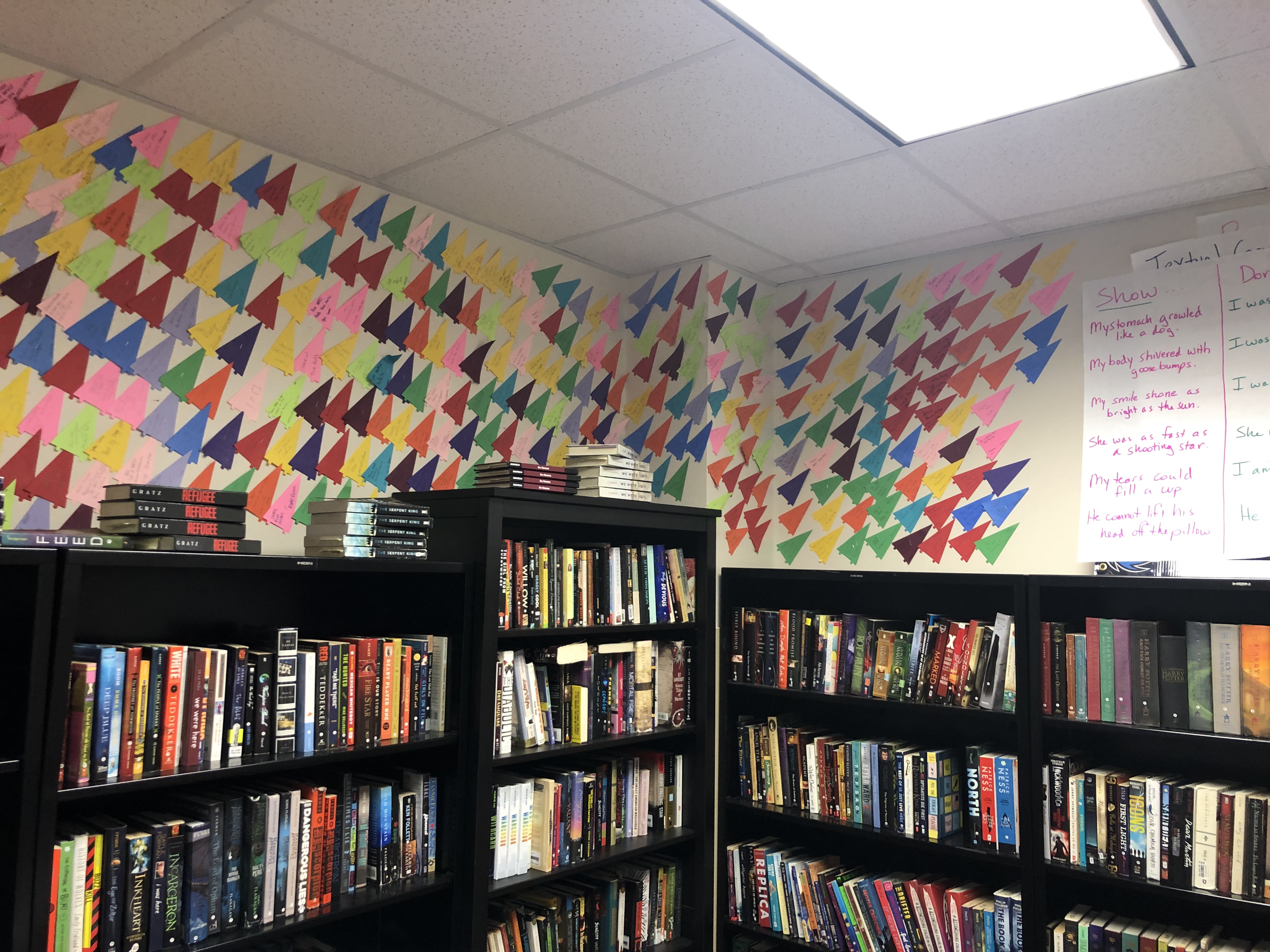
Hundreds of colorful pennants decorate the space above the book shelves; a reminder that as we struggled through our literacy lives this year, we covered vast expanses of literary territory. Upon closer inspection, I notice names, titles, and authors scribbled on each scrap of paper – evidence of books loved, hours of silent satisfaction, and reading identities.  These little flags wave reminders at me of the hard work, joy, and successes we’ve shared.

Books laze haphazardly on shelves overloaded, wondering where their friends have disappeared to. Shifting my eyes towards the door, I see the book nook stacked high with  books waiting for a magic book fairy to shuffle them back into their places in the classroom library before school lets out.

img_5319

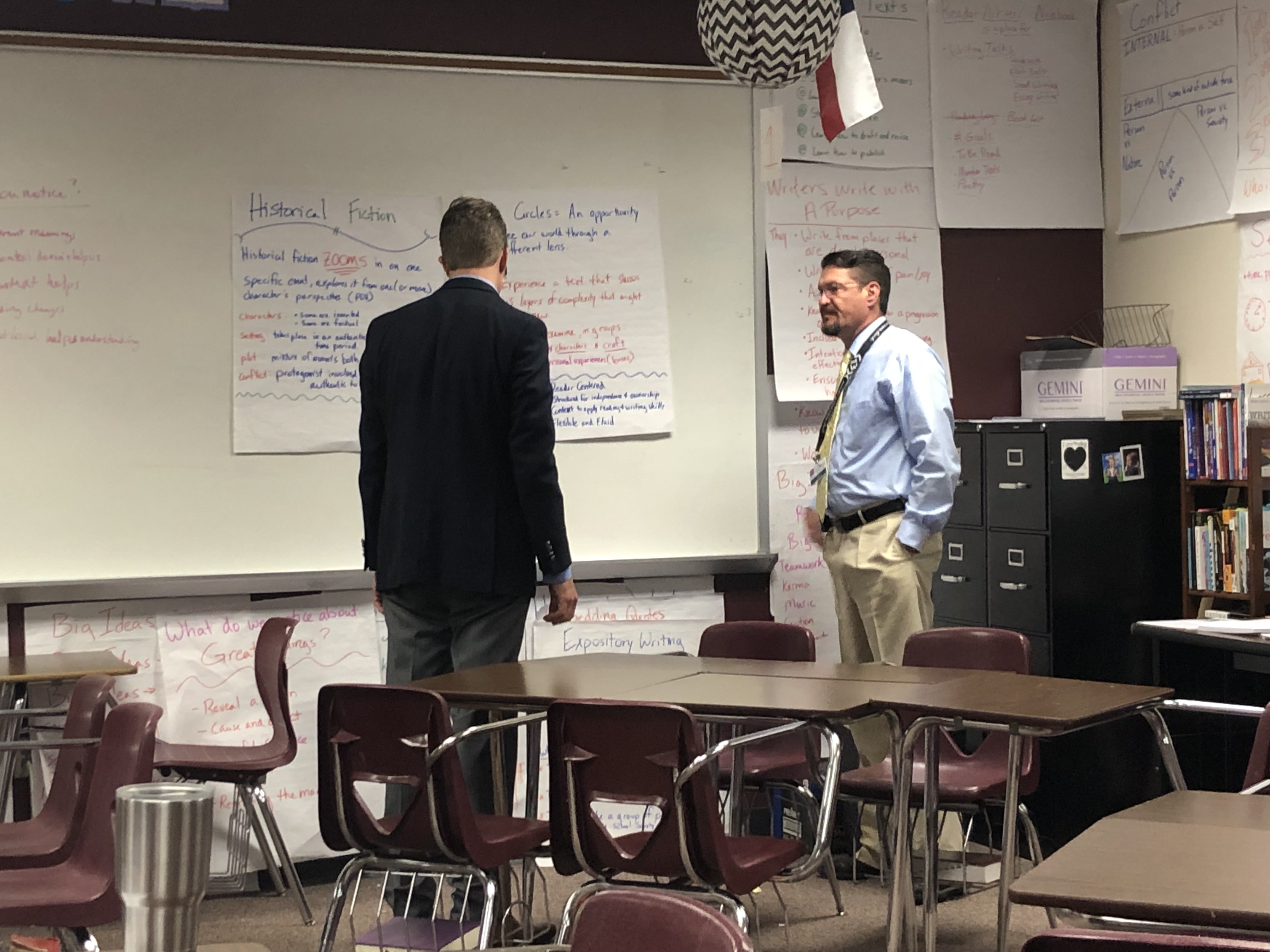
My thoughts move to the front wall, draped in sagging and fading anchor charts, and I remember when two intern teachers – confident and comfortable – created their own “vortex” (more on that another day) and hashed out a lesson cycle like they’d been doing it for years.

My professional library brings up thoughts of lunches spent silently scouring the words great thinkers, and roads traveled; places left to visit or re-visit.  Kittle, Gallagher, Newkirk, Romano, Anderson and many more, remind me of monumental tasks I faced each day and remind me too, that I signed up for this.  Above, those books rest, (on the shoulders of giants, one might say) mementos, pictures, action figures and even a giant check left over from days of football past.

Too often, thoughts grades, lesson plans, assessment, and skills consume my mental calories. Not near often enough do I take the time to reflect, piano music drifting softly through the air, on our work here in this room.

This year was far different from all those that proceeded it.  The end-of-day rush out the door wasn’t a mad dash to football practice or to the parking lot just before driving a bus full of teenagers across town to a soccer game. Instead, I rushed out the door to get home in time to meet my daughter at the bus stop before picking up my son at school. There were no serious talks with students facing graduation, warning them how much it hurts to have life after high school hit them square in the face.

Instead, these freshman taught me as much about teaching as I taught them about reading and writing. They forced me to face struggle as much as I forced it upon them.  They made me look at my craft with fresh(man) eyes and change the way I moved through workshop routines.  I’m better for it.

Graduate school, too, reinforced the importance of life-long-learning and ripped the cover off the academic writing skills I’d boxed up almost twenty years ago.

In one year, I won a #BookLove grant and presented at the district, state, and national levels.  Recently, I was asked to contribute to the ILA magazine, Literacy Today, based solely off of a piece I posted right here back in July. Not bad for a an old ‘ball coach.

Being asked to chair the High School Section for TCTELA has been both an honor and an eyeopener.  I’ve never experienced the feeling of fear that came over me when I realized how much the members of this section needed outlets to amplify their powerful voices, and I didn’t know the first place to start. To even begin to think about conquering these tasks, I leaned on the lessons that have come before this, in times of vulnerability, and I looked at those around me who handle their struggle with grace and composure.  Oh, and those inspirational educators are the people with whom I’ll travel to Louisiana, for ILA 2019, to continue to spread our love of literacy.


Charles Moore looks forward to new challenges and growth opportunities even in his old age.  He’s trying to rebuild his reading habits and write as much as possible.  If you are high school teacher in Texas, and would like to help out with the High School Section of TCTELA, please email Charles at mooreliteracy1@gmail.com.  He wishes everyone a peaceful and relaxing summer and promises to post as many twitter selfies as possible.

Summer Reading: One Answer to this Big Question

By now we all know that we don’t want our students to lose any of the healthy reading habits they have been building over the course of the school year. We’ve all worked too hard to build them, and to give these good habits over to the summer slide seems like a really bad idea.

So we need a plan. We know that if we don’t plan for a positive summer reading experience, that’s the same as planning for many of our students to not read at all… While many of our students will continue to read over the summer because they’ve established their reading habits quite successfully, others are still burgeoning readers and haven’t established these habits in the same way.

For example, I have one student who has resisted reading literally the entire year. She regularly told me that she doesn’t like reading. That reading is boring. That she doesn’t like books.

I kept responding with one word: Yet.

About three weeks ago, she changed her tune. She found a book she loves. She told me it was good. She liked it! (This is another argument for student choice when it comes to reading, but that’s a slightly different post.)

61536753_455526445266068_823497190881099776_n

Her book is Speak by Laurie Halse Anderson.

Screen Shot 2019-06-01 at 8.57.42 AM

This respect for books and reading is new for this student. The reading habits are fragile, and her disposition could change over the summer. Nobody wants that… It’s too important to ignore.

It’s just one of the many reasons why our school has decided that summer reading is something we have to expect and encourage.

We want to honor our students and their individuality. They are all over the place when it comes to where they are in their reading journey, so there is no one-size-fits-all plan for summer reading.

Here’s the we-hope-it-works-for-everyone plan we came up with: Students will choose their own titles, their own number, and even the language in which they read. We’ve told them they need to read books in both Spanish and in English (we are in Nicaragua, so this is entirely appropriate). But no one is telling the students what books to read, how many to read, or what ratio their English to Spanish books needs to be.

  1. Students choose their titles based on next-reads lists, talking to each other, book talks they’ve liked, and what sounds fun for summer reading. Some will choose three, some five, some ten… we don’t give them a minimum number, we simply ask how many they think is a reasonable number for the summer. (We do try to get them to agree to at least three, though.)
  2. Students confer with their current ELA teacher, and that ELA teacher “nudges” them to possibly add something to their lists, or help them make decisions, but only if they need it. We try to avoid student frustrations from choosing books that are too hard over the summer, as they won’t have regular conferences with teachers, for example. We try to make sure they’ve chosen “enough” to read over the summer, based on what we know about them as readers. But all of this is based on student choice and preference.
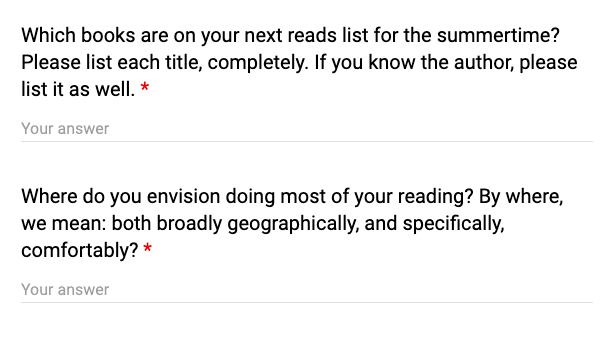
  3. Students fill in a quick google form that will be shared with next year’s ELA teacher. This form will help next year’s ELA teacher with the first reading reflection, the first conference, etc. This is where the summer reading accountability is built in. No one will be “in trouble” for not reading over the summer, but it will be the basis for the first honest reading conference of the school year. Screen Shot 2019-06-01 at 8.54.00 AM
  4. Students email their parents their summer reading choices with an explanation of the summer reading program. At that point they can check out their books from our school library (YES! They really can check out books over the summer! I love this so much!)Screen Shot 2019-06-01 at 8.53.27 AM

Our summer reading plan really is just four easy steps. However, these steps are based on an entire school year of implementing student voice and student choice when it comes to reading. Students have a good idea about how much they could potentially read over the summer because they have just completed semester/year long reflections and recognize their growth and learning when it comes to reading. They have inspired themselves!

This plan will be implemented with this year’s current fifth grade students so they will enter sixth grade knowing that they are respected for who they are and what they like, but there is also an expectation that they will read. It’s a grade six through twelve summer reading plan, and I do think it will work. I’m excited to talk to my new students in the fall already about how their summer reading goes.

What does your school do for summer reading? I’d love to hear other ideas!

Julie has been teaching secondary language arts for twenty years, spending the first fifteen in rural Central Oregon, and the last four in Amman, Jordan. She’s thrilled to report that she and her family moved across the world to Managua, Nicaragua this year, and are loving their new adventure.

Follow her on twitter @SwinehartJulie

5 Things Students Say That Give Me Life

It seems like each year of teaching is more intense than the last–the highs are higher, the lows are lower, and the chaos is more…chaotic. This year was no exception, and as my 7th and 8th graders leave the classroom this week, I am an exhausted mix of relieved and saddened to see them go.

Each year, while the bureaucracy of school politics, students’ disengaged behavior, and the heartbreak of kids who slip through the cracks drags me into despair, my students are the ones who pick me back up again. They, in their own words, give me life. Here are five standout things students say that lift me up when I’m down.

img_3545

JC creates a blackout poem from a dictionary page.

“This is fun!” The surprise and delight in a young teen’s exclamation about learning being fun never fails to bring a small, secret smile to my face. Learning is fun, engaging, and challenging in equal measures when students have choice, agency, and confidence in their work. My students created blackout poems as part of their final multigenre projects, and many students wrote in their final reflections that this was one of the most memorable activities during our time together.

“Can you conference with me about this?” After leaping right into reading and writing conferences with students when I met them in April, the verb “confer” became a standard in our classroom. Conferences about choosing which books to read, about how to improve a piece of writing, or even about those pesky grade questions take on more gravity than a simple comment here and there. Students learned that conferring was a time for one-on-one conversation, during which the participants were not to be interrupted. With the simple introduction of the term “conference,” the culture of the classroom shifted to one where talk was still vivacious, but was also more focused and productive.

img_3662

Logan shows off his final multigenre paper.

“I’m proud of this.” My middle school students are boisterous at their most basic level, but each time they submitted a best draft of a piece of writing or turned in part of a project they’d worked hard on, they became suddenly shy. They’d look at me, almost confidentially, and tell me quietly, “I’m proud of this,” as they slid their work into a turn-in folder. Their multigenre projects this year were some of the longest and most complex pieces of work they’d created in their middle school academic careers, and Logan’s shy smile sums up their feelings of pride and accomplishment about their pieces.

“You should be proud of your daughter.” During my plan period one afternoon, I was chatting with my mom on speakerphone. A few students walked in with a question, and I told them I was on the phone with my mom and asked if they wanted to say hi. They greeted her and said, “you should be proud of your daughter. She’s an awesome teacher.” This mark of respect made me tear up and embarrass the two boys, but nonetheless it restored my faith in the sensitivity and manners all teens are capable of possessing.

img_3908.jpg

“Now look at me.” My students’ final self-evaluations are some of my favorite things to read each year. Page after page of student writing is filled with students assessing their accomplishments and detailing their own growth. I ask them always to tell me how they’ve changed–something they don’t always know until they begin writing about it–and this year I was floored by one student’s response. Her struggles with addiction began at a young age, and as she found a more stable home and her life improved, she transformed herself into an avid reader and writer. This powerful self-assessment–“Now look at me! I’m a writer, a poet.”–floored me. It was a forceful reminder that literacy saves lives.

As difficult as a school year can be, I just keep coming back for more–and the students are really what keep me in the classroom. Each May, as my will wilts from the stresses of testing and schedule interruptions, my students’ energy and vitality give me life at the end of each year…just when I need it.

What do your students do to give you life? Please share in the comments.

Shana Karnes teaches in West Virginia, but only for three more weeks. She’ll be moving to Wisconsin with her family, her books, and her love of teaching. Connect with Shana on Twitter at @litreader.

Q & A: How do I keep my students reading throughout the summer?

Questions Answered

Let us know if you have questions about readers-writers workshop. Throughout the summer, we’ll be posting answers.

Don’t you just love this question so much more than “What do you do for summer reading?”

Of course, we know to get to the “keep my students reading” part, we have to do a lot of work — sometimes a whole lot of work — to get some student reading throughout the school year. And those of us who give so much of our time to this heart work of reading, can feel sad, anxious, and exasperated when our students leave us and get “assigned” a book, or more than one, for summer reading.

For several years, my AP Lang students, many who were second language learners who took a courageous leap to tackle an advanced English class, would read stacks of self-selected books, and grow exponentially as readers, only to get handed at the end of their junior year a summer reading assignment and a list of study questions for AP Lit. Beowulf. This is problematic on so many different levels — but entirely out of my control. What could I do?

The only thing that made sense at the time was to encourage my students to form their own summer book clubs. I suggested they might set some goals to read their assigned text first, and then meet together to talk about it — similar to what they’d done in class in the three rounds of books clubs we’d done throughout the year. Then, they could choose another book and meet up again. Students took it upon themselves to circulate an interest form, and most students wrote that they were interested.

It didn’t really work. I was too busy in the summers to commit to keeping the idea alive. And we all know soon-to-be-seniors, or many teens for that matter:  Procrastination is their BFF.

I still love the idea of summer book clubs, and I know some schools are having great success with them. Hebron High School is one of them. The English department at Hebron is doing amazing things to cultivate a culture of reading, not just during the school year, but throughout the summer as well. They open the school library every Wednesday afternoon, so students can select books — and get coaching for college essays. They’ve got book clubs scheduled with teachers and coaches. They’ve got a wish list for books circulating within their community. Really fantastic ideas to keep the focus on the power of reading.

Scholastic recently released a report about summer reading trends. The report states that 32% of young people ages 15-17 read zero books over the summer — up 10% in two years. The report also states that “53 percent of kids get most of the books they read for fun through schools—so what happens for that majority when school isn’t in session?”

It doesn’t take much to know the answer. So what can we do? Besides following Hebron’s lead, here’s a few ideas:

  • Talk up your public library! Invite a librarian to come visit your classes, and get students to sign up for library cards. One of my biggest regrets at my last school is that I didn’t take my 11th and 12th grade students on a field trip to the public library. We could have walked — the library was that close. I know the majority of my students had never been inside, and every year I thought what a great activity this would be. Every year I didn’t do it. #ifIcouldgoback
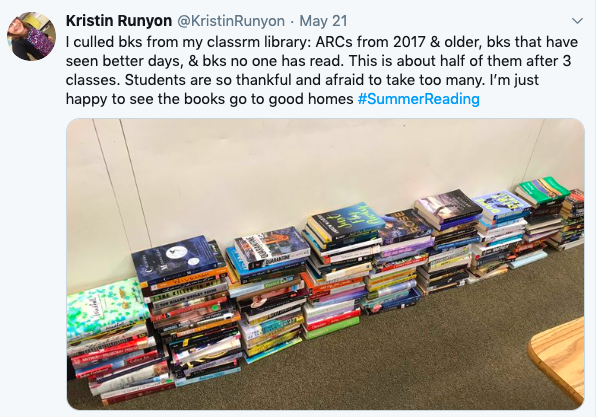
  • Cull your classroom library, and let students take home books. I know. I know. Many of us invest so much time, energy, and money building fantastic classroom libraries, and we lose enough books throughout the year without giving them out freely at the end of it. But, really, what can it hurt? Every year I’d pull books that I felt I could give up and put them on the whiteboard rails for students to take home for the summer. (Sometimes they even brought them back.) It didn’t matter. I’d rather have books in kids’ hands than hidden under butcher paper in my closed up classroom. Kristin does, too:tweet about giving books
  • Give students access to lists of high interest and award winning books —  and free resources. Pernille Ripp shares her students’ favorite books each year. YALSA has great lists. And a cool new Teen Book Finder. BookRiot published “11 Websites to Find Free Audiobooks Online.Audiobook Sync gifts two free audiobooks all summer. Great titles, too!
  • Invite students to talk to you about their reading. Yes, even during the summer! Lisa does this in a slowchat on Twitter with students who will be in her classes in the fall. Students tweet her updates about their reading lives. She tweets back. It’s a great way to build relationships and share book ideas.

Every year I feel like I could have done more to keep my students reading throughout the summer. The truth is — we can only do what we can do. Sometimes it touches the right student at the right time. Sometimes we just keep trying.

I’m sure you have more ideas. Please share them in the comments.

Amy Rasmussen lives, gardens, and rides her bike in North Texas. She will be spending a lot of her summer with teachers facilitating PD around readers-writers workshop in secondary English classes. Her favorite thing. She’s also going to be doing a lot of writing. And a little poetry study at the Poetry Foundation Summer Teachers Institute in Chicago. Follow her @amyrass

Book Talks, Choice Reading, and Fast Food Drive-Thrus by Amy Menzel

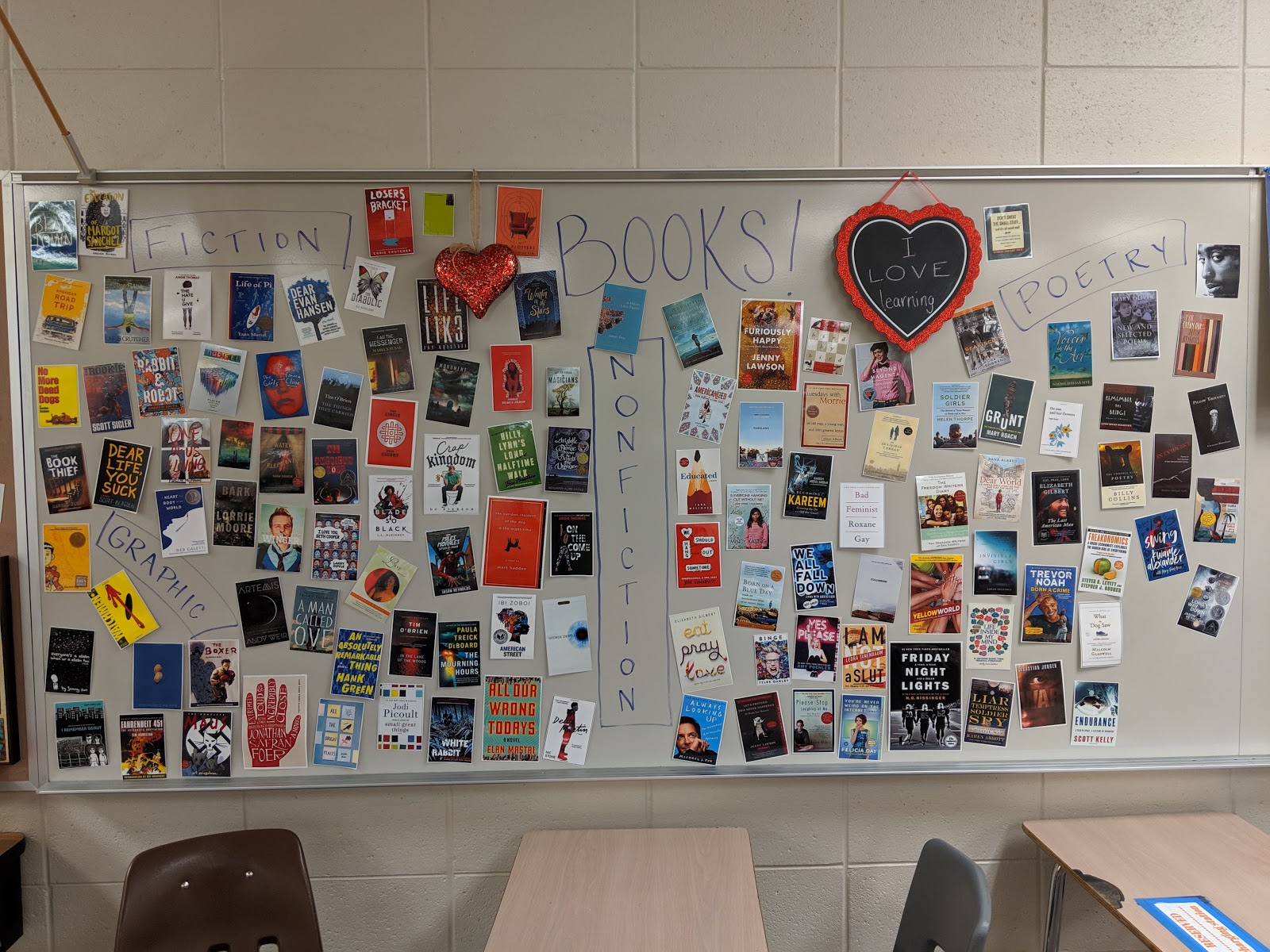
I can’t put my book down. I’m (finally) reading Extremely Loud and Incredibly Close and I am loving it. I book talked it a week ago and I’m 75 or so pages from finishing. I’m not sure why I didn’t read it before! I’ve book talked it before, so I assume I was so engrossed in another title that this one had to wait. Anyway, I’m already anticipating a serious book hangover upon finishing.

As I crawled into bed and turned on my reading light last night, I had two lightbulb moments. In addition to the obvious one, there was the realization that I am not rereading a book for the eleventy-seventh time this year. In fact, I haven’t reread an entire book for the past two years. Not that there’s anything wrong with that. But there may be something misguided about an English teacher focusing all her efforts on teaching the same few books year after year.

I spent nearly the first decade of my high school teaching career doing just that. I could still deliver a solid lesson on To Kill a Mockingbird, Fahrenheit 451, The Great Gatsby, or The Kite Runner at a moment’s notice. Give me an hour or so to prep and I could review layers upon layers of annotations in my personal copies of each and make a solid lesson a good one. But I’ve been there and done that. Sure, I found new insight with each reread, but I don’t think enough to warrant the time it took. I’m not convinced my lessons got that much better from year to year, despite my thoughtful (and time-consuming) planning and preparation. And, really, that shouldn’t surprise me.

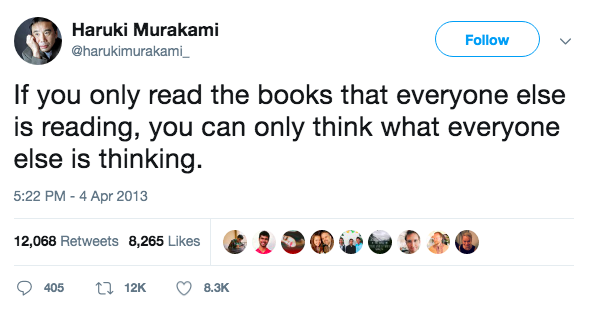
Writer Haruki Murakami once tweeted, “If you only read the books that everyone else is reading, you can only think what everyone else is thinking.” And, there I was, only reading the books that I had read, and only thinking what I had thought. I mean, I added related readings to ever-expanding text sets and used new pedagogical practices, but I was basically the academic equivalent of a Taco Bell drive-thru. It was all the same stuff just packaged differently.

That’s no way to live. It’s no way to grow.

amy 1

I see my job as an English teacher much differently now than I did as an eager newbie. I’m still eager, alright, but I also have this sense of urgency. Part of it is that I teach seniors now. And second semester Senior English is basically the pressure cooker of secondary education.* I have 90 days to help students identify as readers. Let me tell you, it’s not going to happen with a traditional approach. At best, a traditional approach might convince them that reading is “not that bad” as they grind their way through a couple assigned books (or the SparkNotes of a couple assigned books) that they may or may not find all that engaging. I’m striving for more than that.

I don’t have a lot of time with these young scholars and there’s no time to waste. It’s time they find books that intrigue them, inspire them, and challenge them. It’s time they find books they actually want and will read. And it’s really important that we shift to students finding their own texts. “Real world” readers don’t read because some lady named Mrs. Menzel tells them they should. They read because they find books that speak to them. Of course, I’m here to help. I book talk a new title every single day. I make it my job to play nerdy cupid and match the right title with the right reader. It all takes a lot of time. But not more time. I’ve simply reallocated my time. I don’t spend hours rereading the same books and turning last year’s burritos into this year’s enchiladas. Instead, I read. For real. I read a lot. I read books I want to read and books recommended by librarians and students. I read novels and nonfiction and graphic memoirs and collections of poetry. I read magazine and newspaper articles and blog posts and lyrics and scripts and transcripts. And I share what I read. And I ask students to share what they read. And we talk about it and we write about it.

amy 2my book board, featuring all the title’s I’ve book talked this year so far

And I’m finally living a reading life I want my students to follow.

(And look at them follow!)


*I’m pretty certain this analogy checks out. It sounds good. Truth be told, I’m much more Taco Bell than I am pressure cooker kinda person in the nonliterary, culinary sense.


Amy Menzel finished Extremely Loud and Incredibly Close nearly seven books ago. She just got around to revising and submitting this guest post because teaching. She knows you understand. You might also understand why she’s contemplating spending $20 on this “SAVE THE WORD TACOS” t-shirt. She hopes you have a great end of year and a fantastic, restful summer filled with great reads.