Category Archives: Readers Writers Workshop

What’s in Your Teaching Soul?

Our Compass Shifts 2-1I am an idea machine. Really, it’s like Boom! This might be cool–or this–or this. How about this? It relates to that and that and that. Sounds like a pretty great machine, right?

Not even. It’s a problem.

I get so many ideas spinning that I get dizzy with possibilities, and inevitably, I get frustrated. You know what happens next. Do you hear that crashing?

So, as the days of summer disappear, and I start thinking about school starting up again and what I want to do differently with my students this year, the idea machine hums at high speed. And there is just no room on the planning calendar to do every idea that I think is a cool one. And really, why would I want to?

I do this to myself every year:  I try to do too much, so my students rarely get the chance to do some things really well. We’re in too much of a hurry to move on to the next great thing. No wonder I am a stressed out, headache prone, insomniac from August until June.

At the University of New Hampshire Literacy Institute learning from Penny Kittle, she asked us at the beginning of the course and then again at the end:  What is your teaching soul?

The first day of class my answer went something like this:

I’ve lost it. That’s a lot of the reason I am here. My passion for teaching has taken a beating–a lot of it influences from outside of school, (It’s been a hard year personally)– a lot of it the choices I made within the classroom.  I’m here to get my passion back.

The last day of class, and it’s really no surprise, since, you know, I was learning from Penny Kittle, my response was something entirely different. The discussions about writing, the experiences with reading–mostly analyzing author’s craft, and my own writing practice all helped redefine who I am as an educator and as an individual.

And that is what I want for my students. I want them to know who they are and what they have to offer.

So, what is my teaching soul? What are the non-negotiables that matter, the things that will help me keep the passion and help my students define themselves as readers and writers and individuals of tremendous worth? I know in my soul the following things matter:

Community Matters. My students must trust me to establish and maintain a classroom community that allows for risk and creativity. I must encourage conversations that allow students to be their authentic selves so they can find their authentic voices in their writing. Every discussion and every activity can help us feel at ease as we grow to know and appreciate one another as developing readers and writers. Keeping writer’s notebooks, talking about books, sharing our writing–every single day–will help my students feel safe so they are willing to speak up and let me see glimpses into their lives and how they think.

Reading, Writing, and Thinking Matter–a lot. If it’s true that to develop fluency in reading and in writing, students must read and write, then it only makes sense that to develop fluency of thought, students must think. Asking students to analyze, synthesize, revise, create, etc  on a daily basis is the only way to build this fluency. I can start with asking good questions, but more importantly, I want students asking good questions. A student-centered, student-driven inquiry cycle will lead to thinking that involves and engages every learner.

Modeling and Mentoring Matter. I’ve learned the difference between showing students something I’ve written and writing something in front of them. In front of them–so they see the thinking and the struggle–works so much better. If they see me as a writer, and I talk to them as writers, our writing community helps us all grow in our craft and experience. The same holds true for reading. Students have to see me as a reader. Mentor texts that we study for craft act as professional coaches to show us the moves and stylistic devices published authors use to create meaning. My job is to ‘hire’ good coaches and make sure my students know that we can learn from them.

Authenticity matters. I’ve thought about this a lot:  How can students be their authentic selves if we never let them make choices? I read something once that compared high school to a dystopian society: wear a certain thing, eat at a certain time, respond to the bells throughout the day, come and go when they tell you, talk when they let you. All that control. I get that schools must function a certain way, but can’t we give students some control? Allowing them to choose the books they read and allowing them to select topics that interest them to write about gives students a little freedom. The more freedom we give students, the more interest they’ll have in their learning. The more interest they have, the more commitment they will have. Isn’t that what we want–students committed to their own learning? This is where blogging comes in for me, too. By encouraging students to create and post on their blogs, I learn who they are as individuals. I read about the topics that matter to them, and they find their authentic voices as they publish to a world of potential readers far beyond me as their teacher.

Dialogue matters. In a training last spring, Kylene Beers reminded me that “the smartest person in the room is the room.” I needed this reminder because I often shut down conversation when I could explode it. Rich classroom discussion can lead to intense learning. I must trust that when students engage in conversation surrounding a topic, they may learn more from one another than from me. They can learn from me in the dialogue we share during our one-on-one conferences. Talking to students about their reading lives and their writing processes is the best teaching tool I have as an educator–and the best use of my teacher voice.

As I use the last of my summer days to plan the best learning I can for the students I will serve this fall, I pledge to remember how my heart healed in July. I know the power of a student-centered workshop classroom, and I will remember to allow my students the opportunities to learn the way Penny allowed me to learn at #UNHLit13.

I met some awesome educators who will help me remember, and they will help you, too. We bonded over books, breakfasts, love for PK, and zen. In an effort to focus our teaching this year around the things we learned in NH, we devised a plan to 20130713_193936keep us connected and accountable. Once a week we’ll write about our experiences, practicing in our classrooms the things we learned this summer.

We’re calling our reflections Our Compass Shifts because it has and it does, depending on the needs of our students. From Texas to West Virginia to California to New York, we are four high school teachers with different backgrounds, teaching experience, and student demographics, who believe in the genius of our students.

Please meet my new colleagues:  Shana Karnes (WV), Emily Kim (CA), and Erika Bogdany (NY). You’ll find their bios on our About page, but I’ll let them introduce themselves and their students as they take turns posting each week. They’ve got teaching soul that makes me shiver. Oh, and see? They are walking talking FUN.

Think about what swells in the heart of your teaching. I hope you’ll share the answer: What is in your teaching soul?

Dream Come True: Conferring with Penny Kittle

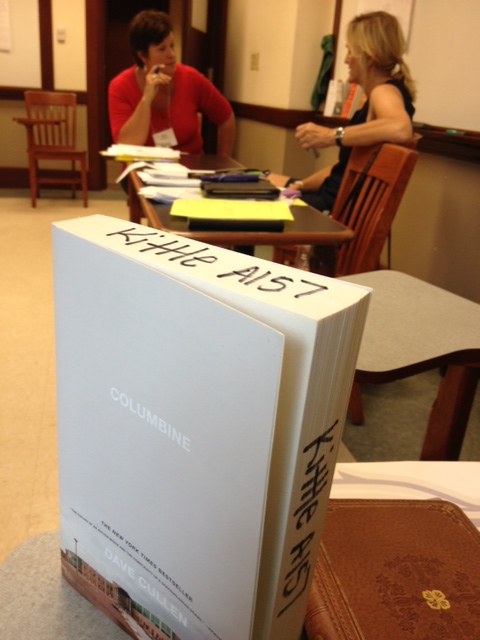
imageFor a teacher like me, this moment was a pretty big deal. I attended the University of New Hampshire Literacy Institute and learned from Penny Kittle for two weeks. Her class was called Writing in the World, and I have to tell you, I learned more than I could have hoped for when I set off with my new green notebook for New England, a place I’d never been.

I’d heard Penny present before, first at Region X here in DFW, and then again when my district brought her in for a couple of days–both turning points in my classroom instruction as I changed my thinking about teaching readers and writers and not just reading and writing. Then, of course, I was a fangirl at NCTE last fall in Las Vegas, tracing my hand in my notebook like she does in hers.

But sitting in her class every day, listening to her read poetry, share videos of her students, and explain that all students will write–and write well–when they are given the opportunity to explore their hearts, reshaped me as an educator, and thankfully, I got my passion back.

Everyone who knows me well knows I had a tough year. Lots of reasons, and none of them pretty. At one point I thought about throwing in the pubic education towel, even applied to Pearson in a moment of desperation. See? I was quite low.

When Penny meets with students in a conference, she focuses on the writer and not the writing. She let me ask questions, and she alleviated my fears. She prodded and questioned, and I found answers to questions I didn’t even think to ask. I saw myself as the student, and I saw my students in me. And I realized when it comes to meeting with my students to help them improve as writers:

I can do better. I must do better.

Of the huge stack of books I lugged home from UNH [I am Amy, and I am a (book) addict], Tom Newkirk’s Holding on to Good Ideas in a Time of Bad Ones resonates in my teaching soul. Even this one little thought speaks to me: “excellent instruction rarely feels rushed.” I know that, really I do, but why do I always feel like I’m in a hurry?

When it comes to teaching writing effectively, helping students to see themselves as writers, allowing students to feel accomplished communicators, I must slow down.

I need to do what Penny did for me in New Hampshire: relax into chair, look into my face, smile her warm smile, and speak to me like she already knew I was writer.

[Special thanks to Emily Kim for capturing this special photo. I owe you.]

OMG! Do You Think You Have Enough Books?

photo-1Last August, as I started in my new role of instructional coach for my district, people often said that I would go through a grieving process as I left behind what I once knew to embrace the unknown. Throughout the year, many have asked if I have missed the classroom, and of course, to some degree the answer is always yes, but there is one specific thing that I miss the most… MY BOOKS!

Walk into my room and more likely you would have asked me, “Jeez, Heather, do you think you have enough books?” Of course, my answer was always, “Uh, NO! How would that ever be possible?” No doubt, the best part about my classroom was my extensive library. If I spent a day and counted, I’d probably total close to 1,500 or more books, all cramped on shelves, waiting to spring into the hands of an unsuspecting reader.

Kids need easy access to books, just like they need easy access to their cell phones. The library can be too intimidating; the book stores are too far away, and often the shelves in their homes are void of books. As the teacher, if I wanted to send the message that books are important, there is no better way than to fill my room with books – good books, colorful books, books that students want to read.

Where I Find Books
* scooped up from a retiring teacher (Why won’t more teachers take early retirement?)
* freebies at conferences (Yes, I lurk in the corners of exhibit halls, executing a flawless freeloader innocence. Note to self: ask Amy to write about her stealing from a vendor experience.)
* purchased at the Scholastic Book Warehouse clearance event (Watch the calendar and pay attention to the Scholastic website)
* given to me by a students – (Please, no more Starbuck’s giftcards and scented candles… I NEED BOOKS!)
* Half Price Books (If near a warehouse, the free give-a-way for teachers is worth it. Otherwise watch for coupons. I just used a $15 off of $50 purchase that meant 21 new books.)

Why I’ll Never Have Enough Books
It’s more effective to walk over to the shelf and hand a student a book than it is to tell her to go to the library or to the bookstore and get it herself. Ever had this happen: a friend tells you about a book, and you think “Oh, I want to read that.” Unless you write it down or make a stop at the bookstore on the way home, you’re not likely to get that title any time soon. Magnify that by 20, and you’ve got what happens with a student. Most often you have to put the book in the child’s hand. Is she guaranteed to read it? No, but I increase the chances exponentially when I grab a book, chat about it, and hand it to a student. And with some students I place one book and another and another, until the student finds the one she wants to read. That’s why my shelves scream with diversity.

In my classroom, I arranged my bookshelves by genre because students may not know what they like to read, but they know what they like. A girl may not know she likes Sarah Dessen novels, but she knows she likes romance. A boy fascinated by the Civil War may search my shelf of war-themed books and discover the writing of James L. Swanson. By placing the books by genre I am able to create a type of comfort zone where my students feel free to explore. Just like no two students are alike, no two readers are alike. The more books on my shelves, the more opportunities I have to get students to read.

How I Kept Track of My Books
I didn’t. I literally have a love relationship with my books. My students know of my affinity, and they quickly understand that the books on my shelves are my personal friends. Friends that will break my heart if I lose the connection. Many a time when a student lost one of my books, he’s replaced it because he knows I care about each of my books. The real deal though– if a book doesn’t make it home to my shelf, I’m okay with it. Maybe it’s altruistic, but I hope she’s happily getting read somewhere by someone. As teachers and librarians we must remember that we cannot be the keeper of the books and the stories they hold (even if they do end up at Half Price Books with your name clearly stamped on them.)

Last May, at the end of the year I carefully selected my most treasured friends, but then I, like someone had once done with me, passed them on to another teacher to share the love of reading with her students. I can only hope her students have found as much pleasure in them as mine once did.

How do you build your classroom library? How do you prevent your books from never returning? (or do you?)

Math in the Real World

Today we want to share a story from a math teacher, yes a math teacher! Embracing transformational teaching practices, Elizabeth Pauley, 8th grade math teacher at Cross Timbers Middle school, brought math to life for her students by creating an authentic experience where students could see first hand math in the real world.

This slideshow requires JavaScript.

As we began our second semester of 8th grade math, I found myself already thinking past our state assessment into May. What was I going to do with my 8th graders who think they are already in high school?  How can I keep their interest peaked as summer quickly approached?

Sitting in the kitchen one evening, participating in our district tweet chat, I found myself thinking about how I could incorporate 21st century skills into our classroom.  My students had the confidence to apply their knowledge of proportionality: however, they still encountered obstacles when it came to applying formulas for surface area, area, and volume.  How was I going to foster my student’s thinking so they would be able to see the connection?  I wanted them to have ownership in their learning!

How could I create a lesson that was student-centered, utilized technology and collaboration, all the while building a bridge between the abstract mathematical concepts and a real life scenario?

Utilizing my district instructional coaches, we began the adventure of creating my students’ first PBL.  Meeting during my conference period, Heather and Aubrey helped guide my thinking as I narrowed down the standards that I wanted to cover.  The chart paper was pulled off the tablet, while the markers etched across the page.  I found that not only did I want this PBL to cover measurement standards, but I wanted it to incorporate the majority of what my students had learned this school year.  I wanted them to experience the connections that are found in the world outside the classroom walls.

Dissecting the standards and focusing on the verbiage focused me as the educator and helped to create the driving question for our PBL:  “Based on the cuts in school finance, how can your design team create a middle school athletic facility to increase revenue?”

The week between creating our driving question and meeting with our instructional coaches was challenging.  Challenging because I had to think; think about what my students’ prior experiences were and what our long term learning goal was.  The question kept echoing: How was I going to create a bridge to yield success in our classroom?  Then the answer:  Innerput.

Innerput are workshops that lead to eliminating misconceptions, while creating connections between experiences.  By creating these workshops for my students, on concepts I felt they may struggle with, I had more confidence about embarking on our PBL adventure.

The thinking started naturally. After our state assessment on a Tuesday, I told my students I was sorry to miss their track meet.  Many looked around the room with confusion.  Come to find out it was not our school’s meet but another in the district.  My students loved explaining to me how we had to give up “our” field for others.  Questions soon arose as to what happens with the money that is collected at athletic events.  Students were thinking!

To spark conversation and more thinking, I gave students various articles about athletics and school funding; why athletics were vital to our educational system and why athletics were being cut from budgets.  Holding a Socratic seminar yielded ownership in students learning, as each held a role in our conversations.   Having to defend different viewpoints, allowed students to begin seeing both sides to our current problem.  What role do athletics play in a school district?

Based on classroom discussions, we looked at the budgets of our school district and campus.  Much to students’ amazement not much money was given to our athletic program.  Thinking was occurring and discussions were happening all because my students were part of the problem and soon to be part of the solution.  As we dissected our budgets, students began to email district officials about the choices behind why certain campuses received more money.

Because our high school is being renovated, both the project manager from Pogue Construction and head architect from Huckabee Inc., spoke with my students about their roles on the design team and what role their company serves in the design process.

Students quickly realized they needed to collect data that was reflective of our student body.  Based on student needs, the facilities were being researched.  Students began researching:  How much space would we need?  Could fields be multipurpose?  How expensive is equipment?

Students quickly realized how expensive construction is.  They asked how our district could afford so many renovations.  I invited our chief financial officer to speak with my classes.  She shared about our district budget and how we give money to other schools.  Students had already discovered the state had cut funding, and now they were learning how much money actually stays within our district.  Hearing that only $0.65 stays in GCISD, students began to get fired up.  They were determined to find solutions on how to increase our district’s revenue.  It was time money stay in GCISD for GCISD students!

Knowing an authentic audience is vital to the success of a PBL, we began to discuss who had a vested interest in our school district.  Students determined that their parents, educators, district administrators and community members, as well as themselves had an interest in the success of GCISD. These conversations resulted in invitations being sent to our district administrators, school board members, educators and parents to come evaluate our final presentations and determine which bond election would pass.

We’ve had our obstacles and arguments over which ideas are the best and how much money to spend and which sports venues to include.  However, each group has learned to problem-solve and justify their thinking.  With various roles in our design teams, students are able to contribute in a meaningful way through their personal strength.

Unlike most educators, I am not counting down the days until summer vacation; I am looking forward to learning about my students’ creative solutions to a real-life problem.  We are learning right until the end. Students have realized numerous factors go into building an athletic facility:  cost of materials, location, architectural design, fees/permits,  but most importantly, they’ve learned that communication and collaboration are vital to the ability to solve a problem!

Building a Community of Readers by Sharing Our Own Struggles

booksAt least once a week, if not more, I see some news piece or article about how students these days are spending less time reading. Taking a minute to reflect upon my own reading life, I thought back to how I encouraged a community of reading in my classroom.

Over the course of a school year my students read a lot. Each year when we would count it up, we found that my eighth graders had read between 50-60 books each over the course of the school year.That’s 60 students reading about 60 books. That’s 1200 books. See? A lot! In my classroom, reading is contagious. Walk in the door, and you breathe in the reading bug. If you aren’t reading, you are separating yourself from something important. Reading takes precedence. By making reading a priority, and emphasizing that reading takes us places we’ll never get to, I am able to get even reluctant students to crack a book and creep into the pages. My struggling readers quickly learn that it is not about quantity or speed, but more about the fact that they are reading. Reading opens doors that the world slams shut.

No doubt, the biggest “Why read?” selling point to get my kids reading is my honesty. I openly tell them that when I was in sixth grade I hated to read. I hated to read! In fact, I hated to read so much that I only read one book all year. My students ooh and aah at that: “One book?” they question. Then I go on to tell them that I had a required book report due every six weeks, which meant read one book every six weeks. As you may guess, this discussion quickly turns into a math lesson with students questioning how I could have possibly passed sixth grade reading only one book. Every year I somehow skillfully turn the conversation back to reading. I let them question me: What about now? Do you like to read now? Do you only read because you have to? And my answer: What do you think?

It’s true that kids don’t care what you know until they know how much you care. Establishing rapport at the first of the year requires immediate, daily and purposeful attention, and honesty with students lends well to the building of it. I know it’s my honesty that makes it okay for my students to struggle with reading. We use my experiences, and make connections with their own, to talk about why reading is important and how we can grow as a room of readers. I flood the room with books. I talk about titles that painted pictures in my head. I read while my students are reading. My kids quickly see me as a reader.

Frequently, students want to know what turned me into a reader, like there’s some magic pill that changed my hate to love. They question me when I boast that I read forty-six books over summer vacation or 150 books total for the year. I model being a proud reader, and sometimes this leads to precious moments where my students and I have tender discussions about reading, and I am able to share my reading transformation story. Often students think that because I am their reading teacher I was born with a love of reading, and that it has always been easy for me. Once I dispel this myth, and they find out that I struggled for the better part of my life with reading, students are able to see me as a peer with a similar struggle, and if I work on the rapport right, they begin to envision themselves as readers. Isn’t that the key? If kids can see themselves as readers, maybe even if that seeing requires a high-powered magnifying glass, we can get pages to turn in their hands and characters to come to life. It only takes one book, and that’s a blog for another day.

In the mean time, what made you a reader?

It’s Monday What are You Reading? Me? Starting Summer Reads

Mon Reading Button PB to YAEarlier in the year I shared some data on literacy rates with my students. Some of the numbers made them mad; they called them “racist” because white readers by and large have higher literacy rates than Latinos. We had a decent discussion about why that might be the case, but I could tell my students still didn’t really “get it.”

Then, I came across this blog post at Literacy Learning Zone, and I knew I had a useful tool to help my students understand why their reading levels might be lower than some of their peers’ at the high school across town. We watched the YouTube video that explains the gaps created by a lack of reading during the summer. The timing was perfect. All morning administrators were busy calling individual students into the hall to discuss their recent STAAR EOC scores and summer school options. Kids were sad.

I’ve encouraged, begged, pleaded with students all year: “The single most importance thing you can do for your education is READ. Read books, magazines, newspapers. Read anything for extended periods of time.”

If only they would believe me!

So, today after watched the video linked inside that blog, I gave my soon-to-be sophomores their summer reading assignments. It’s pretty simple: Read any book of your choice that has some literary merit (we talked about what this means) and make a note of 5 significant quotes. [I suggested they look for the Notice and Note signposts. Thank you Kylene Beers and Bob Probst.]

I will read this summer, too. I am excited to be back in the classroom full-time. That district instructional coach job just didn’t line up with my passion– a lesson I learned from reading Ken Robinson’s book The Element. I miss the students, and I miss learning with my students. My schedule is heavy with three preps, but the trade-off will be worth it. I’m already excited about the reading I need to do to get back into the groove of an AP Language class.

Here’s a shot of what I start reading, and/or re-reading this week.  Lucky me!

My 2013 summer reading


Reel Reading: How about these book trailers?

20130207-190708It’s been a long time coming, but my students have finally produced some pretty good book trailers. I began showing trailers as a way to introduce books and encourage reading at the beginning of the year. Every Friday was silent reading day, and every Friday I chatted with kids about books they’d finished. We wrote on sticky notes and made a “recommendations” wall. We stood up and “testified” to the truth in books and how they touched our souls. No doubt, since I promoted reading more during class time this year, I created more readers.

Evidence? STAAR EOC scores are in. Almost every student who passed their reading test has been vocal in our classroom conversations about books this year. (One kiddo surprised me and scored satisfactorily–his average is a 26, but he passed the reading test. Go figure.)

I know. I know. Test scores are not everything. But… my readers certainly scored better than my non-readers.

On my classroom wall, I have my own six word memoir:  “Reading makes you smarter. Try it.” Those who did have done better than those who have not.

2 reading smarter

Our book trailer project is the culmination of our reading efforts this year. I wish we would have more time to polish them up, make sure we cited image sources, spelled words correctly and all that, but exams are next week, and bell schedules are crazy with awards assemblies, etc. Our time is gone.

Here’s a sampling of the most interesting of my student-made book trailers. Although not perfect, remember, these are 9th graders in an on-level English I class, Title I school. I’m a little proud.

Crackback by John Coy, created by Brandon. He used photos from our own football team.

Brandon Crackback

Unwind by Neal Shusterman, created by Heidi. Look at her hook!

Heidi –Unwind

A Child Called “It” by Dave Pelzer, created by Biridiana. She learned the medium on her own and came up with this!

Child Called It- Biri

The Lifeguard by Deborah Blumenthal, created by Kristen. Okay, so the trailer’s not great, but the video of the girl is Kristen herself. Cool.

The Lifeguard- Kristen

See You at Harry’s by Jo Knowles, created by Brenda. The use of quotes from the book creates the book’s selling points.

See You at Harry’s- Brenda

Reaction by Lesley Choyce, created by Ashley. Other than her characterization using Juno… <smile>

Reaction by Ashley

My Friend Dahmer by Derf Backderf, created by Jonathan. This one got traction when we showed it to the class. Wish it had more umph at the end.

Dahmer- Jonathan

I’d love to hear your ideas of using book trailers to create readers– or anything else you can teach me about books, kids, and reading!

Reel Reading for Real Readers: Summer YA Book Trailers

20130207-190708Pinterest, I love thee!

I didn’t think I would, but when my daughter told me that people were refurbishing and painting “old and ugly furniture like you have in the house, and you can learn how to do it on Pinterest,” I took a peek.

Yeah, ideas galore. (I even took my daughter’s advice, and who knew I could paint such beautiful furniture?)

But, here’s the thing:  There are boards for almost Everything. Even Summer Reading ideas for YA.

Oh, yes, please!

So, #ReelReading will take a break until school starts up next fall, and in the mean time– go check out this awesome board. I’m sharing it with my students next week.

Pinterest

Agh! Grading – Trying to Manage the Scary Beast

assignmentI heard the discussion yet again today. It almost always gets heated. You’ve had them. I know you have.

Topic: Grading.

What is a grade actually for anyway?

While I don’t claim to have all the answers, I have a few that have worked for me.


Here are some thoughts that may help you on your own journey of deciding how your gradebook might look. (I’ll try not to rant, but I might.)

A grade should be representative of a student’s learning over a period of time (usually a six or nine weeks). If that is the case, taking off a bunch of late points because a student is disorganized shows not the student’s academic ability but rather their organizational ability. This thought, however, is somewhat idealistic and not always realistic. I still must find a way to hold students accountable for being responsible, lest they take advantage of me and never turn anything in on time. In my gradebook, I actually had a category called Professional Ethics and Responsibility. This category is where I would put in grades to reflect if a student was turning his work in on time. I also included a grade, or two, reflective of the student’s ability to be responsible–not only with the iPads but also with classroom procedures and norms. The grade counted as 10% of the overall grade. This would not by itself fail a student, but at worst it could drop his grade an entire letter grade. One thing that changed my thinking was the idea of practice (otherwise known as formative assessments). I still don’t understand why other educators haven’t had this Aha.

I know when I am learning a new skill, I want to be able to practice–free from judgement–so that I might build some confidence before I am formally evaluated. The same is true for kids. We should give them opportunities to practice and build confidence. If we create an environment for our students to practice without judgement but with feedback, we might think twice about what we put in the gradebook.

Transparency is important in grading, too. I wanted students and parents to understand the skills that were being taught not just a final score. In order to provide more clarity, in the gradebook I would include in the title of the assignment the skill that was being addressed (characterization, inferencing, critical reading, etc.). Then, in the description of the assignment I would include a bit more information about the specific assignment so that the student might remember exactly what the assignment was. This cuts down on arguments about what was and what was not turned in as well.

Did you know that most online gradebooks have an incredible ATTACHMENT feature? With relative ease, I was able to post rubrics and even the actual assignments directly linked to the assignment in the gradebook. Some parents (and students) love this!

I don’t know about everywhere else, but in my district discussions about grading have been a source of heated conversation for a while. Now, as an instructional coach I hear similar questions all the time:

How can we continue to hold students accountable for their learning all the while creating a grading system that is truly representative of a students mastery of a subject?

Certainly I don’t have it all figured, so I invite you to join in the conversation and post a comment about your thoughts on grading. Love it? Hate it? How do you manage it?

Photo credit: woodleywonderworks / Foter.com / CC BY

Reel Reading: A Child Called ‘It’

20130207-190708.jpgI’d love to get my students to do some of this cool typography. Since they will be making their book trailers this week, I wanted to show them this option for their creations.

I’ve had great success getting even the most reluctant readers to read A Child Called ‘It’ by Dave Pelzer.

See? Isn’t all that letter and word movement cool?

If students like the topic of abuse (which I don’t quite understand), they might also like Ellen Foster by Kaye Gibbons. I haven’t seen the movie, but this trailer looks like it’s pretty well done.

Maybe next time I’ll look for happy topics.

Sheesh, Amy. This is depressing stuff.