Category Archives: Readers Writers Workshop

Reel Reading for Real Readers: The Good Soldiers by David Finkel

20130207-190708My own sons love to read books on war. That’s the main reason I have so many in my classroom library.   My twin sons Zach and Chase both plan to enlist in the military after they serve two year missions for our church. Every once in a while they will come home from Barnes and Noble with a new book. Chase brought this one home just yesterday:

Every once in a while I come across a book that I surprise them with, and usually they argue over who gets to read it first. Good Soldiers by David Finkel is one of those books.

My sons were reluctant readers in middle school and most of high school. The majority of their teachers stuck to the required reading of classical literature and rarely talked about books other than those they were reading for class. Chase finally found books as a way to escape bullying, and Zach found he liked a lot of the books Chase was reading. They became readers on their own, which I am grateful for, but I still think “what if?” What if a teacher had taken the time to learn of their interests in the military, in war stories, in patriotism? What if a teacher had let them read where their passions lay? Maybe they would have had a much more enriching experience in high school English.

I haven’t read Good Soldiers yet, but Chase has. He read it in a day.

Good Soldiers Audio Book Review:

David Finkel reads an excerpt:

Day One Disaster?

Our Compass Shifts 2-1  Fact has it that my wonderful Personal Learning Network (PLN) was back in the swing of things well before the 2013-2014 school year started in the boroughs of New York City.  So, for the entire last week of August and into the beginning of September, I was watching magic take place all over the country through my computer!

I was with Amy @amyrass, in Texas, as she embarked on her first day of Writer’s Notebooks which brought tears to those who were starting their writing journey together; as honest writing so often does.  Shana’s @litreader themed library, standing tall against newly painted bright blue and green walls, inspired her students to embrace literature from the moment they walked into their West Virginia oasis.  Out in California, Emily’s @booknerdkim community of learners were so enthralled to be engaging in the Writing Workshop, that decorating their individual notebooks became a source of (very!) friendly competition.  I was taking note.  I was excited.  I was ready.

Or, so I thought.

Day One has arrived.  I am channeling the beauty of the work being done throughout the country and greeting my students with smiles and complete calm.  Yes, calm.  And yes, I myself am a bit in awe that “I” and “calm” have been partnered to describe the beginning of this journey.

Day One comes and goes in the blink of an eye, as it so often does, and I find myself sitting alone in my classroom with a wild mix of emotions.  I’ve taught my classes; students have left the building and are transitioning into their evening lives; and as I look around I notice…there are no traces left behind that any learning has taken place.  Chairs are pushed in, supplies are neatly organized in each table’s bin, and the floors are still glossy from this summer’s wax.  Did anything happen in here?

As I journeyed home that night, uncomfortable and uncertain, I was unsettled with how calm I remained.  As I reflected on the day I was consumed by the flat energy, the lack of bubbling conversation, the quiet minds, the mechanical smiles…  I couldn’t help but wonder that if I was the most prepared and ready to educate than ever before, how could Day One be so disappointing?  And, if I was this disappointed, I couldn’t imagine what students must be feeling.  Sigh.

Day Two comes, as it always does.   As I’m getting situated to begin the day, there is a knock on the door.  I look at the clock and it is 8:33a.m. – not time for class.  Surprised to see this student with a huge smile on his face peering through the tiny window separating us, I open the door.  There are no words, only actions.  He passes me, what seems to be a blank composition notebook.  I look at him with a puzzled look.  His smile grows.

“I wrote.  Here.”

As I walk back into the classroom alone, I open this Writer’s Notebook.  I happen upon pages of text…full pages, with words scratched out, abbreviations, acronyms, exclamation points, (unintentional) disregard for punctuation, grammar and spelling.   Yesterday, when asked, he thought he was being honest about not being a writer.  So, as I carefully maneuver through and reach the end, I am moved by how brave this student is.  He is courageous to explore his stream of consciousness – in writing- for the first time.  He is an evolving man full of character.  He is willing.  He is hungry.  He is fighting for more.  He shared this all with me. 

Mid-week students’ energy starts surfacing; hands are finding their way into the air in hopes of answering a question; the buzz (I so desperately missed) is starting to fill our community with a new excitement; and while this year is going to be unique (as all others are) we seem to be starting to find our groove.  This groove is calm yet exciting; quiet yet intellectually stimulating, and most importantly…it’s all ours to explore and share as a collective.

Day Five greets me (again!) before the start of the school day.  A student comes rushing toward me with an urgency that stops me in my tracks (hands full of bags, books, and dangling keys) as I’m just about to unlock the door to unload.

“Ms. Bogdany, I LOVE my book!  I was reading last night and shut off the TV so I could concentrate more.  My mom asked me why I was doing that.  She said, “You never shut the TV off to read.  What are you doing?!” I explained that I wanted to focus on my book because I’m really starting to like it.  I still want to read Jesus Land, but I’m going to finish this one first!”

Without interruption, and as we move over the threshold from the hallway to our shared learning space (where I finally put down everything I am carrying), this wonderful young woman continues.

“Yesterday, when I was on the bus, I was reading.  You know my boyfriend he’s in your other class.  When we got to his house he said, “You know we have to read for fifteen minutes.”  I told him of course I knew!  I took out my book, he took out his and we read.  It was awesome!”

I’m smiling, and in my head thinking “Forty-five minutes…forty-five minutes of reading, but we can start with fifteen!”  And just as the bell begins to sing, there is one last message this student wants to leave me with before she rushes to her class.

“You know, Ms. Bogdany, my twin siblings; they’re not good at reading.  I wasn’t either when I was young.  Actually, people told me my mom should pull me from school because I was never going to learn.”

Yes, people actually told her that.

“So, I know what they’re going through and I want to help them be better.  Tonight (Friday) we are going to sit as a family and read; I’m going to help them with their books from school.   I want to do this every week with them.”

My heart starts to swell.

“I’m scared though.  Next year I want to go away to college so who will help them get better?”

While I’m not sure I have the answer to this, and so many other questions, I do know that what seemed to be a disastrous Day One was really an illusion.  I recently heard someone say, “My mind shuts off and my soul takes over.” I made the mistake of allowing my mind to interpret quiet and calm for an educational atrocity.  Students are listening.  They are engaged.  They are passionate.  I am now taking solace in knowing I don’t always have to be swinging from rafters and tap dancing on tables to educate.  My soul truly believes in the power of calm.


Reel Reading for Real Readers: Behind the Beautiful Forevers

20130207-190708This one is still on my TBR list, but just reading this excerpt at NPR has made me think of the many ways I can use Behind the Beautiful Forevers: Life, Death, and Hope in a Mumbai Undercity by Katherine Boo in my English classes this year. Look at the sentence structure, the word, choice, the imagery, the power and beauty of the language. Oh, wow!

Many of my students know next to nothing about life outside of Carrolton, TX–or if they do, it’s the best exits to take for fast food and restroom breaks on their long drives from here to Mexico where they go to visit family. It’s not all their fault. They do not come from families of world travelers. They do not even come from families of readers.

One goal I have this year is to read more world literature myself. If I read it more, I will talk about it more, and I can hopefully get my students reading it more. There are so many wonderful stories, heartwarming and heart-wrenching stories, and I want my students to experience them.

Here’s Katherine Boo explaining her book. I just love her!

Starting Close Reading with Mexican White Boy

Matt de la Pena is scheduled to speak at TAIR in Denton, TX on September 30. If things work out, he’ll be coming to my school to speak on the 28. I am excited for my students to hear Mr. de la Pena’s story. It is so similar to their own.

Mexican White BoyMexican White Boy is the first de la Pena book I’ve read. Ball Don’t Lie, We Were Here, and I Will Save You are rising on my TBR pile. I imagine my students might get at them first.

A passage from Mexican White Boy made me take note. It’s a great read aloud, but it’s also a great piece for a text study. It’s packed with literary and rhetorical devices and would be ideal for close reading for concrete vs. abstract details. Or, tone. Or, syntax, Or, all of them.

It all hits him as he stares at a half-finished love letter. No matter how many words he defines or love letters he composes or pieces of junk mail he reads aloud to his grandma while she waters spider plants potted in old Folgers coffee cans he’ll still be a hundred miles away from who he’s supposed to be.

He’s Mexican, because his family’s Mexican, but he’s not really Mexican. His skin is dark like his grandma’s sweet coffee, but his insides are as pale as the cream she mixes in.

Danny holds the pencil above the paper, thinking:   I’m a white boy among Mexicans, and a Mexican among white boys.

He digs his fingernails into his arm. Looks up to see if anybody’s watching him. They aren’t.

Sometimes he’ll just watch his family interact in the living room. The half-Spanish jokes and the bottle of tequila being passed around with a shot glass and salt. The laughing and carrying on. Always eating the best food and playing the coolest games and telling the funniest stories. His uncles always sending the smallest kid at the party to get them a cold sixer out of the fridge and then sneaking him the first sip when Grandma isn’t looking. But even when she turns around suddenly, catches them red-handed and shots, “Ray! Mijo, what are you doing?” everybody just falls over laughing. Including Grandma.

And it makes him so happy just watching. Doesn’t even matter that he’s not really involved. Because what he’s doing is getting a sneak peek inside his dad’s life (89-90).

My students will start the year with a study of narrative writing. Thanks, Mr. de la Pena for this accessible piece to get us started.

Do you have any similar short texts that you use for close reading? Please share.

“Going There”…and Hopefully Bringing Others Along With Me!

Our Compass Shifts 2-1

I thought for sure my first post would be about my classroom library and books.  My library, which takes up my entire classroom, is my pride and joy.  I’ve worked hard to make it my place of zen (to borrow from Amy).  But it is also my comfort zone; helping students find books they can connect to is one of the few things I know I do well.

In the first two weeks of school, I’ve experienced the familiar joy and success of matching students with books. I’ve connected with students who are devouring books at breakneck speed. I’ve also gladly and eagerly taken on the challenge to find that perfect book for the stubborn “I don’t read” holdouts.  This challenge energizes me like no other!  But I have taken on another challenge, and that is what I want to share about today.

Given I am part of the “Our Compass Shifts” project, you all know that this summer I took a class with Penny Kittle at #UNHLit13. [I will save my fangirl post for another time!] That class totally CML* (Changed My Life). I received affirmation, direction, and practical ideas on how to shift my class to a reading and writing workshop model. But the most important experience from the class was becoming reacquainted with the struggle and vulnerability involved in authentic writing.

Our final project was a non-fiction narrative piece incorporating information or research. I chose to write about my grandfather’s suicide five years ago. I knew it was the story I needed to get out, but as my friends can testify, my writing process was mildly torturous, fraught with resistance, paralysis, and self-doubt. In the end, I “went there” (in the words of Erika, aka “Brooklyn”). I poured much of my own self into the piece, and crying through the read-aloud to my newfound friends and Professional Learning Community took a lot out of me emotionally. It was cathartic, to be sure, and in some ways the beginning of needed processing and healing, but I realized that if I want my students to write the stories they need to get out, I am going to have to commit to “going there” with them all year through writing beside them. I wasn’t sure if I was ready for it!

DaringGreatly_coverRight before school started, I began reading a book called Daring Greatly: How the Courage to be Vulnerable Transforms the Way We Live, Love, Parent and Lead by Brene Brown. [Aside: If you haven’t seen her amazing TED Talk: “The Power of Vulnerability“, you simply must!] Right away, I knew this was a book I needed to read. I started highlighting like crazy, typing out quote after quote.

Brown defines vulnerability as “uncertainty, risk, and emotional exposure” (34). What’s more vulnerable than “going there” in my writing, and then sharing it with others? This summer I learned that I need to model process, not product. That means tons of vulnerability before my students.

My first opportunity came the fifth day of school, as we were writing in response to the poem “Days” by Billy Collins. I chose a particularly happy day from my junior year of high school. As I talked through my own writing process, I showed my students that as I wrote, I remembered more details. My goal was to show my students how you can start out writing one thing, but find kernels of other stories during the process of revision. Through the process of rereading, I noticed a particular detail was much more significant than I had thought initially. In fact it was ominous foreshadowing of the tragic loss of my dearest friend to suicide a year later. But as I explained this, I ended up choking up and crying in not just one, but all five of my classes that day.

Initially I felt embarrassed and really…vulnerable.  I was most definitely emotionally exposed before 150+ young people I had basically just met.  People I had been entrusted with the responsibility of teaching this year.

But later that day I came across a particularly timely gem in Daring Greatly.  Brene Brown’s vulnerability prayer is “Give me the courage to show up and let myself be seen” (42).  I was able to push out the feeling of embarrassment and worry that my students perceived my display of emotion as weakness, and instead recognize it took courage to let myself be seen by them that day.  I didn’t only model for them my writing process, but I took the risk to be the first one to “go there,” and modeled placing trust in the safe space of the community we were beginning to build together.

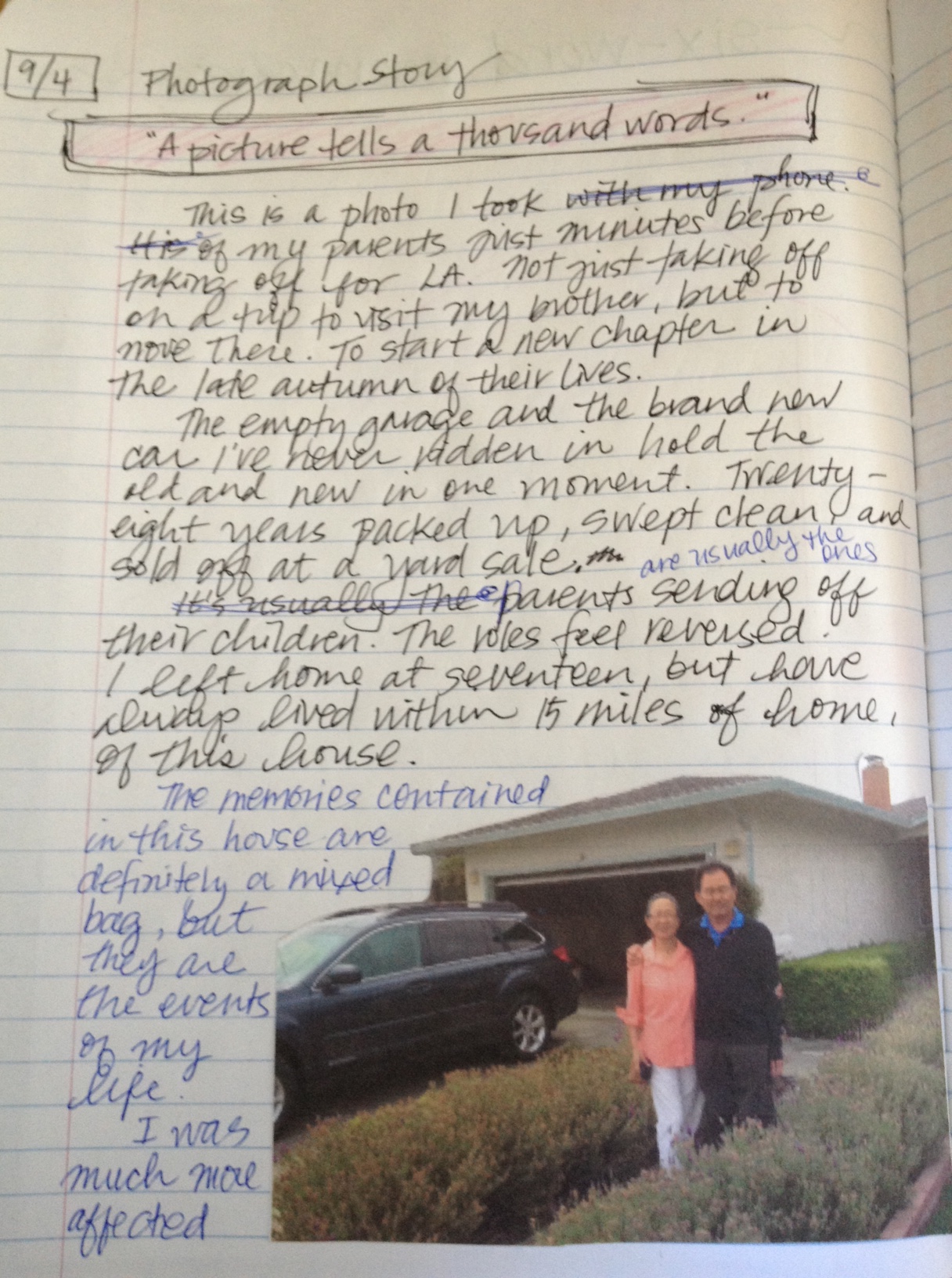
photo-1Taking that first step has made it easier for me to continue writing authentically with my students. This summer, I circled around the topic of my parents moving away, the difficulty of my relationship with my father, and the “grief” of saying goodbye to my childhood home. I wasn’t ready to write about it then, but I began to today. I’ve experienced personally how courage begets courage, increasing connection and building community. Accepting the challenge to write through my vulnerability, rather than resist it, has signaled to my students that it is safe for them to go there as well. And though I haven’t won over everyone yet, there are definitely some who are beginning to take the risks to tell the stories that matter to them.  The stories only they can tell.

*You will get used to some of my go-to initialisms! 

Reel Reading for Real Readers: Pride and Prejudice

20130207-190708.jpgSome of my colleagues might think I am anti-classics, but this is assuredly not so. I just hate how we commit what Kelly Gallagher calls Readicide by reading them to death in English classes. Pride and Prejudice by Jane Austen is my all time favorite:  book and movie. The characters speak to me, and I’d know them on the street; I’ve read of them so many times. I even fantasize about living in turn of the century rural England. Well, maybe not fantasize, but I would like to travel to the English countryside someday.

Official Movie Trailer:  Pride and Prejudice

I want students to read this book. I do not want them to hate it. Therefore, I will talk it up. Quote some characters, show them this movie trailer, and offer a bribe or two if I have to: “I’ll bake you tiny cakes and bring you tea.” Whatever.

“My good opinion once lost is lost forever.” — Darcy, Pride and Prejudice

Do you remember that scene in You Got Mail? Meg Ryan’s character has praised Elizabeth Bennett and in subtle ways thrown down the challenge to Tom Hank’s character to read the book. He tries. For her. It’s the sweetest thing ever.

My daughters and I love all things Jane Austen. When the movie Becoming Jane came out, we were on a girls’ trip in Florida where the drivers love their horns, and we shook hands with a young man named Mr. Stubbs who was missing half a finger. The four of us walked into the movie theater, and we waltzed out humming the score and discussing literature. This mother’s perfect evening, surrounded by loving daughters who talk about books.

I’m all about building relationships with my students. By sharing my love of Pride and Prejudice with them– and why I love it, they will see a glimpse into me. The me outside the English class. The me who loves being a mom. Who goes to the movies. Who takes her girls to Florida on vacation. Who finds irony in people’s names.

If my students know me, I have a better chance of knowing them. Books and literature are so much more than reading material.

So, let’s play a bit here. What’s your favorite CLASSIC text, and why?

Students Want Simple Things from Teachers

"Love all, trust a few, do wrong to none." ~William Shakespeare

Our Compass Shifts 2-1Start slowly. Ease into it. Take the time to let them trust you. Breathe. Relax. Make sure they know that more than anything they matter. I’ve told myself these things every August as the new school year starts, but I don’t listen. Ever. I am always in a rush. Jump in. Get them working. Show them who’s in control.

No wonder the past few years have been rough:  I took too long to build relationships.

This week I’ve done it differently, and I can already tell a difference.

I have not done the get-to-know you bingo games, the list-your-favorite-things cards, the 2 true/1 lie, or the numerous other “relationship building” activities that rise in the back-to-school Google searches.

I have asked students to write. And I’ve written with them. And we’ve shared.

The first day of school I showed the beautiful video of Shane Koyczan’s poem “To This Day.” We didn’t talk; I simply asked students to respond. They wrote on note cards for five minutes and told me what they thought about name calling, bullying, loving the inner person. I then asked them to flip the card over and on the back tell me why they think I chose that poem, of all the millions of poems available, for the first day of school. They thought and wrote, and I set the expectation that we are a community of writers on the very first day.

I read their responses that evening, and I learned a few things, and a few things made me cry:  the death of a father this summer, the loss of a brother, and the abuse experienced by not one but two of my girls when they were younger. The hurt is still raw. I felt it in their words, and I am honored. They trusted me with their hearts the very first day.

Every day this week I’ve read a poem or a quote or a story, and I’ve asked students to write their thoughts in their notebooks. I wrote along with them. I modeled re-reading and revision. I shared my thinking, and I shared my words on the page. Then I asked if students felt comfortable sharing. Many did.

Yesterday we read the poem “Days” by Billy Collins. I did a quick mini-lesson on imagery and personification, and then I asked students to think about a day in their lives that, if they could, they would live over. Sad day. Happy day. Any day. Just choose one and write. We wrote for five minutes.

I shared first. Or, I tried to. I wrote about my mother, and I got so choked up in first period I could not speak. My students saw me vulnerable. They saw my hurt, and they poured out their sympathy. If there’s anything magical about my mother’s illness, this was it. The bond of our relationship cemented with my tears.My notebook Days

During 5th period, one of my girls volunteered to read her response. She began with something like “It was the day I saw my mother for the first time in three years. We hugged and laughed and cried.” Then she began to sob. The class stilled. Silence. Silence. And then soft snickers. I know students were uncomfortable; they are freshmen after all. I cautioned them about respect, and reminded them of the safe place we are developing as readers and writers–the place where we take risks and trust others to understand. I spoke gently but sternly as I made my way to my sobbing young woman and rested my hand upon her back. “Be kind,” I said, “and please be patient. Let me tell you about my experience in first period. I cried . . . because I miss my mother.” My tears spilled over, and this group of 14-year-olds saw my hurt, too, and we all grew as a community.

It’s Friday afternoon, the end of the first week of school. My feet ache, but I am happy.

Students want simple things from teachers:  kindness, patience, a listening ear. They want to share their hurts, fears, hopes, and dreams. They need to know we care enough to let them.

And, guess what? Students will WRITE when we give them the opportunity to write what they feel. I can do a lot of teaching with what they’ve started in their notebooks this week.

Best blessings all my teacher friends. I hope your school year looks to be as bright as mine.

If you have other ideas for relationship building, please share. I’d love to know what works for you.

Reel Reading for Real Readers: Columbine by Dave Cullen

20130207-190708By far the best book I read this summer was Columbine by Dave Cullen. As part of my class at #UNHLit13, I chose to read this book and study it for craft with three other teachers. Maybe that’s why it’s my favorite.

I’ve been in book clubs before, and I’ve had my students conducting literature circles for a long while now, but I’ve never experienced the power of studying a book like this one.  Maybe it was the subject matter. Maybe it was the amazing group of professionals who were invested in the process as much as I was. Whatever it was, Dave Cullen has crafted a masterful piece that moved me.

I want my students to experience this kind of emotion when they read a book. I also want them to see the art in crafting language. (I’ll use excerpts in mini-lessons throughout the year.)

These are the first clips I will show my students this year, and I guarantee my copy of Columbine will land in a student’s hand, and the waiting list will start out long. I better prep the school library to get their copy ready, too.

Tech Tips #306

Image

Regardless of who initially coined the phrase, “A picture is worth a thousand words,” the fact still remains that a single photo can uniquely capture the essence of a single moment in a way unlike any other medium. The Guardian Eywitness App, also a website, is a tool I loved using with students. Taken from all over the world, the photography shared in this app is simply breathtaking.


Image

Here are a few ideas of how to utilize this resource in your classroom:

  • Writing Prompts – Often students are stuck, or scared of the blank page. Have students describe what they see, explain how a photo symbolizes them, or make up a story for what is going on in the photo.
  • Narrowed Focus – Students struggle with wanting to write stories some call, “bed to bed stories” because the story includes too many surface level details and not enough time is spent on the meat of the story. Having students write only about what they see in the photograph forces them to focus and expand on a specific detail of an event.
  • Discussions of tone and mood – or any literary element for that matter. It is quite helpful to students if they can connect visually to an idea and then take that concept back and apply it to what they are reading or writing.

What are some ways you have used photography in your classroom?

“Why Should I Trust You?”

Our Compass Shifts 2-1Every year at this time just as I’m about to focus on, and plan for, this upcoming school year; I remember a very powerful moment I keep with me – always.  This moment, and more specifically this very innocent yet profound notion, continually resonates with me.  I make sure to put myself back in my Day One shoes, standing in front of my class comprised solely of eager male high school freshmen looking to challenge me, test me, but ultimately, accept me (as their educator).

*****

“Good Morning!  I’m Ms. Bogdany.  I am…”

(And we’re off!  This introduction (being oh-so-carefully crafted and rehearsed) had a very distinct mission: do not lead on to the fact that this moment marks your very first day educating in Brooklyn, one of the five boroughs of New York City; the most comprehensive public school system within the United States.  Breathe.  Just keep breathing!  You’ve got this!)

As my introduction was coming to a close, it was time.  Questions.

“So, does anyone have any questions for me?”

At that, I see one particular student’s hand confidently emerge into the air.  This unique student coolly, and wildly presuming, asks:  “Why should I trust you?”  (Wait, Wait, Wait.  Wait!  No one prepared me for this!  Ok.  Just keep breathing, Erika…I mean Ms. Bogdany.  I mean…   Breathe and answer the question.  Quickly, all eyes are on you.) 

I found myself simply replying, “You shouldn’t.” (Did I just say that?!)

 At that, he put his hand down, smirked, and the weight in the room (for all of us) lifted.  The truth surfaced.  I realized what I just admitted.  This unique student was satisfied.

 *****

Throughout the years, I’ve come to realize that Day One truly defines and shapes the journey we all embark on together as a class community, so I need to be ready.  While each year presents unforeseen opportunities and obstacles, I ask myself endless questions before the school year even commences; before I know who my students are; and way before I know how our community is going to function as a whole.  Annually, I will probably continue to do so; yet I always end up finding my way back to this guiding, eight-year-old question, “Why should I trust you?”  Once this question rests its reassuring presence on my question-filled mind, I settle back into the comforts of the same revelation: It’s simple, in order for students to trust me, I need to trust myself.

Disclaimer:  Starting the school year needs to feel authentic…for students and educators alike.  In answering my student’s question for him and the students in that same class; and for all of my students to come…I am not certain of much, but I am certain that the following three intangibles prove to create trust among all of the communities in which I have been fortuitous to be a part of.  For me the most authentic success resides largely within the art of teaching, not the science. 

Create the classroom you’ve always dreamed of!

See beyond the institutional green walls and peeling paint.  Do you see the mismatched desks, tables, chairs, bookshelves…?  You shouldn’t.  This is your canvas so paint it.  There are limitations to all of our working environments, and we know it.  Take charge…change it around…move things…turn things upside down…whatever it takes.  Students know when we’ve invested our time and energy into our shared space; and they are appreciative of it.

Students are less resistant to become a part of a class community when they know educators are doing the best we can to make them feel welcomed in a space that lends itself to learning, teaching, challenging, questioning, struggling, and movement.  Give them the paintbrush, they’re sure not to disappoint.

Where’s the library?!

The inquiries students have about the world never cease to amaze me.  They internalize their own struggles, or struggles of their families and friends, and don’t often know how to process what they’re experiencing.  Hill Harper guides our young men and women via Letters to a Young Brother and Letters to a Young Sister as Esmeralda Santiago does in When I was Puerto Rican.  Other times students want to explore worlds beyond their own; they want someone to guide them through the land, culture, religion…differences.  The Alchemist by Paulo Coelho takes them on quite the journey.  Sometimes students want to just escape; don’t we all?  Speak by Laurie Halse Anderson is comical, relative to students’ lives, and wildly crafty.

Despite the content area in which we educate, it is powerful beyond measure to have literature lining our walls, stacked on tabletops, and accessible to students.  Teaching math this year?  Stock up on biographies of mathematicians such as Emmy Noether: The Mother of Modern Algebra.  Science educators, have you thought about The Hot Zone by Richard Preston or The Last Lecture by Randy Pausch?  Art and Music educators, books with visuals, lyrics, memoirs, and struggles of artists (of all kinds) are empowering for our young emerging artists; it makes it real.  Howard Sounes takes on an enlightening journey with Down the Highway: The Life of Bob Dylan.  History.  Non-fiction heaven!  Night by Elie Wiesel, A Long Way Gone by Ishmael Beah, The Autobiography of Malcolm X by Alex Haley.  There are more…

Make a decision! 

There are so many unknowns we face daily as educators: We take risks before we even realize we’re doing so.  We find ourselves as the ‘go to’ when we know we don’t have answers.  We internally battle if students should leave their ID card in return for a writing utensil.  We wonder when to push a student verse when they have truly reached their limit (for the time being).  We grapple with riding the waves of a ‘teachable moment’ or tossing aside our planned lesson.  We all know, the list is endless.

Rest assured.  When we allow ourselves to make decisions we are giving ourselves permission to trust ourselves.  We are setting the tone for students that while decision making can be difficult, we must trust ourselves in the process, and make students privy to the journey through this process.  Because here’s the reality, when we model our own decision making, students start to follow our lead.  When we exhibit our ability to be independent thinkers and change agents, students are inspired to do the same.  Before we know it, students are showing us the way.

And so, as we all gear up and find ourselves in the midst of the ‘get ready whirlwind’; let’s think about how we can answer (so our students don’t have to), “Why should I trust you?”