Category Archives: Readers Writers Workshop

“Give Jack he jacket”: Teaching Student Writers How & Why to Give Credit by Tosh McGaughy

Before a recent literacy conference in my state, an educator I follow, Lois Marshall Barker (@Lit_Bark), tweeted a popular phrase from Grenada, “Give Jack he jacket.” She was reminding everyone to cite their sources in presentations, and I fell in love with the phrase. Though ethical and academic standards for copyright, plagiarism, and citation have been a part of our literary world for centuries, the instantaneous access to seemingly infinite resources and information of the internet generation has changed the conversation. While formatting those citations in my youth required purchasing the latest edition of the required style guide, now students can easily use digital sites or add-ons to do the formatting in just a click. What have become the more crucial skills to teach are discerning the credibility of the sources that are being cited and avoiding plagiarizing the ideas of others.

Teachers and librarians are teaching critical inquiry lessons to help students learn to evaluate the deluge of information available to them in simple browser searches. A quick Google search will yield many excellent #fakenews lessons. Both Common Core and other state standards include evaluating sources, avoiding plagiarism, and citing properly. While many educators consider these to be College and Career Readiness standards, given the meteoric rise of social media as a news source, these standards actually deserve to be labeled “the most essential standards”.

As “the most essential standards”, the ideas of evaluating a source or author and then giving accurate credit (Give Jack he jacket) must be taught explicitly and modeled with every different piece of text that students are invited to interact with in the classroom. Teaching these standards only when students are doing a research project or paper isolates or compartmentalizes these fundamental skills when they are truly skills that all literate adults must master in order to navigate the inundation of digital information that is at our fingertips or in our feeds.  

With the open access to information that technology provides, plagiarism now can be a simple act of “cut and paste”, so understanding the ethical reasons for avoiding plagiarism and giving credit to authors must be an on-going, face-to-face, teacher-student conversation. Writing conferences provide teachers with many quick opportunities to check-in with students throughout the writing process, and these conversations can grow ethical student writers in deeper ways than simply paying for an expensive on-line plagiarism checker and rarely talking about or modeling how to avoid plagiarism. If only for this one reason, secondary language arts teachers have to find creative ways to make a routine of writing conferences.

As a parent of teens, I have had many conversations about “right and wrong” with my own children who have grown up in a very different world (technologically speaking) than I did just 25 years ago. Heated debates about finding and downloading “free” movies and books on-line has helped me understand how crucial (and frequent) these discussions must be in classrooms, too. The teen default response,“Everyone else does it”, really does seem to apply in this instance, but I firmly believe that teaching “right from wrong” does work when done repeatedly, systematically, and relevantly. And, I think these “most essential standards” must be taught by one writer to another writer and not simply relegated to a digital algorithm that “checks” for less-than-ethical choices. 

Please share (in the comments below) your best lessons and resources for teaching how and why to avoid plagiarism. 

A few resources:

Commonsense Media CultofPedagogy AMLElesson

PBS Learning Media NYTimes Anti-Fakenews Apps

Allsides.com The Flipside Snopes.com

Crafting Compelling Claims: A Lesson With Loose Parts (inspired by Angela Stockman)

I first heard about “making” in a writing workshop a few years ago and to be honest, I was skeptical. It felt like busy work. Sure, it would be engaging, but weren’t we already doing the work of making in our writing workshop?

Then I discovered Angela Stockman. I started following Stockman a year or so ago and have been percolating on her ideas around Hacking the Writing Workshop for about that long. I thought it looked interesting, but I wasn’t quite sure how to incorporate the work into the secondary classrooms that I support as a literacy coach.

Then last month Stockman, who is one of the most generous educators online, started posting about how to use what she calls loose parts to support argument writing. The teachers I was working with were getting ready to enter a new round of argument writing, so I followed Stockman’s posts eagerly.

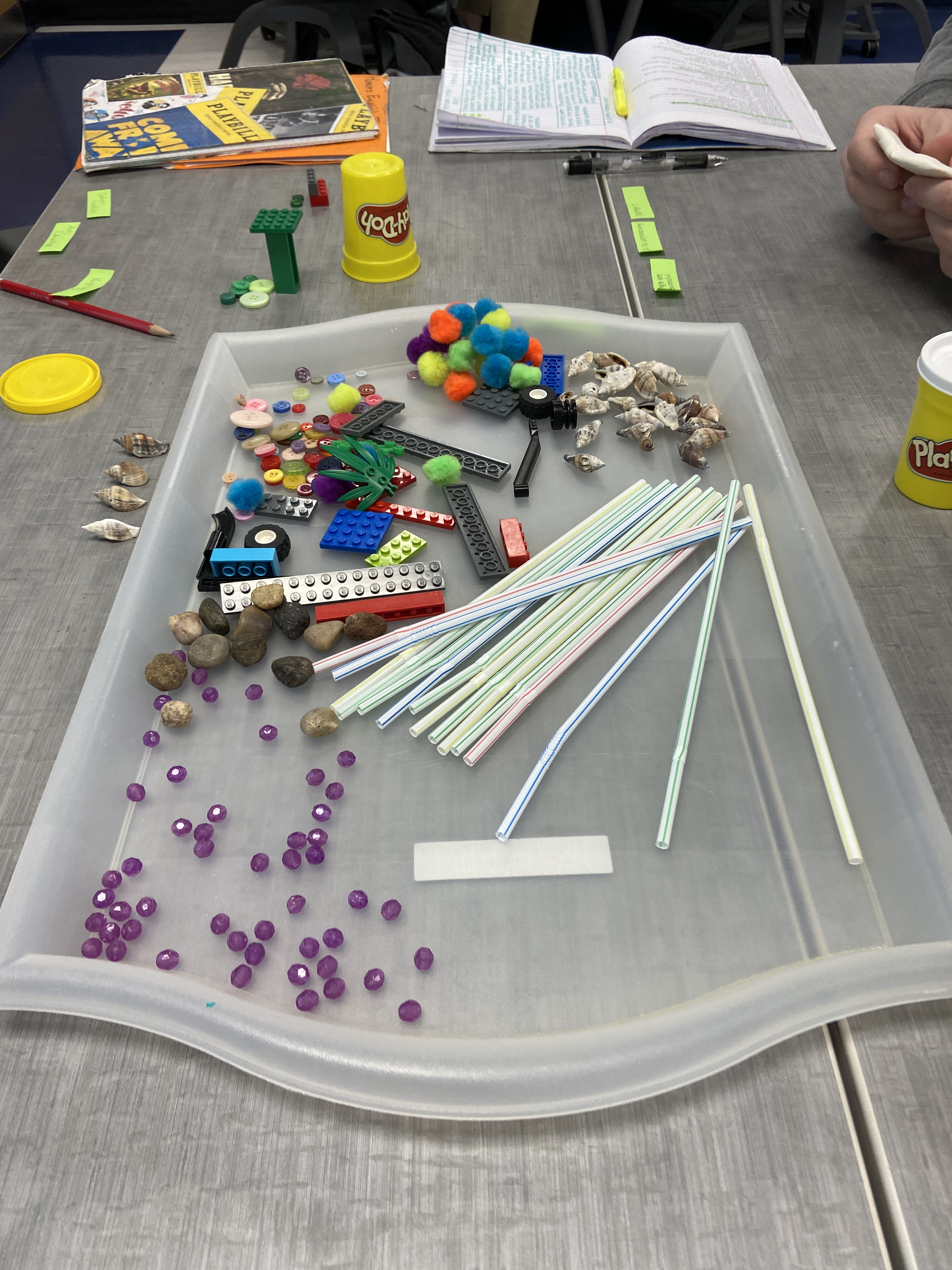
When Stockman shared images of students using loose parts to find their way into arguments, lightbulbs sparked. Partnering with a few willing teachers, we decided to see what would happen. I hit up the Dollar Tree, stocking my basket with bags of shells, rocks, toothpicks, and q-tips. I raided my son’s Lego collection, and pilfered the play-doh basket in our closet. I added beads and buttons. We were all set.

“Today we’re going to play with loose parts,” I explained to the sophomores that morning. I invited them to explore what was on the tray in front of them. They looked at us wide-eyed: “are we playing with play-doh?” Every kid who cracked open the can lifted the dough to their noses and breathed deeply. They let beads filter through their fingers. They began sorting buttons and shells. The joy on their faces as they explored was something we’ve gotten too far away from in high school.

IMG_0402

Each group of students received a tray of loose parts to begin their claim writing.

The students had already generated ideas around argument topics — they’d written beside Wislawa Szymborska’s poem “Possiblities.” They had made quicklists. They had mined their notebooks for patterns.

After letting them explore the loose parts, we gave them three post-it notes to pull out topics that were ripe for argument. They scribbled their topics down: global warming, school funding, screen time, recess for high schoolers, vacations. The topics were as varied as the students.

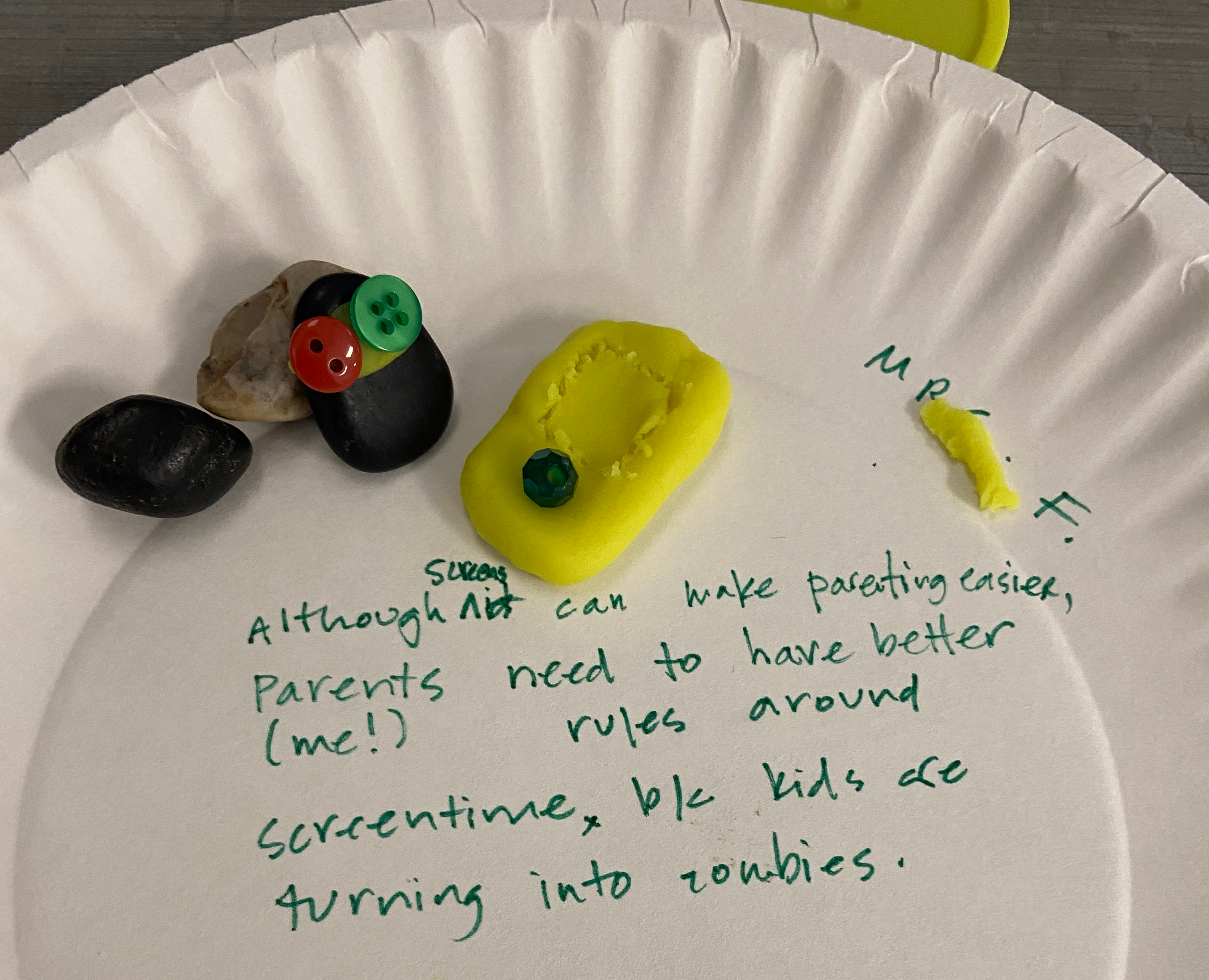
“Now,” I began, “we are going to use these loose parts to write a claim.” I had, as Stockman recommends, been walking around with my own fistful of playdoh. I shaped it into the shape of a phone. “Remember how I said I want to write about how much screen time I let my kids have? Well, I’m making this into a phone.” I held up my sculpture. “What could I add here to communicate my claim?” Students offered ideas.

IMG_0432 2

My claim developed from my topic about giving my kids too much screen time.

And they were off. These kids got it. They began to dig into the trays, shaping clay, piling buttons. Frankly, we hadn’t been sure what was going to happen. As they often do, the students blew us away.

We circulated the room, nudging students to add nuance to their creations. We asked probing questions. “What could you add here to communicate that idea?” We asked for clarity and students knew what to do.

I watched one freshman add details to her sculpture and then scribble more thinking onto her post-its. She had started with the idea that locally, too many new houses were being built. She used q-tips to create homes. She decided to add gray legos. She took a moment to look at the composition in front of her. Then she went back to her post-it, adding the layer about pollution. I was inspired.

We noticed that this lesson did something we didn’t expect. Over and over again, we noticed the students were developing sophisticated claims. This work helped us teach something that had been elusive about argument writing — how to develop a nuanced claim. Using learning from the National Writing Project’s work around argument writing, for years we’ve been teaching students that strong claims are debatable, defensible, and nuanced. The first two qualities were easy to teach. That third one had been trickier.

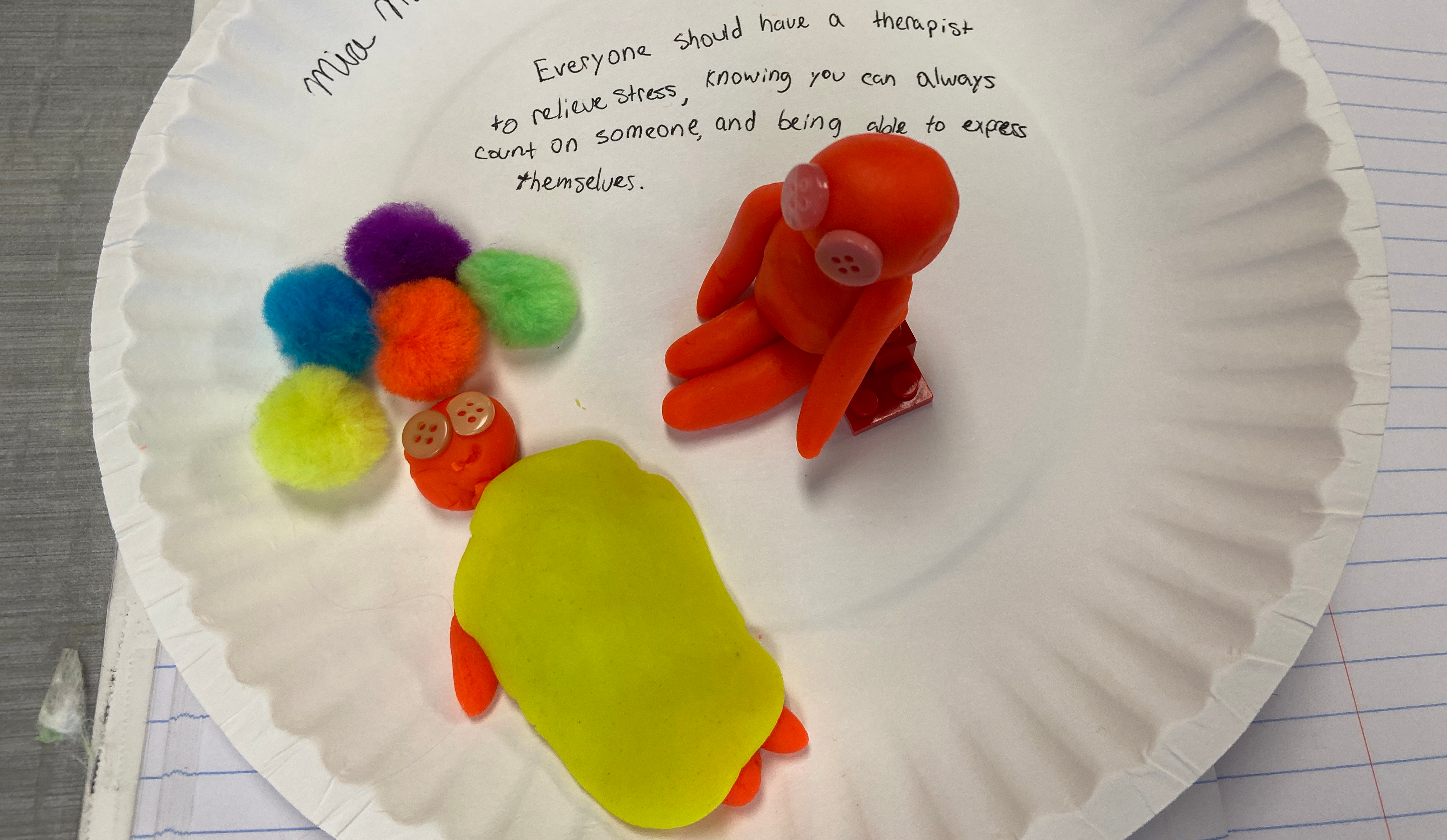
IMG_0423 2

This student started with a topic “The benefits of therapy” and ended up with the claim “Everyone needs a therapist to relieve stress, knowing you can count on someone, and being able to express themselves.” 

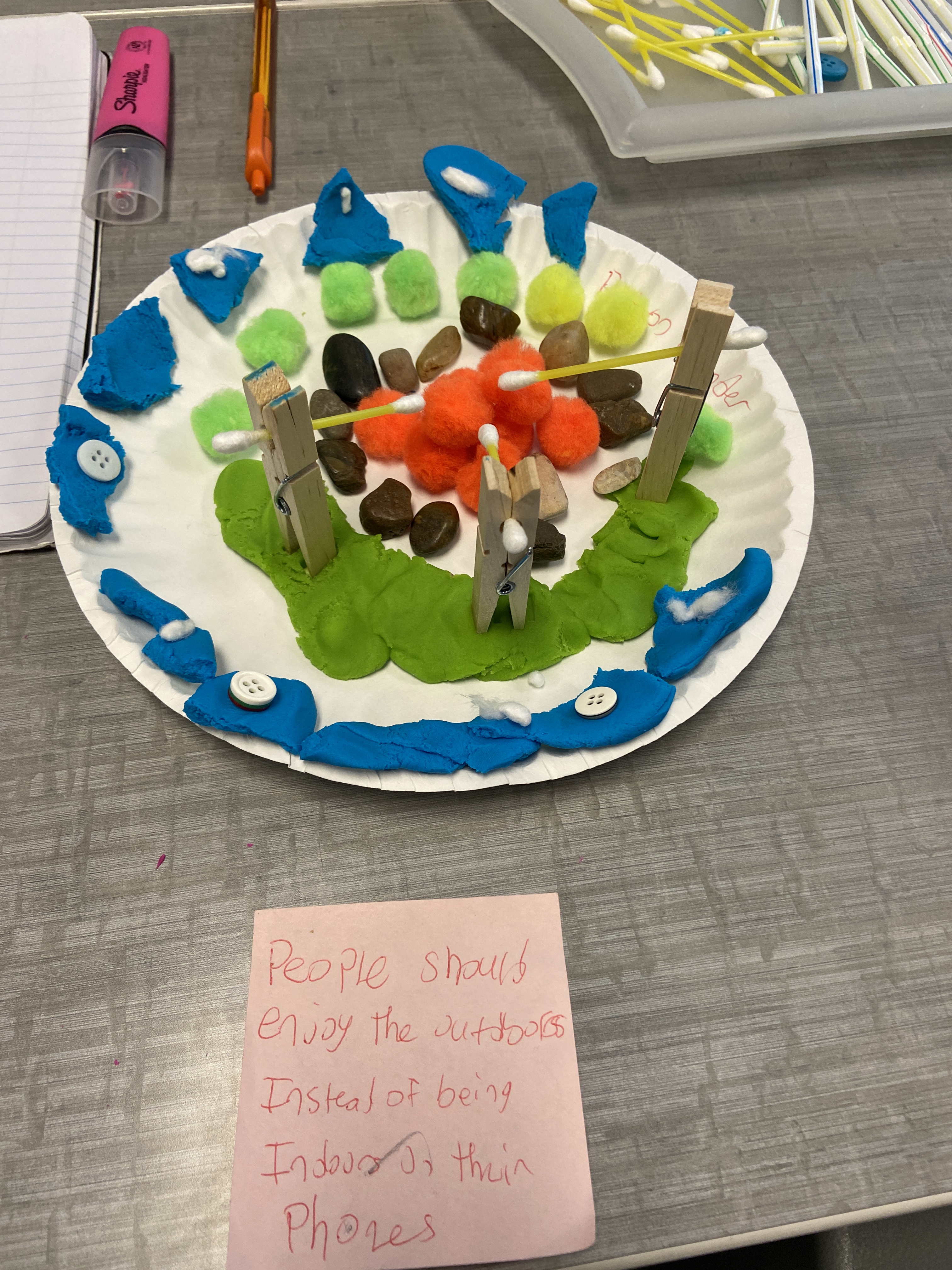
IMG_0422 2

This student started with the topic of “screen addiction” and worked his way towards a claim “People should enjoy the outdoors instead of being indoors on their phones.” 

The loose parts were key.  Suddenly students were digging deeper into their thinking. They were thinking through implications, making considerations, and adding layers.

After about 15 minutes, we asked students to start to put words to their compositions (see Shawna Coppola’s latest book Writing Redefined for more about honoring non-alphabetic ways of composing). Their claims were some of the strongest we’ve ever seen. They were debatable. They were defensible. They were nuanced.

“This is the most fun I’ve had in English class all year,” one student declared.

I am convinced that making has a place in the writing classroom. We writing teachers need to crack open what we mean by “writing” and honor all types of composition. We were validated when students at all levels were both engaged and successful.

Angela Faulhaber is a literacy coach in Cincinnati, OH. 

Poetry Out Loud

As a teacher, we tend to teach what we like and what excites us.  As I confessed before, poetry is hard for me to get into.  I get more jazzed up over nonfiction or an engaging book.  But this year I have pushed myself to be uncomfortable with poetry at times because my students need and deserve poetry.

And you know what, so far so good.  I have enjoyed the challenge of challenging my teaching range and comfort.

This year, aside from dissecting and discussing poems for the AP Lit exam, we have written beside poems like “Desiderata” and “Lost Generation.”  We’ve watched spoken word performances.  We have written poems about our names and heritage.  We have discussed thematically related poems in small and jigsawed groups.  We have created Book Spine poems that connected to another work of literature.  We have found and shared poems connected to our independent reading as a way of book talking those books.  We have read poetry for the sake of hearing words and enjoying them.  We have also participated in the annual Poetry Out Loud competition.  

Screen Shot 2020-02-05 at 1.40.47 PM

As a national competition sponsored by the National Endowment for the Arts, Poetry Out Loud has been around since 2006, with the goal of promoting exposure and participation in poetry and spoken word.  Simply, it is a recitation or performance competition that begins at the classroom level with students reciting one or two poems, then progresses to the school, regional, and possibly national level. When started in 2006, only classic poets (think Dickens, Dickenson, and Front) were featured, but the program has since expanded greatly with hundreds of diverse, living choices for students to recite.

My school participates each year, starting at the classroom level.  Top performances from each period are then selected to compete among their peers in the same English class period (freshmen through seniors), with the top performances then competing at the school-wide assembly.  The winner of the school-wide assembly, which is judged by a panel of non-English teachers with Poetry Out Loud’s official rubric, goes on to represent our school at the regional level, possibly national.

While many students are shy and hesitant to perform in front of their peers, the competition has great benefits.  

  • It is a unique way to incorporate speaking and listening standards and a related performance task.
  • There are ample mini-lessons to incorporate with each student’s choice of poem you can pull from your poetry teaching archives or the website.  We researched the poets and their inspiration, examined how diction creates tone, where to place emphasis when performing, and how one creates a verbal tone that mirrors the message of the poem.  
  • The entire competition is student-centered and differentiated–students are selecting the poems, working to understand their poem beyond memorizing the words, and performing the poems.
  • The competition cultivates an appreciation for performed poetry and exposes all participants, myself included, to new poetry.  This year, I really loved hearing new poems. Some of my new favorites: “How to Triumph like a Girl” by Ada Limon, “The Delta” by Bruce Bond, “The End of Science Fiction” by Lisel Mueller, and our school’s winner, “Rabbits and Fire” by Alberto Rios.

While I still have more ideas for more poetry in the classroom–mimicking a style or genre, weaving a poem with original art, creating blackout poems, crafting poems from chapter titles or lines–Poetry Out Loud adds another dimension to poetry in the classroom. 

Check it out and put it on your school’s calendar for January 2021!


Maggie Lopez is currently reading “Bringing Up Bebe” and “The Coddling of the American Mind” as she awaits her baby girl in April.  She will be taking a hiatus from writing for the blog, but looks forward to reconnecting in the fall.

Embracing Joy In the Classroom by Sarah Krajewski

When I was in high school, I planned to become an architect. I took all the technology classes I could and found joy in them all. Why wouldn’t I, when I had a teacher like Mr. Johnston. His passion for his subject was palpable, and his sarcastic sense of humor made me want to crack the quiet shell I had formed around myself. Each day, I entered that room knowing I would be working, but it wasn’t the kind of “working” I was used to at school. I was building and drawing as I bopped along to music, and, yes, I was still learning. I felt true joy in that room.

When I think back to the other classes I loved in high school, they, too, incorporated joy. I savored the variety in those safe, energetic rooms. I created projects, performed chemistry experiments, and utilized the artistic freedom I was given. I had fun.

Here’s how I attempted to replicate that joy in my classroom:

Liven up the look of the room. Students need to walk into a classroom and feel joy. Recently, I saw Ingrid Fetell Lee’s 2018 TED Talk called “Where joy hides and how to find it,” and she mentions “sensations of joy,” which focus on bright colors, round objects, and symmetrical patterns. I needed that in my tiny, cramped room, so I asked my students to share their suggestions. Now, I have a gorgeous, vivid book mural and round tables instead of desks. Bookshelves line the walls with a wide variety of titles. My classroom is certainly a work in progress, but when my students tell me they enjoy spending time in it, I know I’m doing something right.

Autonomy is a must. When my students know they have choice in what they read, they read more. When they have choice in what they write, they write more. They will see reading and writing as joyful. It really is that simple. I can still challenge my students, but in a mode that works best for them.

Connect through talk. Choice can lead to an innovative, and often powerful, voice. We must talk to our students. I ask mine questions, but, more importantly, I encourage them to ask me more. As proven in this UK study, young elementary students are full of questions, but that curiosity often disappears by the time I meet them in high school. I aim to bring that curiosity back. It all starts with making connections. I put myself on display, often writing on the fly, right in front of them. They know my struggles are real, but that’s what makes me human. When a student has a rough day, we talk. We discuss. We connect.

Add elements of surprise. Though Spring in Buffalo is often not until late April or early May, I can’t wait to take my kids outside to read and write. Yep, I’m talking about high school freshmen and seniors. Let me tell you, beautiful, tangible joy is on every face! We all need a change of scenery sometimes. It’s a welcomed surprise. When I am not the one who can be the “expert” on a given topic, I bring one in who is. Authors, activists, and journalists have come in to speak with my students. They enlighten, encourage, and inspire them.

When joy is apparent in a learning environment, we will see growth and success in our students.

Sarah Krajewski teaches 9th and 12th grade English and Journalism at Cleveland Hill High School near Buffalo, New York.  She is currently in her 18th year of teaching, and is always looking for new, creative ways to help her students find joy in learning, reading, and writing. You can follow Sarah on Twitter @shkrajewski and her blog can be viewed at http://skrajewski.wordpress.com/.

The Rollercoaster of a Teaching Career

Last week, I began a new teaching assignment–the seventh in my career.

As I familiarized myself with my new role, new students, and new colleagues, I couldn’t help but reflect on how many turns my teaching life has taken over its twelve year span.

RIP the Vortex, my first looping rollercoaster

I once heard Penny Kittle refer to her ideal reading life as a rollercoaster–some easy, downhill books; some tough, uphill climb books; some that make you want to puke and abandon the ride; some that make you scream with exhilaration and joy.

My teaching life has been a lot like that: a rollercoaster of good years, hard years, long years, and fast years. It’s been a wild ride of new states, new schools, new colleagues, and new subjects. It’s been difficult, and fulfilling, and exhausting, and uplifting.

My rollercoaster teaching life, as full of ups and downs as it is, is a ride that I don’t see ending anytime soon. In fact, as my personal life settles down in the next few years and my husband’s job will no longer require us to frequently relocate, I hope to see some of the bumps and hills even out.

And as much as I loved rollercoasters as a teenager, I’m getting older. I’m ready for a smoother ride.

As a teacher, this means cultivating a sustainable, healthy practice that allows me to feel comfortable and confident as a teacher, while also providing enough excitement and novelty to keep me engaged and interested.

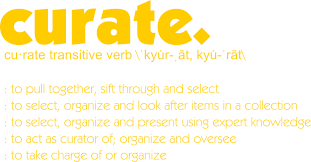
My One Little Word for this year is curate, which I hope will keep me focused and restrained. I’ve been concerned about the health of my teaching practice for a while–my classmates in a summer NWP course noticed that I have a penchant for trying to do/read/learn/investigate/accomplish way too much when it comes to teaching. My friend Chris gave me this invaluable advice: instead of learning more, curate my inquiry process. Hone it. Sharpen it.

And it’s been so helpful, to feel allowed to do less–to make it a goal, in fact, to say “no” more often, or click “save for later” in my Amazon cart for that newest teaching book, or keep thinking about how to improve the depth of my reading instruction without worrying that I’m dropping the ball on writing.

The truth is, teaching is an unsustainable profession if we don’t give ourselves permission to curate. When I was brand new, single, and 21, I relished the fact that I beat the principal to school every day. I loved spending 12 hours in my perfectly-lit, freshly-painted classroom.

But now that I have children, a home, and a slew of other responsibilities to care for, I have to curate. I may not have the most Pinterest-worthy classroom in the future. I may not have the neatest classroom library; I may not sponsor three clubs; I may not volunteer to be on all the committees. But I will be able to do the work I love, which is having a life that allows me to take my daughters to soccer practice and read my students’ fascinating essays from the sidelines.

I hope that this year is a year in the rollercoaster of your teaching life that you enjoy–whether you’re hurtling down the big hill, looping with abandon, or slowly creaking up a steep slope. I hope that you’ve thought of one little word to help focus you, and that it helps you enjoy this year’s ride.

Shana Karnes is enjoying the ride this year with her 9th graders in Wisconsin. She looks forward to moving one last time, to Columbus, Ohio, where she hopes to curate a life that balances teaching, family, and fun. Connect with Shana on Twitter at @litreader.

5 Takeaways from #TCTELA20

Last Monday I made my way up to school fearing the worst. Missing one day of school is stressful for most of us, but missing two days meant that I needed to prepare myself to return to a classroom that needed to be reassembled. I imagined paper strewn floors, piles of books randomly placed around the room, and desks askew if not overturned.  I must have had the two best substitute teachers of all time. The room looked immaculate, the work I’d left for the students sat neatly stacked on my desk.  Both notes reported students who worked hard and followed instructions.  I can’t say enough about how much returning to a well run classroom helps me feel better about missing work to attend a conference.

The 2020 TCTELA Conference left me feeling empowered and excited to return to my classroom stronger than I left it.

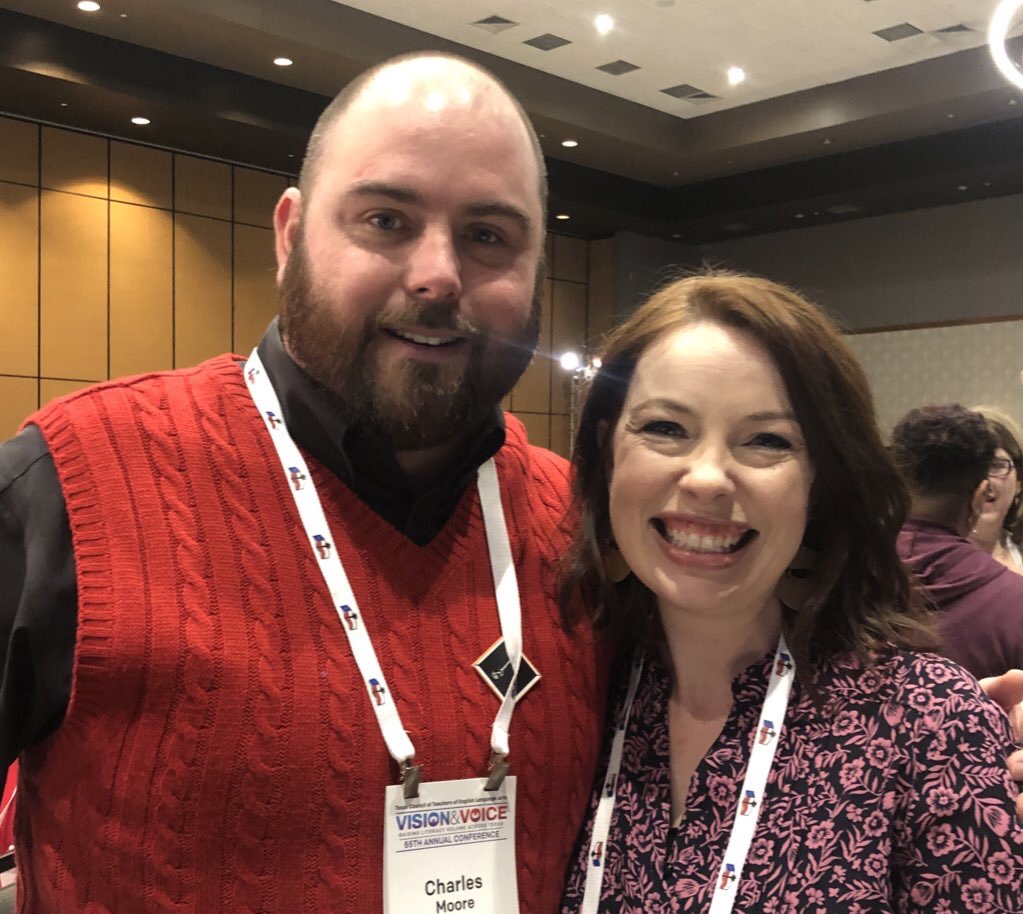
Oh, and I got to meet Rebekah O’dell.img_6255

Several of us on the board agreed that we would answer Rebekah’s call to share our voices through our writing.


Thus, these are the top five takeaways from the 2020 TCTELA Conference

  1. Clarity

    One of my goals for this conference was to visit as many sessions as possible. I bounced in and out of the morning workshops and the concurrent sessions, and almost every speaker talked about or touched on the idea of clarity.  This subject, one I’m learning more and more about each week, is emerging as an area of interest for many of us. Research tells us that teacher clarity has a huge effect size, and I’m excited to see this shift in focus moving forward. The clearer we are in our interactions with our students, the greater our chances of helping them grow in their literacy.

  2. Collective Efficacy

    Saturday morning, sitting at the High School section meet-up area, I kept noticing teachers filtering past with the same maroon t-shirts. Later that morning, I saw them sitting a few rows behind me at the general session. As evening approached, I saw this group presenting at the round table sessions. Their presentation shared their experience with FlipGrid, and it just about floored me. I sat in awe of how many amazing ideas they brought to their session and how they made this technology work for them at every level of high school English.  The most impressive part of their presentation wasn’t their understanding of this teaching tool, rather, it was the mutual commitment to their shared goals. The collective efficacy that they brought to the conference impressed me so much that my instructional coach team and I waited only 3 days before meeting with them online to talk about how I could bring their experience into my classroom.  No offense to all my friends out there, but the English department at Silsbee High School is my second favorite.

  3. Practices based in Research

    Over and over again presenters reached beyond their own experience to support their claims.  Our understanding of research continues to grow in importance, and our capacity to fold that understanding into instructional practices must grow as well. The research piece can be daunting for teachers because we have limited time and energy beyond those factors that immediately affect our students. However, the shift to incorporate research based practices into our instructional methodology will affect the learning of our students as much as anything else.

  4. Service over Self

    My role at this conference differed greatly from conferences in the past.  Typically, I’ve focused on presenting with or learning from others, but this time my position as high school section chair meant that more would be required of me. I talked to so many people on Friday morning that my voice failed me by lunch. I handed out buttons and invited people to join the various sections for meet-ups. I visited with presenters to make sure they had what they needed. I shook more hands than ever before.  One of my goals for the conference was to help our attendees feel like they had a connection to the organization, and I did my best to make those connections happen.  This idea is one that we often preach to our students, and it felt so rewarding to live that message.

  1. Choice

    Choice remains at the top of the list of discussion topics.  Besides being a keyword in the title of the conference, every presentation that I saw touched on the importance of choice. I hope this concept continues to spread to classrooms across out state and empower all students to find themselves as readers and writers.  My first adventure into the world of AP Lang has only strengthened my resolve to advocate for student choice and I know that the support for that commitment continues to grow.


Charles Moore looks forward to his new role as VP-Elect for TCTELA. Every day he looks forward to bringing his very best to his students and his school. He’s excited to finish up graduate school and continue to build his professional learning network one conversation at a time. 

Lap One in Research

pasted image 0

When I first read 180 Days Two Teachers and the Quest to Engage and Empower Adolescents by Kelly Galagher and Penny Kittle, I was intrigued by the way they approached planning and teaching within their four essential writing units. Instead of taking the “4 x 4 approach” of four big essays across the school year, they “plan for students to create a series of texts using a progression of skills.” They call this “taking laps around the track” and with each lap, they increase the complexity of skills. They further explain that by completing multiples laps, their students will increase their volume of writing, which will lead to deeper understanding.

Sadly, I was pretty much a 4 x 4 teacher. We took one genre of writing, immersed ourselves in mentor texts, taught minilessons, and produced a piece of writing. We did this with each writing genre required in our state standards. I knew Gallagher and Kittle’s approach to planning instruction would help me and help my students as well. My units are not as in-depth and are not quite structured the same as the units in 180 Days, but we have slowly moved away from the 4 x 4 classroom.

The emphasis on research skills takes a big jump in the 6th grade, so I knew this was an area where I might explore the planning of a unit and where students may benefit by using a series of laps.

I wanted students to master basic research skills while creating a small research project. They were not yet ready to tackle a full research essay. The unit began by teaching them the skills of using keywords to begin a search and evaluating websites. Many students at this age need to understand the difference between searching and “googling a question.”

Once they learned how to find reliable sources, we moved into finding information that was relevant to their research topic and question. Finally, we tackled paraphrasing and summarizing information to use in the project.

The final product for this first lap in research was a collaborative slide presentation that we called an eBook. The mentors we used were the books in the If You Lived Series, in which the books are written in a question/answer format. The is format was perfect for the researching of a short question and when put together with others, became a book. Each class brainstormed times and events they were interested in learning more about, voted on a topic, and chose questions to research. After researching, each student created their own slide using the question/answer format and the information they learned.

This project was small enough to teach basic skills of researching yet a fun way to work collaboratively with classmates while demonstrating their learning. By having students complete this first lap in research, I believe they will be better prepared to tackle their next research project – an argument in an open letter format.


Have you tried planing instruction using laps similar to Gallagher and Kittle? If so, we would love to hear your success story.

Leigh Anne Eck is a middle school English Language Arts teacher who is currently participating in the #100DaysofNotebooking challenge. 

The Humble Pause and Its Possibilities

In my last post, I wrote about the power of one word–how one word might anchor us in meaning and also make steadfast our mission. I decided on pause. 

Truly pausing requires a certain degree of humility–the kind of humility that requires seeking the unique expression of another’s thoughts or ideas, the kind of humility that elevates those expressions, the kind of humility that necessitates low self-preoccupation. I’ve got much to learn about pausing, especially that part about not focusing on my own thoughts and ideas (workin’ on that whole humility thing!). 

Professionally, choosing pause will help me show up better in some collaborative spaces. I can ask myself whether or not my emerging ideas are really that urgent and instead give space for others’ thinking to surface. It will also help improve my one-to-one coaching. Making intentional efforts to pause my mind and my body will signal my dedication to the person whom I’m coaching.  In either kind of moment, I’ve begun saying to myself, “Pause. Wait. Lean back. Look away.” Wait is a necessary reminder because although I sang a wait-time song in my head in the classroom, engaging in dialogue pressures me into continuous contribution. Hence the reminder. Lean back and look away compel me to check the intensity of my body (am I leaning in, ready to pounce on the next idea?) and signal subtly an openness to what comes next. Interestingly enough, in the moments when I’ve actually adhered to this mantra, I feel peaceful, my own thoughts quieted. And then, neat things happen. 

This occurred most recently as I supported a teacher and his College Prep English students. They were working on interviewing one another to uncover a story that would humanize them to each other, using Humans of New York pieces as mentor texts. I relish my involvement in this, both because for a few years I led my College Prep seniors through this and because I had the opportunity to practice pausing.  When my teaching partner and I first began engaging our students in this, we knew that to uncover a meaningful story, our students needed modeling of strong questioning and intentional listening if their interactions were to be meaningful. We engaged our instructional coaches and other district leaders in this intentional modeling.

So, this time I interviewed my colleague while students observed and made notes. They noticed the pausing, observing that I took a few seconds after my colleague spoke, inferring that this seemed to give him space to say all he needed to say. Another student reflected how this differed from other interviews: as the interviewer, I didn’t interrupt when I thought I had enough information. Again–that whole low self-preoccupation thing afforded another person the space to truly think and reflect. Through the dialogue, my colleague’s thinking was amplified, and his self-awareness increased.  Pausing provided the space for this. 

Engaging students in work like creating their own Humans of the Classroom stories prioritizes the importance of listening with their minds and bodies (Charles wrote about the process he follows here). Our students spend ten plus minutes with a partner; one partner interviews the other, asking questions, using follow up questions, paraphrasing, mirroring body language. We urge them to record the interview so that note taking doesn’t interfere with whole self listening. It’s a moment of profound connections in the classroom. It’s a moment that first as a teacher facilitating and now as an instructional coach observing where I can pause, look around, and  revel in its power and beauty.

Microlab protocol is another way to intentionally honor all voices and cultivate the depth of thought that culminates from the humble pause. It is a thinking routine depicted in Making Thinking Visible (and found elsewhere). Here are the steps.

  1. Students begin first by spending five to ten minutes on their own engaging with whatever material, prompts, or questions they need to grapple with. 
  2. Then, students form small groups and number off. 
  3. With teacher acting as timekeeper, the first student shares their thinking, speaking for the entire time while the other students listen and take notes if they feel they will help. No one else speaks. 
  4. When the student’s time is up, the teacher mandates twenty to thirty seconds of silence. The teacher urges the students to mentally review what they heard. IT’S A BUILT IN PAUSE!!!!
  5. Each student in the group has their turn, following the same procedure. 
  6. Finally, an open discussion ensues. 

Using the protocol helps students learn that productive dialogue is just as much about listening as it is about speaking, that a person’s ideas as an expression of that person are worthy and deserve air time, that expression of them allows for pathways to connection, and that fostering those connections elevates all. The pause in the protocol is integral to this. 

As I write this, I find that I’m pausing here to wonder.

What is possible when we teach students about the power of pausing and its role in listening?

What happens if we anchor their classroom interactions in strong listening skills, using activities and tools like these to help them?

What happens, if in this world where some people shout and stomp to suppress the voices of others, we prioritize the pause to inspire just interactions?    

What is possible when we as educators prioritize the pause?

Kristin Jeschke is an Instructional Coach at Waukee High School in Waukee, Iowa. She’s working in all parts of her life to pause more. Having just spent time with her toddler niece and nephew, the voice in her head reminds her to wait, wait. 


Finding More Time…

neon signage

Photo by Ivan Bertolazzi on Pexels.com

My notes for this blog  (notes that I made in July when I was a VERY different person – pregnant, rested, unfamiliar with the work of Mo Willems…) say that I should write a blog about – not focusing on test prep as testing season begins to rear its ugly head. 

I’m not going to write that blog post…yet (growth mindset…?). 

No, instead, I want to discuss how conferencing and station rotations (which Shelby Scoffield wrote about here just a few days ago) are making my return to the classroom from maternity leave a lot less daunting than I feared it would be. 

First, I really hope that non-moms/dads (paternity leave is just as important as maternity leave) didn’t stop reading…give me a few paragraphs and I’m hoping you’ll find there’s something for everyone. 

Here we go –  there’s a lot of stuff out there about GOING on maternity leave: lesson plans on TPT, blogs, questions about finding subs, questions about who should do the grading while the teacher is gone, questions about structure and organization (elementary teachers rock this part)…and lots and lots of ink shed on how important it is to leave school at school to focus on time with your new baby. Let’s just say I tried my best to go full Elsa and let it all go once our little nugget finally arrived. But with my return to school looming, I knew that I needed to start thinking not just about WHAT we would do when I returned but HOW we would do those things. What attitude did I want for my first few days back? What messaging did I want to send my students? And… I haven’t found a lot out there about HOW to return to class. Apparently, it just goes smoothly for everyone, right?

So with all of that in mind and disappointed that the Internet didn’t just provide a magic answer, I decided to treat this return kind of like the beginning of the school year – a fresh start for us all. So I took a good hard look at what was working for this group of students and what needed to change and began to make plans with those thoughts in mind. 

I also knew that I wanted to hear from the students about their progress while I was gone as soon as possible. So I’m conferencing with all 135 students for 10-15 minutes over the next two weeks. At the suggestion of a friend, I offered them the metaphor of swimming to help them prepare for the conversation. I want to know how they “swam” while I was gone. Did they turn into Michael Phelps and just crush AP Lang while I was gone – putting in extra time, going the extra lap, eating multiple pizzas in a day? Did they just tread water – keeping their Lang muscles moving and loose but not really going anywhere in the pool? Did they get out of the pool completely and take up residence in a nice desert somewhere with no pools or water in sight? I’m going to let them drive the conversation for the first part of our conference – here’s where I am – and then take their temperature (I know, I know – mixed metaphors) to see what they need from me in the next few weeks to feel more comfortable. I’ve made a list of the items they covered while I was gone, and I want us to converse in the last few minutes of the conference about the top 2-3 we should focus on together. Plus, I teach neat students, and it’s going to be nice just to catch up with them. A lot has happened for me in the last 10 weeks; I’m sure a lot has happened in their lives as well. I want to hear about it. 

From here, I’m hoping that the conversation with each student will help put them at ease as we start working together again AND will help me figure out where we are as a group. After these “Check-In Conferences” are over, we will begin our regular writing conferences – looking at pieces they wrote while I was out. 

Now – this second stage of conferencing is where station rotations are key. Before the baby, I would get to work around 7 and stay until 430 or so – holding 15ish conferences throughout the day, using most of my time at school to meet with students and then taking home the grading and the planning. I’m not sure I can sustain that pace right away – if ever again. So I need to find time IN CLASS to make conferences work. Enter MCM’s – for the normal person this is Man Crush Monday – for us, it’s Multiple Choice Monday. 

We work a multiple choice passage from released AP Lang tests every Monday. Normally, students take their MCM individually for 15 minutes. Then, they turn to a neighbor and discuss their responses: “I got A for #1 – here’s how I chose that answer. What did you get? Oh, you got B? Let’s figure this out together.” This process can take anywhere from 5-15 minutes depending on the passage.  I give them the correct answers, and they self score. Then they turn back to their partner and discuss just ONE tricky question now that they know the answer. Finally, we regroup as a class and discuss any questions they are still confused about. I rarely do the talking here but ask for student volunteers who got the question right to explain their thinking. Honestly, if we have to do test prep (and we kind of do), this metacognition/discussion/student driven prep is the best method I’ve ever used. 

So, knowing that I needed some class time to conference, I began looking at how we spent our time and where I could work in conferences routinely. MCMs seemed like the perfect place. Here’s my thinking (and any feedback would be appreciated because while station rotations, MCMs and conferencing aren’t new to me, combining them all together is): 

  • Station 1: Students individually take their MCM
  • Station 2: Students chat in pairs about their MCM results – this would be my empty starting station – students can’t complete this station until they’ve done Station 1 obviously. From here, they would either place their MC answer sheets on my desk/in my hands at the end of this station OR grade their own/discuss and then turn their work in.
  • Station 3: Some kind of writing/peer review station working on a skill we’ve been discussing in class
  • Station 4: Conference with me – I think this would be a good time to group students based on their feedback from the “Check In Conference” and work on those skills in small groups.
  • Station 5: Apply what we discussed in Station 4. (For students who start in station 5 – they will do Station 3 work here and then do Station 5 work where other students do Station 3 work. This group will probably be my most self directed group.)
  • Closing as a whole class – we return to the answers and either grade OR discuss as a whole group. 

For all of these stations, I’m stealing an idea from Catlin Tucker about using video directions at each station so students have your overview of each station, written directions AND a video of verbal directions to rely on. I LOVE the possibilities this simple tweak opens up.

This process can obviously be finetuned, but I’m excited to work in small group conferences into my class every week in another routine way while still maintaining my individual conferences at a less breakneck pace. 

Like I said at the beginning of the blog, I was planning on writing something else entirely. I 100% used this post as a place to process some of my thinking. Thanks for following along – if you have suggestions or feedback, I’d love to hear it. Happy Monday!

Sarah Morris teaches AP English Language and Composition, AP Seminar, and Film as Literature in Murfreesboro, TN. She is currently binging old episodes of Jeopardy with her husband like the two little nerds they are. She tweets @marahsorris_cms.


Teacher Identity Matters

This wasn’t the blog I intended to write but one I felt compelled to write. As a teacher consultant, I work in a variety of schools across the nation and overseas. This particular day I was in a school filled with students new to our country, who have tremendous gaps in their literacy backgrounds, and whose parents struggle to make ends meet. In small groups, teachers were discussing their identity as readers and writers.

“I don’t read except for some informational text,” one teacher said. “I just got burned out in college reading all those books I didn’t want to read.”

And who was this teacher? The interventionist. The professional whose job it is to support striving readers: those readers who don’t know how to choose a book, who don’t have the strategies they need to read with understanding, and who haven’t experienced the pleasure in finding a book they love. I wondered how she could instill the joy and love of reading if she didn’t know it for herself. How could she help students develop their identities as readers if she doesn’t view herself as a reader?

Then I heard a teacher in another group say, “I love to read. I don’t think I’ve ever gone a day without reading. And I know I’ve never gone a day without writing something.”

“What?” someone in her group asked incredulously. “You write every day?” It was clear that the other teachers in her group shared that response. What those colleagues didn’t understand was that this was a teacher who was a member of the literacy club that Frank Smith wrote about years ago, a teacher who could open the door for her students to also join this club.

Overhearing these conversations reminded me of conversations with teachers in other schools and made me think about the importance of a teacher’s identity, particularly in a readers and writers workshop:

  • “I can’t get my kids invested in their writers’ notebooks. They won’t use them unless I stand over them.” When asked about her own writers’ notebook, she shyly admitted she hadn’t kept one since college.
  • It was day one of a two-week writing institute for teachers. I explained, “In the mornings we study writing instruction and in the afternoons, we write ourselves.” At the first break, one teacher left with plans not to return. Her colleague explained, “She hates to write.” And who was the disappearing teacher? A high school English teacher.
  • A principal – formerly a high school English teacher – told me, “High school students hate to write. You have to do something to trick them into it.” When one of her teachers asked for supplies to beef up her writers workshop, the principal turned her request down, convinced that those supplies would be a waste of the school’s limited funds.
  • With surprise, I watched one of the most caring teachers I had worked with teach a grammar lesson. “When do you use semi-colons?” she asked. And when a student answered correctly, she threw him a piece of candy. She posed question after question about conventions, tossing out more candy when students gave her the right answers. When we debriefed, she told me that she hated teaching grammar  and didn’t know any other way to engage her students in thinking about the rules.
  • Down the hall from that teacher, I watched another teacher confer with one of her young writers. Opening her writers notebook, the teacher said, “I hated the way this part sounded, so I thought I’d try using a colon and list some ideas, just like what we saw in Barbara Kingsolver’s story the other day. Why don’t you give this craft move a try and let me know what you think.”
  • “Those young adult novels are lousy literature. I would never assign one to my students.”  When I asked about what she had read recently, she told me that she hadn’t read a young adult novel since college but trusted the judgment of her friend the librarian.
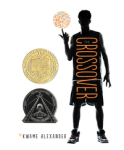
  • I watched another teacher confer with a reluctant reader. “You might try tScreen Shot 2020-01-22 at 5.00.36 PMhis one. I loved it,” she suggested as she handed him Kwame Alexander’s Crossover. A few days later, the student shyly asked the teacher for another book just like that one. And the teacher found one and then another for him. Because this teacher read young adult literature, she could bring herself into the classroom in the same way Julie Swinehart did in her blog about summer reading.

Teacher identity matters. Our identity as readers, writers, literary scholars, even editors carries over into the classroom, shaping our interactions with students, the plans we make, the structures we put into place. A teacher who sees herself as a reader can share her enthusiasm and knows the value of providing choice and time for students to read. I wonder if a teacher can create a dynamic readers workshop if she doesn’t love to read?

And what about writing workshop? Can a teacher design and implement a writers workshop if she never writes herself? Or can he promote the value of a writers notebook if he doesn’t keep one himself? Can we nurture our students identities as readers and writers if we aren’t a part of the literacy club?

I wonder.


How do you nurture you identity as a reader? As a writer? What impact does your identity have on your reading or writing workshop?