Category Archives: Community

It’s About More Than Just the Skills

91w70Ax2LhL.jpgThe reading arc of a school year is a lovely thing to witness, but an even more enjoyable journey to participate in. We begin the year falling in love with reading: a first quarter of high-interest, riveting works that match each reader where he or she is. The first days of school are filled with YA, novels in verse, pithy nonfiction, and short-but-powerful texts.

Second quarter, we begin the stretch toward more challenging texts, whether because of their difficult vocabularies, unfamiliar genres, or tough emotional or intellectual subject matters. My booktalks nudge students toward books that will push them to become stronger, more widely-read thinkers. Our reading ladders begin to incorporate themes of choice as well as challenge.

So, as September wound down, I picked up Neil deGrasse Tyson’s Astrophysics for People in a Hurry. This outside-my-comfort-zone book sent me to Wikipedia many times during each reading as I attempted to make sense of some term I’d newly discovered (dark matter, the Fermi paradox, the multiverse). I found myself down the rabbit hole of Wiki-links many a time, landing on pages like this a little too frequently for my furrowed eyebrows’ liking:

There is no question that anyone who encountered this book might have done the same, and as such, I have ample Internet history evidence to support my claim that reading this book made me a stronger reader. I doubtless practiced reading skills like summarizing, re-reading, decoding complex vocabulary, integrating new ideas into existing schema, looking for outside information to aid my understanding, paraphrasing, learning about new text features and signposts, noting quotes, and more.

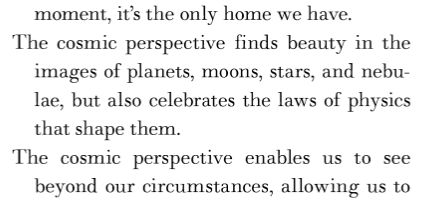
But reading isn’t done solely for the purpose of practicing skills. In fact, the purpose of reading is as far from skills-focused as we are from the edge of the universe (pretty freakin’ far, in case you haven’t recently read about astrophysics). Consider, for instance, this passage from the final pages of Astrophysics for People in a Hurry:

Screen Shot 2018-10-03 at 6.02.30 AMScreen Shot 2018-10-03 at 6.02.59 AMScreen Shot 2018-10-03 at 6.03.11 AMScreen Shot 2018-10-03 at 6.03.19 AM

Beautifully written, no doubt, and I’d use it with my students as a mentor text in a heartbeat. Look at that parallel structure, that use of one-sentence paragraphs, that thoughtful choice of diverse verbs! Lo, the effect of repetition, the deft uses of the dash, the pristine placement of commas! All of these are worth studying alongside our students, but they are mere stepping stones on the path to the true purposes of reading and writing:

Joy, engagement, transcendence, learning, growth.

The expansion of our minds, of our perspectives, marching onward as relentlessly as the universe itself (yep, it’s forever expanding, knowledge I have thanks to Neil deGrasse Tyson). This passage–this argument, for looking at life from the cosmic perspective–is valuable for so much more than the way it is written. The meaning is in what is written, and how the reader makes meaning of it.

Looking at our teaching, our students, our lessons from the cosmic perspective, we must consider our small effect on these students’ lives in the grand scheme of things. Why would we insist students read a certain book, or a certain number of books, or write a certain number of pages, when we consider our real goal for students: to help them access the vast wealth of reading and writing they can do in the world to achieve their true callings.

books-to-read-before-you-hit-30980-1459253850_980x457As we plan instruction for the second quarter, we must center our students’ reading and writing experiences on the highest purposes of those endeavors, and not remain too focused on the skills, structures, and rubrics we often get caught up in. We must not fall into the trap of sharing a passage such as this one with students solely to practice craft study, asking our students to replicate Tyson’s structure without appreciating what he’s trying to say to us by crafting it.

Let’s confer with our readers about not just how a text is doing what it’s doing, but also what their feelings are about that text, what they’re learning from a text on a holistic level, how they’ll insert this reading into their larger life philosophy.

Let’s coach our writers not just to become proficient in certain genres, but also toward authentic, purposeful, meaning-filled writing that they proudly craft and publish.

Let’s remember to harness the cosmic perspective in our work with students, as we consider not just what we know of them as readers and writers, but what we know of them as young adults who will go forth and change the world in some small way with their lives.

Let’s embrace the cosmic perspective when we consider reading and writing: those hallmarks of our intellect that make us uniquely human.

Shana Karnes is a lifelong reader and writer who daily tries to embrace the cosmic perspective in her work as a teacher, wife, and mother. She lives in West Virginia with her husband, two daughters, two cats, and five bookshelves. Connect with Shana on Twitter at @litreader. 

Please share your higher purposes for teaching, for reading, for writing! Let us know in the comments, on Twitter, or on Facebook.

Good books — and a teacher’s expertise in using them — can do it all

On Sunday, my friend and extraordinary literacy-leader, Billy Eastman, and I got to giveBookTweet away books. We presented at the Coalition of Reading and English Supervisors of Texas (CREST) fall conference, and Follett Learning gave us 30 books, six signed by the authors, to raffle off to our audience. It was kind of an Oprah moment: “You get a book, and you get a book.” Oh, the thrill of book giving.

But giving books is just part of the thrill. We know this. We ‘give’ books to readers and students we hope will become readers often. We model our reading lives. We read aloud. We line whiteboard rails with new titles. We do book tastings and speed dating with books. We celebrate our readers and exhaust our arsenal of book-loving ideas.

And some would-be readers still don’t read. What’s a teacher to do?

Here’s three ideas that have worked for me:

1. Never give up. When we set high expectations, when our students know we are serious about Book Love, when we practice keep-on-keeping-on with all the things I listed above– and we relentlessly share our joy, passion, and commitment to their reading lives– even if we never get a student, or a handful of them, to read a book, we have succeeded.

2. Believe in #1. Often we focus on the one student who just won’t budge. She chooses books, flips a few pages, fakes reading a chapter, bluffs her way through a conference, and we get discouraged. Keep trying — but do not let her be a black hole. So often we find ourselves gravitating to the one over and over again when we need the energy to keep encouraging, moving, and celebrating the many.

3. Make it okay to not read novels (yet). Anthologies are awesome. Sometimes

61doyibbmql-_sx395_bo1204203200_

“… this anthology empowers the nation’s youth to listen, learn, and build a better tomorrow.”

students who don’t like reading just need to enjoy a good piece of writing. Many will then want to read more by a particular author. One title many of my students dabbled in, and often read in its entirety, is Flying Lessons & Other Stories with authors Kwame Alexander, Jacqueline Woodson, Matt de la Pena, and more. I’ve recently purchased Fresh Ink, which is similar and looks equally engaging. It’s got authors Nicola Yoon, Jason Reynolds, and more! And I just read about this one this morning:  We Rise, We Resist, We Raise Our Voices. It’s now in my shopping cart.


In our session at CREST, Billy and I discussed implementing the new ELAR standards for Texas (We both served on the teacher committee that wrote them), and we shared the transformative role investing in teacher expertise and authentic resources has made in his district (We wrote about some of it in this English Journal article.). Access to engaging books like the ones we gave away in our session is just part of it. Knowing how to use them to teach thinking, reading, writing, speaking, and listening skills is the other.

Good books — and a teacher’s expertise in using them — can do it all.

Billy Eastman at CREST

We know the real thrill isn’t in getting a new book but in the knowledge, the empathy, or the know-how that books gives to us. This is the thrill we want for our readers. It’s the reason we do what we do.


Amy Rasmussen is a mother, grandmother, reader, writer, and wannabe sleeper. She spends a lot of nights thinking about growing readers, encouraging writers, and talking to her writer’s block. She’s back to working on that book she started five years ago, so if you’ve got any extra luck hanging around, please send it her way. Follow Amy on Twitter @amyrass 

Choice Reading Shouldn’t be a Choice Not to Read

I love that silence that permeates our reading time. A certain peace settles over the room as thirty souls lose themselves in the pages of their books, the only sounds: rustling pages, tapping feet, or contented sighs.  I also love that groan they emit when, after ten minutes, an eternity of silence, I implore them to mark their page and pause their reading for now.  That’s exactly what I say to them, “Alright kiddos, lets pause our reading and get out our reader’s/writer’s notebook.”

While we’ve practiced that transition dozens of times, they still plead begrudgingly, “Can we just have more reading time!!!”  “You can,” I tell them, “on your time.”  Some of them, the truly committed, make time for their self-selected independent reading, but most, for now, do not.  This reality, jarringly disturbing to committed readers like you or me, is something that keeps me up at night.  It prompts old teacher/football coach friends to text me on Sunday morning, asking for some kernel of knowledge that might help them move readers.  For this problem, though, there is only one short and fast answer: Hard Work.

I wrote about the difficult task of moving seniors into reading lives last year: here and here. The results, transformative for some, middling at best, and woeful for many, read like a Picasso.

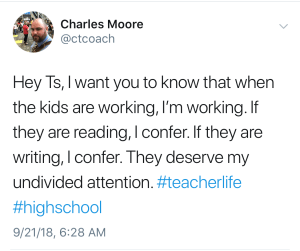
I promise you this: We can’t afford not to give them everything we’ve got.  That thought spurred this tweet from me earlier in the week:

Tweet1


We know reading and writing dovetail to form literacy.  If we instruct using whole class novels, we run the risk of alienating many who can’t engage with something in which they have no interest and as a result, we get nothing. If we encourage choice reading and we allow the kids to choose not to read, we get nothing.

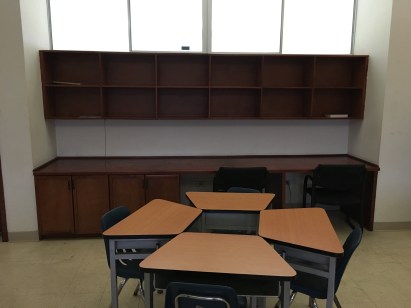
We must engage in their self-selected reading lives and I believe that I can’t do that if I’m reading while they read.  While they read, I’m moving around the room, tracking pages read, asking the reluctant about their reluctance, asking the readers when, where, and why they are reading on their own, simultaneously serving both ends of the reading spectrum.  You won’t ever find me sitting behind a desk, because my desk is shoved up against the wall, relegated to table status, as a place where papers pile.

It’s hard work, like everything about our roles as literacy advocates.  It takes planning,  reflection, and intention to match every kid to the perfect reading conference question.

That’s part of it too.  One question does not fit all.  If a student isn’t reading, they can’t reach into their reading experience to share with me their opinion on the effectiveness of setting, for instance, in their selection.

Also, I have to give them the sobering news that this lack of reading life may hinder their writing life as well, and while I don’t take grades for self-selected reading, I do take grades for writing and their engagement from one directly affects their success in the other.  I need to tell them that, before their grades do.

Charles Moore loves conferring with readers, even struggling ones.  He loves concerts with his wife and when his son texts during the concert, he texts back, “We are having fun without you.”  He’s loving the new adventure with Pre-AP students and his freshman are growing on him; they are adorable.  Check out his book review blog at www.mooreliteracy1.wordpress.com and his far too frequent twitter rants at @ctcoach.

Atmosphere: 4 Big Ways to Nurture Readers And Writers

How do we get our students to become readers and writers; literate, engaged, empathetic contributors to our world?

flexible seating 3It’s simple. Ask yourself, “How do I prefer to read, write, create and learn?” I can guarantee that each and every one of us would have a different idea of what that looks like and would choose something different. We don’t all learn the same, so why do we expect our students to. The relationships we build and the space that we provide to our students each year is crucial to allowing them to become readers, writers and creators, and we have to cater to the different needs that allow them to become what we hope they can be. How do we create open spaces where students can, and want, to learn and grow?

The answer = Relationships!!!

Team building

This happens for at least the first FOUR days of school in my classroom. Yes, four. I don’t even say the word syllabus until day three. I want to start the year getting to know my students and how they function; who they are, what they love and what they hate. I spend these days doing team building activities and switching the teams up each day intentionally. It teaches them to work well with different personalities and it allows me to see who they can work best with. It’s also a nice perk to know who should avoid whom in those more difficult classes. This all plays into how I approach them to start those one on one conversations. These team building moments can carry on throughout the year, not just be left for the first week. I often break up high pressure times of year with a team building activity to help keep the momentum going and refresh their minds and our classroom atmosphere.

A big part of our relationship and team building happens when have a conversation about our classroom social contract. Every year, it never fails, each class initiates the signing of that contract with no prompting from me. It’s a beautiful thing to know that they WANT to act and sign the contract that THEY helped create. The more involvement and choice students have in what they do in our classrooms, the more investment they have in what they are working to create. Giving them the opportunity to have a say in what our classroom expectations are allows them to have that investment.

Team building is so important to me and my classroom environment because if we don’t feel like a team, if the students don’t feel welcome and safe, they will never hear one word of anything I need to teach them the rest of the year. A positive relationship is the best foundation for the rest of the year to be built upon.

Conferring
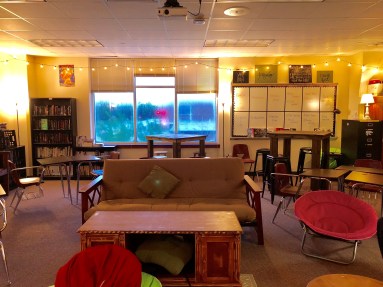
Flexible seating 2Yes, we confer to learn what books they like and guide them in their writing, but we also need to use it to build our relationship. Conferring during the first week (sometimes two) of school is simply “get to know you” conferring. I ask about reading and writing but I also want to know about the person behind the face and name that I will spend all year with. I write with them and they learn about me, then I confer with them about what they’ve written about their own lives.

Allowing our students to get to know us is just as important as us getting to know them. We need to let them see us in the struggle of writing; that’s why modeling what we ask them to do is so important. We need to let them know if we might be having a bad day and let them know it’s their turn to show the teacher some grace, like we show them each day. It’s a swaying tightrope that requires an immense amount of balance through a necessary obstacle if we want our students to become great readers and writers.

When students see their teacher taking the time to notice specifics about their personal life, not just the way they read or write, it creates a trust and willingness to be vulnerable and authentic in their writing. A simple, “I am so happy you shared!” or, “I am sorry to see that you felt this way and hope you never do again” can really allow them to feel like a wanted soul in your classroom, especially when you have 32+ students in one class period and they feel like just a number.

Affirmation and Validation

flexible seating 1These kids need to hear the words from us, spoken aloud, that tell them, “I care about you.” We can assume they know but hearing it out loud is necessary to their belief in that feeling. Sometimes a simple, “Hey! I care about you guys! Have a great rest of the day!” is something that will make a kids day turn around. Some of these precious souls that come through my door each day don’t see an adult figure, or one that is a positive role model, outside of this school. I need to be that for them. If I’m not, then who?

Validation is what they need to feel like they matter, that they are worthy, in order to move into a creative space and explore themselves as readers and writers. Yes, there are probably a million things we could critique about their writing, BUT we need to remember to build them up or they will never have the motivation to create at all. Validating and affirming that they are on the right track through conferring, notes, and blessings is a good way to do this. Starting with the positive and ending with encouragement. Giving them a positive end note can help them become motivated to dive back into a piece and create that authentic masterpiece. If we don’t work to make our students feel welcome, they will never hear what we want to teach them.

SPACE

Alternative seating  –  Five years ago I began my adventure of flexible seating. I have not had one moment of regret ever since. I am so glad I chose to push back against the fear of change, the “norm” in classrooms, and power through to what I have created now.

As you enter my room, you will see a space that ditches that harsh fluorescent lighting and replaces it with soft, warm lighting from lamps and stranded garden lights. You will notice that there are very few desks and many bean bags to sink into. There are two couches that will call to you and beg to be used. There are two bistro tables at standing height for those of us who need to stand in moments of writing to get our energy out. There are saucer chairs to hug you through those difficult pieces of reading and writing. My coffee tables are the perfect height for the “floor sitters,” like me, and accompanying floor pillows. There is also a beautiful, whimsical bench that my husband crafted (he also made the bistro tables with his talents – I might keep him around for a while). The atmosphere is welcoming and inviting, nurturing creativity.

When I first decided to bring in these seating alternatives, it was because I asked myself how I prefer to learn and WHY that space looks the way it does for me. The why is so, so important and gave me direction for which to take my classroom. Why do we need to create a comfortable space for students to create and learn in? The answer was simple. As an adult, I prefer to learn or read or write or create in a space filled with pillows or bean bags. One day I might want to sit on the couch, or, for days when I am really concentrating and creating (like while writing this blog) I prefer to sit on the floor with a coffee table as a desk, where I can spread out. So, as an adult, if I prefer this, I knew for sure my students would appreciate the option of getting to sit in the way they prefer, too. Feeling comfortable in a space provides us with the opportunity to open up all of our senses and focus on the creating of a piece or escaping into a novel. Giving them the opportunity to choose their space in my room is crucial to their development as readers and writers.

Flexible seating does not mean traditional desks are trashed and burned. Students use all the flexible seating, including the traditional desks. Some even move up to a traditional desk in moments of deep thinking or creating. Most of this seating you see in our classroom was free, donated or built. I only purchased the three saucer chairs and large futon from an online garage sale app. This is 5 years of accumulating different seating, so if you are inspired to start using flexible seating, know that it will take some time and always look for those deals! Even spending what you can spare on a simple cushion for the floor will be worth it.

I often get asked many questions when I talk about flexible seating. I think the biggest one is, “How do you get them to behave so well?!” Our flexible seating expectations are a topic we discuss while creating our classroom contract. It is important to voice your expectations at the beginning, just like any other classroom expectation. One of my expectations is that if students are debating on who gets to sit in a certain spot, they will decide calmly and compromise on who gets to sit in the seat that day, then switch the next day. Another important expectation that I make very clear is that it is their responsibility to maintain their focus while in the flexible seating. If they talk to their friends, sleep or just don’t complete the task at hand, they need to practice responsibility and make the decision to place themselves in a successful space. Some kids may need a reminder of this responsibility, but I rarely have to intervene when it comes to this. I think you will be pleasantly surprised at how much responsibility our students will take on when we give them the opportunity to have more responsibility through choice.

My students are free to choose how and where they sit, to learn and create in the way that fits them best. That choice gives them so much ownership of their own learning! And, isn’t that what we need to provide; more responsibility and ownership when it comes to their learning? Giving them a choice is how we provide them with that opportunity; in what they read, what they write and HOW they learn. When we establish the relationships with our students that allow them to feel comfortable in the vulnerability that is attached to what they share and write, when we give them the opportunity to take their learning into their own hands by giving them choice, they become literate, engaged, empathetic contributors to our world. They become readers and writers. Our students have stories to tell, and we need to guide them and give them the skills to tell them through the relationships and space we create for them.

Sarah Roy is currently singing songs from The Greatest Showman nonstop and wondering what took her so long to finally take her nose out of a book and watch those 105 minutes of greatness. She is enjoying spending time in her students work and seeing the potential that they have to create greatness in her class this year. Sarah is also seeking out her next read but enjoying reading all the informational books about salamanders with her eldest son, Crosby.

My Classroom Library Shelves went from Empty to Full . . . and Yours Can, Too!

My family took a big plunge five years ago, and made the decision to move from our placid, beautiful Central Oregon to Amman, Jordan. So much about Jordan was wonderful, but part of our decision to move away from our home, from Oregon, was about traveling the world. So after four years in Amman, we decided to move away from Jordan, to Managua, Nicaragua.

Between making the decision in January to move to Nicaragua and actually arriving this July, Nicaragua’s travel advisory from the US State Department went from level 2 to level 3 because of civil unrest, crime, and limited healthcare availability. Of course that travel advisory rating, combined with what we were reading in the news and hearing from people who lived in Managua gave us pause, and we carefully considered the choice we were making. Ultimately, we decided to move to Managua, and we are happy with our choice.

I share this background because I want to point out that while private schools often don’t share exactly the same issues and concerns found in public schools, private schools are not always utopian. Our school is wonderful, students are eager, teachers are welcoming and caring, and our facilities are beautiful. But with the current situation in Nicaragua, some families have chosen to leave the country, which ultimately means revenue from student fees is down, and the budget reflects that situation.

Everywhere I have ever taught has had budget concerns, public or private. I’m sure all teachers can relate to budget issues, which is why I bring it up.

Even in a time of budget concerns, my classroom library grew from empty shelves to full shelves in a matter of weeks, and it didn’t cost me an extra dime.

I walked into a nice, big, but empty classroom. The bookshelves were beautiful, but bare.

IMG_9968

Within a day or two of being in my new space, at my new job, in my new city of residence, I was having conversations with administrators and coworkers about how to build classroom libraries.

Our first step was to visit the book room. I think most schools have a book room, and in my experience they are full of books that are rarely in the hands of students for any length of time. We decided to gather a copy of each book for each of our five classrooms, and if a teacher needed one of those copies for teaching a whole-class-novel, we would give it to that teacher to use during that particular unit.

There were also books in the book room that were not being taught as whole-class-texts, and that weren’t available in high enough numbers to be used in that way. They might be titles that could be used in future book clubs, but we decided that getting these books in the hands of students sooner rather than later was the right choice, so they were distributed as well.

My classroom library was greatly improved by visiting the book room and reimagining the uses for all of the wonderful reads that could be found there.

I found some small white boards in the closet in my classroom and repurposed them as book displays so that I could highlight titles that might be especially interesting to my students. I think the same thing could be done using repurposed cardboard and printer paper, so I want to encourage others to use what’s available in order to highlight high-interest books. There are many other ways to focus attention on desirable titles, but sometimes simple is easiest.

After raiding the book room, it was time for step two. We checked in with the main library at our school. The shelves in our library were packed tight, full of great titles, and because shelves were so full, we had the ability to pull books out of the library and redistribute them to our classroom libraries.

Our librarian has spent the last several days pulling titles from the shelves and delivering them to our classrooms. Every other day or so, a basket of books arrives, and we never know what we are going to get. What we do know is that we will have more and more books as this process progresses. There will be additional books in our classroom libraries and more room on our school library shelves. Reallocation of resources is working in a very positive way in our school.

Once I received the books from the book room and the library, I implemented step three. I organized the books. I don’t think it matters how the books are organized, just that they are organized.

I categorized my books into the following sections, and used markers and printer paper to make my labels:

  • award winners
  • historical fiction
  • classics
  • mystery
  • fantasy and sci-fi
  • contemporary fiction
  • nonfiction
  • romance and other fun reads
  • “orphan” series books (books that are #2 or later in a series when the others aren’t there)
  • short stories and essays
  • poetry and verse

As you can see, I didn’t spend a dime on any books. I didn’t ask anyone else to spend any money, either. I used what was already in my school and simply helped to redistribute resources.

In some schools or districts, asking students to bring in books, applying for grants, and asking the parent-teacher groups to support classroom libraries will be great options. However, I wanted to share that sometimes, maybe often, classroom libraries can be built with what we already have.

What do you do to help build your classroom library? I’d love to see your ideas in the comments below.

Julie has been teaching secondary language arts for twenty years, spending the first fifteen in rural Central Oregon, and the last four in Amman, Jordan. She’s thrilled to report that she and her family have moved across the world to Managua, Nicaragua this year, where a new adventure has begun.

Follow her on twitter @SwinehartJulie

How We Built our First 3 Weeks of Workshop

Picture1

Look at Sarah’s room!

A classroom built around flexible seating is amazing for kids building their literacy.  Comfy chairs, tall stools, and bean bags take a student out of a “classroom” mindset and into a creative work space that encourages ideas to flow across boundaries that might have been impermeable with rows and rows of sterile desks.

It works just as well for teachers building a workshop from thin air. You can imagine how comfortable that tan couch felt on the last Friday morning before the start of school.

Sitting in that room for this much anticipated planning session felt as comfortable as if I’d been there for a decade.  Five teachers with a singular focus gathered their resources and experience to put together a plan that was student focused and built on the foundation of workshop.   I got to know this group well at the Literacy Institute but I’m still trying to learn the full extent of their individual and collective power.

It is important, on our team, to be intentional and explicit with our lesson design.  The kids should know exactly what we are doing and why we are doing it.  They should recognize the moves their teachers make and take comfort that those moves were selected specifically for them. There is no reason to keep the “why” and the “how” a secret.

On this team, we typically build lessons with an eye towards a learning focus that starts with something like: I want you to know that readers/writers ….. do something. (Thanks Amy, Billy, and the Lit Institute.)

For the first three weeks, though, we talked about using: I want you to know that members of a Reader/Writer Workshop….do…one of the six pillars.  You get it.

Our curriculum documents, designed by teachers, contain a section devoted to the six routines of workshop instruction and the following are the routines around which we built lessons:

The Reader’s/Writer’s Notebook

Lesson Focus: I want you to know that members of this Reader’s/Writer’s workshop use a notebook to explore thier literacy.

Our “notebooks” look very different teacher-to-teacher.  Some of our classes will use traditional composition notebooks and some will use Microsoft OneNote in our explorations.  Either way, the point of having a safe and personal place to plan, draft, revise, reflect, etc. remains consistent across our classes.  Its not enough for us to ask the kids to have a notebook, they need to know the importance of having it.  Some of the kids struggled with following my set-up instructions because they were intentionally vague.

Student: “Mr. Moore, what categories do you want us to use to track our reading this year?”

Me: “That’s up to you.  Its your notebook.”

Self-Selected Independent Reading:

Lesson Focus: I want you to know that members of this Reader’s/Writer’s workshop take ownership of their reading and writing experiences.

I remember back to last year, and how much the kids struggled genuinely connecting to a book. Maybe it was the hurricane sitting out in the Gulf or that they really only had one year of workshop leading up to their senior year.  What ever it was, we worked hard to take ownership of our reading, so much so that I wrote about it here and here. (Looking back at those words is like seeing the words of a different writer, but I digress…)

Mentor Texts:

Lesson Focus: I want you to know that members of this Reader’s/Writer’s workshop use mentor texts to guide their learning.

We use mentor texts to teach kids how to read and write like a writer. The students need to know that we looking at the writing of others with specific intentions in mind. Its important to delineate the separate lenses of craft and content and constantly reinforce the importance and interconnection of both.

We planned for ways to write beside them.  When I write in front of my students it invites them to connect to a writer from their community.  This connection is between a student and a person that shakes their hand every day and smiles when they make eye contact. That’s an incredibly deep connection and one that I’ll leverage every chance I get.

Mini-Lessons:

Lesson Focus: I want you to know that members of this Reader’s/Writer’s workshop look at specific skills that we want to learn and then apply those skills to their reading and writing.

The skills we choose to highlight are intentional and our students need to understand that they aren’t chosen at random.  Not only that, but we aren’t going to spend more than a few minutes in our mini-lessons before we move back into reading and writing, with an emphasis on those specific skills.

Collaboration:

Lesson Focus: I want you to know that members of this Reader’s/Writer’s workshop listen to others share and provide feedback that supports their growth.

I can’t teach all 30 of them all the time and maintain any level of effectiveness.  We have to build a supportive community that  allows me to widen the feedback cycle from one, typically confident student, to 30 who are confident to share with their confidants. They need to know that the days of me asking a question and calling on one person for the answer are far behind us.  We practice the routine over and over. Ask a question, discuss in group.  Ask a question, practice their thinking through written response. Rinse/Repeat.

Oh, and they have to be trained not to shoot up their hands or shout out an answer when they are asked to notice something.  Instead, they will learn to sit in the silence and let their thinking wash over them in waves. Or maybe the metaphor is to peel back the layers of their thinking like an onion. Whichever you prefer.

Conferring:

Lesson Focus: I want you to know that members of this Reader’s/Writer’s workshop take advantage of opportunities to talk one-on-one with the expert in the room.

The importance of regular one-on-one conferences can not be understated. I’m not just “checking-in” on them while they read and write.  I’m digging into their thinking for places I can provide support.  We will explain to our students how important it is for them to be honest and open when we confer.  They can’t hold back due to nervousness or fear. Like Jerry Maquire said, “Help me, help you!!!” with that typically creepy look on his face.


Based on our planning sessions, impromptu secret meetings, and the genuine happiness in which we approach each other, I know this year will be my best ever and it is because of the work this team will do together to move our freshman class forward in their literacy.

Now, in all seriousness, lets cross our fingers and hope nature and fate don’t hit us with the same intensity as last year.  We all need time to heal a little more.  Let’s do it together.

Charles Moore had a quiet Friday night and went to all four of his son’s soccer games this weekend.  He passed El Deafo by Cece Miller back and forth with his daughter this weekend.  He put more than two thousand words to the page this weekend between his grad classes and this blog post; a new record.  He can’t wait to get back into the classroom Monday morning and learn alongside the students.  And he wishes you the same happiness he’s enjoying right now. Visit him on twitter or instagram.


We Can All Be Writers

Penny Kittle absolutely ruined reading for me five years ago.

You heard me. Destroyed it.

In the summer of 2013, at the University of New Hampshire Literacy Institutes, Penny taught me how to read like a writer. Our class studied short poems and discussed the deliberation of the author’s diction with a sense of wonder rather than through the lens of “what does this symbol mean?”. We read whole books in book clubs and gave a presentation about our texts on simply its craft. We wrote process papers at the end of the class that told the story of how we’d written our final essays.

Something about this made me absolutely unable to mindlessly read anythinganymore. Online articles, advertisements, tweets, and even beach-appropriate fiction just screamed CRAFT ANALYSIS!!!! at me. I couldn’t really relax and let go while reading anymore–instead, I was hypersensitive to the words I read, thinking constantly about what the author had lived, and done, to write such a work.

The total immersion in craft study of those two weeks has stayed with me, five years later. In every book I read, I have a new appreciation for the work of the writer–the work of writing.

writer.jpg

The craft of language, the power of literacy, is everywhere.

And seeing writing everywhere helped transform me from a lifelong reader into something more: a writer.

I start my day with the awesome Twitter crew at #5amwritersclub. Many participants are teachers, writing before they begin the day with their students, and many others are parents, writing before they begin the day with their children. I identify with both groups and love the sense of identity that comes from writing beside my tribe.

I feel the same way about writing in online communities like this blog. Every time a Three Teachers Talk post appears in my inbox, I think about not just what the post says, but also what my fellow teachers were thinking and doing as they wrote. I have watched Amy’s and Lisa’s thinking grow over time, since I’ve had the privilege of reading their writing. When Amy wrote about beating the dread, and when Lisa wrote about settling into summer, I read beyond the “I agree” part of my teacher brain. I thought about those women, both moms, cramming in some writing after their (grand)kids’ bedtimes, or in the early morning hours before school, or on their too-packed planning periods.

This is, in part, what helped me shape my identity as a writer. I saw my peers, my friends, my teaching neighbors writing. I saw their process, their thinking, their methods translate into writing. It showed me what was possible: that I, too, was a writer.

Our students need to see this.

As we kick off this school year, we need to make not only our own writing processes visible–from initial thinking, to drafting, to tinkering, to publishing–but our students’ processes visible, too. Students who see one another write understand that it’s not a one-track process; writing can look different from one kid to the next, and from one school year to the next. The possibilities are endless.

We can all be writers. We should all be writers. Viewing the world so differently has no doubt made my brain more tired, but it has made my life so much more rich.

Believing that I could become a writer took time, a shift in my mindset, and lots of work…but it transformed my identity and introduced me to a whole community of writers I wouldn’t have met otherwise, and for that, I am forever grateful. I can only hope that my students someday can feel this sense of gratitude to the writers–both the teachers and students whose words they read, and the published poets and authors whose craft we study to get better–that I feel for every writer, every human, that I know.

Please leave a comment and let us know how you plan to make the writing process more visible for your students this year, so you might all become writers!

Shana Karnes is a mom of two, an avid reader and writer, and someone whose life has been immeasurably bettered by literacy and all it entails. She is grateful to be part of the Three Teachers Talk community, and loves equally her NWP@WVU and WVCTE (where a version of this post appeared earlier) peers and pals. Connect with Shana on Twitter at @litreader. 

Five Ideas that Beat the Dread

A few years ago I stopped reviewing class rules and smacking down my syllabus on the first day of school. I had been doing some research on chronic stress (mostly my own) and read extensively about the fight, flight, freeze response. One description glared at me and gave me pause:  “You have a sense of dread.”

I remembered what I had been taught as a first year teacher:  Set yourself up as the authority figure. Be kind but firm. Establish norms quickly so students know what you will and will not tolerate in your classroom.

Then, almost in the same breathe, I was told:  Develop relationships. Learn students’ names. Let them help develop class rules.

And I muddled through doing a combination of both the best I knew how. Those first few days of my first few years were rocky to say the least. And in hindsight, it’s clear:  there was dread. Lots of dread.

So when I read up on the fight, flight, and freeze response, I realized a big part of my problem:  With my seemingly simple attempt at outlining classroom expectations and detailing how ‘my class would run, chemicals danced a jig in students’ brains: fight, flight, or freeze. Now, I know my syllabus is not on the scale of major life trauma most often associated with this fff response theory, but many of my juniors and seniors didn’t want to be in school anyway. Why was I compounding it?

I learned a better way.

Wait.

Let every other teacher lay down the law. Lay out their plans. Run through the rules.

On the first day of school — maybe even the first five days of school — just write. And talk. Let students drive the discussion. Let them ask questions. Give them a chance to be seen and heard and welcomed.

“Community before curriculum” Angela wrote in her last post, and I love her thinking there. I also think we can merge the two on the first day of school and lay a firm foundation for thinking and talking every day thereafter. We can jump start community and begin our curriculum as we put pen to the page and write.

Here’s my top five sources that beg a response and invite students to write on the first day of school (or at least the first week or so):

  1. To This Day by Shane Koyczan.

Give every student a notecard and ask them to watch and listen and then respond to the poem as a whole or to a line they particularly like or relate to. (I’ve learned some pretty heavy stuff from students over the years. So many of them can relate to the themes in this poem.)

  1. How poetry can help kids turn a fear of literature into love by Jason Reynolds on PBS.

Give every student a sticky note and ask them to think about their reading lives. Then after they listen to Mr. Reynolds talk about reading, ask students to rate themselves. Are they readers eager for the pit bulls or for the puppies? Why? (I quickly find who my readers are and with whom I need to take on the challenge of helping them want to read.) Then for a little more of a challenge, on the flip side of the sticky, ask them to describe in poetic form their feelings about poetry. (You’ll learn even more.)

  1. Possibilities by Wislawa Szymborska. Or the version here where Amanda Palmer reads the poem.

Give every student a copy of the poem. Then read the poem aloud and ask students to write their own list of possibilities. Their list can be straightforward, funny, or interesting things they want the class to know. (I wrote about how I used this poem to practice imitation a couple of years ago. It’s a great lesson and a great poem to revisit.)

  1. Three poems:

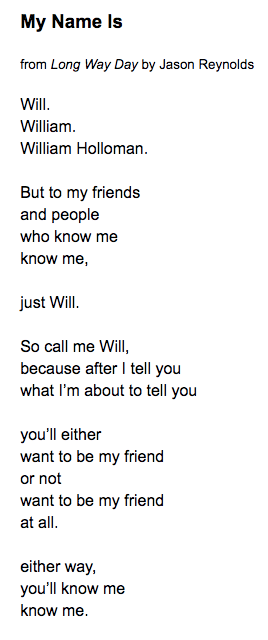
“My Name Is,” an excerpt from Jason Reynolds’ book Long Way Down. (If you haven’t read this book, oh, my goodness. It’s amazing!)

My Name Is by Jason Reynolds

“Instructions” by Rudy Francisco.

Instructions by Rudy Francisco

“Like You” by Roque Dalton, translated by Jack Hirschman

Give students copies of all three poems and a notecard or piece of paper. Read them aloud. Ask students to read them again and then to write a response. They can respond to just one of the poems, a line from a poem, or anything the poems make them think or feel. There is no right or wrong. Just write your thinking. (This is always an interesting response, and it tells me a lot about how to help my students. Many of them will begin to write an analysis of one of the poems — or all three. Others understand that I am asking for a different kind of thinking, one that leads them into ideas for their own poems, stories, or essays.)

  1. Author Bios!

Give students access to books that have clever, witty, or interesting author bios. YA authors like Julie Murphy, Jeff Zentner, Chris Crutcher, Libba Bray, and Gina Damico are great ones, but there are many with a bit of quirk that will draw students in and spark their interest in reading these author’s books. Ask students to explore the author bios and then make a list of the books they think they’d like to explore this semester. Have them write the author’s names on sticky notes for you to put in your conferring notes.

If you want to take this author bio idea further — (this is my favorite):

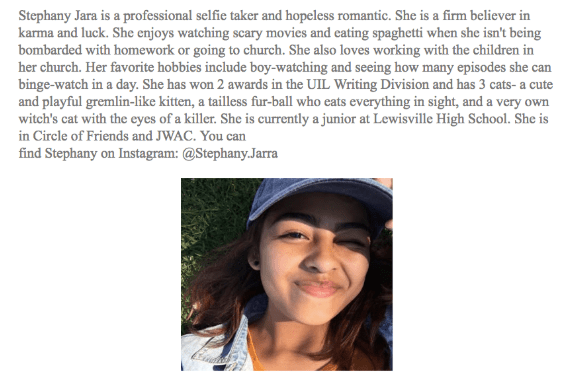
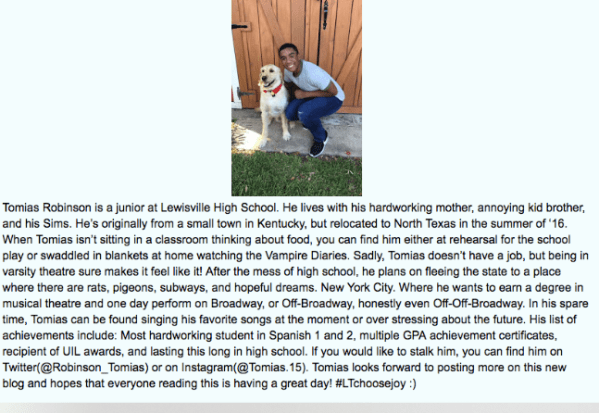
Read several professional author bios aloud. Ask students what information is shared and make a T-chart that lists the what on the left, e.g., name, personal hobbies, awards won, where the author lives, who the author lives with, etc. Then, ask students to describe how this information is shared and add these craft moves to the right. This is the how. For example, short and sometimes incomplete sentences, lists, 3rd person, the author’s name is first, witty word choice, etc. Finally, ask students to write their own author bio while you write yours as a model. Encourage them to try to craft their bio to include ideas from both the what and the how side of the T-chart. Below are two of my students’ bios from this past year.

Stephany author bio

Tomias author bio

(The author bio idea is Lisa’s baby, and she wrote about it here after I wrote about it here. It’s still the best idea I have ever heard to begin students on their journey into developing their identities as readers and as writers. I’ve used this idea in a model lesson for every workshop I’ve facilitated this summer, so if you were there, feel free to share the author bio you wrote this summer in the comments. My newest one is below.)

I wish you happy reading and writing with your students this year. Please share your go to ideas for inviting students to write and build your community.


Amy Rasmussen loves books, pretending to garden, adolescents, and coconut cream pie — not necessarily in that order. She lives in North Texas with her dashing husband of 33 years, their twin-terror Shelties Mac and Des, and a not so loving love bird named Colonel Brandon. Amy spent the summer leading professional development in several districts across Texas and has grown especially fond of the Houston area. If only she could move… Follow her on Twitter @amyrass — and if you are not already, please follow this blog.

3 Ways This Year Will be the Best Ever!!!

Can you feel it coming?  Do you smell new books and old desks?  Are you imagining the sounds of students shouldering their way through the halls and into your classroom like bees through long un-mown grass? (I’m a huge Oscar Wilde fanboy!)

Are you ready to hear a deep breath or quiet giggle interrupt a totally silent self-selected reading segment? Are you ready to mop up tears in buckets and heal emotional wounds with book bandages?

If not, you better get ready.  You may be starting school today, or maybe next week.  It doesn’t matter; time to get your mind right.

I’m ready to launch from the best summer of my life into the best teaching year of my life.  Happiness breeds happiness.

So here are three thoughts I have that will help me be the best teacher I’ve ever been.

  1. Book Talk like my teaching life depends on it…because it does.

If the number one tool in my belt is my classroom library, my number two is my ability to “sell” books.  We all know that we need to be able to sell books both informally and formally.

Informally, we confer with readers and talk about books with individual kids (and adults!) who are in the market for their next reading relationship.  This is the easy back and forth that comes with being a reader and contributing to a literacy rich classroom culture.

The formal moments, in my mind, are those points in time you carve out to stand in front of your class, or some group, and give them the hard sell on a book you’ve decided was worthy of their attention.

To me, these two different bookish scenarios require different thought processes and the latter is example is the one to which I plead my case.

Obviously we have to consider “how” we present the key information that we think will engender interest in deserving books.

But also, we have a massive burden to present books that offer a cultural variety of information that will allow our readers the “windows, mirrors, and doors” that Rudine Sims Bishop wrote about all the way back in 1990.

I took a step forward on the Sunday of the ILA conference and chose to attend a session featuring LGBTQ writers and their books.

Over and over, the panelists describe the point in their lives when they first encountered a character in whom they saw themselves.  Ashley Herring Blake, a primary grade teacher and middle grade writer from Tennessee talked about how she was 32 when it happened to her.  We have to be more pro-active when it comes to offering students windows, mirrors and doors.  Book talks are an opportunity in which we can’t afford to play it safe.

2. Love the kids like their learning lives depend on it…because it does.

I said it before: I will be 100% this year in telling my classes I love them before sending them out the door each period.  I’ve already been practicing with the Student Council kids that I hung out with at Fish Camp.  It was our first time to work together and as the day ended, I told them too. You never get a second chance to make a first impression.

But I’m not just going to say it to their backs as they sprint out of the room.  I’m going to say it to their faces as they enter and I’m going to write it on their papers.  Reading and writing culture revolves around love: of texts, but more importantly the readers and writers.

3. Empower the students to read and write in a massive volume like our world depends on it…because it does.

We know how important volume is in a student’s growth.  We have to let them read and write more than we can ever think about grading.

Also, we have to give them room to read and write in ways that let them explore their place in the world. Anything less than this, and I’ve failed. I will not fail.

Charles Moore will, for the first time in many years, teach Freshman English this year. His bleeding heart required him to volunteer to sponsor Student Council at this new school. You can follow his antics on twitter at @ctcoach


ILA 2018 Conference Run-down!!! (and an epiphany!)

Am I the only person who feels super awkward meeting new people?

So I’m standing in the “New to ILA!!!” section of the Austin Convention Center early Saturday morning.  Several well spoken women and men address the throng of newbies and supply us with important information about the conference.  Remarks concluded and we are encouraged to visit with those around us, meet new people, and hang out.

I’m there by myself waiting for Gretchen Meyer, my fellow literacy advocate, to arrive. She shared this conference experience with me and I couldn’t ask for a better guide.

IMG_4479

Can you imagine a more awkwardly handsome face?

So I’m scanning the crowd looking for familiar faces, assuming there won’t be one.  I’m an award winning people-watcher and for those of you who aren’t, teachers can be incredibly fun to observe.  Anyways, Marcie, an incredibly nice women with a bright smile introduced herself to me and we talked about the conference and how excited we were to listen to the speakers at the General Meeting that was to begin shortly.

Both of us, my new ILA friend and I, massively underestimated the level of brilliance that was about to wash over me.  I listened to Adan Gonzalez talk about his success in the face of poverty and bigotry and how he works to fight those demons today.  Nadia Lopez blew the crowd away with the statement, “I opened a school to close a prison.”  So…um…wow.  If that wasn’t enough, we got to experience the passion of Cornelius Minor and his charge to consider, “How can we not stand for our children…when the traumas of the world weigh them down in our classrooms?”

I had to pinch myself.  Was the rest of the conference going to be this amazing? (It was.) Was this euphoria and uplifting feeling of being re-energized going to fade as I left this hall and moved on to the other presentations? (It didn’t.) Was I ever going to see my new friend, Marcie, again? (I did, on the big screen, at the end of the general meeting.)

Marcie

Meet Marcie Post, the Executive Director of the ILA.

Even now, back in League City, I can’t stop reflecting on the lessons I soaked in at ILA.  Maybe the biggest realization I came to, and there were many, wasn’t about books or kids or literacy.  This realization encompassed all those ideas, but was really about me.

I realized that above all else, I’m a “culture” guy.

I’ve identified myself by so many labels over the years: Football guy, Coach that can teach, Book Lover, Literacy Advocate, Student First Teacher… all those things. But, when its all said and done, after 16 years in the classroom, culture means everything to me. The culture in my classroom is, obviously, important. Just as important, perhaps, and, for the most part out of my control, is the culture of the people around me.  I want to be around teachers that are happy people.  I want to feel like we are all in this together and that the kids will be the big winners in this world.

I think this seed might have been planted by this blog post by Lauren Ambeau, an intermediate school principal in my school district that posts on her own blog. Or it might reach all the way back to my first two principals, Marlene Skiba and Deanna Daws; two women that made me feel confident and valued in my teaching role.

I think, also, the people I learned from at my most recent, and longest, stay had a lot to do with it.  I have the honor of presenting with the brilliant Jenna Zucha next week and this woman took time out of her summer, twice actually, to visit with me about our upcoming opportunity to present about writing to the leaders and stake-holders of our district.  She guest posted on this blog back in May.  What’s funny about our second meeting, is that one of my best friends happened to be at the very same Starbucks. He’s a genius, and famous.  You might have heard of him… Ashton Kutcher thinks he’s cool.

bro

This summer’s Literacy Institute, our own sort of ILA, comes to mind as well.  Billy Eastman and Amy Rasmussen build a culture of respect, trust, and love that I try to recreate in my classroom.  The huge win came from spending three weeks with the beautiful souls whose teaching team I’m so looking forward to joining.   We laughed enough to get stares from the other groups and cried buckets on the last day as we bared our souls through our writing.  Sarah Roy guest posted about that process just two weeks ago and then Austin Darrow guest posted for Amy the next day!!!  Amanda Penny is one of the most fun loving people I’ve ever met. Looks like the culture I’m joining at my new place is strong, and, having gotten the opportunity to interact with the instructional leaders there, I know this is by design.

Kylene Beers, Sunday afternoon, said, “Our democracy requires that we hold onto our own literacy and not turn it over to a few pundits on this network or that one.”  This statement reminded me that I posted about this very same idea back in February.  Thus I’m reminded further that this blog, this digital workshop, is a culturally supportive space for teachers like me.

There is so much more to write about.  I plan to sprinkle those tidbits through my posts this year.

Understand this: I’ll fight for culture.  I’ll seek out good people and happy teachers for the rest of my teaching career.  The kids deserve it.

Charles Moore has his pool looking as clear as crystal.  He’s done a horrible job being a reader this summer. His kids spend most nights sleeping in a blanket fort in the boy’s room (thick as thieves, those two.)  He’s looking forward to sharing the experience of discovering a new school with the incoming 9th graders at Clear Creek High School.