Category Archives: Community

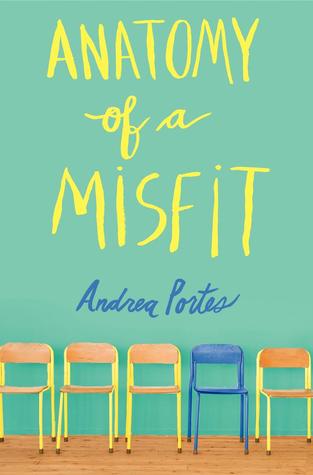
Anatomy of a Misfit by Andrea Portes

18340210This young adult novel was recommended to me by a fellow teacher of reading workshop who said it was immensely popular in her room. I downloaded it on my Nook and began to read it late one night before bed, and stayed up all night to finish.  I laughed on one page, clenched the covers in tension on the next, then cried, then laughed again, thanks to Portes’ masterful narrative skill.

The narrator, Annika, was a unique take on the typical YA protagonist, describing herself as the “third most popular girl in school,” whose Romanian father she calls “Count Chocula.”  Still, Annika finds herself in a number of classic YA conflicts–torn between two boys (Logan, who is unique and thoughtful, but social suicide, and Jared, who is magnetically attractive and popular) and torn between two friend groups (Becky Vilhauer and her evil “mean girls”-esque clique and the victims of that clique’s hurtful gossip).  Annika authentically struggles with these choices in a way I think most teenagers would, so this felt much more real than a John Green book, for example, to me.

As Annika’s unique voice kept me laughing and intrigued, the story grew darker, spiraling into a series of painful climaxes, as the book progressed.  While reflecting on one of these situations, Annika writes:

We tried to be less self-involved.  We tried to look up from our dumb obsessions and notice other people.  We tried to be open, for once.  We tried not to be just another vaguely racist family.  We tried to be enlightened.  We tried to be good.  We tried to be all of the things…we are not.

This beautiful excerpt reflects not just on Portes’ cut-to-the-quick analyses of common situations, but also her writing skill.  My students and I looked at that passage for craft and they created beautiful imitations filled with similar repetitive phrasings.

Portes’ beautiful language made me love this book, but I loved it even more when I read the afterword, which explained the inspiration for the book–Portes’ own high school experience.  Once you read the heart-wrenching conclusion, you’ll understand why I so vastly admire Portes’ blend of autobiography and gorgeous writing skill.


Shelfie Saturday

sticker,375x360.u1


I love Monday mornings.

Monday signifies a new week, new possibilities, and new literature!  At the start of every week, I take time to display different books on each themed shelf.  This provides readers an opportunity to explore new titles on an ongoing basis.  Some books are brand new to Room 382 while other books have occupied our shared space for years; yet feel fresh and enticing when they are uniquely displayed.

Students (and guests) are continually gazing at our Francis Gittens Lending Library and enjoy, not only the vast array of literature to choose from, but how easily accessible it is to find what they are looking for. Gone are the days of ‘genre shelving’ and in are the days of ‘theme shelving’.  Whether students are just emerging into the world of literature or they are deeply rooted in their love for reading; our scholars need to feel supported.  By clustering books via theme, students (regardless of their comfortability with literature) know exactly where to go to get more of what they want!

Many students find their heritage fascinating and want to explore it beyond their current ideologies, beliefs, and familiarities.  So, they peruse the shelves in which they see themselves; racially, culturally, geographically, athletically, and so on.  They find comfort in exploring the lives and stories of those they’ve met before in history class or via conversations taking place within their homes.  They also take pleasure in learning more about who they are within the context of society, and on an even larger scale, within the world; simultaneously honing in on their more localized and individual existence.

All adolescents are searching.  They search for identity.  They seek to understand.  They thrive on building connections.  They strive to be enlightened.  And many times, students stumble upon exactly what they didn’t know they were looking for!  I love that.

Be it non-fiction, fiction, poetry, fantasy, science-fiction, auto/biography, graphic novels, screen plays, what have you; genre holds much less weight when the stories, characters, and settings transcend our students into a world full of exploration.

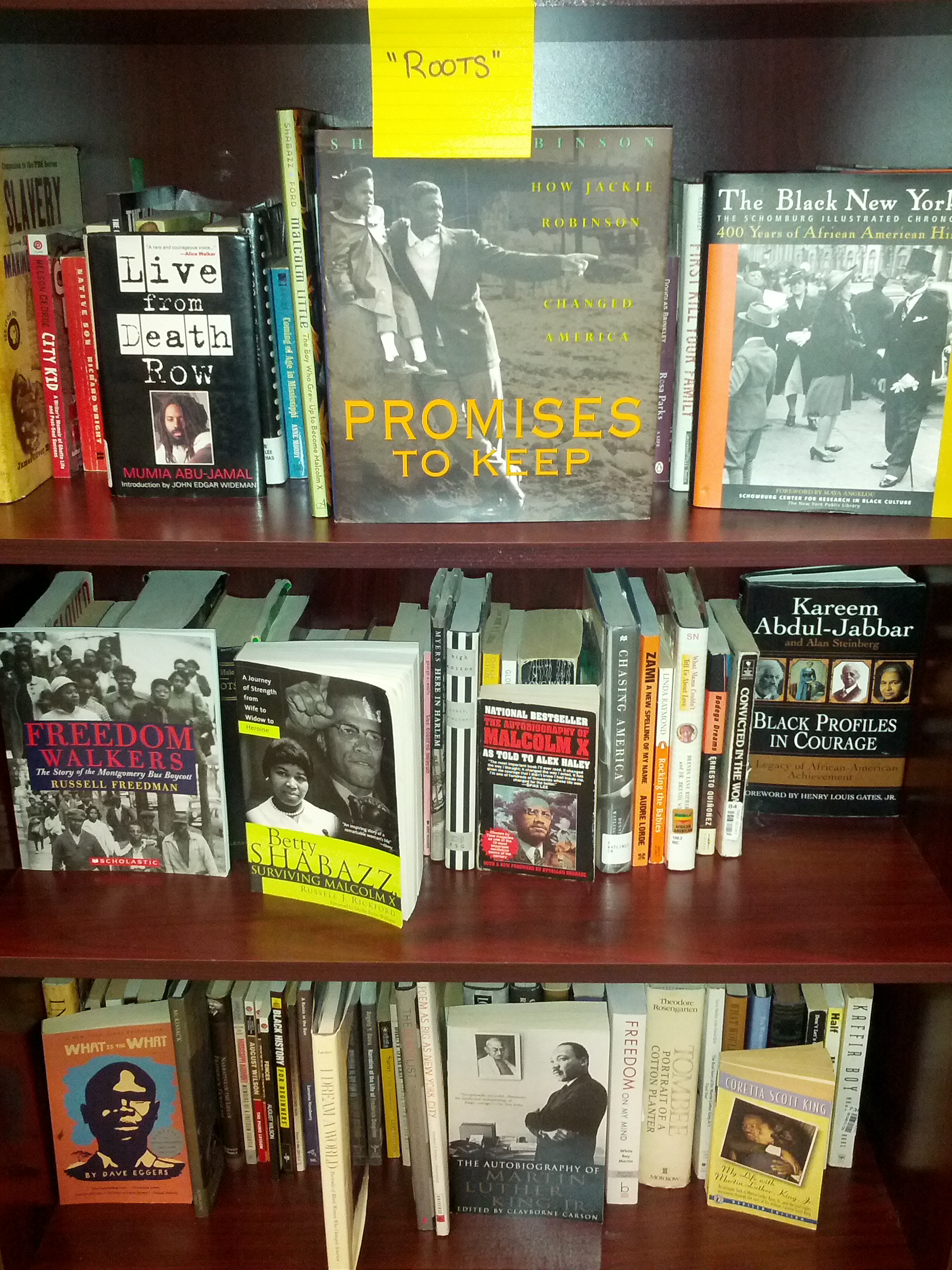
Here, our ever growing and ever evolving “Roots” shelves allow us to embark on a genre free yet culturally rich journey!

Some of our collective favorites include: Mumia-Abu Jamal, Jackie Robinson, Malcolm X, Betty Shabazz, Dr. MLK, Jr. and his lovely wife


Join the conversation by posting your own shelfies!  Share a shelfie with #shelfieshare and let us know if it’s a #classroomshelfie, #bookstoreshelfie, or other miscellaneous find.

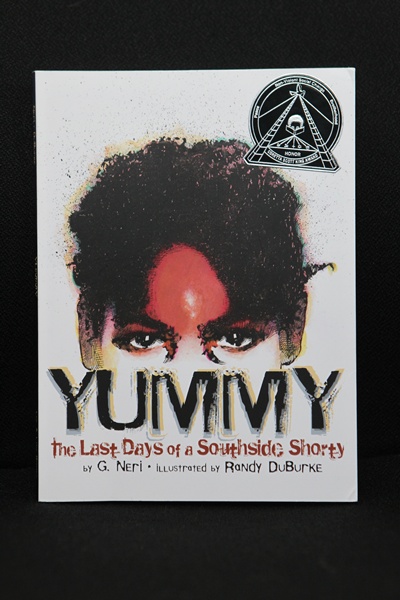
G. Neri’s Yummy


yummy

Synopsis

In this award-winning graphic novel, Robert “Yummy” Sandifer’s life becomes interwoven with other true events from a period in time where Chicago’s south side was running rampant with gang activity and violence. The year: 1994. Yet, its relevance still holds weight today in urban communities throughout our country. Unfortunately.

Narration and Writer’s Craft

Through third person narration, eleven year old Roger, guides us through the ongoings, thoughts, chaos, family ties, brotherhood, fears, ponderings, love, realities and insecurities most young adolescent males experience.

Roger lives on Normal Street.  He addresses what many readers are already thinking:  But I guess “normal” is different to different folks.

In studying craft, this one liner opens up dialogue, the use of language and repetition, and the importance of quotation marks in varying situations.  Throughout the entire story, you are greeted with on-point vernacular, literary devices, and a storyline that pulls at the heart strings.  (Just ask my students.)

Additionally, the incredible illustrations allow us the luxury of experiencing Yummy’s journey through his eyes, Roger’s eyes, and the eyes of all of those that take part in the journey.

It’s pretty loaded.

 Essential Ideas and ThemesYummy: The Last Days of a Southside Short

This gritty exploration of Yummy’s life forces readers (of all ages) to question their own understandings of good and bad, right or wrong, yes vs. no.

It searches for truth.

It provides us with the inner-workings of [the downfall of] self-worth and naturally asks us to question it.

Ultimately, we are challenged to think on a macro level about society; why are so many of our youth feeling forced into a life where statistics are alarmingly glaring?


Yummy is a piece that everyone needs to read.  It’s important.  It’s relevant.  It affords us a window into the lives of so many of our youth.  No wonder it has won just under 30 honors and awards.  This is one piece of literature you cannot afford to miss.

For more books by G. Neri feel free to visit his website: http://www.gregneri.com

——-

Yummy Time

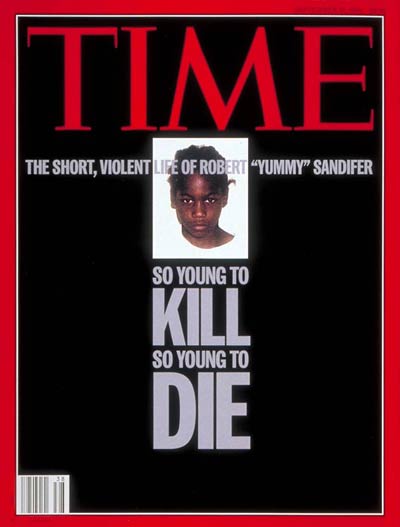
Here is the cover of TIME Magazine’s issue detailing the story of Robert “Yummy” Sandifer.  Tragic and important.

Today We Draw

A Five Day Checklist:

Chancellor visit. (Check!)

Superintendent visit. (Check!)

A posse of outside principals observing. (Check!)

Our CBO (community based organization) pulled out = no counseling…or any other services…for students.  Teachers are now ALL of that. (Continual check!)

End of the Cycle (think semester) and the accompanied wildness. (Checking…all week long!)

*THIS WEEK.  Yes, in one week.  And, it’s Wednesday only.

 —–

The above is an email I composed to Amy, Jackie, and Shana in one of our most recent communications. In response, Amy wrote:  You’ve got the world on your shoulders this week, E!  And, it wasn’t until I was greeted with this affirmation that I realized it most definitely felt that way.  I was too busy moving through it to take a moment’s pause and acknowledge the intensity of it all.   The. Weight. Of. The. World.

It got me thinking.  If I felt this way, I couldn’t imagine how students were feeling as they were the reason for all of the visits.  They were the ones ‘on display’.  I just kept it business as usual with our Readers Writers Workshop flow; rigorous expectations, Writer’s Notebooks being utilized, Independent Reading occurring, questions being raised; chuckles here and there.  Yet, it felt off.  As I looked around the room, it occurred to me that students have taken on the weight of the world too.

They’ve been trying to articulate their thoughts wrapped around their chosen literature when the Chancellor asked them about their favorite books.  They’ve tried to be loyal to our collective work and answer the Superintendent’s question about rubrics (aside from the thought provoking work they’ve been creating) knowing that we are currently exploring with our pens and ideas sans a rubric.  They have tried to find comfort in their movement over the last six months, but these pressures have made them second guess themselves.  And the reason I know?  They’ve told me.

Yet, their resilience astounds me.  So, I dug deep.

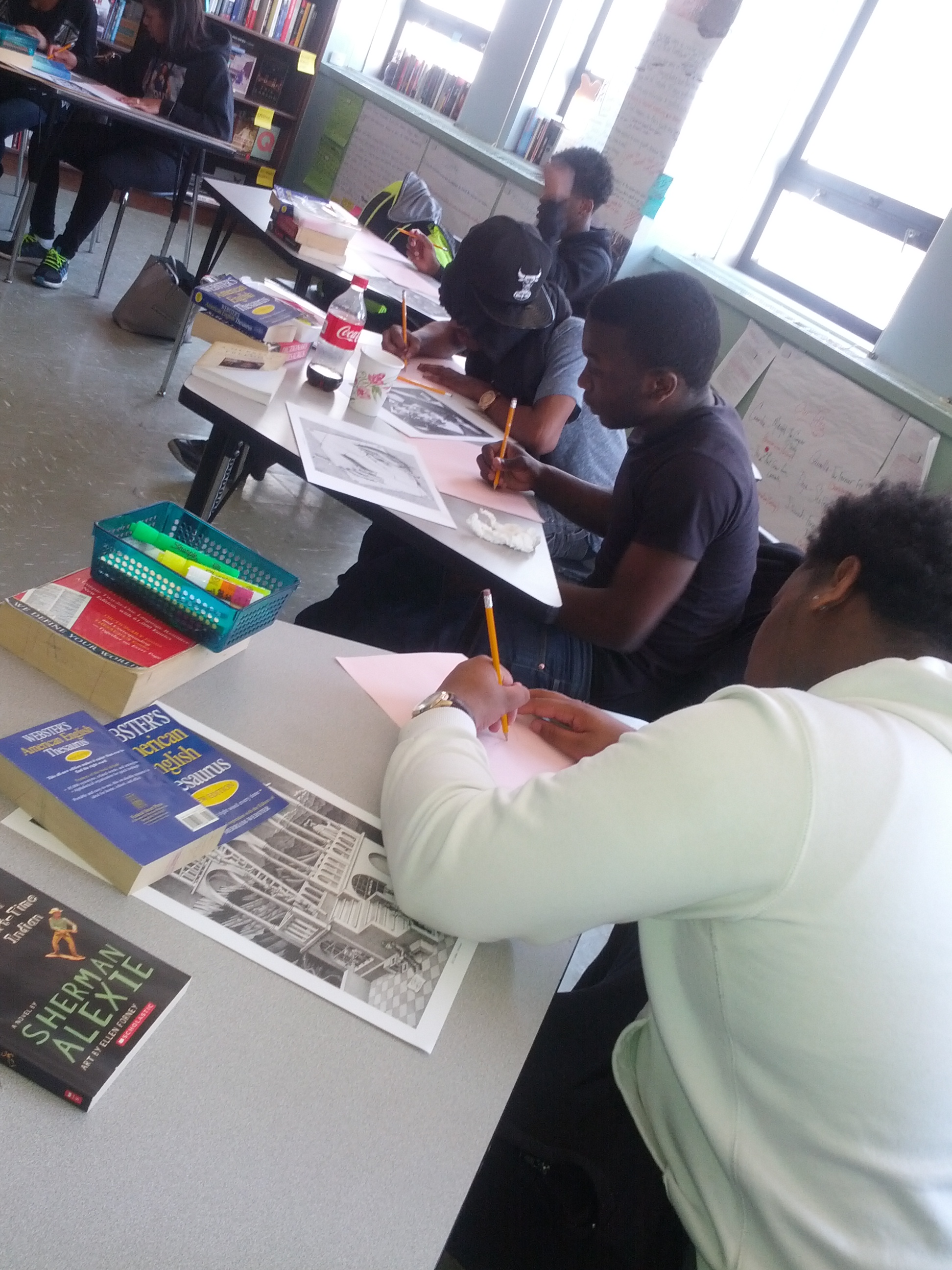
We needed a collective breath.  With all of the tension and uncertainty swirling about Room 382, we needed a class period full of calming zen.  I channelled my extraordinary experience at #UNHLIT13, as I was guided by Penny Kittle in sketching an already created piece of art.  Aside from my internal voices loudly telling me that there was no way I was going to be successful at this; I tried.  And regardless of how my sketch came out I knew the most important lesson is that I didn’t give up.
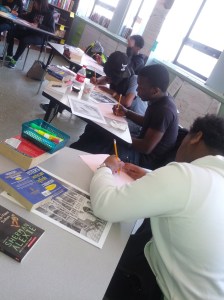
Calmly, yet intensely, sketching.

Calmly, yet intensely, sketching.

So, today we draw.

The weight lifted immediately and you could feel the energetic life seeping back into 382.  Students were riddled with questions: Wait.  We’re just going to draw today?  You mean, no writing?  We can do that?!  

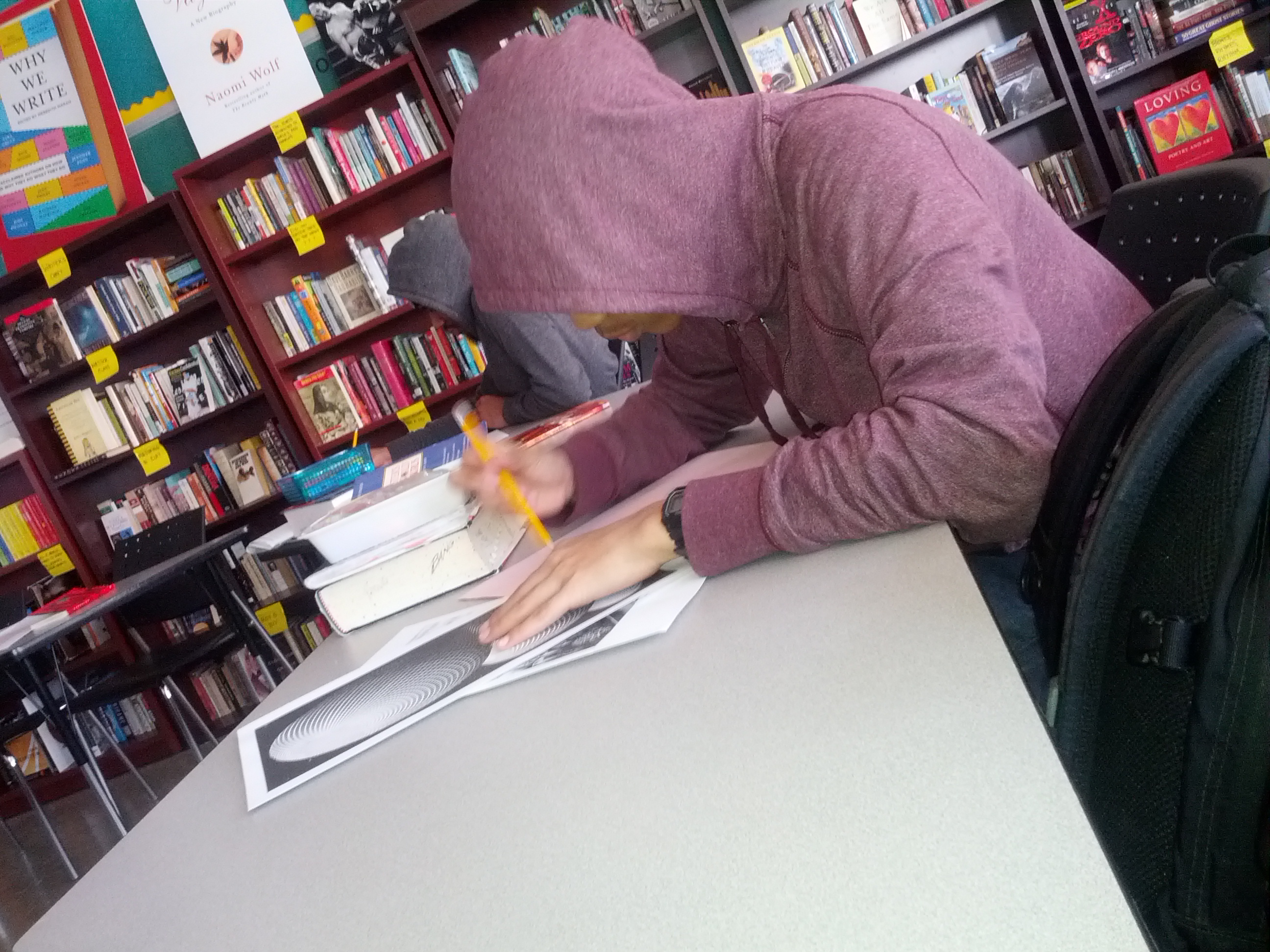
And, while some questions made me laugh and others prompted me to reflect, students were back.  So, everyone grabbed their newly sharpened pencils, chose the drawing that spoke to them most, and got to it.  I mean, really got to it.
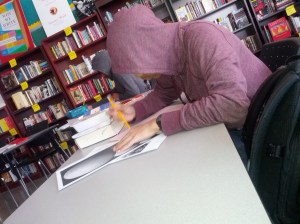
Hoodies up.  Concentration in full effect.

Hoodies up. Concentration in full effect.


It was important for me to voice my intention: Folks as we partake in this together, I need you to know that I am wildly uncomfortable with all things drawing!  For the last six months I have asked you to find strength and courage in reading and writing that has challenged you to the core.  Today, I do the same.  (Deep breath)  Here I go…

While students zoned in, I followed their lead.  I sketched under the document camera so students could watch me struggle…and I mean struggle.  Yet, while drawing/sketching isn’t my forte, I needed students to watch me play with a level of discomfort they are not used to observing.  Students engaged in non-literacy conversation (as Shana brilliantly suggests here) while honing in on their focus.  Students approached me to lend their expertise on how to curve lines or align measurements or see the artist’s sketch with a different perspective.  It was exhilarating being the student!
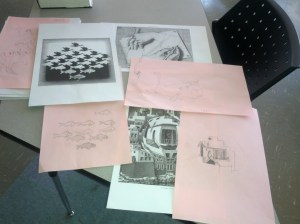
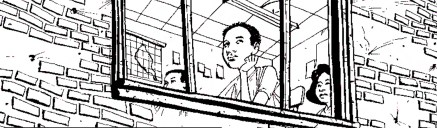
Some of our masterpieces!  My attempt at creating a balcony.

Some of our masterpieces! My attempt at creating a balcony.

All said and done, here’s what I know.  The RWW is about so much more than always reading and writing; it allows the space to explore, mess up, build community, redefine rigor, and just enjoy.  On this given day, the latter is my favorite.

How do you find ways to calm the tension within your learning environment using the Readers Writers Workshop model?


Shelfie Saturday

One of the foundations of a strong reading and writing workshop is providing students access to a wide variety of excellent mentor texts.  You may provide access to those books through your classroom library, school media center, or public library–but how do you know which books to purchase?  How do you predict which titles will be most popular with teens?  How do you know which authors will teach your students the most about writing?

sticker,375x360.u1We hope to offer you a few answers to these questions on Shelfie Saturdays.  Here, we’ll share shots of our classroom library shelves, bookstore tables, yard sale treasures, and more.  We hope these will act as examples of which books to buy, how to shelve them, and which ones to get into the hands of your readers.

So, to get us started, here’s one of my most popular library shelves–the Award Winners shelf.  This shelf houses winners of the Printz Award for Young Adult Literature, the Pulitzer Prize, the Man Booker Prize, the National Book Award, and more.  I also include nominees for all of those awards, as well as honorable mentions.  The genres are varied–YA, nonfiction, general fiction, even multigenre.  The books are at a range of difficulty levels–some have complex narrative structures, others are very long, and others are tough only because of their dense topics.

FullSizeRender[1]

I asked a few students why they liked this shelf so much.  Mylana said, “I want to challenge myself sometimes.  Whenever I read for fun I usually choose fiction, so I like to pick a nonfiction book that’s long but not boring.  I know I can find that on this shelf.”

I asked Garrett how he chose books on this shelf.  He said, “I pick books on this shelf because I hear about them on GoodReads or because they’re made into movies.  So I go to this shelf and pick the ones with the coolest covers.  The length is challenging, but if I get far enough in I won’t give up as a point of pride.”

Students gravitate toward The Goldfinch, Jellicoe Road, Grasshopper Jungle, The Round House, and Why We Broke Up more than any other texts on this shelf.  Again and again, I hear the same refrains during conferences regarding award-winning books–this book was hard, but I finished it because I just couldn’t put it down.  Award winners are shelved so for a reason–they’re the best writing has to offer in a given year, and are incredibly valuable teachers for the young readers and writers in my classroom.

Join the conversation by posting your own shelfies!  Share a shelfie with #shelfieshare and let us know if it’s a #classroomshelfie, #bookstoreshelfie, or other miscellaneous find.

The Talk-Funny Girl by Roland Merullo

10460266Marjorie Richards could be my student. In fact, she could be anyone’s student. The seventeen-year-old main character of The Talk-Funny Girl by Roland Merullo haunted me for weeks after I finished the book. I had seen her before, lingering in the eyes and mannerisms of some of my teens. The fact that she was so relatable yet so distant was disturbing.

Marjorie’s story is complex and multilayered. She lives in rural New Hampshire where teen girls are being abducted. Her abusive parents are so isolated from society that they have developed their own obscure dialect of language, a language that earns Marjorie the name “the talk funny girl” amongst her classmates. And her town has fallen under economic hardship with the closing of the local mill; in turn, she is forced to take on a job with a stonemason building “a cathedral” to support her unemployed parents.

Marjorie’s transformation is raw, inspiring, and cathartic. Her story is riddled with poetic lines that provide this quiet character with a strong internal voice. In one passage she says, “I had my protective shell of funny talk and shyness, but underneath that lived a wilder me, a girl who would take punishment, and take it, and take it, but who would never let go of herself all the way, never completely surrender” (Merullo 87). As a reader, I both relished and resented her authentic responses to her surroundings. At times she was open with her emotions, clear and contemplative. Other times I struggled yet understood her willingness to stand silent. This ebb and flow made her even more real.

Merullo found balance between maintaining a plot that lasts over years while also intertwining a thread of suspense. I began the book expecting one storyline and was forced to revise my predictions with the turn of every page. In the end, Merullo’s vivid writing, unique dialogue, and brilliant character development left an indelible mark.

The Value of Talk

Talk is one of the most powerful tools at work in my classroom.  Now, I’m talking about talknot discussion, sharing, peer editing, Socratic seminars, think-pair-share, or any other structured form of communication that might occur.  The simple act of letting our students just talk is invaluable, and we must create spaces in our curriculum for it to take place.  Here are three ways I encourage talk in my classroom.

Conferences – Reading and writing conferences aren’t just about assessment.  They’re also a valuable time for teachers and students to just talk to one another, getting to know each other as the humans that we are.  Creating a space for talk breaks down the teacher-student barrier, humanizes both parties, and by and large erases discipline problems in my classroom.  I begin every conference with a simple, “How are you today?”, and after genuinely listening for the child’s answer, direct the conference from there.  Some conferences, we don’t talk about books or writing–we just talk, because the student needs to.

IMG_6441

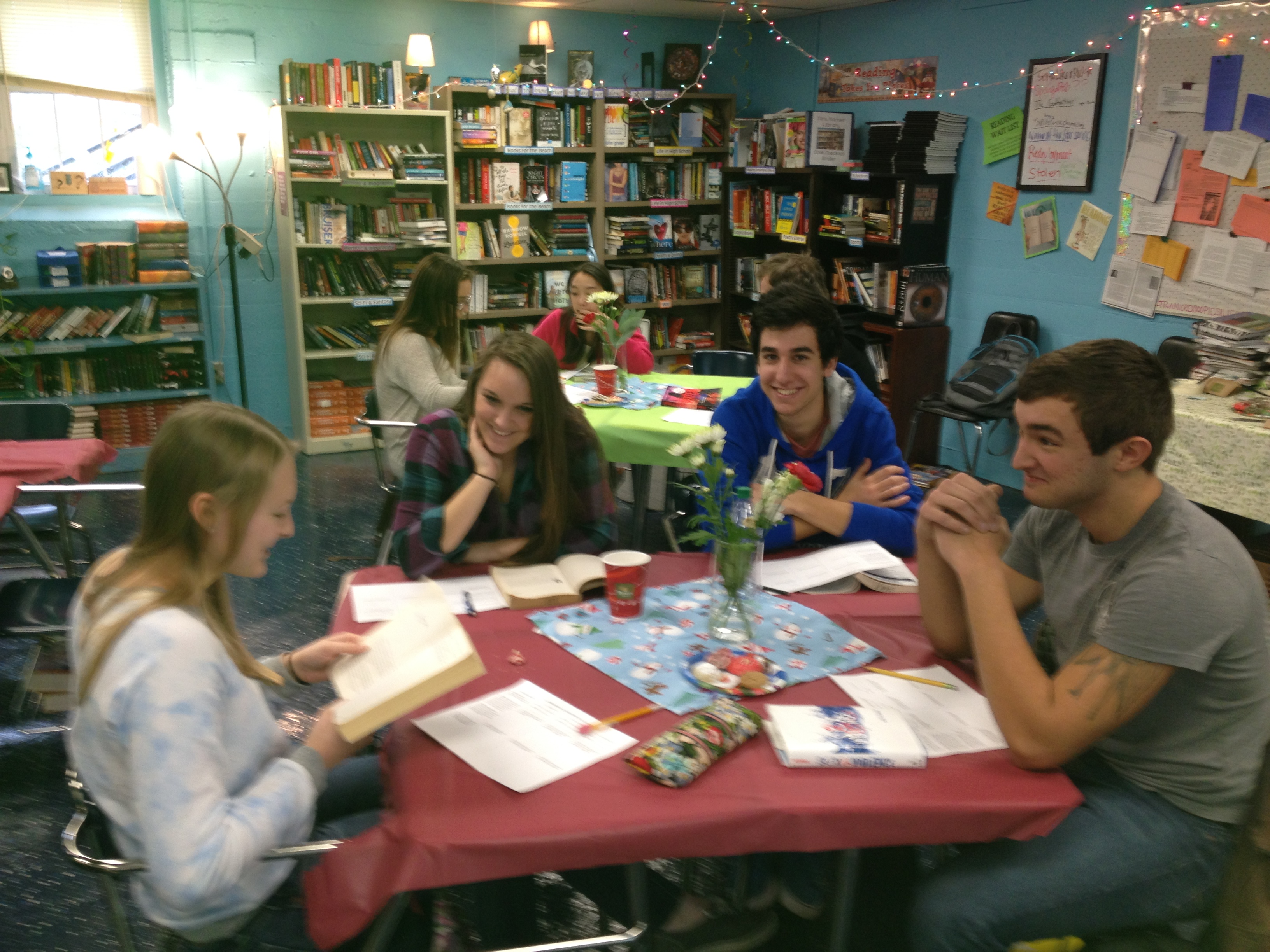
Students chat during the ‘Book Bistro’

Book Clubs – Not every book club meeting requires structure or an agenda to be valuable.  During this most recent unit, I simply asked students to keep the conversation going for 20 straight minutes.  They sometimes had to cast about for topics, but they always found something to discuss–mostly their books, but often text-to-text/self/world connections they’d made, which spun off into generalized, real-life conversations between kids who wouldn’t ordinarily find themselves chatting.  After finishing book clubs, Ana wrote, “I loved our book clubs because I felt like I got to know everyone better.”  She wrote other things about how she grew as a reader and writer…but she LOVED the unit because of the TALK that happened.

Root of the Writing Process – My journalism students consistently talk out their ideas at the very beginning of the writing process.  They chat in groups, usually starting with, “so what should I write about?”  It takes a few minutes, but enlightenment inevitably follows–the other day, Shay threw a few silly ideas out for Kenleigh about bathroom graffiti, but then they got serious about that as a story idea.  “You could call your piece ‘Signs from the Stalls,'” Shay said.  “AHHHH, that’s a great idea!!” Kenleigh enthused.  What kids like to talk about is often what they’d like to write about, and they need to talk to get to the heart of those topic ideas.

Talk builds community.  Talk is the tool that made my former student Emily say, “I felt like by the end of the year, everyone in the class became my best friend, including you.”

How do you see talk improving your classroom and its community?  What spaces do you create for talk in your classes?

The Modern PLC

Sometimes things stay with you. In December I got this message:

I have been working with three teachers this fall who have transformed their classrooms (all ranging from freshman level to AP Lit and AP Lang) from the traditional class to a readers/writers workshop approach.  Your blog posts always show up in my email box at the exact right time when they are in need of inspiration to keep going and figure out what to do in their classes.  They realized very quickly how fast they were able to get through “old curriculum” when they dropped the class novel approach and were then scrambling to find new and exciting mentor texts, books to share, and additional writing ideas. Their students have read thousands of pages and enormous amounts of books which never happened in their classes before.  Students were writing them thank you letters for inspiring them to become true readers and writers.  Penny Kittle’s books got them started on this path, but your real life teacher posts have helped them validate what they are doing.  So… thank you and keep those posts coming.  They are making a difference in our classrooms.

I could write a book about the value in that feedback (Probably will). Feedback should make writers want to write more. That is exactly what Melissa Sethna’s kind words did for me and my friends here at TTT.

Her simple thanks also made us want to follow her work, support her even more, watch how she helps other teachers. We’ve become colleagues with a united purpose. We’ve become friends.

And that is the beauty of the modern PLC.

A literacy specialist in Mundelein, IL sends a thank you to a teacher/blogger in Lewisville, TX, which makes the teacher/blogger want to become a better teacher so she becomes a better writer so she writes more inspiring and instructional blog posts for other teachers and so on.

Teachers supporting one another as we do our best to do right by the children that we teach. As ELA teachers the best way we know how to do that is through balanced literacy practices in readers and writers workshop.

That’s the foundation for the Three Teachers Talk blog, which started as three friends committing to stay in touch by sharing our work through our writing. We are four teachers now — writing, sharing, and growing. And participating in a Professional Learning Community that’s been redefined, refocused, and restructured by connected educators around the globe who are just like us.

Thank you, readers, for being part of the best PLC on the planet.


Note: Melissa Sethna posts as a guest blogger here tomorrow. Her work inspires us.

©Amy Rasmussen, 2011 – 2015

March Book Madness for Choice Reading Books

Can you believe it’s already the middle of March!?  This school year is flying by…and so is the list of titles I’ve booktalked so far.  I’ve exhausted the bestsellers of YA, dystopian sci-fi, classics, books for the beach, war books, and sports books.  At this point in the year, I’m starting to booktalk new purchases, which means I’ve often not yet read them–which means that sometimes, the quality of my booktalk decreases.

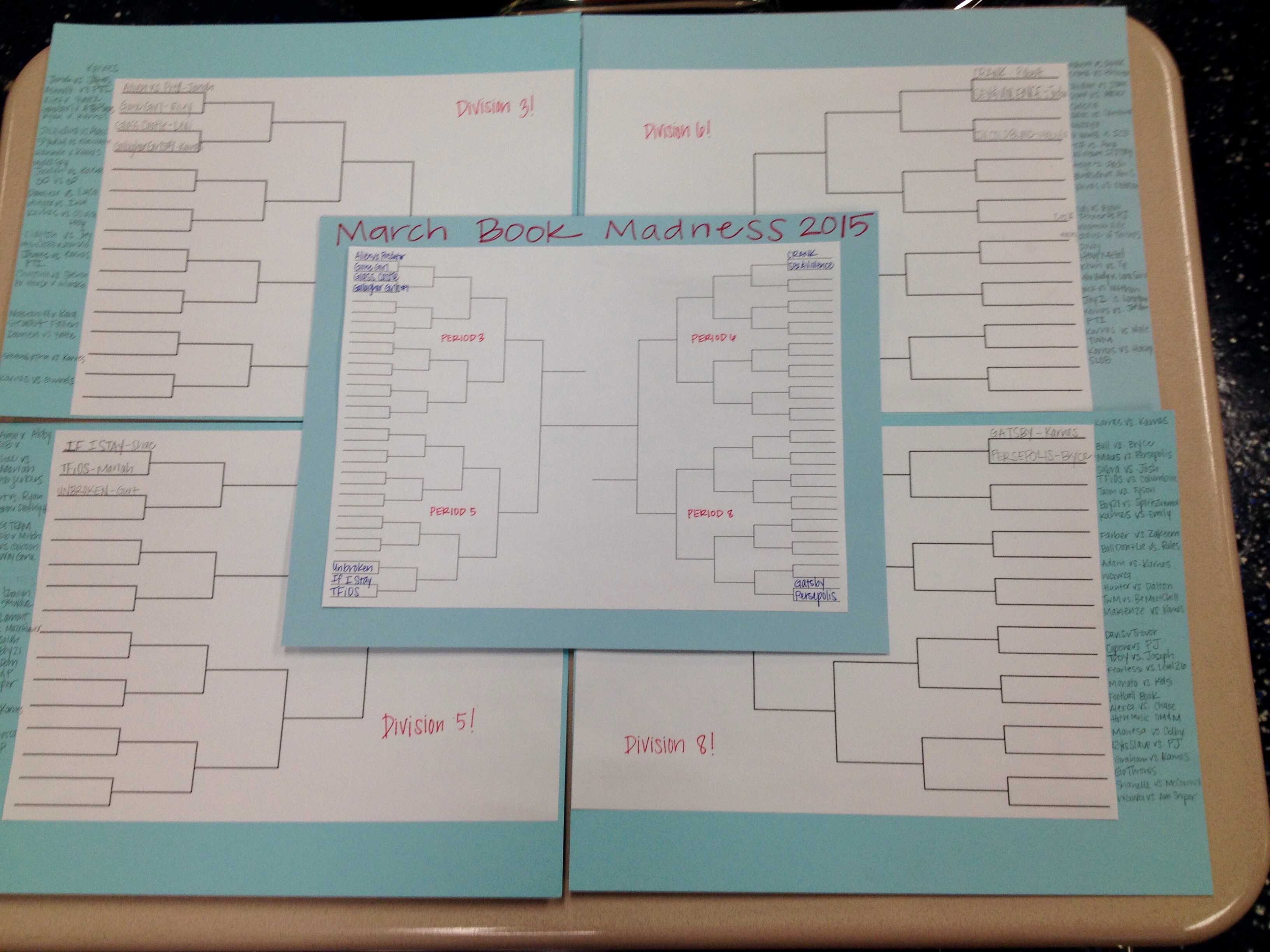
FullSizeRenderSo, because I want to shift the balance of not just grading from myself to my students, but also some of the teaching, I’ve turned to my own version of March Book Madness.  I heard about this competition from Tony Keefer’s Nerdy Book Club post, and I pitched it to kids, but they wanted to choose their own titles for the bracket.

So, blank brackets were printed, and to fill them, the guidelines were broad:  in each of my four English classes (which worked out well because they each get one corner of the bracket), students could choose a book and a partner to face off against.  Simple.

That was all I said, but as students began penciling in round one of the brackets, I was impressed mightily–they intuitively paired related books together, much like I do during booktalks.  Two boys in 8th period paired the excellent graphic novels Persepolis by Marjane Satrapi and Maus by Art Spiegelman.  Two girls in fifth period paired John Green’s The Fault in Our Stars and Gayle Forman’s If I Stay–two viral tearjerkers.  The Absolutely True Diary of a Part-Time Indian by Sherman Alexie will face off against Mexican White Boy by Matt de la Pena in sixth period.  And so on.

FullSizeRender (1)

Shae vs. Mariah in the Battle of the Tearjerkers…TFiOS vs. If I Stay

As book battles began, I laid out equally simple guidelines for voting.  Each student in a faceoff would give a short (1 minute) booktalk about their chosen text, and audience members could vote for one title based on any criteria–their own experience reading that book, the person’s booktalk, the presenter’s enthusiasm, the book’s stats on GoodReads behind the presenters, etc.

This modification to our daily routine–which is that students begin with reading, then hear my booktalks–has accomplished several wonderful things in our classroom.

First, students’ what to read lists, which had recently plateaued, are lengthening rapidly once more.  The sheer social capital of having a kid share his or her own reading experience of a book makes certain titles more tantalizing than I ever could.  Matthew Quick’s Sorta Like a Rock Star, for example, never quite flies off the shelves after I booktalk it.  It’s only after one or two kids read it and enthusiastically share it that it goes viral–and it does–year after year.  I see the same thing happening now during March Book Madness with lots of other books.  Kids are clamoring, suddenly, for several of the same titles.

FullSizeRender[1]Second, students are learning more about one another’s reading tastes.  They look at the brackets from other classes every day to see which books are advancing, and are sometimes surprised by who’s booktalking what.  “Huh…I didn’t know Jordan loved A.S. King too!”, I heard Hannah say yesterday.  “You read that book too!?  Wasn’t it awesome?!” Tyler said to Hunter, as he stood up with Ned Vizzini’s Be More Chill.  Despite my efforts to make their reading lives transparent with reading groups and notebook passes of book blogs, some of my larger classes haven’t quite unearthed the darkest corners of one another’s reading preferences.  MBM is fixing that quickly.

Third, this is not for a grade.  This is just a semi-structured celebration of books, with bragging rights as the purely intrinsic reward of the whole endeavor.  The five or so minutes we spend on this in class daily are a worthy time investment for the revelatory feel they bring to the start of our learning.  Kids are excited and upbeat after the two daily faceoffs, and excited to often add one or more of the four daily books discussed to their to-read lists.  The post-winter doldrums are quickly lifting…and the sunshine certainly isn’t hurting, either.

Is anyone else doing a version of March Book Madness?  How’s it going?  Please share in the comments!

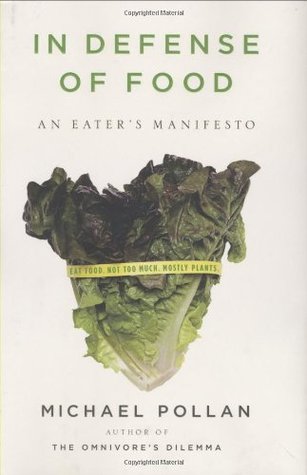
In Defense of Food: An Eater’s Manifesto

315425I grew up as a reader, but I was a steadfast reader of fiction only–especially series.  I remember receiving my PSAT score report in high school, which strongly suggested that I begin reading more nonfiction in order to improve my vocabulary and reading comprehension.

So, not being informed about the wonderful nonfiction tomes I now know about, I began to read the newspaper.  That probably contributed to my majoring in journalism, and now teaching that subject in addition to English.

But it wasn’t until I took Penny Kittle’s class at the UNH Literacy Institute in 2013 that I fell in love with nonfiction (pardon me, Mr. Lehman and Ms. Roberts!).  I read Malcolm Gladwell’s Outliers and was enamored of his use of narrative to help me understand seemingly disparate facts.  I quickly read all of Gladwell’s other books, then devoured the rest of the booklist from Penny’s class–The Emperor of All Maladies by Siddhartha Mukherjee, The Immortal Life of Henrietta Lacks by Rebecca Skloot, Behind the Beautiful Forevers by Katherine Boo, Zeitoun by Dave Eggers, and plenty more.

However, it’s not since Gladwell that I’ve found another nonfiction author whose collected works I’m dying to devour…until now.

I recently asked my students to brainstorm as many nonfiction genres as they could, then select three for us to focus on for this quarter.  One of their selections was a recipe.  I wanted to show my students lots of examples of writing about food, so I purchased Michael Pollan’s In Defense of Food: An Eater’s Manifesto and The Omnivore’s Dilemma: A Natural History of Four Meals.  I picked up In Defense of Food first, and was left defenseless.

This book rocked my world, and my worldview.  It’s a book about the food we eat, where it comes from, how it’s different than other cultures’ foods, and how it’s good and bad for us.  I learned about the wild inaccuracies of food science, the nutrient-depleting process of processing food, and the government’s allowance of all this because of their dependence on food marketers’ money.  I also learned about the evolution of America’s food culture–from farm fresh to TV dinner to fast food–and its deleterious health effects on our population.

So, after Pollan sufficiently freaked me out and made me swear to myself that I’d never eat any processed food again in my life, he presented a clear solution to my fretting and outlined some rules for eating healthily (the subtitled Eater’s Manifesto).  I learned how to shop smart, defy the American diet’s unhealthy customs, and consider my foods in the contexts of their meals, which can completely transform their nutritional value.

It wasn’t just the topic that fascinated me (admittedly, I love to cook)…it was the writing.  From knee-slappingly incredible food puns like “let them eat Twinkies” and “the silence of the yams” to his deft skill at citing other writing to support his own arguments, I was convinced.  The clear organization of the book mirrors his three basic rules about eating well, which he states in sentence number one:  “Eat food.  Not too much.  Mostly plants.”  The complex narrative he weaves makes perfect sense, but is incredibly layered.  Through it all, Pollan made his claims and supported them sturdily, leaving me not only swept up in a great story, but thoroughly knowledgeable about what real food is and isn’t in America today.

I can’t wait to bring this book to my students through book clubs, a reading challenge, or a craft study mini-lesson…so I’ll booktalk it tomorrow to my Funyun-munching students with as much fire and brimstone as I can manage, and hope they hop on the Pollan diet with me.