Category Archives: Community

Try it Tuesday: Silent Sticky Conferences

A burning question I seem to repeat year after year is “How do I talk to more of my students one-on-one beginning on the first day of school?”

I know the value of making eye contact with the adolescents who enter my room. I know the importance of making them feel like they belong here — like they are in a place where they can be themselves, a place where they want to learn.

I confer regularly with my students — about their reading lives and their writing lives — but every year it seems to take me a while to get in the groove. You know, get all the procedures introduced and underway, get students interested in books (and sometimes reading itself), learn names, set up our writer’s notebooks and our blogs and all the different bits of technology we use regularly like Google Classroom and Twitter.

I know all of these things are important, but sometimes I feel like I miss valuable moments of just I-want-to-get-to-know-you in my rush to get everything set up so we can finally begin to learn.

I know myself well.

So this year — I’ve slowed the pace a bit. And my students and I are passing notes.

Screen Shot 2016-08-29 at 7.49.08 PM

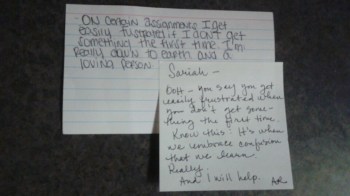
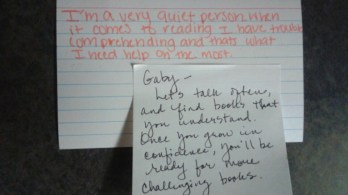
On the first day of school, I asked students to write their names big and bold on one side of a notecard. (I use these throughout the year to select non-volunteers to speak up and share their notebook responses and to answer questions. You know, like the popsicle sticks with everyone’s name on them idea.) Then, on the other side of the card, I asked students to tell me what they think I need to know about them as a learner in relation to the reading and writing we will do in this English class.

Silent confer1Some of my students’ notes were telling:  Many of them lack confidence. Few of them like to read. A couple feel ready for the complex texts they will have to tackle. Some explained in very few words a need to feel validated and cared for and something personal and important to them as learners in my care.

silentconfer3

I responded to each student’s note with a personal note of my own, written on a sticky note that I returned the next day in class. One young man questioned as I walked the room passing them out:  “Miss, you wrote to all of us?”silentconfer2

“Yes,” I told him, ” and I need you to carefully read what I wrote. Let’s see if we can start a conversation about you and what you need from me as a reader and a writer.” His grin grew as golden.

Silent sticky-note conferences have been the norm in my class for quite some time. They bridge the gaps between face-to-face conferences, build relationships, show we care enough to pick up a pen and pen a few words of encouragement or instruction.

With class sizes of 30 (sometimes 30+) we have to find ways to talk to our students one-on-one often. This passing little notes method fulfills my need to touch base with students, and it fuels their need to be recognized, validated, and hopefully inspired.

If you haven’t invested in sticky notes this year, hurry to the store while they are still on the back-to-school sales. I’ve got a whole crate of them.

Next step:  We’ll eventually move into larger pieces of paper, so I want to teach my img_1845students to fold notes like I did way back in seventh grade before the advent of all this technology. Texting friends just cannot be as fun as all those little folded notes.

What are your ideas for more face-to-face and one-on-one conversations with students this year? Please share in the comments.


Every Opportunity on Day One and All Year

Every Opportunity

You’ve probably seen this video. When I watched it this afternoon, it had over 8 million views. If you haven’t seen it, I challenge you to watch it. Then, think for a bit about where you see yourself. I did.

And it’s humbling.

As I start a new year with new students today, I want to remember the me I want to be every single day — the adult with the smile who takes the time to greet each student with a genuine hello, the teacher with a voice of care and concern — even when I’m tired or frustrated or worried about something completely unrelated to school. I want to show every student that they matter — because they do.

We teach students as much by our actions and attitudes as we do by our instruction. We know this, and we love children — that’s why we went into education in the first place, or at least I hope it is.

So today, when my students come to my door, I’ll be there to greet them. I’ll talk to as many of my juniors as I can. I’ll look into their eyes and invite them to think and write and share as much as they are willing to about their lives.

How will I extend this invitation? You guessed it. Our first response of the year will be to this Every Opportunity video. I’m eager for the conversations.

Building community on day one and then working to strengthen community every day throughout the year.

I’d love to hear your ideas for building classroom communities that work to ensure all students feel seen and heard. Please share in the comments.


Try It Tuesday: Red Thread Notebooks

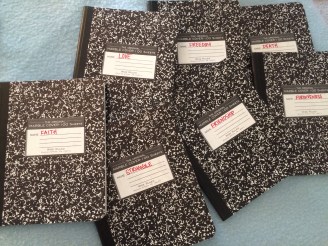
img_3173-1So much of a workshop philosophy centers on the assumption that reading and writing are forever intertwined.  Vocabulary, grammar, poetry–they’re all pieces of the puzzle that make up literacy and a passion for words, too.  It was with this in mind that I created Red Thread Notebooks.

The idea came from two places–one was Penny Kittle’s “big idea books” (found on page 8-9 of those handouts), which are reading response notebooks  centered around themes in literature.  The other was Tom Romano‘s “red thread” assignment, in which teachers had to write about which parts of our teaching philosophy would run through all of our teaching, like a red thread.

img_3177

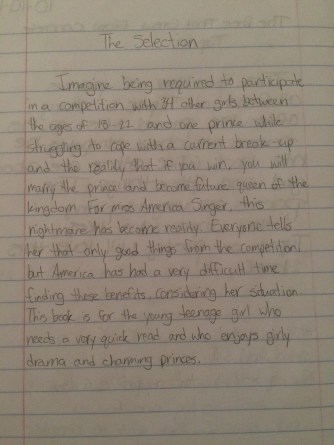
This student booktalks The Selection in the “STRUGGLE” notebook.

So, when composition notebooks are just a nickel in the summer, I buy 60 of them each year.  My students and I begin the year by brainstorming themes and topics that are important to us–love, cell phones, faith, music, family, video games, death, high school, forgiveness, four wheelers.  We label our notebooks and use them all year long.

There are a variety of ways I invite students to write in these notebooks:

  • Vocabulary practice: list related words, synonyms, word associations, etc. similar to the notebook title
  • Skill practice: write dialogue, revise sentence structure, practice figurative language, craft descriptive writing, about the notebook’s title
  • Book talks: write about how the book you’re currently reading might add to a conversation about the notebook’s title
  • Grammar instruction: revise a sentence, imitate a paragraph, tinker with style, while writing about the notebook title
  • Free writing: write your thoughts and musings on the notebook title
  • Poetry: find an existing poem, craft your own poem, or create a found poem about the notebook’s title
img_3179

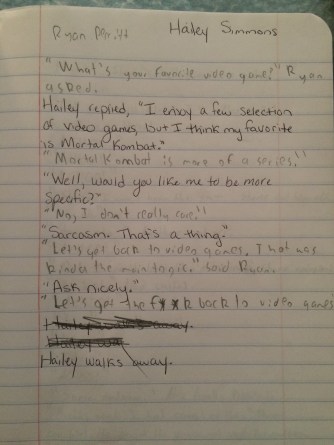
Hailey and Ryan practice dialogue in the “VIDEO GAMES” notebook after I teach a mini-lesson on its conventions.

Because these are shared notebooks, I ask students to refrain from using profanity in them or writing about any of their peers.  I don’t require names, but many students like to sign their writing.  Those are the only rules.

Once the notebooks have begun to fill up, students can refer to them to find book recommendations, writing topic ideas, or vocabulary words to add to their personal dictionaries.  They can also look for examples of skills practice, craft studies, or grammar lessons that we’ve done for additional guidance.  One year students even selected multigenre topics based on our red thread notebooks.

These notebooks are a lovely way to make permanent a yearlong conversation about literacy.  The topics change every year–Michael Jackson had his own notebook my first year of teaching, and this year Lebron James had one–but the opportunities to write, reflect, and make connections remain the same.

Do you think you’ll try Red Thread Notebooks next year?  Do you do something similar?  Please share in the comments!

#FridayReads — Picture Books in AP English

Sometimes speakers make you want to write. Last week when I listened to Lester Laminack was one of those times.

The North TX Council of Teachers of English Language Arts one-day conference was one week ago today. As president I had the honor of calling the meeting to order, and looking out at the audience of almost 600 ELA teachers, grades K-12, I could not help but think how fortunate the children in Texas are to have such dedicated teachers, teachers who want to help kids write, teachers who practice writing themselves.

Listening to Lester’s keynote as he talked about his writing process made my memories swirl, and my fingers get itchy.

I was not the only one.

Screen Shot 2016-06-17 at 3.29.59 PM

I left wondering:  What if more teachers stirred that kind of memory moment in the students we want to move as writers?

Picture books have that power. Elementary teachers know this. They read books aloud to little writers. They talk about meaning around moments their students can relate to.

Sometimes I think we secondary teachers forget the power in stories. We forget that seemingly simple things can spark big thinking. I want to remember.

Here’s a list of 15 of the books I will read with my not-so-little writers in the coming year: Screen Shot 2016-06-17 at 4.45.37 PM

Saturdays and Teacakes by Lester Laminack

All the Places to Love by Patricia MacLachlan

The Other Side by Jacqueline Woodson

The Hundred Penny Box by Sharon Bell Mathis

Is There Really a Human Race? by Jamie Lee Curtis

Harold and the Purple Crayon by Crockett Johnson

The Dot by Peter H. Reynolds

Chrysanthemum by Kevin Henkes

Henry’s Freedom Box by Ellen Levine

The Wretched Stone by Chris Van Allsburg

I Want my Hat Back by Jon Klassen

It’s a Book by Lane Smith

The Dark by Lemony Snicket

The Secret Olivia Told Me by N. Joy

Beautiful Oops by Barney Saltzburg

And I’ll probably use several of these:  wordless picture books

Please share your suggested titles for picture books you use in your secondary classroom.


Finding Solace in our Students

IMG_2666

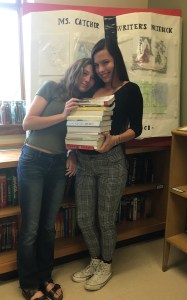
End of the year pics with friends and books.

The shooting in Orlando this weekend has weighed heavily on my mind for the past few days; it has settled into the back of my brain, penetrating my thoughts whenever I get a moment to rest between the hectic last days of school.  While I only know victims through six degrees of separation, I can’t help but see the images of friends, family, and students in the 49 faces of those murdered.

I’m not sure if it is the lockdown drills at school that make these tragedies feel all the more chilling and real, or if it’s the targeting of LGBTQ+ populations when I, oftentimes for the first time, watch young people finding their true identities in my classroom, but this time I feel nauseous and weak and powerless.

To think that this is the world my students are graduating into and growing up in, is frightening.

But as I scrolled through the profiles of the deceased, I found a statement from the father of victim Mercedez Flores.  He wrote, “We must all come together, we must all be at peace, we must all love each other, because this hatred cannot continue for the rest of our lives.”  That is what the workshop classroom allows me to share with my students—a corner of this peace and love.  It opens a door for me to connect with them on a personal level, allowing them to find not only acceptance but also stories, understanding, and success in their books.  Allowing them to open up to new literature and explore themselves as a reader sends the message that I not only value them as learners, but I value them as diverse people with a wide variety of needs, curiosities, and interests.  This avenue may only be minor, but in the wake of all the hatred and fear, I hope my classroom is a respite from the world.  A place where students can learn to at least respect one another’s differences without judgment or condescension, a place where we can explore the difficult themes and navigate challenging conversations in safety.

IMG_2693Everyday gives me a little more hope that this next generation has begun thinking about the innumerable struggles they will have to face.  As one of my students wrote about the universality of To Kill A Mockingbird, “For an innocent man to be found guilty is a miscarriage of justice, but for an innocent man to be found guilty for being black is a result of bigotry and prejudice, and shouldn’t happen…Sadly, as seen with Trayvon Martin, Mike Brown, and others, racism still does exist in this country. To Kill A Mockingbird is a constant reminder of how far we have come and how far left we still have to go when it comes to overcoming racism.”  Charlie’s words remind us that stories show us both the fallibility and overwhelming strength of the human condition.

Yesterday morning, as I prepared for my last day of classes (we still have three more days of exams), I reminded myself that teaching allows me to model a life of acceptance and love, of caring and compassion, of concern and advocacy.  It may not be much in the general scheme of things, but it is the most productive way I can handle the tragedies our country continues to face.  Between cramming in grading and pulling together final assessments, I spent invaluable time writing notes to my classes, collecting ice cream toppings for our last day parties and signing the backs of photos of my students with the books they read this year.

The best part is that the love is returned as graduating seniors from years prior show

IMG_2701

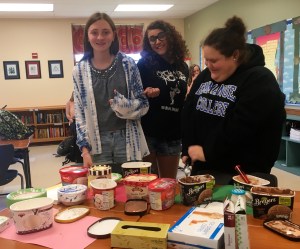
Ice cream parties to finish up our yearlong adventure together.

up at my door to hug me good bye and have me sign their yearbooks.  College students visit to update me on their lives, current students voluntarily help me pack up my room, and former students spend their first summer afternoon organizing my bookshelves for future students.  For all the hate that exists in this world, there is far more kindness, far more compassion, and far more love.  I know because my students remind me of this every day.


Try It Tuesday: 11 Weeks to Regroup

In Wisconsin, we talk a lot about the weather. This may be due, in part, to the fact that it’s downright frigid, cold, and/or disturbingly chilly for (conservatively) seven months of the year. Block off October through April for likely snow (and as a special bonus, when I was nine years old, it snowed eight inches on May 10th), September and early May for possible winter jacket wear, and viola! Summer arrives and all residents are forbidden from complaining about heat. Ever.

must-see-imagery-wisconsin-summer-one-day

Thankfully, I find myself at the start of that all too brief period when summer is brand spanking new. In the last three days I’ve picnicked with my family, gone kite flying in the park, attended a Sam Beam concert, returned to running after a few weeks break, randomly decided to try yoga last night, cleaned out two closets, and finally had time to finish reading The Handmaid’s Tale (I am in love by the way. Mandatory reading for all progressively minded ladies and the men that love them, I think.  I’d never stand for being Ofnick, though I love my husband so, and that’s really the point of the dystopian adventure, yes? A quick bucket of ice water to the face in avoidance of complacency.)

Then, two nights ago, I picked up Hillary Jordan’s Mudbound and I cannot put it down. And you know what? I don’t have to. It’s summer.

But I digress. Over the past few weeks, the Three Teachers have been reflecting on the school year that was. Its trials, tribulations, successes, explorations, and even goodbyes (That’s four links to awesome posts, by the way. Enjoy!) And as we approached the end of the school year, and worked to reflect on so many experiences and experiments of thought, I noticed an underlying current of…weariness. Or rather, some well veiled (crippling) stress and (abject) exhaustion.

Now, don’t get me wrong. We love our work. We love our students, we love to read, we love to write, and we love to challenge ourselves and our craft. We love to blog. However, the reality is, it’s hard work and the four of us are tired (I love that Three Teachers Talk is really four teachers. Surprise! More bang for your workshop buck.) Between the four of us we have a wedding to plan, a new baby to attend to, a toddler to wrangle, grandbabies to dote after, and full time employment as teachers, readers, and writers. Any teacher on the planet will tell you – we love what we do, but sweet mother of mercy, can an educator get a nap up in here?

So here is my summer edition of Try it Tuesday:

I want you to rest.

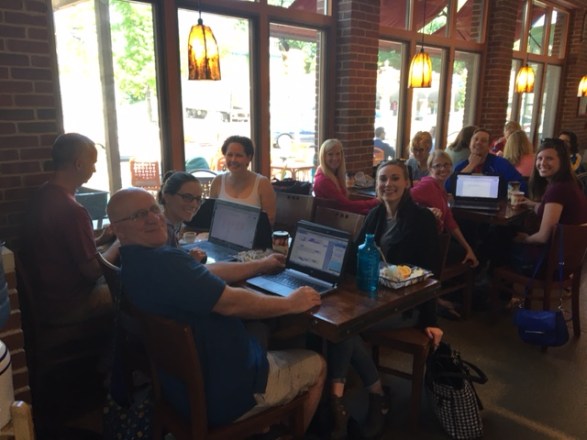
I know it’s contrary to our nature. I know that just four paragraphs ago I detailed all that I’ve crammed into the last three days (It’s like my soul sensed a vacuum created by the absence of school and sucked up anything and everything to fill the sudden void. Panic! Panic!) I know many of us have conventions to prepare for, curriculum to refine, classrooms to organize, final exams to score, and some have relatively beleaguered personal lives that need attention (My daughter asked me this morning if we were going to sit down to eat our toast today or take it in the car. Sigh. This lesson in slowing down brought to you by a three year old.)  I also know we are dedicated to a fault. Please see the following…my beautiful English colleagues working on the day after school let out.

IMG_1516

Exhibit A: This was day one of summer. Our entire team got together to finish up some district level curriculum work. They are all so sweet to look so pleased to be there.

The summer will be rich with opportunities, no doubt. Some of us will be blessed with opportunities to travel, attend workshops, dig into pedagogical texts, reflect on our craft, and excitedly (because teachers are downright adorkable) plan for next year.

But it can wait. A week? Two? I’m not sure. I’m betting it differs for everyone. But there is a reason we all get vacation at one time or another. Be it a stretch of summer or smaller breaks throughout the year, we all need to rest. In order to be our best selves when we return to the classroom, we all need time to recharge. I have eleven weeks, five of which already have one or more meetings in them. So right now…I’m going to take a few deep breaths and stare. At everything. Or nothing. Could be both. 

Don’t let anyone make you feel like you don’t deserve this break. Without it, I fear, many of us wouldn’t make it. Not for lack of trying, of course, but teacher burn out is horribly high with time away. And we all know the percentage of the coming weeks that we will (happily) dedicate to continued work as educators will be high anyway. Then, before you know it, we’ll be back at it.

IMG_1499

All quiet. For now.

So, take a bit of time for you. Catch up on Scandal or check out that Downton Abbey you’ve heard so much about (It’s over, you know, but I won’t tell anyone you’ve never seen it.) Pay someone to cut your lawn. Get in the car and drive with no real destination in mind. Sit next to the pool (Do you have one? Can I come over?) Sit down at a table to eat your breakfast, take more than 27 minutes for lunch, and demand that someone else make you dinner. Stare. 

IMG_1593

Heck, read a…wait. That suggestion’s a bit loaded.

Oh, alright. Read a book.

Read several.

I know I can’t stop you and why would I want to try?

I’m right there with you (Did I mention Mudbound is incredible?) 

Enjoy! You deserve it.

What are you doing to take a much needed break? Post your plans in the comments below!


Giveaway WINNERS!!

Thank you to everyone who entered our giveaway!  We’re so excited to award books to so many amazing teachers.

Without further ado, here are the winners:

  1. Andrea Anderson from Parkway Central High in Chesterfield, Missouri
  2. Hope Bobonick from Trumbull County Career and Tech Center in Warren, Ohio
  3. Melinda Buchanan from Sanger High School in Sanger, Texas
  4. Lindsey Cary from Peru High School in Peru, Indiana
  5. Janelle Christensen from Henry Sibley High School in Mendota Heights, Minnesota
  6. Karen Drake from Lee-Davis High School in Mechanicsville, Virginia
  7. Kopper Ernst from Riverheads High School in Staunton, Virginia
  8. Amanda Gaul from Waukee High School in Clive, Iowa
  9. Jill Gerber from Whitfield School in Creve Coeur, Missouri
  10. Amanda Graham from Latta High School in Dillon County, South Carolina
  11. Benjie Haugen from Monticello Middle School in Monticello, Illinois
  12. Colleen Kiley from Mount Abraham Union MS/HS in Bristol, Vermont
  13. Kimberly Kroll from Lapeer High School in Lapeer, Michigan
  14. Ashlee Kuhry-Larsen from Waukesha South High School in Waukesha, Wisconsin
  15. Kyla Louis from Hood River Middle School in Hood River, Oregon
  16. Anita Miller from Miami Trace Middle School in Washington Court House, Ohio
  17. Kyle Nelson from Lone Peak High School in Highland, Utah
  18. Tasha Rios from Grand Rapids Catholic Central in Grand Rapids, Michigan
  19. Paola Ruocco from Evanston Township High School in Evanston, Illinois
  20. Sarah Whitman from Collingswood Middle School in Collingswood, New Jersey

Be on the lookout for your books to arrive to your school addresses!  If you’d prefer for me to ship your books to your home address, please feel free to email it to me at shanakarnes@gmail.com.

Thanks to everyone who joined the Three Teachers Talk conversation!  Happy Summer!

Mini-Lesson Monday: First and Last Lines

In the spirit of all the books we’re giving away (winners announced tonight!), today’s mini-lesson is one of my favorites to do with independent reading books.  It celebrates the beauty and power of language, no matter the text–poetry, nonfiction, YA, award-winners, graphic novels, and more.  It also celebrates the pure joy of discovery; the launch into a new world attained only by opening to the first page of a new book.

Objectives:  Using the language of the Depth of Knowledge levels, students will identify patterns in opening and closing lines of texts, synthesize their noticings, and draw conclusions about a text’s craft and structure.

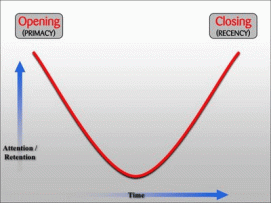
primcacyLesson:  “Have y’all learned about the concepts of primacy and recency in psychology yet?  Who can refresh us?”

A student reminds us that the concept says that the first and last items in a series are easier and more likely to be committed to memory.

“Well, this concept isn’t just for psychology.  It applies to books too.  The first and last lines of books are the most powerful, and the most likely to stick with us.  Let’s talk in our table groups about why the first and last lines are so powerful.”

I wander the room for three minutes as students discuss, in groups of 3-4, these concepts.  They conclude that the first line often sets the tone, introduces a new world, or hooks the reader with some mystique.  The last line, they say, helps keep the reader wondering, or solves a lingering mystery, or even makes you cry.

I write these conclusions on the board, or elicit them from groups if necessary, so that we’re all on the same page.

“Okay, let’s take a look at some of our current reads and see how they can grab our attention.  Open up your independent reading book and read the first line again, and then read the very last line, too.”  (There’s always some anxiety about this, but I reassure them that last lines rarely contain plot giveaways.)

618698KrJJL._SX325_BO1,204,203,200_

(OMG, have you read this? It exploded in popularity the last few weeks of this school year. Read it!)

I ask a few students to give me examples:

  • Miss Peregrine’s Home for Peculiar Children begins with “I had just come to accept that my life would be ordinary when extraordinary things began to happen,” and ends with, “We rowed faster.”  
  • A Prayer for Owen Meany opens with “I am doomed to remember a boy with a wrecked voice—not because of his voice, or because he was the smallest person I ever knew, or even because he was the instrument of my mother’s death, but because he is the reason I believe in God; I am a Christian because of Owen Meaney,” and ends with, “I shall keep asking you.”
  • The First Fifteen Lives of Harry August begins with “The second cataclysm began in my eleventh life, in 1996,” and concludes, “Instead, for those few days you have left, you are mortal at last.”
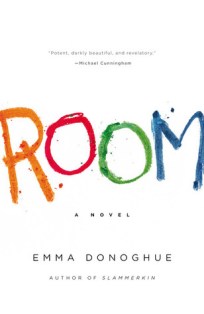
  • Room opens with “Today I’m five,” and ends with “Then we go out the door.”

I ask students to write for a few minutes about all that they can learn from the first and last lines, based on what they already know of the text from reading.  This is key–the lesson is much different than a simple craft study of a text they’re not already invested in, because they’re bringing lots more prior knowledge to their text analysis.

7937843I quickly model with Room, whose plot is simply explained and well known from a recent booktalk.  “I notice the sentence structure first–both lines are short, simple sentences.  Then I get a sense of the narrator’s voice, as he is obviously five years old, and that shapes how I’m going to view the text.  I also know that while they start out trapped in Room, they manage to escape somehow, either literally or figuratively, because of the last line.  I’m intrigued by all of these things, and it sets me up for what sounds like a pretty good read.”  As I talk, I note on the board the kinds of things I’m noticing–craft, tone, characterization, theme, plot, sentence structure.

Students write for five minutes about these topics.  Because they’re midway through these books, they have more knowledge of the text than just the first and last lines.  After a few minutes of writing about what they’ve noticed, I ask, “Now, how does revisiting the first line, and looking ahead to the last line, shape your reading of the text?  What do you find yourself thinking about?  What do you predict might happen?”

Follow-Up:  After students have written their reflections, I ask that they pass notebooks.  They’ll read all of their table mates’ entries, providing 2-3 mini-booktalks–a variation on speed dating.

This lesson could also be a great companion to Jackie’s mini-lesson on writing leads.

This lesson also acts as one of a series of lessons leading up to the students’ writing of a craft analysis of their independent reading books.

Summer Book Giveaway!

Fellow teachers, I have a problem.

img_2969

A book-buying, grant-writing, donation-receiving, classroom-library-growing problem.

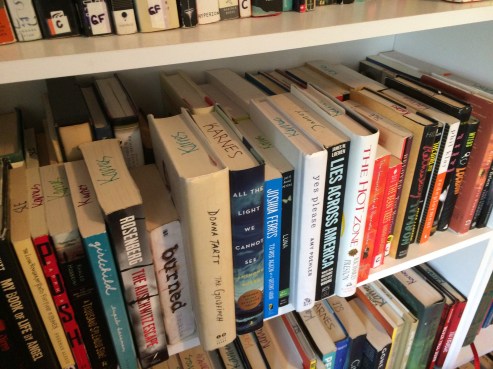
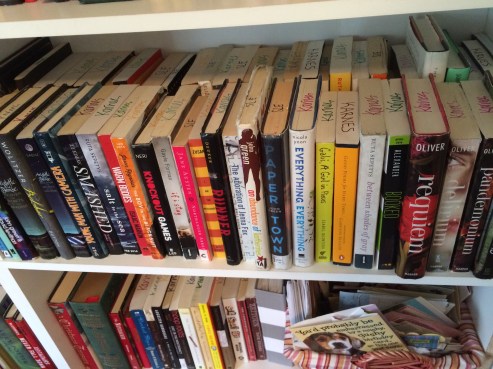
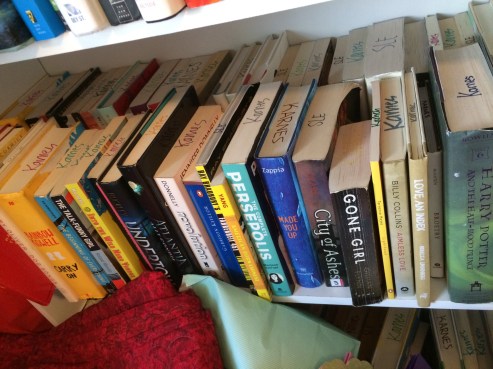
After making it my mission to build a gigantic classroom library, Karnes & Noble has gotten a little…well, out of control.  It has grown to over 3,000 titles, many of which are dog-eared and well-loved, but all of which are wonderful reads.

The problem is, I’ve left the classroom for a while, and…I’ve got wayyyy too many books, and wayyyy too few bookshelves in my tiny townhome.

img_2967

Luckily, I know a few (thousand) deserving teachers whose students would love these titles.

(Yes, I’m talking about you!)

If you don’t mind the Sharpie-d KARNES emblazoned on their spines, then enter to win one of twenty boxes of books I’m giving away!  Nothing would make me happier than knowing that all of these books will wind up in the hands of students who will fall in love with them.  (I’ll also be happy to have my guest room regain the title “guest room,” rather than its current moniker, “Amazon book storage warehouse.”)

There are five ways to enter the giveaway:

  • Complete this 5-minute readership survey to help us tailor our writing to your needs.
  • In the comments section of this page, leave your name, school name, grade level(s) taught, and a list of the 5-10 most popular titles in your existing classroom library.
  • Like our Facebook page, then post to the page a brief description of one of your favorite reading or writing assignments you do with your students.  (Example: I love the multigenre research paper the best!)
  • Using the hashtag #3TTbooks, tweet us an excerpt (pictures welcome) from a text you might use for a craft study or mentor text, as well as your school name and grade level(s) taught.  (Example: a picture of the first page of Peak by Roland Smith, or a picture of the first page of Everything Everything by Nicola Yoon.)
  • Subscribe to TTT, comment on an old post from which you learned something you loved, and then share that post via Facebook or Twitter using the hashtag #3TTbooks.

img_2968

Feel free to enter as many times as you’d like–you may just wind up with two big boxes of books at your classroom door!

And as a consolation prize, even if you don’t win, you’ll be helping to build–and have access to–a toolbox of assignment ideas, book excerpts, classroom library titles, and other useful resources that will be of eminent use to all of us in the fall.

Thank you, thank you, thank you, Three Teachers Talk readers–for getting these books into the hands of kids, and for being with us on our teaching-writing journey every day!

Try It Tuesday – The ‘Secret’ to Workshop Success

At this point in the school year, teachers do a lot of counting. Counting days, counting essays left to grade, counting books missing from a classroom library (Seriously people, it’s not cool to steal from teachers. Your growing passion for reading is the bee’s knees, but my own kid may have to pay her way through college at the rate I spend on books for you. Might you return them? Please? Thank you). At graduation this past weekend, I found myself counting seniors I had taught and I began imagining all the opportunities in front of them. Interestingly enough, this year, I looked at those seniors and saw…books.

Zak raved about Ready Player One early this year. It was one of my first workshop successes.
Zoey emailed me over the weekend a few months back about The Girl on the Train.
Jenna plowed through Brain on Fire recently, after Zoey’s recommendation.
Larissa swears that Walden will change your life.
Ellen blushed when she told me she absolutely loved The Sociopath Next Door.
I counted at least eleven kids that read and sobbed over A Monster Calls.

Birds singing and happy little clouds everywhere.

And now…for a moment of full disclosure in the opposite direction. As my department makes the transition to workshop, sometimes the numbers are overwhelming and scary. We are one of only a handful of high schools moving to this model in the entire country. The path before us is paved by K-8 workshop instruction, but the number of secondary schools already doing workshop is relatively limited. This makes the sheer volume of curriculum we’re creating staggering and models hard to find.

On top of those numbers we have extremely limited common prep time, surface level understanding of the best way to break up our 86 minute class periods most effectively, and hundreds of new classroom texts we are working to keep track of (not to mention read). All with three preps for most of my colleagues and a grand total of one hour of collaborative PLC time per week.

In short, this transition isn’t easy and it’s already had some pretty sobering/ugly/weep-worthy moments.

We’re wrestling with very real questions about how to hold students accountable for their skill progression, how to keep track of meeting student need most effectively, how to appropriately conference with all of our students in large classes throughout the school year, and how to balance a need for college/career readiness with our desire to afford students the choice that will fuel their passions for both reading and writing.

At the end of the day, and the end of school year in which we have all been working to

IMG_1112

AP Language Super Readers – Simrah discovered nonfiction, Louise (our school salutatorian) delved into the study of language, and Ellen and Kaley blew through Brain on Fire.

incorporate more and more workshop practice into our daily instruction (knowing we will be expected to operate in the workshop model to fidelity next year), we are tired. Tired, overwhelmed, and nervous.

However, the visual of an Escher-like hellscape I’ve just created for you, thankfully, isn’t the whole story. As I reflect back on this move to workshop, the overwhelming nature of the preparation involved ultimately pales in comparison to the positive feedback I’ve received from students.

I was sitting on the patio a few nights ago with my husband discussing the class-feedback forms my students had just emailed to me (What did you learn from this class? What did you enjoy? What should I work on for next year?) with the completion of our regular class work and impending exam week. I expressed to him how proud I was of the number of students who commented on reading more, enjoying writing more, and basically being more invested in English class than any other year I can remember.

It sort of dumbfounded me as I recalled the emails over the course of the year. The casual

IMG_1090

My 2A AP Language Crew – Dema read Black Boy after a book talk, Bennett read Ishmael and says it changed his life, and Larissa fell in love with American Classics.

conversations with kids that showed their deep thinking about topics they cared about. Countless peer to peer discussions with overheard snippets such as “Oh, I loved that book. You need to read it” and “Yeah, I just couldn’t put it down” and “This topic sentence is really good, but if you combine it with this idea, the paragraph will make more sense.”  The longer I talked with my husband, and the more I recounted the year in student snapshots, the more surprised I was to realize that my stories of the year had little to do with content I “taught” and everything to do with the students themselves – what they were doing with the content. The difference of 2015-2016 was choice and encouragement to be readers and writers. In short…workshop.

So with my recent numerical obsession (did you know it’s only two more sleeps until the last day of school?!), I compiled the following rundown of my first year of exploring the workshop model:


Workshop by the Numbers

1 – Teacher playing around with workshop. Discovering its benefits, its challenges, and its similarity to and differences from her current instruction. Exhausting in the way teachers love. Some call it masochistic. I call it professional development.

IMG_1100

We learned how to make paper cups on the last day with our seniors…a nod to the practicality of English class…then we read. 

3 – Teachers (Talk) who journeyed to the wild North during February to instruct the Franklin High School English department on the day to day of workshop instruction. Exhilarating.

11 – Colleagues opening their lesson plan books and starting almost from scratch to first play with and then make a full transition next year to the workshop model. Collaborative.

117 – Students who read for 10 minutes of every class period we shared, wrote and reflected during every period of second semester, and changed as readers and writers in ways I’ve not seen before in my 13 years of teaching. Thrilling.

180 – Days in the school year to remind students that they will grow as readers and writers with practice, passion, and a commitment to question, explore, and expand their views of the world. Daunting.

2088 – Hours of summer to read the 16,983 books on my “To Read” list (No time for love, Doctor Jones…or sleep for that matter). Delicious.


So many opportunities.

But now, I am going to be brutally honest once again. As previously stated, the move to workshop can be scary. It’s new. New to us, our students, and in a formal sense, it’s relatively new to secondary education altogether.

However, here’s the part that sort of sounds like cheating:

Though teachers, myself included, are very rarely afforded the opportunity to take it easy, there are few things easier than throwing open the doors on choice and seeing what happens. Of course, there are many systems that need developing in my classroom and so much of workshop requires routine and consistency, but the heart and soul of workshop is really
IMG_1116

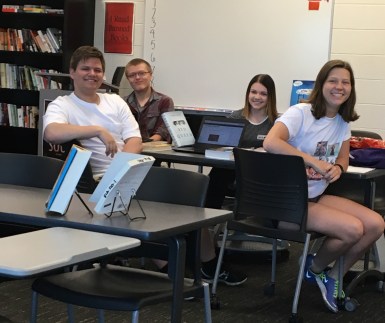
1B AP Language and Composition – The seniors have left us, but this crew still has final projects to present

choice – choice, talk, and lots of writing – all of which mainly require simply being honest with, invested in, and responsive to student need. No, it’s not totally easy. It can’t be a free for all. It can’t be totally haphazard. But it can be trial and error. It can be learn as you go. It can be beautifully impactful.

To provide proof, here is a sampling of student reaction from my class-feedback form this year. I tried a lot of different things. I messed up a lot. We backtracked often. I sometimes forgot to book talk. I sometimes didn’t provide enough modeling or take the time to write every time they did, but we worked with choice, we wrote more, and we talked more than ever before.

Here are just a few reactions from my AP Language and Composition class:


Hello,
This year I really learned to be literate. AP Lang actually taught me that I can read books that I want to read and no matter what they are I can discuss them in a scholarly way because even if the book is something like poetry or a comic it is still a book. I’ve learned that all books have something to teach and that’s why they were written in the first place. I’ve read some amazing books this year and I’ve learned how to discuss my opinions on things using a higher vocabulary and assertions that are beyond the obvious. I’ve learned that you can look at anything in life a little deeper and you might just learn something. My tendencies to look deeper into things was fostered and practiced through books and reading so thank you Mrs. Dennis for helping me become a scholar. The first time you called us scholars I didn’t really think you were serious, but now I feel it. I feel like I want to spend my entire summer reading and I plan on trying to finish a large chunk of my I want to read page because reading truly and utterly makes one a better person. Reading makes you a better thinker, citizen and friend. Language is truly a beautiful thing. Also, you should know that coming into this class I was intimidated and almost dropped. English is not my strongest suit as I want to go into premed, but now I can be a poetic Doctor am I right??
Thank you also for always being a nice person and a smiling face to see in the morning.
Love,
Nimmi
Mrs Dennis,
I loved this class, a lot. I’ve never really felt like I’ve learned much from English classes, but in AP Lang this year, I’ve grown so much as a writer and a reader and a thinker. Part of that is the class itself, part of that is the practice work we’ve done throughout the year that forced us to think for ourselves (I actually like doing one pagers now), and a big part of that is you as a teacher. You made us want to be smart. I wouldn’t change a thing, and I think that I’ll probably look back on this class as one of the most valuable I’ve taken in high school. I’ll miss having you as a teacher next year!
Thanks for everything,
Maddie
Mrs Dennis,
I always thought becoming a man would require some sort of coming of age. Some sort of ‘killing the beast and dragging it home’ type situation…
I began this year as a boy and ended it as a man. Throughout the year I became increasingly disillusioned with being a dependent, in ideology and in living situation. I read books about Manliness, articles about what it “means” to be a man and looked far and wide for what the distinction was.
There is no amount of *physical contact*, “macho” rites of passage, or waking up one day transformed that made me into a man. Oddly enough, it was sharing my feelings that made me a man. The turning point was the day you told us “Feel free to share more feelings in your one pagers”.
“Sharing my feelings” translated to me having to figure out WHAT I felt and believed and WHY.
Instead of having some book tell me that I should be principled and have virtue (which is simple enough for me, and not only a manly thing) AP Lang and you made me feel like I had a SAY in my own life and thoughts. AP Lang made me no longer dependent on others for what I believe and why, giving me the ability to evaluate, challenge, qualify AND support things.
AP Language and Composition MADE A MAN OUT OF ME.
I am eternally grateful,
Bennett
Encourage everyone to read Walden, strongly encourage. It’s life-changing.
Continue teaching everyone to question ideas or anything at all; I think that was really fundamental in my growth as a student as well.
Larissa

And here, ladies and gentlemen, is the secret formula…

It’s no secret at all.

These are the simple changes I made to my daily practice. And though I have a lot of work to do in regards to running a true workshop classroom each and every day, the results this year have felt amazing. Give it a try!

  • Provide 10-15 minutes per class period for students to read books of their choosing. It’s time well spent. Best spent, actually. 
  • Conference with students during that reading time to better understand what, how, and why they read. This will assist you in recommending further reading and in determining mini lessons your students need to make them better readers and writers.
  • Have students write each and every day. Encourage them to write without stopping (building fluency), revise something every time they write (building capacity to internalize the writing process), share that writing (to build community), and take pride in that writing by choosing and developing ideas.
  • Use additional class time for more conferences with students around what they are reading and writing. Students can work individually, in pairs, or in small groups during this time, depending on the mini lesson for the day.

Of course, readers and writers workshop involves so much more, but this is where I started this year. This is what resulted in the student response above.

If my calculations are correct, I have roughly 25 years left in the classroom (holy, holy, holy). That’s 3000 students (conservatively) over 4500 days. Talk about an opportunity. Or rather, 4500 opportunities.

What books will they love?

What great stories will they tell?

Whose life will change by becoming a reader and a writer?

I can’t wait to find out. Because the secret to workshop success is no secret…it’s the students.
IMG_1352

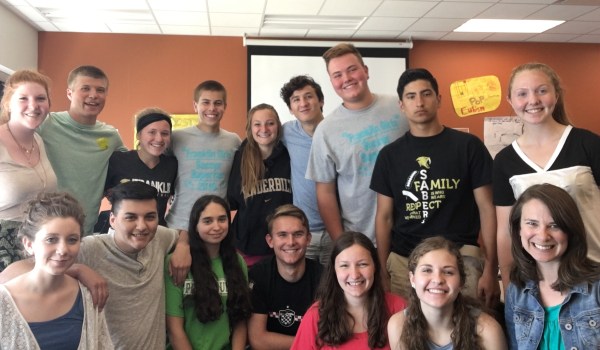
3A Sophomores – Trevor said he read more than he ever has, Errin and I read Metamorphosis  together, Josh read (and loved) Moby Dick, and Lauren’s “To Read” list is two pages long. 

What moves have you made to workshop that have made a difference in your practice? Please feel free to leave your comments and questions below!