Can you feel it coming? Do you smell new books and old desks? Are you imagining the sounds of students shouldering their way through the halls and into your classroom like bees through long un-mown grass? (I’m a huge Oscar Wilde fanboy!)
Are you ready to hear a deep breath or quiet giggle interrupt a totally silent self-selected reading segment? Are you ready to mop up tears in buckets and heal emotional wounds with book bandages?
If not, you better get ready. You may be starting school today, or maybe next week. It doesn’t matter; time to get your mind right.
I’m ready to launch from the best summer of my life into the best teaching year of my life. Happiness breeds happiness.
So here are three thoughts I have that will help me be the best teacher I’ve ever been.
-
Book Talk like my teaching life depends on it…because it does.
If the number one tool in my belt is my classroom library, my number two is my ability to “sell” books. We all know that we need to be able to sell books both informally and formally.
Informally, we confer with readers and talk about books with individual kids (and adults!) who are in the market for their next reading relationship. This is the easy back and forth that comes with being a reader and contributing to a literacy rich classroom culture.
The formal moments, in my mind, are those points in time you carve out to stand in front of your class, or some group, and give them the hard sell on a book you’ve decided was worthy of their attention.
To me, these two different bookish scenarios require different thought processes and the latter is example is the one to which I plead my case.
Obviously we have to consider “how” we present the key information that we think will engender interest in deserving books.
But also, we have a massive burden to present books that offer a cultural variety of information that will allow our readers the “windows, mirrors, and doors” that Rudine Sims Bishop wrote about all the way back in 1990.
I took a step forward on the Sunday of the ILA conference and chose to attend a session featuring LGBTQ writers and their books.
Over and over, the panelists describe the point in their lives when they first encountered a character in whom they saw themselves. Ashley Herring Blake, a primary grade teacher and middle grade writer from Tennessee talked about how she was 32 when it happened to her. We have to be more pro-active when it comes to offering students windows, mirrors and doors. Book talks are an opportunity in which we can’t afford to play it safe.
2. Love the kids like their learning lives depend on it…because it does.
I said it before: I will be 100% this year in telling my classes I love them before sending them out the door each period. I’ve already been practicing with the Student Council kids that I hung out with at Fish Camp. It was our first time to work together and as the day ended, I told them too. You never get a second chance to make a first impression.
But I’m not just going to say it to their backs as they sprint out of the room. I’m going to say it to their faces as they enter and I’m going to write it on their papers. Reading and writing culture revolves around love: of texts, but more importantly the readers and writers.
3. Empower the students to read and write in a massive volume like our world depends on it…because it does.
We know how important volume is in a student’s growth. We have to let them read and write more than we can ever think about grading.
Also, we have to give them room to read and write in ways that let them explore their place in the world. Anything less than this, and I’ve failed. I will not fail.
Charles Moore will, for the first time in many years, teach Freshman English this year. His bleeding heart required him to volunteer to sponsor Student Council at this new school. You can follow his antics on twitter at @ctcoach.

 My cleaning ensued – painfully, I might add, as my technician was unnecessarily rough, and I wanted to ask her if she remembered that a person was attached to those teeth, but I found it too difficult to ask such questions with someone’s hands in my mouth. I waited for the post-cleaning check-up with the dentist, knowing the only question I had for him was about the dark staining I’ve been experiencing lately despite my careful brushing and (sometimes) flossing regimen.
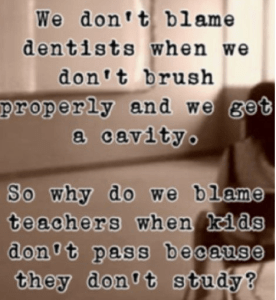 expect him to congratulate me on the steps I’d taken for my overall health in giving up on sodas, and I didn’t expect him to have sympathy for how hard that habit must have been to break, and I didn’t even expect him to think logically about how much less acid was wearing away at my enamel now that I don’t drink soft drinks, but I also didn’t expect to feel as though I had done something so very wrong.
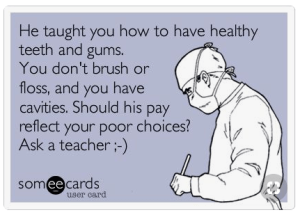 My teeth will continue to stain, I guess. I’ll brush with baking soda once a week to combat that. But I’ve gained better health and energy. I’ve lost the migraines I used to get when I drank colas all the time. And if we allow our students to read what they want and need to read, they might lose content knowledge of some of the classics that we read (or fake-read) in high school, but they will gain an authentic love of reading. They will find connections with characters in their books. They will connect with each other as they enthusiastically discuss their books. They will feel empowered and in control of their lives as readers. Their reading levels will improve. And yes, the test scores will follow.
 But, as ever, reading is the great escape.
 Murder-Mystery
 The Word Exchange was completely, compulsively, un-put-down-able. Alena Graedon is a new author for me, and her tale of a world that loses its grip on language once a massive tech company monopolizes and commoditizes words was, for me, perfectly timed–I’ve been a little unsettled lately by my observations about how addicted to technology everyone is, and how afraid I am of what it’s doing to my students, and could potentially do to my children. This book spurred me to action in terms of deactivating my Facebook and Instagram accounts and making a conscious effort to leave my phone in another room–to make space to just be, and be bored, and have time to think and wonder and ponder.
 The Power by Naomi Alderman was just wonderful. It had all the elements of a gripping adventure story, along with a powerful message about what corrupts us. In this novel, women develop an electrostatic power and a society shifts from patriarchal to matriarchal in the space of a few generations as a result. The effect of women suddenly becoming more physically powerful than men leads to widespread revolution in everything from interpersonal relationships to world leadership. It’s beautifully written, too.
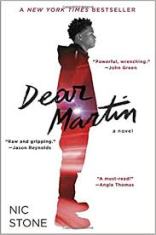 Dear Martin was a book I’d been recommended a thousand times, it seemed, but after reading so many books that felt similar–The Hate U Give, Long Way Down, etc., I just couldn’t pick it up–but I’m so glad I finally did. Nic Stone crafts this novel as a series of letters from young Justyce McAllister to Martin Luther King, interspersed with transcripts of news reports and first-person narrative. It’s complex and thoughtful and plausible and readable and powerful. I loved it.
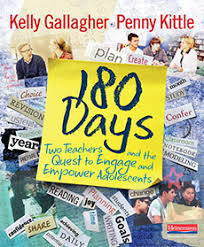 Teaching Books


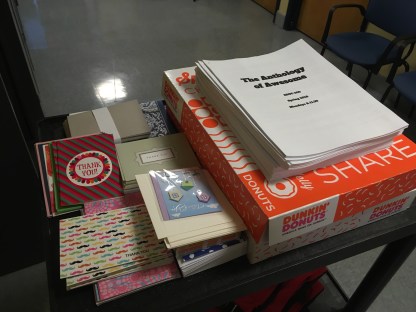

 students’ names and personalities. For my future teachers, I created our ideal school, in which we’d all teach and get to work together forever. In past years, I simply wrote a letter of well-wishes to my kids, and included each student’s name and a little compliment toward them all.


 Character lists, timelines, family trees, and maps are also useful to talk to students about, and I would share my thinking as I went through these pages. (This is where the document camera is handy – projecting a larger image of some of these pages is quite helpful.)
 Another title I picked up was

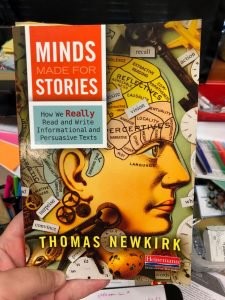
 plan for her draft. Suddenly, she felt like “it just wasn’t going anywhere,” and she was ready to abandon the project entirely. I think we’ve all seen this before; it was a classic case of “I know what I want to say, but I don’t know how to say it.” She was also suffering from the mind-numbing effects of having more material than she could manage. What to do?



 Three Teachers Talk