Category Archives: Books

Book Talks & How To Do Them–#3TTWorkshop


img_0331-1

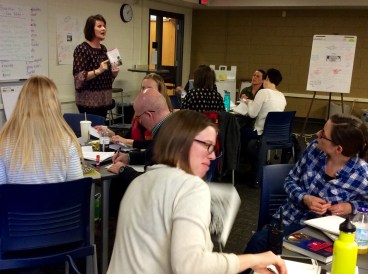
Amy booktalks during our visit to Franklin High School

Conversation Starter:  What’s a book talk and why do you do them?

Shana:  Booktalks are a structured way to fangirl about my favorite things in the world: books.  I do two booktalks per class, right after independent reading wraps up.  They’re a great way to transition from the relaxed reading mood of the classroom and move into the fast-paced work of critical reading and writing, but they’re also the number one change I’ve made to my teaching that has influenced how much I can get my kids reading.  Three years ago, I only did booktalks whenever the mood struck or whenever I got new books into my library, but now I do two a day, every day, no matter what–and it’s made an incredible difference.

Amy: You are an inspiration in consistency, Shana. I’ve done better at doing book talks this year than I have in the past. I try to do two a day as well — one non-fiction book and one fiction. I always seem to fall off the wagon at some point though. The demon, impending testing, pulls me to the dark side every year. I’m putting up a good fight this time around, and I have a plan to reinvigorate, not just my book talks, but the reading that’s happening in my room. Curiosity and intrigue: my goal for better book talks.

Is there a set protocol for a book talk — like length, reading a passage, etc?

Shana:  Just talking books is the biggest nonnegotiable for me.  While most days I do follow a protocol–one fiction, one nonfiction; 2-3 minutes per book; always share a passage, a brief plot teaser, and my own reading experience; try to mention a student who’s read the book–some days I just have to gush over a book that’s been recently returned, or a book I am reminded of during conference time, or some new items I’ve purchased.  Either way, I talk books every day, no matter what, which helps students become accustomed to exposure to new titles, adding books to their what-to-read lists, and hearing about trends in authors, genres, or topics.

Amy:  Remember at Penny Kittle’s Book Love class at UNH two years ago how she had everyone model a book talk? She set no guidelines other than modeling a few for us. After just a few turns, it became clear:  The best book talks are short, energetic, and introduce the book in some insightful or clever way. I try to do that.

When I read the books in my library, I look for passages for craft studies or beautiful sentences we can use as mentors. Sometimes I share those in book talks without doing the study — we just enjoy the language or listen to the voice of the narrator. I’ve started asking questions and trying to get my students to think about the topics the writers might address in the books. Just another way to get my readers to make a connection with writing.

The hardest books to book talk are the ones I haven’t read yet, but even those are doable when we show genuine excitement about the book. Why would I have a book in my library if I am not excited about students reading it? That’s a pretty easy sell in and of itself. It’s fun to get students to ask questions about the cover and to read the comments.

41drZBnWSzL._SY344_BO1,204,203,200_How do you decide which books to talk about within each unit?

Shana:  This is pretty easy for me since most of my units of instruction are themed.  For reading units themed around a topic, I find lots of books about that topic, or that contribute an alternate perspective to whatever central text we might be reading.  (Example:  While reading Siddhartha and thinking about coming of age and going on journeys, Outliers, Marcelo in the Real World, The Other Wes Moore, Paper Towns, and Their Eyes Were Watching God fit right into our unit.)  While in the  midst of a writing unit, I think about books that might serve as mentor texts in terms of topic or structure, or that are written by authors who serve as good mentors in general.  Other times, I have no rhyme or reason to my booktalks, because I simply MUST talk about a new book (like Dumplin’, which I just read and LOVED and had to booktalk randomly.)

Amy:  I structure my units more around genre than theme, so my book talks are more random than yours. Hey, maybe that’s the problem with my consistency!

My students and I talk a lot about aesthetic and efferent reading. I want them to understand the importance of making connections with the books they choose to read, and lately, I’ve seen that there is a real disconnect. Just because students choose books does not mean they are making personal connections to them. This is in part why so many of my students this year are having a hard time sticking with the books they choose. Because I know many are abandoning books so quickly, I’ve been working on getting students to talk a lot more about topics and how writers approach these topics. My hope is that my non-readers will find interest in learning about things, even if they are not interested in reading for the pleasure of it.

I’ve done several book talks this year around a topic; for example, depression, which is one of my 11th graders’ favorite topics to write about this year. Forgive Me, Leonard Peacock, Every Last Word, My Heart and Other Black Holes all flew out of my hands, and I had to get more copies.

Do you ever have students conduct book talks?

Shana:  Very occasionally, I do, when it’s really authentic.  When a student finishes a book and just raves about it during a conference, I ask them to share that enthusiasm with the class.  Last quarter, I asked all students to read a challenge book and then complete their choice of follow-up activities with the book–one choice was a booktalk, and the students who shared about the titles they loved did spark some interest in their peers.  However, those booktalks didn’t go over as well as the ones that arose from sheer exhilaration, so I think my future goal will be to limit student booktalks to spontaneous ones only.

Amy:  Like you, I rarely have students conduct book talks — at least the way I do. I’ve tried, but you are right, without the spontaneous excitement about the book, the other students just do not respond the same as they do when I conduct the book talks.

However, I do have students talk about books with one another. Most of the time it’s pretty informal:  Talk to your table mates about what you are reading. Sometimes it’s a little more formal:  Speed dating with a book, which is one of our favorite ways to share books.

What are some other ways you talk about books with your students?

Shana:  Basically, I bombard them with talk about books all the time.  When I see current or former students in the halls, I ask them what they’re reading.  When they come to visit me, I urge them to leave the room with a new book.  I make lots of segues in conversations from all topics to all books (mostly because this is just what I do in real life…ask anyone who knows me).  I also share with students all the time what I’m reading, and why they might like a given book.

Amy:  We are so much alike! I love to have former students borrow books, and I talk about books with every person who will listen — and some who don’t. I also try to get students to engage with me on Twitter, using the hashtag #FridayReads to share what they are reading each week. A few students set up accounts and we follow each other on Goodreads. I love those kids! I’ve also started a favorite quotes wall, and I’ve asked students to pull significant lines that lead to theme and/or beautiful sentences that show author’s craft. Getting students to pay attention as they read, noticing how writers use language to create meaning, leads to significant improvements in their own writing. Without fail, it’s my best readers who are also my best writers. If only more students would get that.

Do you have topic ideas you would like us to discuss? Please leave your requests here.

Best Books About Life and How to Live It

Amy and I have been talking a lot lately about how to help our students connect meaningfully to the books they’re reading independently.  This focus on personal connections stems from our recent reading of  Louise Rosenblatt’s work, our effort to make our instruction authentic, and our noticing of the ease with which our students disconnect from the world.

One activity we gave our students the option to complete was the creation of their own Top 10 Lists, like this one.  Emily’s list is titled “Life and How to Live It,” and it is full of her own personal connections.  It’s reflective of Emily’s desire to become a published other, full of her love for literacy and learning about the world through reading.  I hope her passion spreads to your students when you share this list with them.

img_1502Emily’s Top 10 List: Life and How to Live It
Here, I present to you my top ten favorite books all loosely based around my personal favorite theme to read about: life and the different outlooks different people have on life. Some see the good in life, some see the bad, and others get to see both. Each one of us will face hardships throughout our lifetime while later on finding that one thing that makes us feel as if we have a purpose to exist. When we first open our eyes at the beginning of each day, we are faced with the option to treat this day like a curse, hiding away from this beautiful life we are given to live, or to focus our attention on the positives we have. The choice is yours.

The Giver by Lois Lowry

The Giver is hands down my favorite book of all time. I first read it in middle school and have been in love with it since then. The idea is basically that Jonas, the main character, lives in a utopian society with no bad whatsoever. At age 12 everyone in this society receives their career, and Jonas has a difficult time dealing with the career he has been given. I love this book for a few reasons: one is the way that the book itself is written, and the other is the story behind it. I love the idea that Jonas is the only one who gets to see the bad in the utopian society, because to me it sends the message that what may seem perfect, deep down has repressed secrets we all can’t see.

Of Mice and Men by John Steinbeck

Of Mice and Men: a classic. In this tale Steinbeck tells the story of George and Lennie, two friends who take on the hardship of the Great Depression. Lennie, however, takes on more considering he is practically a father figure to George. Times get hard, but they don’t give up on each other. In the end, Lennie realizes that sometimes no matter how much you love something, if it’s not what is best for you then you can and will be able to survive without it, no matter how hard it is. I think overall this is the reason why I love this book so much.

Tuesdays with Morrie by Mitch Albom

This book brings me to tears–a lot of tears. Based on the true story of a young man who is happy in his life, living a life full of money and materialistic things. On the other side of the story, his old college professor Morrie is diagnosed with a deadly disease and must reunite with Mitch to teach him the things in life that are truly important. I love the idea behind this story, that in life we get lost in materialistic things and lose sight of the things that are most important in this short life we are given.

717Tx5+P+7LIt’s Kind of a Funny Story by Ned Vizzini

The relationship between myself and this book is remarkable. I can honestly say that I personally connect to it more than most other readers. This book is about a young man who deals with severe depression and one night decides to admit himself into the hospital after contemplating suicide. He then spends a week in a psychiatric hospital, learning things about himself and everyone else. Vizzini actually spent time in a psychiatric hospital before writing this book which makes it that much better considering he can grasp the inside look on what it’s really like. I, myself, have spent time behind the doors of a psychiatric hospital, and strangely enough my story started off almost the same way Craig’s did.

Perks of Being a Wallflower by Stephen Chbosky

Yet another amazing book that has the ability to bring tears to my eyes. The Perks of Being a Wallflower follows the story of Charlie, a freshman in high school who is struggling with depression and anxiety issues. Through letters, he talks about the good days and the bad, along with what is going through his mind. Charlie befriends Patrick and Sam who being to show him that it is okay to be different from everyone else.

Looking For Alaska by John Green

Looking for Alaska by John Green is a beautifully written story of a young boy who develops the nickname Pudge at a private high school where he meets and falls in love with the beautiful Alaska Young. So much happens while they are there together and he learns a life lesson. She teaches him to not be afraid of life, to go out and grab it because it can be a lot shorter than we expect.

Paper Towns by John Green

Paper Towns tells the heart-warming story of Quentin Jacobson who has secretly been in love with the girl next door, Margo. Margo taught Quentin a lesson which is the main reason I love this book so much – she taught him to go through life without being afraid of adventure. This is one of my top favorite books because I relate to Margo and her adventurous personality. I love Morgantown but I have always wanted to move somewhere where I can start completely over – the idea of recreating myself in a new place is thrilling.

410BrI9l37L._SY344_BO1,204,203,200_Skinny by Ibi Kaslik

Many teenage girls face a deadly mental illness – anorexia. Skinny tells the story of Giselle and how her battle with anorexia has flipped her life around. It also tells the story of her younger sister, Holly, and how her sister’s disease is effecting her life as well. The writing in this book was not my favorite, but it was still a great read. I love the idea that someone would want to put the issue of anorexia into words. My favorite part of the book, and the main reason it made my list of favorites, is the fact that it not only goes into the mind of the person facing the anorexia but someone close to her as well.

Afterparty by Ann Redisch Stampler

When I first started reading this book I didn’t think I would make it through but I’m glad I decided to finish it. Afterparty follows the story of a quiet girl who moves to a new town and decides it’s time for a change. She meets new people and gets to experience new and exciting things. This is something I have always wanted to do, which is why it made this list. Getting into a new place where you get to start completely over is more than exhilarating.

Everyday by David Levithan

Have you ever wondered what it would be like to be someone else for a day? To get inside of their minds and read their deepest secrets? A, the main character in Everyday, gets to wake up in a new body each and every day. To me, the idea of this is both terrifying and fascinating. When I was reading this I was thinking about the psychological aspects of this because I want to become a psychologist one day so I will be in people’s mind, understanding then, just as A does.

What other titles teach readers about life and how to live it?  Please add your recommendations in the comments!

Mini-Lesson Monday: Freezing Time

dumplinIt’s -4 degrees in West Virginia today, which might explain why I’m thinking about the narrative skill of freezing time.  I’m also thinking about it because I’m reading the fantastic Dumplin’ by Julie Murphy, the story of an unconventional small-town beauty pageant contestant.  As I read, I was aware of how quickly the writing hooked me–I began to look for reasons why, inspired by Writing With Mentors.  My noticing of Murphy’s freezing of time to show me the thoughts and feelings of her narrator, Willowdean, reveals two skills I’d love for my students to utilize: the skill of reading like a writer and imitating the craft they notice in their own writing.

Objective:  Using the language of the Depth of Knowledge levels:  students will identify and categorize Murphy’s craft moves, then revise their own narrative drafts to apply the concepts they learned.  Or, in the language of the Common Core:  Analyze the impact of the author’s choices regarding how to develop and relate elements of a story or drama (e.g., where a story is set, how the action is ordered, how the characters are introduced and developed); Use narrative techniques, such as dialogue, pacing, description, reflection, and multiple plot lines, to develop experiences, events, and/or characters.

Lesson:  I’ll introduce Dumplin’ during book talks by describing the plot and passing out the following excerpt:

The car behind me at the drive-thru backfires, and I rush inside.  My eyes take a second to adjust to the dim light.  “Sorry I’m late, Bo,” I say.  Bo.  The syllable bounces around in my chest and I like it.  I like the finality of a name so short.  It’s the type of name that says, Yes, I’m sure.

A heat burns inside of me as it rises all the way up through my cheeks.  I run my fingers along the line of my jaw as my feet sink into the concrete like quicksand.

The Truth:  I’ve had this hideous crush on Bo since the first time we met.  His unstyled brown hair swirls into a perfect mess at the top of his head.  And he looks ridiculous in his red and white uniform.  Like a bear in a tutu.  Polyester sleeves strain over his arms, and I think maybe his biceps and his hips have a lot in common.  Except the ability to bench-press.  A thin silver chain peeks out from the collar of his undershirt and his lips are red with artificial dye, thanks to his endless supply of red suckers.

He stretches an arm out toward me, like he might hug me.

I drag in a deep breath.

And then exhale as he stretches past me to flip the lock on the delivery door.  “Ron’s out sick, so it’s just me, you, Marcus, and Lydia.  I guess she got stuck working a double today, so ya know, heads up.”

“Thanks.”

I give students a specific purpose for reading, since we’re looking at this text as a mentor.  “While I love a lot about this book–the author’s diction, how her word choices change the narrator’s voice and reveal her personality and sense of humor, and the fantastic chemistry between Bo and Will, today I just want to pay attention to how Julie Murphy paces this scene.  As you read, you’ll notice how she just freezes time so you feel like you’re holding your breath.  Annotate how exactly she does this, and we’ll talk about it in five minutes.”

I read alongside my students, modeling notes on craft with the document camera.  After five minutes I ask them to share at their tables, very specifically, what they noticed.  Then, I solicit from each table group one craft move they saw, and where it was in the text.

“Well, dialogue kind of brings you back into the present, like at the end when Bo says something and kind of snaps Will out of her daydream,” one student offers.  I write on the board, dialogue–keeps you present.

“Awesome.  What else?”

“The long description of Bo’s appearance stops the action,” another says.

“Yep.”  I write on the board, description–freezes action.

We continue until each table has shared a craft move they’ve noticed.

“Okay, so today during workshop, I want you to think about how you might play with freezing time in your narratives.  Use what we talked about to help you revise the pacing in your scenes, and if you think Dumplin’ sounds good, add it to your what-to-read list.”

Follow-Up:  During that day’s workshop, I’ll confer with students and see where they might be strengthening existing moments of freezing time, or adding some brand new ones, in their narratives.

Later, as we finish the narrative unit, we’ll return to the anchor chart we’ve been adding to and create a rubric that reflects the skills we’ve focused on, one of which will be pacing.  I’ll also hope to see lots of students reading Dumplin’ over the coming weeks–doubling a booktalk with a craft study lesson is usually a highly effective way to get kids hooked on a book.


Writing With Mentors: A Nonnegotiable of Writers Workshop

41dIMvzIynL._SX395_BO1,204,203,200_

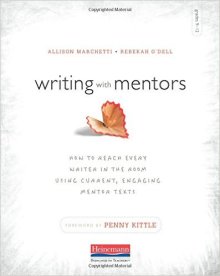
WRITING WITH MENTORS by Allison Marchetti & Rebekah O’Dell

Reading Allison Marchetti and Rebekah O’Dell‘s Writing With Mentors is reminding me of the summer, three years ago, that I committed to making the move to readers and writers workshop.  Like my new friends in Franklin, Wisconsin, I already had many of the structures of workshop in place–I just didn’t know how to fit them all together.

As I read and wrote and thought beside the likes of Penny Kittle, Amy, Jackie, Erika, and my other UNH friends, I learned quickly which parts of my instruction to keep and tweak, and which parts to flat-out jettison.  While I felt like my reading workshop practices were solid, I knew I needed to completely rethink the way I designed writing instruction.

I wish I’d had Writing With Mentors that summer.

That summer, I learned that I shouldn’t be designing lessons around a staid form like a persuasive essay or a literary analysis.  I needed to begin thinking about having my students write authentic, interesting pieces on topics of their choice–but I didn’t know how.

img_0791

I immediately saw Gregory Pardlo’s DIGEST, full of prose poems, as a mentor text.

I learned how to read like a writer, how to look at the craft and structure of my favorite authors’ works.  I began to see mentor texts everywhere, and in fact too many places–I was exhausted by trying to keep track of everything I wanted to share with my students, and even resolved to read less as a teacher.  I wanted to offer a variety of rich mentor texts to my students without losing my mind–but I didn’t know how.

I learned that my writing process was as unique as my handwriting, and that process has value just as much as a written product does.  I wanted to restructure my unit planning, my gradebook, and my classroom routines to reflect that–but again, I didn’t know how.

Over three years, through trial and error, I’ve figured out how to reckon with a lot of those issues, but I would have known instantly had I read Writing With Mentors then.  This book succinctly showed me great writing units and products, how to plan for them, and how to select and organize current, engaging mentor texts.

img_0480

Books are at the center of my writing instruction–literally.

It reminded me that when we read–even to study the craft moves of a mentor author–we must read as readers first, for the “pleasures of story time” and to “hear the rhythms of good writing” (65).

It affirmed my habit of designing new units each year, complete with brand new mentor texts, to meet the needs of my current students and the sociopolitical climate in which we live and read and write.

It helped me cement mentor texts, alongside the writer’s notebook, conferring, and authenticity, as nonnegotiables of a successful writers workshop–because, in Allison and Rebekah’s words, “mentor texts enable complete creativity and individuality to emerge in student writing and writing instruction” (3).

And it reminded me that when students leave our classrooms, “mentor texts will always be present” (167).  When we teach students to write with mentors, they remain capable of reading like writers as they engage with print and media and other real-world texts.   Since getting my students to become lifelong readers and writers is my ultimate goal, this book is now an important mentor to me.

Writing With Mentors is the book to pick up when you put the textbook down, toss out your binders of writing rubrics, or throw up your hands when you read your 94th crappy plagiarized paper in a row.  If you’re seeking to rejuvenate, organize, and revamp your writing instruction, don’t undergo three years of trial and error like I did…let Allison and Rebekah help you write, more happily, successfully, and authentically, with mentors.

Have you read Writing With Mentors?  Share your feedback in the comments!


Best High-Interest Books for Teens

This year, Amy and I were determined to make our exams authentic.  One of the options for the reading portion of the exam was for our students to create top 10 lists, and many of them did.  Their lists are funny, honest, and so valuable for helping spread the word amongst readers about good books.  Below is Aleigha’s list of recommendations for high-interest books that will hook teens and get them to fall in love with reading–feel free to share them with your students!

img_1175Aleigha’s Top 10 List:  Best High-Interest for Teens
  1. Fangirl by Rainbow Rowell

Though this book was funny and lighthearted it still had the ability to change my life.  It really helped me realize that you should appreciate your siblings while they are close to you.  Seeing how quickly Cath and Wren distanced themselves in college put my relationship with my siblings into perspective.

  1. Eleanor & Park by Rainbow Rowell

This book is so much different from your usual love story. By that I mean it’s extremely realistic. It changed my life because I could picture myself as Eleanor. It was one of those books that are so realistic it’s kind of scary not many love stories can make you envision yourself as the character.

  1. I Hate Myselfie by Shane Dawson

hatemyselfieI have never laughed so hard while reading a book. This guy literally takes everything that should have been traumatic to him and turns it into humor. This book changed my life because it taught me that it is important to laugh at your own pain. You shouldn’t take everything so seriously.
  1. Looking for Alaska by John Green

This book for me is one that really set an example. It breaks away from the normal click of kids you have in high school and puts a group of complete opposites in a single friend group. That was one of my favorite things about this book. It just kind of made me feel like it’s okay for me to talk to the jock or the pothead.

  1. All the Bright Places by Jennifer Niven

This book is very eye opening. It is about two teenagers who bond over a mental illness and fall in love it. It makes you very aware of the signs of depression and makes you analyze not only yourself but others. This book has the ability to change lives because it teaches you about the sensitive topic of depression.workinprogress

  1. A Work in Progress by Connor Franta

The author of this book is a Youtuber who tells you all about his life in high school and his YouTube journey. The book itself contains a lot of life lessons. He tells a story and then wraps it up with a lesson at the end. I enjoyed this book a lot because it shows how a normal really small town kid can become really successful with hard work.

  1. We Were Liars by e. lockhart

If we’re being honest, the only reason this book changed my life is because it just made me really depressed. I was just extremely upset once I reached the end of it. I didn’t want to believe what had happened was true and I cried for the main character. And then I cried because what other reaction can you have to a book that ended so terribly. So I guess this book changed my life because it made me realize that I cry more for fictional characters than I do for people I actually know.  

  1. The Fault in our Stars by John Green

Again another book that screwed me up emotionally. This one really does make you cherish your life and your friends. If after reading this you are not greatful for what and who you are blessed with that will be a surprise. Everytime I read this book I don’t just form my own imaginary relationship with Augustus Waters. I also find myself being very thankful that I have experienced little loss in my life.  This book is another one that puts it all into perspective.

  1. Every day by David Levithan

Every day is a book about a person who wakes up in a different body every day. He never has the chance to experience what it is like to have a family or best friend. This book is perksofbeinglife changing for me because it makes you appreciate the blessing of continuity. I think having a constant in your life is something that we all take for granted.

10. The Perks of Being a Wallflower by Stephen Chbosky

The Perks of Being a Wallflower is one of those books that make you really cherish your friends. Until you find out what happens to Charlie as a child, you assume the book is about a young boy coming out of his shell. As u read through the book, you experience the ups and downs of friendship and watch Charlie become a whole new person. This book has made me really appreciate my friends.

4 Monthly Challenges to Beat the Winter Reading Slump

New England winters lend themselves to steamy mugs of cocoa, plush blankets, and chilly evenings curled around a book.  Despite the ideal environment, halfway through the year, some of my students hit a reading slump.  The initial momentum of the reading initiative subsides, leaving students a bit more lackluster come second semester.

In turn, here are four challenges I plan to integrate over the next three months to beat the winter slump and reinvigorate students’ passion for reading.

1. January: Reading Bingo and Challenge Lists

The New Year, or for us, the second semester lends itself to fresh reading goals.  Goal-setting and self-reflection aside, I love reading challenges that push students to step out of their reading comfort zone and delve into new genres.  This year I comYA-Reading-Bingo-Challenge-2014piled a variety of reading challenge lists that I’ll be printing out on bookmarks to provide to my students.
I personally love the #26BookswithBringingUpBurns challenge, which has readers fulfilling challenges like reading “A book set somewhere you’ve always wanted to visit” and “A book with a color in the title.”  I’m also enjoying Rebeccah Giltrow’s BookaShelf 2016 Reading Challenge, which has participants base their book choices on the alphabet.  For example, “A” stands for “a book with an apocalyptical theme.”  Finally, Random House’s “YA Reading Bingo” is the perfect way to get students reading through rows of books while competing with one another to fill in a bingo card.

2. February: Book Trysts and Library Dates 

February lends itself to romance with Valentine’s Day, so to celebrate our book love, students will set up blind dates for some of their favorite books.  They will cover their choices in brown packing paper and write “dating profiles” including intriguing qualities readers will hopefully fall for.

In addition, students will participate in a library “date” with a friend from class.  Inspired by this “date night at the library” post by The Dating Divas, I created a list of entertaining and useful tasks and challenges for students to complete.  From “finding a book authored by someone with the same name” to “finding a book that has been made into a movie,” this friendly competition will put books in students’ hands while also promoting conversations revolving their reading.

3. March: March Madness and the Literary Hashtag Challenge

As March Madness approaches, my basketball students will be building teams and taking bets.  I know little about basketball…but I do know about books, which is why I’m hoping to create a March Madness that looks similar to Shana’s last year.  For those looking to create student-based teams, Principal Justin Cameron’s “Fantasy Reading League” at Frederick W. Hartnett Middle School gets the entire school involved in the competition together.

Finally, in March I will launch a new literary hashtag challenge that asks students to IMG_1801.PNGexhibit their reading lives outside of school.  Students will e-mail a Twitter or Instagram class account with literary images that include the following hashtags: #LiterarySwag (a hashtag for fashionistas who know books can serve as a stylish statement piece for any outfit), #Shelfie (a hashtag for beautiful bookshelves), #IReadEverywhere (a hashtag to highlight reading in unique places), and my favorite #BookFace (a hashtag that pushes people to be a bit more creative with their book covers).

By putting new books in students’ hands, I’m hoping to inspire a little competition, a lot of conversation, and a passion that will turn them into lifelong readers.


How do you reinvigorate students’ passion for reading?  What tips do you have to make it through the winter reading slump?


10 Pedagogical Must-Reads for Workshop Teachers

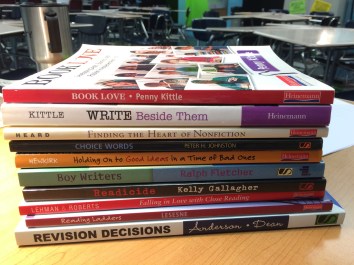
IMG_0650I met with my new student teacher a few weeks ago, and he asked me to borrow any books that might help him get going on the readers-writers workshop–the “theory” version of Jackie’s starter kit.  He’s been in my classroom before, so he knows the general routine and character of our work, but he wanted to know the ins and outs of how I thought and planned and conceptualized the whole thing.

I sat at my desk and looked at all of the titles I had on hand, remembering how influential reading them for the first time had been.  As a result, it was hard not to just dump my entire professional bookshelf onto a cart for him, but I managed to pick out a few titles that have guided me most adeptly in one aspect or another of my current classroom practice.

  1. Book Love by Penny Kittle – This was the book that helped to solidify my vision of an ideal classroom.  Before I read it, I had already been doing many of the best practices Penny mentions–writer’s notebooks, choice reading, personalized writing.  But I didn’t know how to bring it all together until Book Love.  As such, this is my #1 recommendation for any teacher looking to jump-start their individualized workshop curriculum.
  2. Write Beside Them by Penny Kittle – This book introduced me to the concepts of mentor texts, reading like a writer, and best draft/publication of writing.  I learned about quickwrites, constant revision, writing conferences, and a great deal more of what are now standard routines in my classroom.  This is the book for anyone curious about the big picture of writing instruction.
  3. Finding the Heart of Nonfiction by Georgia Heard – I was raised in the tradition of literature as containing mostly fiction and poetry, but Penny’s books helped me see the great value of nonfiction.  I wanted to know how to integrate it well into my thematic units, and this book helped me do that.  Georgia’s book is full of wisdom about finding the soul of good nonfiction writing and matching it to your students’ needs.
  4. Choice Words by Peter Johnston – This book taught me how to talk to students.  It is my #1 recommendation for anyone looking to address those pesky Speaking and Listening standards in the Common Core–this book teaches you about the delicate, volatile power of a few choice words between you and your students.  I re-read it every year, and it might be the most important book in this stack.
  5. Holding On to Good Ideas in a Time of Bad Ones by Tom Newkirk – This book is subtitled “Six Literacy Principles Worth Fighting For,” and Tom Newkirk certainly made me want to engage some of my former teachers in fisticuffs when I finished it.  This text is full of common-sense brilliance that will transform the way you think about why we teach reading and what kinds of texts we teach.
  6. Boy Writers by Ralph Fletcher – Why do my students keep writing about violent gun battles?  Why do they always ask if they can swear in their writing?  What’s up with the complete unwillingness of my boys to be vulnerable?  If you’ve asked yourself these questions…this book is for you.  Ralph writes about everything you ever wondered about boy writers and how to move them forward in their writing.
  7. Readicide by Kelly Gallagher – Schools have been killing reading for many years, Kelly argues, and then presents ways you can stop the slaughter.  He fires away at pop quizzes, assigned chapters, multiple-choice tests, and all the practices that steer our students toward SparkNotes.  Then he reveals ways to get students authentically engaging in literature in a way that doesn’t kill their love of reading.
  8. Falling in Love with Close Reading by Chris Lehman and Kate Roberts – After finishing Readicide and wanting to abandon the eight or so whole-class novels I once felt chained to, I wasn’t sure how to teach close reading skills.  This book answered that question for me, and more.  Chris and Kate reveal how to use poems, articles, short stories, and selections from novels to get kids interacting with the beauty and power of language in all kinds of texts.
  9. Reading Ladders by Teri Lesesne – When all of your students have finally found a book they will actually read–then what?  Teri Lesesne taught me how to help students climb a reading ladder of text complexity with this book.  It’s a tough battle to get all kids reading, but it’s even tougher to get them to all challenge themselves once they are.  Reading ladders are the solution to the increasing complexity question–now they’re a consistent part of my instruction.
  10. Revision Decisions by Jeff Anderson and Deborah Dean – After reading the first nine books on this list, I still wasn’t sure where grammar instruction fit in.  I knew to have students read like writers and learn from language and sentence structures that way, but I wasn’t sure how to structure my mini-lessons, until I read this book.  Jeff and Deborah helped me find strong craft study lessons and bring them into the classroom in a way that appealed to students and also benefited them immediately in their writing.

This is by no means an exhaustive list–That Workshop Book by Stephanie Harvey, Read Write Teach by Linda Rief, The Book Whisperer by Donalyn Miller, and many other integral titles were simply not on my shelf when I gave this stack to Mike.  But these top ten are ones I wouldn’t be the same teacher without.

What other titles are essential to your practice?  Please share in the comments!

Update:  Here are must-read folks that readers have suggested via Twitter and Facebook, as well as in the comments:

  1. Lucy Calkins
  2. Nancie Atwell
  3. Linda Rief
  4. Katie Wood Ray
  5. Donalyn Miller
  6. Don Graves
  7. Donald Murray
  8. Peter Elbow
  9. Ariel Sacks
  10. James Moffett
  11. Louise Rosenblatt

Five things you can do to guarantee your students will read

“Pull up a chair. Take a taste. Come join us. [Books are] so endlessly delicious.”
― Ruth Reichl

I’ve spent a lot of time with the love birds my children gave me for my birthday. They are beautiful. Marianne and Colonel Brandon And scared. I made the mistake of not reading enough about them before I tried my hand at training. Now, I am having to back track just to get them to like me. I knew better. Should have done my research.

It all starts with trust. Every day I put my hand inside the cage, hold it there, and just talk. I talk about the weather — it’s been quite tragic in north TX lately. I talk about the book their names come from — Sense and Sensibility. (My daughter dubbed them Marianne and Colonel Brandon.) I talk about how we will be the best of friends if they will just trust me.

Colonel Brandon bit my finger and held on so hard I stamped my feet for five full seconds hoping he would let go.

I’ve even tried speaking my limited Spanish. (The birds came from a Mexican vendor at an outdoor market.)

“Hola, buenos dias.”

Sitting on the floor near the cage is my school bag. In it is my conferring notebook. It holds a roster with check marks for books read and pages for each student where I record our conversations about books and reading.

This morning I was finally able to get Marianne to step up on to a perch and gently pull her from the cage. She sat on the top, eating happily on a millet twig. Progress.

I flipped through the notebook, remembering conversations I’ve had with students this fall.

“I used to love to read,” Henry told me, but then I didn’t like textbooks so I didn’t read anything again until 8th grade.

“What do you mean textbooks, you mean like an anthology of stories and poems and such?”

“Yes, those,” he said, “I hated those, so I just didn’t read anything in middle school. Then my teacher in 8th grade let us choose the books we wanted, and I read a ton. Hunger Games, Divergent, all those dystopian books. Then in 9th and 10th it was back to textbooks. I stopped reading.”

Henry was a hard sell at first. I’d already set up the routines in my reader’s workshop classroom. He missed the read arounds, the notebook set up, the initial book talks with the titles I know students love every year. And just like with my birds, I started wrong with Henry.

I expected him to step up without question into our reading world. He didn’t.

I had to back track and build some trust. I’d do a book talk and then set the book not far from him. I’d talk to other students about their reading near enough so Henry could hear. I’d ask Henry questions and I’d listen to his answers, so he would know I cared about him as a person more than as a reader.

And Henry started reading.

Henry has read four books since September when he joined my class:  Article 5, Friday Night Lights, Peace Like a River, and Labron James’ Dream Team.  Not bad for a young man who went two years without reading anything in 9th and 10th grade.

For any teacher who says independent reading just doesn’t work for you or your students, I issue this challenge:  Backtrack and try again.

Five things you can do to guarantee your students will read:

  1. Read. The more you read books you think your students will enjoy, the more you will be able to talk about books your students will enjoy. Don’t have a clue about YA? Read anything by Matthew Quick, A.S. King, Jandy Nelson, or John Green (my personal favorites). You’ll have a good start.
  2. Share book talks daily. Talk about books you know students love. If you don’t know titles, ask your librarian for help, read book lists like this one, read lists we’ve shared in previous posts.
  3. Show book trailers. I used to post book trailers on this blog. You’ll find many post with trailers, interviews, and other ideas here.
  4. Get students talking. The more students talk to one another about their reading the better your chances of getting all students to read. One favorite activity in my classroom is speed dating with a book.
  5. Give students time. I heard it first from Penny Kittle:  “If they aren’t reading with you, they are not reading without you.” We must give students time to read during class. Too many teachers and administrators think silent reading is not a good use of instruction time. FALSE. The only way to become a reader — or to become a better reader — is to read. If we want students to develop the habits of life-long readers, we must help them develop the habits in class where we can help them 1) stay focused, 2) learn what readers do when they get stuck, 3) practice choosing books for learning and for pleasure, 4) make plans for future reading.


What tips can you share for anyone who’s struggling with independent reading? Please leave your suggestions in the comments. Thanks!


#FridayReads: 8 Stocking Stuffers That Will Change Your Classroom

While I love the beautiful handmade gifts of my students the most, there are a couple untraditional stocking stuffers that I’m putting on my Christmas wish list this year.  These are the tried and true tools that somehow keep my classroom just a bit more sane during those hectic moments (like the days leading up to holiday break).  So in the last eight days before Christmas, here are eight stocking stuffers for a colleague, teaching friend, or even yourself!

  1. Headphones: This was the greatest gift my cooperating teacher gave me. His secret was to always keep extra sets of ear buds handy.  To this day, I stock up on cheap headphones from Marshalls (and alcohol wipes to clean them) at the beginning of the school year. Oftentimes it helps some of my antsier students tune out their surroundings and dial into their writing.
  1. Crazy Aaron’s Thinking Putty: Amy bought this for me this past candy-cane-9summer, and it is a miracle worker.  I initially brought it in for a student who has severe ADHD.  He was oftentimes overstimulated by his peers.  Playing with the thinking putty changed his behavior drastically.  What I love most is the thicker viscosity of the putty keeps students more engaged…and it comes in holiday colors, including white christmas, gelt, and candy cane.
  1. Conferring Chair: I wrote about my conferring chair here, but I cannot stress enough what an impact having this chair has had on accessing my students within the classroom. Last year I spent time kneeling next to students or awkwardly standing over them as they sat at their desks. Purchasing a conferring chair that was lightweight, foldable, and small allowed me to discreetly enter conversations, conference with students, and set up mini workshop areas throughout the classroom.
  1. Awesome Citations: I love giving my students small pick-me-ups, 12098_Awesome_1which include these quirky “awesome citations” I found at a novelty shop. I enjoy filling them out, leaving a small note at the bottom, and either tucking them into writer’s notebooks or dropping them off at unexpected times.
  1. Writing Prompt Books: As the advisor of Writer’s Club, I can’t get enough of writing prompt books like The Writer’s Block: 786 Ideas to Jump-Start Your Imagination by Jason Rekulak, 642 Things to Write About by the San Francisco Writers’ Grotto, and 100 Quickwrites by Linda Rief. Not only do I pull them out during club meetings, but I use them as inspiration for class quick-writes, or to begin brainstorming for independent writing pieces.
  1. Magnets: Magnets might not be on the top of your wish list, but they are exceptionally convenient when it comes to students’ presentations of writing, artwork, or posters. Odd, yes, but I love when my students can present hands-free without the awkwardness of holding large posters or pictures for other group members.
  1. Coloring Meditation Books: I love keeping photocopied pages from coloring meditation books on hand for spare moments. Not only are they calming for many students, particularly those with anxiety, but 51N8TdfrZ6L._SX331_BO1,204,203,200_they are also great for extra time during club meetings and advisory or homeroom periods…or, as one of my students said, “My mom loves doing those when she drinks wine.” That is always an option for tired teachers too.
  1. My True Love Gave to Me: High school English teachers (and their students) will love this anthology of Christmas stories from top YA authors including some of my favorites, Rainbow Rowell, David Levithan, and Matt De La Pena!


What is on your teaching wish list or gift list this season?


#FridayReads: Investments, Books, and the Need to Read

I am addicted to books. No question. I am a bibliophile.

And I am proud of it.

I have this not-so-secret hope that my students will be bibliophiles, too. I work very hard to make them so.

This year I’ve had a bit of trouble getting students to read. Okay, I’ve had a lot of trouble getting students to read. It’s been the hardest year for me in the years since I turned to a workshop and choice pedagogy.

I am at fault for not conferring enough, not talking about books enough, not introducing enough books that I know my students will love.  I’ve reflected enough on my practice to get that.

Finally, the light dawned:  Get them investing in the books, not just invested in the reading. But get students making the choices about what books I need in my classroom library.

Fortunately, I’ve been blessed with some kind grant benefactors and have some money to invest in books. (Shana is an expert at grant writing, and I’ve highlighted her post in the past. I do it again here.) It takes some time to write grant proposals, and then once awarded, it takes some time completing books orders — I should have done all this sooner in the year.

In class this week, I gave students an assignment:

  • Search and find a book about social issues you want to read with at least one other person in class. (I’m working on getting multiples of great titles in my classroom library.)
  • Find an award-winning book, or at least a book written by an award-winning author. (At NCTE Penny Kittle said something like “…the more you read of the best literature, the more you’ll recognize it.) I know this is true. Students begin to see it too when they read books that reflect rich and meaningful author’s craft.

So, today for #FridayReads I share with you the list of books my students came up with. I’m pretty sure they will be fantastic reads.

The Martian Andy Weir
Everything I Never Told You Celeste Ng
Challenger Deep Neal Shusterman
Love and Other Ways of Dying Michael Paterniti
Did You Ever Have a Familly Bill Clegg
Fate and Furies Lauren Groff
All the Light We Cannot See Anthony Doer
The Goldfinch Donna Tartt
The Road of Lost Innocence Somaly Mam
Between the World and Me Ta-Nehisi Coates
Inside a Hollow Tree Kevin White
Behind the Beautiful Forevers Katherine Boo
Symphony for the City of the Dead M.T. Anderson
A Little Life Hanya Yanagilhara
Refund: Stories Karen E. Bender
Sickened: the True Story of a Lost Childhood Julie Gregory
The Invisible Girls Sarah Thebarge
Pretty Little Killers Daleen Berry
Columbine Dave Cullen
Redeployment Phil Klay
My Story Elizabeth Smart
Hope: A Memoir of Survival in Cleveland Amanda Berry