Category Archives: Classroom Culture

Try it Tuesday: Quick and Easy Formative Feedback

Remember last week, when I was waiting for spring?

Yup. Still waiting.

Meanwhile, it’s snowing outside my classroom window, and let me tell you, my students are (brace yourself for sarcasm) delighted. Not only is it a Monday, but it’s the first day back from break and it’s November-esque gloomy outside. Add snow to the mix and I’m staring down an epidemic of crippling apathy.

Needless to say, we have our work cut out for us today.

And yet…I have hope.

Simrah walked into last period with a smile and said, “Ah…Home.” She sat down, opened a book, and started reading. I almost cried.

It reminded me first and foremost how lucky I am to work with such wonderful students every day. In addition, it reminded me that an overwhelming number of  students value the choice a readers workshop model affords. It reminded me too that most students value the time we devote to that reading every class period and many have even said they look forward to it.

And really, it comes down to value. Valuing our students, their insight, their commitment, their time, and their drive. As the article “The Top Five Reasons We Love Giving Students Choice in Reading”from English Leadership Quarterly suggests, students feel valued when given the choice to read what interests them, and in turn, as we talk with our students about texts they have enthusiastically read, the relationship between teacher and student deepens as does their connections to what they read.  I referenced the above article in a previous post and Amy and Shana just spoke beautifully about choice in their workshop through EdCollabGathering this weekend. In short, choice empowers students. Who couldn’t use a little empowerment as third quarter crawls into fourth? My snow weary kids certainly could.

So, I felt it necessary to offer some encouragement and praise to my students to welcome them back from break and push us forward with our independent reading. It came in the form of a super quick formative that I was able to turn around within the same class period, providing feedback to each and every student and a quick snapshot for me to move our conferences forward purposefully in the coming weeks.

I found students that I suspected needed a push, and I was able to request that they come see me during our resource period. I found students that crushed their reading goals over break, their reflections brimming with pride, and I was able to congratulate them and encourage them to keep up the great work. I found students struggling to settle on a book, and I was able to list a few recommendations.

The prompt was simple: Give me a snapshot of your current independent reading life. What are you reading? How is it going? What do you need from me to help you be successful?

Below, you’ll see a few samples from students of varying abilities, interests, and commitments to independent reading. I am encouraged to see a number of students pushing themselves to meet the reading goals we are setting in class and so happy to be able to quickly intervene with those that need encouragement.

Bottom line: I was able to connect with each and every one of my students in only about ten minutes time. That is a huge win for the first day back from break. Bring on fourth quarter!
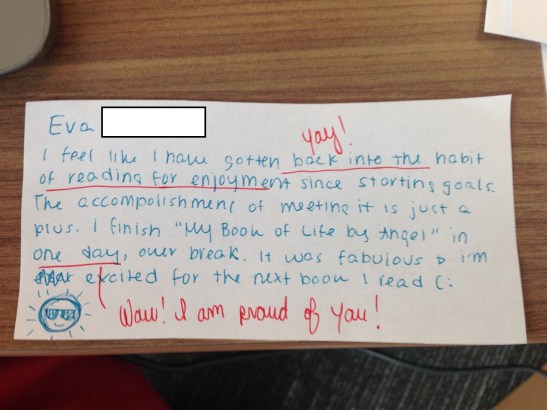
Formative 1

Eva often struggles to submit work on time. To see her excitement for My Book of Life by Angel made me smile. 
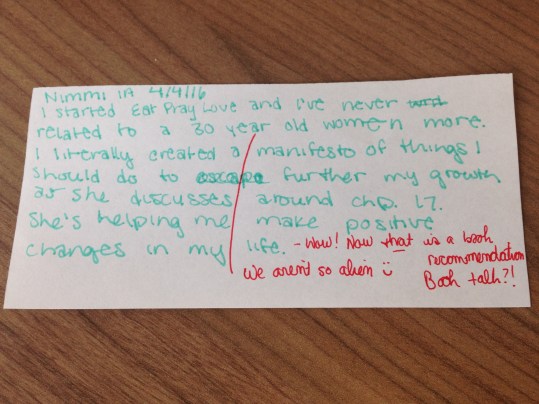
Fomrative 3

Nimmi cracked me up with this response. Apparently, it’s otherworldly to relate to someone as old as 30, but she’s making plans for her life based on her reading. Outstanding! 
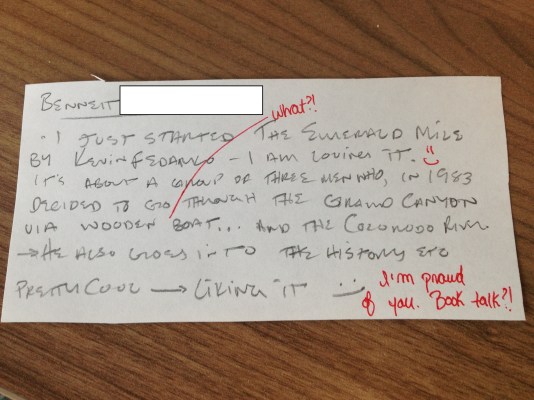
Formative 6

Bennett is a brilliant (accelerated) student who admits that reading isn’t often his priority. I can’t wait to hear his thoughts on The Emerald Mile. 
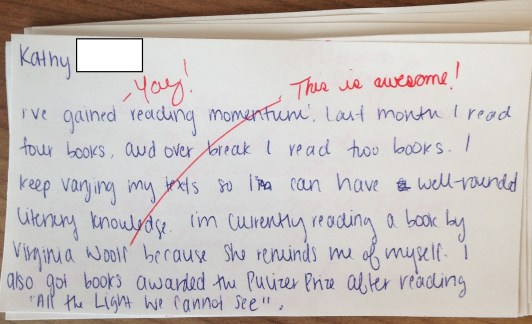
Formative 5

Kathy is an extremely hard worker who tackles reading specifically to better herself and prepare herself for AP Literature. We read an essay from Virginia Woolf and it sparked Kathy’s interest. 
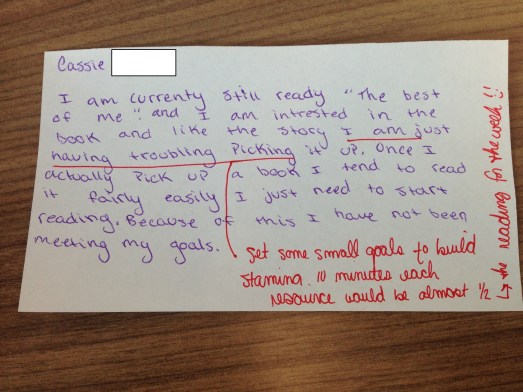
Formative 2

Cassie is a sophomore who struggles with analysis. I’ve requested her for resource tomorrow so we can talk through what might be holding her back with this book in order to help her move on and meet her goals. 
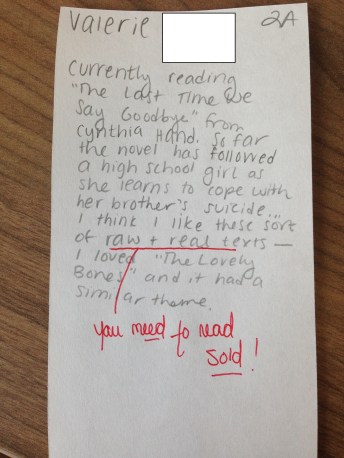
Formative 4

Several students responded with insights into texts they are loving, which afforded me the opportunity to recommend further reading. 

What are the quick formatives you use to provide feedback to and motivate students? Please leave your comments below! 


The Winds of Change Smell Like Books

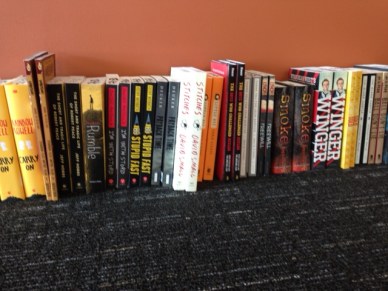
Everywhere I look, I see books. bookshelf

Open in the hands of students.

Shared at the hands of teachers.

I’m dreaming about books. Like the pursuit of the one that got away, I am chasing after unopened books in my sleep. Waking in a state of minor panic – When WILL I have time to read all of these books?  I need a prep period just to read. I need an extra hour in the day. I need a sabbatical.

In the days since TTT came to share their wisdom and enthusiasm with the English Department at Franklin High School, literary excitement is wafting through our hallways and it’s all about books, books, and more books.

Students are buzzing about books.

As I walked through the commons a few days ago, I saw one of my AP Language students, Maddie, reading during her free block. I smiled and walked on. Then, I stopped, turned around, and went back to talk with her.

It was the best move of my day.

Sitting on the table next to Maddie was a copy of A Monster Calls (Since I sobbed over this book and poured myself into sharing it  with students in a book talk a few weeks back,  I’ve acquired six copies for my classroom and not seen one of those copies in days. Kids are handing them off in the hallway. Meeting for coffee to discuss. Making their parents read it. It’s beautiful) and in her hands The Girl on the Train. I asked her how it was going. “Ugh! Mrs. Dennis! I can’t read fast enough. I need to meet my reading goal and finish this book so I can start A Monster Calls.”

I almost hugged her.
Okay…
I hugged her.
Maybe a second longer than was necessary, but I think we had a moment.

Only a few weeks earlier, before I had recommitted to book talks every day and conferring with kids about their independent reading, we had talked in class about how independent reading was going. Maddie had shared that while she likes to read, she wasn’t making time for it. She had been enthused earlier in the year, when getting time to read in class was something new and different, but hadn’t kept up with the expectation to read 2 hours per week.

I was reminded that Penny Kittle says teachers sharing their passion for books is contagious. In this area, I needed to do better.

While I was giving time to read, sharing lists of books to choose from, and piling books on the shelves, I had let my own passion for texts slip away into the haze of curriculum redesign, semester exams, and lesson planning. In essence, I was asking students to make reading matter without me. Not cool.

So, I grabbed a copy of Stiff, by Mary Roach and got reading.

Of course, I couldn’t put it down. Of course, I wanted to tell my kids all about it. So,  I shared my passion in a book talk, we ended up chatting about the use of humor in nonfiction, and my students were reminded that we are a community that makes time for what matters. READbooks

Reading matters.

And our commitment to that as teachers needs to be visible and constant if we are to have any hope in keeping kids enthusiastically discussing what they are reading and reaching for more.

My colleagues are buzzing about books.

I’ve been wonderfully lucky to work with brilliant and passionate English teachers for each of the thirteen years I’ve been in the classroom. In the past two years, I’ve even been lucky enough to be their department leader and do my best in recent weeks to facilitate our move toward workshop.

While we all share the very traditional love of To Kill a MockingbirdPride and Prejudice, and The Great Gatsby, our passion for reading runs so much deeper. In workshop, it’s our responsibility (and pleasure!) to get kids reading all manner of texts. Not just glancing in the direction of a book, but digesting it.

In short, we know that to get a majority of our students excited about reading, their teachers need to be readers.

Tickled to share a passage, can’t wait to see what you think too, ask a million questions, highlight in multiple colors, adorkable readers. The classics have a role in this, but so do countless other styles, genres, and soon-to-be classics.

Our district has blessed us with a huge surge in classroom library materials in preparation for our shift to workshop instruction. This puts dozens of books in the hands of teachers who are now chatting about Patrick Ness in the hallway between classes, feverishly searching for texts that are suddenly in high demand (Anyone have a copy of Columbine? They are ALL checked out! How about The Nightingale? I’ve got a wait list. With six names on it. For a book)and frequenting Thriftbooks.com to compare how much money they have saved to add even more titles to their libraries.

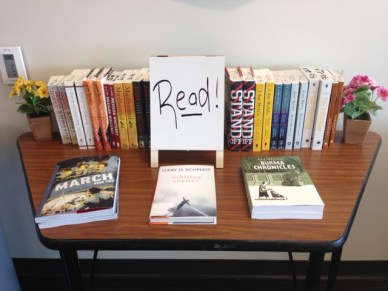
When in doubt, promote. We enlisted the help of some art students and had a poster made to show how super cool it is to read. A nicer group of people, you will never meet, but this poster says read, or else.

Reading Poster (1)

The students think it’s a riot…and have asked on more than one occasion which books we are reading in the picture.

Mission accomplished.

So, as the wind ushers in both spring and a journey with workshop, let the books come raining down as well. The more I see, the more I want to read. And the more I want to read, the more excited I get to prove to kids that we can all be readers.

How do you keep the beautiful buzz that surrounds books going in your classroom? Please share your ideas in the comments. 


Writing With Mentors: A Nonnegotiable of Writers Workshop

41dIMvzIynL._SX395_BO1,204,203,200_

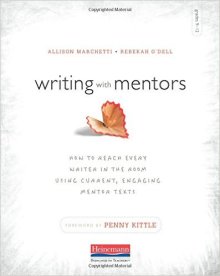
WRITING WITH MENTORS by Allison Marchetti & Rebekah O’Dell

Reading Allison Marchetti and Rebekah O’Dell‘s Writing With Mentors is reminding me of the summer, three years ago, that I committed to making the move to readers and writers workshop.  Like my new friends in Franklin, Wisconsin, I already had many of the structures of workshop in place–I just didn’t know how to fit them all together.

As I read and wrote and thought beside the likes of Penny Kittle, Amy, Jackie, Erika, and my other UNH friends, I learned quickly which parts of my instruction to keep and tweak, and which parts to flat-out jettison.  While I felt like my reading workshop practices were solid, I knew I needed to completely rethink the way I designed writing instruction.

I wish I’d had Writing With Mentors that summer.

That summer, I learned that I shouldn’t be designing lessons around a staid form like a persuasive essay or a literary analysis.  I needed to begin thinking about having my students write authentic, interesting pieces on topics of their choice–but I didn’t know how.

img_0791

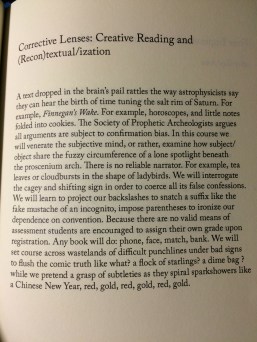
I immediately saw Gregory Pardlo’s DIGEST, full of prose poems, as a mentor text.

I learned how to read like a writer, how to look at the craft and structure of my favorite authors’ works.  I began to see mentor texts everywhere, and in fact too many places–I was exhausted by trying to keep track of everything I wanted to share with my students, and even resolved to read less as a teacher.  I wanted to offer a variety of rich mentor texts to my students without losing my mind–but I didn’t know how.

I learned that my writing process was as unique as my handwriting, and that process has value just as much as a written product does.  I wanted to restructure my unit planning, my gradebook, and my classroom routines to reflect that–but again, I didn’t know how.

Over three years, through trial and error, I’ve figured out how to reckon with a lot of those issues, but I would have known instantly had I read Writing With Mentors then.  This book succinctly showed me great writing units and products, how to plan for them, and how to select and organize current, engaging mentor texts.

img_0480

Books are at the center of my writing instruction–literally.

It reminded me that when we read–even to study the craft moves of a mentor author–we must read as readers first, for the “pleasures of story time” and to “hear the rhythms of good writing” (65).

It affirmed my habit of designing new units each year, complete with brand new mentor texts, to meet the needs of my current students and the sociopolitical climate in which we live and read and write.

It helped me cement mentor texts, alongside the writer’s notebook, conferring, and authenticity, as nonnegotiables of a successful writers workshop–because, in Allison and Rebekah’s words, “mentor texts enable complete creativity and individuality to emerge in student writing and writing instruction” (3).

And it reminded me that when students leave our classrooms, “mentor texts will always be present” (167).  When we teach students to write with mentors, they remain capable of reading like writers as they engage with print and media and other real-world texts.   Since getting my students to become lifelong readers and writers is my ultimate goal, this book is now an important mentor to me.

Writing With Mentors is the book to pick up when you put the textbook down, toss out your binders of writing rubrics, or throw up your hands when you read your 94th crappy plagiarized paper in a row.  If you’re seeking to rejuvenate, organize, and revamp your writing instruction, don’t undergo three years of trial and error like I did…let Allison and Rebekah help you write, more happily, successfully, and authentically, with mentors.

Have you read Writing With Mentors?  Share your feedback in the comments!


Holden

Today I asked my colleague, Elaine Miskinis, if I could share her writing with the TTT community.  Elaine teaches Sophomore English, Junior English, and AP Language and Composition.  I am fortunate to pass my freshmen along to her while receiving her juniors in return. She perfectly sums up the struggles of first semester, the hope that comes with second, and the transformative power of literature. ~Jackie

Rye_catcherThe plan?  Spend the hour and a half between the end of the school day and kiddo pick up time entering my students’ midterm grades, doing some lesson planning for “Hamlet” and cleaning and organizing my room in preparation for third quarter.

The reality?  A student who is failing with a single digit average came to finish his midterm.  He mentioned, in passing, that reading Catcher in the Rye made him realize some things about himself.   Any conversation that opens with “The Catcher in the Rye made me realize…” is never going to be a short conversation.  It’s just the nature of that novel and the power it holds.

Long story short, he’s experienced some significant trauma and, like Holden, nobody has really been there to help him to process it.  He said, “You know how Holden is really smart, but he’s failing because he just can’t get out of his own head and move on from what he’s experienced?  I think that’s like me.”  Over an hour later we came up with a plan to get him someone to talk.  We also scrapped any plans of turning him into a model student this year and replaced them with the goal of helping him so that he, in his words, “Can stop pretending to be happy and actually start to feel it”.

So, now my classroom is a fire hazard of papers and books, my planning for Monday stands at “Wing It” and I have two bags of papers that have come home with me that still need to be logged into my grade book.  But, this was one of those days that will likely stand out when I think about why I teach. And, more specifically why I value teaching literature.  For every kid who whines and “Spark Notes” and skims, there might be one kid in the back of the room who looks like he’s disengaged and disconnected but who, in reality is so much in his own head at that moment, and possibly even so far in the head of a character that he’s lost in ways we can’t begin to see.

It’s easy to forget the power of novels, especially the ones we teach year after year and it’s easier still to forget the power we hold as teachers, especially when we’re consumed with midterms and grades and planning, and frankly, all of the things that really, in the end don’t amount to a whole lot.  Today was an important reminder to me of what it’s really about and why what we do really does matter.  I don’t know that we’ll be able to help this kid in any substantial way, although I certainly hope we will, but I do know that he felt comfortable broaching the topic with me this afternoon because he had Holden Caulfield there to lean on.  It makes me wonder how often these small, important moments get lost as we focus on assessments and core competencies and all of the minutia of our lives as teachers.  Sometimes it just has to be about more than that, and about more than reading check quizzes and essays.  Sometimes it has to be about letting our kids hang out with characters for a while to learn that they’re not alone.

4 Monthly Challenges to Beat the Winter Reading Slump

New England winters lend themselves to steamy mugs of cocoa, plush blankets, and chilly evenings curled around a book.  Despite the ideal environment, halfway through the year, some of my students hit a reading slump.  The initial momentum of the reading initiative subsides, leaving students a bit more lackluster come second semester.

In turn, here are four challenges I plan to integrate over the next three months to beat the winter slump and reinvigorate students’ passion for reading.

1. January: Reading Bingo and Challenge Lists

The New Year, or for us, the second semester lends itself to fresh reading goals.  Goal-setting and self-reflection aside, I love reading challenges that push students to step out of their reading comfort zone and delve into new genres.  This year I comYA-Reading-Bingo-Challenge-2014piled a variety of reading challenge lists that I’ll be printing out on bookmarks to provide to my students.
I personally love the #26BookswithBringingUpBurns challenge, which has readers fulfilling challenges like reading “A book set somewhere you’ve always wanted to visit” and “A book with a color in the title.”  I’m also enjoying Rebeccah Giltrow’s BookaShelf 2016 Reading Challenge, which has participants base their book choices on the alphabet.  For example, “A” stands for “a book with an apocalyptical theme.”  Finally, Random House’s “YA Reading Bingo” is the perfect way to get students reading through rows of books while competing with one another to fill in a bingo card.

2. February: Book Trysts and Library Dates 

February lends itself to romance with Valentine’s Day, so to celebrate our book love, students will set up blind dates for some of their favorite books.  They will cover their choices in brown packing paper and write “dating profiles” including intriguing qualities readers will hopefully fall for.

In addition, students will participate in a library “date” with a friend from class.  Inspired by this “date night at the library” post by The Dating Divas, I created a list of entertaining and useful tasks and challenges for students to complete.  From “finding a book authored by someone with the same name” to “finding a book that has been made into a movie,” this friendly competition will put books in students’ hands while also promoting conversations revolving their reading.

3. March: March Madness and the Literary Hashtag Challenge

As March Madness approaches, my basketball students will be building teams and taking bets.  I know little about basketball…but I do know about books, which is why I’m hoping to create a March Madness that looks similar to Shana’s last year.  For those looking to create student-based teams, Principal Justin Cameron’s “Fantasy Reading League” at Frederick W. Hartnett Middle School gets the entire school involved in the competition together.

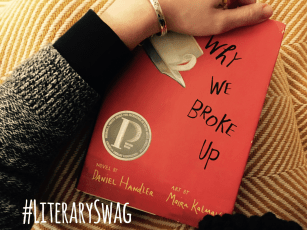
Finally, in March I will launch a new literary hashtag challenge that asks students to IMG_1801.PNGexhibit their reading lives outside of school.  Students will e-mail a Twitter or Instagram class account with literary images that include the following hashtags: #LiterarySwag (a hashtag for fashionistas who know books can serve as a stylish statement piece for any outfit), #Shelfie (a hashtag for beautiful bookshelves), #IReadEverywhere (a hashtag to highlight reading in unique places), and my favorite #BookFace (a hashtag that pushes people to be a bit more creative with their book covers).

By putting new books in students’ hands, I’m hoping to inspire a little competition, a lot of conversation, and a passion that will turn them into lifelong readers.


How do you reinvigorate students’ passion for reading?  What tips do you have to make it through the winter reading slump?


Starting with Why

“People don’t buy WHAT you do, they buy WHY you do it” ~Simon Sinek, Start With Why

I first heard of Simon Sinek from my son Zachary. He came home from work one day excited to share a TED Talk he’d listened to during his break. I had not seen my youngest son so animated in months. Zach had big dreams, but he made some poor choices that led to him having to wait a while after high school to start making those dreams a reality. This young man needed some inspiration. Simon Sinek gave it to him.

At Zach’s request, I watched Sinek’s TED Talk “How Great Leaders Inspire Action,” and talked with my son about Sinek’s message:

“There are leaders and there are those who lead. Leaders hold a position of power or influence. Those who lead inspire us. Whether individuals or organizations, we follow those who lead not because we have to, but because we want to. We follow those who lead not for them, but for ourselves.”

Zachin Taiwan

Elder Zachary Rasmussen

Zach watched that TED Talk multiple times, and my husband pulled Sinek’s book from a shelf in our hallway. “You ought to read it,” he said.

“I want to be that kind of leader, the one who inspires,” Zach told me, and he began to make choices based on his drive to help people instead of what he thought he would get out of helping people. As I write this, Zach is in Taiwan. He gave up his cell phone and his friends and jumped into learning Mandarin Chinese. His 6’4” frame dons white shirts and ties everyday as he rides a bike through Taipei, serving a full-time two year Mormon mission.

My son found the WHY that Sinek inspires, and it changed the direction of his life.


Sinek’s book is about identifying why some leaders are able, not just to sell a product, but to create a movement. He explains his purpose: “to inspire others to do the things that inspire them so that together we may build the companies, the economy, and a world in which trust and loyalty are the norm and not the exception” (7).

That reads like a nice idea for educators, too, doesn’t it? I do not know a teacher who does not want “to inspire [students] to do the things that inspire them.” However, according to Sinek many in business go about it backwards. By extension, I argue that many in education do, too. We focus on the WHAT and the HOW– like making learning relevant, engaging our students, teaching them grit, focusing on achievement, calculating grades, teaching a specific book, giving them a quiz — instead of WHY we teach our students in the first place.

Sinek says, “All the inspiring leaders and companies, regardless of size or industry, think, act and communicate exactly alike. And it’s the complete opposite of everyone else.” They start with WHY. Instead of a focus on the WHAT they produce or sell, or HOW they produce or sell it, they focus on WHY they produce and sell it in the first place. Apple, for example, obviously sells computers. That is their WHAT, but their WHY is to challenge the status quo. It always has been. Stay with me here with Sinek’s explanation:

“A marketing message from Apple, if they were like everyone else, might sound like this:

We make great computers.

They’re beautifully designed, simple to use and user-friendly.

Wanna buy one?

When we rewrite the Apple example again, and rewrite the example in the order Apple actually communicates, this time the example starts with WHY:

Everything we do, we believe in challenging the status quo. We believe in thinking differently.

The way we challenge the status quo is by making our products beautifully designed, simple to use and user-friendly.

And we happen to make great computers. Wanna buy one?

Apple doesn’t simply reverse the order of information, their message starts with WHY, a purpose, cause, or belief that has nothing to do with WHAT they do” (40-41).

Now, let’s think about this as educators:  Most of the time, we think and talk about WHAT we do. “I teach English,” or “I teach high school,” or even “I teach kids.” Sometimes we talk about HOW we do it. “I teach readers and writers in workshop,” or “I advocate for choice independent reading,” or even “I teach To Kill a Mockingbird, ” or “I teach Hamlet.” These are different from WHY we teach and have nothing to do with what motivates us to greet our students each morning, armed with carefully crafted lesson plans, and a smile.

According to Sinek, when we focus on WHAT we do instead of WHY we do it, we are like most of the businesses and companies in the world that drive their work with manipulations and punitive rewards, which might work in the short-term, but do not breed loyalty and long term change. We see this in education all the time:  threats of in-school suspension and failing grades, mandatory tutorials, new test-prep programs, increased numbers of safety nets designed to keep students from failing, changes in grading policies, and more. “There are only two ways to influence human behavior: you can manipulate it or you can inspire it,” writes Sinek. Most decisions we make to motivate students are based on manipulation, and we fail to inspire long-term change. No wonder we see the same students in the same trouble year after year. When we define ourselves, or our schools, by WHAT we do, that’s all we will ever be able to do (45), and that is not enough “to inspire [students] to do the things that inspire them,” or to build a world where trust and loyalty are the norm. We need what Sinek calls “inside out thinking.” To inspire lasting change, we must start with WHY.

Let’s take that example of Apple from before and apply it to our schools. If we are like everyone else, we might talk about our school like this:

We teach high school.

Our school culture is spirited and sound. Our curriculum is rich. Our test scores are high.

Wanna come here?

When we rewrite the example again, and rewrite the example in the order an inspiring school leader actually communicates, this time the example starts with WHY:

Everything we do, we believe in challenging our students’ thinking. We believe in genuine and individual inquiry.

The way we challenge our students is by making our school safe and innovative, with passionate and knowledgeable teachers who are caring and compassionate, who cater to the needs of all students.

And we happen to graduate honorable and educated citizens. Wanna come here?

Does that example make you feel a little different?

As I read Sinek’s book, I kept imagining what his argument looked like when applied to education, but more specifically, I kept imagining what it would look like applied to me as a literacy leader in my classroom. The way I talked about teaching was like everyone else I knew; I focused on what I did as an educator instead of WHY I did it.

I taught AP English Language and Composition. I taught skills to pass a test. I taught students to love books and to like reading. I taught students to write.  Although I had changed my instruction from when I first began teaching, from whole class novel studies with little writing instruction, to readers and writers workshop with choice, modeling, and mentoring, I still struggled. I struggled until I turned my thinking inside out. I took that example Sinek uses to explain what makes Apple such an innovative force in the market and applied it to my belief about myself as an educator and how I make that belief happen in my classroom.

See how I start with WHY:

WHY:  Everything I do as a teacher, I believe in helping my students identify as citizens, scholars, and individuals whose voices matter. I believe our world is better when individuals understand their value, believe in their capacity to cause change, and take action to better the world around them.

HOW:  The way I challenge my students is by making my classroom safe and inquisitive for my individual learners, with instruction that centers on trust, esteem, equity, and autonomy. Through the rituals and routines in my workshop classroom, students gain a sense of belonging, identify themselves as readers and writers, develop their voices, advance in literacy skills, and take risks that have the potential to change their worlds and the world around them.

WHAT:  And I happen to teach English by modeling my reading life and writing life.

It works.

My readers and writers advance because they know we are in the business of learning about ourselves and our world — together.

Simon Sinek is right:  “[Students] don’t buy what we [teach], they buy why we [teach] it.”

My challenge for you:

Follow Sinek’s model like I have above, and write your WHY. Please share it in the comments.

The Best Gift You Can Give Your Students

A few weeks ago, when I sat down to confer with Asia, she told me that she bought me a Christmas gift. She was really excited about it. “I’ve never bought a teacher a gift before!”

She’s a senior in high school.

img_0731

My scarf from Asia

I asked her why she’d never bought a teacher a gift before. She thought for a moment. “No teacher ever gave me respect automatically, like I deserved it.”

It breaks my heart that in twelve years of public education, this girl never felt that a teacher respected and cared about her.

“How did you know I respected you?” I asked her. A few other kids sitting with us answered this question too.

“You talk to us every day, like we’re adults, about our learning, and you really care what we say.”

We confer.

“You do all our assignments with us so we know they’re not busywork.” This from Shailyn.

I write beside them.

“You always expect us to know more than we do, and you don’t take BS excuses about why our work isn’t done,” Jocelyn said.

I have high expectations.

“You know exactly what your students are capable of,” Jocelyn further explained.

I know them, well, through frequent talk about their choice reading and writing.

“You just seem to really like me, and see me,” Asia finished.

A few days later, she eagerly presented her gift to me, and waited eagerly for me to open it.  It’s a lovely seasonal scarf much like the ones I always wear–a very thoughtful gift that, when I thought about her reason behind giving it and combined that with my pregnancy hormones, made me completely bawl.  I love it, because Asia gave me much more than just this scarf–she gave me proof that my teaching is important, if only just to her.


Readers and writers workshop is about more than just nurturing literacy skills–it’s about nurturing people, their thinking and creativity and confidence.  Conferring isn’t always about teaching into a standard–it’s often about just talking with another person about what’s in your mind, helping to flesh it out through talk before writing.  Writing beside your students isn’t just valuable because it’s modeling–it’s essential to creating a true community of learners committed to growing as readers and writers and thinkers.

This holiday season, give your students the best gift possible–respect, love, value, and the equal footing that comes with shared learning and the collaborative creation of knowledge.

Weekly One-Pagers to Develop Writing Fluency

IMG_9425

Janelle, now in college, appreciates the one-pagers belatedly

This summer, Amy and I talked a lot about what we wanted for our students.  While there were lots of complex ideas tossed around, we knew that our goals boiled down to two simple ones:  for our students to become real writers and real readers.

We had lots of structures in place to help our students become authentic, fluent readers–weekly reading homework, daily booktalks, reading conferences, reading workshops, and more.  But writing was a bit different.  Daily quickwrites and longer compositions were already in place, but I wanted to add something more to get students writing more regularly outside of class on topics of their choice.  I wanted them to gain the same fluency with writing that they did through their weekly reading homework.

So, I was reminded of something I used to require my AP and Honors English students to do–a weekly one-pager.  Every Monday, a one page, single-spaced, typed paper was due.  I offered topic suggestions, but ultimately, students could choose what to write about.  I decided to revive this routine, inspired by Kelly Gallagher’s powerful claim that students should be writing four times as much as teachers could ever assess.  Why shouldn’t all students–not just the AP and Honors level students–write this much?

This year, I only have one Honors class, but all four of my English classes write weekly one-pagers.  We have a section in our notebooks called “Weekly Writing,” which is rapidly filling up with writing on a variety of topics.  During bi-weekly notebook collections, I check to see that these weekly one-pagers are being completed, but I don’t “grade” them–that’s not the point.  The point is to build writing fluency.

These one-pagers are low stakes–ten points apiece, so on a particularly busy week, if students just don’t have time to write, it’s no big deal.  But the frequent follow-up and sharing activities we do in class with these writings, combined with the autonomy students have in their topics, make the missed one-pager a rare occurrence.

I was initially inspired to create this routine by some of my greatest college professors, for whose classes a written response was due each day.  Alan Frager’s “study guides,” Tom Romano’s “one-pagers,” and Don Daiker’s “reading responses” were handed in at the start of each class period.  By writing a short paper every single day for most of my college years, I developed incredible writing fluency.  I knew I wanted my students to develop this written fluency as well, partially in preparation for their own college experiences, but also to bridge the gap between a writer’s thoughts and his words on the page.

As evidenced by Janelle’s testimony above, building this writing fluency pays off.  Already this year, students are remarking that it’s becoming much easier to write a full page, after only writing eight of them thus far.  I’m enthused by the growth I see in all my students’ writing fluency, and looking forward to seeing how much they can develop as writers by the end of this school year thanks to the weekly one-pager.

What routines are in place in your classes to help build students’ writing fluency?

#FridayReads: Matching Reluctant Readers to the Classics

IMG_9287On Tuesday, during a lull in class, Tyler was staring at the ceiling.

This isn’t unusual, or even discouraged, as our ceiling is covered with tiles that represent books.

“What’s that book up there?” he asked, pointing. “The one with the fire?”

“That’s Fahrenheit 451, by Ray Bradbury,” I replied.  I know that Tyler is a volunteer for our fire department.  I also know that he hasn’t had a lot of positive experiences with reading, so I tailored my impromptu booktalk to my knowledge of him specifically.

Fahrenheit 451 is a book about a fireman.  But he’s not an ordinary fireman–instead of putting out fires, he starts them.”

Tyler looked incredulous, and a bit offended.  “So he’s an arsonist?”

“He is, but that’s the job of the whole fire department in this book. Their job is to start fires to burn books and maintain censorship. Anyone whose house has books in it is the target of the department–they burn the house, and the books inside.”

“That’s messed up!” Tyler said, eyebrows raised.

“Right?!?” I agree, equally outraged for his benefit.  I tell Tyler some more of the plot–the corrupt fire chief, the terrifying mechanical hound, the strange professor that Guy happens upon.  “But eventually the main character–his name is Guy–gets curious.  He’s never read a book.  He starts to wonder, do they really need to be burned?  So, one day, at one house, he takes one.”

“The hound goes after him, don’t he?” Tyler predicts.

IMG_9289“He does.  And a lot of other crazy stuff happens.  I love that book so much…the way that Guy changes is so cool.  I really grew to love him by the end.”

Then, he asks the best question:  “Do you have that book?”  We cross to the bookshelf and I thank the gods–it’s there.

I give it to him, and he starts reading right away.

Tyler has abandoned a lot of books, but I think he’ll finish this one.  This was a case of matching the right book with the right reader at the right time, as Teri Lesesne says.

Tyler wants to read this book, despite its difficulty–he has reading strategies to cope with the challenges in vocabulary, sentence structure, and chronology that he’ll encounter.  I have faith that he will employ those strategies and grow as a reader and a thinker, as I have seen many a student do before, with greats like The Poisonwood BibleTheir Eyes Were Watching GodPride and Prejudice, and Brave New World.

We don’t need every single student to read all of those books.  They are gorgeous works of art that I hope everyone will discover, but thinking the only way to expose students to those books is to make everyone read them isn’t the way to do that.  Our student readers will find the classics on their own, if we give them the tools and the hunger to do so.  Tyler has the tools, and the hunger, so he found Fahrenheit–all because of a simple desire to know more, to find out why firemen would act so radically, sparked by the depiction of a flame on our classroom’s ceiling.

How do you match your readers with classic texts?

Window Shopping and Writer’s Notebooks

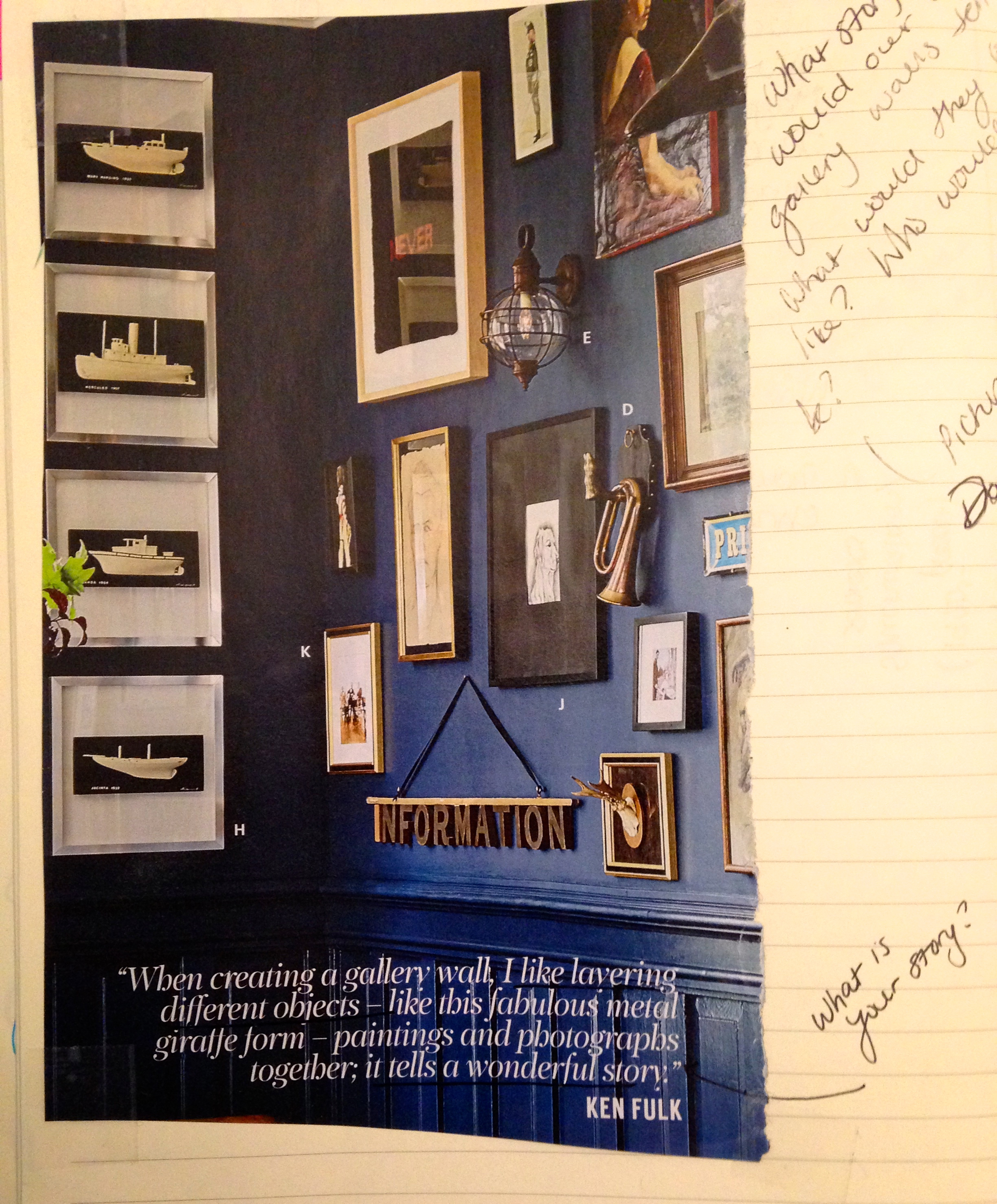
IMG_2848While thumbing through a Pottery Barn catalog, I paused to appreciate a navy gallery wall. Inky prints, gold frames, and brass hardware framed an assortment of images, below them designer Ken Fulk wrote, “When creating a gallery wall, I like layering different objects…paintings and photographs together; it tells a wonderful story.” I looked at the images, trying to decipher the story these antlers, ivory boats, dogs, and pencil sketches communicated. To be honest, I have no idea what he was going for, but I ripped out the page anyway, taped it into my writer’s notebook and started writing around it: “What story would our own gallery walls tell?” “What is your story?”

These are the questions I want my students to answer, and bit-by-bit their stories unravel. But all too often the process of answering these questions through writing intimidates them. In turn, one of the first activities we did this year to establish classroom culture involved designing and decorating our writer’s notebook covers. In the past I had students create inspiration page collages on the inside of their notebooks, but these were hidden and personal. They didn’t distinguish one’s self or serve as a conversational piece between peers. These images, which could serve as gallery walls for my students, were tucked away.

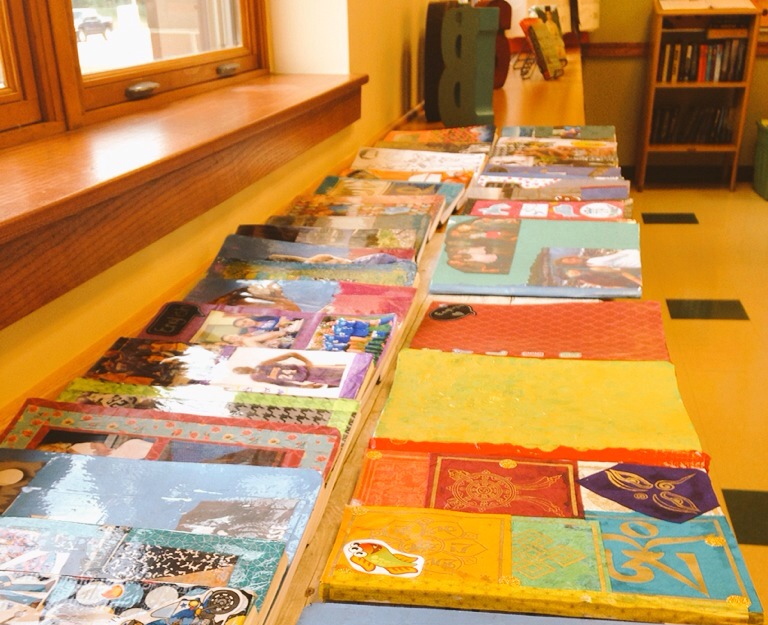
Student notebooks ready for writing.

Student notebooks ready for writing.

In turn, this year I stocked my classroom with scrapbook paper, patterned tape, and stickers. I lined tables with butcher paper and allowed for the messy process of gluing and cutting and painting. Together, my class sat listening to music and chatting about TV shows, cars, sports, summer vacations, and the scary transition between middle and high school. While this artistry and expression is typically celebrated at the elementary level, I encounter few secondary teachers who value setting aside class time for these collages. Some of my colleagues use it as a homework assignment, but I love how blocking out one class period and allowing for exploration becomes an icebreaker in and of itself. After all, these interactions mirror the same writing process students will engage in as they begin filling their notebooks and sharing the stories of their images.

Today we’ll circle around the classroom, sharing our notebooks with each other and highlighting one meaningful aspect of our covers. This activity is low stakes and comfortable; they have a choice in how much or how little information they provide. Hopefully they’ll find that these collages are snapshots in time of who

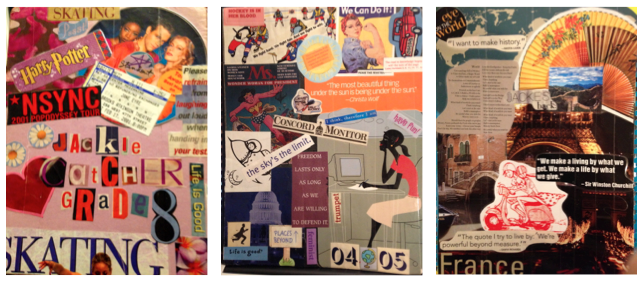
we are, reminders of what we value, and visual hopes for who we’ll become. I know this because as we sit in a circle, I will share, for the first time, the cover I created in 8th grade when I was caught between childhood and adulthood, the cover from 11th grade when I thought I wanted to be a journalist, and the cover from my junior year of college when I left on a great adventure to study abroad in Ireland. In the end, we’ll take a great leap forward in beginning our process of sharing who we are through words and images.

My notebook covers through the ages: 8th grade (far left), 11th grade (middle), junior year of college (far right).

My notebook covers through the ages. 8th grade (far left), 11th grade (middle), junior year of college (far right).