Category Archives: Professional Development

Why Workshop? Because Kids Deserve It!

When I first watched the Rita Pierson TED Talk titled Every Kid Needs a Champion, I found myself shouting, “Yes! This lady gets it!”  Our job is to help kids feel connected at school- to ensure that kids feel safe and taken care of while also giving them the best educational experience possible.  This TED Talk catapulted me into thinking- How Screen Shot 2018-03-07 at 10.40.19 AMcan we do things even better? How can we reach more kids?  How can we ensure that every student feels connected to their school and their teacher? Don’t misunderstand me- I work with the best teachers around, who love kids and are passionate about the work they are doing in their classrooms.  However, we can always do more and get better, right?

I am a high school administrator, that is lucky enough to work with the English department.  We serve almost 3,000 students on a daily basis. It’s my job to ensure that every kid has a champion, someone they trust and feel has their best interest at heart.  It’s also my job to ensure that we are providing the best educational experience possible for our students because our students deserve that. James Comer said, “No significant learning can occur without a significant relationship.”  That’s where the workshop model comes in. The workshop model provides us with the opportunity to give students choice in what they read and an authentic environment to write about things that hold value to them. It provides an avenue for our teachers to get to know students on a deeper, more personal level because students are ingrained in work that matters to them.  Teachers are able to work one-on-one with students through reading and writing conferences. Teachers are able to have in depth conversations over current events through philosophical chairs and classroom debates. Students talk about what they’re reading on a daily basis. Students improve their writing because they have great mentor texts and a teacher who is writing with them and modeling writing for them.  In short, we know our kids better because we have implemented the workshop model.  We are also able to teach all the skills we need to through choice reading and providing authentic writing opportunities for our students.

I love Amy Rasmussen’s blog post, So You Don’t Think Workshop Works?  5 Reasons You are Wrong, because she makes key points about why the workshop model can and does work in classrooms everywhere.  I found that as we made the shift away from a more traditional classroom structure to the workshop model, we encountered some people that questioned its effectiveness and its validity.  Some questioned how it would impact our state testing scores (they’ve gone up and we are closing the gaps for our students), some questioned whether students would actually be reading and learning the required TEKS in our classes (they definitely do and on an even deeper level than before), some questioned whether or not you could teach a PreAP or AP class through the workshop model (I see it happen on a daily basis).  It’s important to know your why and your purpose. When you know and believe that the workshop model is what is best for students, because of the positive impact it has for them both academically and relationally, it’s easy to defend.

As the workshop model has become more pervasive, and people notice the positive results happening within our department and in our district, we have received lots of requests for campus visits (which we love!), and I get asked quite often about how and why we made the shift to the workshop model in our department.  I thought I’d share my top tips for implementing and sustaining the workshop model in hopes that it helps you carry on the great work.

  1. Teammates.  You need a team of people who “get it” and believe that building student relationships is the key to success in education.  You need a team that understands workshop and why it’s essential in the English classroom, or at least a team that is willing to learn.  Hiring and retaining the best teachers around will help make your workshop thrive.  If you have an administrator, or teachers, that don’t understand the value, send them the Three Teachers Talk blog!  Point them towards professional authors such as Kyleen Beers, Penny Kittle, Jeff Anderson, Donalyn Miller, Kelly Gallagher, etc.  Have them attend conferences so that they are able to immerse themselves in the work.  Take them on learning walks so they can see it in action, or utilize technology to view workshop from afar.  It has been my experience that you have to see it in action to truly understand the work.  You need to talk to students to understand the impact it is having on their educational experience.
  2. Professional Learning Communities.  Whether you have a team of 6, 3 or 1, PLCs play an essential role in getting the workshop up and running and then also sustaining the workshop model.  Teachers need to collaborate with others. We need to talk about the work we are doing, how our students are doing, what engages them, and even what frustrates them.  We have to learn from each other.  At my school, we team within our school, our district, and even with teachers in other districts.  Additionally, I love blogs and Twitter and consider them a vital part of my learning community. I strongly encourage you to connect with as many people as you can while you are navigating the wonderful world of workshop.
  3. Conferring. Andrea Coachman, a Three Teachers Talk guest blogger and also the English Content Coordinator in my district, wrote a post about Accountability Through Conversation which details our district’s journey of implementing the workshop through one of the most Screen Shot 2018-03-08 at 5.47.07 PMimportant aspects- talking with our students.  This area was a big learning curve for us.  The tendency is to think that having a teacher table or holding daily student conferences is an elementary concept, but in reality it’s what’s best for students at all levels.  The teachers I work with would say that conferencing with students has been a game changer.  They know their students strengths and weaknesses in reading and writing better than before, and they are able to target specific skills that each student needs.
  4. Money. Every school allots a certain amount of budget money to each department.  It really doesn’t matter if it’s a lot or a little, but you need to commit to spending your budget money on professional development for teachers and also books!  Teachers must have the training they need to run the workshop. It’s always a good idea to send them to professional development where they can learn from the experts. My teachers always come back and share with the department, so we all benefit from their learning.   If money is an issue, apply for grants and scholarships to help teachers attend professional development. There are also a plethora of professional books written to help teachers with workshop- check out 10 Pedagogical Must-Reads for Workshop Teachers.  Another important component of the workshop is having classroom libraries; they are a key component because our students must have a selection of books to choose from.  We have been lucky that our Media Resource Specialist has purchased many of our classroom libraries.  However, our teachers are also great about adding to their own libraries as well.
  5. GRIT.  Angela Duckworth wrote Grit which examines why some people fail and others succeed.  She defines grit as a combination of passion and perseverance for a singularly important goal.  It takes a lot of work to get the workshop up and running because the teacher is creating mini lessons based on their students needs, helping students find choice books, modeling writing with mentor texts, and conferencing with students.  We are in year 3 of implementation and are still learning and adjusting each day.  It’s a marathon, not a sprint.  

Workshop works and it’s worth it.  At 7:30 AM this morning, I was on hall duty, and a group of students came walking by, and said, “I love starting my day with English class.  It’s so fun- we read, we write, and we talk about it all. My teacher is the best! It’s the best way to start the day.”


TCTELA 2018: Professional Learning in Style on the Isle

I like to think I know about teaching.  Then I go hang out with hundreds of brilliant educators and I realize how much I have to learn.

(I hope Helen and Megan see what I did there)

Teachers

I just got home from the TCTELA Conference.  The 30 minute ride north on I-45 allowed me a brief opportunity to reflect on this weekend and think about the experiences that I encountered and the people I had the pleasure of meeting.

Collaborative Conversations:

Spending time in different sessions with different people from our District rejuvenated me. I enjoyed sitting with Adam Glasgow and taking in a presentation on curriculum development from two teachers from our district: Helen Becker and Megan Thompson.  I loved hearing them speak the workshop language.  It’s nice to take in a lunch with teachers from other schools in our district and really get to know them. There were also impromptu twitter education sessions and conversations about snacks.

Mary Margaret

Super Star Speakers:

Alfred Tatum is brilliant.  His presentation was first thing in the morning on Friday and was a perfect start to the conference.  His ideas about texts belonging to all students perfectly echo the words of Atwell, Kittle, and Gallagher.  Here is a video of Dr. Tatum talking about self-selected reading.

Pernille Ripp is inspiring and passionate.  She is one of the most ardent speakers I’ve ever heard and when she said, “Our fidelity should be to the students, not the programs. See the children and hear their voices,” I knew I had a new teacher-crush (Sorry Kelly Gallagher).

Donalyn Miller made me continue to think about my role in the classroom and as an advocate for literacy.

Chris Lehman closed out the conference this morning and his ideas about close reading should be standard practice for all of our reading teachers.

Chris Lehman

Looks like I’ll be spending money on more teacher books soon.

Harvey Panel:

Diane Miller of U of H Downtown set up this panel of amazing educators.  Unfortunately, our time slot worked against us and more people sat on the stage than in the crowd.  In that aspect, it kind of reminded me of the JV soccer game the night before.  That wasn’t really the point though.  The point was that these educators shared their uplifting stories and shared some of their emotional baggage.  It’s important to give a voice to those who are thinking and acting outside the box to help kids.

Call to Action:

Get involved.  Connect with innovative people on social media!!!  NCTE is in Houston this year.  Meet up with us!!!! If you are a Texan, Join us at TCTELA next year in San Antonio!!!

Charles Moore’s students sometimes revolt when he tells them to quiet down and all they want to talk about is their writing.  He can’t wait for the weather to warm up so that he can enjoy craw fish and his pool and maybe even devour craw fish while in the pool.  You can find his frequent thought bursts and his passive aggressive treatment of trolls by checking out @ctcoach on twitter.  His poorly executed instapoem collection can be seen @mooreliteracy1 on Instagram.

What do colors have to do with teachers writing? Today, a lot.

When I read You Don’t Have to Say You Love Me by Sherman Alexie, I knew I’d found mentor gold. Infused with stirring poetry, this memoir tells the story of Alexie’s less than ideal relationship with his mother and how he grieves the loss of her, what was, and what could have been.

I reached for this book Monday as I began a session of PD. On a whim, I flipped the pages and landed on the poem, “Ode to Gray,” thinking it may spark some kind of response in my audience. It’s simple enough. And lovely.

Ode to Gray

This isn’t the complete poem. I just wanted you to get the idea. There’s one more stanza. Really, get this book.

After I read the the poem aloud, I asked listening teachers to write in response.

“Think of a color, and write about that. Write your own poem, or a paragraph. Doesn’t matter. Just write about your color.”

After writing five minutes, which is rarely long enough, I asked these writers to read over their words and do a bit of revision, challenging them to add an appositive phrase somewhere in their writing. This is a directive I often use with students:  We write. We read our work. We revise, often with a singular purpose that ties to a specific skill or craft move.

I walked the room, peeking over shoulders, listening to conversations — and noticed about a third of the group didn’t write a thing. Funny how some teachers are so much like some students, huh?

Maybe they didn’t get the simple task. I guess that makes sense if they’ve never been asked to write like this. I do not think that’s the case though. I heard one too many sigh and saw one too many eye roll to know I wasn’t the first presenter to ask this group to think and write.

It didn’t matter. We cannot make people eat. We can keep inviting them to the table.

Writing teachers should be willing to write.

Accountability in RWWorkshop

Some teachers in that session wrote a lot — and they wrote beautifully. Adam showed me his piece about the color black. I should have asked for a copy. All I remember is the line “Little black lies.” It’s a great line.

Of all I wrote, one line holds a bit of promise:  “Orange, the color of sunsets, why are you so lonely?”

And then there’s Mary. She took that little quickwrite and turned it into something tender, touching, real. She published it on Facebook and said I could share it here:

An Ode to Red
Workshopping With Amy Rasmussen
1.15.18
Red is the fire of your cheeks as you demand to be heard in the morning before school, on a day I was supposed to get to sleep in late. Red is the fire of mine as I scream back, frustrated, unsure of how to solve this trembling toddler enigma. You want red grapes, I gave you purple. In your mind, they are not the same.
“What’s your favorite color, Mommy?” you ask. You expect an answer.
“Purple,” I say, knowing the question that comes next. We do this daily dance, aware of each other’s rhythm.
“And what else?” you ask.
“And orange.”
“That’s good, Mommy. Mine’s red. Red and blue. I love red and blue.”
Red is the sucker, no, the second sucker you negotiate for after getting your hair cut. Just one of the many tricks/bribes that I’ve learned along this short parenting trip we’re on together. Sticky, stained red lips, sticky, stained red teeth and sticky, stained red fingers.
“Go wash your hands before you hug me!” I yell as we walk in the house. “5, 4, 3, 2, 1…”
Red is the color of the bath water after you dump the entire bottle of finger paint into the tub.
“Bubble bath!” you shriek excitedly, giggling, red steaks strung along the sides of the just-washed tub.
Red is my heart each time I leave, and each time I return. Red is the love. All of the love, engulfing me in flames.


I see red a bit differently today.

Thank you, Mary. My kids are grown, and now I get to watch them practice parenting. It’s hard and noble work, and you will feel every color of emotion — sometimes all on the same day and sometimes more than once. But it’s that “love. All the love” that turn these emotions into rainbows. And sometimes just writing about them helps us see every moment just a bit more clearly. Thank you.

In an article by Tim Gillespie, published on the National Writing Project website, he sums up what I believe and have experienced myself as a teacher writer.

Accountability in RWWorkshop (1)

Here’s the thing, you teachers who refused to even try:  It doesn’t matter if you think you can write. Just write.

What does matter is that our students see us working at it. Just like we must be readers in order to help our students find the “just right” book, we must be writers if we want to know the struggle our students face when writing.

We learn when we are vulnerable. We learn when we practice.

So I am challenging myself as much as I am challenging you:  Write beside your students more. Let them see your thoughts, your mistakes, your struggles. Ask them for feedback.

If I truly want a community, where we all work to grow as readers and writers, I need to do more to get us there.

Amy Rasmussen began writing in journals at age 8. In addition to this blog, she now writes in notebooks and on sticky notes. A lot of sticky notes. She also tries to write the assignments she gives her students. She wishes she would have had teachers who wrote with her, but she does not remember one K-12 teacher ever doing so. Follow Amy on Twitter @amyrass and @3TeachersTalk

#NCTE17 – Pearls of Wisdom From Those Far Smarter Than I

Have you ever attended professional development that reached into your soul and stirred things up so thoroughly, so deliciously, so deliriously, that you knew your teaching would never be the same?

I hope so. If not, consider packing your bags for #NCTE18 – Houston next fall. Or book some inspirational PD for your district. Or simply follow any of the heavy hitters on Twitter. Professional development is everywhere because sometimes all it takes is a few words to send you down the path of beautifully rich, and possibly practice changing, reflection.

Our students deserve teachers who see the classroom as an opportunity. Teachers who see them as deserving of unending work to help create the best opportunities for their learning. Teachers who see each day as an opportunity to build up readers and writers, as the most important work to be done in education.

The voices below, that I was lucky enough to drink in at #NCTE17 this year, speak of opportunity in every endeavor: The day to day, the conversations we have with kids, the responsibility we have to see beyond test scores, and things we can do to stay true to what we believe as educators.

Dave Stuart Jr. – Doing more isn’t doing better. Refocus your practice with a personal Everest/Mission Statement.

Mr. Stuart’s session focused on how to teach English and still have a life. Sounds lovely, doesn’t it? I’m still working on it, personally, but anyway, this sentiment stemmed from the idea that we often spend a lot of time doing things that don’t align with our true beliefs about what’s important in our classrooms. His suggestion to craft and publically post in your classroom a mission statement really hit home with me. I need to boil down my practice to stay focused on what is most important in my classroom, and a visual reminder will help me filter my stressors through what I’ve claimed is most crucial to the daily movements in our experience as a class. Often, what stresses me out most, for example, is returning emails. While important, I’m certain it wouldn’t be included in my mission statement for my classroom. Therefore, I need to set some limits to when and where I allow this work to take away from the work that will move my students forward as readers and writers. My Everest statement, so named because it’s really evident what the goal of climbing Everest is, will bring me back to readers, writers, and critical thinkers who use both their heads and hearts to guide not only our work but their lives. Work in progress.

Kylene Beers – If we raise test scores but fail to raise compassionate people, we have failed.

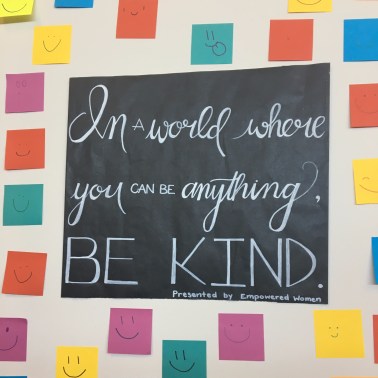
I thought the crowd in the theatre might come out of their seats at this suggestion. If there’s one thing anyone who has ever been acquainted with education understands, it’s failure, and we avoid it at all costs whenever possible. I’ve let this sentiment guide my IMG-8069work this week specifically as it’s Kindness Week here at Franklin High School. Student need does not end (or perhaps more importantly begin) with the test scores they generate throughout their time with us, but if I can influence their capacity to better care for and understand one another, I’ve really made a difference.

Linda Reif – End in the middle of a sentence. It makes getting into the thinking again much easier.

I often have my students end their quick writes by suggesting that they should take a moment and wrap up their thoughts. I’d never considered the subtle shift of having them stop mid-thought as an encouragement to go back and finish, expand, explore, and keep at those thoughts. A quick write is inherently incomplete in terms of the time given and the depth of process used, so why suggest to students that their work should be wrapped with a nice little bow? I head back to my writing often. It’s where some of my best work grows – from the hazy suggestions I started with, to the revisited and revised thinking. Ask students to come back to their work more often. They might be surprised at what comes of it.

Kelly Gallagher – Reflected on Nancie Atwell’s quote about American schools having an aversion to pleasure.

This suggestion made me laugh out loud. How painfully true, yes? How often have I struggled to let go of the control in my classroom? How often have I feared that exploratory writing would be at the expense of preparation for the work my students would do after they left me? How often have I worried that it would be a “waste of time”  IMG_7306.jpgto extend a discussion or let students read just a bit longer? Far too often. As a colleague of mine famously suggested years ago, “Big Bird can’t come to class every day,” but pleasure doesn’t have to be a throwback to elementary playground free-for-alls. It can be simple. It can be personalized. But it must also be considered a worthy goal of any daily lesson planning. What opportunity for joy, satisfaction, or pleasure am I organizing for my students today? If the answer is nothing, then I wouldn’t want to be in my room either.

Tom Romano – There is language inside of you…Be fearless in heading down the page with it.

Tom said this casually before we did some quick writing in his session on multigenre writing. While I filled two pages with notes on how to incorporate a multigenre project into my classroom, this simple sentiment really stuck with me. I’ve used it several times with my students since then because I love how it rephrases the idea that we have to outwrite our inner critic. This phrasing suggests that we are already full of valuable ideas! We need simply to give ourselves permission to let them out onto the page.

What seemingly simple sentiments have changed your teaching for the better? Please share in the comments below.


Lisa Dennis teaches English and leads a department of incredible English educators at Franklin High School near Milwaukee. Her personal mission statement is a work in progress but needs to involve equal parts readers, writers, thinkers, believers, and dreamers. Follow Lisa on Twitter @LDennibaum. 

3 Sparks to Shift Thinking and Practice

What gives you pause as an educator? Not politically speaking. Not shake your head and think of simpler times speaking. Not even “Yes, death is the narrator in The Book Thief. You’re on which page?!” speaking.

I’m talking about the changemaker moments. The moments that make you stop in this crazy profession, take a breath, and think about how you do what you do, why you do it that way, how you got to where you are, and how to move forward in the best interest of kids.

You know. A Tuesday, for example.

If you frequent Three Teachers Talk, chances are you’re quite familiar with the benefits of reflective practice. You’re already on the lookout for motivation and inspiration to move your professional work forward. You’re interested in change. You’re not afraid to wear stripes with polka dots.

Three Teachers Talk

But often, the moments that change us the most are the ones that sneak up on us. We don’t go looking for them, but there they are, in the blink of an eye, demanding, “So, now what are you going to do?”

I started this workshop journey over two years ago. And while I’m sad to say that the move wasn’t so much motivated as mandated,  I was ready for a challenge and always in pursuit of positive change. Or, so I thought.

When I found Three Teachers Talk, I had naively come looking for a way to ‘deal with endless annotations to assess assigned reading’ in the workshop model. Yikes. wisdomJust typing that feels like malpractice. I had an open heart and and open mind, but past practice and a limited knowledge of varying philosophies afforded me a narrow scope of imagination on the subject. My mind heard choice, voice, student talk, and for the most part, I believed I was already “doing all that.”

And to some extent, I was.

But, in many cases is was how I was doing it that kept me in control and my students in a cycle of compliant work completion vs. curious exploration as readers and writers. I’m happy to say that I’m growing, but like most things in my life, I have plenty of growing left to do.

So, because I work best with snippets of inspiration, the kind that I can digest, reflect on, and work to put into practice without feeling paralyzed by the scope of change before me, here are three shifts in my thinking and practice this week, and where they came from, where they took me (or took me back to), and the great minds that inspired them:

  1. Shana got me thinking hard earlier this week. Her post “What Will You Teach Into?”, stirred so many feelings that had been resting heavy on my heart the past few months. The world we live in, raise children in, guide students through, and try to navigate ourselves (because really, who among us can consistently stomach everything that’s been crashing down upon the nightly news lately?), is no longer just frightening, it’s often demoralizing.

    In response, Shana wrote, “This week and every week, I hope teachers are having difficult conversations with our students. I hope we are not shying away from the ease of ignoring our nation’s pain in favor of teaching about comma splices or symbolism or character development. I hope our time with students is deliberately geared toward talk about these incredibly complex, nuanced topics.”

    In an nation so politically polarized, it may seem uniquely difficult to have these conversations, but it’s precisely for this reason that the conversations are all the more important. Our students need to see, and in some cases learn, what civil discourse looks like.

    Our classrooms are certainly not the place to promote our own political opinions, but they must be a place to explore nuanced topics with students. My step this week was to have students look at the statement Senator Chris Murphy made after the mass shooting in Sutherland Springs, Texas this weekend. We’d recently talked about the debate over guns in our country, sadly after the previous mass shooting in Las Vegas just a few weeks before, with Kelly Gallagher’s article of the week that presented opinions on both sides of this debate, and Senator Murphy’s statement brought us back to this discussion with an exploration of not only the topic, but writer’s craft, bias, and argument.

    Students quickly latched on to word choice (“That word, ‘slaughter,’ it’s heartbreaking.”), the use of context, and possible bias from a senator from the Democratic party. What mattered the most in the course of our 15 or so minute exploration, was that we devoted the time to do it at all. Students referenced the article of the week pieces we had read previously and marveled at the fact that we were having to talk about this. Again. So…we focused on “again” and students vented some of their fears and frustrations about what this all means for their daily lives.

    We didn’t change policy. We didn’t write to legislators. We didn’t protest. We talked. We talked carefully and candidly. It was the best spent 15 minutes of the week so far.

    These conversations are not easy. They shouldn’t be. But they must happen. Reading Shana’s piece reminded me that the time is now. Have a conversation, let students write, invite them to read, today.

  2. Students in our AP Language classes have been writing one pagers weekly since the first few weeks of school. With 76 students, the feedback on these pieces has been relatively minimal. I had been thinking the task of providing consistent feedback on this writing was well beyond my capacity, so I filed this work away as the writing students need to do, even when it’s not assessed.

    However, as I sat scrolling through the weekly work on Monday, it struck me that I had my feet in two worlds. Students still receive a formative grade for this work. Often, when I fail to record consistent scores, their work falters. So, I take a look, put a formative score in the gradebook and try to email five students from each class with feedback each week, which happens…sometimes.

    Noble, I guess, but straight up stupid on my part too.

    It’s disingenuous to record a score to make students compliant in writing these explorations of their independent reading, when growing as writers (which requires more consistent feedback!) is the goal.

    So, I’m getting out from behind my desk and moving those feet, previously in the two worlds of old school and real school, to more purposefully make moves as a workshop teacher.

    On Monday, I recorded reflections on the one pagers for my fourth period class. Just for five students. During reading time, I went to briefly speak with these students about what they had reflected on in their one pager. Since they write these pieces from the books they are currently reading, we just had more to guide the conference. I asked a follow-up question from the one pager and students talked about their writing process in relation to the book in their hands. Heart. Warmed. Goals. Clarified.

  3. Lastly, and probably most impactful, was a reminder from Carol Jago that I nearly scrolled past on Twitter. I’m so glad I didn’t. It’s catapulted my thinking back to a place I’ve known, but sometimes forget. It’s sparked some wonderful conversation with my dear friend Alejandra. It’s made an immediate impact on the feedback I’m giving:

    carol
    There are huge implications here. Enough for a whole separate post. But, I will say this – My shift here had less to do with philosophical agreement, because I’m already there, and everything to do with mindset. It was a simple reminder to encourage and instruct more, and correct less.

    My pledge to my students this week was a return to the type of feedback that has everything to do with their next paper. If I do my job and confer with students during the writing process, in an effort to improve the current work, my focus can and should remain on the writer and his/her next paper when I give summative feedback.

The power of wonder moves us forward. The curiosity that surrounds our work is not only necessary to foster in students, but critical to keep our own work fresh, functional, and full of meaning for everyone in the classroom.

What has sparked moves in your thinking or practice this week? Please comment below and share the love through snippet PD. 


Lisa Dennis teaches English and leads a department of incredible English educators at Franklin High School near Milwaukee. Her desire to grow as an educator is only inhibited by the number of classes she can conceivably afford to take, the number of times her daughter wants to re-watch Mary Poppins, and the number of hours in the day. Follow Lisa on Twitter @LDennibaum 


Story, Self-Generosity, & Student Success: #3TTchat with Tom Newkirk

For our inaugural #3TTchat last night, we were privileged to be joined by the great Tom Newkirk. This bright light of literacy scholarship talked with us about reading, writing, and assessment in the context of two of his most recent books: Minds Made for Stories: How We Really Read and Write Informational Texts and Embarrassment: and the Emotional Underlife of Learning.

Just as his books are, Tom’s tweets were full of one-liners of wisdom and wordplay as he engaged in the chat with teachers, instructional specialists, and writers:

Many of us, in thinking about this question, highlighted the importance of identity in our reading lives–how do I see myself in books? How do I find myself in books?

Our next question asked how we taught students to do this very thing: make connections between people’s stories and their stances and beliefs:

As we pondered this question, many of us offered up the value of having students read books that they couldn’t see themselves in–moving from mirrors to windows. We connected this to moving from recognition to empathy.

Q3 focused on specific reading practices to help students view their reading lives dynamically; Tom encourages his readers to hone in on beginnings:

Book clubs, multigenre projects, studying mentor texts, modeling our reading lives, and crafting reading and writing autobiographies were all journey-focused practices chat participants offered up.

As we shifted toward talk about writing, we wondered how we might best help students read like writers in order to strengthen their own written products. Tom offered his view that variety is key:

Avoiding becoming stuck in one genre was a theme of the night–mixing narrative with nonfiction, blending story and poetry, lab reports and literary devices, all through studying provocative, unconventional mentor texts and practice, practice, practicing imitating their craft moves.

Q5 wondered specifically about genres of writing that might help students do this, and Tom replied that any genre containing “trouble” was a good place to start:

Ideas included memoir, commentary, op-eds, origin poems, author bios, annotated lists, letters, and straightforward exposition and essays. In short, the opportunities for emphasizing narrative are endless!

We shifted toward thinking about assessment, and our conversation focused on celebrating student successes rather than emphasizing shortcomings:

We railed against grades, but honed in on emphasizing process over product, using student work as mentor texts, and teaching students to have a growth mindset when it comes to goal-setting and their reading and writing lives.

Finally, we wondered about takeaways, and Tom’s just about made us weep:

His ideal teacher voice is one of kindness and encouragement, as were so many of our chat participants’: “writing is a living process;” “your voice matters;” “everyone has something to say that matters;” “there is no one correct way to write.”

Together, #3TTchat told a story of leading students to success in reading and writing through encouragement, patience, and self-generosity.

All we can say is thank you to Tom and our many participants for helping us write that story.

We are so looking forward to talking more about the role of narrative in informational reading and writing at NCTE this year. This topic has been a long time in the making–starting with some thinking at NCTE in 2014, then growing with our reading of Minds Made for Stories, and growing some more when we took a class with Tom Newkirk at the UNH Literacy Institute. We hope you’ll join us in St. Louis for more thinking about this important topic!

Shana Karnes, unfortunately, will NOT be able to attend NCTE this year, breaking her 8-year attendance streak for the important reason of having her second baby. While waiting impatiently to meet Baby Jane, Shana teaches preservice teachers at West Virginia University, works with practicing teachers through NWP@WVU, and participates in Halloween festivities strictly for the candy. Follow Shana on Twitter at @litreader or find more of her writing on the WVCTE Best Practices Blog.

Teachers Are Awesome. Let’s Learn from Them.

i-love-my-students-bags-backpacks.pngToday, I’m reflecting on how much I love my students.

There are 52 of them, all pre-service teachers from a variety of content areas and grade level specializations. Despite all the ways we are misaligned pedagogically, we have fantastic discussions every Friday about the work of education–the broad strokes that define good teaching, no matter the topic, age level, or context.

My students and I have opened one another’s eyes to so many things during our time together. If there’s anything that they’ve taught me, it’s that we can all learn from each other.

I feel much more knowledgeable, passionate, and informed about teaching reading and writing now that I’ve studied with elementary literacy specialists for over a year. I’ve learned from my history teachers how to spin what seems an ageless interpretation of a text into something new and fresh. My math and science preservice teachers have shown me more about process-oriented teaching, learning, and feedback than all my disconnected reading on the subject.

In studying with these young teachers, I am reminded of how much we can learn from one another, if only we try.


I think the most frustrating thing for me about teaching is the isolation.

Not just the physical isolation of our classroom spaces–being the only one who seemingly holds our role in the room, alone as the adult–but also the way that we never get to see one another practice our craft.

We rarely get to see other teachers teach.

As a result, most of our information about what other teachers are doing comes from secondary sources–our students, their parents, our colleagues, or, more professionally, from books, articles, blogs, or journals.

What would education look like if we changed this?


In my many roles this semester, I’ve gotten to be in lots of West Virginia classrooms. As a supervisor of English Ed interns, I’ve gotten to visit 7th graders and their teachers. As a teacher of preservice teachers, I’ve gotten a glimpse inside the myriad classrooms they’ve been placed in. And as a substitute teacher, I’ve gotten to “be” ten different practitioners so far this year.

I love, love, love going into these other classrooms. From the first impression I get from the empty space, to the first students who walk in the doors, to the ways I see teachers and students interacting as I study them–I love all of it.

There is beauty in every single classroom.

Getting to see all of these learning environments supports, strongly, the idea that no two teachers will ever teach alike. There is value in that truth–if the instruction we value for our students involves choice, authenticity, rigor, and relevance, then the instruction we want our teachers making involves those things too. That means providing time and training and encouragement for teachers to design their own curricula, assessments, and and products.

Because we don’t live in a perfect world, many teachers don’t get to do those things–but what does become reality is the fact that no two classrooms are alike, nor should they be.

What we can do is embrace that reality and learn from each other. Collaboration is a goal for many of our students’ thinking; why not apply it to our teachers’ learning, too? Here are four ways you might do this with your colleagues soon.

Ask Questions. As you’re enjoying your school’s delicious lunch special in a tiny student desk with your teacher friends, don’t just talk about what happened last on The Walking Dead. Ask questions: what are you guys working on this week? How do you approach grading that? What struggles are your students having? Where do you wish you could improve?

These questions help not just the asker, but the answerer, too. How many times do we actually get to talk about the pedagogical aspects of our work? I know when I tell stories over the dinner table I don’t talk about my methodology or lesson planning. I talk about the kid who tooted incredibly loudly in the middle of an active shooter drill, causing the whole class to burst out laughing in the dark classroom (that happened yesterday). Asking questions helps us learn not just about one another, but about our own teaching, as well.

Observe One Other. It can be tough to fit everything a teacher has to do into 24 entire hours, let alone the free moments we get in a school day. But take some time, even if it’s just once a month, to pop into a friend’s classroom on your lunch, plan period, or PLC bell. Just see what they’re up to for 15 minutes and learn from them–the way they arrange their space, the precision of their language, how they have kids organizing materials, or who and what and how they’re teaching.

We can always learn from one another, even across content areas. Invite others into your room, too; you never know what good someone else’s eyes might see that yours have missed.

Share Resources. Standing in line at the copy machine? Have a glance at what your peers are xeroxing. And do steps one and two, too–ask questions about those questions, or mentor texts, or essay samples, or whatever it is you see. Get talking about the work we do on the most nuts-and-bolts level–how do you organize your planning? Are those copies for today or tomorrow or next week? How do kids turn them in? How do you grade them? Let your curiosity guide you.

Listen. The final step, of course, is to listen thoughtfully to what you learn during this process. We have to open our eyes, ears, and minds to what good we can see in one another’s practices. Don’t pre-judge the math teacher making a thick stack of copies of practice problems. Don’t assume the English teacher relying on the textbook comprehension questions has nothing for you to learn.

Every teacher does good work–young and old, new and veteran, AP and on-level, quiet worker or school-wide leader. We spend too much time assuming the worst of people in our world–we don’t need to make our jobs harder by doing this at school too. Look for the good. Teachers are awesome. All you have to do is remember that, look for it, and prepare to learn.

Imagine would education would look like if we did.

Shana Karnes is mom to 1.5 spunky little girls and wife to a hardworking surgical resident.  She teaches practicing and preservice English teachers at West Virginia University and is fueled by coffee, a pregnancy craving of orange jello (this week), and a real obsession with all things reading and writing.  Follow Shana on Twitter at @litreader or read more of her writing on the WVCTE Best Practices Blog, where a version of this post originally appeared.

More Than a Coach, a Reader

Clear Creek ISD June 2017 (1)The following is a guest post from an inspiring teacher and football coach I met this summer. He sent it to me the day after my daughter got married, and I’ve been playing catch up with life and getting-ready-for-back-to-school ever since. Sorry, I am late in posting it, Charles. You have to know, this post excites me:  I’m excited for the PD experiences we had this summer. I’m excited for the students who will walk through your door this fall. I’m excited to know you will spread your love of books and reading far and wide — and I’ll be excited, and not at all surprised, when you share a few titles with your linebackers. (Have you read Twelve Mighty Orphans?)

It’s August 6th and my summer is effectively over. We start football camps Monday and I’ll work until 5pm most days making sure helmets are ready, tackling dummies are out of storage, and duties are clear. This isn’t a necessarily dreadful thing because I love coaching football, and this part of the year is rife with expectation and uncertainty.

It’s also, for me, a time of reflection. Did I make the most of my time away from the classroom? Did I find enough time to shower my own kids with love and affection? Did I make sure I did the dishes and laundry and kept the house in order so that my wife had time to relax when she got home from work? I hope the answer to all these questions is “yes,” but I fear it’s a “maybe,” at best.

I was at school most days. The first two weeks after graduation were dedicated to our very first CCISD Literacy Institute, and mornings spent with athletes at Strength and Conditioning camp consumed most of the rest. The Literacy Institute was an incredible experience in almost every way. I learned so much from my teaching partner, Meggie Willner, and we both fell head over heels in love with our group of STAAR Camp students. Working with our curriculum director, Billy Eastman, and Amy Rasmussen made this the most valuable professional learning I’ve ever experienced. Those two weeks will make a difference in the lives of students in my class and the time trade off was more than worth it. Strength camp is bittersweet because I didn’t get to sleep past 6:15, but my football players and my own kids were there for most of it, and seeing them learn and work was worth it. For better or worse, this physical connection to campus means that I never really stop thinking about teaching or coaching. I’m always there.

My summer was, for the most part, wonderful. Whether afternoon napping, writing, playing board games with my kids, or swimming in our new swimming pool, my family and I always found ways to fill our time with laughter and joy. This summer was, however, different, and not just because of our much deeper sun tans. This summer I read like a “real” English teacher should. I’ve always listened while my colleagues extolled the virtues of their summer reading regimen. Don’t get me wrong: I’ve been known to crack open a book on a hot summer afternoon while sitting in the cool air-conditioning, but it hasn’t been my habit. Reading during the summer always felt like “work,” and I shouldn’t be working during my break. I should be chasing my kids around the house, helping them build blanket forts or taking them to the trampoline park. Reading threatened to get in the way of all that fun, but I wasn’t going to use that excuse this summer.

This summer, I consciously committed to being an avid reader, and while I’m sure many of you read much more than I did, that felt like a success for me.

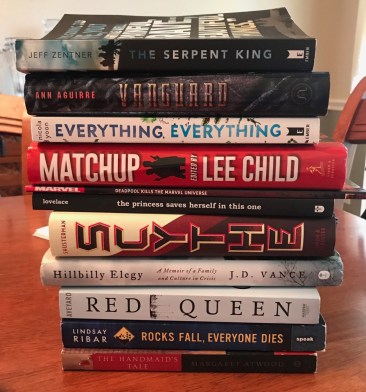
CharlesMoorebookstackI read so many amazing books and looking at my stack makes me realize what an eclectic collection it is. I read fiction, memoir, poetry, a thriller short story anthology, and even a graphic novel. I read the first book in a series, the fourth book in a series and a few standalone novels.
I’m proud of the volume that I consumed (remember I must spend SOME time thinking about inside linebackers). I’m proud of the variety and scope and I think it will make me a better teacher going forward.

These are the books in the order in which I read them:

The Handmaid’s Tale by Margaret Atwood

My teaching partner, Meggie, and our curriculum director, Billy, wanted to throttle me when I told them how I felt about this book. They both RAVED about it and I really didn’t care for it. I’m sure a second reading would do it justice because I was dealing with a lot personally and professionally at the end of the school year while reading it, but it just didn’t resonate with me. I hope this doesn’t make me an embarrassment to the profession.

Rocks Fall, Everyone Dies by Lindsay Rebar

They say reading is like a roller coaster and I went with an easy to read book for the Literacy Institute at the start of summer. A super straightforward, gently-paced book was exactly what I needed at the start of summer. I really enjoyed this book and for those seeking YA that appeals to both boys and girls, you can’t go wrong here.

Red Queen by Victoria Aveyard

I loved this book!!! It is a blend of Sci-Fi and fantasy with a strong female protagonist. I loved the author’s take on super powers and the surprisingly effective post-apocalyptic setting. I was tempted to read the second and third books in the series, but I want this world to be there for me when I want to revisit it.

Hillbilly Elegy: A Memoir of a Family and Culture in Crisis by J. D. Vance

This book spoke to my teaching soul. Vance examines a culture drowning in poverty and while it’s a reflection on his firsthand experiences, I felt like there was so much from his past that echoed in mine. I don’t think I realize how much our students’ home lives affect their school lives, but this book made me reflect on it again and again. This book coupled with a viewing of The Shack, directed by Stuart Hazeldine caused a sort of mid-summer epiphany that will change my teaching in the years to come. Another blog post, maybe?

Scythe by Neal Schusterman

I one-clicked this book the day Billy Eastman book talked it at the literacy institute and once I picked it up, I couldn’t stop. It’s original and well-written and even though parts of it were somewhat easy to predict, others still kept me guessing until the end.

the princess saves herself in this one by Amanda Lovelace

I read this poetry book under a shade tree in Wimberley, Texas, on our 16th annual summer camping trip. My mother-in-law noticed how fast I was turning the pages while reading this one and told me it wasn’t a real book. I handed it to her and she read it cover to cover. We didn’t talk about it, but I think we both knew how it affected us: deeply.

Deadpool Kills the Marvel Universe by Cullen Bunn and Dalibor Talajic

Determined to read a graphic novel, I picked up one about my favorite Marvel character. I’m not particularly experienced with graphic novels, having only finished George R. R. Martin’s graphic novels that are companions to his A Song of Ice and Fire. It was fun but not intellectually stimulating. Maybe this experience will help me with a reluctant reader or two or maybe give me some “street cred” with my Manga readers.

Matchup edited by Lee Child

Please don’t hate on my man crush on Lee Child. I’m obsessed with his Jack Reacher character and devour anything Child publishes. This book is produced by the International Thriller Writer’s Association and paired a dozen female authors with a dozen male authors to write a dozen short thrillers with varying success. There might be mentor texts here.

Everything, Everything by Nicola Yoon

This book was a quick read for me and it made me feel like an idiot because I didn’t see the plot twist until it was too late. I really enjoyed reading about how Yoon’s main character dealt with her problems the way a teenager would. I think this is an important book for our students to experience. To some, the main character’s relationship to her mother will be an eye-opener; to others, all too familiar.

Vanguard by Ann Aguirre

A vanity read if there ever was one. I love the Razorland trilogy and I couldn’t resist buzzing through this fourth book in the series. The love story made me uncomfortable at first, but I think books should do that sometimes. I enjoyed the happy ending in this book as my summer also draws to a happy ending. A modern Romeo and Juliet story? Maybe, maybe not.

The Serpent King by Jeff Zentner

This might be the top of the list of my summer reading. The story was incredible, the characters were deep and it is set in the same part of the country that J. D. Vance visits in his memoir from earlier in the summer. I love when books connect like that. This is one of the few books this summer that would keep me up late at night reading. I fell in love with this book and can’t wait to read Zenter’s Goodbye Days (if I can ever get it back from our freshman A.P. teacher).

Ah, the ones that got away…

Looking for Alaska by John Green

The Essex Serpent by Sarah Perry

Goodbye Days by Jeff Zentner

The Last Neandertal: A Novel by Claire Cameron

House of the Scorpion by Nancy Farmer

One of Us Is Lying by Karen M. McManus

and so many more…

So now I must start a list for the new school year. I don’t typically read a lot during football season. Working 80-hour weeks and trudging through months without a day off will take the motivation out of me. But maybe I can set a goal for the fall. Something to reach toward even when my knees and ankles are tired and my eyes won’t stay open.

Maybe I can get to school 20 minutes earlier and squeeze in some reading while the coffee percolates. I crush coffee.

Charles Moore is the senior English team lead at Clear Springs High School in League City, TX. He enjoys leisure swimming, reading, and coaching linebackers. Follow Charles on Twitter @ctcoach

Want to RENEW! Get the book by @ShawnaCoppola

I have never written a book review. (Okay, maybe that’s not true. I think I remember writing one in 4th grade over a biography of Marie Curie, the first biography I ever read.)

I have never written a review of a teaching book. But I am going to try.

I am a teaching book junkie. I have stacks of them, but I rarely read the whole of them. I cannot even tell you why, and I admit there is great irony here because as I write this, I am also trying to write my own book for teachers (I have been for four years, sigh.) If I ever get it written, I hope you’ll read it.

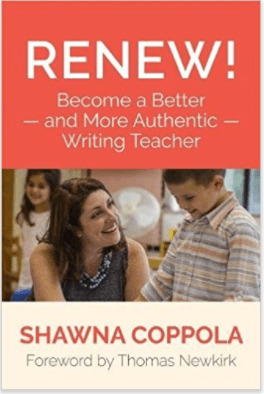
In the mean time, I have to tell you about Shawna Coppola’s new book RENEW!

I read the whole of this book in one afternoon! Thank you, Shawna, for writing so much of my own thinking about “Becoming a Better — and More Authentic — Writing Teacher.”

Shawna’s voice sings with passion and positivity. She paints the pages with possibilities! I know, I am gushing (and that’s probably too many p’s.) But here’s the thing —

I know so many ELA teachers who do know know how to teach writing. I know many more who are not confident teaching writing. I know even more who are not writers themselves, so it’s no wonder that teaching writing is difficult. Teaching writing is hard. A book like RENEW! not only gives us a starting place, it gives us desire.

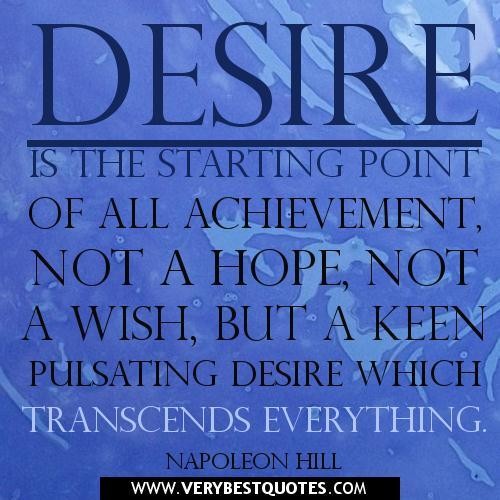
desire-is-the-starting-point-of-all-achievement-not-a-hope-not-a-wish-but-a-keen-pulsating-desire-which-transcends-everything-napoleon-hill

I am doing a lot of thinking lately around the idea of transcending. How do we go beyond our limits into something more, something better, something real and sustaining?

Let me share with you some of the passages I marked in RENEW!. I think you’ll see why this book is a must read for any teacher who needs a bit, or a lot, of renewal when it comes to teaching students to write.

“. . . if we are truly willing to honor the individuality of our student writers, the RENEW!uniqueness of each community of learners, and the ever-changing nature of our global landscape, we must continually rethink, revise, and renew our practice. Otherwise — to paraphrase Dewey — we rob “today’s students of the tomorrow today’s students deserve” (10).

“Broadening our ideas about what writing “is” can be scary, as if we are opening up a Pandora’s box. But in all reality, continuing to teach our student writers through a narrow, outdated lens — one that, in overvaluing written composition, does not accurately tell a story about the world of writing beyond most schools and classrooms — harms their development as writers by limiting the kinds of composing they are exposed to and encouraged to practice” (51).

“Teaching our writers how to develop their own tools is infinitely more sustainable than using preexisting tools. Quick survey:  How many of you use the graphic organizer your sixth-grade teacher taught you to use to write a persuasive piece? That graphic organizer may have been helpful to you then (although I doubt it was helpful to 100 percent of your classmates), but how useful is it you now?” (62).

“What message or “story” are we sending our student writers with a single overall score? Not only does it imply that their worth as a writer can be whittled down to one letter or number (which itself can mean different things for different teachers and even within different units of study), but that the worth of writing itself can be whittled down this way” (73).

“. . . readers of writing are human, an done person’s response to a composition may not perfectly align with another’s (If it did, what a drab, boring world we’d be living in!)” (79).

“Which is more likely to help students learn:  offering them specific feedback about their work, behavior, or performance, or slapping a score on a piece of paper?” (82).

“. . .when we engage in a semi-regular habit of writing, we can much more genuinely speak to those incredibly fantastic moments that writers experience on occasion, like the amazing feeling of completing a particularly difficult draft or writing something that makes a reader spontaneously laugh out loud. Anyone who’s ever taught a group of students of any age knows that when we are faking our way through something, or at the very least “phoning it in” by only engaging on a superficial level with what we are purporting to teach, students can smell our lack of authenticity a mile away. They know, even subconsciously, that they are being sold a decidedly moldy bill of goods” (92).

That’s all well and good, right? But here’s the beauty of Shawna Coppola’s book — she gives us the research that supports each of her positions AND she gives charts and graphs and resources to help us rethink, revise, and renew our approach, instruction, and practice as we become better teachers of writing. This book is chock full of everything good when it comes to writing instruction. It is a book I will return to again and again.

I hope you’ll read it. I hope you’ll share it with every ELA teacher you know. Really, it is just that good.


Amy Rasmussen lives in north Texas and teaches AP English Language and English 4 (new prep in ’17.) She loves talking books, daughters’ weddings (two this year), and grandbabies (five). She also loves facilitating PD for other teachers making the move into a workshop pedagogy. Amy adheres to the words of Emerson: “We aim above the mark to hit the mark,” and Jesus: “Love one another.” Imagine a world if we all aim higher. Follow Amy on Twitter @amyrass. And she really hopes you will follow this blog!

Are You a Reader, Darlin’? 

A few weeks back, I was on a flight home from Dallas to Milwaukee, my thumbs clicking away at my phone. Working to stifle my usual chatter in a effort to be a good fellow traveler to the woman I was sitting next to, I had been reflecting on the past few days of learning with fellow educators. However, it hadn’t taken me long to realize that I might be sitting next to an archetype wrapped in pink. My curiosity was piqued.

She was an older woman with white hair cut into a sassy pixie style, a pink shawl wrapped around her tanned shoulders and a pink Bible in her lap. I was Honey, Darlin’, and Sugar in the first 20 minutes I knew her, and she had even put her hand on my knee Are You A Reader, Darlin'- (1)to ask me to reach up and adjust the air vent for her, replying to my action on her behalf with a long and drawn out, “Bless you.”
Her slow, sweet drawl suggested that she was the one on a trip North, not headed home as I was, and when we ended up chatting, she confirmed she was headed to Milwaukee to visit a friend she met on a cruise almost 30 years ago.

After awhile, my new friend reached over with a long, manicured finger (you guessed it, pink nails) and tapped the book on my lap.

“Now, isn’t that an intriguing cover. The Nest,” she said, emphasizing the E with a smile and turning the word to Nast. “Do you like it?”

I smiled back, “I haven’t had a chance to get very far yet. Do you like your book?” I took a chance at a small joke.

She chuckled. “Darlin, I’ve read this one several times. It’s a bit different each time. Never read it in pink before though.”

We laughed and I asked if she read often.

“Oh, yes, (I love how E’s are A’s in the south) always been. How about you? Are you a reader, Darlin?”

I smiled inwardly at the revelation that the North needs to use more pet names and told her a bit about workshop.

“Then you are a reader,” she said, leaning over a bit and pausing. With a dropped voice she whispered, “Go make a lot more of ’em.”

I smiled broadly at 40,000 feet. Yes, Darlin. I’m a reader. 

An educational leader capable of professionally developing peers? Of that, I’m still not sure…

But a day earlier I had been in Dallas, sharing a two day workshop with Amy for about 40 educators. To say I was nervous would be a gross understatement. 3 years ago, I didn’t really know what workshop was. Now, I was walking into a library, full of expectant educators, to professionally develop them, like I had the necessary social capital (thanks for that new one, Amy!) to pull it off. 

As the training got underway, I felt like it was the first day of school. Ever. The very first day of my very first year, when my smile didn’t quite reach my eyes because I was actively trying not to vomit. However, as I think back on my first professional development experience, from the other side (and vomit free), I feel blessed.

I’m blessed because I was afforded the opportunity to teach other teachers about something I am truly passionate about. I am blessed because their questions and concerns not only helped clarify my own beliefs, but strengthened them. I am blessed because I was able to teach beside one of my workshop mentors, Amy Rasmussen. I’m blessed because I got to see the excitement and possibility that light up the eyes of fellow educators when they see how empowering choice and talk can be in their classrooms.

Then, this past week, our fellow writer Jessica asked a few questions in our ongoing Three Teachers WhatsApp conversation that took me right back to McKinney:

How do we prove workshop to our colleagues? How do we prove that it works? That we are doing the right thing? How do we prove that it can help make all the difference for our students and their futures as readers and writers?

The short answer? We do it.

We jump in and try it. Just as Amy and I asked the teachers in McKinney to do, you try it. You hold on to the core values of workshop (choice, student talk, time to read, mini lessons, conferring, writing with mentors) and you begin. A comment made by a veteran teacher during our McKinney training sums up this ironically simple, and yet seismic, shift quite pointedly. This rather stoic, obviously brilliant, and totally skeptical educator, leaned back in his chair on our final day of training and said to the group, “What the hell have I been doing all this time?” 

This gentleman’s astonishment at how limiting teaching English can be if we are trying to teach students to be English teachers, was moving. It does nothing to negate all of the amazing work he (all of us!) has done in his career to move students forward. The practices he implemented in good faith and with good reason were to benefit students.   But now, he was seeing that something could be added to benefit the young people in front of him, not only as students, but as people. Something could shift. Something meaningful needed to change if his ultimate goal was now different too . No longer was the fight to make students read a particular text (or to read/write at all), but to build a support system to show students all of the opportunity, benefit, and enjoyment that come from reading and writing, and the lasting impact if can have on their lives.

Ambition (1)

It’s not easy.  It will not be easy, but the right work rarely is. My move to workshop and my recent training work has reminded me that this is the good, hard work that I need to be doing. In order to do it, I need to remember the following:

  • Be vulnerable. This is hard. No kidding. But it’s about effort to be real with your students. They need to know you are a human writer, not some enlightened literary god/goddess who is there with the right answers and a perfect draft each time you put pen to paper. Write with your students. Share your work. Share your revisions. As Shana suggested earlier this week, share your writer’s notebook. Also, keep in mind, that vulnerability doesn’t have to be all or nothing. Students don’t need to know every little detail about you in order for you to share. Not comfortable detailing the deep dark secrets you only share with your therapist and your murky, tortured soul? Good! Being vulnerable means sharing your writing about dogs, because you love them, not your poetry about the loss of your innocence. Open up a little and you’ll get back a lot.


  • Be honest. There is little room in my classroom to connect with students on the level I need to in order to know them well enough to build them individually as readers and writers, if I am anything but myself. If we as teachers are not raw ambition, pure desire for student success, and the occasional humble failure, then we are not really what our need.  Tell your students which books you’ve loved, which you’ve abandoned, and which classics you haven’t read. I keep Don Quixote, with 258 pages read, on my desk for that very reason. I thought I should read it. I struggled so long, I grew to dislike it. I moved on. I haven’t read all of the classics. Who has? And who determines the classics?! Share the pieces that mean something to you in an effort to help students find pieces that mean something to and move them.


  • Be a reader and a writer (Darlin’). If we truly want to build readers and writers in our classrooms, we must be readers and writers ourselves. Listen, a few short years ago, I wasn’t a reader. I had always loved reading, but in the first few years of my career, I had allowed myself to read less, because I claimed to have no taste for it after reading so many student papers. This just can’t be. Of course we can share our love of books through the pieces that have touched us over a life of reading. But, how can we claim a life and love of reading, if we aren’t doing so voraciously now? The same with writing. It’s malpractice in my mind to promote reading and writing as transformative if we, the teachers, are not taking the chances and the time to transform ourselves in the same way. I want my doctor to love and practice medicine. I want my mentor to truly believe in the power of education and promote best practice through his own leadership. I want my students to know they can trust what I’m selling them, because I’ve bought in.

I’m a reader and a writer, Darlin’. Won’t you join me?

Lisa Dennis teaches English and leads a department of incredible English educators at Franklin High School near Milwaukee. As this summer rolls on, she looks forward to sharing more of the wonders of workshop next week with the awesome educators in Wiley, Texas. Follow Lisa on Twitter @LDennibaum.