Category Archives: Conferring

What is Your Teaching Everest?

I’m standing on my desk.

It’s dangerous, but exhilarating, and I probably look like a loon, but I don’t care. (Please see my post where I embrace my dorkdom in an effort to really get to know my students and move on happily with passionate living and teaching.)

oh-captain

High heels kicked off, channeling the spirit of Mr. John Keating and brazen pigeons everywhere, I’m perched on the edge of my desk during prep, looking around the room to try and gain gain a different perspective.

Oh, Captain, my Captain…Somebody call security. She’s lost it.

No, no. I’m all right. (Well, you know – Relatively speaking. Dear colleagues, if you hear a thud, please investigate.)

So, what caused this poetic exploration of my abandoned classroom? I was thinking about a quote I heard at NCTE 2016:

What is your Everest this year as a teacher?

No, my desk isn’t my Everest. I’m not that far gone. But, per Shana’s inspiration to start with a question, I was thinking about what needs my attention the most right now. With 86 minutes to plan, grade, create, and locate necessary motivation to do all of the roomaforementioned tasks, what should I start with?

There’s certainly a lot to chose from: stacks of papers, countless books to read, share, and sort, a department in need of collaborative time to plan, students flying under the radar.

Everything in front of me is important. I need to grade the narratives my sophomores wrote, to put some ending punctuation on that adventure. When She Woke by Hillary Jordan is calling to me too. That book is Hester Prynne meets Offred meets futuristic criminal justice system that injects offenders with a skin altering virus based on their crimes – I need several extra hours in the day to read. Truth be told, I should have started this post sooner too. Procrastination and exhaustion mix into a delightful little cocktail called Crippled Motivation. Bartender, I’ll take another when you have a minute.  

In all seriousness though, I return to my question (Yes, I’m off my desk, Mom), because answering it means I can get something done. I’m weird that way. Could I pick up a stack of papers and just start? Of course. But I have to mentally work up to it, know my plan, have a reward of some sort (read five papers, read When She Woke for five minutes). This time, the question, the task, the implication is much bigger.

What’s most important right now? When I could do a thousand things, what needs to be done right now because it will mean the most?  I know the answer. And not only because I was just standing on my desk :

My Everest this year is feedback.

Consistent, responsive, quick feedback that first encourages, and then focuses in on promoting growth. Remember the old saying about catching more flies with honey than vinegar? That’s the stuff right there.

I want to move my students forward. We all do. But now, more than ever,  I believe the way to do it is through sincere investment in the original thoughts and explorations of my students. Personal connections that, yes, take some time, but build relationships that have helped me to better recommend texts, suggest style moves students may need to make in their more formal writing, and encourage additional critical thinking beyond the classroom.

I used to stress about “finding something good” to include in my comments to my students. And I hate to say this, but it’s downright hard in some instances, isn’t it?

I really like what you did with the title there. 
Interesting transitional choice. 
Wow. So many words in that sentence.
Nice…font selection.

But now,  I’m thinking about feedback in new ways and delivering it in new ways too. To reach my Everest, I’m going to have to get creative and intentional. So, here’s what I did this afternoon:

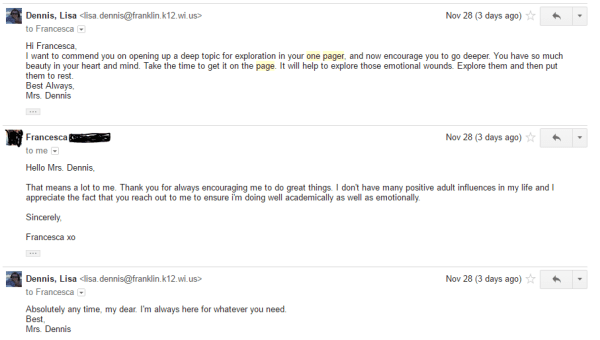
  • Read through a section of one pager submissions from my AP students. Check them in with the quick rubric for a formative score, and email five students per class with reactions. Not corrections, but reactions. Students are encouraged to explore in these writings and the best means of moving them forward in this case is to share additional insights, question, and encourage. I highlighted the students’ names in my gradebook to know I’ve contacted them and I’ll do the same with several more students next week. Writing feedback…check.
fran

  • I made a plan for conferring during reading later this week. Without a plan, it’s feeling random and I’m not doing it enough (the thousand things on my desk keep capturing my attention). So, I have a list. I know who I want to talk with based on quick writes students did today. They reflected on their progress toward their weekly reading goals and some students are struggling. Just by having them take a quick photo with their phones and email me the page, I got a literal snapshot of how each and every one of my students is doing with their independent reading, and I didn’t have to collect notebooks. Now, I’ve emailed a few students congratulations and made this plan. In the picture below, Alexis refers to her current read as “a beautiful romance of adventure.” Love! Reading feedback…check. 

    img_1012

  • Students will self-assess their latest practice AP argument essays. Feedback does not need to come from me to be beneficial. Using the AP rubric to help justify scores, students will take a sheet of paper, put a score and justification on the top, fold it over and hand it to the person next to them. Scoring will proceed in the same way around the table until everyone has his/her paper back. The table will then need to calibrate/norm and agree on a score. Self assessment and peer assessment…check
  • I am going to question and listen more. Long ago, I gave up on the idea that my imparting knowledge on others was the best way for them to learn. Everyone learns best when the are motivated to do so through personal connection to the work, interest in the material, and an understanding of how to improve. Workshop sets this up in a classroom, it’s now my job to remember to listen more and jump in less. During conferences, during book clubs, during discussion. Listen first, respond, encourage, and redirect/suggest later. This certainly doesn’t mean my presence in the room diminishes. It means I remember that my presence in the room is to guide my students, not steamroll them.

Gaining a new perspective feels like hitting the reset button to me. It provides clarity of mind and purpose. Skill development is my professional responsibility. Human development is my personal responsibility. They work hand in and hand and they are the Everest I will climb all year, every year, as I talk with, respond to, and gain insights alongside my students.

What is your teaching Everest this year? We’d love to hear from you! Please add your insights to the comments below! 

Try it Tuesday: Partnering Up for Reading Conferences

Sometimes inspiration strikes at the most opportune times.

One day last week I had the honor of hosting two small groups of teachers from a different high school as they observed my classroom, one class period in the morning and another in the afternoon. Many of the teachers on their campus have been exploring and practicing with the workshop model for a while now, and they wanted to see my workshop classroom in action.

After each lesson, we met to debrief and hold a kind of question and answer session. Talk about an awesome experience (except for the voice in my head that kept saying “When did you become the expert on workshop? Yikes.)

I think one of the best things we can do as teachers is invite others into our rooms to watch us teach. Talk about keeping on the A Game. That’s a Try it Tuesday suggestion all in itself.

Here’s another one:

During one of those debriefs, one teacher asked about the conferences I conducted as my students read for the first 15 minutes of class. “What questions did you ask?

I explained that it depends on the student.

If I go with “How’s it going?”

My students answer, “Fine.”

If I go with “What are you thinking?”

My students answer, “Nothing.”

So I usually lead with “Tell me a little something about …will ya?” And then I listen to see what direction the conference might take.

That’s pretty much the genesis of every conference with my readers.

Another teacher mentioned that she and a colleague had been thinking about asking students to bring a question, thought, or problem to their reading conferences. You know, kind of like we ask students to do when we meet with them about writing. I’d never thought about it for a quick reading conference though. She wanted to know if I thought it was a good idea.

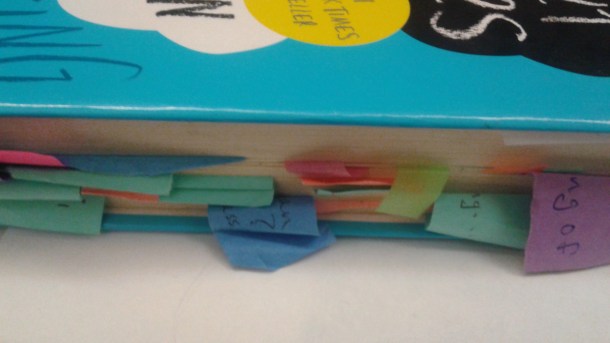
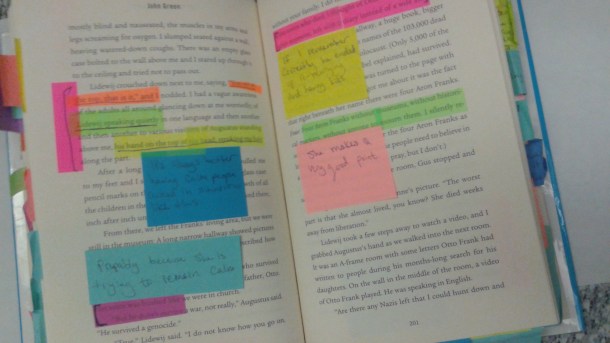
The image of this book came into my head. I found this copy of The Fault in Our Stars at a thrift store. It looked just like this:  plastered with sticky notes that reflect the student’s thinking. Now, I have no idea why this book is tattooed with notes, but I can imagine a not-so-great idea.

tfiosmarkup2tfiosmarkup

I hope a teacher didn’t assign this book and ask students to bring ideas to a reading conference. If that happened, I doubt this student got into reading flow. I doubt this student enjoyed this lovely, heart-wrenching book. I doubt she felt the beauty of the language and felt the loss of a beloved character. Maybe all that happened, but it wouldn’t have happened for me.

I want my students to love to read. I think we have to be careful with what we ask them to do with their independent reading books besides fall in love with the story and the language. Sure, they may recognize craft, they may recognize characterization. But the important thing is that they recognize that they are liking to read. That is so important to so many of my readers. They have to realize they like reading.

I do believe we can, and should, ask students to revisit passages — and maybe even the whole of a book — from time to time, even quite often. We can teach many important reading and writing skills that way, but we have to temper our desire to teach a book to death, even the books students choose to read themselves.

What I told my inquiring friend:  What if before independent reading time, on any given day, we ask students to read for a specific purpose.

Read to find interesting figurative language. Read to notice clever imagery. Read to discover how the writer shares an insight about a character. Read to find a beautiful or startling sentence. Or maybe a sentence that’s not really a sentence.

fabian

Fabian before class sharing his awe at the writing style of Jonathan Safron Foer in Extremely Loud & Incredibly Close

Isn’t this what readers do? I do. When I read a passage that strikes me in some way I want to share it. And let me tell you:  When my students start to do this on their own? That’s celebration time.

“What about the student who cannot find anything to share?” you might ask.

Well, that’s important information, isn’t it? I don’t know, maybe like the kind we might discover in a one-on-one reading conference.

Right?

I’d love to know your thoughts on this. What ideas do you have that work for your reading conferences? Please share in the comments.

Big thanks and shout out to @Sean_G_Hood and @mrs_friend and the inspiring teachers at Hebron High School!


How Conferring and a Book Solved the Tissue Issue, and Hopefully, Much More #FridayReads

You know the boys who cannot sit still? I’ve got a gaggle of them in my second period. Now, I’m not talking about elementary school kids, nor middle school. I’m talking about the juniors I teach in high school.

No sooner do I blink, and at least one of them is up walking to the tissue box. He’ll slowly take a tissue. Saunter on back to his seat (for about three minutes — I’ve timed it) and then waltz on over to the trash can to throw the tissue away and then mosey on back to his seat.

With eight of these guys, it’s constant motion. And I need Dramamine.

One class period. Five days. Two boxes of tissues. Gone.

At the end of that first very long week, I realized the reality. All kinds of memories flooded back from Tom Newkirk’s class “Boys, Literacy, and Popular Culture”at UNH Lit Institute the summer of 2015.  (If you haven’t read Tom’s book Misreading Masculinity:  Boys, Literacy, and Popular Culture, it’s insightful.)

My tissue-loving boys were posturing all over the place, and somehow I needed to stop the Tissue Issue.

It’s been easier than I thought. Really, it’s all about getting them into books they want to read.

On the first day of school, I’d prepped my room with stacks of colorful engaging books on every table. We did a book pass and wrote down titles we thought we’d like to read. I showed my passion for books and reading, and my students rolled their eyes at my request they read for three hours a week.

“No way,” I heard one young man mutter, “I ain’t reading.”

This attitude doesn’t deter me.

Even if they were faking it, after just a few days and lots of one-on-one mini-conferences, every kid in a class of 30 at least looked like they were reading. Except two.

I invited these two separately into the hall for private chats about their social PATT (party all the time) moves in the classroom.

“You know, they all follow your lead, right? I need you working with me to make this class work.”

Both agreed, and I asked them to shake my hand on it.

But old habits die hard.

Then, today — 13 days into the school year — gold.

Book gold.

“Hey, Mrs. Ras, can I talk to you in the hall?

“Do you think you could help me find a different book to read — one with music. You already know I like music.” I remembered his free verse rap at the end of class last Friday.

“So give me some ideas –”

“Well, something like that book JaBo’s reading…the long way one.”

A Long Way Gone?” (I’m trying to remember if there’s any music in this memoir about a child soldier.)

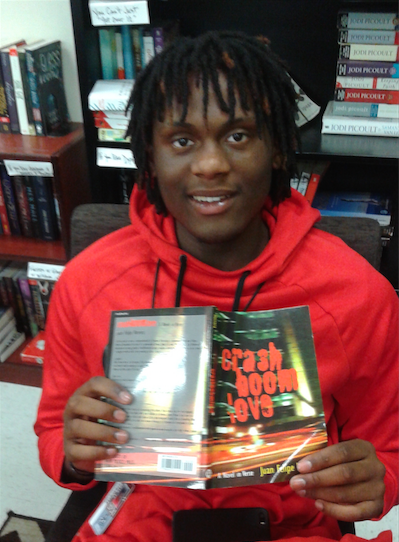
Both of my copies were checked out. I had to think fast. Crash Boom Love, a novel in verse by Juan Felipe Herrera, National Poet Laureate, flashed in the corner of my eye. (Thank you, poetry shelf just inside the door.)

We flipped through the pages, and I explained that it’s a book written in verse — all poems that make a complete story.

“You mean like one long poem?”

“Yep. Do you want to trade me this book for that one?” I said nodding at My Friend Dahmer, the graphic novel in his hand he’d been fake reading for 12 days. (I know he chose it for the pictures. “It’s weird” is all he could tell me in our first conference.)

Not six seconds after we’d entered the room, I saw Kameron flipping through the pages and showing his new book to JaBo.

That’s when you know you’ve got them — or at least got a chance at getting them to read — when they do a book talk to their friend before they’ve even read a page.

screen-shot-2016-09-08-at-11-05-01-pm

Meet Kameron. He may be a famous rapper one day.

I love this work with adolescent readers. I know we can change lives as we help young people grow in literacy skills, as we help them recognize themselves in books, and help them see others so different from themselves in the books they read.

It might be the only hope we have as a nation. Empathy, compassion, tolerance, justice, mercy, and love all wait for discovery like healing treasure and hope in the pages of the books we share with our students.

And when that book gold finally glistens — well, that’s when I have to cross the room for a tissue.


ftc-guideline-%22affiliate-links%22

Try it Tuesday: Silent Sticky Conferences

A burning question I seem to repeat year after year is “How do I talk to more of my students one-on-one beginning on the first day of school?”

I know the value of making eye contact with the adolescents who enter my room. I know the importance of making them feel like they belong here — like they are in a place where they can be themselves, a place where they want to learn.

I confer regularly with my students — about their reading lives and their writing lives — but every year it seems to take me a while to get in the groove. You know, get all the procedures introduced and underway, get students interested in books (and sometimes reading itself), learn names, set up our writer’s notebooks and our blogs and all the different bits of technology we use regularly like Google Classroom and Twitter.

I know all of these things are important, but sometimes I feel like I miss valuable moments of just I-want-to-get-to-know-you in my rush to get everything set up so we can finally begin to learn.

I know myself well.

So this year — I’ve slowed the pace a bit. And my students and I are passing notes.

Screen Shot 2016-08-29 at 7.49.08 PM

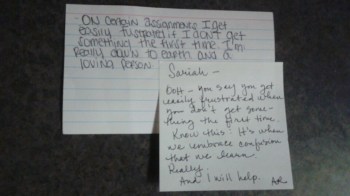
On the first day of school, I asked students to write their names big and bold on one side of a notecard. (I use these throughout the year to select non-volunteers to speak up and share their notebook responses and to answer questions. You know, like the popsicle sticks with everyone’s name on them idea.) Then, on the other side of the card, I asked students to tell me what they think I need to know about them as a learner in relation to the reading and writing we will do in this English class.

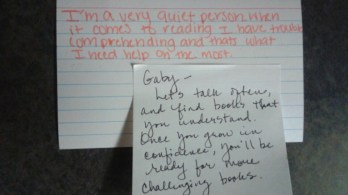
Silent confer1Some of my students’ notes were telling:  Many of them lack confidence. Few of them like to read. A couple feel ready for the complex texts they will have to tackle. Some explained in very few words a need to feel validated and cared for and something personal and important to them as learners in my care.
silentconfer3

I responded to each student’s note with a personal note of my own, written on a sticky note that I returned the next day in class. One young man questioned as I walked the room passing them out:  “Miss, you wrote to all of us?”silentconfer2

“Yes,” I told him, ” and I need you to carefully read what I wrote. Let’s see if we can start a conversation about you and what you need from me as a reader and a writer.” His grin grew as golden.

Silent sticky-note conferences have been the norm in my class for quite some time. They bridge the gaps between face-to-face conferences, build relationships, show we care enough to pick up a pen and pen a few words of encouragement or instruction.

With class sizes of 30 (sometimes 30+) we have to find ways to talk to our students one-on-one often. This passing little notes method fulfills my need to touch base with students, and it fuels their need to be recognized, validated, and hopefully inspired.

If you haven’t invested in sticky notes this year, hurry to the store while they are still on the back-to-school sales. I’ve got a whole crate of them.

Next step:  We’ll eventually move into larger pieces of paper, so I want to teach my img_1845students to fold notes like I did way back in seventh grade before the advent of all this technology. Texting friends just cannot be as fun as all those little folded notes.

What are your ideas for more face-to-face and one-on-one conversations with students this year? Please share in the comments.


Think Big and Grow Friends

My colleagues here at TTT and I met in a Google Hangout for a long long time last week. I love being surrounded by wise and witty people who make me feel more wise and witty.

When I was a teen my dad had me read How to Win Friends and Influence People by Dale Carnegie and Think and Grow Rich by Napoleon Hill. I don’t remember Dad ever reading for pleasure*, but I know he got pleasure from reading self-help books, and he read to learn. Then he shared what he learned with anyone who would listen.


I was a willing listener, always seeking to please my father.

I learned from Carnegie powerful truths that improved my interactions with strangers, friends, peers, and colleagues. And when I began teaching, I put into action these truths as I interacted with students. I believe trusting relationships and conferring moments rest heavily on Carnegie’s principles.

I learned from Hill seemingly simple steps that gave me vision, taught me to set goals —Screen Shot 2016-06-28 at 1.54.04 PMand to surround myself with those who would help me see them through. I’ve followed his advice for several decades now — each time developing skills, gaining trust and gaining knowledge, more readily and passionately. And while I am not rich in terms of monetary wealth, I am rich in all the ways that matter.
My TTT colleagues and the readers of this blog add to that wealth.

Thank you for subscribing, reading, sharing, commenting. Thank you for giving me a focus, a place to sharpen my skills as a teacher and a writer, a place to think big and make friends.

For the next several weeks, Shana, Lisa, Jackie, and I will take a break from writing posts. Like you, we are tired. We’ll use July to refine some plans and rev up for fall and a brand new school year. Maybe one of us will get the urge to write and post, but in the meantime, we’ll schedule some repeats of our favorite topics so you will keep getting content about how to make readers and writers workshop even more effective in your classroom.

We’ve got some plans for TTT that we know you’ll like. Please like the Three Teachers Talk page on Facebook if you haven’t already, and follow us on Twitter @3TeachersTalk.

And if you want to get in on some practical tips we’ll be sending to our readers’ inboxes starting when school comes back around, be sure you follow this blog by clicking on the “follow” link and providing us with your email address.

If you have questions that just cannot wait, feel free to email me at amyprasmussen@yahoo.com.

Join us as we continue the conversation in August. Until then, happy summer!

14 Days to Take It Up a Notch

I keep thinking that if I could consider myself an expert at conferring I might actually feel confident in writing a book about it. Then every once in awhile I hear a voice that tells me that the only way to become an expert at conferring is to write about it. Then another voice says, “Can anyone ever be an expert?”

I think about conferring a lot. I know that when I confer regularly with my readers they read more, and they read better. The same holds true for my writers. The more we talk about the moves they make and the meaning they want to convey, the more they take ownership of their work and confidently work at it.

But the consistency in conferring trips me up a lot.

This week I read in a student’s notebook: “I didn’t take the AP exam because my teacher didn’t make me feel like I was good enough. I know that is a terrible excuse to go off an emotion like that. But it also connects with the reason why I don’t do my homework. I get no educational support from anyone. I feel like I’m a nobody that just exists in school. That’s why I turn to music cause it makes me feel special and important.”

That burned. He knew I’d asked to read it. He wrote that for me.

I flip through the notebook and read poem after poem that reflects this student’s sadness, despair, and thoughts of hurting himself. Of course, I take it to the counselor.

I turn to my conferring notes and see that I’ve conferred with this student as much as my others, but he has never let on he was quite so unhappy. We’ve talked of academics, of books, of English things like reading and his writing. I’ve known he’d been depressed in the past. I thought he was doing better.

Now, I wonder. What if more of my students feel this way? What could I have done differently this year that would have let them know I care more about them as people than as English students?

I could have approached conferring differently, more purposefully, more personally. The irony? I wrote about the need to confer with fidelity here, and my first point is about our students’ need for personal attention.

I have 14 days left with my students this year. Surely not enough time.

I’m still going to try.

______________________________________________________________

And now for the rest of the story.


That evening I went to the bookstore thinking I would buy this boy a book. I was on the hunt for the YA novel Someday This Pain will Be Useful to You by Peter Cameron, a book I haven’t read yet — but oh, that title.

No copies available.

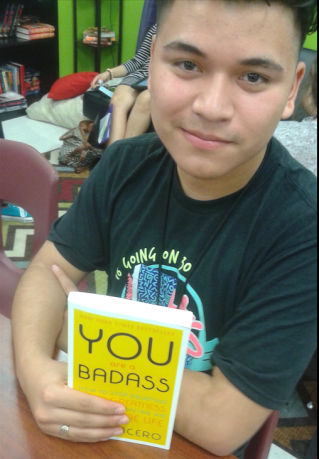
Then, I saw You are a Badass:  How to Stop Doubting Your Greatness and Start Living an Awesome Life.

Screen Shot 2016-05-13 at 1.19.08 PM

Diego:  “…when you feel like you have everything but you are never satisfied” that speaks to me.


Perfect.

The next morning, I scribbled a note inside the cover and called Diego into the hall to give it to him. I told him that I’d read his message and handed back his notebook. We talked a bit, and he assured me that he’d written those poems awhile ago, but he still felt lost at school. I assured him that he was not alone, he needed to believe that every adult in this school cares about him — that’s why we teach here, and the worst thing we could do is take it easy on him because life never will. I gave him the book and watched as he hurried back inside the room and quickly read my note.

I’ll take that smile.

Day 13.


Note:  When I snapped that photo of Diego, one of the girls nearby laughed and said: “Mrs. Rasmussen, taking it up a notch.”

“I’ll be writing about you next,” I said.

Student name and writing used with permission.


#3TTWorkshop — Some Thinking on Feedback and How We Use It


Did you know there are 167 synonyms for feedback? reaction, response, answer, reply, assessment, comeback . . . criticism . . .

By definition, feedback in the business world means: Process in which the effect or output of an action is ‘returned’ (fed-back) to modify the next action.

In the mini-lesson I posted Monday, I mentioned that I’d asked my students to write for five minutes in response to this:  Think about your reading growth and improvement this year. Can you honestly say you are better now than you when you walked in the classroom in the fall?

TTT reader Leigh Anne commented:  “I love this idea. . . I do wonder though, what were some of their responses to how they grew as readers this year. I only teach 6th grade, but answering this question seems to be a struggle for them. I can’t image how junior AP students would answer it.”

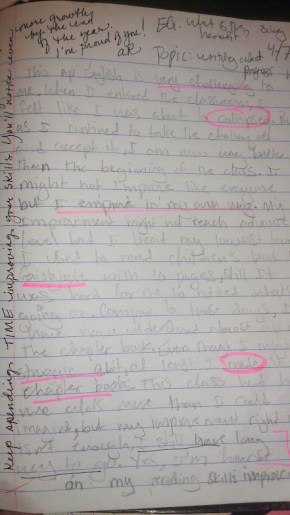
So I took snapshots of four students’ writer’s notebooks and transcribed what they wrote.

notebook response

For quickwrites, I ask students to write as much as they can as fast as they can as well as they can. Then, we always read over our writing and try to revise.

Before you read (in their own quickwrite language), I’d like to suggest that while this simple writing exercise served as self-evaluation for students and set up the personal reading challenge activity, more importantly, it served as valuable feedback for me. We spend an awful lot of time self-selecting books and reading them. One way I know if the investment in time is worth it is to ask my readers. As a result, I now know how my students feel about their progress, and I have ideas on how to “modify the next action.”

“This AP English is being challenging to me. When I entered the classroom, I felt like I was about to collapse. But as I continued to take the challenge and accept it, I am now way better than the beginning of the class. I might not improve like everyone but I improve in my own way. My improvement might not reach advance level but I beat my lowest level. I used to read children’s book, fairytale with 10 pages , still it was hard for me to notice what is going on. Compare to those days, I have now understand almost all the chapter books. This class had helped me more than I could imagine, but my improvement right now isn’t enough, I still have long way to go.” ~Sui

Next action:  Sui said she now understands “almost all the chapter books.” I’ll talk to Sui and find out what she thinks might help her understand all the chapter books. She may be able to tell me where she gets confused. If she does, I will be able to offer strategies and support so she will continue to improve.

“I haven’t done all the required reading in a timely manner, however, I have grown slightly as a reader. My pace has increased with some books, but also slowed down due to difficulty of certain books. That happens to everyone, hopefully, because it could just be me. I still have a focus issue with reading, but it has improved within the time frame of this year. I’m not where I should be as a junior in high school, but it could be worse.” ~ Cerin

Next action:  I’m curious to know if Cerin truly believes she might be the only one who has to slow down when reading more complex books — and I didn’t know she has “a focus issue.” I need to talk with Cerin and find out what she means by this and determine how I might help. I know she’s abandoned several books this year. Maybe she’s one of those expert fake readers, or maybe she still hasn’t found any books she likes enough to finish.

“Honestly, I can say that my reading has improved since the beginning of the school year. I can say this because before I lacked motivation when it came to picking up a novel. It might have had something to do with lack of interest with the topic. Also, I found myself skimming through the text and not critically annotating the pages, but now looking forward this semester my book is tattooed with my thoughts, and each word read one after another.” ~Unity

Next action:  First, I must tell this girl how much I love that “tattooed” bit! I know Unity spent a lot of time reading and annotating the non-fiction book she chose for our research mentors. She shows me here how proud she is of that, and I need to recognize and celebrate her efforts. Our next one-on-one conference may turn into a discussion on the notes she made in her book and why. I need to see her critical annotations.

“I can honestly say that I got so much better at my reading in English classroom. When I enter this year I could not tell if the book is non-fiction or fiction, but after Mrs. Rasmussen talked to me one on one I can tell which one is non-fiction and fiction. I am currently reading the book that is challenge on me but I really want to catch up with my classmate on reading skill and level. I improve so much this year and like reading now. I never like reading in my freshman year or sophomore because I thought reading is useless and it take all of my time. But now I like reading fiction book because I see myself in the book and it get into my head.” ~Siang

Next action:  Siang’s challenged herself for a while now. I need to be sure she is not stuck reading a book that bogs her down too much. She’s been frustrated with reading in the past, and she finally found success with some fairly easy reads. Fluency means comprehension, and that is where the story is. By saying she likes to read fiction, Siang is really saying she likes good stories. I need to make sure she finds another one.

_________________________________________________________________

Were all student responses quite so encouraging? No. These are juniors in high school after all. I’ll say this for them though: they are usually brutally honest when I ask them for this kind of response.

One student wrote that he has not improved as a reader this year, and he does not think he needs to. He feels like he’s as good as he ever needs to be. (I wish this was satire — we are in the middle of that right now.) Alas, it is not. This young man does the bare bones minimum to show he’s learning anything — just keeps his head above passing, goes through the motions. But his response is valuable feedback, too.

“Hey, kid, we have about seven more weeks of school. I’m not done with you yet.”

And that’s the thing, isn’t it? They enter our rooms, and we give them our all. In my case, my all gets charged by the hope I have. I hope my students will grow as competent, confident, intelligent, and compassionate citizens. They can energize the world.

I believe reading more and reading well is the fast track to all of that.

Please share your ideas on getting  — and giving feedback.

What Janitors Can Teach Us About Getting Kids Into the Reading Zone by Amy Estersohn

guest post iconI love pop-psych self-help books.  I love books written by professors.  This book, by University of California professor Sonia Lyubormisky, happens to be both.  I love this book so much I bought a second copy because my first copy had too many post-it notes on it.

Lyubomirsky claims that happy people often achieve a state of “flow” and understand how to make flow happen.   We are in flow when we are absorbed in an activity that is not too challenging and not too easy for us.  In flow, we lose our sense of time completely: we are not bored, we are not anxious, we are not thinking about whether Trader Joe’s will have our preferred frozen meal in stock by the time we get there.  

IMG_0492If you’re like me, you read this description of flow and thought, “Oh, that’s just another word for the reading zone, only made more general for activities that aren’t reading.”

It’s easy to assume that flow experiences are reserved for avid tennis players, chess enthusiasts, artists, musicians, doctors, athletes, and others who have been able to live a lifestyle that caters to their interests.  However, research shows that even janitors can experience flow at work.  

“Other [janitors], in contrast, transformed the job into something grander and more significant.  This second group of hospital cleaners described their work as bettering the daily lives of patients, visitors, and nurses.  They engaged in a great deal of social interaction (eg. showing a visitor around, brightening a patient’s day), reported liking cleaning, and judged the work as highly skilled.  It’s not surprising that these hospital cleaners found flow in their work.  They set forth challenges for themselves– for example, how to get the job accomplished in a maximally efficient way or how to help patients heal faster by making them more comfortable” (Lyubomirsky 188-189).  Original research here.

Lyubomirsky believes that habits of mind like these are teachable and trainable.  Here’s what developing them can  look like during a reading conference:

The conference move: Critical Shopper

How I do it:  I’ll ask a student if she would recommend the book she is reading for a classroom library or book club set purchase.

How it supports “flow” or “reading zone”: It gives readers a reminder that reading can have a larger social purpose, and the more engaged they are in their reading lives, the better they can improve the reading lives of their classmates.

What I learn about the reader:  I learn about how a reader can engage critically with a text and can provide text-based evidence for a claim about whether a book would or would not make a suitable classroom library investment.


The conference move: Younger Sibling/Cousin

How I do it:  I ask a student what their younger sibling or cousin would say the book is about were he or she to read the book that the student’s currently reading.  Then I ask the student what he or she thinks the book is really about.

How it supports “flow” or “reading zone”:  It reminds readers that there are more ways than one to read a story, and that good stories beg to be shared with family, friends, and loved ones.

What I learn about the reader:  I learn about a reader’s ability to grasp themes and ideas in a text.  When I start off with, “What would your younger sibling say?” I expect the reader to give me plot summary and basic character traits.  Then, when I ask them for what they think the book is really about, it subtly lets the reader know that there are additional ways to answer this question.


The conference move: Goal-setting

How I do it: I ask students to set a goal, and I ask how I can help the student achieve that goal.

How it supports “flow” or “reading zone”: Just as the janitors who experience flow play an active role in setting their own goals, allowing a reader to set his goal gives him an additional purpose and meaning to his reading.

What I learn about the reader: I learn about a reader’s assessment of her own reading strengths and weaknesses.  Often the goal a student sets for herself is the same goal I would have chosen for her were I asked to make one.


The conference move: Remember when?

How I do it: I ask students to recollect a time when they were in “the reading zone.”  Sometimes I will use their reading log or my memory of their reading to jump-start this conversation.

How it supports “flow” or “reading zone”: By noticing and naming the characteristics that are associated with the reading zone — everything from body positioning while reading, the feeling of “Just one more chapter!”, the sensation of the pages flying by — we can celebrate the reading zone and try to make it happen more often.

What I learn about the reader: I learn about a reader’ self-awareness, and I learn what books got them in the zone, so I can recommend more books just like them!


Amy Estersohn teaches in New York.  Her classroom overlooks the parking lot where she learned how to drive.  She tweets about books at @HMX_MsE.

5 Things I Need to Remember When Teaching my Writers

I know we’ve been posting mini-lessons on Mondays on this blog for awhile now, but today marks the first day of my spring break, and since my students and I just finished a fairly complex writing task, this is a good time for reflection.

don-graves-quoteMy AP Language students wrote arguments as spoken-word poems, and then performed them in class. (Or if they produced their poems digitally, which was an option for publishing, they projected them.)
Our process included reading and studying several poems. We watched YouTube videos of spoken word poems by Shane Koyczan, Harry Baker, Marshal Davis Jones and more. We analyzed structure, craft, and theme. We pulled out lines we felt held the weight of the poem and wrote responses to them, hoping to find inspiration for our own writing. We reviewed the elements of argument. We discussed the claims the poets make and how they use evidence (or do not) to support these claims. We spent workshop time thinking, writing, and revising our poems. And my student teacher Zach and I spent hours talking to writers about their writing.

I’ll share some of the amazing poems my students produced in another post. For now, here are some things my students reminded me I need to do better so they can do better in our next round of writing:

  • Topics matter. If I want my students to produce well-written texts, they must select well-chosen topics. Too often my writers choose topics they might have a passion for, but they know little about. This leads to vague superficial writing.

I need to take more time on the front end of the writing process to make sure all of my writers choose a topic that they not only care about, but that is specific enough to the task at hand. One resource that will help as we choose topics for other writing tasks is this tutorial from University of Arizona Libraries. I need to remember to slow down on the front end and help students select narrow topics.

  • Clear feedback matters. For this writing project, I only left feedback once on student drafts. It was not enough. Or it might have been — if students had read it. (Please tell me I am not the only teacher with this issue:  Students ignoring feedback.)

The best feedback is not when I leave comments on Google docs like I did for this project, but when I talk to them face-to-face and answer their questions. Students need to see my response to the work they have done. They need to see if I like it. They often misread, or don’t read, my tone in written feedback. I must remember to give them a balance of both — and a lot of it all along the way.

  • Sometimes more explicit instruction matters. In more than one conference, when I asked students why I didn’t see application of the mini-lesson in their writing, they said: “Oh, I thought that was just a suggestion.” Well, yes. But what’s the point of a mini-lesson — designed to help students write better — if they refuse to at least try it?

I know that we must teach the writer and not the writing, but sometimes without a little push to make specific changes, my writers just do not improve. I need to remember that with some students I must be more explicit in my instruction.

  • Accountability throughout the process matters. I was out of the classroom several days when students had writing workshop time to work on their poems. (Someday I’ll tell you about the standards revision work I’ve done with the TEKS Review Committee in Austin this year.) Although my student teacher was there, and my substitute — a former teacher and a sub my students know well — too many of my students clearly wasted the time given them in class to write. They are teenagers after all:  give them an inch and they take a mile. And they are major procrastinators. I think they are finally understanding that good writing takes time, but many are still not taking the time to produce good writing.

I need to do a better job at holding them accountable for working during workshop time. More exit slips. More sharing a favorite line or passage they’ve written that day. More purposeful formative assessment and personal evaluation of their writing processes.

  • Conferring (more) matters. The two days students shared their poems were exciting. So many were fantastic. So many clearly showed their understanding of how to write an effective argument — and how to be clever and creative with poetic elements as they did so. But quite a few did not.

As Zach and I discussed each performance and each poem, matching the writing to our rubric and assigning a grade, we became clearly aware of which students we conferred with the most and which students we did not. One of us would say: “She did exactly what we discussed in our conference,” or “That was something he and I talked about in his conference.”

The students we conferred with the most not only fulfilled the requirements for the assignment the best, they produced the most creative and convincing argumentative and poetic writing. And they knew it. Their confidence as they performed their poems was evident, and they rocked the house with their beautiful and inspiring poetry.

Taking the time to confer with every student — whether they want to talk about their writing or not — must be a regular part of the writing workshop. Too often conferring becomes optional when I get too busy or spread myself too thin. I must remember to schedule conference time into the lesson plans and hold myself responsible for making them happen — not once but several times for each student.

How do you know when your writing workshop is working?  Please share your ideas in the comments.

#3TTWorkshop — Conferring with Our Readers

Three educators. Three states. Three demographics. All practicing Readers and Writers Workshop in our Secondary Classrooms. Read more about us here.

We are the Modern PLC, and every Wednesday, we share our behind-the-scenes collaboration as we talk about the most urgent moving parts of our classroom pedagogy.

This week’s conversation took root over a year ago in a hotel room at NCTE in Washington D.C.  As with many of our TTT get togethers, we threw out a question from our classrooms and began discussing our struggles, questions, and ideas.  This time it was Amy, asking about conferring.  The three of us mutually agreed that one of the greatest challenges we face as workshop teachers includes conferences, yet while they take time, practice, and diligence, they are one of the most necessary and rewarding components of the workshop classroom.  

In this week’s conversation, Amy and Jackie discuss the the value of conferring within the reader’s writer’s workshop.  Part one of this conversation delves into why conferring matters and how we find time in our classrooms to sit down with each student one-on-one.

Please join the conversation in the comments and check back for the second installment tomorrow!

Conversation Starter:  Why must we confer with our readers?IMG_9734

Amy:  Conferring regularly is what makes a readers’ workshop classroom work. Simple as that. If a teacher says to me “I tried allowing students to read what they want, and it didn’t work — they still won’t read,” I know I have to ask something about how he confers with his students. How often? What do you talk about? How do you make them feel about reading?

I learned about the importance of conferring just like everyone else who makes reading workshop her pedagogy:  If I do not purposefully sit down and talk with students one-on-one and face-to-face on a regular basis, many of them will not read. They are too used to playing the game of high school English. They know how to flip the pages, move their eyes across the page, and lie to my face about how they liked, or did not like, a story. I teach 11th grade. Some students have done this for years.

The only way to create readers is to get them reading. The only way to get many students to even give reading a try is to talk with them in non-threatening conversations about their lives, about what they are interested in, and why this or that book might be something that matters to what they want to know or feel or do. Conferring is conversing about what matters to my students and talking to them as if they are already readers — until they begin to call themselves readers, too.

I also think this applies to every content area. If math teachers spoke to their students like mathematicians, and science teachers spoke to their students as if they were scientists, maybe we’d have many more students interested and invested in math and science. Every teacher should hold regular and consistent conferences with her students. Even if those students never come to like reading or math or science, they will become more engaged in the learning environment because the teacher has shown personal interest in the life of the learner. Face-to-face leader and learner conferences make for genuine and consistent engagement in the learning process. And teacher and student both benefit.

Jackie:  I love the process of conferring with students, particularly at the beginning of the year when students aren’t quite as used to having their teacher sit beside them just to chat.  Even now as I pull up my mini-folding-conferring chair, I enjoy the shift from awkward first interactions to excited chats about their reading.

Reading conferences aren’t just about accountability, although that is one of the many perks.  During these conferences I get a better sense of what books to recommend to students, how their past history affects their reading practices, what they’re coping with on a daily basis, and what they think about when they crack open a book.  As Don Graves writes about his most formative teachers in The Energy to Teach, “All of these teachers expected more of me and we had a strong personal connection that I did not want to disappoint them.”  Reading conferences allow me to connect with my students on a level that not only shows them that I am committed to their reading journey, but it that I am invested in their life and education.

Amy:  I love how you pull up a mini-folding-conferring chair! I used to have a single yellow chair that I invited students to come and sit in — the special chair. I had to leave it at my old school. I saw this nifty rolling stool at a thrift store and almost bought it. I could have rolled from table to table to confer. I talked myself out of it, but there are days a roll-about-the-room would be handy.

Jackie: It’s the best purchase I’ve made all year! Mine looks similar to this one.  What I love most about it though is I sit at the same height as my students, so I can easily set up next to their desk or join in group conversations.

When do you confer?

Amy:  I’d like to say I confer every day. In my heart I want to have a regular system, and on paper I do. In reality, so much administrivia gets in the way. When I am purposeful, I meet with one to three students every day during our independent reading time (usually 15 minutes.) I try to be consistent because I only see my students every other day. If I am not careful, weeks will go by without me talking to some of them.

I have a binder where I keep conferring notes, and I place sticky note reminders to help me remember to get back to certain students who need a quicker follow up time than me making it around the room again. I’ve also started charging my readers to be advocates of their follow up with me. It’s important that juniors in high school take ownership of their learning. If a reader and I discuss a certain skill, and she decides to complete X, I ask her to be the one to remember to come in and confer. Many of my readers remember, and they are the ones who are gain skills and mature as critical readers much faster. Sometimes these conferences happen between class periods or during lunch or at the end of class when students are working on their writing, and sometimes I let them slip into my normal conferring routine. I’ll never turn a reader down who wants to have a quick chat about her book or what she learned.

Jackie: I agree with Amy–my goal every year is to become better at conferring.  I want to make sure to meet with as  many students as possible, but as the year progresses I struggle with the administrative tasks.  That being said, I typically meet with two students within the ten minute reading time we have daily.  On block days when I allow for twenty minutes, I can get around to four.  

My freshmen enjoy the process of chatting about their books, their interests, and their reading.  They enjoy using new vocabulary we’ve learned in class, and I love picking their brain about writer’s craft.  I also try to focus on reflective questions with them so they look at their reading progress holistically.  With my AP Literature students, I focus more on their depth of analysis within their independent challenge books.  I also take this time to check their critical reading journals as well as to discuss whole class novels.

In terms of logistics, I have a cubby where I keep stacks of conferring forms paper-clipped together and sorted in alphabetical order by first name. At the beginning of every period during reading time, I pull out that class’ papers, clip them into my clipboard, and start with the last student I conferred with.  This allows me to quickly keep track of who I met with last and what we discussed.  

Sometimes I can’t keep track of everything and I will reflect back on my notes, jotting down conversations I know I had on Monday when I collected pages or during passing time.  Every minute offers a moment to conference, and while these conferences aren’t always formal, they show students that not only do I hear them but also I am interested in what they have to say.

Amy:  Most days I feel like I do more spontaneous conferences than planned ones. A students needs a new book, so we meet for a chat by the bookshelves. A student finished a book, so we chat for a few minutes in the halls. I almost wrote that these were my favorite kinds of conferences, but that’s not true — I like all conferences. I do like the joy I recognize so readily when my students start identifying themselves as readers though.

Do you have topic ideas you would like us to discuss? Please leave your requests here.