Category Archives: AP English

Writing When It’s Hard. Or School Should be Out Already.

Let me just say how cruel the school calendar is this year:  We have school through noon Wednesday. Kids are beyond crazy. Last Friday is typically the last school day before break, so it feels a bit like we are making up snow days for snow days that haven’t happened. It’s cold. And no one is going to want to be at school for the next three days. No one.

I’ve been toying with this post all morning. I don’t feel like writing. I just want to shop with my daughters who arrived in town over the weekend, and tend my five month old grandson who came to visit yesterday, and maybe bake some bread pudding in the crock pot. I do not want to write.

So what do I do to get myself to put words on the page? What do I do when I need students to want to put words on the page?

I look for inspiration. I help them find inspiration.

Lately, my students have been writing spoken word poems as arguments. They chose personal or social issues they care about, and they’ve crafted drafts that argue a position about their issues. Some are digging deep and writing with wondrous words. Others — not so much. But I’m not giving up.

I’ve learned that three things will help my writers when they sink low and cannot seem to rise back up. I must consistently —

Flood the room with beautiful language. In a spoken word poetry unit, this is easy. We watch a performance on YouTube most every day. “Spelling Father” by Marshall Davis-Jones is a new favorite. (I love the narrative frame and raw emotion in this piece.) If our goal is to help develop writers who intentionally craft meaning, we have to help students intentionally craft meaning. The more we recognize, analyze, and model the moves of writers, the easier writing with intention becomes.

Allow time for thinking. Waiting on students to think their way into writing can be hard. But I know that writing takes time, and when I rush students who haven’t had a chance to think about their ideas before they begin writing, the finished pieces rarely get the revision they need to be truly effective. Don Murray said, “Writing is self exposure.” It is. And the vulnerability can be immobilizing for some of us. Giving time and then waiting for students to make decisions about their writing pays off on the back end of the writing process. If we truly value student ideas, we have to give them the time to think of them.

Talk to students and keep them talking to one another. One-on-one conferences are a good idea any time, but during a writing unit, conferring time is essential. In large classes, we may have to stagger our live conferences with paper ones, and leave conferring questions, and “I wonders” on their pages. More than anything, students must know we are reading their drafts and offering feedback. I am working on getting faster at leaving quick notes. I find that when I zero in on one skill at a time students find my feedback a lot less intimidating (which is something I had to learn was even a thing.)

screen-shot-2016-12-18-at-10-36-53-pm

Martina’s writing her poem about her culture. “I’m too white to be called Mexican, but I’m a Mexican.”

My plan for this week is to put these three things on a replay loop. We’ll start class with beautiful language, think and write and write and think — all the while talking to one another about our process and our craft.

We may just make it to Christmas break a little bit merry after all.

If you are still in school this week, what’s happening in your classrooms? Please share in the comments.


Better Teaching: Please tell me your story

I already knew they were hard workers. This group of girls spent a lot of time in my classroom after school. They huddled together at the far table, speaking in a language I did not understand. They asked questions occasionally, afraid of being wrong.  

“Is this right?” one would say, timidly showing me her iPad where she’d written a few sentences in the Docs app. Returning to her table, she’d share my response with her friends.

They held on in AP English by decimal points as each grading period ticked by. Lucky for them, I scored on improvement, not on the AP writing rubric.

In class we watched the documentary “A Place to Stand,” based on the book by the same name by Jimmy Santiago Baca who became a poet while serving time in prison. Baca’s story captivated my students. They identified and analyzed the argument: “Education matters. Fight for it. Words matter. Learn them. Write them. They empower you..”

Some students understood that more than others. These girls, for sure.

We read several of Baca’s poems. Although mine is primarily a non-fiction course by nature of AP Language and my syllabus, I know that it’s through poetry that my students more easily grasp the beauty and intention in an author’s craft.

The task was to re-read Baca’s poem “As Life Was Five” and to write a reflective piece in response to it.

These girls were struggling, so I finally joined them at their table.

“Tell me what’s going on,” I said.

“We just aren’t sure,” Biak said. She spoke more often than the others, although her English was only a little better.

“Can I see what you’ve written?” I asked, and she timidly passed me her writing, carefully penned on notebook paper.

She quickly broke into explanation:  “I wanted to write my own poem. I don’t know how, and I don’t know…” Words tumbled out, and she lowered her head, waiting for me to read the page.

I looked, and before I could read anything, the words “Burmese!! STUPID and CRAZY!” shouted at me.

“Wait,” I said, “I thought you were from Burma.”

Five voices rose in chorus:  “Yes, yes, we are from Burma, but we are not Burmese. We are Chin.”

I needed them to teach me. I’d never heard of Chin, and my knowledge of Burma was limited to the first few chapters of Saving Fish From Drowning by Amy Tan I’d tried to read and abandoned years ago.

“Will you tell me your story?” I asked, looking closely into the small faces of these beautiful young women, similar yet so different in features and personality.

Biak began to talk.

“We are from the state of Chin in Burma. The Chin are the mountain people. The Christians. The Burmese hate the Christians.”

And then they all talk and tell me their story:

They fled Burma with their families, leaving grandparents and loved ones behind. Sometimes not getting to say goodbye for fear the secret of their journey would be told. They traveled in groups, mostly at night, walking, walking, walking, they said. Often barely eating food, and even then, mostly rice balls or an egg stirred into water.

Bawi told of a Buddhist monk who acted as their guide. “He wouldn’t let us pray,” she said. “Every time we tried to pray, he would knock away our food. ‘Pray to me,’ he’d say, ‘I’m the one who gave you food, not God.’ He was so scary!”

“I lost my shoes,” Biak said, “I walked for miles and miles with no shoes, and the.. What are those things?” she turned to her friends, motioning with her hands like claws, “…those things that stuck to my feets?”

“Thorns,” they said.

“Yes, thorns stuck in my feets, but I had to walk. Walk and walk.”

“Walk quickly and don’t let go,” Kimi said.

“There was a pregnant woman with us. She could not keep up. When we reached the border of Malaysia, she could not run. I do not know what happened to her.”

“I remember we heard the POW POW POW. We had to run as fast as we can to cross the border. I was so little. My legs short. I was so scared.”

Biak begins to cry. She bows her head and covers her face with her hands, “I don’t like to think about it. I remember my grandmother’s face. We barely got to tell goodbye. She cried so much.”

I look around the table. Their eyes shine with memories.

“You all left family behind, didn’t you?”

They nod, and I see Van’s chocolate eyes pool with tears.

“Did you travel together?”

“No! But we all have same stories. All Chin students do,” Duh says.

“Wow,” I say, “Just wow.” My heart throbs in my chest, heavy with the weight of these stories. Resilience takes on new meaning.

“So you must think it’s pretty lame when your classmates whine about having to work a three hour shift and that’s the reason they cannot do their homework.”

The tension breaks, and they laugh.

“What an amazing gift you’ve given me,” I say, “You need to write your stories.”

“I wanted to write a book,” Kimi says, “but I don’t know how.”

I smile. “We can work on that.”

My heart changed after that chat with my girls from Chin. I also felt chagrin. I waited three months into the school year to extend the important invitation:  “Tell me your story.”

I can come up with fourteen different reasons why. None of them matter.

Throughout the fall, I struggled with my classes because I focused on the skills needed to be successful in AP English instead of focusing on the individuals who needed to learn the skills to be successful in life. I forgot why I wanted to teach teenagers in the first place.

Perspective matters.

The most important conversation is the one that invites our students to tell us their stories.

Those young women from the state of Chin grew to trust me because I asked, and I listened. They told me later that I was the first teacher who asked them to tell me their stories — they had all attended U.S. public schools for at least four years.

I am sure other teachers assumed they knew. I thought I knew until I saw the emotion in five pairs of eyes. “We all have same stories,” Duh had said, but that is not true. They all have similar experiences. Their stories are uniquely personal, and they serve as cardinal prerequisites to the identities of each individual.

Identity matters.

How our students see themselves — as teenagers, thinkers, readers, writers, friends, students — matters, and to instruct the individual we must know what she believes about her abilities and her capabilities, both of which have been shaped in one way or another before she ever steps through our door.

Peter Johnston helped me understand the importance of identity in his book Choice Words. He reminds us, “[Children] narrate their lives, identifying themselves and the circumstances, acting and explaining events in ways they see as consistent with the person they take themselves to be” (23).


screen-shot-2016-12-03-at-8-45-20-pm

Trust and esteem are imperative to effective conferring. They are imperative to effective teaching. They are two cornerstones of conferences that allow for the relationships students need with their teachers, the relationships students need to learn.

If our goal is to help our students incorporate reader and writer into their identities, we must build foundations that allow them to take on the behaviors of those who read and write. Equity and autonomy create balance in this foundation and become the other cornerstones.

All students must feel that we meet with them fairly and without judgment. They must know our goal is to inspire independence as they become more effective readers and writers — and of course, literate citizens.

Really, it all begins with the invitation:  “Please, tell me your story.”

my-chin-girls

Graduates Lewisville High School Class of 2016


THAT DAY  THAT DAY
by Biak Par
Far from my Home, my Family
When looking at the sky they seem so happy
But me,
Thinking about that day
Every word they speaks, every looks, every smiles, every laugh
They tear me apart, the soul sing Be Strong
That day
Every word they talk, it burn my ears like Hell
Its torture me every night, in intimidate me every day
When I see those similar faces
That day
Those word, those eyes         
Tear my heart into two pieces.
Those words are as sharp as a razor
They call me foolish, Yea, I don’t know them
Burmese!
That day
My body fills with wound and remorse.
It like drawing into the water, I could not breathe nor talk,
Walking to class
All eyes on me,
Looking down with hope that there is a place I can conceal
But the room seems so small
As I take a step to the room, the room seems colder
Like I was at Antarctica,
Very Cold
Looking at the room I was isolated for this people,
This entire people are strangers.
That day
Standing still
People examine me, like I am from the others planet
That day…
My tremble body, drum in my blood
Eyes fill with water,
That day
The word of Burmese, such as STUPID, CRAZY echoed through my ears
Stupid, crazy,
My mouth wants to shout, but my mouth feels numb
And makes my throat feels tight like I am being choked,
Almost tearful
Wanting to run away can’t bear the exposes of feeling being hunted.
That day
Eyeing for a place to seat
But none of them invites me or speak,
It like I am walking into a room full of a babies Dolls,
They do not talks
But their EYES,
Their evil eyes talk, its say get out of this room
That day
Head down, looking at the floors as I walk toward to the edge of the room,
Seat alone,
The room feels so dark, so lonely and scary
Even, I was surrounding by those people
That day
My silent cry, wishing I can revisit to where I’ll be safe
Because every second, every minute, every hours this place seems so hazardous
That day…
Hopes and dreams are fading away like the wave of the cloud fade, little by little.
From that day the world is never the same
That day, change my life
Made me feels like a woman, made me realize
That because I am different from them (Burmese) and I only speak
CHIN,
They destroy and killed my hopes, my thought, my believe,
The thought of what might come next. I am Scared.
But,
My soul sing to me, be strong. BE Strong Biak Par. Be STRONG.


#3TTWorkshop –Right Now Literacy

My 11th grade curriculum overview begins:  Unit I of English III invites students to explore multi-genre texts that reflect diverse perspectives through reading and writing. Students evaluate the credibility of different viewpoints and consider how the ideas of others strengthen their own voice.

I set out to design lessons that met these guidelines. I began introducing a variety of contemporary texts in a variety of forms — all about high interest, high profile topics. Good idea, I thought, for a never-an-empty-seat diverse class of sixteen year olds.

My plans quickly met resistance right there in the classroom, and I faced the terrifying conclusion:  My students are too biased to recognize bias, too emotionally attached to their own viewpoints, so they are blinded to the viewpoints of others.

Reminds me of a few of my “friends” on Facebook, a few of the people I follow on Twitter, a lot of the stories on pretty much any type of social media.

This fall as I’ve designed lessons, it’s been one puzzle piece after another as I’ve worked to meet the needs of all of my students in the limited amount of time they are with me. (Accelerated block means I have them only one semester.)

Then, the presidential election happened. The doublespeak, the false news, the protestors, the name calling, the ramifications, the incivility…on every side.

Obviously, my students are not the only ones who suffer from a suffocating bias that makes them blind.

And I am bothered. I know many of you are bothered, too.

So as educators, what do we do about it?

I wrote about this idea of Right Now Literacy in a post as I reflected on NCTE. I would love for the educators I trust most to help me think and expand this idea in a once a month post. The first Wednesday of each month, I’ll first get the ideas rolling and then ask questions to Shana and Lisa, and then we’ll run a post centered around my on-going investigation of right now literacy.

We invite you to join this conversation by voicing your own thinking in the comments. Here goes:

Amy:  We all attended some great sessions at NCTE, and we’ve all written posts with some of our reflections. One session that we attended together (thanks for saving me a seat) shines as a highlight for me:  The panel discussion called Expert to Expert: The Joy and Power of Reading with Kylene Beers, Pam Allyn, Ernest Morrell, and Kwame Alexander. (Lisa, I know you cried at least once. I would’ve slipped you a tissue if I had one.)

What was your biggest takeaway from that session?

Lisa: My biggest takeaway is that I should bring Kleenex to NCTE sessions. Rookie mistake. I had no idea how powerful this learning would be!

I wrote yesterday about Kwame Alexander’s insights that we must “be the manufacturers and purveyors of hope,” and that we must “help students become more human.” These ideas have propelled quite a bit of writing and reflecting in recent days as I reexamine my daily practice through the lens of developing my students as people as well as learners.

Early in my career, I was just getting my footing. I taught the way I had been taught and the way my collaborating teachers were teaching. It was pretty traditional. But about a decade ago, our department really started changing. More choice, more authentic assessments, more student voice. I learned to talk with my students instead of at them. Alexander’s quotes above reiterate this to me. Hope for the future flourishes when people take ownership of resolving problems with well reasoned and fair solutions. In this case, allowing students to take ownership of much of their learning fosters hope for their futures as critical thinkers and skilled communicators.

In that same vein, I’ve examined the resources I have made available to kids, because as Kylene Beers said in the same session, “If you don’t have kids falling in love with reading, take a look at the books in your room.”  All of these ideas together remind me that I need to consistently refine my role in the classroom to see learning through the eyes of my diverse students and their unique experiences. While my ideas, plans, and suggestions might guide our daily practice, it’s the students that fuel the inquiry and it’s their discoveries that we expand on to emulate in writing, debate as a class, and guide future reading selections.

Shana:  Pam Allyn is right up there with Penny Kittle and Tom Romano in terms of people who have impacted my teaching life profoundly.  She is brilliant and brave and I fell madly in love with her and her work at NCTE last year, when I sat next to her mother to listen to a similar session.  We got to turn and talk to our neighbors about a variety of topics, and at the time, I was pregnant with my daughter.  I’ll never forget Pam’s mother telling me about the books she’d read to Pam as a young child, and I think of that every time I read to Ruthie–look what a literary giant was borne of a simple indoctrination into a love of reading.

But, I digress.  Pam referred to the fact that the day she spoke was the anniversary of the Gettysburg address, a “hopeful story on a ground of despair.”  She mentioned this in the context of saying that “we’ve been enculturated to allow injustice to occur, especially in education.  We have to say when something isn’t working.

For me, that rang true.  I can’t sit back and listen to people discuss practices of blatant readicide, assuming someone else will speak up–they have been enculturated not to.  Instead of viewing this as a battle, though, I think standing up for what’s right is an act of hope.  As Kwame said, “Teachers, librarians, and parents are purveyors and manufacturers of hope.  We have to offer literature to kids to help them find, raise, and share their voices.”  That’s what I want literature to do for kids, and I have to speak up about it.

Amy:  When Ernest Morrell answered Kylene’s question about the kind of literature we should be reading now with the comment: “We are in a new classic movement in English Language Arts. It’s a need for right now literature.” I thought of a million reasons why a workshop pedagogy fits the immediate need of students today. It wasn’t seconds before my brain connected so many dots made bold by the election:  What we really need is Right Now Literacy, not just literature.

Here’s some of the thoughts percolating in my notebook (They may even work as chapter headings).

  • Story as an Equalizer — How do we give voice to every student’s story?
  • Audience Participation — How do we truly give voice if we are the only listener?
  • Communication as Compromise — How do we move speaking and listening skills to the forefront of instruction?
  • Reading as Literacy Presencing — How do we provide opportunities and encourage students to see themselves in the books they read?
  • Reading as a Bridge — How do we provide opportunities and encourage students to view multiple perspectives?
  • Critical Lenses — How do we teach bias, fallacies, multiple viewpoints, how to validate of sources, including a focus on digital literacy?
  • Design Thinking — How do we shift learning to designing? This is what employers want.

How do you define Right Now Literacy? What would you add or take away?

Shana:  Amy, you are so great at conceptualizing books as mirrors, windows, or doors.  I was thinking about this and realized that while I’ve heard those terms thrown around a lot at NCTE, I don’t know where they originated.  After some googling I discovered the work of Dr. Rudine Sims Bishop, who pioneered the idea of taking these terms from architecture and applying them to the reading of literature.  Here are her words:

Books are sometimes windows, offering views of worlds that may be real or imagined, familiar or strange. These windows are also sliding glass doors, and readers have only to walk through in imagination to become part of whatever world has been created and recreated by the author. When lighting conditions are just right, however, a window can also be a mirror. Literature transforms human experience and reflects it back to us, and in that reflection we can see our own lives and experiences as part of the larger human experience. Reading, then, becomes a means of self-affirmation, and readers often seek their mirrors in books.

So, those concepts to me are central to what Right Now Literacy is:  in an era of homophily and a lack of cultural responsiveness, we need to teach kids how to see not just literature as windows, doors, or mirrors, but also the stories of other people’s lives.  I’ll draw on the Tom Newkirk lovefest when Tom’s editor read aloud the first line of his book, Minds Made for Stories:  “Our theories are really disguised autobiographies, often rooted in childhood.”  She advised us to get curious about the stories that lead people to their stances and belief.  I don’t think kids know how to do this, and for me it’s a big part of Right Now Literacy.

Lisa: I love what Shana shared about literature reflecting the “larger human experience,” and how we seek ourselves in books. In addition to these ideas, I think what Amy referred to as “suffocating bias” is at the top of my Right Now Literacy Focus.

Literacy instruction can be daunting enough when goal is to help students gain the necessary skills to first comprehend, then analyze, and evaluate what they read. This is, of course, in addition to the self-affirmation piece Sims references. But now, it’s become downright demoralizing that teaching literacy must not only mean standing guard against bias, but evaluating sources of “news” for outright lies.  

But while it’s difficult to stomach that teaching these additional skills has to be a part of Right Now Literacy, and that we need articles like NPR’s “Fake or Real? How to Self-Check the News and Get the Facts,” this is necessary work in our modern world. Students need to be able to sift through the information around them, tossing out the misleading and sometimes incendiary “news,” if we are to hope that they can synthesize the perspectives and get back to the enlightening work of finding that self-affirmation referenced above.


rmmibfe4czy-jeremy-thomas

photo by Jeremy Thomas   Longmont, United States

Amy:  Thanks for sharing your thoughts here, Lisa and Shana. Dear Readers, I hope you will join the conversation, too. What are your thoughts on a Right Now Literacy?

Opening a Space to Help Others and the Spirit to “Lean in”

I sat at the Heinemann breakfast at NCTE listening to those who knew and learned from him honor the legacy of Donald Graves. Penny Kittle began. She spoke of Don’s ever mindful mission to “open the space to help others” and how he had a “lean in” spirit. Everyone he spoke to knew he listened, knew he truly cared about who they were as people as well as who they were as teachers. Penny said Don had a “settle the soul” effect on those he encountered, even strangers in an airport on the way to NCTE after 9/11. In a time of turmoil, Don publicly read poetry.

Every individual who spoke that morning shared a credo, rooted in the influence of Donald Graves.

We listened, enthralled in the passion and purpose that bound us together as educators — all attending a conference intent on improving our practices to better instruct the children we teach.

I have only felt this kind of community two other times in my career:  once at the University of New Hampshire (UNH) Literacy Institute, the other at the North Star of TX Writing Project Invitational Summer Institute in 2009.

In class this week, my students and I read a poem that lead to a discussion about indelible moments, not just the ones that mark us with memories we cannot shake, but the ones that infuse us with new found understanding, new purpose, new hope. They change us for the better.

My experience with North Star changed me for the better. I owe a lot to this writing project.

I had only been in the classroom three years, and I was newly assigned to teach AP English Language and Composition. I didn’t have much of a clue. That summer I met other educators, who like Don Graves, had that “lean in” spirit. They knew how to “settle the soul.”

Dr. Carol Wickstrom lead with wisdom and wit and listened as I expressed frustration about my lack of preparation to teach an advanced writing class. Kip Nettles demonstrated daily routines of writing workshop instruction and modeled how these moves could have lasting effects on writers.

I grew to love the other teachers who attended that ISI with me that summer. We wrote. We shared. We worked hard to learn the meaning of authenticity in writing instruction. We cried as we read our writing, and we cried as we listened to the heartfelt writing of one another.

Heather Cato showed me how to “play” with technology and taught me how to effectively use it for instruction. She became my dear friend, thinking partner, and first writing collaborator, and along with Molly Adams, we started the blog Three Teachers Talk.

Few people know the history of Three Teachers Talk, but I tell it when I lead professional development, which thanks to an ever growing move to Secondary Readers and Writers Workshop has been quite a lot.  In that history are the roots of what Don Graves modeled so ardently:  How do we open the space to help others?

We started writing at Three Teachers Talk as a way to share how we internalized what we learned through our National Writing Project (NWP) experience. We wanted to help others welcome authentic choice writing practices into their instruction. We wanted to stay connected as friends and collaborators.

Molly and Heather have since moved to other great spaces in their careers. I am sure they write other places now:  Molly at her high school and with NWP and Heather as a curriculum and instruction leader in her district. I follow (stalk) them and celebrate their successes. I will be forever grateful for their listening hearts and “lean in” attitudes, especially Heather who shouldered me along at a time when I wore heavy boots to work each day.

It’s belonging to a community that brings out the best in who we want to become. When we surround ourselves with those with the same passion to learn and grow and share, we learn and grow and share passionately — or at least we learn how to open the spaces to do so.

Another North Star TC Amanda Goss opened a space for me when she told me about the UNH Literacy Institute and that I could take a class from Penny Kittle. I did, and my world shifted. My teaching took on new meaning as did my writing, and I met the friends who now write with me at Three Teachers Talk.

So many North Star TC’s have opened spaces for me that have helped me grow as an educator and as a human:  Audrey Wilson-Youngblood, Carol Revelle, Dr. Leslie Patterson, Marla Robertson, Juanita Ramirez-Robertson, and Holly Genova, Whitney Kelley, and Amber Counts.

Thank you for “leaning in,” “settling my soul,” and walking with me on my journey to become who I want to become.

In the summer of 2013, I sat in a class at UNH and listened to Penny Kittle and Thomas Newkirk talk about the influence of Donald Graves on writing instruction. They co-edited the book Children Want to Write, compiling his writing, research videos, and presentations to teachers and spoke warmly of their mentor, Don. In chapter one, they write:

“We used to joke that after a talk, a line of teachers would wait to speak to Don. And each one would say some version of, “I thought that you were speaking just to me.” That was his gift, an uncanny sense of empathy and understanding for the situation of teachers…Before the advent of No Child Left Behind, he saw the negative effects of mass testing — testing is not teaching, as he claimed in one of his book titles.

“But more significantly, he could articulate, and even dramatize, the reasons we all went into teaching in the first place — the challenge of monitoring the progress of students; respect for the decision making and reflection (even improvisation) of thoughtful practice; the rock-solid belief that student learning is tied to teacher learning; the need for focus on the key goals of learning (cutting through the curricular clutter); and his belief that no system or program — even those drawn from his own work — could predetermine the decisions a teacher must make. He stood like a rock in the face of anything that diminished this form of learning. It is a message more critical now than when he was presenting three decades ago.”

Ten years into my teaching career now, I embrace Don Graves message. I thank those of you who have helped me get here. I can only hope I can emulate his “sense of empathy and understanding for the situation of teachers” and stand “like a rock” as I teach my own students through the lens of Don Graves teachings:

“Teaching…[is] a form of research; it [is] real intellectual work” (6).

“…create the “conditions” for writing to occur and for students to become invested in their work” (11).

“Children want to write” (15).

“People want to write” (20).

“…when students cannot write, they are robbed not only of a valuable tool for expression but of an important means of developing thinking and reading power as well” (20).

“A democracy relies heavily on each individual’s sense of voice, authority, and ability to communicate desires and information” (20).

“Good teaching does produce good writing” (21).

“Writing is most important not as etiquette, not even as a tool, but as a contribution to the development of a person, no matter what that person’s background and talents” (21).

“Writing contributes to intelligence” (21).

“Writing develops courage” (22).

“Inane and apathetic writing is often the writer’s only means of self-protection” (22).

“Writing also contributes to reading because writing is the making of reading” (22).

“Auditory, visual, and kinesthetic systems are all at work when the child writes, and all contribute to greater skill in reading” (23).

“The ability to revise writing for greater power and economy is one of the higher forms of reading” (23).

“Children want to write before they want to read” (23).

“Neglect of a child’s expression in writing limits the understanding the child gains from reading” (24).

“…if writing is taken seriously, three months should produce at least seventy-five pages of drafts by students in the high school years” (26).

“Seldom do people teach well what they do not practice themselves” (27).

“Children may see adults read and certainly hear them speak, but rarely do they see adults write” (27).

“A single completed paper may require six or more conferences of from one to five minutes each” (29).

“Without information a student has nothing to write about” (31).

“Writing is the basic stuff of education” (35).

screen-shot-2016-12-03-at-6-01-08-pm

Mini-lesson Monday: A Matter of Perspective

I am thinking about the importance of perspective. Mine and others.

To truly understand how the world works, why decisions are made, what issues matter to individuals, when things do not go our way, we have to be willing to peer into the thinking of those who think differently than we do.

Sometimes — no, most of the time, this is hard.

It is especially hard for the sixteen year olds I teach. They wear their bias like badges, and they often silence those who disagree with them with blatant disregard. I fight against this every day, but last Friday we took a few steps forward. I want us to keep moving.

Objective: Students will formulate ideas while writing from a perspective other than their own: Who? What? Where? When? Why?; draw conclusions based on observations and interactions with peers.

Lesson: First, we’ll write. Students will take out their phones and take a photo of the person sitting across from them. They will then write for ten minutes, trying to convey that person’s point of view about their future. What do they want to do after high school? Where do they see themselves in five years?

We will then share our writing and discuss how difficult it is to know another’s thinking without ever having a conversation. We will tie this thinking into the conversations we had last week about stereotypes and making judgements.

Next, we will do the Crossing the Line activity as outlined here by Vanderbilt University. Of course, I will have to change some of the questions:  Coke vs Pepsi? Pshaw. This is Texas! I will have to say Coke vs Dr. Pepper.

This activity will inspire discussions about our similarities and our differences, and the poem will allow for even more discussion, analysis, and critical thinking around a text.

Follow up:  As we move into choosing topics for our Poetic Rhetoric unit, I will remind students of the importance of investigating all sides of a topic and the importance of considering alternate points of view as they compose their poems. I did not do this last year, and this will add a critical element to their arguments. Too many of the spoken word poems I’ve listened to seem like rants against some issue instead of including a shift or two that lead toward solutions.

In times like these, we definitely need solutions.

NOTE:  Shana, Lisa, Jackie and I are presenting at #NCTE16 this week. If you will be with us in Atlanta, we’d love it if you attend our session on Sunday, Nov. 20 at 1:30 pm. Room B211 of the GA World Congress Center. I will start our presentation with more on the value of perspective and how it relates to Advancing All Students in Readers-Writers Workshop.

screen-shot-2016-11-13-at-8-48-43-pm

Try it Tuesday: Building Fluency (And Relationships) One Page at a Time

I got to know Bennett because he “grew up” in my classroom.

I got to know Kathy because she discovered how much reading could challenge her thinking.

I got to know Austin because his sense of curiosity,  coupled with his sense of humor, brought him back after graduation to share his insights on college level critical thinking with my students last year.

I got to know Trevor because he had lost his love of reading, and workshop helped him find it again.

I got to know Abbey because I unknowingly played a part in developing her confidence.

We get to know our students in countless ways and through countless circumstances. Through conferences, writers notebook entries, overheard conversations, questions, books in their hands, and sometimes simple nods and smiles, we better understand the humans we as teachers are blessed to work with everyday.

And it is my belief that understanding (connecting with, acknowledging, listening to) students is the component that makes true growth and learning possible. As in life, building relationships breeds understanding, compassion, insight, tolerance, empathy…the list goes on and on (and as I’m typing this, is strikingly similar to a list of reading/writing benefits as well. Coincidence? I think not).

Yet, there are plenty of students I feel like I never get to know as I should. In fourteen years of teaching, I’ve had the opportunity to know roughly 2000 students. That’s 2000 unique life experiences, desires, learning styles, and needs, and I’d be lying if I said I connected, to the degree I might have wanted to, with each and every one, or even most.

But workshop does bring me closer. I talk more with students than at students now, and it makes a world of difference. I’m also offering up more opportunities these days for students to have real and honest connections with the classes I’m teaching. They share who they are in what they choose to read, how they respond to it, and what they write in far more meaningful ways, because the personal connections they create with the material allows for more depth.

My task now is to match those personal connections to learning through assessment of their acquisition of skills.

Sounds simple.
Not simple. Not at all simple.

But you know this. I’m pushing at an open door.
And yet, I would wager, it’s rarely easy for any of us.

So. How to keep students honestly sharing, deeply thinking, connecting to their reading, and growing as writers?

The one pager.

Shana wrote about weekly one pagers about a year ago, and I first started them with my AP students last January. It’s a simple concept. Students write every week. They write what they think, feel, and want to explore.

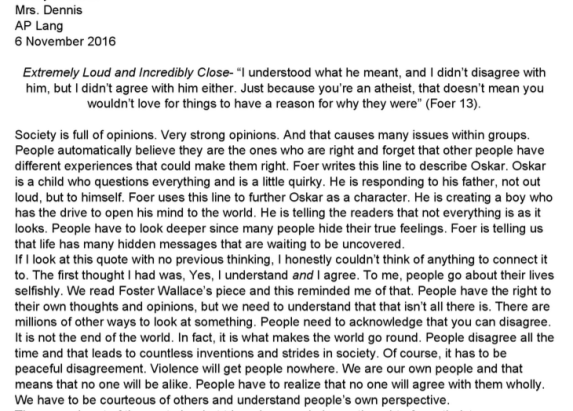
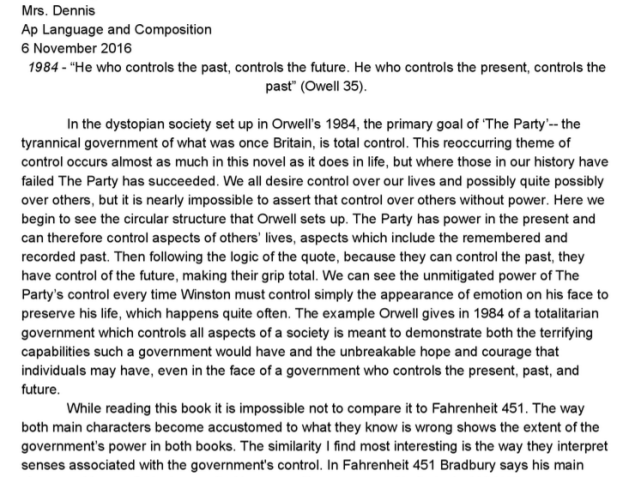
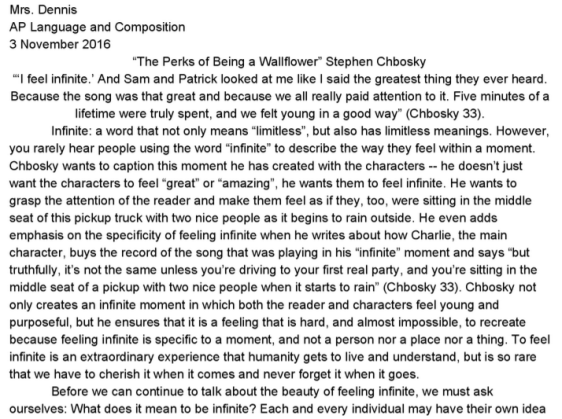
My modification for my AP students is to have them write weekly about what they are reading independently or specifically for class. The emphasis is to contextualize a chosen quote that they find impactful in some way and then react to it. Part craft study, part reflection, part magic. Beyond that, I encourage students to let their writing flow. 500 words (ish). Single spaced. Analysis. Reflection. Once per week. No exceptions.

Since the point is to write more (and more, and more, and more), I try to keep in mind that I don’t need to read every word. With four sections of AP Language this year, totalling 81 students, I’d be in way over my head. So instead, I keep the scores formative, rotate through the classes to comment on one section of the four per week, and give completion scores for those I skim over. Students use turnitin.com to submit the writing each week, so it’s organized and in one place. Occasionally, we’ll discuss our quotes in small groups and/or use the writing for some craft study in class.

sample-3

sample-2

sample-1

Those are the logistics.

My favorite part of this practice, however,  is the way it provides a safe place for my writers to grow, and when they really embrace the exercise, fantastic things happen.

At the start of this school year, I received an email from Simrah, a former student who finds herself in college this year:


Mrs. Dennis,
     I hope you are doing well. I’m having a wonderful time in college and have been meaning to email you to say thank you for having us write one pagers. In English these first two weeks of school, we have been writing one pagers on different readings. Doing so last year was very helpful. We continue to write one page type essays in my class as a grade and being able to do it without question has been great! You can tell you AP Lang students I said this. Thanks again and I hope you have a wonderful school year. Hopefully I’ll stop by the school some time to say hello personally 😉 ❤

Sincerely,
        Simrah —– (a very thankful one pager writing college student)


Just this week, as I introduced my AP Language students to their upcoming “opportunity” to grow as writers, I received an email from Charlie, a young man whose heart is big, his desire to learn is bigger, and unfortunately, this week, he had an unexpected topic emerge for his one pager that turned his piece into an outpouring of emotion that he desperately needed and brought tears to my eyes.

Charlie lost his grandfather this past weekend. Up to this point, Charlie and I have laughed together, as he is a wonderfully personable young man, but I wouldn’t say we had particularly connected. Then he emailed me Sunday to (can you believe) apologize for going over the word limit on the one pager and share with me a picture of how striking the resemblance is between his grandfather at the same age Charlie is now.

Charlie’s writing touched me. He quoted Dr. Seuss in saying, “Don’t cry because it’s over. Smile because it happened,” and went on to detail the events of the past week and his deep thinking/feeling about them.

When I hugged him this morning, he smiled again, and then hung back for a few minutes after class to tell me more about his grandpa, how the family was doing, and how he was doing. It was a conversation he needed to have and I was honored to share it with him. He joked on his way out the door that it would be hard to top his first one pager this coming weekend, but he would try.

Earlier in the weekend, Charlie had ended our email exchange by saying, “I am so lucky to have a teacher like you who cares so much.”

Well, Charlie, you’re sweet to say, but really,  I’m the lucky one.

Because I’ve gotten to know Charlie, Bennett, Kathy, Austin, Trevor,  Abbey, and I’m learning more and more ways to know more and more students.

I’m getting to know them in ways that truly matter.

As readers.
As writers.
As learners.
As people.

As writers of one pagers. Simple assignments that can be simply amazing.

Have you tried “one pager” writing in your classroom? How do you work to build fluency in your students’ writing. Please share in the comments below. 


Try it Tuesday: Taking a line

My AP Lang and Comp students have been writing. A lot.

We’ve analyzed arguments and written short analysis essays. We’ve read powerful OpEd pieces like this and this and this, and we’ve written responses and modeled these writers’ craft moves. We’ve written arguments on our blogs and had a bit of fun modeling Neil Pasricha’s Awesome writing as we practiced using figurative language and specific examples in our essays.  We’ve read about the importance of serious reading, and written one-pagers to defend, challenge, or qualify. Lately, we’ve studied the work of Bryan Stevenson in Just Mercy and watched his TED talk.

I sensed my students needed something a little different, but I needed to keep them writing. So with just one class last week, instead of using a full mentor text to inspire great writing, we used a sentence.

I pulled this quote from Stevenson’s talk:

screen-shot-2016-10-30-at-2-47-56-pm

And then I asked students to write anything they wanted: poems, essays, stories, whatever. The only requirement? Use that line somewhere in your own writing.

Then, on Friday, students moved to our “writer’s chair” and shared their writing. Our community responded with sticky note blessings.

Several students were reluctant to share. “Mine isn’t good,” more than one student said.

“We are a community of writers,” I encouraged. “This is a safe place, and we all want to know what you have to say. Truly, no pressure.”

After a few volunteers, Martina finally rose to share her response to Stevenson’s quote. Her voice was soft yet powerful:

It’s the sigh of relief and relaxed muscles from knowing you did the right thing. It’s liberating and lightweight–the world suddenly doesn’t seem to be positioned heavily on your shoulders. It can be the doubt and little knock of guilt on the back of your head knowing you did the wrong thing. It’s the tempting feeling of doing correct actions, but not being able to when you’re being held against a wall by your own conscious.

It’s difficult to see greener grass on the other side of the horizon when it’s fertilized with the negative aspects of your actions. Learning to realize and move on from what cages you in is the only form of developing into a healthier person–sometimes this ends up being all it takes for it to be “The right thing to do.”

“Always do the right thing even if the right thing is the hard thing”

As kids we grow up with love from family, the goodnight kisses from your parents after a bedtime story, the reassurances of  “It’s Okay” after a tumble on the playground, and the form of love that lingers in the atmosphere when you’re around the individuals that raised you. As we grow our love transforms into something deeper, something more emotional, something dangerous. It might have started with a crush on the new individual at work, the butterflies twisting and turning in your belly are a pure indicator that you’ve deeply fallen in a midst of hearts and dazy clouds of love.

Often times, things go wrong. Abusive relationships exist and they are common amongst the men and women in our society. Nearly half (43%) of dating college women report experiencing violent and abusive dating behaviors, Nearly 1.5 million high school students nationwide experience physical abuse from a dating partner in a single year, and one in seven men age 18+ in the U.S. has been the victim of severe physical violence by an intimate partner in his lifetime.

The right thing in this case is following your heart. Men and women trap themselves in abusive relationships because loving the one person that hurts you seems to be the right thing. Other times, allowing yourself to step away from the relationship/situation is not an option and it becomes a tough obstacle to get out of the arms that hold a restricting grasp on you. There’s always help, there’s always somebody there. Reach out for the right motives even if it’s the hard thing to do.

Never let a person of interest degrade your actions or make themselves superior to you. The most damaging thing to do–and often hardest–is staying in an abusive relationship. Love is a beautiful thing, don’t let anybody damage that for you. Instead, do the right thing for your health, mind, and body without the harm of anyone or anything. 

Two students shared poems, others shared why they think that quote is important, and others wrote arguments of a sort like Martina’s. All were important reminders to me to let students choose how they show they are learning.

Of course, the shared experience of reading their work was pretty fabulous, too.

One of the best things I can do as a teacher of writers is to offer opportunities for students to share their writing. I know the more we share with one another, the better our writing will become. If I remain the only audience (or even mostly their only audience — my students do write on their blogs and leave feedback for each other), some students may never make the connection between writing and truly conveying meaning. Too many just care about the grade.

By just taking a line last week and then asking students to write whatever they wanted, and then sharing… we built trust in our community and we celebrated that we really are on our way to becoming better writers.

What have you tried lately that improved some aspect of your classroom community? Join in the conversation and share in the comments.


ftc-guideline-%22affiliate-links%22

Mini-Lesson Monday: Do Teens Read Seriously Anymore?

It’s the end of our nine weeks. Well, kinda. I have one class of English 3 students that are at midterm since they are on accelerated block, and I’ve got two classes of AP English Lang who I share with AVID every other day in a year-long class, so they are at about the 4.5 weeks mark. Talk about crazy trying to keep the pacing straight and everyone moving.

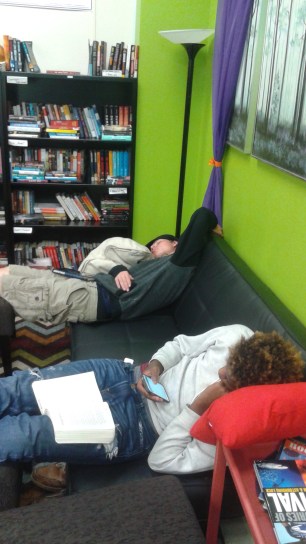
One thing I know:  All my readers need to revisit the goals they set for themselves the first week of school. We’re going to start with independent reading. I’ve seen a little too much of this lately:

joshandtajhnotreading

Taken after exams when I suggested students use the time to read.

and not enough of this:

juniorboysreading.jpg

Daily routine: 15 minutes of independent reading

I set the standard high and ask my students to read three hours a week. This is difficult for busy teenagers who are not used to reading (and if we are honest, many are not used to completing any type of homework).

We will read this article this week “Do Teens Read Seriously Anymore?” and create our personal reading challenge cards. But before we do, I want to get students thinking about themselves as readers and what reading can, and should, mean to them and what they hope to accomplish in their lives.

Objective:  Interpret a quote on the importance of reading and connect it to my own reading life; construct a plan to help me meet my reading goals.

Lesson:  Students will select up two literacy/reading quotes and glue them into their writer’s notebooks. They will then think about their reading habits over the past several weeks of school and write a response to the quotes that connects their reading experiences (or not) and begin constructing a plan on what they can do differently in the upcoming weeks to either continue to grow as readers, or start to.

Follow-up: Later in the week we will also read “The Insane Work Ethic of Mark Cuban, Jeff Bezos, and 15 Other Powerful Leaders” and write a synthesis-type response using the two articles and their personal goals for reading.

Please share in the comments your ideas for getting and keeping students developing their reading lives.

Why I Love My Writers (and some book suggestions, too) #FridayReads


Maybe you see this, too:

I’ve got truly brilliant, fun-loving, willing-to-learn students this year, but when it comes to writing, they are as sloppy as a room full of toddlers with their first plates of spaghetti.  Missing periods and capital letters, too many commas (or not enough), and the makes-my-eyes-bleed lower case i. That one’s all over the room.

And I keep seeing this new thing:  the missing “it.”

Take this for example, all sentences from a self-evaluation students completed last week:  “My reading’s good, is something I do to release stress,” or this one: “Is the same thing as going somewhere,” or this: “My reading improved is better because I tried more.”

What?

Do I worry about mechanics over ideas? Never. Do I worry that my students know better and are just not paying attention? Always.

I teach juniors in AP English Language. This string-your-spaghetti-anywhere-you- want-punctuation should not be happening.

So we slowed down a bit. Took a step back. Searched in our in our independent reading books for sentences that struck us as interesting.

Students wrote their sentences on notecards. Here’s some they chose:

“It’s easier to jump out of a plan — hopefully with a parachute — than it is to change your mind about an opinion.” Think like a Freak by Levitt and Dubner

“We looked over toward the echoes of burdensome chimes, the slip and boom of the clutch and rasp of gears as the ice cream truck entered the dead-end streets and curves of Las Lomas.” Always Running by Luis J. Rodriguez

“They played basketball the way basketball is supposed to be played, and in the end they lost — but not before proving that Goliath is not quite the giant he thinks he is.”  David and Goliath by Malcolm Gladwell

“The barber gazed in amazement at this man with long-thick and black hair and beard, which gave his head the appearance of one of Titan’s portraits.” The Count of Monte Cristo by Alexander Dumas

“When he smiles, she notices that he has a dimple on only one side, and there’s something about this that makes him seem endearingly off-balance.” The Statistical Probability of Love at First Sight  by Jennifer E. Smith

“At the end of the hallway is a boy so powerful, so fearless, that he’s set up shop in the middle of a sacred site and renamed himself Goliath.”  Vivian Apple at the End of the World by Katie Coyle

“I felt a hot, tingly sensation spread spread over my skin as I slid down a few inches against the bench seat, wishing I could just melt directly into it’s crusty upholstery.” We Should Hangout Sometime by Josh Sundquist

“This is an ordinary Monday morning school day.A Stolen Life by Jaycee Duggard

“You see, Cinderella and I know what it’s like to look in the mirror and not recognize the reflection.”  Skinny by Donna Cooner

Then, in small groups we categorized sentences long and short, many punctuation marks or few. And we discussed the whys:  How does that mark help create meaning?

We could have spent days on this lesson. I should have allotted more time, and we will certainly return to it (maybe next week — it’s that pressing).

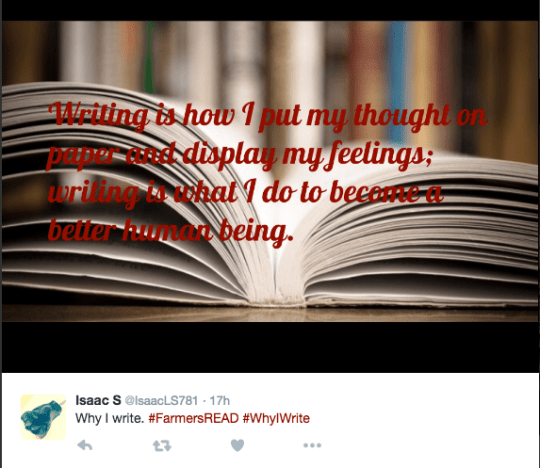
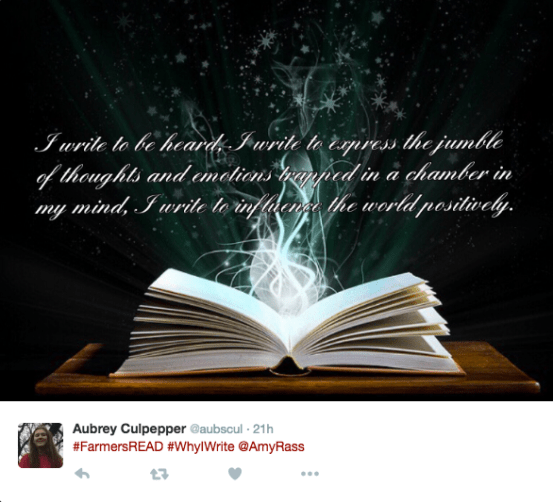
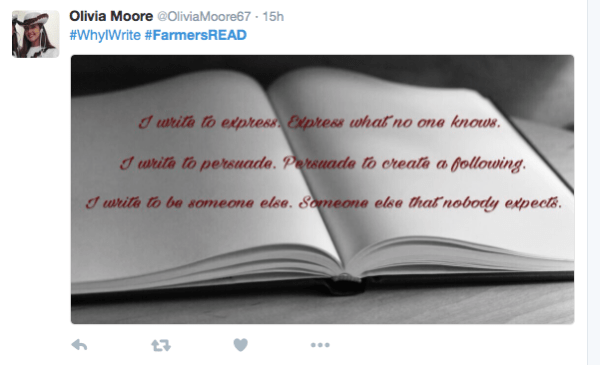
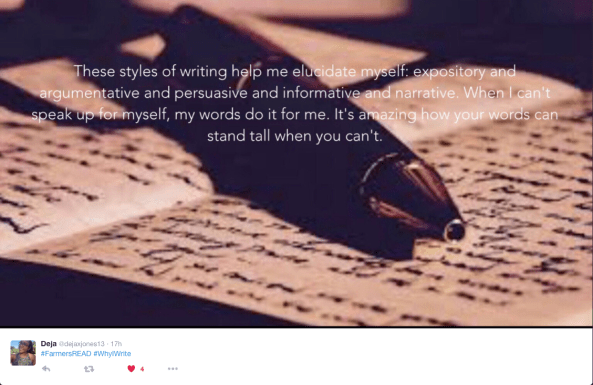
Then, yesterday as a way to join in on the National Day on Writing, I asked students to create a slide that explained why they write. Their slide needed to contain an image, a beautifully crafted sentence that included at least one of the literary or rhetorical devices we’d focused on recently, AND everything had to be correct: capitalization, spelling, punctuation. You might call me out on Olivia’s, but I think it works.

The ratio for correctness on this voluntary assignment was 22:6.

Here’s some of their tweets, evidence of why I love my writers. And also the reasons I hope we can take a little more care as we write. They have such amazing things to say.

screen-shot-2016-10-21-at-8-37-16-amscreen-shot-2016-10-21-at-8-35-42-am
screen-shot-2016-10-21-at-8-23-59-amscreen-shot-2016-10-21-at-9-23-40-amscreen-shot-2016-10-21-at-9-25-23-am


ftc-guideline-%22affiliate-links%22

Mini-lesson Monday: Deeper Reading


I posted this on the TTT Facebook page on Saturday, but I think it also makes for a good mini-lesson, so here goes:

I went to a session by Kelly Gallagher at #IRC2016. He shared ideas from his book Deeper Reading, combining ideas he’s using with his students now. I was reminded of his thinking around thinking from a text: What does the text say? and What does the text not say?

Gallagher shared a few images from the news, a fact statement, an ad for a truck, and he modeled how he asks his students these two questions as ways to get them thinking about their reading.

I’d heard these same ideas before, but they resonated with me again. Critical thinking matters. We cannot get thoughtful writing, if we are not helping our students to think thoughtfully through texts.

Objective: Read a visual text, make observations and inferences that push critical thinking about a text. Draw conclusions and write your thinking.

Lesson:  Tell students that critical readers don’t just pay attention to what a text says, we also must pay attention to what a text does not say. This ties into the idea that everything is an argument — sometimes overt, sometimes covert. Bias also comes into play. So to get into some critical thinking today, we’re going to watch a short video about the refugee crisis.

Draw a T-chart. Label one column with “What does it say? and the other column “What does it not say?” As you watch the video make lists that answer these two questions.

Watch the video “Your phone is now a refugee’s phone.”

After students have time to do their own thinking and writing their lists (and maybe watch the video again), have them talk in pairs or small groups about the things they noted.

Hold a short whole class discussion about what it does for our thinking when we consider what the author, or in this case, the video creator, intentionally leaves out of a text.

Follow up:  Ask students to find their own text and apply this same thinking. Tell them they can find an advertisement, a chart or graph, an info graphic, another video — any text that they can answer the following questions:

What does the text say?
What does it not say?
Why does it matter?

Continue to ask students to consider these questions with a variety of texts throughout the year. This may also serve as a good exercise to help students find writing topics. Bonus!


Do you have any videos, ads, or short text suggestions that you use in similar ways to get students thinking critically? Please share them in the comments.


ftc-guideline-%22affiliate-links%22