Author Archives: Shana Karnes

Mini-Lesson Monday: First and Last Lines

In the spirit of all the books we’re giving away (winners announced tonight!), today’s mini-lesson is one of my favorites to do with independent reading books.  It celebrates the beauty and power of language, no matter the text–poetry, nonfiction, YA, award-winners, graphic novels, and more.  It also celebrates the pure joy of discovery; the launch into a new world attained only by opening to the first page of a new book.

Objectives:  Using the language of the Depth of Knowledge levels, students will identify patterns in opening and closing lines of texts, synthesize their noticings, and draw conclusions about a text’s craft and structure.
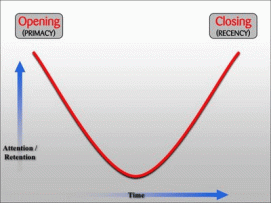
primcacyLesson:  “Have y’all learned about the concepts of primacy and recency in psychology yet?  Who can refresh us?”

A student reminds us that the concept says that the first and last items in a series are easier and more likely to be committed to memory.

“Well, this concept isn’t just for psychology.  It applies to books too.  The first and last lines of books are the most powerful, and the most likely to stick with us.  Let’s talk in our table groups about why the first and last lines are so powerful.”

I wander the room for three minutes as students discuss, in groups of 3-4, these concepts.  They conclude that the first line often sets the tone, introduces a new world, or hooks the reader with some mystique.  The last line, they say, helps keep the reader wondering, or solves a lingering mystery, or even makes you cry.

I write these conclusions on the board, or elicit them from groups if necessary, so that we’re all on the same page.

“Okay, let’s take a look at some of our current reads and see how they can grab our attention.  Open up your independent reading book and read the first line again, and then read the very last line, too.”  (There’s always some anxiety about this, but I reassure them that last lines rarely contain plot giveaways.)
618698KrJJL._SX325_BO1,204,203,200_

(OMG, have you read this? It exploded in popularity the last few weeks of this school year. Read it!)

I ask a few students to give me examples:

  • Miss Peregrine’s Home for Peculiar Children begins with “I had just come to accept that my life would be ordinary when extraordinary things began to happen,” and ends with, “We rowed faster.”  
  • A Prayer for Owen Meany opens with “I am doomed to remember a boy with a wrecked voice—not because of his voice, or because he was the smallest person I ever knew, or even because he was the instrument of my mother’s death, but because he is the reason I believe in God; I am a Christian because of Owen Meaney,” and ends with, “I shall keep asking you.”
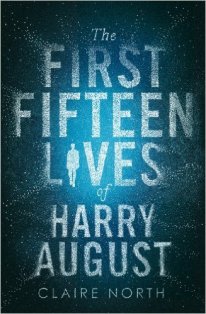
  • The First Fifteen Lives of Harry August begins with “The second cataclysm began in my eleventh life, in 1996,” and concludes, “Instead, for those few days you have left, you are mortal at last.”
  • Room opens with “Today I’m five,” and ends with “Then we go out the door.”

I ask students to write for a few minutes about all that they can learn from the first and last lines, based on what they already know of the text from reading.  This is key–the lesson is much different than a simple craft study of a text they’re not already invested in, because they’re bringing lots more prior knowledge to their text analysis.
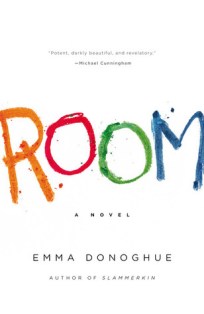
7937843I quickly model with Room, whose plot is simply explained and well known from a recent booktalk.  “I notice the sentence structure first–both lines are short, simple sentences.  Then I get a sense of the narrator’s voice, as he is obviously five years old, and that shapes how I’m going to view the text.  I also know that while they start out trapped in Room, they manage to escape somehow, either literally or figuratively, because of the last line.  I’m intrigued by all of these things, and it sets me up for what sounds like a pretty good read.”  As I talk, I note on the board the kinds of things I’m noticing–craft, tone, characterization, theme, plot, sentence structure.

Students write for five minutes about these topics.  Because they’re midway through these books, they have more knowledge of the text than just the first and last lines.  After a few minutes of writing about what they’ve noticed, I ask, “Now, how does revisiting the first line, and looking ahead to the last line, shape your reading of the text?  What do you find yourself thinking about?  What do you predict might happen?”

Follow-Up:  After students have written their reflections, I ask that they pass notebooks.  They’ll read all of their table mates’ entries, providing 2-3 mini-booktalks–a variation on speed dating.

This lesson could also be a great companion to Jackie’s mini-lesson on writing leads.

This lesson also acts as one of a series of lessons leading up to the students’ writing of a craft analysis of their independent reading books.

Summer Book Giveaway!

Fellow teachers, I have a problem.

img_2969

A book-buying, grant-writing, donation-receiving, classroom-library-growing problem.

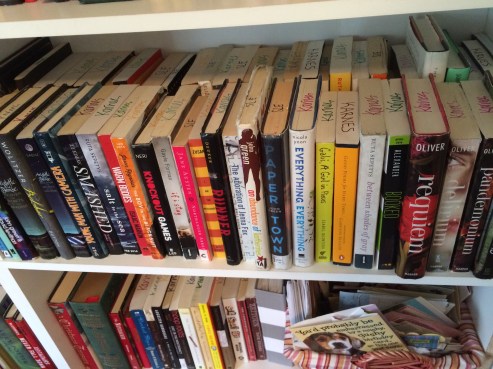
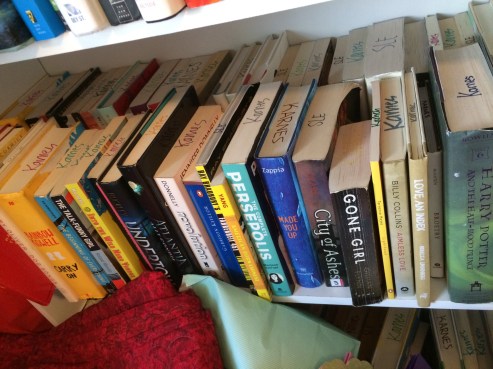
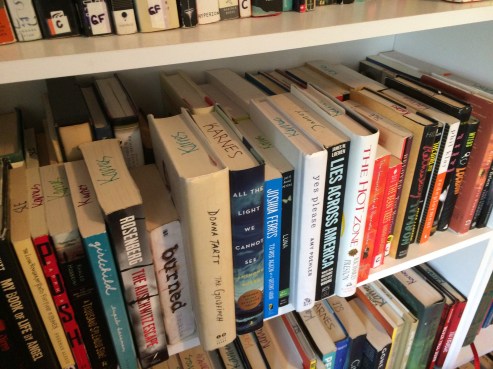
After making it my mission to build a gigantic classroom library, Karnes & Noble has gotten a little…well, out of control.  It has grown to over 3,000 titles, many of which are dog-eared and well-loved, but all of which are wonderful reads.

The problem is, I’ve left the classroom for a while, and…I’ve got wayyyy too many books, and wayyyy too few bookshelves in my tiny townhome.

img_2967

Luckily, I know a few (thousand) deserving teachers whose students would love these titles.

(Yes, I’m talking about you!)

If you don’t mind the Sharpie-d KARNES emblazoned on their spines, then enter to win one of twenty boxes of books I’m giving away!  Nothing would make me happier than knowing that all of these books will wind up in the hands of students who will fall in love with them.  (I’ll also be happy to have my guest room regain the title “guest room,” rather than its current moniker, “Amazon book storage warehouse.”)

There are five ways to enter the giveaway:

  • Complete this 5-minute readership survey to help us tailor our writing to your needs.
  • In the comments section of this page, leave your name, school name, grade level(s) taught, and a list of the 5-10 most popular titles in your existing classroom library.
  • Like our Facebook page, then post to the page a brief description of one of your favorite reading or writing assignments you do with your students.  (Example: I love the multigenre research paper the best!)
  • Using the hashtag #3TTbooks, tweet us an excerpt (pictures welcome) from a text you might use for a craft study or mentor text, as well as your school name and grade level(s) taught.  (Example: a picture of the first page of Peak by Roland Smith, or a picture of the first page of Everything Everything by Nicola Yoon.)
  • Subscribe to TTT, comment on an old post from which you learned something you loved, and then share that post via Facebook or Twitter using the hashtag #3TTbooks.

img_2968

Feel free to enter as many times as you’d like–you may just wind up with two big boxes of books at your classroom door!

And as a consolation prize, even if you don’t win, you’ll be helping to build–and have access to–a toolbox of assignment ideas, book excerpts, classroom library titles, and other useful resources that will be of eminent use to all of us in the fall.

Thank you, thank you, thank you, Three Teachers Talk readers–for getting these books into the hands of kids, and for being with us on our teaching-writing journey every day!

#3TTWorkshop: End of the Year

Conversation Starter: What kinds of reflections do you have for your year? Let’s start with celebrations.

Amy:  Before I celebrate, let me say this:  I have two whole pages of notes written on the back covers of my writer’s notebooks with reminders of what to do new and differently next year. Why is it always easier to focus on the negatives that need improving versus the positives that worked well?

Lisa: This was a year of experimentation and excitement, and my celebrations come from student reflection and collegial collaboration. Our district has a clear vision that they want to move workshop from K-8 to K-12, so it was a year of exploration. Last year, workshop loomed. We had very little knowledge of what it would look like at the high school level, so I naturally…Googled. Having read Penny Kittle and talked with a few colleagues who were already embracing elements of workshop, I was excited. I loved the idea of choice and set about organizing some notes of “how to.” I knew, as department leader, I would be tasked with spearheading the shift with my colleagues, so I wanted to have some solid ideas of how best to proceed.

Original_5000If you Google “Readers workshop for high school English,” guess who comes up? Ta-da. I had found Three Teachers Talk. Specifically, Amy’s post with resources to make the move to workshop. I had struck gold. I read. And read, and read, and shared the blog with our literacy coach, and read, and started quoting sections of the blog and taking notes, and read some more. Real teachers, in real classrooms, with honest reflections on the work. I was elated.
Our district leaders moved forward, rolling out workshop with UBD training, visits to the middle school to see workshop in action, and reviews of Penny Kittle’s key principles. And while valuable and necessary for our progress as a department, it wasn’t until February when Amy and Shana came to Franklin, professionally developed us by teaching us in the workshop just as they would their own students, and let us experience workshop firsthand that workshop really took off. The department was excited. There was wild planning, replanning, reading, purchasing of books, collaborative meetings on the fly (five minute passing periods afford more than enough time for drive-by enthusiastim). And talk. So much talk. Though we weren’t expected to make the “official” move to workshop until next year, we were all trying new things (book talking, setting up writer’s notebooks, and shopping on thriftbooks.com), seeing incredible responses from students (readers spread out all over the building and students writing something, anything, every single day), and basically diving into the work to see what would help us float.

It hasn’t been easy, but as I wrote yesterday, the small (and for some of us BIG) moves we are making have us enthusiastic about what workshop will look like across our department. It’s been a great year to grow and see some incredible enthusiasm from students as choice changed their minds about the written word and its power.

The big takeaway from workshop this year? Do it. Now. You won’t regret it.

Shana:  This was a weird year for me, and I’m wistful.  I was just telling my mom that I feel like I barely taught this year, and I think I mostly feel that way because I didn’t have a firm end of the year (I was out on maternity leave from mid-April to the last day of school).  Instead of doing reflections alongside my students, studying their self-assessments and working with them on the year-end MGPs, learning from my own thinking and my reading of my students’ thoughts, I just…slowly drifted away from my classroom and saw most of my students for the last time at their graduation instead of for a celebratory last-day-of-school photo.  It made the end of my teaching career feel really nebulous.  I hated that.

But, there were lots of great things about this year.  I looped with my students, so I began the year knowing most of their likes and wants and needs already.  I was able to dive right back into helping some of my reluctant readers find new books, help my new students assimilate into a workshop culture more seamlessly, and leap into newer, more complex writing tasks with more confidence.  I loved that so many tenets of workshop were already norms in our classroom in September–book talks, conferences, notebooks, and just book love in general.  It was transformative to begin a school year without having to gain students’ trust with the workshop model, instead having the trust already established.

And my students did and wrote and created great things.  Carleen reassured me that workshop structures made her fall in love with reading again.  Jak showed me that having choice in reading helped him advance as a reader far further than any assigned text could have catapulted him.  Tyler showed me that even the most reluctant reader can fall in love with a complex classic.  And countless other kids helped me re-fall in love with reading and writing and teaching every day in my classroom, when they had miniature successes and failures and highs and lows.  I celebrate that act of falling in love with literacy all year long.

Amy: My biggest celebrations came in the form of one-on-one moments with students. I wrote about an experience with Diego previously. He ended up writing a well-constructed
and extremely personal multi-genre piece about his brother’s drug addiction. Our final conference was a powerful moment. Diego opened up about his love for music and showed me how to find his YouTube channel. He is a talented musician. His ability with poetic language suddenly made sense. I wish I had a do over with this talented young man.  I would have done things differently.

Another celebration came from a conference I had with Emerita in the spring. She was a Screen Shot 2016-06-07 at 9.10.40 PMtough student: smart, outgoing, talkative, eager — but she didn’t like that I wanted to

push her into writing even better, reading even better. We locked horns, and sometimes her silent attitude made me feel inept and out of sorts. (I know we shouldn’t take things personal, but I struggle with this. I want everyone to like me.) Finally, in a moment of
divine inspiration, I gave students to opportunity to do some extra credit. Anyone who wanted to improve their grade could research
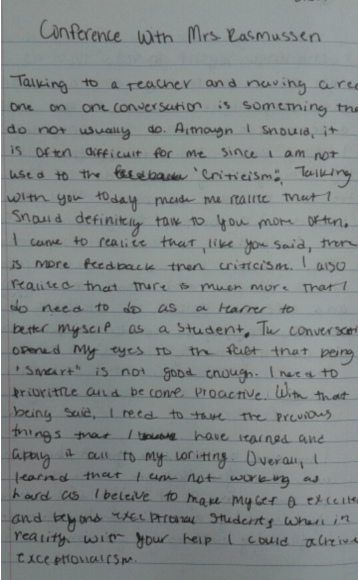
the work of Carol Dweck on mindset and then write up an essay that answered specifics about the characteristics of Dweck’s work and how it relates to their attitudes in school. Emerita changed after that. She understood what I’d been trying to get her to see all along:  we can always work on our craft and improve. After our conference reviewing her extra credit essay, her work improved as did her attitude towards everything we did the rest of the year. I share a copy of her conferring notes here.

What are some things you know you want to do differently?

Amy:  Well, like I said, I have two pages of notes. Some of them relate to things I’ve done successfully in the past and just forgot to do this year like taking more time to allow students to decorate their writer’s notebooks. I’ve always allotted sufficient time for students to do this in class, but I didn’t this year, and as a result, I noticed quite early on that students did not have much attachment to their notebooks. They still represented “just another composition notebook for class” instead of a place to capture ideas and notes about themselves as writers. I’ve already got NOTEBOOKS clearly outlined on next year’s calendar.

I also need to be a better Reading Teacher. That might sound strange since I teach AP Lang, but many of my students struggle with reading, not to mention critical reading. I need to utilize strategies that will help them not only read more, which I already do quite well, but read better. I’m re-reading Cris Tovani’s books, and I will introduce Beers & Probst Notice and Note next year. I’ve used both in the past, but not with AP students. After two years in this position, I’ve learned that we’re going to need to practice some basic comprehension and some thematic work before we can go too far into rhetorical analysis.

Shana:  My hubby spilled an air freshener on my notebook yesterday, so from its ruined depths I’ve turned to my “teaching ideas galore” section for this question.  The first thing I’d like to shift into thinking about is ways to write or respond to reading nonlinguistically.  For years, much of my students’ writing was about reading.  Then I shifted away from that and toward making reading and writing activities independent and celebratory, while still asking what we could learn from one and apply to the other.  I’ve kind of gone back toward writing more about reading this year, but next year I’d like to see how we might tell stories through visuals, or write book reviews in doodles, or create collages to illustrate patterns in a text, or diagram similar story arcs across independent reading books.  I’ll be on the lookout for this theme during my summer reading of journals and books.

The obvious change I’ll be shifting to is toward working with preservice teachers rather than high school students.  Still, I’d like to keep many similar structures in place.  As Tom Romano began every class with two poems, I think it’d still be valuable to begin classes with two booktalks.  Writer’s notebooks are a must, as are things like book clubs, wide reading, and writing with an eye for mentor texts.  I’ll be asking myself, though, how to prepare a new generation of teachers for the wild world of high school learning.

Lisa: Give me a second, I need to gather the seven million post-it notes I have scattered across my existence and I can tell you the six million things I am ready to improve for next year (the other million notes are on books I want to read).  

One thing I am really looking forward to is the idea of total immersion. We’ve done a lot of standards based planning around this move to workshop, and I’m excited to blend the skills focus with the choice I’ve already dipped into.

I’m also excited about the creative aspect that Shana talked about above. While more and more skills based over the years, my instruction, up until recently, had really still focused on reading and then writing about that reading. Analysis is obviously important, but there are so many more authentic, thought-provoking, student-driven assessment tools and just plain exploratory modes of expression, that I really want to delve into. To think, I taught through a few years there where poetry was almost lost in my classroom. Thank goodness I rediscovered it for mentor work and had my students writing powerful verse over and over. What amazing modes discourse will I discover next year that I will eventually be appalled to have missed before? Geek alert. I am so excited to find out. 

Finally, better time management. A wonderful colleague of mine, Mrs. Leah Tindall (co-organizer of our high school’s incredible Literary Showcase) said of this year that we were stressing out because we were trying to balance new work with an old workload. This was so true. The work I need to be doing is talking with my students, reading with my students, getting organized enough to have conferences lead to more pointed minilesson work, and provide ongoing feedback that doesn’t require every extra minute of my existence to “grade.” Certainly, workshop is no easy way out in terms of time invested, but it’s time invested differently. Time invested with one-on-one feedback at the forefront and building our students up by our own examples as readers and writers. This certainly takes time, but it does so in a way that makes so much more of an impact than just red pen on paper. It’s honest communication. It’s investment. It’s caring.

I need to stop using reading time to take attendance, and get out there and confer with my students. I need to stop putting off the reorganization of my library, because really, how can I make solid recommendations if I can’t find the book I’m after? I need to stop providing the bulk of my feedback with a pen at all and start using my ears more – feedback after careful listening and reflection. That’s what I’m after next year. I want to hear my students talk from their hearts and their minds and on paper in ways my previous teaching didn’t account for. I can’t wait to hear all that they have to say.

Do you have topic ideas you would like us to discuss? Please leave your requests here

The Right Book May Be an Audiobook

headphones_bookMatching the right student to the right book is at the heart of the reader’s workshop, and lucky for one and all, there are plenty of great books to go around–even for the most reluctant readers.  As a reader’s workshop leader, teachers must be well versed in a variety of genres to do their jobs well:  young adult, nonfiction, and even the classics.  But what about audiobooks?
Admittedly…I’m a book snob.  I was dedicated to paper books for years, until I got married and my early-to-bed husband complained about my reading lamp’s brightness.  Enter my very first e-reader, with which I quickly fell in love.  I reasoned that even though I wasn’t reading a book, per se, I was still reading.  I still wasn’t on board the audio train, though; after all, listening isn’t the same as reading.

Enter my best friend’s move to Virginia Beach, then a 10-hour drive away from our native Cincinnati.  What was I supposed to do for 10 hours whilst driving to visit her?!  “Listen to an audiobook,” she suggested.  “Duh.”  So, I grabbed Thirteen Reasons Why on CD from our library, and (12 hours and a one-state detour thanks to being so caught up in the book that I wound up in Maryland later) I was hooked on audiobooks.

It’s important to note that listening skills are not the same as reading skills, but in the battle to build literacy, one is a scaffold to the other.  While decoding can only happen when a reader is looking at text, the analysis of universal themes, practice of reading strategies, and ability to make connections can happen with any text, written or oral.

“Understanding the message, thinking critically about the content, using imagination, and making connections is at the heart of what it means to be a reader and why kids learn to love books.” –Denise Johnson

Were it not for audiobooks, my own reading life would almost certainly be suffering right now, as I’m so busy and sleep-deprived with an infant, but I love listening to my favorite murder-mystery series in my spare moments.  In countless conferences with my student athletes, I’ve come to realize that their practice and travel schedules keep them incredibly busy on nights and weekends, and audiobooks have helped them remain readers in their busiest seasons, too.

I strongly believe that audiobooks can save, strengthen, and supplement any rich reading life, and as such, I take great pains to recommend this medium to my students, often in the following categories.

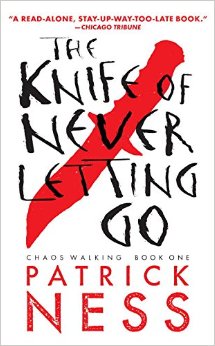
51NcMaqTCsL._SY344_BO1,204,203,200_Series – A great way to immediately get students hooked on audiobooks is to recommend a series they’ve already started.  Sequels to titles like The Maze Runner, The Knife of Never Letting Go, Percy Jackson, Harry Potter, Legend, Divergent, City of Bones, and more are great gateways to the world of audiobooks.

Books read by their own authors – Many writers read their own audiobooks, and it’s fascinating to hear the nuances of Michael Pollan’s or Malcolm Gladwell’s writing as he reads it aloud.  The likes of Maya Angelou, Neil Gaiman, Barbara Kingsolver, and even Barack Obama have deigned to offer themselves to readers in audio form.  It’s endlessly fascinating to me to add a new dimension to “reading like a writer” when I listen like one, too.

20910157Humor – Similarly, so many amazing essayists, comedians, and satirists read their own audiobooks.  Amy Poehler, Tina Fey, David Sedaris, Mindy Kaling, Neil Patrick Harris, and more are just a few of the folks whose movies or TV shows I’ve watched, and who’ve then joined me in my car or at the gym in audiobook form.

Challenge Books – Books that for one reason or another–length, difficulty, topic, multiple narrators–are challenging are great candidates for audiobooks.  I don’t think I could’ve made it through Unbroken, Behind the Beautiful Forevers, Thinking Fast and Slow, or other lengthy, difficult tomes had I not listened to them rather than read them.  Their tough topics and intimidating lengths would have been much too off-putting for me, and many students find themselves in similar situations.  Audio is my favorite way to scaffold students up to the level of a slightly too difficult text.

Whatever’s always checked out – No one could ever find Winger, Crank, Paper Towns, Because I Am Furniture, My Book of Life By Angel, Boy21, Red Queen, or The 5th Wave this year–they were just way too in demand.  Instead of waiting for those titles to be returned, many students opted to download the audio version instead.

What are your thoughts on the world of audiobooks?  Which titles are your favorite?

Letting Go: A Farewell to High School Teaching

IMG_0642

They bought me a microwave.

Do you remember your classroom management course?  You know, the one you took in college where you had to design a discipline plan, a seating chart, and a parent phone call log?

I remember mine.  I remember reading Harry Wong’s The First Days of School like it was a bible.  I remember clinging to its lessons my first year of teaching.  I remember trying to craft my “teaching persona,” which I was assured was not to be too friendly, or too close to my real personality (which was still developing–heck, I was 21).  If I just stayed cool–icy, in fact–I could prevent any misbehavior and ensure perfect lesson delivery any day of the week.

I remember well when teaching was as new and scary and overwhelming as parenthood is to me today.

Screen Shot 2016-05-30 at 6.29.32 PM

#nofilter

Fast forward to this school year, during which I did most of my teaching from a chair with my very swollen ankles propped up in front of me (very professional).  There were no filters–I shared so much of myself with my students–how I was feeling, what I was reading, how my writing was going.  I was vulnerable.  I cried.  I accepted their gifts.  I met them for coffee to talk about books.  I laughed with my students when they made jokes, cried with them when they wrote powerful stories, and celebrated with them when they achieved their reading and writing goals.  Our classroom was loud and chaotic and full of love.

I don’t know if Harry Wong is alive, but if he’s not, he’s definitely doing somersaults in his grave.

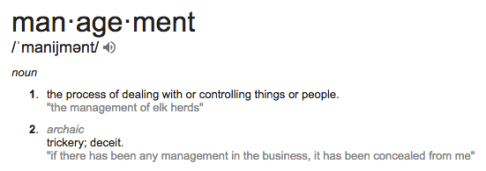
The old-school style of classroom management fits this definition:

Screen Shot 2016-05-30 at 5.41.51 PM

It’s all about control and discipline.  Desks in rows, students forward, no talking, just listening–the classic I teach, you learn method.  “Gotcha” is prevalent as pop quizzes, and cell phone confiscation, and standardization abound.  Harry Wong loves this.

In contrast, in a workshop classroom, “classroom management” is more in line with the business field’s definition of the word management:

Screen Shot 2016-05-30 at 5.41.38 PM

IMG_1470

They bought me a milkshake.

It’s a group endeavor to make the days run as smoothly as possible so we can accomplish our goals and objectives–namely, becoming lifelong readers and writers.  You want to make a joke?  Cool, go for it.  It builds community–a community of readers and writers.  A kid who feels comfortable joking feels comfortable recommending a book.  A kid who feels comfortable making suggestions feels comfortable making mistakes, too.

And so we have structures and routines in place–start with reading, then do some notebook work, revise and tinker, then consider a mini-lesson, then move into workshop.  It’s never quiet; there is a lot of talk in all of those parts of our routine.  The desks are in pods, not rows.  I learn with my kids and from them–I don’t “teach at” them.

The evolution of my first classroom to my last required a paradigm shift, some confidence, and most importantly, the release of control.

I’m thinking a lot about this as I navigate new parenthood, desperately seeking a playbook, wishing someone could just give me a pamphlet of answers.  But that’s not going to happen and I’ve got to just relax and know that if I keep the right structures in place–feed the baby, change the baby, love the baby–things will come together.

It’s the same with a workshop classroom.  When the teacher can let go of control, her students can flourish.

I’m so glad that as each year went by, I gradually let more go.  Teaching became learning, and my classroom became so much more authentic as a result.  I released more and more control.

Now it’s time to let go entirely.

And so, nine classrooms after my first, I’ll clean out my desk and my cabinets and my Karnes & Noble to move on to the next great adventure.  New parenthood awaits, as does an adjunct position working with preservice teachers at our local university.  But I’m leaving high school teaching behind, for now, and it’s heartbreaking.  It was nothing like what I imagined it would be.

It was so much more.

I met some of the most amazing people in the form of my students–people I still keep in touch with and consider friends, who send me poems and notes and emails and to whom I send book recommendations and doodles and musings.  I’ll leave high school teaching with memories, microwaves, and something akin to a middle finger for whoever had the idea that learning was something neat and orderly enough to be “managed.”

img_2708


Vulnerable Learning by Janet Neyer

My Writing Project colleague, Sharon Murchie, wrote about taking a risk in sharing her writing with her students on the CRWP Teachers as Writers Blog. Her post got me thinking about how I do the same in my own classroom.

guest post iconI am feeling nervous, insecure, and uncertain as my ninth graders start to file into class today. We just started the new trimester a week ago, and about half of my students are still new to me — having come from a different English teacher first term. I remind myself that I am the adult; I am the teacher. Nothing to worry about, right? What’s the worst that can happen?

You see, I am about to give a book talk and admit to my students that I have no clue what the book I am reading is about. Truly. I just don’t get it. The book is a title I was eager to read — The Buried Giant by Kazuo Ishiguro — but I am 30 pages from the end of the novel and I don’t know what the real story is. In fact, all I really know is that an elderly couple, Axl and Beatrice, have undertaken a journey to reunite with their son. As Axl and Beatrice travel across the countryside, they meet knights, Saxons, river boatmen, and frightened citizens, but all have one thing in common: they cannot seem to remember much. Axl and Beatrice worry that the loss of their memories will be their undoing: “But then again I wonder if what we feel in our hearts today isn’t like these raindrops still falling on us from the soaked leaves above, even though the sky itself long stopped raining. I’m wondering if, without our memories, there’s nothing for it but our love to fade and die.” The mist of this memory loss has the effect on me as a reader of clouding the truth in the story. In short, I find myself uncertain about what is real for the characters and what is fantasy.

I am about to reveal to these students that I don’t understand this book.

I don’t have the answers.

I don’t have a profound interpretation.

I am lost.

How will they respond?

The room settles in as I grab the book from my desk and turn to face them.

71yaTpRiJgL“I want to tell you about this book I’m reading…”


This is what I have been working on for the past several years in my practice as an English teacher: vulnerability. Through a great deal of reflection, professional reading, conversation with colleagues, and intention, I have been trying to practice what Antero Garcia and Cindy O’Donnell-Allen in Pose, Wobble, Flow: A Culturally Proactive Approach to Literacy Instruction, call “vulnerable learning: an inquiry-driven process that engages both intellect and emotion…” (34).  Garcia and O’Donnell-Allen explain that “Teachers who foster vulnerable learning create classrooms where “not-knowing” (Barthelme, 1997) is the norm…they create conditions in which students can claim and exercise their own power as learners, primarily because these teachers are vulnerable learners themselves” (36). I am trying to model for my students what a First Attempt In Learning (FAIL) means for me. I want to take a risk in front of them by acknowledging that I don’t have all of the answers, and, in fact, on any given day, I have many more questions than answers.

Every day when students enter my classroom, I want them to ask questions, to push back, and to wonder. I want to grow literate citizens who question what is happening in their communities and in the world. Students, however, often see school as a place where there is one correct answer, and in most cases, it is the teacher who has it. In addition, in most classrooms — despite teachers’ encouragement to the contrary — everyone knows that asking questions makes you look foolish. I understand this mindset, as I remember being one of those students as well. Though I wish I had, I did not take intellectual risks in my high school days. I let the teacher tell me how I might improve upon my writing or what meaning I should take from the novel. I wish something different for my students, though. I wish for them to acquire the tools needed to be independent learners — deep learners who are willing to take on challenges and see them through.

I recognize that I ask students every day to take risks and to be vulnerable in their learning. If they are to write something powerful and meaningful, they will have to risk putting it out there for their classmates and for me. If I am to find them the right book to appeal to them, they’ll have to risk telling me something about what matters to them.  If they are to grow as readers, writers, and thinkers, they will need to struggle and persevere. The reality, however, is that many of my students would prefer I just tell them the answer.  How can I expect them to be vulnerable if I am unwilling to take that risk?

It’s that simple…

And that scary.

In her short story “Eleven,” Sandra Cisneros writes in the voice of eleven-year-old Rachel, “…what they never tell you is that when you’re eleven, you’re also ten, and nine, and eight, and seven, and six, and five, and four, and three, and two, and one.” And even though I am well past eleven, today I still feel all of those layers. As I stand in front of my ninth graders, I am feeling 14. I am the vulnerable one, hesitating to reveal that I don’t understand. This is an uncomfortable feeling, but one that is so valuable for me to remember as a teacher of 14-year-olds.


“I want to tell you about this book I’m reading because I am only 30-pages from the end, but I do not know what this story is about.” I show the students the book and the place where my sticky note holds my spot. I explain that I have read other books by this author and that I have sometimes had to hang on for a while before I understood what was happening, but never for this long.

“This is an author I trust, so I want to keep going, but I’m frustrated.”

A student in the front blurts out, “What’s it about?”

“Well,” I say, “There’s an elderly couple on a search for their son. And there’s a knight and a dragon and a lot of battles. The story takes place in ancient England, but no one seems able to remember anything very clearly. I feel like nothing in this book is as it seems, like there is something else going on here.”

“Why don’t you look it up on the Internet?”

I admit that I had thought about that, but reading this book for me has become like solving a puzzle. I really want to figure it out on my own. I have the chance today to talk with them about perseverance, about my willingness to stick with a text even if I’m unsure about the pay-off, about my tolerance for uncertainty. Essentially, I have the opportunity to remind even my most reluctant readers of The Rights of the Reader (Pennac). Yes, I have the right to leave this book unfinished, but I won’t; in fact, I might even exercise my right to read the book again after I finish it.

When one student asks, “Why would you want to do that?” I have the opportunity to explain what I gain from a second reading of a text.

When another asks if he can borrow a copy so he can help me, I have to tell him that this is my only copy, but I promise he can have it when I finish. I know he is excited to meet this challenge — to help the teacher understand a book. What better boost for a ninth grader?

This is one of the best book talks I’ll give all year — mostly because it’s a reminder that my students need to see me struggle with books, just as they might. They need to know I am willing to be vulnerable in my learning, just as I ask them to be.

In fact, tomorrow, I think I’ll share a piece of writing I’m working on — a blog post about being a vulnerable learner.


Post Script: If you haven’t read The Buried Giant, I recommend it. In fact, I gave it five stars on GoodReads. It was absolutely worth the persistence. After I finished the novel, I did turn to the Internet, and was comforted to find this New York Times review from Neil Gaiman in which he says, “Not until the final chapter does Ishiguro unravel the mysteries and resolve the riddles.” Whew. I’m glad to know I wasn’t alone in my puzzlement.

Profile PhotoJanet Neyer (@janetneyer) teaches English and psychology at Cadillac High School in Cadillac, Michigan, where she is passionate about incorporating authentic reading, writing, and research experiences into all of her classes. She serves as a teacher consultant for the Chippewa River Writing Project in mid-Michigan, and she is a Google for Education Certified Trainer.  You can find Janet’s Google Apps resources as well as her thoughts about teaching at upnorthlearning.org.


References

Garcia, Antero, and Cindy O’Donnell-Allen. Pose, Wobble, Flow: A Culturally Proactive Approach to Literacy Instruction. New York: Teachers College Press, 2015. Print.

Ishiguro, Kazuo. The Buried Giant. New York: Knopf, 2015. Print.

Pennac, Daniel, Quentin Blake, and Sarah Adams. The Rights of the Reader. Cambridge, Mass: Candlewick Press, 2008. Print.

Mini-Lesson Monday: Notebook Passes

While we’ve written often about the value of writer’s notebooks–how to set them up and establish them as part of a learning routine–I’ve been thinking lately about the importance of sharing notebooks, creating a community space for writing, and keeping the writing process transparent.  Similar to how revision is a daily part of workshop, peer feedback is too.  It’s key that we know how to open our notebooks to other eyes so that our writing can grow its best thanks to many brains.  This mini-lesson focuses on a low-risk intro to an open notebook and its role as a workshop norm.

Objective: Using the language of the Depth of Knowledge levels, make predictions about a character’s actions and interpret  their actions thus far; create a response to a peer’s questions and inferences.

41Cx8mY2UNL._SY344_BO1,204,203,200_Lesson:  I love to introduce students to each other’s notebooks through a shared bit of reading.  Early in the year, we’d just finished reading a selection from Fahrenheit 451 about halfway through the novel, and were all intrigued by what in the world was going on with the variety of characters.  What was Guy’s wife doing with herself all day?  Was the fire chief good or evil?  Would Guy become a reader?  Would the mechanical hound eat everyone alive?  There were more questions than answers (as is the norm in workshop, I feel), so we turned to our notebooks.
“Today, we’re going to write a letter to a character we’re fairly interested in.  Maybe you find Guy indecisive and aggravating.  Maybe you think Clarice is a great role model.  Maybe you think Ray Bradbury himself is a genius for predicting so many of today’s technological innovations.  Whoever you’d like to write to, ask them all the burning questions you have and don’t worry about the answers!”  I turn to model on the board, writing to the main character’s wife.

“Be as real as you want–I’m going to write to Millie, who lives in this trancelike state all the time, obsessed with TV and media.  She drives me nuts!  I’m going to really hit her with some hard questions.  But know that we’re going to share our letters, so don’t get too crazy.”

img_0966We’ll take 6-7 minutes to write our initial letters, and I circulate the room as kids work to select and address a character.
“Okay, time up.  Sign your letter, and then I want you to pass your notebook to the person to the left of you.  Whoever gets your notebook is going to write you back–but here’s the catch.  They have to pretend to be the character you addressed.  So if you wrote to Millie, like I did, then whoever gets your notebook will pretend to be Millie and try to answer all of your questions.”

We take a few minutes to read letters, giggle, ponder a response, and then write.  After about 5 minutes of responding, I ask students to close their in-character letters, then return the notebooks to their owners.  When kids get their notebooks back, the volume in the classroom inevitably increases–everyone loves seeing someone else’s words in their notebook, and there are questions about handwriting and the veracity of a response and shouts of laughter at someone’s humor.

“Okay, take a few minutes to read your responses, then summarize both letters with your table.  As a group, talk about all the new insights you reached about these characters.”  The classroom gets loud as everyone shares at small tables.

Follow-Up:  Once small group sharing concludes, I ask for a few volunteers to share exemplars and we discuss those characters in depth as a class.  I love this lesson because it gets students to deeply analyze characters, as well as creates a norm for notebooks as a space for shared writing.  It’s a lengthy lesson–usually consuming the quickwrite and mini-lesson portions of my class–but one that’s worth repeating frequently to get students doing deep analysis and writing to one another in a no-risk way, which lays the groundwork for more vulnerable sharing later.

As we move further into the novel, I’ll ask students to revisit these letters to see if their predictions came true or their questions proved insightful.  Further, when I collect notebooks, I can check for deep understanding of the text with these letters.

How do you use notebooks to create a shared learning space or blend reading and writing instruction?


A Reflection to Reinforce Workshop Non-Negotiables

Establishing an authentic readers-writers workshop community isn’t easy for teachers or for students.  Our discussions this week–on student and teacher buy-in and how to get students to thrive–have focused on helping both teachers and students to grasp the many moving parts of workshop.  While they’re straightforward, these non-negotiables are unfortunately often ones that neither students nor teachers have experienced firsthand in a learning setting:

  • A reading community filled with a diverse classroom library, frequent talk about books, and time to read
  • A writing community centered on a writer’s notebook for play and practice, frequent revision, and constant talk about writing
  • Choice in all matters–in what to read, how to read it, and at what pace, as well as about what to write, how to write it, and at what pace
  • Choice for the teacher, too, in what units to design based on what all parties are interested and invested in
  • Talk, talk talk:  structured talk in the form of student-teacher and peer conferences; discussion about the day’s topics and mentor texts; and an atmosphere of frank honesty

It’s sometimes tough to fit all of those things in every day (or to conceive of how to plan for them) but when we can manage it, it pays off.  Below is a reflection from Carleen–whose thought processes I wrote about here, too–that illustrates her journey from English disenchantment to workshop engagement.  This reflection is from Carleen’s winter midterm, and helps reinforce the value of the non-negotiables of a strong readers-writers workshop.


IMG_1537In the past, I’ve always dreaded going to English class. It was always the same every year with grammar, vocabulary, reading classics that were really boring, and writing about subjects I could care less about. I especially disliked English last year because it was AP. That class always put me in a bad mood. Writing rhetorical analyses almost every day as well as working on the dreaded ORP, which consisted of reading a nonfiction book and writing 20 journal entries and an essay, almost killed me. That class kind of depressed me because I couldn’t understand any of it. … I just stopped caring about my assignments because I didn’t see a good end result. On the bright side, I got a 3 on the AP exam; however, my high school English experience was basically ruined because of that class.

This was a lot of pressure for you, Mrs. Karnes, because you had to deal with my bad experiences. Yet, you have made this class my favorite (out of all my high school classes) and made me actually enjoy English. This semester I actually feel like I’m learning and improving my writing skills, which I’ve always been self-conscious about. I have definitely been reading more and trying to challenge myself with reading books outside my comfort zone. You made me care about my work and in return I worked really hard on my projects and assignments.

I’ve grown more as a writer this year more than any other year. I looked back at my first one-pager, which was dreadful because my sentences were super choppy, and compared it to my recent writing. I found that over the course of the semester, I have become more confident in my writing and I started to really enjoy writing my fanfics. You gave us the freedom to choose what we write about, which helped my writing immensely because I CARED about the topic and I enjoyed doing it. I realize that I’m eventually going to write about things I don’t care about and I probably won’t enjoy doing it, however I have been looking at writing differently now. I don’t really see it as a chore. It’s just something that I do on a weekly basis and it’s become a habit. I no longer see writing in a negative way, which helped me grow as a student.

In the beginning of the year, when you told us that we had to read two hours every week, I got super excited. I was always looking for an excuse to read, which my parents restricted me from. You know I’ve been an avid reader since the beginning of the year and I probably have been reading the same amount since the beginning of the semester (which is to say A LOT); however, with your recommendations, I have read books that I thought I would never read. This class helped me expand my reading repertoire, and I’m really grateful for it. I’m always excited when I leave your “Karnes and Noble” with a new book.


Share your students’ stories of workshop success in the comments!

Top 10 Books That Will Drastically Change Your Mood

img_1534I don’t know about the weather where you live, but it has been raining cats and dogs for a week here in West Virginia.  Baby Ruth and I are dying to go out for a walk, a coffee, a Target run–anything!!–but the rain is keeping us indoors and we’re feeling rather glum.

Luckily, I have a solution–reading.  It can transport us to other worlds, brighten our days, and alter our moods for the better.  Her little bookshelf is full of great titles by Shel Silverstein, Eric Carle, and other children’s greats, and mine is full of great titles like the ones my awesome student Giulia recommends below.

Giulia made a Top 10 List of books to drastically change your mood when reflecting on her semester’s reading last winter.  She realized that no matter what she was embroiled in–school, work, friends–these ten books could rip her away from reality and change her mood.  So if you’re looking for something to sweep you away, check out Giulia’s list below…and make sure you have these titles in your classroom library!

Giulia’s Top 10 Books That Will Drastically Change Your Mood

71VBpx0qsmLThe Glass Castle by Jeannette Walls

This is one of the few non-fiction books I’ve read. I was more interested in this non-fiction book because the events that took place in The Glass Castle were completely insane so it seemed more like a fiction book. I think this is why I was more intrigued. This girl went through the majority of her life with the most ridiculous parents. They traveled America and went on all these adventurers that most people would consider insane. One part of the book that really stuck out to me was when this girl was little, she was boiling hot dogs on the stove, BY HERSELF, and something happened where the boiling water spilled down the front of her body and she had third degree burn and scars for the rest of her life.

The Book Thief by Markus Zusak

This is one of the rare books where I’ve seen the movie first then read the book, and come to find out that the book was way way way better than the movie. Both the movie and the book made me cry like a baby, but the book was more interesting, obviously. The book is based around a little girl who is growing up in Germany during the Holocaust. She begins to find that she is fascinated with books and does anything she can to get as many books as she can. Her family also faces the fears of hiding a Jew in their basement. Everything that happens in this book seems so fragile to me because I basically get to see this little girl grow up and face the world.

The Sky is Everywhere by Jandy Nelson

This book was recommended to me by a friend and usually I like to discover good books on my own, but I decided to read it. It was a nice love story mixed with humor. I love when authors do that. This girl is in high school and her older sister just died so she’s living with her crazy grandma and uncle. She and her sister’s dead boyfriend begin to fall for each other, but they both know it’s a big no no. They finally start to come back to reality and realize that they aren’t actually falling for each other, they are just trying to find comfort in one another. Throughout the entire book, this girl is STRUGGLING to find her way out of a hole she fell in when her older sister died. It’s touching and humorous and I loved every single bit of it.

sun_375wI’ll Give You the Sun by Jandy Nelson

This book and the previous book both have the same author, Jandy Nelson. I’m assuming Jandy either grew up with a rather odd family or she has a rather odd imagination because both the families in each of these books are not your typically family. This is one of the first books I’ve read where one of the main characters is gay. It was definitely interesting, but not weird at all. The two main characters are a set of twins, both struggling with the divorce of their parents. One child is a boy and the other is a girl. Basically, they are both trying to get into this really nice art school, but the boy is trying harder than the girl. Throughout their childhood they are super close, like best friends, but as they grow older, there are a couple specific events that happen that tear them apart. This book, while wildly outrageous, was fun to read. It may seem confusing and slow at the beginning, to the point where you might contemplate finishing it, but it was totally worth finishing.

Everyday by David Levithan

I just recently read this book so it is fairly fresh in my mind. I was crazy about this book in the beginning, like I thought this was my favorite book of all time, and then it ended. It was maybe one of the worst endings I’ve ever read, but besides the ending, this book was ridiculously amazing. There were some things that were never answered, but then I keep thinking of how awesome the beginning of the book was and all I can do is fantasize about it. There is a boy and he is currently sixteen, and he wakes up in a different body every day. But there’s a catch. He only wakes up in sixteen-year-olds’ bodies, and it only happens in Maryland. It’s a little more complicated than that, but that’s the gist of it. On top of all that, he begins to fall for this girl that he only meets one day. He then continues to spend the rest of his “life” trying to find the girl he fell in love with all while trying not to harm any of the bodies that he inhibits. Crazy book, but ridiculously intriguing.

5152478Wintergirls by Laurie Halse Anderson

This book actually disgusted me in so many ways, but it was sooo good. These two girls have been best friends for a while, then one of them dies. Before the one girl dies, they make a pact to be skinner than the other… gross. The girl that’s still alive is literally insane. She starts hearing/seeing her dead friend. This girl continues to be as skinny as humanely possible. At one point I think her weight was a little less than 90 pounds, which is extremely poor for your health. She’s just having a hard time dealing with her friend’s death, so she is trying to feel better about herself by working out and eating basically nothing to reach her desired weight. The ending seemed a little rushed, but the rest of the book made up for it. I’ve never, in my life, read a book that seemed so realistic like this before. I didn’t know people like these girls actually existed or that it was so extreme.

Ugly Love by Colleen Hoover

I began to start reading books by Colleen Hoover because I wanted to take a break from some of the harsher books I’d been reading, so any of Colleen’s books are a nice book to read if you want to chill. The majority of them are all romance books, but not the cheesy kind. The main character is a girl who just moved into an apartment with her brother because she has a new job and is attending college at the same time, so she needed some help. Come to find out, her brother’s friend is insanely good-looking, so she is attracted to him immediately. There is something that this boy is hiding from her, but every time she tries to pry it from him, he immediately closes up. Warning: there is an EXTREMELY heart-breaking part in this book where I cried for a good ten minutes before continuing on with the rest of the book. The best part is that the movie is coming out in 2016 and I didn’t even know there was supposed to be a movie! So I’ve already made plans to go see it and determine if it will be as good as the book.

Dark Places by Gillian Flynn

I read this book shortly after I read Gone Girl, and this book was an intense, short read. I have always been intrigued with the most profuse, disgusting, murderous books I can find, and this book definitely hit that level. This family is based on a girl whose family was murdered when she was a little girl. Everyone in her family is dead except for her, her brother, and her deranged father. She lives by herself because her father fell off the face of the earth and her brother is in prison for supposedly murdering the rest of her family. Ever since she was young, this girl was told to believe that her brother was responsible for the murder of her family, but as she grows older, she begins to wonder whether or not her brother was actually capable of something so insidious. She starts to dig deeper into the history of the murder and discovers the real murderer, along with her family’s mysterious past. This book was simultaneously disgusting and captivating and I love how Gillian Flynn writes.

Gone_Girl_(Flynn_novel)Gone Girl by Gillian Flynn

Everything I’ve ever read up until the point of reading Gone Girl didn’t matter to me (until I continued reading other books). This book was that good. I mean I’ve never read any type of thriller like this before in my life and I will never forget this book. It wasn’t the shortest book, but I finished it in two days, and that’s quick for me. The book is centered around this man whose wife goes missing and of course, he is the main suspect. He begins to find clues to lead him to his wife’s whereabouts, which become more gruesome as the “scavenger hunt” goes on. I REFUSE to watch the movie because I know nothing can beat the book. It was excruciatingly hard for me to set this book down. While some of the book was rather sexually descriptive and intense, I still loved it. The ending made me mad, but a good kind of mad.

Sharp Objects by Gillian Flynn

I read this book after I read Dark Places and while I liked this book a little less, it was still amazing. I don’t know how Gillian Flynn comes up with all the insane, nasty events that occur in her books, but it’s all brilliant. This girl is a journalist and lives by herself, but she just heard about a good story to write about back in her hometown, where her deranged mother, father, and younger sister. So she travels back to her hometown and is temporarily living with her family. As she does some research about the murders in town, she starts to link them back to her family. This girl is also not the most stable, so she has a terrible habit of making her body a canvas, and by this I mean she is constantly carving words into her body with any sharp object she can find. While the girl may seem somewhat crazy, it is nothing compared to her mother. One part of the book sticks out to me where the girl was spying on her mother who was taking care of a friend’s baby. When her mom thought no one was looking, the mom bit the baby’s cheek hard enough to draw blood. Obviously, the mother is crazy as well, but everything ties in at the end. The ending is the best part.


What titles do you and your students love that drastically alter your mood?  Please share in the comments!

3 Mentor Text Mini-Lessons

I am the worst at successfully locating mentor texts when I need them (even though Amy gave me great advice on how to do so here), but I do far better at tripping over mentor texts in life and designing subsequent lessons around them.  Recently I found three mentor texts that inspired me to create mini-lessons in which my students could write beside their authors.  Their written products could be cultivated as stand-alone pieces, but because May means multigenre in my classroom, I’d envision these mini-lessons as possible genres for a longer MGP.

img_2531Mentor Text #1:  Microfiction on a Chipotle Bag
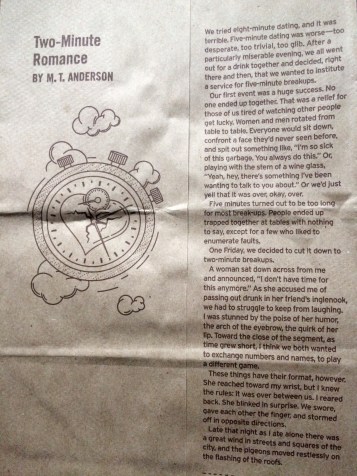
I love Chipotle for a variety of reasons (did you get your free burrito yesterday for Teacher Appreciation Week?), but one surprise I love encountering is whomever is published on my bag.  On my latest visit, I spied one of my favorite new authors on my heavenly-scented bag of burritos–MT Anderson.  This phenomenal author of Feed and Symphony for the City of the Dead is already a favorite in my classroom, so I know his work will go over well.

His story is a piece of microfiction, or a short short story, or flash fiction.  Whatever you call the genre, it’s a highly useful one for the multigenre research paper, which seeks to tell the story of its topic using a variety of genres.  This year, my students are focusing on their relationships to literature in their MGPs, and re-reading one of their favorite books from the year with an eye for telling the story of how they interacted with, learned from, and grew because of the text.

This piece of microfiction is, as a result, a great mentor text.  MT Anderson’s story leaps into the action without directly establishing setting, employs minimal but highly effective dialogue, and uses extremely precise diction.  These skills could easily be practiced during a quickwrite, which could then be revised into an MGP piece.

Screen Shot 2016-05-04 at 7.39.17 AMMentor Text #2:  Annotations in Books

Billy Collins’ great poem “Marginalia” has always been one of my favorites, and I thought it’d be a wonderful genre for this year’s MGP.  On a re-read, there’s plenty to say in the margins, plenty to preview on the inside cover, and plenty to exclaim about after the afterword.  For the project, I asked students to purchase their own copies of their favorite books they’d read this year so they could marginalia the heck out of them.

The creation of marginalia could be done, in part, in two separate class periods–one day for the preview note at the beginning, and one day for the review note at the end, with the remaining marginalia being written while the student was re-reading at home or during independent reading time.  Many of my students relish the idea of writing in books and enjoy encountering previous readers’ marginalia, so I know they’re excited to create a new text by adding to their favorite book.

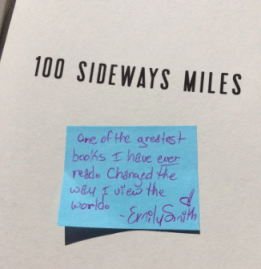
img_2536While I’ve been wanting to have students try this genre for a while, I was inspired by two mentor texts I stumbled upon–a note left in Andrew Smith’s 100 Sideways Miles, and the notes my students wrote in a copy of Shel Silverstein’s The Giving Tree, which they presented to me as a gift for Baby Ruth.  (Yes, it made me sob, and it wasn’t just the postpartum hormones!)
Mentor Text #3:  Biography Picture Books

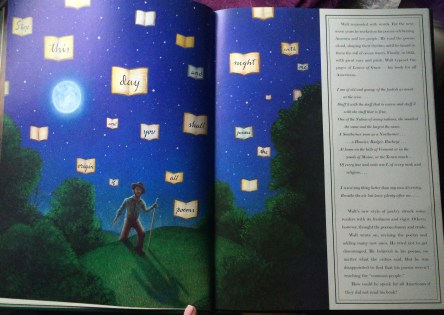
With the arrival of little Ruthie, I’ve found my taste in literature skewing to a decidedly younger set of titles.  One of my favorites is a beautiful, lyrical biography of Walt img_2535Whitman. As my students work to reflect on and engage with their favorite books, I want them thinking about the books’ authors as well–and writing about them, too.  This book is a wonderful mentor text for showing how an author came to be a writer.

Walt Whitman, written by Barbara Kerley and illustrated by Brian Selznick, is a gorgeous text that tells the story of Walt Whitman’s upbringing and eventual discovery of his love for writing.  Kerley intersperses lines of his poetry into the story, and they’re paired with beautiful illustrations by Selznick.  My students could easily create short biographies focused on how their authors became interested in writing, then pair them with an illustration for a children’s book genre to add to their MGP.


What writing lessons have you designed after stumbling upon random mentor texts?  Please share!