Author Archives: Shana Karnes

7 Moves in My Workshop Schedule

return and talkThis summer, we’d like to return and talk about some of our most useful, engaging, or popular posts.  Today’s post, written by Amy in 2015, reminds us how we might structure our days in a workshop classroom.

Please return to this topic and talk with us in the comments–what are the moves in your workshop schedule?


Quite often teachers ask me what the daily schedule looks like in my workshop classroom.

This is a hard one. I think mainly because it is not about the schedule as much as it is about the routines we start putting into place at the beginning of the school year.

I’ve had a lot of adapting to do this year. Moving to a new school and adjusting my lessons to fit 85 minute class periods where I see my students twice a week for sure and every other Friday (sometimes.) This is quite a change from 50 minute class periods where I saw my students five days a week.

Our normal routines  — and these are non-negotiables that make workshop work — consist of reading, conferring with readers, talking about books, writing in our notebooks, revising in our notebooks, sharing a bit of our writing, and learning or reinforcing a skill, then….it all depends on our workshop task. That’s why writing about my daily schedule is hard.

Here’s the best I can do without going into a long explanation.

READ — 10 to 15 minutes. This is sacred and silent reading time. Students choose books that interest them. I CONFER with my readers, most often with a specific focus, depending on my reader.

TALK about books. Sometimes I do a book talk, reading a few pages of the book, or holding

fabian

Fabian was so excited to share an insight from his book I could not get the camera to take the photo fast enough.

a book interview like Erika does. Sometimes a student does a book talk, if I’ve talked to her first and know she’s passionate about the book she’s just read. Sometimes I ask my students to just talk about the books they are reading, then ask them to write down any titles they think they might like to read next. Shana wrote about the Value of Talk, and I agree completely: “Talk is one of the most valuable tools at work in my classroom.”

WRITE in our writer’s notebooks. Everyday we need to have our students thinking on paper. When I forget, or think we do not have time to open our notebooks and write — in response to a poem, or a video, or a story, or about the books students are reading, or about whatever — I regret it.

Discussions are richer when we write first. Discoveries are more insightful when we write first. Writing is better when we write, just thinking about our ideas, first.

Then, something I learned from Penny Kittle, we always read what we wrote and REVISE. Penny modeled revising with a different color, and I ask my writers to do the same. I simply say, “Read over what you just wrote. How can you make your writing better? Maybe add a phrase or two that develops your thinking more. Maybe change a word or two that adds a punch. Maybe you can remove some words and make your thinking more concise. Where can you add figurative language or a list or an interesting style move?” (When I check writer’s notebooks, I always look for evidence of revision. We work on establishing the habit of revision, daily.)

SHARE some of our thinking. Sometimes we pair up and read our writing to a shoulder partner. Sometimes I ask for volunteers to share out their writing with the class. Sometimes I randomly call on someone (and I usually allow them to opt out at least once if they are uncomfortable reading aloud). Sharing is an important part of our community, and from the first day of school, we work on establishing a safe and respectful community where we can all grow as readers and writers.

Learn, or reinforce, a skill via MINI-LESSON. (If I introduce something totally new, like one of the AP English Language exam prompts, obviously, the mini-lesson will not be so mini. On these days, the mini-lesson time and the workshop time allotment swap places. Sometimes I need the focused direct instruction time because it saves time in the long run.)

Our routines usually take about 35 to 45 minutes. That leaves us about half the class period to hold a workshop. This might be a readers workshop if we are practicing close reading or if we are preparing for a Harkness discussion. This might be a writers workshop if we are composing a piece of writing or studying the moves of a favorite author.

Of course, if we are writing, I change my hat and confer with my writers.

I would love to know the workshop routines you establish with your readers and writers. Please share in the comments.

©Amy Rasmussen, 2011 – 2015

Four Ways to Formatively Assess in Workshop

return and talkThis summer, we’d like to return and talk about some of our most useful, engaging, or popular posts.  Today’s post, written by Shana in 2015, reminds us that formative assessment doesn’t have to be intimidating.

Please return to this topic and talk with us in the comments–how do you build routines for formative assessment into your classroom?


dtrfyguhujSometimes I wake up in the morning, thinking about what I’ll be teaching and learning that day, and feel like a rebel.  That’s right–I think to myself, feeling inexplicably cool–I teach workshop. Yeahhhhh.  Even though this is the most research-based, data-driven form of instruction I’ve encountered in my teaching career, a successful workshop is still such a rarity that I feel like I’m breaking all the rules by employing it every day.  I’m a rebel with a cause.

Still, when I stop feeling like James Dean and reality bites me in the butt, I know I need to be practical and follow the rules by putting some grades in the gradebook–once per week is the suggestion at our school.  If I had it my way, I’d go gradeless and celebrate the myriad acts of literacy within the confines of a classroom.  That’s not possible right now.  I needed another solution, and I think I found it in Amy, right here on this blog.  She writes powerfully about formative assessments in this post.  Her thinking mirrors mine:

I know when I am learning a new skill, I want to be able to practice–free from judgment–so that I might build some confidence before I am formally evaluated.  The same is true for kids.  We should give them opportunities to practice and build confidence.

One grade per week, when I’m grading to evaluate, is impossible.  We don’t master a different skill every single week.  Mastery requires practice.  So, I’ve focused lately on formative assessment for eight out of the nine-week grading periods, and summative for just one.  Here are the four categories I see formative assessment broken down into, and how I put them in the gradebook.

IMG_5605

Un-gradeable, amazing writing

1. Writer’s notebooks – I collect writer’s notebooks every two weeks, and students can receive up to 20 points per collection.  If all of our prompts and exercises are present, and I can see the student’s effort, he or she gets the full 20/20.  I also ask students to mark for me anything they’d like feedback on.  I check to see the status of their to-read, wondrous words (vocab), and cool craft (quotes) sections, but I also look for a telltale pink sticky note.  If I see one, I read the marked piece and write back–just feedback.

2.  Reading logs – Our reading logs are quite messy; you can see one example here.  There are arrows everywhere, new reading rates scribbled in, and tons of titles being read every week.  When students complete their reading goal of two hours per week–determined by individual reading rates–they get 10 points, every week.  Reading logs show me the big picture of a class’s progress, while conferences help me go deeper.  The reading log lets me know, at a glance, who’s soaring and who’s not–helping to give my conferences direction.

IMG_6904

Word play

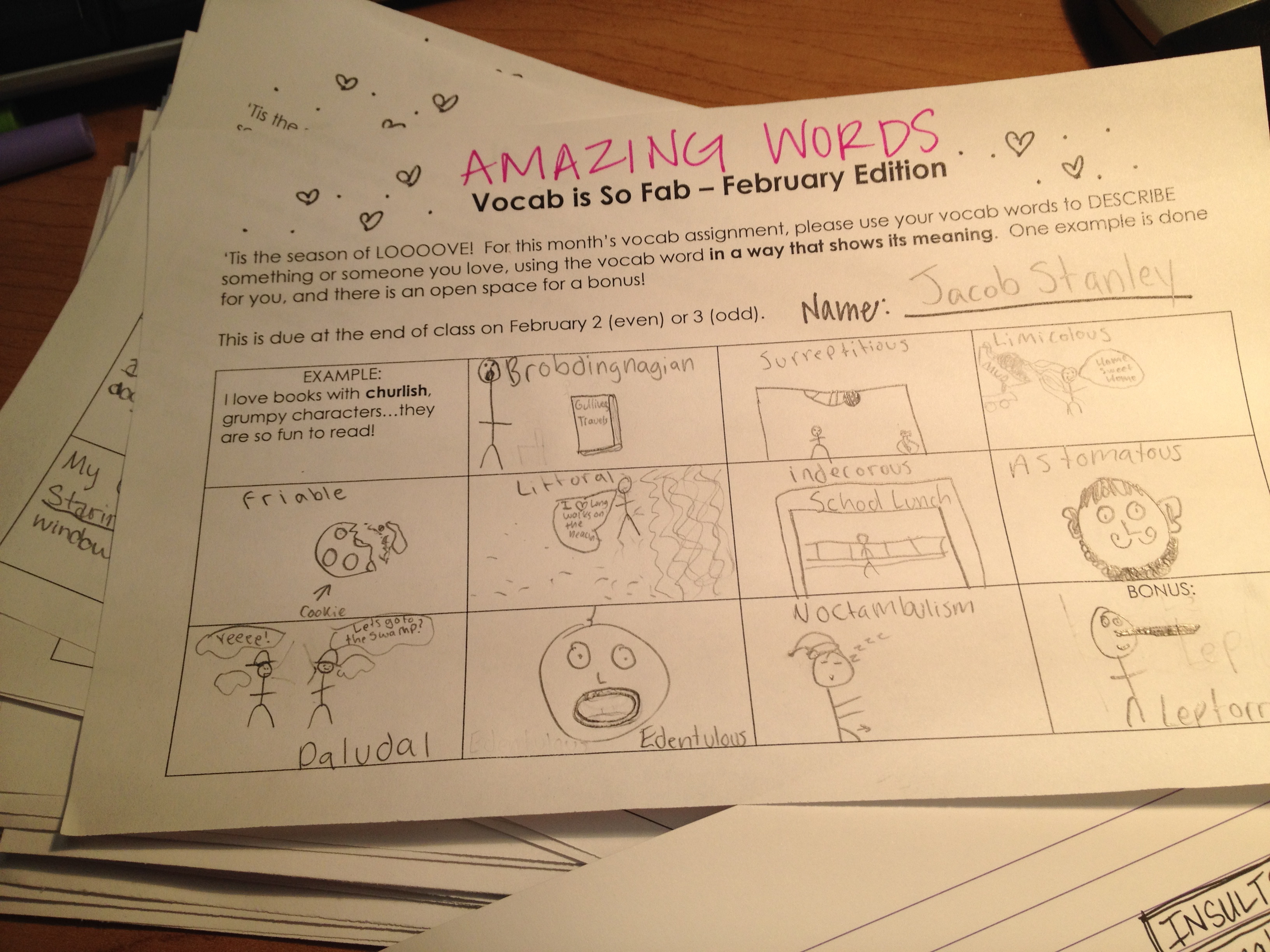
3.  Vocabulary – I still remember my orange Sadlier-Oxford vocab books from high school.  Those well-worn paperbacks were the source of many a cramped hand and a frantic fifteen minutes of homeroom before English class.  I know from personal experience that I don’t retain new words by completing fill-in-the-blank exercises–I learn by reading widely.  So, I ask my students to maintain a “wondrous words” section in their notebooks, writing down unfamiliar or unknown words as they read.  Then, I give them a different activity to complete with those words every two weeks.  The activities are worth 10 points each, and run the gamut from writing stories using the words to drawing pictures illustrating their meanings.

4. Honest self-assessments – When we finish a unit of any kind, usually about once a month–a writing unit, a reading unit, a book club, a challenge–I pass out a half-sheet with self-assessment questions on it.  I begin each half-sheet with a disclaimer:  “Be honest.  There’s no judgment here.  I just want to know why you were as successful as you were with this unit, and to know how I can help others be successful in the future.”  Students answer very truthfully, sometimes humorously so.  If their answers are thorough, they receive 15 points.

These four formative assessments total about 115 points per month.  With 9-week grading periods, students’ grades therefore are made up of about 2/3 formative assessments (230 points or so) and 1/3 summative assessments (100 points or so).  Well over half of the formative assessments are credit for the simple acts of doing the assigned reading and writing–no evaluation of those acts, just credit for the effort.  I value practice and process over product–and this grading system reflects that.

How do you handle grading, formative assessment, evaluation, etc.? Please share in the comments!

An Honest Reflection: No Ugly Crying Required

return and talkThis summer, we’d like to return and talk about some of our most useful, engaging, or popular posts.  Today’s post, written by Lisa in 2016, reminds us both that a love of reading and literature is a joyous part of our jobs, and also that it is often what leads us to a joy-centered workshop approach to teaching.

Please return to this topic and talk with us in the comments–how did your readers-writers workshop journey begin?


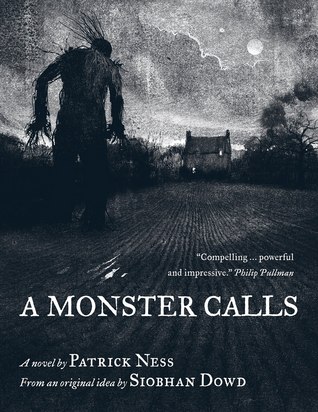
I just finished an ugly cry. You know, the kind where you sob until your eyes close so tightly that you wonder if you might hurt yourself? The delicious, exhausting, purge of a cry that leaves you breathless and wholly satisfied at the same time? In my humble opinion, it’s the type of weep-fest that only great writing can deliver, and I am delighted to report that I just slobbered my way through another story’s end that left me wanting to pick up the book and start right over again. On the recommendation of colleague, I picked up A Monster Calls on Friday afternoon during last period and finished it by Sunday afternoon.

Though I could go on for pages about how amazing this book is, and how excited I am to 8621462book talk this story tomorrow, and how transformative I think this text could be for some of my kids, it’s what led me to this text that I find really important right now. As a result,  approximately eight minutes after finishing that book, seven minutes after shoving a copy of it into my husband’s hands and insisting he “Read this. Read this immediately” (thankfully we’ve been married long enough that he can recognize a literary induced meltdown and not fear for his own safety), five minutes after texting half my department to tell them of my ugly-cry recommendation, and three minutes after blowing my nose one more time and pulling myself together enough to see the screen clearly, here I am. Counting the minutes until school starts, so I can tell students about this text. It’s the best feeling and it’s fueled by what I have deemed A Workshop Whirlwind.

A Workshop Whirlwind. And that’s not just cutesy alliteration either. It’s representative of an urgent and necessary flurry in my teaching career. And I, for one, could not be more excited. You see, it was this past week that Workshop came to knock on the door of the Franklin High School English Department in a real and meaningful way. And this is the story of how we’ve started down a path that I believe will change our practice and lead our students to see themselves as both readers and writers in a way we would not have thought possible.

Our journey with workshop is a unique one. We are going to be moving to this new delivery method as a whole group in one glorious leap. Thankfully, by a bit of divine intervention, we have had the support of the lovely and overwhelmingly talented ladies at Three Teachers Talk. It was TTT that gave us a place to land and see that workshop is not only possible at the high school level, but it can make a world of difference for our kids. And it was a little over a year ago, with the knowledge that my department was being asked to drastically change our day to day practice, that I pored through post after post on this blog searching for guidance. How to plan, how to assess, how to hold kids accountable, and how to organize, but most importantly…how to inspire our students. How to help them see that reading and writing could be so much more than an assignment. That our study of English could be a study of what it means to be. What it means to feel.

Now, change is rarely easy. In fact it sometimes leads to a brand of ugly-crying that is reserved for just these circumstances, where you feel the happy ship you’ve been sailing on has hit something substantial and the band has already started playing “Nearer My God to Thee.” Everyone find a lifeboat! We’re never going to make it out of here alive! I liked this boat a lot better before you put this big hole in the side.” And that, my friends, is what change does to a person. What change can do to an English department. Like the seven stages of grief, change too has its stages, and I’ve both felt these stages and watched my department try to stay afloat as this major shift comes our way. See, we aren’t individual contractors, coming at this move to workshop only out of our own desire to do so. This is a district level move that has led to the following:

Shock They want us to do what? I can’t even. I just…can’t.
Denial This isn’t happening. This isn’t happening. This isn’t happening.
Anger Nope. Just nope. You people are crazy. We should just set  the place on fire, while we’re at it.
Bargaining I can still teach __________ right? I’ll do this workshop thing, but only if I can still    teach ________.
Depression Whatever. It’s fine. More change. Not like we aren’t used to it. What does it matter, anyway? What does any of it matter? I’ll be in my room, reading __________ (please see stage above).
Testing Well, I guess I could give them time to read at the start of class. That makes sense to me. I love books too, so, natural move.
Acceptance I too am a reader and writer. I can do this.

And now, I am happy to report an eighth and amazing stage to this move – genuine enthusiasm.

In the last week, since Amy and Shana came to lead our department in two incredible days of professional development, I have felt a surge of excitement at everything I want to do in my own classroom and I’ve seen my entire department rally around this initiative in a way I would not have thought possible. In the last week, the halls of Franklin High School have echoed with book talks, students are curled up in corners with texts, and  teachers are chatting about trying out new strategies and putting together mini lessons. In the last week, the Wisconsin  “Bleak Mid-Winter February” has been anything but.

The teachers I am privileged to work with have been doing phenomenal work for years, since long before I joined their team. Their skill and passion, which has long fueled their sincere desire to help students learn, makes this an incredible place to work. And so, while my team would collectively injure me if I announced that everyone feels totally relaxed and ready to hold hands and sing Kum Ba Yah, I can confidently say that our journey has begun. We are poised and now also excited, to continue learning with and inspiring our students in new ways.

No ugly crying required.

Lisa Dennis is the English Department Manager at Franklin High School in Franklin, WI. Her energetic leadership and insight leads her department into the wonderful world of workshop instruction. TTT appreciates Lisa’s candor and drive to do right by her colleagues — and all their students. We thank God for teachers like Lisa!

The Value of Talk

return and talkThis summer, we’d like to return and talk about some of our most useful, engaging, or popular posts.  Today’s post, written by Shana in 2015, reminds us that frequent talk–both structured and unstructured–in addition to frequent reading and writing is what’s at the center of workshop.

Please return to this topic and talk with us in the comments–how do you create space for both student-to-student and student-to-teacher talk in your classroom?


Talk is one of the most powerful tools at work in my classroom.  Now, I’m talking about talknot discussion, sharing, peer editing, Socratic seminars, think-pair-share, or any other structured form of communication that might occur.  The simple act of letting our students just talk is invaluable, and we must create spaces in our curriculum for it to take place.  Here are three ways I encourage talk in my classroom.

Conferences – Reading and writing conferences aren’t just about assessment.  They’re also a valuable time for teachers and students to just talk to one another, getting to know each other as the humans that we are.  Creating a space for talk breaks down the teacher-student barrier, humanizes both parties, and by and large erases discipline problems in my classroom.  I begin every conference with a simple, “How are you today?”, and after genuinely listening for the child’s answer, direct the conference from there.  Some conferences, we don’t talk about books or writing–we just talk, because the student needs to.

IMG_6441

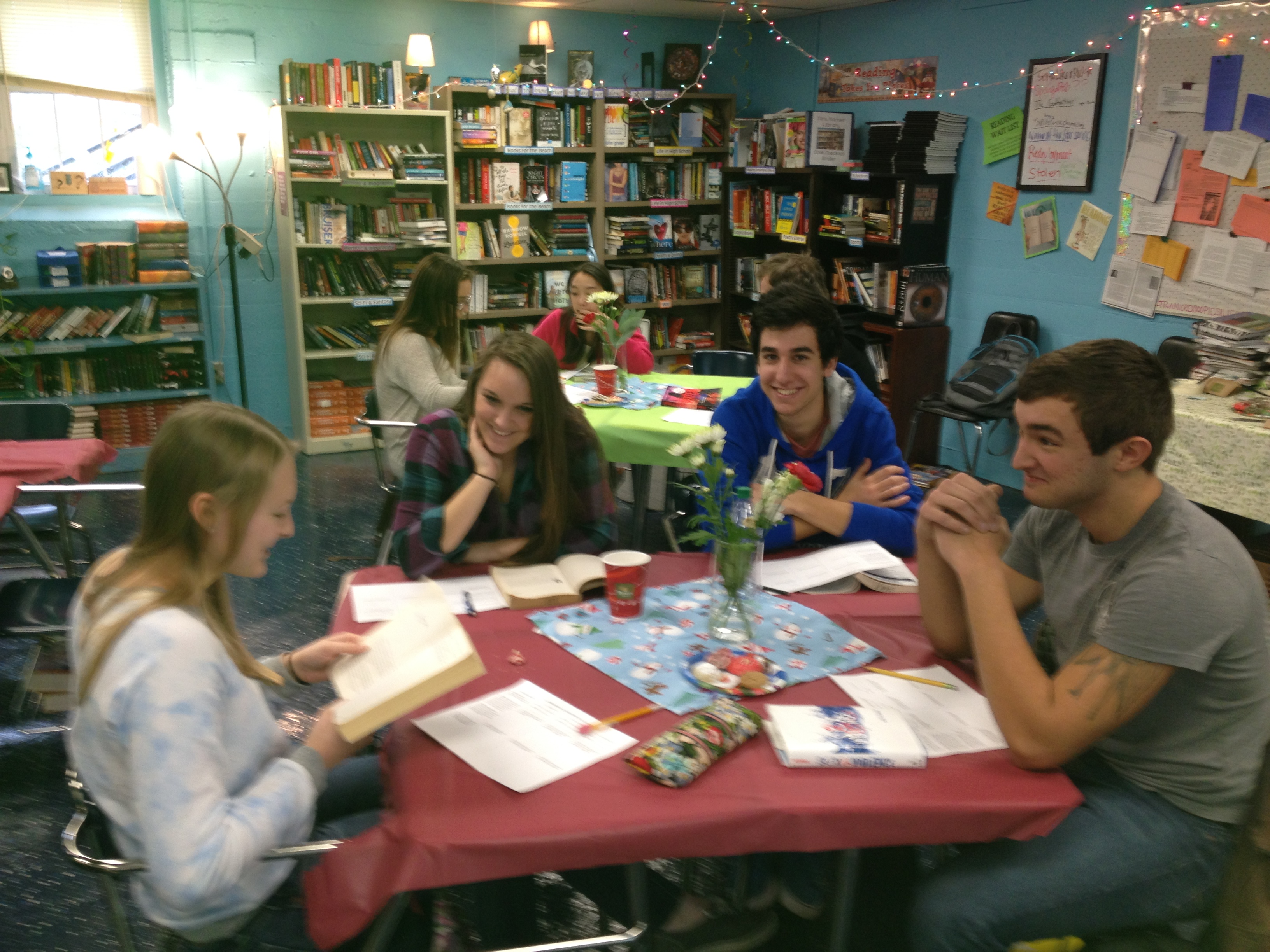
Students chat during the ‘Book Bistro’

Book Clubs – Not every book club meeting requires structure or an agenda to be valuable.  During this most recent unit, I simply asked students to keep the conversation going for 20 straight minutes.  They sometimes had to cast about for topics, but they always found something to discuss–mostly their books, but often text-to-text/self/world connections they’d made, which spun off into generalized, real-life conversations between kids who wouldn’t ordinarily find themselves chatting.  After finishing book clubs, Ana wrote, “I loved our book clubs because I felt like I got to know everyone better.”  She wrote other things about how she grew as a reader and writer…but she LOVED the unit because of the TALK that happened.

Root of the Writing Process – My journalism students consistently talk out their ideas at the very beginning of the writing process.  They chat in groups, usually starting with, “so what should I write about?”  It takes a few minutes, but enlightenment inevitably follows–the other day, Shay threw a few silly ideas out for Kenleigh about bathroom graffiti, but then they got serious about that as a story idea.  “You could call your piece ‘Signs from the Stalls,'” Shay said.  “AHHHH, that’s a great idea!!” Kenleigh enthused.  What kids like to talk about is often what they’d like to write about, and they need to talk to get to the heart of those topic ideas.

Talk builds community.  Talk is the tool that made my former student Emily say, “I felt like by the end of the year, everyone in the class became my best friend, including you.”

How do you see talk improving your classroom and its community?  What spaces do you create for talk in your classes?

Aim Higher: A Case for Choice Reading and a Whole Lot More in AP English

return and talkThis summer, we’d like to return and talk about some of our most useful, engaging, or popular posts.  Today’s post, written by Amy in 2015, makes the case for choice reading in AP English.

Please return to this topic and talk with us in the comments–does choice reading belong in AP?  How do you put student autonomy at the center of your AP classes?


I’m going to just say this right up front:  I hope to challenge some thinking.

I asked some friends for feedback on this post and got opposing advice. I let it rest for half a week. I prayed about it. And then today I read this post by Donalyn Miller, author of The Book Whisperer and Reading in the Wild. I’m not positive, but I’m pretty sure she wrote it in a response to a comment on this post by Amanda Palmer, Secondary Language Arts Coordinator in Katy, TX. I’ve written about my own students and their experiences as they’ve grown as readers before at Nerdy Book Club and on this blog; and I’ve presented on how I advocate for choice in AP English at conferences.

I hope I can be a voice of reason and an inspiration for the good of all students. So, if you’ll hang with me here, I’ve got a case for choice reading in AP English.


“I wish my daughter was in your AP English class,” my friend told me. “She has to decorate Kleenex boxes in hers.”

We’d had this conversation before:  I am an advocate of self-selected reading, and I fully embrace readers and writers workshop in my AP English Language and Composition classroom; Sarah is an advanced reader in an AP English course where the teacher chooses all the texts and assigns “clever” ways for the students to show that they are reading. Anyone who knows Penny Kittle’s work, and Donalyn Miller’s work, and my work, which is so much about helping students develop as life-long readers, understands that Sarah is not having the kind of experience in her English class that we advocate and hope for all children.

Making the Move to Move Readers

Many teachers and administrators across the country have recognized that students in secondary classrooms are not reading. If students are not readers, they tend to struggle in all academic subjects — not just English. Schools adopt interdisciplinary practices, whole school vocabulary instruction and stop-everything-and-read programs in an attempt to improve reading scores on standardized tests. Many have moved to readers and writers workshop, where choice-independent reading is key, instead of the traditional secondary-English pedagogy where the teacher selects all the texts, usually classics, and all the writing topics a student is expected to write about for class. Those who have made the move will tell you that choice matters, along with time to read and write, when it comes to student engagement and real movement in our teenage readers and writers.

However, from what I’ve seen and heard, most of this choice is happening in general education classes — not honors and AP English. The teachers in most advanced classes I know of are still making all the choices. It’s like we do not trust our high-achieving students to move themselves into complex texts. We focus on the literature instead of the literacy. And we rob children who already have a grasp of language, who already have many of the study skills they need to pass English classes, with the opportunities to grow as much as they are able.

We make changes in our pedagogy that allow our reluctant and struggling learners to grow but not our proficient kids? Where is the sense it that?

Evidence that Readers and Writers Workshop Works

One day last week, I sat and listened to my district’s ELA director share our state re-tester data. I usually hate this kind of meeting, but our gains are huge — due in large part because of the redesign of tutorial lessons, many of which teachers have adopted into their mainstream instruction. The ELA director changed the model and worked closely with North Star of TX Writing Project to produce writing workshop lessons (most of which came out of my classroom and pedagogy) that broke the mold of Response to Intervention. The dramatic increase in re-tester scores (an average of 200+ point increase per student) proves the lessons are working to move student readers and writers. Workshop-style writing lessons and a campus-wide, district-wide commitment to independent reading is working.

Making the Move in Advanced English Classes — or Not

The next day I sat in a meeting with the AP English team on my home campus. (Important note:  The same day that in second period a young woman asked me to recommend her a book of classic literature because she wanted to read something more complex. She and I stood in front of my “Challenge Yourself” shelf, and in about six minutes while the rest of the class read silently, I taught a mini-lesson on Gothic literature and the Regency Era and book talked the Bronte sisters’ books and Jane Austen. Rebecca left class with Pride and Prejudice, a book she chose to read because she wanted a romance that sounded interesting.) In that vertical alignment meeting, the conversation bounced around to what students must know and returned a few times to the books “all students must read.” After a while, someone asked me what I thought.

“Is it really about the book, or is it about the reader?” I asked.

“Well, it’s both,” two teachers answered.

“Then why does the book matter as much as the students’ abilities to read the books?”

“Because they will never read these books on their own, and they have to read a storehouse of canonical texts in order to write on the AP Lit exam,” they said.

“So you’re basing the reading lives of all pre-AP students in 9th and 10th grade on one open-ended question on the AP exam their senior year?”

“Well, they also have to analyze a passage,” one teacher added.

“Yes, and that’s like studying lists of SAT words hoping students learn the few out of 5,000 that might be on the SAT exam. It’s a total crapshoot.

“Shouldn’t we be more concerned about students being able to read at complex levels than deciding which books they must read?”

Another teacher joined in “I want my students to be prepared for the kinds of reading they will be expected to know when they go into college classrooms. That is providing equity. If they know The Iliad, Beowulf, Dante, they will be on equal footing as those classmates who read those things at the affluent schools across town.”

“Shouldn’t the equity be in the skills our students possess? Can they read and understand complex texts like the students across town?”


How Do We Know If Students Are Reading

I know that many, if not most, of those students at other schools are not reading those books. Few high school students read the assigned texts in English classes. Ask them. I have student writing from the past five years that tells me in their own words about their reading habits in high school. And there are plenty of well-researched articles like this one from the English Journal that concur. It is true: few high school students read the assigned texts in English classes. Why doesn’t this matter to their teachers?

“How do you know they are reading the independent reading books you let them choose?” a teacher asked me.

“Because I talk to them about what they are reading,” I answered.

“I do that, too, about the books I assign,” she said, but I am pretty sure that her idea of talking about books with students and mine are very different. I call it conferences. She calls it lectures.

I felt disheartened and sad for the honor student at the outcome of that vertical alignment meeting:  AP teachers deciding what four books teachers in preAP 9th and 10th grade must teach in order to prepare students for Advanced Placement in 11th and 12th grade.*

I fear that students will be just as prepared as they have been, which in my one-semester at this campus is not much. At the most, they will read four books a year, and the only students who will read the assigned texts are the ones who are readers anyway, who are studious enough, or care about their grades enough, to do what the teacher says. Everyone else will read a little and Sparknotes a lot, listening in to class discussions, and learning enough to pass exams that cover the conflict, plot, symbolism, and theme of the assigned text. Few, if any, will grow as readers who fall in love with words and characters and the beauty and the texture of carefully crafted stories.  It happens over and over and over again.

We deprive the students who take advantage of the College Board’s open enrollment policy, the students who voluntarily agree to more rigor, and we allow them to make it through high school English without growing as readers. I would argue that in many cases, there is high probability that they regress as readers.

How does that make any sense?


Looks Like the College Board Advocates for Readers Writers Workshop

The College Board provides course descriptions for each of the 34 AP courses and exams it offers. The descriptions reflect the course material that might be taught in a comparable college course. This makes designing a curriculum relatively easy for many of the courses taught. Biology and World History, for example, have definite knowledge-based skills that must be covered throughout the course. AP English courses are another story. Since first-year college composition courses are so diverse and vary from college to college, the structure of these classes on high school campuses can be diverse as well. AP programs, and even individual teachers, may design their courses based on their own interests and desires. Of course, the AP classes must reflect and assess college-level expectations, but that’s pretty much the only requirement. There are no prescribed essays that students must write, although there are suggestions of form. There are no required novels to read, although there is a suggested list of authors. Suggested being a key word. Teachers have a great deal of freedom in how they design their courses and what they put on their syllabi. See

AP English Language and Composition Course Overview

AP English Literature and Composition Course Overview

We can still read texts spanning from the 1600’s to the 21 century. We can still read literature that we deem important to our literary canon. But do we have to make all the choices in our Advanced Classes?

We can foster literate lives if we will take the same approach to literacy that is working in thousands of classrooms across the country:  Readers and Writers Workshop where choice matters and time to read and write mean deep and lasting learning.

So What’s the Real Deal

After talking this over with several of my peers, I’ve decided on a few reasons why honors and AP English teachers refuse to “drink the Kool Aid” (Isn’t that a nice derogatory way of describing readers/writers workshop? I hear it often):

  • Some teachers loved the experience they had with literature in their high school English classes. This is the reason they chose to be English teachers. (I am one of these teachers.) They want to duplicate those positive experiences for their students. A worthy ambition. However, I wonder if they have considered how many of their classmates experienced the same excitement at reading (or not) the literature that the teacher mandated.
  • Some teachers are not readers themselves. They love the books they’ve chosen to use in their classes, but rarely do they read anything from a best-seller list, or an awards list. They want to stay with what is known and comfortable. Many times these teachers mistake their duty:  to teach the child and not the book.
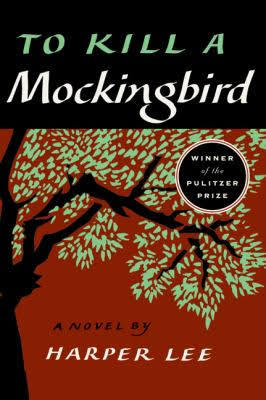
  • Some teachers believe that certain pieces of literature must be read by every student on the planet. “If I don’t teach this book, then these students will never read it” is a statement I’ve heard many times. My answer is always “Yes, but many are still not reading it when you teach it.” We ruin the the taste of great literature for many students when we force books on them that they are not ready for. I’ve asked all of my students this year about their reading in 10th grade. Not one of them has said they love To Kill a Mockingbird, one of two books they had to read last year. Why would we want to turn students off of a much beloved book like TKMB?
  • Some teachers believe that 10 to 15 minutes of sustained silent reading at the beginning of class is the same as instruction with choice reading. Sure, this reading time, especially if students are reading books that they choose, is important. It is a step. But it is not the same as structuring instruction around readers workshop where students not only read books that they choose, they think about them, talk about them, learn within them. They confer with a teacher intent on moving the reader in the best differentiated instruction possible.
  • Some teachers are afraid of giving up control. They fear that if students are all reading different texts they won’t know how to manage the class or guide the learning. This is a valid concern, but it is also something they can learn how to do. Many of us are doing it. We are happy to share how.

I am sure there are other reasons, and really, I mean no disrespect. I know my colleagues are hardworking and loving educators. I like them a lot. I respect them for the work they do, and I am sure that their students are learning in their classes. I know this is true for many other teachers and classrooms across America, too. I just really want to challenge some thinking.

What if we can do more?


Let’s Allow all Students the Advantages of Choice

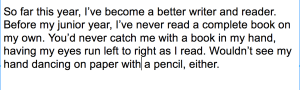
More than anything, I want all students to have opportunities to rise above the norm, and maybe, just
~Joseph, AP English Language and Composition Student

maybe, we will see many more students, not just our struggling ones, immersed in books they love, and thinking about their reading in ways we’ve never imagined. Their engagement will improve. Their growth will astound us. They will develop as critical thinkers, accomplished writers, and as empathetic individuals ready to take on the challenges of college and their world.

I mentioned at the beginning of this post that I shared a draft of it with my writing partners. This response from Shana is important:

“I was an AP Lit kid, and an Honors English kid.  I SparkNoted The Scarlet Letter, Beowulf, Iliad, Catcher in the Rye, and the rest.  I never read a bit of it.  In fact, I didn’t read ANYTHING that was assigned to me simply because of the fact that it had been ASSIGNED.  I was stubborn like that.  And I got A’s all the way through.  And a 5 on the AP test.  All the while tearing through John Grisham, Elizabeth Peters, and the entire Bestsellers section of my public library outside of class.

“Then, my freshman year of college, when I took a workshop class in which I was allowed to self-select what I read, I chose the Scarlet Letter and thought it was the most beautiful love story I’d ever read.  I finished it and read it again.  Since that day, when I realized that because I was one of those AP kids and I COULD read those works, I’ve discovered that I LOVE them.  But I never read a single one of them until after high school.  My well-known love for Jane Austen didn’t emerge until I wrote a paper on Pride and Prejudice and A Midsummer Night’s Dream for my Shakespeare capstone.  I just read Mockingbird last summer for the first time ever.  [Note: I read it when I was 40.]

“I was never allowed to choose for myself in AP or Honors English, but had I been allowed to…I would have read all of those books, and arrived at a deeper level of love and reverence for literature, much earlier in my reading life.

“One thing I might add — I totally disagree with that AP Lit teacher saying that students needed to draw from classic lit for the test.  Many of my AP kids who got 5s wrote about modern classics…Oscar Wao, Life of Pi, whatever.  You don’t have to know CLASSICS to ace the Lit exam…you just have to know how to write authentically about complex texts, and that’s what we do in workshop, and what kids should be doing in AP classes.”

I know there are others who have made the shift. I got this in an email message just today from Jeannine in CA. We had a nice chat at NCTE:  “Thank you for our November communication. I have altered much of my instruction to incorporate choice reading.  The students are soaring!!!”

Another AP English teacher trusting herself and her students enough to make a change and see where it takes them.


Why, Yes, There’s Research to Support This Pedagogy

I mentioned Donalyn’s post at the beginning of this long one. It is all about the research, the theory that outlines and supports what it takes to grow readers. Allington, Atwell, Krashen, Moss, Fisher, Ivey, and Kittle, and Gallagher and more.

I add another:  Last summer at the University of New Hampshire Literacy Institute Penny Kittle had us read Making Meaning with Texts, Selected Essays by Louise Rosenblatt. Rosenblatt’s research spans decades and is just as applicable today as when she wrote it years ago. I challenge every English educator to read the whole of Rosenblatt’s essay “The Acid Test for Literature Teaching, published in 1956. Or, at least to respond honestly to Rosenblatt’s conclusion. Odds are you will make the shift to choice, if you haven’t already:

“As we review our current high school programs in literature, we need to hold on to the essentials, or take the opportunity as re-adjustments come about, to create the practice that will meet the acid test:

Does this practice or approach hinder or foster a sense that literature exists as a form of personally meaningful experiences?

Is the pupil’s interaction with the literary work itself the center from which all else radiates?

Is the student being helped to grow into a relationship of integrity to language and literature?

Is he building a lifetime habit of significant reading?”


*In an email after I’d written this post, I received the notes from that meeting, and I am happy to say that there were no specific book titles listed, just the admonition that students in 9 and 10 grade preAP classes read 3-5 whole class texts of a complex nature. And students need to read 15-20 books a year to grow as readers. (Yes, I did throw in that bit of research while in that meeting.)

©Amy Rasmussen, 2011 – 2015

Whole-Class Novels: To Teach, or Not To Teach?

return and talkThis summer, we’d like to return and talk about some of our most useful, engaging, or popular posts.  Today’s post, written by Jackie and Shana in 2015, asks us to consider why we teach whole-class novels, and what happens when we do–and don’t.

Please return to this topic and talk with us in the comments–how do you teach whole-class texts?  By choice?  By mandate?  What do you do to teach readers, not books?


This past summer Shana and Jackie found that we’d both taken on a unique experiment within some of our classes–we had decided to strip them of whole class novels and instead focus on independent reading, book clubs, and smaller whole-class texts.  As workshop teachers confident in the power of choice reading, we each felt that this shift would be both empowering and inspiring within our classrooms.  After our year of experimentation, we both left our classrooms with unique perspectives on the power of whole-class novels as well as how we would incorporate them moving forward.

Over the next three days, we will post our insights and discussion we’ve had over the past week using Google Docs.  Please, join the conversation in the comments!

imagesQuestion 1: How did you decide to get rid of of whole class novels?

Jackie: Last year I was faced with a unique opportunity: the English Department voted to end popular College Preparatory Advanced Composition course.  Despite the well established curriculum, I tossed aside the typical whole class novels in favor of independent reading. As a primarily freshman English teacher, I am required to teach one Shakespeare play and To Kill A Mockingbird.  Advanced Composition gave me the opportunity to focus on smaller whole class reads and mentor texts within daily writing workshops without devoting whole units to one book.

Shana:  After six years of teaching, I wasn’t really sure why I felt compelled to teach whole-class novels.  Every year, when I picked up Catcher in the Rye, I dreaded my job.  I hated that book, and I had no idea how to get my students to love it or connect with it.  It felt like a chore to drag my students through “reading” that text (mostly they were SparkNoting it, sometimes with the assistance of their football coaches–true story).  I knew that not every student loved every novel that I did (particularly Their Eyes Were Watching God), and I knew that I didn’t love every novel my students read on their own (particularly everything by Nicholas Sparks).  I started to wonder–what would my teaching be like if I didn’t feel compelled to teach a whole-class novel…merely because I should?

Jackie: The eye opening experience for me was definitely during my first year of teaching.  I began integrating independent reading into my curriculum and I suddenly found out how many voracious readers I had in class.  My teaching was getting in the way of these students’ education! I like how Shana puts it–I also knew that my students didn’t love the novels I did (Speak by Laurie Halse Anderson) and in the end, if I gave them freedom, I too would learn much more about literature, reading, and teenagers.

Shana:  I like that Jackie mentions the issue of devoting whole units to a book–I loved having the freedom to design units of study that weren’t anchored around a novel, but rather a different genre.

Rye_catcherQuestion 2: What were the positives of having no whole class novels and what were the negatives?

Jackie:  After a year, I have found both positives and negatives to removing whole class novels.  Getting rid of whole class novels allowed me more time to focus on the positive aspects of the workshop model.  Naturally student choice led to easier student buy-in, and I spent less time convincing students of the value of reading.  As a result, we spent more time cracking apart smaller whole class reads like essays, poems, and articles and truly contemplating the author’s choices and craft.  Additionally, I liked that I could assess students and discuss their growth based on their own reading goals and progress.  

I have yet to find a solution to the “be on this page by this day” debacle that comes with teaching whole class novels.  Too often whole class novels lead to less differentiation and more stress, which can lead to the “gotcha” feel that comes with discussing larger, longer texts.  

That being said, there was a lot that I missed about having whole class novels.  Losing a longer common text meant that students didn’t have the common classroom experience of connecting over both the successes and frustrations of working through a complex text together.  I was surprised by how much students want to discuss their reading with classmates.  While reading can at times feel solitary and maybe even isolating during the actual act, in reality, reading complex texts is a communal activity that unites groups through a variety of perspectives, opinions, and interpretations.

Shana:  The positives were that I felt like my curriculum map was much more relaxed and flexible, in contrast to the years where I felt like I had to teach a minimum number of novels and “fit them in.”  I also loved seeing my students’ love of reading skyrocket as they engaged in choice and challenges on only an independent or small-group basis.

The negatives were more nebulous–I just felt like something was missing.  Our learners crave a challenge, and navigating a difficult novel is a challenge all readers relish if they have autonomy in their reading of that novel.  Reading a novel together provides an opportunity for me to create instruction that scaffolds a student’s reading skills up to the level of that novel, allowing them to participate in a reading experience they may not have been able to enjoy otherwise.

I also really missed being able to ascertain the barometer of a class’s feelings on a certain theme or issue through discussions of a complex text.  Crime and Punishment explores issues of morality, regret, and psychology in a far more complex way than “The Tell-Tale Heart” ever could, and although both stories have very similar themes, the novel lends itself to the sustenance of thought, evolution of a character, and length of a reading experience that I so craved for my students.  I also think that some reading skills specific to stamina, fluency, and automaticity cannot be practiced or taught effectively without a lengthy text, so I felt that last year, my students missed out on practicing those skills.

Jackie: While we both feel similar in the value of whole class novels , I know that neither of us would return to a set list of novels.  Whole class novels allow us to engage in common discussions but independent reading lays the groundwork for students’ stamina and confidence.  I don’t start my first round of literature circles until the second quarter because of this.  As much as students need a communal reading experience, I believe they first need a taste of independence and success.
Shana:  I still haven’t figured out the whole reading schedule thing either, nor how to create buy-in for every single student so that they autonomously, independently want to read a novel.  I struggle with the this-page-by-this-day conundrum, too, mostly because I feel like that creates a certain accountability that kids get hung up on, because it relates to the dreaded word GRADES. 

More of our discussion will follow tomorrow.  Be sure to join the conversation today in the comments!

Click here to read day two of our discussion.

Why Workshop? It’s All Very Simple

This summer, we’d like to return and talk about some of our most useful, engaging, or popular posts.  Today’s post, written by Amy in 2014, reminds us why we, as teachers, make the decision to have a readers-writers workshop classroom.

Please return to this topic and talk with us in the comments–why do you choose workshop?


return and talkAttending the University of New Hampshire Literacy Institute for the past two summers has been one of the best blessings in my teaching career. I’ve remembered what it means to be a student, replete with pages and pages of reading assignments, almost nightly research papers, and the expectation that I will participate in class.

Sure, I earned graduate credit, but more importantly, I sat as a student. I remembered what it feels like to have a teacher present a task, encourage a discussion, require I read something. I remembered what it means to be the learner. And I wanted to learn.

I think all students want to learn. I also think that many of them do not know how.

Last week I met with my new friend Holly. We shared ideas about our plans for August and how we will more fully implement readers/writers workshop in our classrooms. We discussed what it means to struggle as a student in an English class where English is not our first language, and reading books is a new idea, and the lack of food in our home is just one component of the lack of security we feel every single day. We talked about what it must feel like to these children to fail state tests year after year. Because they do. Holly will be teaching 10th grade for the first time, and her ESL background will benefit her students immensely. I will be teaching AP English Language, and all my students will be in the AVID program. I am convinced the AVID philosophy is one every teacher should embrace:

Hold students accountable to the highest standards,
    provide academic and social support,
 and they will rise to the challenge.

It’s a philosophy every good teacher I know applies in his classroom. It’s also why so many of us choose the pedagogy of Readers and Writers Workshop. Our high standards might be the same for all students, but the support we must give to help them rise to the various challenges with reading and writing must be individualized. Their needs are different; therefore, we must differentiate.

One-on-one reading and writing conferences become daily events.

We encourage, and nudge, and teach the skills that a student needs at that moment, during that task. This is authentic instruction. And it invites authentic learning.

As I think about this new school year on a new campus in a new district with new colleagues, new administrators, and new schedules (block days versus the traditional eight period days), I want to remember what it feels like from the student perspective.

“I need you to notice me, support me, show me how to learn.”

I had a colleague ask me recently, “Which is harder to plan:  teaching the traditional way with teachers making choices, or your way with students making the choices?”

I should have said, “Is that really the right question?” which would have been a better response than the one I gave him.

It is hard work being a teacher in a workshop classroom. I have to know my students. I have to talk with them and know what they do with their time outside of school, who their friends are, what their dreams are for after high school. I have to be a reader, and I often have to read books I’d never read except to try to match the right book with a student who hates reading. I have to allow choice in topics, and get used to feeling uncomfortable. I have to give up control, and let teens be real in an environment that invites their opinions, and sometimes their scorn. I have to write in front of them and show my vulnerability. They have to see me struggle because all writers do. I have to love moving students as readers and writers because ultimately, if I am their English teacher, and I am not moving readers and writers, I am not doing my job.

Is it hard? Absolutely.

But here’s the thing: It’s really not a ‘have to’ as much as it’s a ‘get to.’

“Simple can be harder than complex: You have to work hard to get your thinking clean to make it simple. But it’s worth it in the end because once you get there, you can move mountains.”  ~Steve Jobs

“It’s all very simple. But maybe because it’s so simple, it’s also hard.” ~Natuski Takay

The Importance of Summer Reading by Sarah Krajewkski

guest post iconIt’s that time of year again when the beauty of our classrooms begin to disappear. Posters and signs that inspired students vanish from walls and doors. Classroom supplies get dumped into storage bins and closets. Those smiling cherubs are no longer waiting for us to greet them. It’s summer.
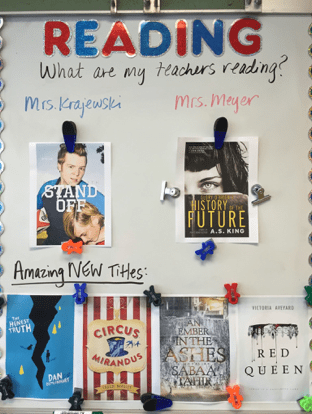
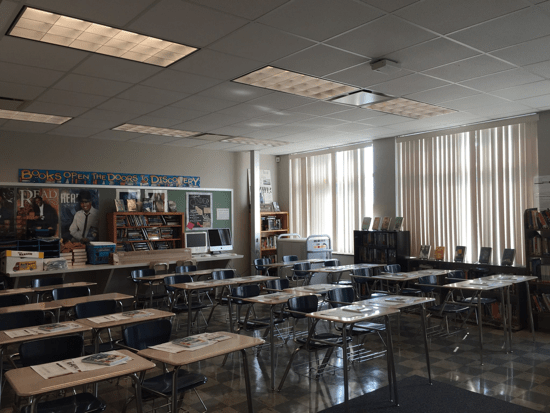
Summertime doesn’t mean that reading has to stop, but too often it does for our students. For many students in low-income areas, the moment they leave school on the last day is the last time a book enters their hands until the following school year. Reading is not a priority over the summer for these students, and it should be. Study after study proves what Richard Allington has been saying for decades: the achievement gap between high and low income children continues to widen. Allington states that as they enter public school, children go “from less than a year’s difference upon entering Kindergarten to almost 3 years’ difference by the end of 6th grade” (Allington and McGill-Franzen 4-5). Summer reading loss is a huge part of the problem, for students who do not pick up a single book in those 10 weeks of summer are 10 weeks further behind in the fall. My district has a high poverty rate, so this concerns me. Each school year, I aim to do more to promote the importance of independent reading in my district. I also do all I can to show students that reading can provide them with as much entertainment as their iPhones can. Now, I am revising my goal to include summer vacation.

Picture1

One of the front whiteboards in my classroom

Picture2

Five of the 12 bookshelves in my classroom library


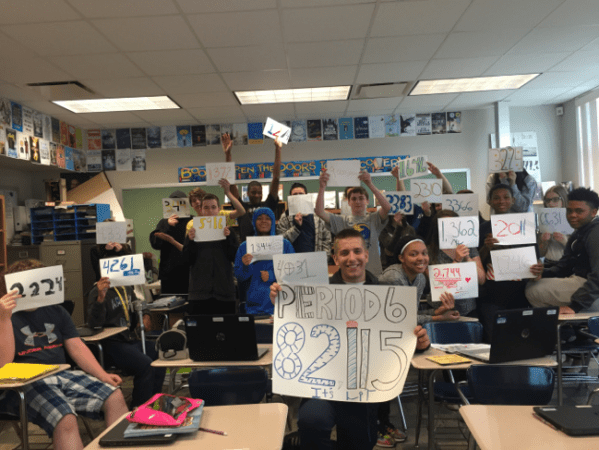
It all starts with falling in love with reading during the school year. If students aren’t reading consistently from September to June, they won’t read on their own over the summer. So, starting that very first week, I gave all of my students time to read in class EVERY DAY. It became a habit. After those 15 minutes, I always “book talked” an intriguing new title I read myself or heard about from a trusted source. I really had to know my books, as well as the various genres my students enjoyed. I made sure my classroom library was visible. I surrounded my students in a sea of books. “Book passes” got students into new titles they didn’t know about. (Think speed dating with books.) We used Goodreads to reflect and share our reading experiences with peers, which created a reading community outside of our classroom. We Skyped with some of their favorite authors. I showed them all the important reading statistics I could find. Most importantly, I never gave up on those students that said they “just hated reading” or “couldn’t find a good book.” By the end of the year, my 94 9th graders read over 366,000 pages, and all but three read at least 1,000 pages. ALL of them said they found books that they enjoyed. They are readers, and I want them to stay readers, so I began thinking about encouraging summer reading.

Picture3

My 6th period English 9 class shares how proud they are of all that they read


Throughout the last few weeks of school, I began the prep work. I started promoting my all-important “summer library hours” during the daily announcements so students knew when their trusted reading sanctuary would be available to them. Almost every Tuesday and Wednesday they will be able to check out a few books, preview new titles, or even just stay and read quietly for a few hours. (Soon weekly emails will be sent out to parents with reminders about these summer hours, as well as “reading tips” to get their children reading, and a link to my blog that contains the Class of 2019’s favorite books of the year.) Next, I began book talking titles that would be coming out over the summer to lure my students into my classroom library. At the beginning of June, I encouraged my students to help me promote the Little Free Libraries our district would be getting at the end of August. These libraries will serve as an additional reading reminder, for students will be coming into my classroom to paint and stock them. I also told them I will be attempting Donalyn Miller’s #bookaday challenge. Many students were shocked by this, but I told them some of the books would be picture books I’d be reading with my own young children. I mentioned that I am still aiming to read at least 30 YA titles, and some students are challenging themselves to read even more than that!

As of today, many districts are already a few weeks into their summer vacation, but in my Western New York district, final exams are just wrapping up. I only have a few days left to take care of some paperwork and get my classroom in order. I hope that, starting next week, some familiar faces pop in to see what new titles I have awaiting them. I can only wait and hope that reading has become its own incentive.

How do you encourage summer reading?  Please share in the comments!

Sarah Krajewski is a 9th grade English teacher at Cleveland Hill High School in Cheektowaga, New York.  She is just finishing her 14th year of teaching, and is always looking for new, creative ways to help her students enjoy learning, reading, and writing. She is anxiously awaiting another trip to the NCTE Annual Convention to expand her literacy knowledge. At school, she is known for her dedication to her students and for being a devoted reader who “knows her books.” At home, she is a proud wife and mother to three avid readers.  You can follow Sarah on Twitter @shkrajewski and her blog can be viewed at http://skrajewski.wordpress.com/.

Source:
Allington, Richard L., and Anne McGill-Franzen. Summer Reading: Closing the Rich/Poor Reading
Achievement Gap. New York, NY: Teachers College, 2013. 4-5. Print.

Try It Tuesday: Red Thread Notebooks

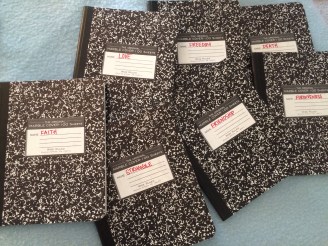
img_3173-1So much of a workshop philosophy centers on the assumption that reading and writing are forever intertwined.  Vocabulary, grammar, poetry–they’re all pieces of the puzzle that make up literacy and a passion for words, too.  It was with this in mind that I created Red Thread Notebooks.
The idea came from two places–one was Penny Kittle’s “big idea books” (found on page 8-9 of those handouts), which are reading response notebooks  centered around themes in literature.  The other was Tom Romano‘s “red thread” assignment, in which teachers had to write about which parts of our teaching philosophy would run through all of our teaching, like a red thread.

img_3177

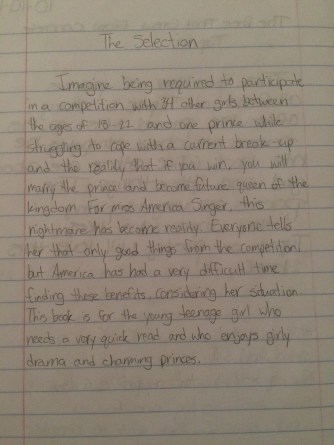
This student booktalks The Selection in the “STRUGGLE” notebook.

So, when composition notebooks are just a nickel in the summer, I buy 60 of them each year.  My students and I begin the year by brainstorming themes and topics that are important to us–love, cell phones, faith, music, family, video games, death, high school, forgiveness, four wheelers.  We label our notebooks and use them all year long.

There are a variety of ways I invite students to write in these notebooks:

  • Vocabulary practice: list related words, synonyms, word associations, etc. similar to the notebook title
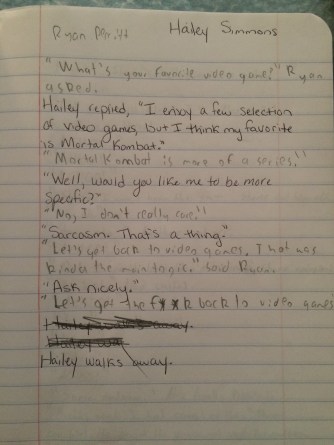
  • Skill practice: write dialogue, revise sentence structure, practice figurative language, craft descriptive writing, about the notebook’s title
  • Book talks: write about how the book you’re currently reading might add to a conversation about the notebook’s title
  • Grammar instruction: revise a sentence, imitate a paragraph, tinker with style, while writing about the notebook title
  • Free writing: write your thoughts and musings on the notebook title
  • Poetry: find an existing poem, craft your own poem, or create a found poem about the notebook’s title
img_3179

Hailey and Ryan practice dialogue in the “VIDEO GAMES” notebook after I teach a mini-lesson on its conventions.

Because these are shared notebooks, I ask students to refrain from using profanity in them or writing about any of their peers.  I don’t require names, but many students like to sign their writing.  Those are the only rules.

Once the notebooks have begun to fill up, students can refer to them to find book recommendations, writing topic ideas, or vocabulary words to add to their personal dictionaries.  They can also look for examples of skills practice, craft studies, or grammar lessons that we’ve done for additional guidance.  One year students even selected multigenre topics based on our red thread notebooks.

These notebooks are a lovely way to make permanent a yearlong conversation about literacy.  The topics change every year–Michael Jackson had his own notebook my first year of teaching, and this year Lebron James had one–but the opportunities to write, reflect, and make connections remain the same.

Do you think you’ll try Red Thread Notebooks next year?  Do you do something similar?  Please share in the comments!

Giveaway WINNERS!!

Thank you to everyone who entered our giveaway!  We’re so excited to award books to so many amazing teachers.

Without further ado, here are the winners:

  1. Andrea Anderson from Parkway Central High in Chesterfield, Missouri
  2. Hope Bobonick from Trumbull County Career and Tech Center in Warren, Ohio
  3. Melinda Buchanan from Sanger High School in Sanger, Texas
  4. Lindsey Cary from Peru High School in Peru, Indiana
  5. Janelle Christensen from Henry Sibley High School in Mendota Heights, Minnesota
  6. Karen Drake from Lee-Davis High School in Mechanicsville, Virginia
  7. Kopper Ernst from Riverheads High School in Staunton, Virginia
  8. Amanda Gaul from Waukee High School in Clive, Iowa
  9. Jill Gerber from Whitfield School in Creve Coeur, Missouri
  10. Amanda Graham from Latta High School in Dillon County, South Carolina
  11. Benjie Haugen from Monticello Middle School in Monticello, Illinois
  12. Colleen Kiley from Mount Abraham Union MS/HS in Bristol, Vermont
  13. Kimberly Kroll from Lapeer High School in Lapeer, Michigan
  14. Ashlee Kuhry-Larsen from Waukesha South High School in Waukesha, Wisconsin
  15. Kyla Louis from Hood River Middle School in Hood River, Oregon
  16. Anita Miller from Miami Trace Middle School in Washington Court House, Ohio
  17. Kyle Nelson from Lone Peak High School in Highland, Utah
  18. Tasha Rios from Grand Rapids Catholic Central in Grand Rapids, Michigan
  19. Paola Ruocco from Evanston Township High School in Evanston, Illinois
  20. Sarah Whitman from Collingswood Middle School in Collingswood, New Jersey

Be on the lookout for your books to arrive to your school addresses!  If you’d prefer for me to ship your books to your home address, please feel free to email it to me at shanakarnes@gmail.com.

Thanks to everyone who joined the Three Teachers Talk conversation!  Happy Summer!