Author Archives: Amy Rasmussen

We Should All Strive to be More Peculiar

I sat at a table with my English teacher colleagues the week before school started. Our district ELA leaders had us look at photos of “peculiar” children and write responses. A great lead into their encouragement to pay attention to “the one,” and the book talk of Miss Peregrine’s Home for Peculiar Children by Ransom Riggs that came later.Miss Peregrines

My colleagues and I put pen to paper, thinking about the students we’ve taught and the students who we’ll teach this year. We wrote, and then we shared. We laughed at our responses, and then we talked seriously about the students we serve. We love them. They are needy, and so many fall in the low SES column every time we sit in a meeting like this and look at data.

But they are ours, and we love them. We love the challenge of reaching the kid with the dark eyes and the rough demeanor. We love the hope we see when a child “gets” what we hope he’ll get.

I work with some of the best teachers on the planet. (I know that’s an overstatement. I haven’t even met close to enough teachers on the planet to make that call. But seriously, you should meet these people.)

Here’s a glimpse into how they think. Remember, we each had a picture of a “peculiar” looking child:

Matt:  I know you, kid. Life has asked a lot of you, early. Feed yourself, protect yourself, find your own place to lay your head at night. Unsurprisingly, you think of yourself as an adult, and you’ve acquired some adult habits. To cut the stress, you know? Now you’re here in my room, and there are rules for kids, which you are definitely not. Who the hell are these people, anyway, with their nice phones and clothes, and not a worry in the world beyond what grade they get on some ridiculous paper. Their hand aren’t covering in thick, yellow callouses, their nails aren’t dirty and chipped from hauling who knows what for too little pay. Someone made sure their hair was cut, they have glasses, they’ve got time to give a shit about some book. Not you. Not like you. You got yourself up, and made it here, thank you very much, and ?I had better not waste your time, because you have things to do. Responsibilities. I know you kid, and I suspect that you are going to break my heart.

Tess:  Peculiar children?  They’re probably more interesting that non-peculiar children … if there is such a thing as a non-peculiar child.  I think many children, like adults, learn quickly to hide their peculiarities to blend in, to seem ‘normal,’ to avoid judgment and the need to explain themselves.  What a shame. The truly peculiar child – like the truly peculiar adult – is one with no peculiarities at all.  Our differences are what make us interesting, what make us human, what make our society function.  If encouraged to embrace their peculiarities and nurtured to develop their peculiarities, I dare suspect that we would have a more dynamic, productive, functional society.  A girl can dream.

Perhaps a matter of semantics, I liken “peculiarity” to “atypical” … but neither term should be confused with “abnormal”.  “Abnormal” connotes some sort of condition that necessitates correction, while “peculiar” and “atypical” are flags of something interesting, something precious, something unique to be treasured.  We should all strive to be more peculiar. 

Just sharing.

What are your thoughts on “peculiar” children?

What is it about teachers and office supplies?

I heard it twice today:  

“If I wasn’t a teacher I don’t know how I’d justify my obsession with school supplies.”

“I love office supplies. The pens. The paper. The crisp white paper.”

Yes. Admit it. If you are a teacher, you are in this very special club. You have the best pen collection of all your friends. You have paper clips in shapes like frogs and hearts and even little pigs (if you don’t have them, you know you’ve seen them and secretly hope someone gets you some when Secret Santa rolls around.)

Maybe this is the best part of starting a new school year:  shopping for the supplies to put in children’s hands. Bright shiny and moist markers. Notebooks with blank bright pages.

Today at my first department meeting of the year, I picked up a brand new set of Prismacolor pencils. My department chair knocked it out of the park with his supply order. I’ve never been happier!

notebook and colored pencils

I don’t know about you, but to me the newness of supplies symbolizes hope.

I have such great hope for the students who will enter A202 today. I hope they’ll give me a chance to help them grow as readers and writers. I hope they’ll take risks that will help them become responsible young adults. I hope we can grow as a community of learners that empathize with one another as we take this journey throughout the year.

I have three distinct goals that will help me turn my hopes into realities:

1. Be diligent about using and holding students accountable for their writer’s notebooks

2. Hold more frequent and regular reading and writing conferences

3. Allow for more class discussion around topics of interest that promote critical thinking

My new notebook is ready, and my pencils are sharpened. The door is opening, and teenagers are streaming in. Here we go.

Tech Tips #306

Image

Regardless of who initially coined the phrase, “A picture is worth a thousand words,” the fact still remains that a single photo can uniquely capture the essence of a single moment in a way unlike any other medium. The Guardian Eywitness App, also a website, is a tool I loved using with students. Taken from all over the world, the photography shared in this app is simply breathtaking.


Image

Here are a few ideas of how to utilize this resource in your classroom:

  • Writing Prompts – Often students are stuck, or scared of the blank page. Have students describe what they see, explain how a photo symbolizes them, or make up a story for what is going on in the photo.
  • Narrowed Focus – Students struggle with wanting to write stories some call, “bed to bed stories” because the story includes too many surface level details and not enough time is spent on the meat of the story. Having students write only about what they see in the photograph forces them to focus and expand on a specific detail of an event.
  • Discussions of tone and mood – or any literary element for that matter. It is quite helpful to students if they can connect visually to an idea and then take that concept back and apply it to what they are reading or writing.

What are some ways you have used photography in your classroom?

I Might Be Ready. Thanks, PLN!

I got the idea from Jennifer Fountain @jennann516 to post the covers of the books I’ve read on the door of my Fountain book doorclassroom. See how awesome hers looks?

I’ll go to my classroom this week with a new color ink cartridge and start printing book covers. It might be expensive–my printer’s kind of a wimp, but I think the more we talk about books, display books, show off books, the more likely we are to get kids to read books.

So far this summer I’ve read nine books. I have a week to finish one more to reach my summer reading goal. It’s a good start on my book-lover’s door.

I have three teaching books I’m reading, too.  I have to read them slowly and mark the pages, so I can remember the things that made me want to read them in the first place. I will let my students know I read these books, and I’ll let them know I’m writing one. We will be readers and writers learning together. Every day.

Shana classroom libraryLast spring when school was letting out, with a little help from some National Honor Society students, I finally got around to sorting and categorizing my bookshelves. I have close to 2,000 books. My daughter made me cute labels that I’ll laminate and put on my shelves this week. My friend Shana Karnes @litreader finished her library in her brand new classroom, and she’s my inspiration. My walls aren’t quite so cheery, but I hope to make my bookshelves look as inviting. Who wouldn’t want to browse here?

I “listened” in on a Twitter conversation about getting rid of the teacher’s desk to make more room in the classroom. I think that was Ms. Fountain and Mini Rench @mindi_r who bounced around the ideas, and inspired me to move some furniture. I couldn’t quite boot my desk, but I did turn it around, and I moved a table, so my personal real estate shrunk four feet. I can now wander the room, weaving between my round student tables much easier, and if I want to stop and teach the whole group, I can do it from three distinct places: front, back, and right side. The left side is loaded with bookshelves, and I just got asked if I wanted a rocking chair that will have to go there. Yeah, maybe. (I’ll take pictures soon.)

This year, besides my personal goal to do better at conferring with students and holding them Kitras Glassaccountable for their writers’ notebooks, I aim to be at peace. This is hard for me; I hang onto stress like that kitten and the frayed rope. Thanks to Erika Bogdany @erikabogdany, I now have a Zen garden on the shelf by my desk. “It will work!” she promised me. At the urging of Emily Kim @booknerdkim I also have a Woodstock Tranquility Table Chime. But my Kitras Tree of Enchantment globe is my favorite. I saw it in a shop in Maine in July and knew it would help me keep my center.

My PLN (personal learning network) on Twitter is my best source of learning. Sometimes I join chats: #engchat, #rwworkshop, #titletalk are favorites. Most often I just read what people share–and it’s an amazing thing. I’ve favorited tweets all summer and now categorized them into folders in Drive. I’ve got mentor texts for narrative, informational, and persuasive writing. I’ve got infographics, Youtube videos, and TED talks to use as quick writes and/or discussion starters. And more. All first shared on Twitter by educators like me who want to do the best by their students.

I might be ready for the new school year, and it’s a big thanks to my personal learning coaches for helping me get there. This week is inservice, and I’m actually looking forward to it:  new principal and three out of four new assistant principals, 31 new staff at my large high school this fall–at the very least it has to be interesting.

I’ll slyly keep my Twitter feed open, and maybe I’ll score one or two more ideas before students show up in a week.

I’d love to know the best ideas you’ve learned this summer. Care to share?


50% of the Teachers Were Willing to Try

I underestimate people sometimes. For those who know me personally, this is no big surprise.

Today, a colleague and I taught (or attempted to teach) some of our peers how to use two (we believe) pretty simple technology apps. We kind of thought it would be easier than it turned out to be. Here’s what I learned:

1. Some teachers are not interested in learning–or even trying–to do anything with technology. It does not matter how much you testify to what has worked wonderfully well with your students. They do not care. They are not going to even pull out the cell phone and give it a try.

2. Some teachers are so impatient with their own devices that they will not even give you a chance to help them, or walk them through whatever application you want them to see. This frustration comes out as anger (and is often rude) against the person just trying to show them a tiny little thing.

3. Some teachers watch and listen, turn on, and try. They ask questions. They push buttons. They light up when they “get it.” They enjoy the experimenting and the experience of it all.

Quick quiz. Which of the three above do you think I want to work with every single day?

Self-evaluation. Which of the three above are you?

My friend JC Hamlin and I showed our peers Twitter and Vine today. We’ve both used Twitter with our students for awhile now; we both want to use Vine with our students this year.

Here’s a tidbit of our presentation:

Three Ways to Use Twitter in the classroom:

  • as communication within the walls of the class and beyond
  • as a backchannel (Shy students speak up when they can tweet their responses)
  • as a way to include the outer-circle in an inner-circle discussion

Why using Vine makes sense:

  • students love to make and share videos
  • most students have a Smart phone–or a classmate who has one
  • it’s fun

The assignment:  1. Create a Vine that introduces yourself to your students without showng your face. 2. Tweet it to us.

My Vine Introduction

50% of the teachers in the room successfully “played” with technology today. 50% of the teachers were willing to TRY.

I wonder how this translates into what the instruction looks like in their classrooms. Really, I wonder.

15 hours later:

Okay, so after thinking about this pretty much all day, I realized a few things:

1. I exaggerated. It wasn’t 50%. I’m amazed at how a few sure can feel like A LOT.

2. I must remember to be patient. At first I took a long time to learn tech things; I need to allow others time, too.

3. The experience, the emotions–positive and negative–are an fine parallel to what happens in class with my students.

So, the question I ask myself as I go into another year of teaching: What systems do I have in place, what communication skills, strategies, relationship-building tactics do I have in mind to deal with it. Better.

What’s in Your Teaching Soul?

Our Compass Shifts 2-1I am an idea machine. Really, it’s like Boom! This might be cool–or this–or this. How about this? It relates to that and that and that. Sounds like a pretty great machine, right?

Not even. It’s a problem.

I get so many ideas spinning that I get dizzy with possibilities, and inevitably, I get frustrated. You know what happens next. Do you hear that crashing?

So, as the days of summer disappear, and I start thinking about school starting up again and what I want to do differently with my students this year, the idea machine hums at high speed. And there is just no room on the planning calendar to do every idea that I think is a cool one. And really, why would I want to?

I do this to myself every year:  I try to do too much, so my students rarely get the chance to do some things really well. We’re in too much of a hurry to move on to the next great thing. No wonder I am a stressed out, headache prone, insomniac from August until June.

At the University of New Hampshire Literacy Institute learning from Penny Kittle, she asked us at the beginning of the course and then again at the end:  What is your teaching soul?

The first day of class my answer went something like this:

I’ve lost it. That’s a lot of the reason I am here. My passion for teaching has taken a beating–a lot of it influences from outside of school, (It’s been a hard year personally)– a lot of it the choices I made within the classroom.  I’m here to get my passion back.

The last day of class, and it’s really no surprise, since, you know, I was learning from Penny Kittle, my response was something entirely different. The discussions about writing, the experiences with reading–mostly analyzing author’s craft, and my own writing practice all helped redefine who I am as an educator and as an individual.

And that is what I want for my students. I want them to know who they are and what they have to offer.

So, what is my teaching soul? What are the non-negotiables that matter, the things that will help me keep the passion and help my students define themselves as readers and writers and individuals of tremendous worth? I know in my soul the following things matter:

Community Matters. My students must trust me to establish and maintain a classroom community that allows for risk and creativity. I must encourage conversations that allow students to be their authentic selves so they can find their authentic voices in their writing. Every discussion and every activity can help us feel at ease as we grow to know and appreciate one another as developing readers and writers. Keeping writer’s notebooks, talking about books, sharing our writing–every single day–will help my students feel safe so they are willing to speak up and let me see glimpses into their lives and how they think.

Reading, Writing, and Thinking Matter–a lot. If it’s true that to develop fluency in reading and in writing, students must read and write, then it only makes sense that to develop fluency of thought, students must think. Asking students to analyze, synthesize, revise, create, etc  on a daily basis is the only way to build this fluency. I can start with asking good questions, but more importantly, I want students asking good questions. A student-centered, student-driven inquiry cycle will lead to thinking that involves and engages every learner.

Modeling and Mentoring Matter. I’ve learned the difference between showing students something I’ve written and writing something in front of them. In front of them–so they see the thinking and the struggle–works so much better. If they see me as a writer, and I talk to them as writers, our writing community helps us all grow in our craft and experience. The same holds true for reading. Students have to see me as a reader. Mentor texts that we study for craft act as professional coaches to show us the moves and stylistic devices published authors use to create meaning. My job is to ‘hire’ good coaches and make sure my students know that we can learn from them.

Authenticity matters. I’ve thought about this a lot:  How can students be their authentic selves if we never let them make choices? I read something once that compared high school to a dystopian society: wear a certain thing, eat at a certain time, respond to the bells throughout the day, come and go when they tell you, talk when they let you. All that control. I get that schools must function a certain way, but can’t we give students some control? Allowing them to choose the books they read and allowing them to select topics that interest them to write about gives students a little freedom. The more freedom we give students, the more interest they’ll have in their learning. The more interest they have, the more commitment they will have. Isn’t that what we want–students committed to their own learning? This is where blogging comes in for me, too. By encouraging students to create and post on their blogs, I learn who they are as individuals. I read about the topics that matter to them, and they find their authentic voices as they publish to a world of potential readers far beyond me as their teacher.

Dialogue matters. In a training last spring, Kylene Beers reminded me that “the smartest person in the room is the room.” I needed this reminder because I often shut down conversation when I could explode it. Rich classroom discussion can lead to intense learning. I must trust that when students engage in conversation surrounding a topic, they may learn more from one another than from me. They can learn from me in the dialogue we share during our one-on-one conferences. Talking to students about their reading lives and their writing processes is the best teaching tool I have as an educator–and the best use of my teacher voice.

As I use the last of my summer days to plan the best learning I can for the students I will serve this fall, I pledge to remember how my heart healed in July. I know the power of a student-centered workshop classroom, and I will remember to allow my students the opportunities to learn the way Penny allowed me to learn at #UNHLit13.

I met some awesome educators who will help me remember, and they will help you, too. We bonded over books, breakfasts, love for PK, and zen. In an effort to focus our teaching this year around the things we learned in NH, we devised a plan to 20130713_193936keep us connected and accountable. Once a week we’ll write about our experiences, practicing in our classrooms the things we learned this summer.
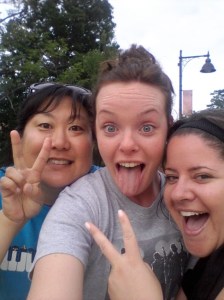
We’re calling our reflections Our Compass Shifts because it has and it does, depending on the needs of our students. From Texas to West Virginia to California to New York, we are four high school teachers with different backgrounds, teaching experience, and student demographics, who believe in the genius of our students.

Please meet my new colleagues:  Shana Karnes (WV), Emily Kim (CA), and Erika Bogdany (NY). You’ll find their bios on our About page, but I’ll let them introduce themselves and their students as they take turns posting each week. They’ve got teaching soul that makes me shiver. Oh, and see? They are walking talking FUN.

Think about what swells in the heart of your teaching. I hope you’ll share the answer: What is in your teaching soul?

Dream Come True: Conferring with Penny Kittle

imageFor a teacher like me, this moment was a pretty big deal. I attended the University of New Hampshire Literacy Institute and learned from Penny Kittle for two weeks. Her class was called Writing in the World, and I have to tell you, I learned more than I could have hoped for when I set off with my new green notebook for New England, a place I’d never been.

I’d heard Penny present before, first at Region X here in DFW, and then again when my district brought her in for a couple of days–both turning points in my classroom instruction as I changed my thinking about teaching readers and writers and not just reading and writing. Then, of course, I was a fangirl at NCTE last fall in Las Vegas, tracing my hand in my notebook like she does in hers.

But sitting in her class every day, listening to her read poetry, share videos of her students, and explain that all students will write–and write well–when they are given the opportunity to explore their hearts, reshaped me as an educator, and thankfully, I got my passion back.

Everyone who knows me well knows I had a tough year. Lots of reasons, and none of them pretty. At one point I thought about throwing in the pubic education towel, even applied to Pearson in a moment of desperation. See? I was quite low.

When Penny meets with students in a conference, she focuses on the writer and not the writing. She let me ask questions, and she alleviated my fears. She prodded and questioned, and I found answers to questions I didn’t even think to ask. I saw myself as the student, and I saw my students in me. And I realized when it comes to meeting with my students to help them improve as writers:

I can do better. I must do better.

Of the huge stack of books I lugged home from UNH [I am Amy, and I am a (book) addict], Tom Newkirk’s Holding on to Good Ideas in a Time of Bad Ones resonates in my teaching soul. Even this one little thought speaks to me: “excellent instruction rarely feels rushed.” I know that, really I do, but why do I always feel like I’m in a hurry?

When it comes to teaching writing effectively, helping students to see themselves as writers, allowing students to feel accomplished communicators, I must slow down.

I need to do what Penny did for me in New Hampshire: relax into chair, look into my face, smile her warm smile, and speak to me like she already knew I was writer.

[Special thanks to Emily Kim for capturing this special photo. I owe you.]

OMG! Do You Think You Have Enough Books?

photo-1Last August, as I started in my new role of instructional coach for my district, people often said that I would go through a grieving process as I left behind what I once knew to embrace the unknown. Throughout the year, many have asked if I have missed the classroom, and of course, to some degree the answer is always yes, but there is one specific thing that I miss the most… MY BOOKS!

Walk into my room and more likely you would have asked me, “Jeez, Heather, do you think you have enough books?” Of course, my answer was always, “Uh, NO! How would that ever be possible?” No doubt, the best part about my classroom was my extensive library. If I spent a day and counted, I’d probably total close to 1,500 or more books, all cramped on shelves, waiting to spring into the hands of an unsuspecting reader.

Kids need easy access to books, just like they need easy access to their cell phones. The library can be too intimidating; the book stores are too far away, and often the shelves in their homes are void of books. As the teacher, if I wanted to send the message that books are important, there is no better way than to fill my room with books – good books, colorful books, books that students want to read.

Where I Find Books
* scooped up from a retiring teacher (Why won’t more teachers take early retirement?)
* freebies at conferences (Yes, I lurk in the corners of exhibit halls, executing a flawless freeloader innocence. Note to self: ask Amy to write about her stealing from a vendor experience.)
* purchased at the Scholastic Book Warehouse clearance event (Watch the calendar and pay attention to the Scholastic website)
* given to me by a students – (Please, no more Starbuck’s giftcards and scented candles… I NEED BOOKS!)
* Half Price Books (If near a warehouse, the free give-a-way for teachers is worth it. Otherwise watch for coupons. I just used a $15 off of $50 purchase that meant 21 new books.)

Why I’ll Never Have Enough Books
It’s more effective to walk over to the shelf and hand a student a book than it is to tell her to go to the library or to the bookstore and get it herself. Ever had this happen: a friend tells you about a book, and you think “Oh, I want to read that.” Unless you write it down or make a stop at the bookstore on the way home, you’re not likely to get that title any time soon. Magnify that by 20, and you’ve got what happens with a student. Most often you have to put the book in the child’s hand. Is she guaranteed to read it? No, but I increase the chances exponentially when I grab a book, chat about it, and hand it to a student. And with some students I place one book and another and another, until the student finds the one she wants to read. That’s why my shelves scream with diversity.

In my classroom, I arranged my bookshelves by genre because students may not know what they like to read, but they know what they like. A girl may not know she likes Sarah Dessen novels, but she knows she likes romance. A boy fascinated by the Civil War may search my shelf of war-themed books and discover the writing of James L. Swanson. By placing the books by genre I am able to create a type of comfort zone where my students feel free to explore. Just like no two students are alike, no two readers are alike. The more books on my shelves, the more opportunities I have to get students to read.

How I Kept Track of My Books
I didn’t. I literally have a love relationship with my books. My students know of my affinity, and they quickly understand that the books on my shelves are my personal friends. Friends that will break my heart if I lose the connection. Many a time when a student lost one of my books, he’s replaced it because he knows I care about each of my books. The real deal though– if a book doesn’t make it home to my shelf, I’m okay with it. Maybe it’s altruistic, but I hope she’s happily getting read somewhere by someone. As teachers and librarians we must remember that we cannot be the keeper of the books and the stories they hold (even if they do end up at Half Price Books with your name clearly stamped on them.)

Last May, at the end of the year I carefully selected my most treasured friends, but then I, like someone had once done with me, passed them on to another teacher to share the love of reading with her students. I can only hope her students have found as much pleasure in them as mine once did.

How do you build your classroom library? How do you prevent your books from never returning? (or do you?)

Math in the Real World

Today we want to share a story from a math teacher, yes a math teacher! Embracing transformational teaching practices, Elizabeth Pauley, 8th grade math teacher at Cross Timbers Middle school, brought math to life for her students by creating an authentic experience where students could see first hand math in the real world.

This slideshow requires JavaScript.

As we began our second semester of 8th grade math, I found myself already thinking past our state assessment into May. What was I going to do with my 8th graders who think they are already in high school?  How can I keep their interest peaked as summer quickly approached?

Sitting in the kitchen one evening, participating in our district tweet chat, I found myself thinking about how I could incorporate 21st century skills into our classroom.  My students had the confidence to apply their knowledge of proportionality: however, they still encountered obstacles when it came to applying formulas for surface area, area, and volume.  How was I going to foster my student’s thinking so they would be able to see the connection?  I wanted them to have ownership in their learning!

How could I create a lesson that was student-centered, utilized technology and collaboration, all the while building a bridge between the abstract mathematical concepts and a real life scenario?

Utilizing my district instructional coaches, we began the adventure of creating my students’ first PBL.  Meeting during my conference period, Heather and Aubrey helped guide my thinking as I narrowed down the standards that I wanted to cover.  The chart paper was pulled off the tablet, while the markers etched across the page.  I found that not only did I want this PBL to cover measurement standards, but I wanted it to incorporate the majority of what my students had learned this school year.  I wanted them to experience the connections that are found in the world outside the classroom walls.

Dissecting the standards and focusing on the verbiage focused me as the educator and helped to create the driving question for our PBL:  “Based on the cuts in school finance, how can your design team create a middle school athletic facility to increase revenue?”

The week between creating our driving question and meeting with our instructional coaches was challenging.  Challenging because I had to think; think about what my students’ prior experiences were and what our long term learning goal was.  The question kept echoing: How was I going to create a bridge to yield success in our classroom?  Then the answer:  Innerput.

Innerput are workshops that lead to eliminating misconceptions, while creating connections between experiences.  By creating these workshops for my students, on concepts I felt they may struggle with, I had more confidence about embarking on our PBL adventure.

The thinking started naturally. After our state assessment on a Tuesday, I told my students I was sorry to miss their track meet.  Many looked around the room with confusion.  Come to find out it was not our school’s meet but another in the district.  My students loved explaining to me how we had to give up “our” field for others.  Questions soon arose as to what happens with the money that is collected at athletic events.  Students were thinking!

To spark conversation and more thinking, I gave students various articles about athletics and school funding; why athletics were vital to our educational system and why athletics were being cut from budgets.  Holding a Socratic seminar yielded ownership in students learning, as each held a role in our conversations.   Having to defend different viewpoints, allowed students to begin seeing both sides to our current problem.  What role do athletics play in a school district?

Based on classroom discussions, we looked at the budgets of our school district and campus.  Much to students’ amazement not much money was given to our athletic program.  Thinking was occurring and discussions were happening all because my students were part of the problem and soon to be part of the solution.  As we dissected our budgets, students began to email district officials about the choices behind why certain campuses received more money.

Because our high school is being renovated, both the project manager from Pogue Construction and head architect from Huckabee Inc., spoke with my students about their roles on the design team and what role their company serves in the design process.

Students quickly realized they needed to collect data that was reflective of our student body.  Based on student needs, the facilities were being researched.  Students began researching:  How much space would we need?  Could fields be multipurpose?  How expensive is equipment?

Students quickly realized how expensive construction is.  They asked how our district could afford so many renovations.  I invited our chief financial officer to speak with my classes.  She shared about our district budget and how we give money to other schools.  Students had already discovered the state had cut funding, and now they were learning how much money actually stays within our district.  Hearing that only $0.65 stays in GCISD, students began to get fired up.  They were determined to find solutions on how to increase our district’s revenue.  It was time money stay in GCISD for GCISD students!

Knowing an authentic audience is vital to the success of a PBL, we began to discuss who had a vested interest in our school district.  Students determined that their parents, educators, district administrators and community members, as well as themselves had an interest in the success of GCISD. These conversations resulted in invitations being sent to our district administrators, school board members, educators and parents to come evaluate our final presentations and determine which bond election would pass.

We’ve had our obstacles and arguments over which ideas are the best and how much money to spend and which sports venues to include.  However, each group has learned to problem-solve and justify their thinking.  With various roles in our design teams, students are able to contribute in a meaningful way through their personal strength.

Unlike most educators, I am not counting down the days until summer vacation; I am looking forward to learning about my students’ creative solutions to a real-life problem.  We are learning right until the end. Students have realized numerous factors go into building an athletic facility:  cost of materials, location, architectural design, fees/permits,  but most importantly, they’ve learned that communication and collaboration are vital to the ability to solve a problem!

Building a Community of Readers by Sharing Our Own Struggles

booksAt least once a week, if not more, I see some news piece or article about how students these days are spending less time reading. Taking a minute to reflect upon my own reading life, I thought back to how I encouraged a community of reading in my classroom.

Over the course of a school year my students read a lot. Each year when we would count it up, we found that my eighth graders had read between 50-60 books each over the course of the school year.That’s 60 students reading about 60 books. That’s 1200 books. See? A lot! In my classroom, reading is contagious. Walk in the door, and you breathe in the reading bug. If you aren’t reading, you are separating yourself from something important. Reading takes precedence. By making reading a priority, and emphasizing that reading takes us places we’ll never get to, I am able to get even reluctant students to crack a book and creep into the pages. My struggling readers quickly learn that it is not about quantity or speed, but more about the fact that they are reading. Reading opens doors that the world slams shut.

No doubt, the biggest “Why read?” selling point to get my kids reading is my honesty. I openly tell them that when I was in sixth grade I hated to read. I hated to read! In fact, I hated to read so much that I only read one book all year. My students ooh and aah at that: “One book?” they question. Then I go on to tell them that I had a required book report due every six weeks, which meant read one book every six weeks. As you may guess, this discussion quickly turns into a math lesson with students questioning how I could have possibly passed sixth grade reading only one book. Every year I somehow skillfully turn the conversation back to reading. I let them question me: What about now? Do you like to read now? Do you only read because you have to? And my answer: What do you think?

It’s true that kids don’t care what you know until they know how much you care. Establishing rapport at the first of the year requires immediate, daily and purposeful attention, and honesty with students lends well to the building of it. I know it’s my honesty that makes it okay for my students to struggle with reading. We use my experiences, and make connections with their own, to talk about why reading is important and how we can grow as a room of readers. I flood the room with books. I talk about titles that painted pictures in my head. I read while my students are reading. My kids quickly see me as a reader.

Frequently, students want to know what turned me into a reader, like there’s some magic pill that changed my hate to love. They question me when I boast that I read forty-six books over summer vacation or 150 books total for the year. I model being a proud reader, and sometimes this leads to precious moments where my students and I have tender discussions about reading, and I am able to share my reading transformation story. Often students think that because I am their reading teacher I was born with a love of reading, and that it has always been easy for me. Once I dispel this myth, and they find out that I struggled for the better part of my life with reading, students are able to see me as a peer with a similar struggle, and if I work on the rapport right, they begin to envision themselves as readers. Isn’t that the key? If kids can see themselves as readers, maybe even if that seeing requires a high-powered magnifying glass, we can get pages to turn in their hands and characters to come to life. It only takes one book, and that’s a blog for another day.

In the mean time, what made you a reader?