Author Archives: Amy Rasmussen

Reel Reading for Real Readers: Between Shades of Gray

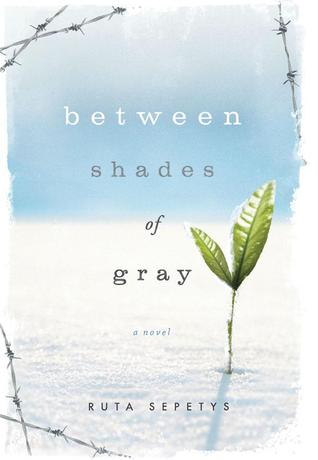
20130207-190708.jpgI’ve wanted to read this book for some time now, but it wasn’t until I was searching the shelves at my  favorite Salvation Army that I got my hands on it. (That’s a post for another day:  Building a Killer Classroom Library by Hanging out at Charity Shops) I have a students who is passionately interested in WWII literature. He’s already read two books a

bout it this grading period. I will put Between Shades of Gray in his hands as soon as I am finished with it.

I’m doing a good job this year of talking about a lot of books. Of my 140 students, I’m down to just threefake readers. Many students are reading slowly, but they are reading. I’ve decided I need to do a bit more than just talk about books. I need to step up my use of videos and book trailers to get them interested. The only problem? Every time I use visual images like this, I have more than one student who wants the book. I want to believe that this is a good problem, but it’s pretty sad when not everyone gets a copy of a book when they are excited about it.

Here’s a clip of Ruta Sepetys talking about the story behind the story.  I just know I’m going to need more than one copy.

Gifted and Talented Teacher Leaps off Cliff of Faith and Experimentation

Guest post by Tess Mueggenborg

Make no mistake about it: I’m a classical canon gal.  Always have been, always will be.  And when I say “classical,” I also mean “really old” – few things written after 1650 hold much interest for me.  Favorite work of literature? Milton’s Paradise Lost.  Favorite time period of literature? Early Roman Empire (Ovid & Virgil).  Favorite English Lit class from my undergrad days? Greek Tragedy.

But as much as I love the canon – and I’ve had surprising success with teaching the canon in the past – I’m also a pragmatist.  I know that what I love isn’t always what’s best for my students, and their learning should take priority over my passions (I know … radical idea, right?).  I also acknowledge that the real world in which I live and work is far from my ideal.  Would I like to devote all of my class time to discussing Beowulf and Canterbury Tales?  Of course.  But can I realistically get my students to read and engage with these texts, and develop a passion for them?  Not likely.  Some, of course, will – and I’m happy to guide them on their own paths of classical literature studies.  But I bet (I hope) that those students will wind up as English Majors, and they’ll get their fill of such works in college.  I must work with the students I have, not the students I wish I had.  And the students I have are awesome: bright, curious, hungry for meaningful learning and wisdom.  So this classical pragmatist has started to break her own mold.  Here’s how …

I teach a class known as World Experience; it’s for Gifted and Talented sophomore students, and it combines AP World History with literature.  The history drives the course – it sets the pace, scope, and sequence for the year.  It’s then pretty easy to match up literature with the corresponding time periods.  leap off cliffAncient River Valley civilizations at the start of the year? We read Gilgamesh and Horus the Hawk.  Classical civilizations come next – that mean Antigone and a few selections from Metamorphoses.  Next up is the Medieval period … and this has always been a struggle.  I love Medieval lit, I can read Middle English, and I can wax poetic on the virtues and merits of The Song of Roland and Sir Gawain and the Green Night ad nauseum.  And while the students usually enjoy these stories, they don’t usually get much out of this unit in terms of literature.  They don’t learn much about author’s craft, they can’t do much literary analysis, and they become so frustrated with the archaic language of the text that most of them give up … and it takes me another six weeks to pull them back into literature.  So this year, I’ve scrapped all this, and leapt off a cliff of faith and experimentation.  The results have been pleasantly surprising.

Our district head of English Language Arts was kind enough to buy $600 of books for my classroom library.  I got to choose every one of them: all award-winners (or by award-winning authors), all world literature, all contemporary, all high-level.  No softballs in this classroom library – these are, after all, GT students.  Each student got to pick a book (this was a time-consuming and sometimes contentious process, but it certainly got every student interested in the books and invested in their choice).  Once a week, they’ve been blogging about their novel, based on someone generic questions posed by me.  Some of the questions are just opinion (Do you like this book so far? Why or why not?); some of the questions are analytical (Who is the main protagonist of your novel? What problems do they encounter in the course of the novel? How do you predict they will resolve these problems … or not?); some relate back to the history half of the course (In what ways does your novel relate to the history we’ve studied so far this year?).  Some responses have been good.  Some have been profound, moving, passionate, and elegant.  None have been outright bad, and none have been missing.  That’s right: NONE have been missing.  Every student has been reading and blogging.  Even the student who earned a grade of 9 (yes, a single-digit 9) for the first 9-weeks is reading and blogging about her novel.  I’m calling this experiment a success.

To be fair, I should say: this hasn’t been easy, and it hasn’t been without challenges.  But they’re good challenges, and not insurmountable.  Some students read their novels in a week – and then wanted to borrow another book.  YES!  Many students didn’t devote enough time to reading their novel, and they’ve fallen behind.  But they haven’t given up: they’re still reading.  I haven’t had any complaints of “this book is boring,” though I’ve had many complaints of “this book is so sad/depressing/pessimistic/disheartening.”  Which has led to some great discussions about the point of literature, analysis of tone, and some hefty doses of maturation (I’m pretty sure the girl who read The Kite Runner in a weekend has been inwardly weeping for two weeks now).

We’re wrapping up this unit, and thus this great experiment.  And I think it bears repeating: I’m calling this experiment a success.  Enough of a success that I’ll be spending this weekend revamping the next unit (which starts Monday) to include more student choice and incorporate more of these novels, though in a slightly different fashion.  Stay tuned.

Am I still a classical canon gal? Heck yes. Always have been, always will be.  But my students don’t need to be classical canon fans – they just need to be readers, eager to engage with the world and its complexities.  I think they’re well on their way.

“Professor” Tess Mueggenborg teaches English (and anything else with which her students need help) at RL Turner High School.  Her academic passions lie in comparative language and literature.  The Professor lives in Dallas with her husband, Jeff. Tess’ on Twitter @profmueggenborg

The Last List of Apps You’ll Ever Need

appsLet’s face it there are so many apps out there that can be used for education. It really is quite over whelming. If you are paying any amount of attention, literally every where you go you will be inundated with suggestions for apps to use in the classroom. Spend five minutes on Twitter and you will come across at least ten different tweets offering some insight into the best apps for whatever it may be. Spend five minutes on Google searching and you’ll come up with at least ten million suggested sites. Spend five minutes in a room of educators talking about technology and there will be at least 10 questions about the best apps to use in the classroom.

While people have made a solid attempt to provide some suggestion or organization to apps, the sheer volume of the lists that are out there really is just as overwhelming as the amount of apps that are available. And it concerns me that anyone would rely on an arbitrary list of apps without other considerations in mind. What if we only allowed learners to read books of the Newbery Award list. Granted there are some amazing books on that list, but what about all the other amazing titles that are not on that list.

So we are effectively back to square one.
What apps should I use with my learners in the classroom? 

My list really is simple:

1. Take the pressure and responsibility off of you as the educator and let the learner decide what tools, apps, and resources they want to use to demonstrate their profound learning of the skills or concepts.

I know that this may seem like a radical notion, but if we want learners to take ownership of their learning we have to also include them in the design process by allowing them to have voice and choice in the ways the go about doing their work. In order to allow learners to have a say in their learning, we as educators need to be willing to take a step back and allow the learners to take some of the lead.

Still not sure if learners can be empowered to take charge of their own learning experiences? Check out this pretty amazing Ted Talk.

Reel Readers for Real Reading: Sarah’s Key

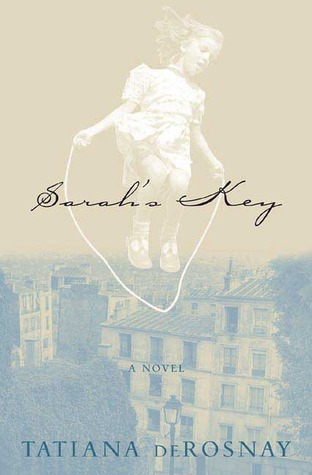
ReelReading2When my friend Tess got all her world literature novels, one of the hot student favorites proved to be Sarah’s Key by Tatiana de Rosnay. Tess called my room to see if I had another copy. Sadly, I did not– then.

I remembered how much I loved the movie, and while I know that books and movies are often very different, I could see why students were clamoring for this book.

My copy of Sarah’s Key should be here by the time this post runs. I’m sure when I show the movie trailer I’ll have a waiting list of students eager to read it. I already have one young man and another young woman who are passionate about Holocaust literature. My collection of this genre grows year after year because I love it, too. So many tragic yet heartwarming stories that teach and remind us to love.

For the past several years I’ve taken students to the Holocaust Museum in Dallas. We’ve listened to survivors speak to us on several occasions. Sadly, they are all getting so old. In a very few years, these great warriors of a terrible time will be gone. It will only be through great literature that we keep their stories alive.

What is a Reader Anyway?

Guest Post by Marla Robertson

As a teacher of undergraduates in a pre-service teacher course for future 4-8 teachers with various goals for future endorsements – Generalist, English/Language Arts, Math, Science, etc., part of my community building/getting to know you activities this semester included having each student fill in two surveys – one each about their Reading and Writing habits. I ask similar questions when I am presenting at teacher conferences to get a feel for where my audience is in their beliefs about reading and writing and about themselves as readers and writers.

I have noticed a pattern in the type of answers that I get to these questions in particular:

Are you a reader?

Are you a writer?

No matter what context I am in – at a conference with practicing teachers or in a classroom of pre-service teachers – the majority of participants say, no I am not a writer. This answer has been universal. I’ll address my thinking about writing beliefs at a later date, but….

Most participants usually acknowledge that they are a reader to some degree but often qualify that answer in some way. Like, “Yes, I am a reader but I don’t have time to read because I’m in school”, or “Yes, but I only read _____(insert type of reading here), or “No, I only read …..”

These responses about reading led me to wonder – just what is the definition of a reader?

Google says that a reader is a person who reads or who is fond of reading. That’s it! That’s the
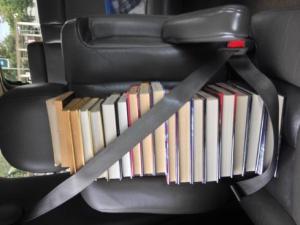
My daughter took this photo after a library visit.  If the books were turned around so the titles were visible, her sophomore Pre-AP English teacher would have been appalled at the types of books Courtney was reading because they weren't considered good literature in her eyes.  That teacher never cared that Courtney was an avid reader outside of school, only that she didn't like to fill out the worksheets and read the assigned readings for class the way her teacher wanted her to. Luckily Courtney never cared what that teacher thought and continues to devour YA fiction anyway.

My daughter took this photo after a library visit. If the books were turned around so the titles were visible, her sophomore Pre-AP English teacher would have been appalled at the types of books Courtney was reading because they weren’t considered good literature in her eyes. That teacher never cared that Courtney was an avid reader outside of school, only that she didn’t like to fill out the worksheets and read the assigned readings for class the way her teacher wanted her to. Luckily Courtney never cared what that teacher thought and continues to devour YA fiction anyway.

dictionary definition – no qualifications, no buts or exclusions. But when asked that question, what do people really think? Do people narrow that definition to exclude the types of reading that we do as a part of our everyday life, like reading the newspaper, surfing the web, reading our favorite magazine, etc.?

What about the reading that people do for their job? Does that type of reading qualify them as a reader? A friend of mine told me once that her husband doesn’t think of himself as a reader because he only reads non-fiction. If we as adults qualify ourselves as readers by the type of reading that we do, then it’s not surprising that our students may do this as well.

So, is a student who reads comic books/graphic novels a reader? How would they answer this question?

Does a student who reads about hunting (insert personal interest here) by perusing articles in the latest hunting magazines qualify as a reader?

Is a student who gets online and searches out all the information they can find about their favorite boy band, One Direction (or any other topic of personal interest), a reader?

Is the person who scans Facebook posts, reads Twitter feeds, loves roaming around Pinterest (or any other app) – are they a reader?

Can a reader be someone who is in school and is constantly reading textbooks, articles, or other assignments related to their coursework,

… or do they have to be reading a novel to be a reader?

So what do you think? How would you answer this question….

Are you a reader?

Whether your answer is yes or no or qualified in some way, switch to wearing your teacher hat and think about your students – what is your definition of a reader….for them?

Is it the same or is it different?

I know for myself as a teacher, I have to be careful that I don’t narrow the definition of “reader” to mean a person who reads novels, which is probably my definition of being a reader when applied to myself.

What do you think? In our role as teachers do we need to consider our perspective of what it means to be a reader and how we apply it to our students?

How can we help our students come to believe that they too can be a “reader” if they do not consider themselves as one already?

Marla Robertson currently teaches undergraduate literacy courses at Texas Woman’s University in Denton, Texas to budding teachers.  She is a Teacher Consultant for the North Star of Texas Writing Project and strives to keep current on the latest research and trends in reading and writing instruction.  She is passionate about advocating for authentic purposeful writing opportunities for students of all ages and believes that everyone has a story to tell. She can be reached at mkrobertson2009@gmail.com.

When a Student Tells You What to Teach: Sweet

I mentioned before that I gave a Pulitzer Prize winning novel to one of my AP English students recently. He gave it back to me three days later.

“Did you read it?” I asked.

“Well, I tried,” he said. “There’s just too much description. I couldn’t get into it.”

“What do you mean?” I asked.

“I don’t know exactly, but it’s the kind of book you should pull passages out of and teach with,” he said.

Okay, then.

I still haven’t read the novel Tinkers by Paul Harding, but I did take a look to see what Levi meant. (He’s a bright young man–taking both AP Lit and Lang his junior year.)

Just read the first page. You’ll see what I did.

Yes, I can teach some skills with this. It’s beautiful, and now I’m reading it– on the lookout for mentor slices that engage and inspire great reading and writing.

Screen Shot 2013-11-03 at 10.02.26 AM

Reel Reading for Real Readers: Stephen King Fest

ReelReading2I am not much of a horror reader, but I am a Stephen King fan. I remember the first of his books I read was It, but I don’t think I finished it. Too chicken. I also read The Long Walk, which I thought was an okay read until the end, and I thought it was stupid–probably because it made me mad.
My favorite King book is Misery, maybe because it’s more realistic than some of the others. Annie Wilks is a truly frightening character. (Now that I am a Criminal Minds re-run junkie, Annie scares me even more.)

Since I am trying to get many of my student readers to reach beyond YA fiction, I’m thinking a few Stephen King book talks with a few book trailers might be just the thing for Halloween.

The movie for Misery was almost as creepy as the book.

And, of course, the new movie version of Carrie is in theaters now.

Reflecting on Connections

ocsI’ve been thinking about connections. With Connected Educator Month coming to a close, many of you might be thinking about it, too. I’ve read chats and tweets about what it means to be connected, and I’ve thought a lot about what being connected has meant to me in learning how to be a better teacher.

My husband had me take the Six Human Needs test designed by Cloe Madanes a few years ago. According to Cloe’s research, we all have two needs that drive us and influence our decisions, behaviors, and actions. Of Significance, Certainty, Uncertainty, Contribution, Connection, Growth, my driving needs are growth and contribution. Learning this was not surprising, and it explains in part why I became an educator, and why I love to help other teachers grow in their practices.

While connection didn’t rise as one of my primary needs. It’s impossible to contribute and grow as a teacher with out connections. I have many.

photo @2003 Anselm Hook Flicker

photo @2003 Anselm Hook Flicker

I connect with my peers in the English department as we talk about the needs of our students, design lesson plans, and try to help students succeed. I connect with my colleagues in other content areas as we meet in faculty meetings, school activities, and crowded hallways.

Then I have my North Star of Texas Writing Project connections, the amazing educators that make up our Teacher Consultants. It’s because of them I am a confident presenter, researcher, writer, and workshop teacher.

Much of my confidence comes from the connections I’ve made on Twitter. Joining chats with my teacher heroes, receiving responses to questions, discussing issues with other professionals with similar challenges, all these connections help me improve the instruction in my room and the relationships with my students.

The relationships I made this past summer at the University of New Hampshire Literacy Institute changed my teacher soul forever. The connections made there gave me hope on more than one occasion. Emily, Erika, and Shana allow me to contribute and grow on a regular basis, and I am grateful for their insights and encouragement in my life. It can be difficult being the only teacher on my campus who believes in the power of a readers/writers workshop classroom. Support from these friends, even as far away as CA, WV, and Brooklyn, NY, comes at the most opportune and significant times. (Of course, the Words with Friends games help our camaraderie, too. What English teacher doesn’t want to beat another one at a word game? BK, join us!)

So today as I reflect on my week of blog posts, comments, and shared goals for students, I am thankful. Thankful for new connections, new friends, and even new challenges as I keep writing, keep sharing, keep trying to change the way I reach the students in my care.

Thanks to all of you, my connected educators.

Part II. In an AP Class, Shouldn’t It Be about the Reading?

Angels sang to me again today. This doesn’t really happen too often, but when it comes to awesome adventures with students and books, the choir starts belting out in fff.

Based on the feedback to my post on Wednesday, I know many of my peers feel the same way as I do about AP students and reading–or not reading–as the case may be. I appreciate the comments and the emails and the encouragement. (I gave a student the Pulitzer Prize Winner Tinkers today, and another one asked for a copy of The Great Gatsby with no prompting from me whatsoever. I know I am doing something right here.)

I’m pretty much the advocate for independent reading on my campus. I talk about it every chance I get: slip it into a conversation here, there, and everywhere. Sometimes the words work their way into another teacher’s thinking, and Hallelujah! the angels bust out in song.

Read this email I got from my friend, Tess Mueggenborg. She teaches our gifted and talented Globesophomores in a special humanities course, which combines AP World History and Honors English II, and AP Literature. She and I share a lot–some things curriculum related, other things not. When we first worked together six years ago, it was as a team teaching the G/T course: me English/her history. I can tell you this:  Tess loves classic literature–some of which I’d never heard of. Gilgamesh, Horus the Hawk. Sigh.

For the past few years Tess’s heart’s been changing (I say that tongue in cheek because her heart is shiny gold), and she’s allowed for much more student choice in all her English classes. This fall she asked for funds to create a World Literature library of contemporary and complex books for her advanced students. Our ELA coordinator granted the request, and. . .

Read this. You’ll hear the choir.

_____________________________________________________________________________________

Thought you might like to hear (and read) what’s going on with the new novels in World Experience … Last Friday, we had a day of “book speed dating.”  The students had about 60 seconds with each novel, and if the book interested them, they put a sticky note with their name on the back cover.  Then we divvied up the books, which proved to be arduous but entertaining.  Some of these kids were REALLY passionate about which book they ended up with! Today, they had their first assignment (other than “start reading!”) – a blog post.  Here are the questions I posed:

By now, you should be 1/4 to 1/3 through your novel (if not more!).  Based on what you’ve read thus far, answer the following questions on your blog.

1. How many pages are in your novel?  How many have you read?

2. Who is the protagonist (main character) of your novel?  What is the main conflict this person faces?  What are some possible outcomes that you foresee for this person?  (In other words: guess the ending.)

3. In a well-developed paragraph (with text evidence), respond: so far, what do you like about your novel?  What do you not like about your novel?  Why? Explain.

4. Based on what you’ve read thus far, would you recommend this book to someone else?  Why?  Explain.

5. Pick ONE quote that has stood out to you from the novel.  Give the quote, then explain: what made this quote stand out to you?  How does this quote relate to the whole novel?

And here are the links to several of their blogs:

Chris is reading Transatlantic: http://keyboardandseafood.wordpress.com/2013/10/24/transatlantic-novels-assignment-part-1/

Neha is reading The Namesake: http://neha614.wordpress.com/2013/10/24/assignment-for-1024-the-namesake-part-1/

Nico is reading All the Names: http://nicolasrequena28.wordpress.com/2013/10/24/novels-response-1024/

Rafael is reading Enrique’s Journey: http://parrarafael872.wordpress.com/2013/10/24/enriques-journey-part-1/

Angelica is reading Girl in Translationhttp://perezangelica477.wordpress.com/2013/10/24/novels-part-1/

Aaliyah is reading The Secret Life of Bees: http://aaliyahgonzalez.wordpress.com/2013/10/24/novels-part-1/

Overall, I’m really pleased with the results I’m seeing thus far!  Many of the students aren’t as far into their books as I had hoped they would be, but they all seem genuinely interested to keep reading.  I’m definitely getting more traction with these novels than I have with the literature I’ve done in the past for this unit (“Sir Gawain and the Green Knight,” plus Islamic and Chinese poetry).  Next week, I’ll start having them tie the cultural content of their novel to the things they’ve learned about World History thus far.  I’m VERY curious to see how that goes!

_____________________________________________________________________________________

I ran down to Tess’ room the first chance I got. I was too excited to respond in an email. The books Tess filled her shelves with are rich and diverse. Here’s her list: World Literature Library

As I left her room, one comment made me smile:  “I’d still be using the classic lit, if the students would read them.”

And that’s my point: In an AP Class, Shouldn’t It Be about the Reading?

Reel Reading for Real Readers: Lone Survivor

I am always on the lookout for books for my boys– my own and those in my classes.

I heard about Lone Survivor on a blog post that talked about the author Marcus Luttrell’s speaking tour. The author of the blog said Luttrell was warm and funny, and his story would break your heart. I couldn’t help but want to share this story of survival with my boys.

I still haven’t read this book. It’s been in too many male hands. Now there’s a movie coming out, and since the book is always better than the movie, I’ve put on my wish list two additional copies.

Take a peek at the movie trailer. I know, the movie is Rated R. If the book had a rating, it probably would, too. It is about war after all. How could it be realistic if it weren’t?