Tag Archives: Writing Workshop

Thanks for being our writing coach, Mr. Lightman

I’ve done a lot of thinking about structure lately. My students need to learn some. They’ve finally got some great ideas, but they are struggling with effectively sharing them in their writing.

I’ve become hyper aware.

I notice when an author introduces a topic. I notice when he builds a paragraph with reasoning and evidence. I notice when he concludes with a sentence that alludes back to the main idea. I notice balanced ideas in balanced sentences, and I get a thrill when the author captures meaning through structure and not just words and phrases.

Like this passage by Alan Lightman in his little novel Einstein’s Dreams (53-54):

There is a place where time stands still. Raindrops hang motionless in air. Pendulums of clocks float mid-swing. Dogs raise their muzzles in silent howls. Pedestrians are frozen on the dusty streets, their legs cocked as if held by strings. The aromas of dates, mangoes, coriander, cumin are suspended in space.

As a traveler approaches this place from any direction, he moves more and more slowly. His heartbeats grow farther apart, his breathing slackens, his temperature drops, his thoughts diminish, until he reaches dead center and stops. For this is the center of time. From this place, time travels outward in concentric circles–at rest at the center, slowly picking up speed at greater diameters.

Who would make pilgrimage to the center of time? Parents with children, and lovers.

And so, at the place where time stands still, one sees parents clutching their children, in a frozen embrace that will never let go. The beautiful young daughter with blue eyes and blond hair will never stop smiling the smile she smiles now, will never lose this soft pink glow on her cheeks, will never grow wrinkled or tired, will never get injured, will never unlearn what her parents have taught her, will never think thoughts that her parents don’t know, will never know evil, will never tell her parents that she does not love them, will never leave her room with the views of the ocean, will never stop touching her parents as she does now.

And at the place where time stands still, one sees lovers kissing in the shadows of buildings, in a frozen embrace that will never let go. The loved one will never take his arms from where they are now, will never give back the bracelet of memories, will never journey far from his lover, will never place himself in danger in self-sacrifice, will never fail to show his love, will never become jealous, will never fall in love with someone else, will never lose the passion of this instant in time.

_____________________________________________________________________________________

I love it when an author becomes our writing coach.

Thank you, Mr. Lightman.

We are in Process, and that is Beautiful

A follow up to a comment on the post Not the Same ‘Ole AP Writing Teacher

Wow. Thanks for following my blog. I’m grateful. I appreciate your inquiry into our Snowfall writing project. It’s made me do some thinking, and you’ve inspired me to turn my response into a follow up post. Thanks for that.

Here’s my best shot at answering your questions:

1. Do you have any completed student assignment that you would be willing to share? and 2. What vehicle/medium did you use for to students to publish their work?

No student samples yet — this is the first year I’ve had students complete something quite so extensive. In regard to publishing their work, we aim high, so students will do a bit of research to see if they can submit their articles somewhere for publication. When they were first selecting topics, we discussed audience, and students had to justify what kind of magazines would run a piece about their topics. For sure, students will publish their finished articles on their blogs. They each have their own blog in which they write weekly.

3. What were your specific requirements for the assignment?

Since I am pushing toward authenticity, I intentionally did not start with a rubric. I’m sure John Branch didn’t have a rubric when he started writing “Snowfall: Avalanche at Tunnel Creek” either. I want students to take ownership of this work, so I want them to think through the parts and pieces that will make their work turn out the best.

Students and I read five pages of Branch’s piece together, and I encouraged students to read the rest of the article online in their own time. All I really told them was that we were each going to write a full-length feature article, and this Pulitzer Prize winner was our model. I am trying to break habits of skating through writing assignments with weak ideas and weaker research. Many of my student are used to getting A’s without having to actually learn anything. This bothers me. That is partly why, although they got to choose their topics, I had to approve them and be sure there was some depth to what students were thinking in terms of what they could discover in their research.

While it may sound strange, I do not have specific requirements other than–

1. show me that you have learned several different modes of writing, including how to embed and cite research,

2. include several different images, including photos, video clips, info graphics, charts, etc that make your article multi-media and convincing,

3. prove that you take pride in your work by revising, evaluating, improving, and learning as you move toward publishing your best work.

I do keep tick marks in my records of students who submit their work to me for review on time and who use their time wisely in class, but those benchmarks become daily grades and will not influence a student’s final grade on the piece he finally publishes. Most likely I will allow students to give themselves a grade when all is said and done. Without question they always grade themselves harder than I ever do, and I have to score them up a bit.

4. Any other information that you could share with us would be greatly appreciated.

Every week we work on some aspect of this writing. Last week we read some descriptive writing, and students finished up their narrative intros. I read aloud the prologue of The Emperor of All Maladies–a Biography of Cancer (also a Pulitzer), a non-fiction text that begins with a narrative intro, similar to the narrative at the beginning of Snowfall, although different at the same time. We connected our thinking back to Snowfall, and students moved their “remember it” paragraph to the top of their page and revised to make emotional stories that would draw their readers into their articles. They read and evaluated the writing of their peers– aiming for the WOW factor (our way to gut-read a text), and they revised to make better.

Later we talked about definition as a mode, and students began writing a paragraph that defines their topics and includes a position statement. (We are including a persuasive slant more than Snowfall because of the argumentative focus of AP Lang.)

I showed students how to use google forms to conduct surveys, so they could gather their own data instead of relying on whatever they found on the internet, and they took a survey I created that I will use in my own feature article I am writing beside them. Every step I ask students to take, I take as well. They can see my piece develop and change and grow as theirs does. Soon I will introduce info-graphics with the hope some students will include those in their full-length article. I think info-graphics are so cool.

So, that’s about where we’re at with this huge and engaging writing project. I wish we could stop everything else and only work on this piece– we had a district checkpoint, and we have an AP mock exam looming, so we have to move back and forth into the genre of test taking. But … maybe, this slow process is for the best: I am able to show how the skills needed to write on demand are the same as developing a long process piece–only s.l.o.w.e.r.

We are in process, and that is exactly what I want. Kids are learning and growing as writers, and that is so much more important than rushing into a finished product.

I hope this helps. Please ask if you have other questions. I am happy to share and share and share. I am thrilled that others are doing this same kind of exciting and engaging work with students. We are teaching the writer and not the writing, and that is beautiful.

Warmest regards,

Amy

AP English: Improving Our Rhetorical Analysis One Quickwrite at a Time

I’ve mentioned that I am working on finding a way to be more efficient in my writing workshop. I want to expose students to beautifully written language that we can study together, and maybe learn a little grammar, but I also want to use these pieces of text for quick writes. I know that the content (or at least my questioning) has to be compelling enough that students will have something that makes their fingers itch to pick up their pens.

When I read I find myself dog-earing pages and book-marking passages that have been crafted with many rhetorical devices and/or literary elements. By helping students recognize how these strategies, used deliberately by the authors, create meaning, my students’ rhetorical analysis timed writings are scoring higher than they have at this point of the semester in years past.

I love it when my ideas work.

This is the passage we will read and respond to this week:

From An Invisible Thread by Laura Schroff and Alex Tresniowski p4

And so, when Maurice spoke to me, I just kept going. Another thing to remember is that this was New York in the 1980s, a time when vagrants and panhandlers were as common a sight in the city as kids on bikes or moms with strollers. The nation was enjoying an economic boom, and on Wall Street new millionaires were minted every day. But the flip side was a widening gap between the rich and the poor, and nowhere was this more evident than on the streets of New York City. Whatever wealth was supposed to trickle down to the middle class did not come close to reaching the city’s poorest, most desperate people, and for many of them the only recourse was living on the streets. After a while you got used to the sight of them–hard, gaunt men and sad, haunted women, wearing rags, camped on corners, sleeping on grates, asking for change. It is tough to imagine anyone could see them and not feel deeply moved by their plight. Yet they were just so prevalent that most people made an almost subconscious decision to simply look the other way–to, basically, ignore them. The problem seemed so vast, so endemic, that stopping to help a single panhandler could feel all but pointless. And so we swept past them every day, great waves of us going on with our lives and accepting that there was nothing we could really do to help.

Write about a time when you encountered a homeless person or a beggar. How did you feel? What did you do?

I am still working on the questions. Sometimes I think it’s best to say, “Just respond.” Other times I think students need more direction.

What do you think?

Can’t Get Students to Write? Try These Mentor Texts for More Engagement


I had a dream the other night where I was in a conversation with my principal about student engagement. Of course, I’d just spent the day in Internal Rounds at one of the other high schools, specifically looking for and analyzing data that was supposed to show if students were engaged in their learning– not compliant, maybe committed,  and hopefully, taking ownership. In my dream I felt exasperated. I struggled, and I probably hit my husband in the head. I finally threw up my hands and said, “I can’t do it! You’ll have my resignation tomorrow!” and I huffed out the door.

What the heck?

Yes, student engagement. Those seem to be the buzz words I keep hearing lately. Well, those or student apathy, the ugly step-sister. I’d rather at least try to stay positive.

I teach 9th grade English. I try to teach students how to write. Sometimes I want to beat my head against the wall because I have so many kids who just don’t get into what I try to get them to do. I imagine this sounds familiar to some of you–at least I hope I’m not alone here.

In my search for ways to get students engaged, I’ve discovered a few texts that serve as friendly mentors to help me get my students to care about what they have to say and how they say it. These mentors have interesting text structures or themes–or, hey, they are short, which goes over well with my kids.

I shared a few of these during my presentation at TCTELA in Dallas last week. The Prezi posted two weeks ago called “Reading Writing Workshop in High School? Yep, the Shoe Will Fit” has images of the book covers, and the handouts have some excerpts and ideas from some of my favorite mentors: The Book of Awesome by Neil Pasricha, The Dictionary of High School B.S. by Lois Beckwith, Six Word Memoirs from SMITH Magazine, and  The Encyclopedia of an Ordinary Life by Amy Krause Rosenthal. I’ve used excerpts from all of these and have had great success in getting students to take interest and ownership of their writing. We read the mentor, analyze the author’s craft–specifically looking for the moves he makes, and then we write our own version or addition to that text. Sometimes I require certain devices like metaphors or alliteration or parallel structure or whatever; sometimes not. Always I allow for student choice in the subject matter. I get the best student writing this way.

At the end of that presentation at TCTELA, I asked the audience to contribute ideas for mentor texts that they’ve had success with in getting students to write. Take a look at these fun books; you’ll see the value in how these can work to give students choice in what they write, while you give them say in how they write it.

(Thanks, Goodreads.com, for the synopsis and book cover images.)

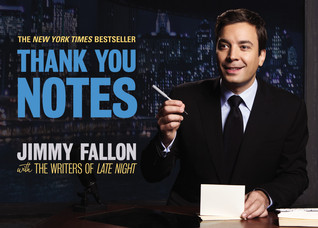
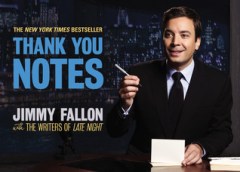
Thank you Notes by Jimmy Fallon
10505349
Thank you, slow walking family walking in front of me on the sidewalk. No, please, take your time. And definitely spread out, too, so you create a barricade of idiots. I am so thankful that you forced me to walk on the street and risk getting hit by a car in order to pass you so I could resume walking at a normal human pace.Jimmy Fallon has a few people and a few things to thank. In this brand-new book, the very first to come from his show, he addresses some 200 subjects in need of his undying “gratitude.” Each page will feature one note and a photograph of its recipient.
_____________________________________________________________________
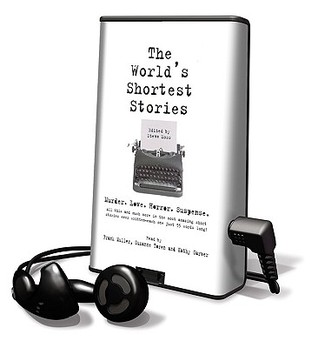
World’s Shortest Stories by Steve Moss
8791206
Murder. Love. Horror. Suspense. All this and much more in the most amazing short stories ever written each one just 55 words long! Consider for a moment 55 words. It’s an absurdly tiny number. No, it’s an impossible tiny number. It’s what O. Henry might have conjured up if he’d only had the back of a business card to write upon. You’ll find murder and suspense, horror and intrigue, love and betrayal, plus distant worlds and inner demons.
All in a measly 55 words.
_______________________________________________
Devil’s Dictionary by Ambrose Bierce
49256
A virtual onslaught of acerbic, confrontational wordplay, The Unabridged Devil’s Dictionary offers some 1,600 wickedly clever definitions to the vocabulary of everyday life. Little is sacred and few are safe, for Bierce targets just about any pursuit, from matrimony to immortality, that allows our willful failings and excesses to shine forth.

________________________________________________
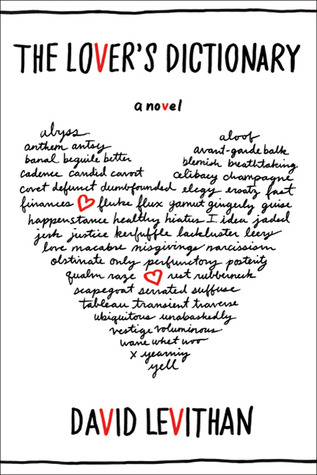
Lover’s Dictionary by David Levithan  [This one fits the list appropriately after the last one. I read this book in one sitting. It’s tender and sweet, and the cover is AWESOME!]
9279177
How does one talk about love? Do we even have the right words to describe something that can be both utterly mundane and completely transcendent, pulling us out of our everyday lives and making us feel a part of something greater than ourselves? Taking a unique approach to this problem, the nameless narrator of David Levithan’s The Lover’s Dictionary has constructed the story of his relationship as a dictionary.

_________________________________________________
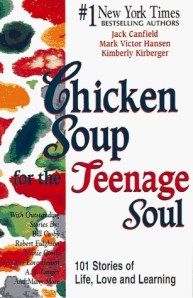
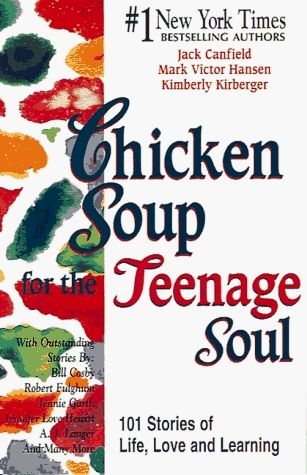
Chicken Soup for the Teenage Soul by Jack Canfield, Mark Victor Hansen427920
This first batch of Chicken Soup for Teens consists of 101 stories every teenager can relate to and learn from–without feeling criticized or judged. This edition contains important lessons on the nature of friendship and love, the importance of belief in the future, and the value of respect for oneself and others, and much more.
_____________________________________________
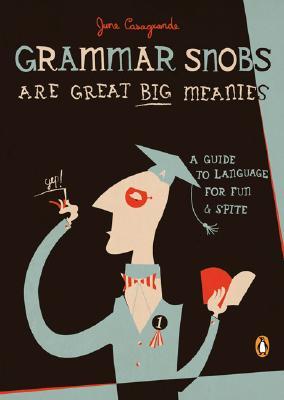
Grammar Snobs are Great Big Meanies: A Guide to Language for Fun and Spite by June Casagrand
14106
What do suicidal pandas, doped-up rock stars, and a naked Pamela Anderson have in common? They’re all a heck of a lot more interesting than reading about predicate nominatives and hyphens. June Casagrande knows this and has invented a whole new twist on the grammar book–a laugh-out-loud funny collection of anecdotes and essays on grammar and punctuation, as well as hilarious critiques of the self-appointed language experts.

Do you know of any more fun texts to use as writing mentor texts? Please leave your suggestions in the comments.

“Blog, blog, blog…that is all I ever hear.”

'student_ipad_school - 025' photo (c) 2012, Brad Flickinger - license: http://creativecommons.org/licenses/by/2.0/

An Open Letter to Parents:

I have heard you have some questions about our student blogs and writing in my class. I hope this letter answers them.

Did you know that our classroom blog is each student’s portfolio of work, which includes all types of writing? It is a combination of digital journal and portfolio. So far this year, students have been given opportunities to write in many modes: expository, narrative, literary response, and personal reflection. In addition to the assigned writing tasks, I encourage students to write about topics that interest them. The growth I have seen in my student writers has been easy to measure, since so many of them have taken ownership of their blogs and write to their personal world-wide audiences.

This summer I attended a conference where Alan November, an international leader in educational technology, described the urgency teachers must take in changing practices that limit learning to one-year increments. Teachers must expand learning practices so students retain and build upon the knowledge they gain each year. This idea of expanding learning practices resonated within me because I have often found it frustrating that a student’s body of work is essentially not available to him for reflection, or continued study, after a given school year.

For my students, their blogs are a collection of their work. For some, this blog will become a place where they can explore and express complex ideas about our society, even after they leave my classroom. Research shows that bloggers are more prolific writers than their teenage counterparts who do not blog. Additionally, blogging allows for an authentic voice in student writing.

When a student writes for the teacher, as grader and sole audience, the writing is often contrived and trite. However, when we give students the opportunity to find an audience outside the walls of the classroom, they find their voices and their writing dramatically improves. In addition, the feedback students receive on their writing is not just from me, the teacher. The feedback may come from anyone who reads their posts, which makes the opportunity for connections to the real-world exciting for student writers. Just last month, a student elatedly read a comment on her blog from a pastor who said that her post gave him a refreshing view of heroism–a thought he would love to share with his congregation.

I received another bit of positive feedback recently. An author contacted me saying he was interested in publishing for his readers a visual literacy piece one of my students created about that author’s book. My student had posted this original piece on his blog. Again, feedback from our beyond-the-classroom audience.

In my classroom we do not “do blogging;” blogging is the medium students use to publish their work.

Many people, some personal friends of mine, have received book publication contracts simply from the body of work they have posted to their blogs. Why would I not encourage blogs as a place for students to publish their authentic work?

Still not convinced? Consider this: Blogging can be a great equalizer in a Digital Classroom.

The author is not struggling to physically form letters, and the reader is not struggling to read cramped handwriting. When students type, they are no longer judged by their penmanship. In addition, technology supports the author’s spelling. Without these limitations, students are judged by the depth of their ideas and the connections they make to their world and our society. Isn’t that the kind of thinking and learning we want?

Parents, please, I encourage you to frequently read your student’s blog. Share the link to your son or daughter’s blog with grandparents, aunts, uncles, friends, and all the important people in your child’s life. Imagine the kind of writing we can develop in our student writers if we show them we care about what they have to say. And, believe me, my students have a lot of good things to say.

Help me expand the Learning Community and comment on your child’s blog posts. The opportunities for growth are endless!

Respectfully,

Mrs. Cato