
Tag Archives: world literature

Tu Eres Mi Otro Yo

ocs While recently in the throws of February break rejuvenating away from the hubbub of the city in the quaint beach town of Montauk; Malcolm X and I were becoming intimate acquaintances.  We had been for quite some time, actually.  But it was here that I really started questioning him, his motives, and his overall sense of dedication to any cause he finds justified.  As I was making direct connections to my own beliefs and passions, my pen went haywire.  There was, by no means, enough blank space on the pages of this autobiography for my own thinking.  Out came the post-its.  The power button on the iPad came alive and my inquisition and deep thought went ablaze.  While X and I could not be more different human beings the ideal of commonality among passion elated me.

Later that very same day, I was introduced to Dr. Jeff Duncan-Andrade’s invigorating message that immediately added even more fuel to my already-burning fire.  From the moment I pressed play (thank you, Apple TV) I was captivated.  Jeff is an outstanding educator who believes there are three kinds of hope: material, critical and audacious.  He believes that our [urban] students are roses growing in concrete.  I mean, the city has always been referred to as the concrete jungle!  In order to really grasp the intensity and genuine love Jeff exudes with his message, you’ll have to watch for yourself.

There I was, hours away from the city and my students, yet never have I felt so connected.  X’s passion exudes from his autobiography; Jeff’s passion seeps through his pores as his care is so loudly presented; and my passion was turning up the waves in the ocean right outside my window.

On my drive back to work that first Monday morning after break, I made a promise to myself.  I promised to stay true to my passion and invite the new found passions I discovered to reside within me as well.  My focus was by no means on the road, it was zoomed in on Jeff’s mantra: Tu eres mi otro yo! (You are the other me!)  How could it not be?  How could I not be heading back to room 382 thinking, “Students, you are my reflection…you are what I see when I look in the mirror.  We are one.”?

As I headed into our building, my mind automatically trained itself on a female student that I have been working with for six months, but have yet to authentically connect with.  Today was the day that was going to happen.  The day had not begun, but I was sure of it.  I was sure of it because I was going to channel all of the passion, intensity, and love I gathered over the break and pour it all over this student.  I only hoped she wouldn’t mind!

As independent reading commenced I asked this student to join me with her new book, highlighter and pen.  It was a piece well below her reading level (as is typical of her reading selections), but the premise captured her attention immediately: females making decisions based on their desperate need for belonging among other female peers.  There’s no wonder.

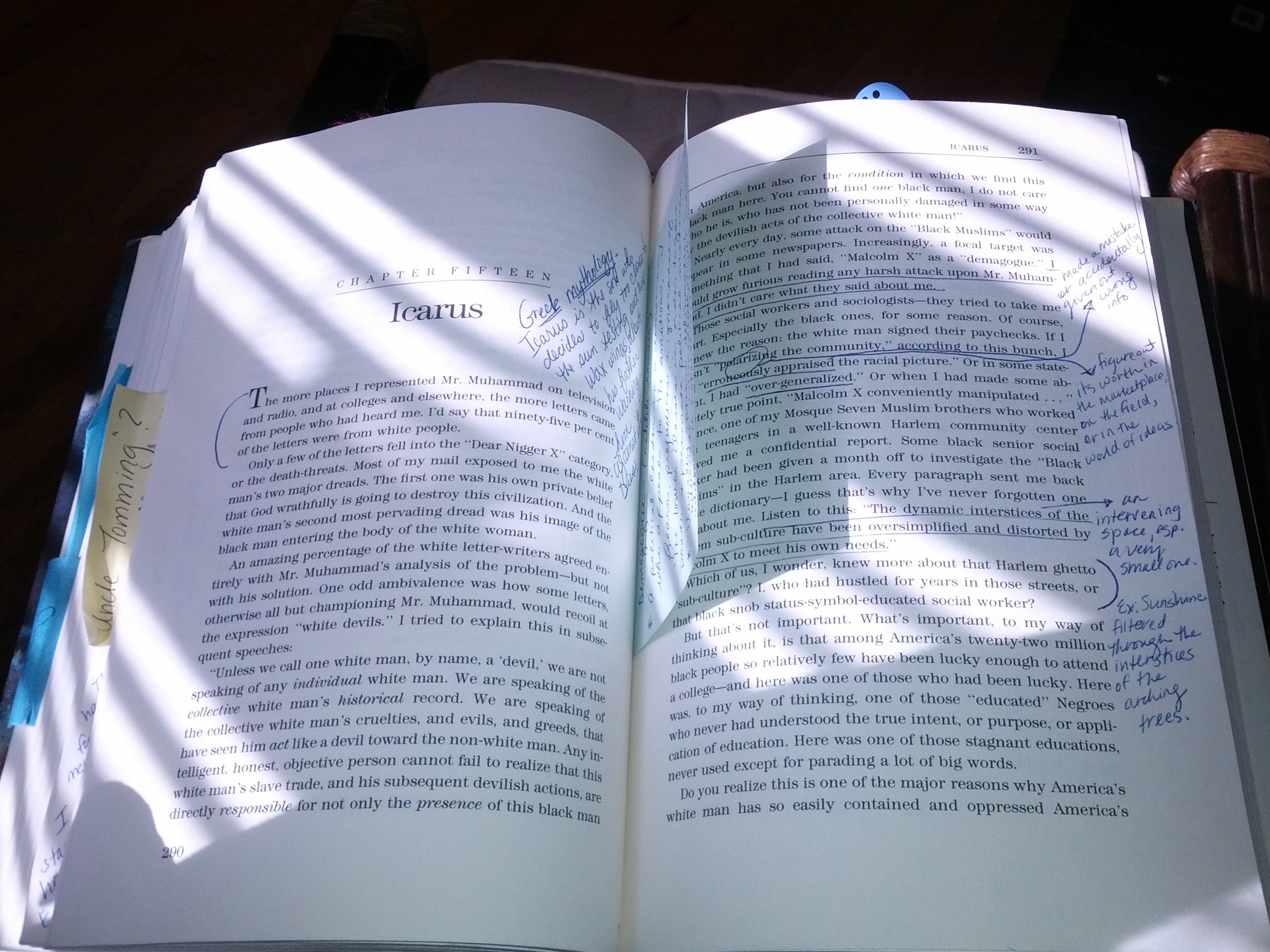
X followed me to class that day, in many regards.  As I put my chosen piece of literature on the table, a ‘huh’ surfaced from this female student.  I opened to the chapter titled Icarus.  IcarusI asked her if she knew what the title meant and the following is the dialogue that surfaced:
B: Nope.

Ms. B.: Neither did I.  I decided I wasn’t going to go any further into this chapter until I understood what this name resembled.

B:  Huh.

Ms. B.: So, I took to the internet and realized Icarus is the name of a Greek mythical figure whose father warned him of not flying too close to the sun with the wax wings in which he created for him.  But, he did.  And he fell straight out of the sky.  Can you imagine?

B: Wow.  Huh.  That’s interesting.

Ms. B.: Isn’t it?  Then, check this out…(I flipped to the last page of the chapter.)  Read this last sentence.  (B does.) Do you see it?

B:  Whoa.  It connects to the title.  It explains what you just did.  (Smile)

And it was at this moment, that the gathered passion, intensity and love I poured all over this student started to work its magic.  Because here’s what happened next:

B: Ms. Bogdany, how do you know what to highlight though?  I never know what to say — I mean annotate.

This may seem like a simple (and potentially expected response) but after working with this student since September, this was the very first time she was confident enough to be vocal with her inquiry.  From there we opened her book (with much fervor) and highlighted a portion that she noted.  I asked her what it meant, and she started to explain it…and, in her book, I wrote down her thoughts.  I then asked her about her own ideas regarding this concept, and (with the longest response to date) she explained her insights about the decisions the main character is making.  So, again…I scribed.  We discussed.  I annotated.  She smiled.

Ms. B.: Do you see it now?

B: Hahah.  I do.  It…it makes you understand more.  Thank you.

Before she left to resume this process solo, I pointed her in the direction of another female student who had just started reading:                                                                          Odd Girl Out
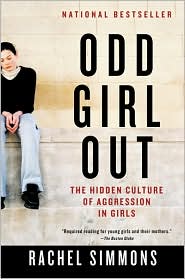
I explained the premise of this piece.  She raised an eyebrow.  I mentioned that when the other student was done, she may want to engage with it as it’s the same concept that envelopes her piece, yet it’s an informational, non-fiction piece.  This piece is more level appropriate for her.  Same concept, different genre, enhanced level.  We’ll see.

In the meantime, I noticed during the rest of our two hours together that day, B’s book kept finding it’s way back onto her desk; her highlighter was incredibly busy; and her pen was relaying her inner voice on those very pages that previously would have remained untouched.  And instead of refocusing her on the day’s lesson and activity; I whispered internally, “Tu eres mi otro yo.”

Gifted and Talented Teacher Leaps off Cliff of Faith and Experimentation

Guest post by Tess Mueggenborg

Make no mistake about it: I’m a classical canon gal.  Always have been, always will be.  And when I say “classical,” I also mean “really old” – few things written after 1650 hold much interest for me.  Favorite work of literature? Milton’s Paradise Lost.  Favorite time period of literature? Early Roman Empire (Ovid & Virgil).  Favorite English Lit class from my undergrad days? Greek Tragedy.

But as much as I love the canon – and I’ve had surprising success with teaching the canon in the past – I’m also a pragmatist.  I know that what I love isn’t always what’s best for my students, and their learning should take priority over my passions (I know … radical idea, right?).  I also acknowledge that the real world in which I live and work is far from my ideal.  Would I like to devote all of my class time to discussing Beowulf and Canterbury Tales?  Of course.  But can I realistically get my students to read and engage with these texts, and develop a passion for them?  Not likely.  Some, of course, will – and I’m happy to guide them on their own paths of classical literature studies.  But I bet (I hope) that those students will wind up as English Majors, and they’ll get their fill of such works in college.  I must work with the students I have, not the students I wish I had.  And the students I have are awesome: bright, curious, hungry for meaningful learning and wisdom.  So this classical pragmatist has started to break her own mold.  Here’s how …

I teach a class known as World Experience; it’s for Gifted and Talented sophomore students, and it combines AP World History with literature.  The history drives the course – it sets the pace, scope, and sequence for the year.  It’s then pretty easy to match up literature with the corresponding time periods.  leap off cliffAncient River Valley civilizations at the start of the year? We read Gilgamesh and Horus the Hawk.  Classical civilizations come next – that mean Antigone and a few selections from Metamorphoses.  Next up is the Medieval period … and this has always been a struggle.  I love Medieval lit, I can read Middle English, and I can wax poetic on the virtues and merits of The Song of Roland and Sir Gawain and the Green Night ad nauseum.  And while the students usually enjoy these stories, they don’t usually get much out of this unit in terms of literature.  They don’t learn much about author’s craft, they can’t do much literary analysis, and they become so frustrated with the archaic language of the text that most of them give up … and it takes me another six weeks to pull them back into literature.  So this year, I’ve scrapped all this, and leapt off a cliff of faith and experimentation.  The results have been pleasantly surprising.

Our district head of English Language Arts was kind enough to buy $600 of books for my classroom library.  I got to choose every one of them: all award-winners (or by award-winning authors), all world literature, all contemporary, all high-level.  No softballs in this classroom library – these are, after all, GT students.  Each student got to pick a book (this was a time-consuming and sometimes contentious process, but it certainly got every student interested in the books and invested in their choice).  Once a week, they’ve been blogging about their novel, based on someone generic questions posed by me.  Some of the questions are just opinion (Do you like this book so far? Why or why not?); some of the questions are analytical (Who is the main protagonist of your novel? What problems do they encounter in the course of the novel? How do you predict they will resolve these problems … or not?); some relate back to the history half of the course (In what ways does your novel relate to the history we’ve studied so far this year?).  Some responses have been good.  Some have been profound, moving, passionate, and elegant.  None have been outright bad, and none have been missing.  That’s right: NONE have been missing.  Every student has been reading and blogging.  Even the student who earned a grade of 9 (yes, a single-digit 9) for the first 9-weeks is reading and blogging about her novel.  I’m calling this experiment a success.

To be fair, I should say: this hasn’t been easy, and it hasn’t been without challenges.  But they’re good challenges, and not insurmountable.  Some students read their novels in a week – and then wanted to borrow another book.  YES!  Many students didn’t devote enough time to reading their novel, and they’ve fallen behind.  But they haven’t given up: they’re still reading.  I haven’t had any complaints of “this book is boring,” though I’ve had many complaints of “this book is so sad/depressing/pessimistic/disheartening.”  Which has led to some great discussions about the point of literature, analysis of tone, and some hefty doses of maturation (I’m pretty sure the girl who read The Kite Runner in a weekend has been inwardly weeping for two weeks now).

We’re wrapping up this unit, and thus this great experiment.  And I think it bears repeating: I’m calling this experiment a success.  Enough of a success that I’ll be spending this weekend revamping the next unit (which starts Monday) to include more student choice and incorporate more of these novels, though in a slightly different fashion.  Stay tuned.

Am I still a classical canon gal? Heck yes. Always have been, always will be.  But my students don’t need to be classical canon fans – they just need to be readers, eager to engage with the world and its complexities.  I think they’re well on their way.

“Professor” Tess Mueggenborg teaches English (and anything else with which her students need help) at RL Turner High School.  Her academic passions lie in comparative language and literature.  The Professor lives in Dallas with her husband, Jeff. Tess’ on Twitter @profmueggenborg

Part II. In an AP Class, Shouldn’t It Be about the Reading?

Angels sang to me again today. This doesn’t really happen too often, but when it comes to awesome adventures with students and books, the choir starts belting out in fff.

Based on the feedback to my post on Wednesday, I know many of my peers feel the same way as I do about AP students and reading–or not reading–as the case may be. I appreciate the comments and the emails and the encouragement. (I gave a student the Pulitzer Prize Winner Tinkers today, and another one asked for a copy of The Great Gatsby with no prompting from me whatsoever. I know I am doing something right here.)

I’m pretty much the advocate for independent reading on my campus. I talk about it every chance I get: slip it into a conversation here, there, and everywhere. Sometimes the words work their way into another teacher’s thinking, and Hallelujah! the angels bust out in song.

Read this email I got from my friend, Tess Mueggenborg. She teaches our gifted and talented Globesophomores in a special humanities course, which combines AP World History and Honors English II, and AP Literature. She and I share a lot–some things curriculum related, other things not. When we first worked together six years ago, it was as a team teaching the G/T course: me English/her history. I can tell you this:  Tess loves classic literature–some of which I’d never heard of. Gilgamesh, Horus the Hawk. Sigh.

For the past few years Tess’s heart’s been changing (I say that tongue in cheek because her heart is shiny gold), and she’s allowed for much more student choice in all her English classes. This fall she asked for funds to create a World Literature library of contemporary and complex books for her advanced students. Our ELA coordinator granted the request, and. . .

Read this. You’ll hear the choir.

_____________________________________________________________________________________

Thought you might like to hear (and read) what’s going on with the new novels in World Experience … Last Friday, we had a day of “book speed dating.”  The students had about 60 seconds with each novel, and if the book interested them, they put a sticky note with their name on the back cover.  Then we divvied up the books, which proved to be arduous but entertaining.  Some of these kids were REALLY passionate about which book they ended up with! Today, they had their first assignment (other than “start reading!”) – a blog post.  Here are the questions I posed:

By now, you should be 1/4 to 1/3 through your novel (if not more!).  Based on what you’ve read thus far, answer the following questions on your blog.

1. How many pages are in your novel?  How many have you read?

2. Who is the protagonist (main character) of your novel?  What is the main conflict this person faces?  What are some possible outcomes that you foresee for this person?  (In other words: guess the ending.)

3. In a well-developed paragraph (with text evidence), respond: so far, what do you like about your novel?  What do you not like about your novel?  Why? Explain.

4. Based on what you’ve read thus far, would you recommend this book to someone else?  Why?  Explain.

5. Pick ONE quote that has stood out to you from the novel.  Give the quote, then explain: what made this quote stand out to you?  How does this quote relate to the whole novel?

And here are the links to several of their blogs:

Chris is reading Transatlantic: http://keyboardandseafood.wordpress.com/2013/10/24/transatlantic-novels-assignment-part-1/

Neha is reading The Namesake: http://neha614.wordpress.com/2013/10/24/assignment-for-1024-the-namesake-part-1/

Nico is reading All the Names: http://nicolasrequena28.wordpress.com/2013/10/24/novels-response-1024/

Rafael is reading Enrique’s Journey: http://parrarafael872.wordpress.com/2013/10/24/enriques-journey-part-1/

Angelica is reading Girl in Translationhttp://perezangelica477.wordpress.com/2013/10/24/novels-part-1/

Aaliyah is reading The Secret Life of Bees: http://aaliyahgonzalez.wordpress.com/2013/10/24/novels-part-1/

Overall, I’m really pleased with the results I’m seeing thus far!  Many of the students aren’t as far into their books as I had hoped they would be, but they all seem genuinely interested to keep reading.  I’m definitely getting more traction with these novels than I have with the literature I’ve done in the past for this unit (“Sir Gawain and the Green Knight,” plus Islamic and Chinese poetry).  Next week, I’ll start having them tie the cultural content of their novel to the things they’ve learned about World History thus far.  I’m VERY curious to see how that goes!

_____________________________________________________________________________________

I ran down to Tess’ room the first chance I got. I was too excited to respond in an email. The books Tess filled her shelves with are rich and diverse. Here’s her list: World Literature Library

As I left her room, one comment made me smile:  “I’d still be using the classic lit, if the students would read them.”

And that’s my point: In an AP Class, Shouldn’t It Be about the Reading?

Reel Reading for Real Readers: The Lowland by Jhumpa Lahiri

20130207-190708I’m starting an Award-Winning Books Only shelf. (Okay, maybe award winning authors, too.)

Since I am teaching only advanced classes, and since I am allowing students choice in pretty much anything of length they read, I want to be able to challenge students to take a step up the ladder to more complex texts than the YA literature they so readily pick up. Not than any student, advanced or otherwise, shouldn’t be challenged; not that YA is not great reading for all students. But, you know, I am supposed to provide the rigor for an AP class as required by the College Board.

I want Pulitzer Prize Winners and National Book Award Finalists and Man Book Prize Winners.

I want students to take on the challenge and the feeling of accomplishment of reading a Prize Winner.

My list of award winners is long, and it will take me even longer to purchase all the books I want. But I’ve started, and The Lowland by Jhumpa Lahiri, a Pulitzer Prize Winning author, is the fifth on my shelf.

See the author talk about this Man Booker shortlisted title here: