Let us know if you have questions about readers-writers workshop. Throughout the summer, we’ll be posting answers.
Don’t you just love this question so much more than “What do you do for summer reading?”
Of course, we know to get to the “keep my students reading” part, we have to do a lot of work — sometimes a whole lot of work — to get some student reading throughout the school year. And those of us who give so much of our time to this heart work of reading, can feel sad, anxious, and exasperated when our students leave us and get “assigned” a book, or more than one, for summer reading.
For several years, my AP Lang students, many who were second language learners who took a courageous leap to tackle an advanced English class, would read stacks of self-selected books, and grow exponentially as readers, only to get handed at the end of their junior year a summer reading assignment and a list of study questions for AP Lit. Beowulf. This is problematic on so many different levels — but entirely out of my control. What could I do?
The only thing that made sense at the time was to encourage my students to form their own summer book clubs. I suggested they might set some goals to read their assigned text first, and then meet together to talk about it — similar to what they’d done in class in the three rounds of books clubs we’d done throughout the year. Then, they could choose another book and meet up again. Students took it upon themselves to circulate an interest form, and most students wrote that they were interested.
It didn’t really work. I was too busy in the summers to commit to keeping the idea alive. And we all know soon-to-be-seniors, or many teens for that matter: Procrastination is their BFF.
I still love the idea of summer book clubs, and I know some schools are having great success with them. Hebron High School is one of them. The English department at Hebron is doing amazing things to cultivate a culture of reading, not just during the school year, but throughout the summer as well. They open the school library every Wednesday afternoon, so students can select books — and get coaching for college essays. They’ve got book clubs scheduled with teachers and coaches. They’ve got a wish list for books circulating within their community. Really fantastic ideas to keep the focus on the power of reading.
Scholastic recently released a report about summer reading trends. The report states that 32% of young people ages 15-17 read zero books over the summer — up 10% in two years. The report also states that “53 percent of kids get most of the books they read for fun through schools—so what happens for that majority when school isn’t in session?”
It doesn’t take much to know the answer. So what can we do? Besides following Hebron’s lead, here’s a few ideas:
- Talk up your public library! Invite a librarian to come visit your classes, and get students to sign up for library cards. One of my biggest regrets at my last school is that I didn’t take my 11th and 12th grade students on a field trip to the public library. We could have walked — the library was that close. I know the majority of my students had never been inside, and every year I thought what a great activity this would be. Every year I didn’t do it. #ifIcouldgoback
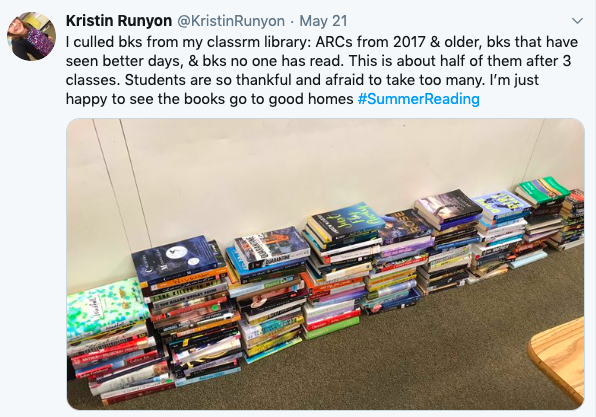
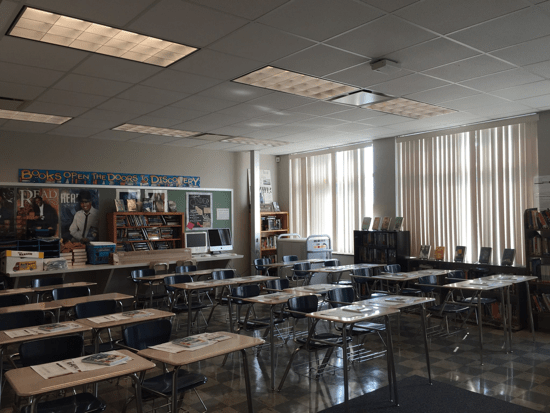
- Cull your classroom library, and let students take home books. I know. I know. Many of us invest so much time, energy, and money building fantastic classroom libraries, and we lose enough books throughout the year without giving them out freely at the end of it. But, really, what can it hurt? Every year I’d pull books that I felt I could give up and put them on the whiteboard rails for students to take home for the summer. (Sometimes they even brought them back.) It didn’t matter. I’d rather have books in kids’ hands than hidden under butcher paper in my closed up classroom. Kristin does, too:
- Give students access to lists of high interest and award winning books — and free resources. Pernille Ripp shares her students’ favorite books each year. YALSA has great lists. And a cool new Teen Book Finder. BookRiot published “11 Websites to Find Free Audiobooks Online.” Audiobook Sync gifts two free audiobooks all summer. Great titles, too!
- Invite students to talk to you about their reading. Yes, even during the summer! Lisa does this in a slowchat on Twitter with students who will be in her classes in the fall. Students tweet her updates about their reading lives. She tweets back. It’s a great way to build relationships and share book ideas.
Every year I feel like I could have done more to keep my students reading throughout the summer. The truth is — we can only do what we can do. Sometimes it touches the right student at the right time. Sometimes we just keep trying.
I’m sure you have more ideas. Please share them in the comments.
Amy Rasmussen lives, gardens, and rides her bike in North Texas. She will be spending a lot of her summer with teachers facilitating PD around readers-writers workshop in secondary English classes. Her favorite thing. She’s also going to be doing a lot of writing. And a little poetry study at the Poetry Foundation Summer Teachers Institute in Chicago. Follow her @amyrass


 But, as ever, reading is the great escape.
 Murder-Mystery
 The Word Exchange was completely, compulsively, un-put-down-able. Alena Graedon is a new author for me, and her tale of a world that loses its grip on language once a massive tech company monopolizes and commoditizes words was, for me, perfectly timed–I’ve been a little unsettled lately by my observations about how addicted to technology everyone is, and how afraid I am of what it’s doing to my students, and could potentially do to my children. This book spurred me to action in terms of deactivating my Facebook and Instagram accounts and making a conscious effort to leave my phone in another room–to make space to just be, and be bored, and have time to think and wonder and ponder.
 The Power by Naomi Alderman was just wonderful. It had all the elements of a gripping adventure story, along with a powerful message about what corrupts us. In this novel, women develop an electrostatic power and a society shifts from patriarchal to matriarchal in the space of a few generations as a result. The effect of women suddenly becoming more physically powerful than men leads to widespread revolution in everything from interpersonal relationships to world leadership. It’s beautifully written, too.
 Dear Martin was a book I’d been recommended a thousand times, it seemed, but after reading so many books that felt similar–The Hate U Give, Long Way Down, etc., I just couldn’t pick it up–but I’m so glad I finally did. Nic Stone crafts this novel as a series of letters from young Justyce McAllister to Martin Luther King, interspersed with transcripts of news reports and first-person narrative. It’s complex and thoughtful and plausible and readable and powerful. I loved it.
 Teaching Books
 The following is a guest post from an inspiring teacher and football coach I met this summer. He sent it to me the day after my daughter got married, and I’ve been playing catch up with life and getting-ready-for-back-to-school ever since. Sorry, I am late in posting it, Charles. You have to know, this post excites me: I’m excited for the PD experiences we had this summer. I’m excited for the students who will walk through your door this fall. I’m excited to know you will spread your love of books and reading far and wide — and I’ll be excited, and not at all surprised, when you share a few titles with your linebackers. (Have you read
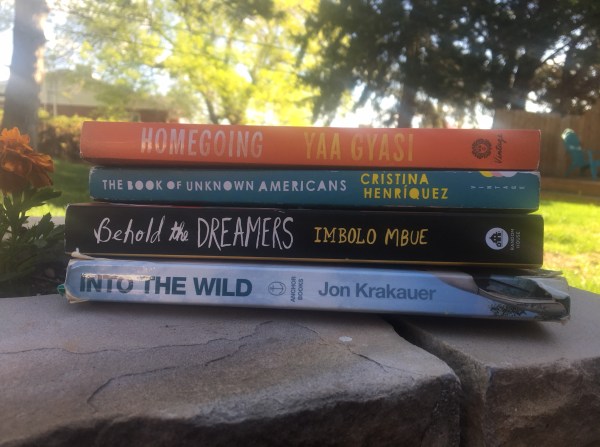
 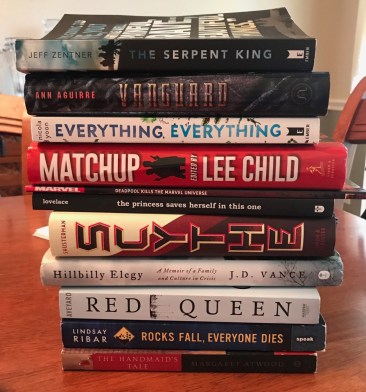 I read so many amazing books and looking at my stack makes me realize what an eclectic collection it is. I read fiction, memoir, poetry, a thriller short story anthology, and even a graphic novel. I read the first book in a series, the fourth book in a series and a few standalone novels.
 It’s that time of year again when the beauty of our classrooms begin to disappear. Posters and signs that inspired students vanish from walls and doors. Classroom supplies get dumped into storage bins and closets. Those smiling cherubs are no longer waiting for us to greet them. It’s summer.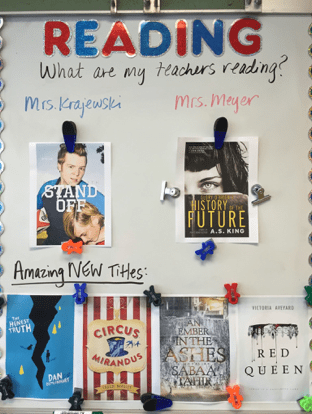



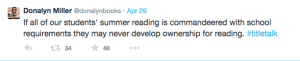 mandating one specific book.


 Three Teachers Talk