Tag Archives: Organization/Planning

Calling All Principals!

ocs    “I’m curious.  Tomorrow as you wake up and head out the door to start your day, you are faced with the reality that all educational institutions have been permanently shut down.  How does this impact your lives?  And, most importantly, what are you going to do about it?”  

As I set out to write this piece, I internally chuckle as I reminisce about the beginning of the school year.  Three weeks ago, if you had peered into room 382 to see what my Social Justice and Student Voice class was up to, you’d be welcomed by silence and quizzical looks replacing the vibrant and eager-to-learn sparkle in students’ eyes.  This off-the-cuff question became the catalyst for an unplanned three week project.  Here’s how: 

  1. I happened to be curious about something.
  2. Students couldn’t stop talking about it.
  3. All other plans were pushed aside. 
  4. Then, magic!

At that very moment, eleven principals were born.

From Dr. Collins to Principal Senat, students decided the only way to ensure that all human beings are given a fair shot at pursuing their dreams and goals is to reconstruct our educational system.  And they were very clear about this – the system needs to be customized to meet the needs of students far and wide.  Who better to do so then those most versed on the issue?  Vision, passion, and commitment ooze out of these change agents as they take to the process.  

As students have welcomed and emerged themselves in taking on this charge, there’s not much room for me in the process!  The way in which I sliver my way in is by providing guidance and options regarding organization.  Here’s what it looks like:

Write!  Just write!  There need not be any organization at first.  Students glanced at me through the corners of their eyes, caught each other’s eyes, glanced back, and repeated this eye game various times.  When they noticed I was not giving any further guidance they realized “she’s serious”.  And they tried it.

* Get dirty!  (Again, the eyes.)  When I explained that getting dirty means you can tell Principal Gordon “has been here” because he’s ruffled up his thoughts, he’s playing with his words, and he’s continuing to shift around his ideas…they liked the sound of others knowing “they had been there”.  Armed with highlighters, post-its, and colored pens.  Again, they tried.  

PP - self-edits

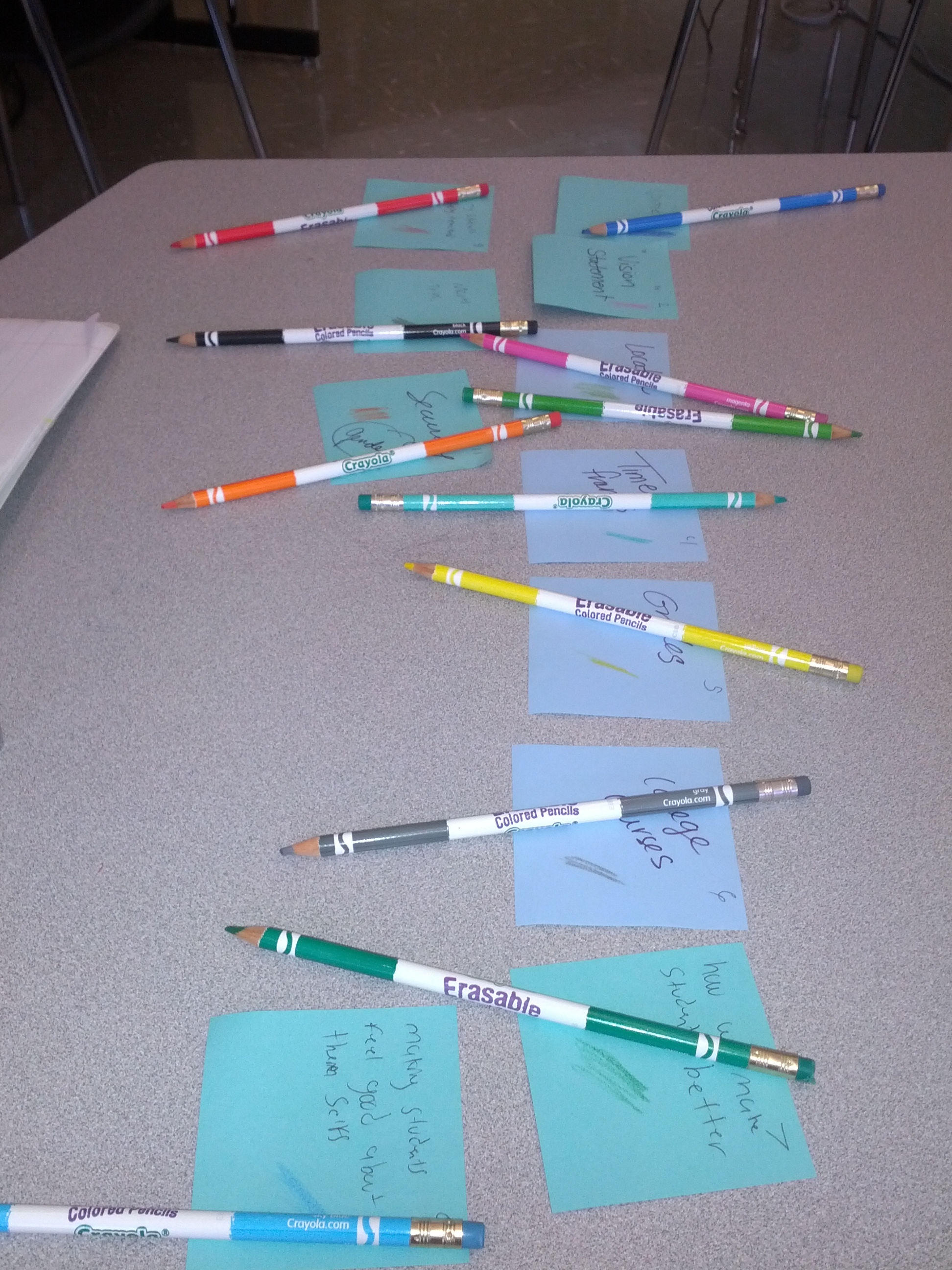
Now, let’s start to organize!   I know I know…it feels a little backward, but without students feeling as though they have to write in boxes, this process frees them.  They write first, organize next.  Yes, the key to the Writer’s Workshop! Write down the main topics in which you have decided to write about.  (See loose leaf)  Partner a topic with a color.  Each topic deserves its own post-it with the same color.

PP - color coded paper

*Once topics are color-coded and placed on post-its, now students have freedom to move their topics around! Literally.  Students have a holistic scope on all of the topics they have written about and now move post-its around in the order in which they want to introduce (and discuss) their topics.  

PP- color coded more pencils

 *Now, go into your paper using the color you indicated for each topic and underline wherever you find ideas about the topic!  Many times students enjoy seeing the same color throughout additional parts of the paper.  This visual guide helps them realize that their writing is (while sometimes scattered) valuable, and even though they (unintentionally) drop the topic into various parts of the paper, they have the power to locate it, restructure it, and reorganize it.  

*Would you like to take a look?  Students, when comfortable, reach out to other students to peer review their work.  This is a wonderful opportunity for students to talk practice, content, and work through ideas together.  I provide them with guidelines on how to productively, and respectfully, provide feedback.  (Pardon the red marker.  Students gravitate toward them!  Next up: using gentler colors for all revisions!)  

PP- peer edits

*When all of our drafting has landed in a comfortable place, we take to formalizing “Best Drafts”. (Thanks to Penny Kittle for this wonderful and inviting phrase students and I have comfortably adopted).  Each principal now makes themselves cozy in their “offices” and takes to their visual presentation.  Our principal and assistant principal will be in the audience when students present their projects next week.  Students have expressed some nerves, but little do these experts know we’re all here to borrow a few ideas from them!  

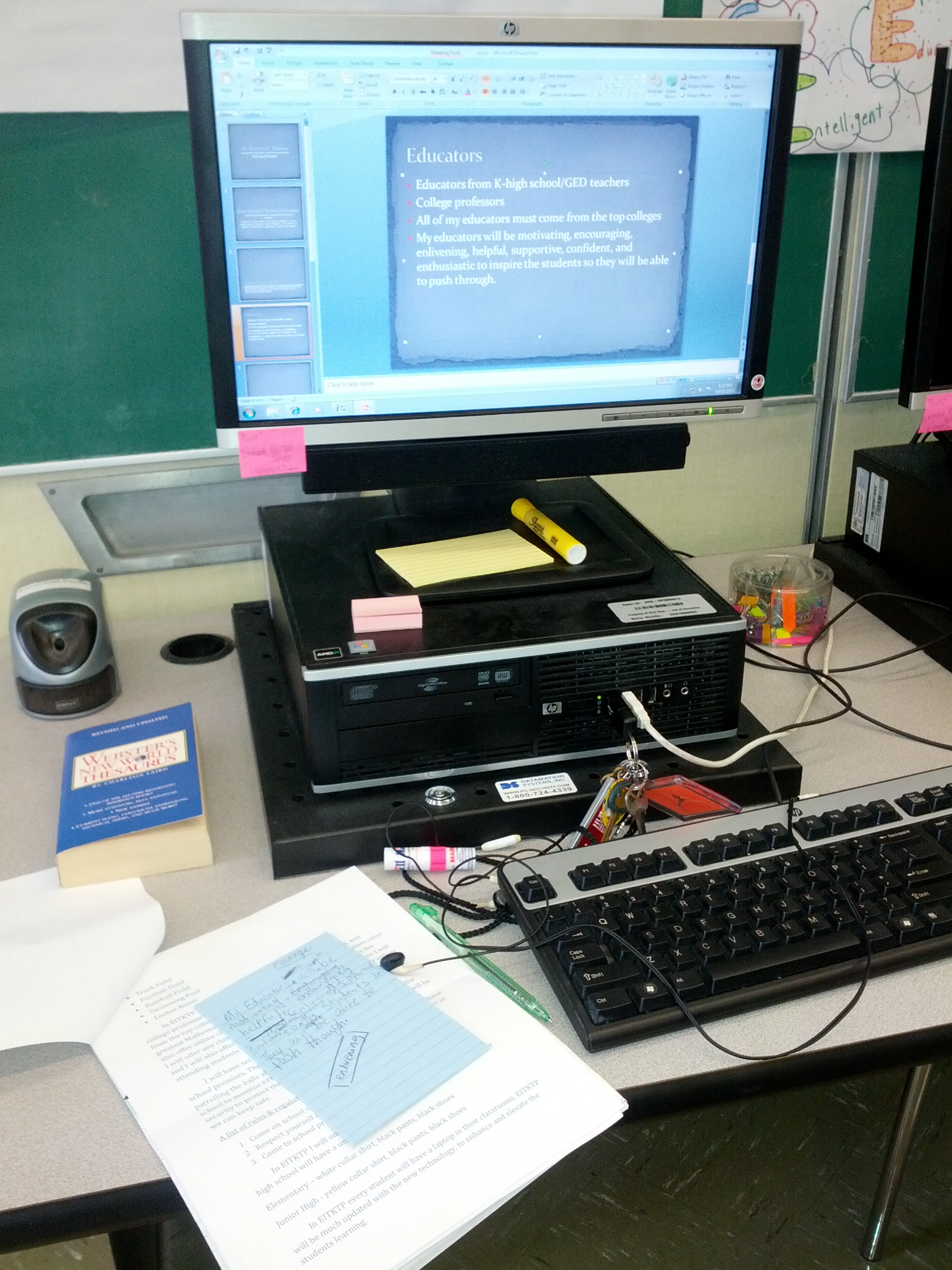
PP- Office


Eleven principals, three weeks of hard work, and one wildly proud educator makes for quite the beginning-of-the-year journey.  While finding the moments in which I can guide students along their writing paths, and support them individually in the way in which they succeed best; I can resort less to asking how to educate, and listen to what they are offering.  They are whispering to me through their vision.  These educational leaders have invited me to understand their views on what an educational system, derived on justice, looks like.  I am now the student.  

What is it about teachers and office supplies?

I heard it twice today:  

“If I wasn’t a teacher I don’t know how I’d justify my obsession with school supplies.”

“I love office supplies. The pens. The paper. The crisp white paper.”

Yes. Admit it. If you are a teacher, you are in this very special club. You have the best pen collection of all your friends. You have paper clips in shapes like frogs and hearts and even little pigs (if you don’t have them, you know you’ve seen them and secretly hope someone gets you some when Secret Santa rolls around.)

Maybe this is the best part of starting a new school year:  shopping for the supplies to put in children’s hands. Bright shiny and moist markers. Notebooks with blank bright pages.

Today at my first department meeting of the year, I picked up a brand new set of Prismacolor pencils. My department chair knocked it out of the park with his supply order. I’ve never been happier!

notebook and colored pencils

I don’t know about you, but to me the newness of supplies symbolizes hope.

I have such great hope for the students who will enter A202 today. I hope they’ll give me a chance to help them grow as readers and writers. I hope they’ll take risks that will help them become responsible young adults. I hope we can grow as a community of learners that empathize with one another as we take this journey throughout the year.

I have three distinct goals that will help me turn my hopes into realities:

1. Be diligent about using and holding students accountable for their writer’s notebooks

2. Hold more frequent and regular reading and writing conferences

3. Allow for more class discussion around topics of interest that promote critical thinking

My new notebook is ready, and my pencils are sharpened. The door is opening, and teenagers are streaming in. Here we go.

I Might Be Ready. Thanks, PLN!

I got the idea from Jennifer Fountain @jennann516 to post the covers of the books I’ve read on the door of my Fountain book doorclassroom. See how awesome hers looks?

I’ll go to my classroom this week with a new color ink cartridge and start printing book covers. It might be expensive–my printer’s kind of a wimp, but I think the more we talk about books, display books, show off books, the more likely we are to get kids to read books.

So far this summer I’ve read nine books. I have a week to finish one more to reach my summer reading goal. It’s a good start on my book-lover’s door.

I have three teaching books I’m reading, too.  I have to read them slowly and mark the pages, so I can remember the things that made me want to read them in the first place. I will let my students know I read these books, and I’ll let them know I’m writing one. We will be readers and writers learning together. Every day.

Shana classroom libraryLast spring when school was letting out, with a little help from some National Honor Society students, I finally got around to sorting and categorizing my bookshelves. I have close to 2,000 books. My daughter made me cute labels that I’ll laminate and put on my shelves this week. My friend Shana Karnes @litreader finished her library in her brand new classroom, and she’s my inspiration. My walls aren’t quite so cheery, but I hope to make my bookshelves look as inviting. Who wouldn’t want to browse here?

I “listened” in on a Twitter conversation about getting rid of the teacher’s desk to make more room in the classroom. I think that was Ms. Fountain and Mini Rench @mindi_r who bounced around the ideas, and inspired me to move some furniture. I couldn’t quite boot my desk, but I did turn it around, and I moved a table, so my personal real estate shrunk four feet. I can now wander the room, weaving between my round student tables much easier, and if I want to stop and teach the whole group, I can do it from three distinct places: front, back, and right side. The left side is loaded with bookshelves, and I just got asked if I wanted a rocking chair that will have to go there. Yeah, maybe. (I’ll take pictures soon.)

This year, besides my personal goal to do better at conferring with students and holding them Kitras Glassaccountable for their writers’ notebooks, I aim to be at peace. This is hard for me; I hang onto stress like that kitten and the frayed rope. Thanks to Erika Bogdany @erikabogdany, I now have a Zen garden on the shelf by my desk. “It will work!” she promised me. At the urging of Emily Kim @booknerdkim I also have a Woodstock Tranquility Table Chime. But my Kitras Tree of Enchantment globe is my favorite. I saw it in a shop in Maine in July and knew it would help me keep my center.

My PLN (personal learning network) on Twitter is my best source of learning. Sometimes I join chats: #engchat, #rwworkshop, #titletalk are favorites. Most often I just read what people share–and it’s an amazing thing. I’ve favorited tweets all summer and now categorized them into folders in Drive. I’ve got mentor texts for narrative, informational, and persuasive writing. I’ve got infographics, Youtube videos, and TED talks to use as quick writes and/or discussion starters. And more. All first shared on Twitter by educators like me who want to do the best by their students.

I might be ready for the new school year, and it’s a big thanks to my personal learning coaches for helping me get there. This week is inservice, and I’m actually looking forward to it:  new principal and three out of four new assistant principals, 31 new staff at my large high school this fall–at the very least it has to be interesting.

I’ll slyly keep my Twitter feed open, and maybe I’ll score one or two more ideas before students show up in a week.

I’d love to know the best ideas you’ve learned this summer. Care to share?


Whew! It’s (Still) Monday! What Are You Reading?

Heather and I talk a lot about our work, and we talk a lot about what to write on this blog. We set goals. We schedule posts. Sometimes we do okay, and sometimes we simply (or not so simply) let the demands of school and home and family get in the way of what we really want to do here. In an attempt to DO BETTER, we are going to join the It”s Monday! What Are You Reading? meme.

If you look at the Book Journey blog, you can see the original idea, but really, it’s all about sharing books and outlining a weekly plan for reading. Our stacks of To-Be-Read Piles rival any of yours, but this is a little different. We’re actually going to commit to what we are reaching to read during any given week. By doing so, we can show our students that readers have a plan. Readers know what they will read next. It’s not just a willy-nilly wandering through the stacks of a library. (My students think this is the same as having a plan.)

Our friends over at Teach Mentor Texts host their own version of It’s Monday! What Are You Reading? with their focus on #kidlit — book reviews and suggestions for children’s literature from pictures books to all things YA. We’re going to tag along here for a while.  So. . .

Mon Reading Button PB to YA

I love dystopian novels:  Fahrenheit 451, 1984, The Handmaid’s Tale, and this is a genre that lots of teens enjoy reading. Of all YA books, I’ll choose dystopian over any other. Three of my favorites, all of which are the first in a series (added bonus with kids and reading) and have been around awhile:

Delirium by Lauren Oliver

Matched by Allie Condie

Divergent by Veronica Roth

This past week I read the ARC of Revolution 19 by Gregg Rosenblum. Interesting. Not quite 13667361as engaging as some others. The concept is I-Robot–ish. Robots have taken over society in an attempt to save humans from themselves. The character development was pretty good:  three siblings and a couple of friends. I guess the thing that weakened the appeal was the dialogue. I thought it was boring–real as in what kids actually say to their parents and one another but boring. Overall, I give it three of those five gold stars.

This week I am reading another ARC:  The Different Girl by Gordon Dahlquist. I am not positive it’s dystopian, but I have a pretty good idea based on these last few sentences from chapter one:

15721645“We heard Irene and stopped whispering. She came in, turned out the light, and bet over each of our cots in turn. First Isobel, then Caroline, then Eleanor, then me, leaning close to my face and whispering. ‘Go to sleep, Veronika.’

Then she pushed the spot behind my ear, with a click, like always, and I did.”

What’s next? I plan on tackling the pile of dystopian books I haven’t read yet. Some students are helping me sort and categorize the book shelves in my classroom. For now, we have labels taped around the whiteboard rails around the room and stacks of books beneath them. The dystopian stack is the tallest right after Teen Angst. I’d rather not tackle that stack for a while, but that’s just me rebelling against the teen angst I deal with every single day.

I’d love to know your favorite dystopian reads. Please leave your book suggestions in the comments.

Yes, You Can Do Workshop in an AP English Class

I sat listening to Donalyn Miller the author of The Book Whisperer talk about how she gets her students to read an average of 60 books a year. She talked about student choice in selecting books. She talked about reading herself in order to match books with kids. She talked about creating readers and not just teaching reading. I thought:  “Cool, but how do I do that with MY students?”

I’d just been assigned to teach AP English Language and Composition the next fall, and I was trying to get my thoughts aligned with the expectations from the College Board. At the same time I was in the middle of my three weeks National Writing Project summer institute, and I kept hearing that I must give students time, and more time, to read and write. My head swam.

At one point, I asked Donalyn: “This is all great, but how does student choice and all this reading work in an AP English class when the focus is on students passing the exam?” Honestly, I was put off by her response:  “It’s not all about the test. Is it?” Yes. Yes it is.

Or so I thought at the time.

It took me three years to figure out how to use Workshop in my AP English class, but I have. Mostly.

My Definition of Reading Writing Workshop:  Students do more work than me!

Weekly Schedule

Monday Tuesday Wednesday Thursday Friday
Flex Instruction/ Writing Workshop: Timed Writing Debrief

HW: blog post due

Reading Workshop:

Multiple Choice/Critical Reading

Direct Instruction/ Reading or Writing Workshop as needed Writing Workshop: Timed Writing


HW: blog comment due

Alternate Weeks:

Topic & Theme Flood/Vocab & Current Events

The table shows a typical week in my AP workshop classroom. Of course, there are always interruptions to my well-planned schedule.

Blogs:  Student Own and Class

One of the best instructional practices I have is mandating that my students create and post to blogs. Some kids truly take ownership and write more than I assign; some do the absolute minimum. Some refuse to blog at all. Those are the kids who miss out on the practice it takes to become an effective writer, and most of those do not get qualifying scores on the AP exam. My class blog is Citizen Scholars. You can see how I post prompts that students respond to either in the comments or on their own blogs. To see student sample blogs scroll down my blogroll and click on a few. Some are better than others: Joseph, Sarosh, and Simina’s are quite good. When I give students choice about what they write on their own blogs, I consistently get better writing.

In the fall of this past year, I had students find and read current events of their choice. On their blogs they had to write a response to something within the article they read. I scored their writing based on whatever skill we worked on in class that week, using a generic version of the AP writing rubric. Spring semester I tried something new: students were to move through the modes of writing. They got to choose their topics; one week they were to write a description, another week a compare/contrast, etc.

My students write more than I can ever grade. I might grade one in three blog posts, but the more feedback I give, the better the writing. Using Google Reader and the Flipboard app on my iPad is a simple way to read student blogs. I give feedback on sticky notes. Or, if you get your students using Twitter, they can tweet their blog urls every time they post. Again, using my iPad, I can read their blogs and leave feedback quickly via my own tweets and re-tweets of student blog posts.

Multiple Choice Practice/ Critical Reading

Historically, the part of the AP exam that my students do the worst is on the multiple choice section.  As a result, I’ve tried to include more targeted practice with critical reading. My goal is for students to complete 30 multiple choice practices per year. This is difficult (I think I got through 24 last year) but is proving to be worth it as students’ scores improve. Some variations on multiple choice practice (all can be done in small groups or with partners) include:

  • Students read and discuss the passage, finding rhetorical devices and explaining the effect they have on the piece
  • Students use question stems to write their own questions and/or answers for the passage
  • Students receive the multiple choice questions without the answer choices and must answer the questions in short essay format
  • Students receive only the answer choices and must compose the questions that go with them

When students engage in the “work” of reading, they are absorbed in what I called Workshop. The challenge for me was learning to trust that my students would find everything important within a passage. They surprise me every single time!

Direct Instruction/ Reading or Writing Workshop

I learned from Penny Kittle the value of using professional authors like Leonard Pitts, Jr. and Rick Reilly as mentors. Craig Wilson, USA Today columnist, and Mitch Albom are also favorites. These authors write about high interest, contemporary topics, and their writing is chalk full of the rhetorical devices I want my students to include in their own writing. Some weeks we read like readers–reading articles as we focus on content and comprehension. Some weeks we read like writers–analyzing articles as we identify and discuss the effects of the language the authors use to create their messages. Like Kittle, with students I create anchor charts that hang in the room, which detail the different techniques authors use in the majority of their pieces. In years past I’ve had students write process papers on topics of their choice, modeling the writing of one of our mentors. These are often students’ favorite pieces of writing.

Since time is so limited, students write their drafts outside of class. (Of course, I have to teach them the difference between a draft that they are ready to get feedback on from peers and their pre-writing that they quickly sketch during the period prior to mine. Drives me crazy.) In class, students read, evaluate, and give feedback on one another’s writing as I wander the room and conference with as many students as possible.

Conferencing is the key to creating better writers.

During my larger classes, it is difficult to conference with each student. I often post a sign up sheet with time slots for before or after school. Students may choose to meet with me for a more in-depth discussion about their writing. Depending on the student’s needs, I might make this additional conference time mandatory.

Book Clubs

Since I want my students to become lifelong readers, I try to introduce them to books that they will be compelled to read. The AP English Language exam, unlike the Literature exam, does not require students to be well-versed in any specific pieces of literature. It would be easy to delete full-length books from my syllabus, but in my heart I am still a literature teacher, so I want my students to read good books. I also agree with Penny Kittle:  students must be prepared for the rigorous reading they will have to do in college. If I can get students to spend time reading books they enjoy, perhaps they will be better prepared for the time demand of college reading.

I got the idea of student book clubs from a colleague in a neighboring district. She introduced me to the novel Extremely Loud and Incredibly Close by Jonathan Safron Foer (before the movie) and told me that once I read that book and felt the need to talk about it–because I would, I would understand how Book Clubs could work with my students. She was right. When students read something that is interesting and requires discussion, they will read (instead of Spark Note), and they will be more likely to read more.

My students read a minimum of four books outside of class (not enough, I know.) They choose titles from my short list. While this does not allow for complete student choice, it does allow for a little. I try to select books that have complex themes or subject matter yet are engaging enough that teenagers will find them interesting. Students meet in Book Clubs during class once a week for about three weeks to discuss their books. Then, our focus changes from reading to writing. Students continue to meet with their Book Clubs, but now the clubs become writing groups. Once the books are read, students must write process papers in which they address some aspect of the book they read and write an argument about it, using evidence from the books as their support. Many students find these essays difficult; they are very college-like in that students must “read the book and write a paper about it.”

I conduct many mini-lessons while students are writing these essays, i.e., structure of an essay, semi-colon and/or colon use, periodic sentences, embedding quotes, etc. Students know if I teach a mini-lesson, I expect to see evidence of mastery of that skill within their essays.

Topic & Theme Flood/ Vocab & Current Events

The topic & theme flood is something my team is going to try this year. We got the idea from a trainer from AP Strategies we’ve been working with for the past year. She suggested that since most students know so little about the world in which they live, we need to bring the world inside our classrooms more. Every other Friday students will engage in a discussion about a specific topic, e.g., integrity, belief, power, success. They will read a short passage that focuses on the topic, identify the theme, and then have to “hunt” via the web for current events that relate to that topic and/or theme. Then they will engage in some kind of activity wherein they share the articles that they find. We hope this will help build student background knowledge for the variety of passages that might appear on the exam, and build their knowledge of the events happening in the world around them. We plan to include vocabulary instruction that corresponds to our topics, but that is still a work in progress. Most recently we used a vocabulary list of SAT words, but we feel that focusing on words that would describe tone might be more beneficial–not sure how that will look yet.

_________________________________________________________________________________________________

While I do not have Workshop at an AP level all figured out yet, I love the challenge of trying. I know that students like to think, and they like to be busy in class in a way that forces them to figure things out. Workshop is the best avenue I have found for getting there. The best comment I heard all year came from Daniel, a genius of a kid with a knack for cutting up and getting under my skin. He said, “Mrs. Rasmussen, this is so hard. You make us think so much.”

Yep. Something is working.
It’s Monday! What are you Reading?


See this? These are the books I brought home to read this summer. The crate is full of YA literature, mostly early releases I picked up in the exhibit hall at ALAN in May. I probably left there with 100 books. I think I’ve read one. I also have a tall stack of ORCA Soundings, short edgy books for reluctant and slow readers, in that crate somewhere. I’ve read two so far, and yep, they are edgy. I think my hostile readers will love them.

I know if I want to get my students to read, I have to be a reader. But this is not how I want to spend my summer. I want to read me books:  mystery, adventure, romance…you know, reader candy, books that I devour quite simply for the sweetness of the story.

I do not think there is enough time in my summer days to do both.

In the bag on the right are my book resources for curriculum writing. There’s a whole shelf in my classroom empty because I may need these trusty friends. I am spearheading re-writing 9th grade curriculum to more effectively meet student needs as EOC/STAAR tests threaten to destroy us. (Okay, that’s over-statement, but still…our scores this spring were dismal.)  A favorite? I’ve become a disciple of Jeff Anderson and praise his book 10 Things Every Writer Should Know every chance I get. I’ll be using some of his ideas to coach teachers into conducting writer’s workshop with more fidelity. An ELA goal across my district.

See that book in the bag on the left–Instructional Coaching? That’s the title of my new job–Instructional Coach, and I’m reading it because I need to!  I am excited for the opportunity, and change always makes me eager to learn. I will be teaching two sections of English I on my home campus, and then I will be coaching English I teachers on my campus and the other three high schools in the district in the afternoons. I love that I get to keep working with students, and I love that I get to work with teachers. It’s a perfect marriage, and I think I’ll love it.

So much to read, so little time to read it. So occasionally I’ll claim to be a part of #bookaday, and I just signed up today for #summerthrowdown, although I won’t be too much help to Team Teacher. However, I will be reading. Every day I will be reading.

And I will read those YA books because I can read all the pedagogy books in the world, but if I can’t get my students to read…all the strategies in my toolbox won’t help a thing.

Get Organized with Web 2.0 Ease


Back to school is just around the corner. Before you know it you will be back in your room straightening the desks, making copies and sharpening pencils, but before you jump right back in to the chaos and commotion that school can bring take just a moment to organize yourself. A few web tools will do this for you. Use these tools on Mac or PC and find high functioning apps for many of the mobile devices as well.

Evernote

You know it’s important to take notes and document what goes on in your classroom.  Are you good at this task? I’m not.  I know people use journals or even take notes directly on a calendar, but for me that’s all a big fail–until I started using Evernote.  With Evernote I can take notes, add images, post audio and pdf documents that can then be tagged, or categorized.

A few things I do with Evernote:

  1. Keep notes about parent and student phone calls.
  2. Record notes about behavior and interventions.
  3. Keep up with to-do lists and other things I don’t want to forget.
  4. Take notes from conferences.
  5. Document professional development, committee meetings, and other events I participate in related to school.

Dropbox

Between my personal and school computers it seems that the file or assignment I am working on is never where I need it. With Dropbox I easily add a file to a folder on my desktop that in turn saves on the Internet that I can then access any Dropbox folder on any of the computers I am using.  How cool is that? And get this– I  can also share files with students, which makes turning in assignments online super easy.

Diigo

Ever save a website under ‘favorites’ on your computer only to realize you saved it at school instead of at home or visa versa?  Have you ever lost all of your saved favorites because of computer reimaging? Diigo is a social bookmarking site that lets you save your favorite websites externally,  so you can get to them from anywhere. In addition to merely bookmarking sites,  you can add tags, or categories, as well as notes on why you like it or how you’d use it.  The tags make the websites easier to search later and the notes help you remember why you saved it in the first place.  Other features include the ability to share your favorites with friends, colleagues, and students as well as view others favorites. This one’s a time saver!

Twitter

Connecting with one another and sharing ideas is an important part of being a teacher.  Often times what we teach can seem so specialized that it becomes difficult to collaborate with others in your building.  Twitter is an excellent way to meet up with other teachers looking for the same things you are.  Whether you want to talk about YA books, technology use in the classroom, or even classroom management, I can guarantee you can find your place on Twitter.  One of the most beneficial things on Twitter are the chats that people host for all different topics at all different times.

GoodReads

I read a lot, and I like to keep track of what I’ve read. Goodreads, a social networking site for bibliophiles, is one great way I to keep up with my books.  Keep a record of what your reading, write reviews, share your recommendations,  and even participate in a book club. Goodreads provides a cyber-venue for all of this.  I especially like how I can create shelves and sort my books by genre. I send my students to this virtual library, and they get ideas about what to read.  Goodreads is a good tool!