Tag Archives: Organization/Planning

6 Ways to Spend Your Snow Day

snow-day2So it’s your fifth snow day this winter…or your fifteenth.  Either way, you’ve done all of your spring cleaning, you can’t grade or lesson plan because you haven’t seen students for a week, and you’ve completely emptied your queues on Netflix and Hulu.  What’s a teacher to do?

1. Read a good book.  If you’re anything like the hundreds of English teachers I know, you love reading.  Use the time you’ve been cooped up to read something you’ve been wanting to but just haven’t had the time to start.  I haven’t stopped hearing about Jennifer Niven’s All the Bright Places, Atul Gawande’s Being Mortal, and Anthony Doerr’s All the Light We Cannot SeeI’ll think I’ll try to tackle the last two this week.

2. Write around a poem.  Penny Kittle shared once that she likes to tape poems into her notebook and write around them–it’s one way to move toward doing your own beautiful writing, she advised.  So, I signed up to receive the Poetry Foundation‘s daily poem via email, and when I read one I love, I print it and tape it into my writer’s notebook.  I’m amazed at the nuggets of written wisdom I arrive at after responding freely to a poem in writing.

3. Read a teaching book.  I’ve been wanting to finish Tom Romano’s Zigzag and Donalyn Miller’s Reading in the Wild for quite some time now, but with the day-to-day craze of the school year, it seems like the only time I find to read teaching books is over the summer.  This is the time of year, though, that I often need a little lift in my teaching spirit, so it’s always rewarding to explore some new thoughts from some of my old favorites.  Since I’m in the middle of a nonfiction book club and writing unit right now, I think I’ll settle down today with Georgia Heard’s Finding the Heart of Nonfiction.

4. Check out that dreaded State Test.  Dana Murphy at Two Writing Teachers reminded me that when our students are accustomed to writing in a choice-based, unit-driven workshop, they are not accustomed to writing to a prompt, and that while standardized tests do leave a bitter taste in our mouths, they are a reality our students must face.  If we want them to feel confident as writers in all environments, we must prepare them for all writing situations–especially the two or three standardized writing tests they may face each year.  Here in West Virginia, we’ve elected to go with SmarterBalanced as our Common Core-aligned assessment.  Today I’d like to spend some time looking at the writing portion of that test and brainstorming some lessons to help my students feel confident writing to those prompts.

5. Catch up with your tweeps. Twitter is a bottomless pit (seriously; you can get lost in it) of resources, ideas, and inspiration for teachers.  I could spend hours perusing the archives of #engchat, #titletalk, and #litlead, just to name a few.  I’d also love to look at the archives of some chats I missed recently–#mindsmadeforstories, for one.

6. Read incredible teacher blogs. I could browse the virtual thoughts of my colleagues forever!  We have so many brilliant and inspirational people in our profession, from the genius team at Nerdy Book Club to the marvelous ladies at Moving Writers; the steady wisdom of What’s Not Wrong to the joyful inspiration of the dirigible plum.  I’ve also been loving the thoughts of Hunting EnglishThe Reading Zone, and countless more…really.  I could never list all the great teacher blogs I’ve stumbled upon.  I feel so grateful to the many, many teacher-writers who have helped me fill my writer’s notebook with thoughts and ideas on dreary snow days like these.

What are your favorite ways to relieve the restlessness of several snow days?  Share in the comments!

Cliché No More

Yes, I’m going there.  I’m making it wildly obvious and apparent that we have made it to the end of yet another year.  Cliché, I know.

cli·ché – klēˈSHā/ noun –a phrase or opinion that is overused and betrays a lack of original thought.

As if we haven’t been counting down the days for sometime now or looking forward to a fresh start as 2015 rolls around in less than 24 hours; this is a time when we allow ourselves the luxury to think about everything we’d like to leave in the past (and slip into the belief that we actually can leave whatever it is we don’t want anymore in 2014 – simply because the clock strikes twelve).  We’ve been detailing and tweaking our New Year’s resolutions to complete and utter perfection (because in these euphoric (some would argue – desperate) moments we believe perfection actually exists).  We’re ready for a change.

But, should we be?

I’ll be the first to admit that my 2014 was as tumultuous as tumultuous can be.  No, really.  Room 382 has been turned up, shifted around, marked, bruised, taken advantage of, and sadly (at moments) not utilized to its fullest potential.  Yet, every morning with the heat blasting (awaiting student complaint) there’s an essence that is viscerally undeniable.  I walk into a space, a quiet and waiting space, that invites risk, mistakes, setbacks, and quite frankly – the undeniable ugly.  Yet, there is no judgement, discerning undertone, nor slight anticipation that today there will be no progress.

Why would I want to leave all of that in 2014?!

I want these feelings, these realities, these quiet moments of hope to stay tightly tucked in my pocket as I make the invisible leap into 2015.  I don’t want to leave the struggle, nor the beauty, behind – it has become a part of who I am (as an educator, woman, thinker, problem solver, learner…).

can’t forget those moments when students found their way through pieces of literature that sparked their love for reading.  And I’m talking: “we’re-so-thirsty-we-can’t-get-enough”esque love of reading!

won’t allow myself to pretend none of this happened – because it did.  I know it.  Students know it.  It’s been what we’ve all held onto when it seemed there wasn’t anything else to keep us grounded, or stable, or…moving forward.

But, we have moved forward, right into the New Year.IMG_20141223_083315

And, while we are half way through our 2014-2015 winter break, I hold tightly to this: Our Reading Plan for Winter Break.

Students have committed, willingly, to really think through which books they want to explore during our hiatus.  Every student’s list is vastly different than the next, yet their pride in taking on this challenge (an hour of reading per day) is evident.  They are playing with genres; being honest about time constraints and the length of specific books; some wildly ambitious, others playing it safe.  Regardless, this is the tangible that will be welcoming us all into the New Year.

This will be the first thing we talk about upon re-entering room 382 and our time together on January 5, 2015.  We will be exploring all we learned about reading in 2014 and see how we all (myself included) challenged ourselves independently.  How did we fly?  When did we feel our wings getting clipped? What did we learn?  What do we want to share?  And so on and so on.

So, as the New Year always brings new promise and a sense of intrigue, I challenge us all to not lose sight of the beauty of the year past.  Bring with you the moments that challenged you the most. Capture, in vivid detail, the time you (and students) felt alive and connected.  Take a moment to massage the inner strength you know has become dormant sitting right below the surface and embrace it.

We owe it to ourselves and our students to relish in the relaxation, adventure, and exploration that this break offers, yet continue to embrace the challenges of late and invite the unforeseen new ones in.  This year, I am shouting loudly and proudly,”Cliché No More!” because with every year comes a newness balanced with a familiarity of knowing.

Here’s to a happy and healthy to you and yours!

Chaos

The beginning of each school year is always chaotic.  Sometimes it’s the overwhelming chaos that can feel debilitating.  Other times it’s that quiet chaos that only you know ensues.  At times it creeps up on us in silence, yet we know it’s found its way into our spiraling minds.  But always, it lives within our being because, quite simply, we are so wildly passionate about upping the ante with each and every group of students that crosses our threshold.  This year, I welcome the chaos.

I have complete and utter belief that the Reading Writing Workshop (RWW) is exactly what my students need.  Better yet, I know in my soul, that it’s exactly what they deserve for their lives; both inside and outside of room 382.

Both inside and outside room 382 students are starting their journeys through the RWW.

Students are starting to journey through the RWW: Inside and outside of room 382.

We have a promising year ahead full with mentor texts, writer’s craft, brilliant student generated ideas, ‘aha’ moments, and all of the unknown that we are willingly going to dive into – together.  But, I would be remiss if I pretended that chaos and uncertainty were not eagerly awaiting our arrival.

Between rolling out the RWW in its entirety last year, more summer classes at the lovely campus of UNH’s Literacy Institute, and a month in the Bronx writing with the NYC National Writing Project; I have been planning.  Incessantly.  Yet, I very quickly realized that all of my planning may be better utilized at some other time, in some far off distance, or at the very least, later in the year.

My plans are fantastic.  I feel it in my gut.

Yet I know they will be utilized and enjoyed when the time is…right.

You see, the beauty within the RWW is that the authentic and natural flow is magical.  Straight up, hands down – magic.  The luxurious task of choosing which piece of literature to start with when oh-so-many are enticing.  The creation of one’s Writer’s Notebook.  The roller coaster writing that sheds light on our own movement and development as writers.  The organic inquiry that surfaces.  All of it.  Every piece is essential.

So you can imagine that after rounding day three of educating, fully engulfed by a feeling of unease, I knew that all of my planning was by no means an effort to be mourned but most definitely an effort that needed reshaping.  As to not let the chaos (starting its crawl toward my vulnerability) completely immobilize me, I made a decision right then and there.  I was by no means going to shift my expectations.  Instead, I had decided to rework all ideas I had about what my students would find engaging.  Because the reality is, my new students are not the same students as last year.

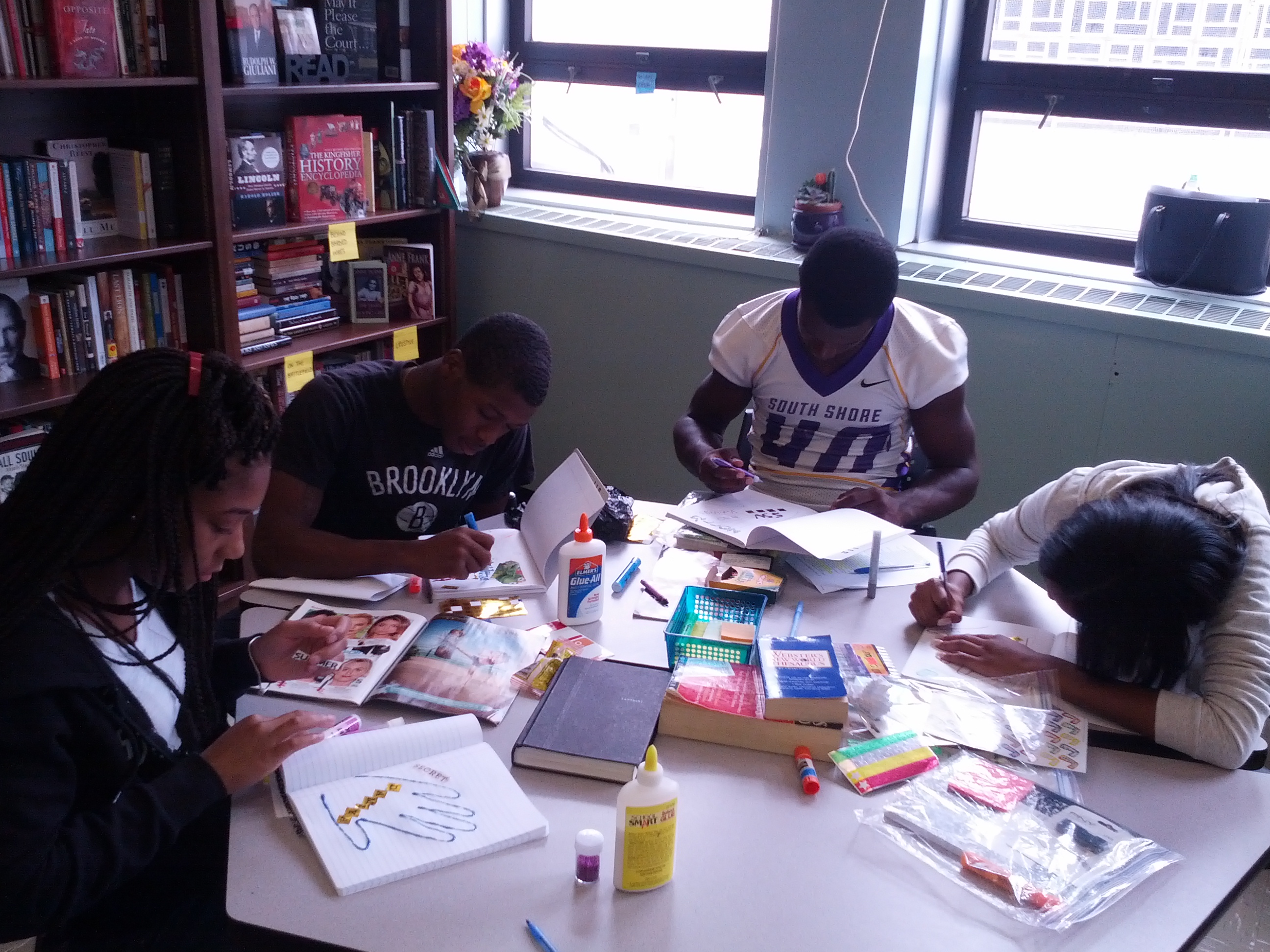
Students creating their Writer's Notebooks in ways that feel most authentic.

Students creating their Writer’s Notebooks in ways that feel most authentic.

Mystery books have flown off the shelves – for the first time ever!  Color is most often preferred when expressing themselves vs. the written word.  There is an untapped intellectual power among every young adult occupying each individual seat that is awaiting its own explosion.  Their passions have yet to be discovered within the context of our learning community.  And, not unlike years worth of previous students, they are incredibly focused and hardworking.

When students are not meshing with the material; when the sparkle does not twinkle in the corner of their eyes as they try to explore new found interests; or they have absolutely no questions…something’s wrong.  Very, very wrong.

I am responsible for guiding students through the beauty of the RWW to foster their own strength, perseverance, and dedication toward the development and growth that is inevitable to happen.  I feel the promise and hope.  I am no longer vulnerable nor am I even remotely entertaining the potentially consuming chaos.  Instead I am enjoying the exploration of new mentor texts while listening intently to the views and beliefs of my wildly intelligent learners.

Here’s to an invigorating year full of unforeseeable experiences, ideas reworked, and chaos debunked.


More about Readers/Writers Workshop

(See my post yesterday for the backstory of all this, if you missed it, and you’re interested.)

More on my exchange with Holly who is dedicated to moving readers and writers in her new workshop classroom. I am so impressed with her questions and reflection on her practice!

Her: I am slightly fearful but I’m trying to put “the test” out if my mind and work on creating readers and writers. Then the test will take care of its self. I hope!

Me (My heart singing because she gets it! It is not about a test; it never should be.): The first  year I jumped ship and swam my way in Workshop was scary. I didn’t do much that year except get kids writing more. That was the autumn after I did my Invitational Summer Institute with North Star of TX Writing Project. I know I didn’t hurt my students, but I didn’t help them become better readers and writers, although they did do a lot of writing. I’ve learned more about balance since then.

Her: My classroom library is in pretty good shape, but I could always use more. I’ll take advantage of donorschoose.org for part of my overall plan that I need help with. 

Me:  Your library looks lovely; however, how do students know which books to choose?

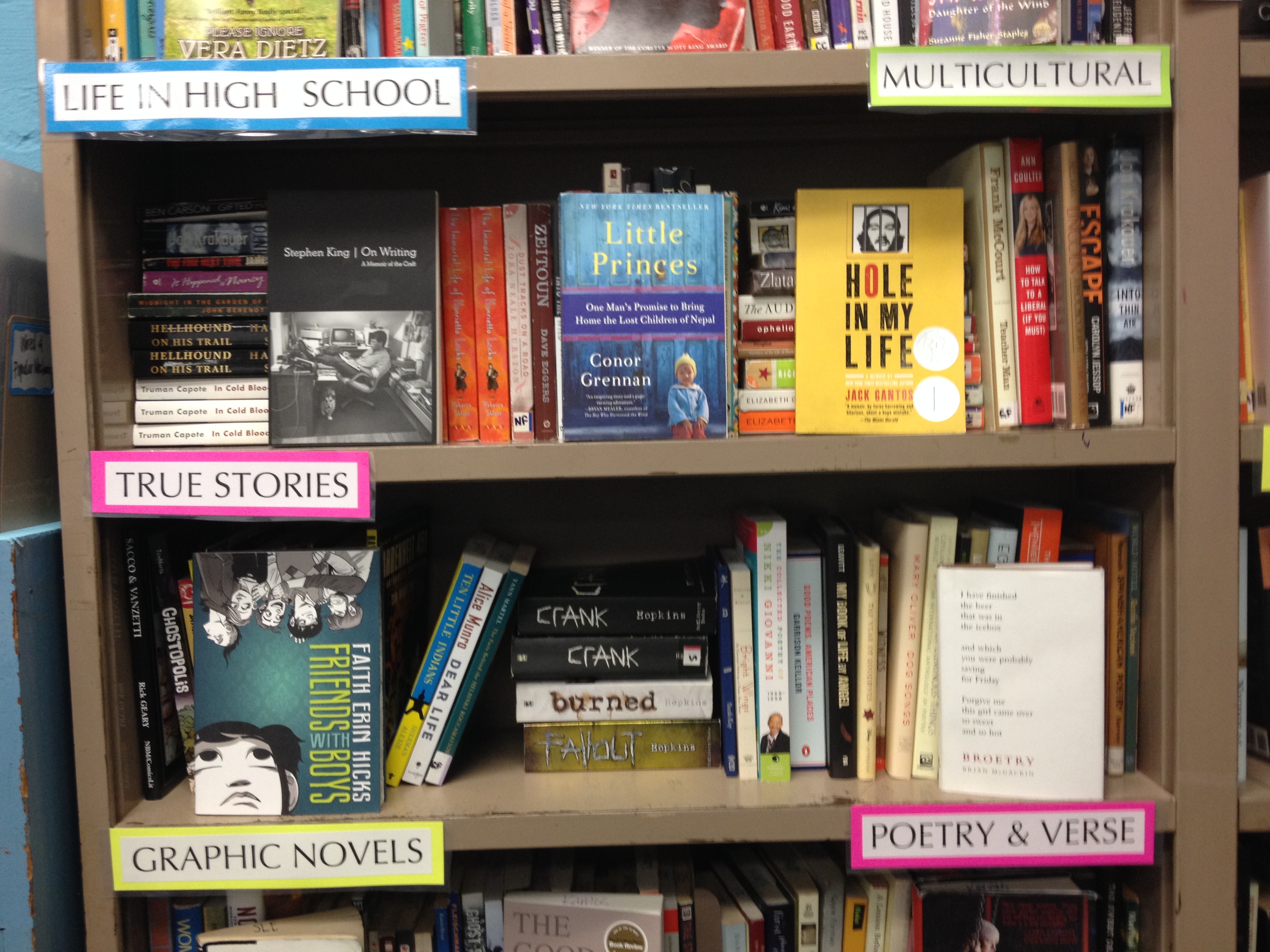
One idea I got from a friend:   if you will label the shelves, organize by topic or theme, turn some of the titles out — then students will treat your shelves like a library.  Also, I just got new “favorite YA books” from some of my classmates at UNH. I will [post] that list in another message.

Her: This is my work in progress…. Begin with 15 minutes of SSR. 2-4 Book talk or students share an interesting part of what they are reading to encourage others. . . .

Me:  15 minutes is a good idea; however, it is a LONG time for students who are not readers — yet. I am sure you know that already. I learned from my experiences that I cannot push too hard too fast, until everyone is matched with a book.

Her:  I also want to incorporate reading logs to have a functional use to teach literary terms and have students be responsible for adding 5 words a week to their own vocabulary journal.

Me:  Reading logs? What do you mean by that exactly? The research by Krashen, Allington, and others shows that readers who are able to read without a lot of demands will read more and move faster than those who have to document their reading all the time. Holding regular reading conferences with students and asking them about what they are reading about is formative assessment without them feeling bogged down about having to justify their reading in logs.

Do students need to write about what they are reading? Yes, sometimes. But we do not want to kill the love of just reading. (Thank God I do not have to log my reading life.)

Yes! to students creating their own vocabulary journal. I call them Personal Dictionaries. Same idea. Penny Kittle has kids find four words a week (she requires 2 hours of reading homework per week, based on each student’s individual reading rate). I am changing to this model.

Her:  Then I want to read aloud a chapter from an engaging YA novel or a piece of poetry everyday. (I’m struggling to think of novels to use. The ones that I have success with are being used in reading.) 

Me:  Besides the research-based benefits of reading aloud to students at all levels, WHY do you want to devote time to this? If you can answer that question, you will be able to find what to read.

Have you thought of doing craft studies with poems and short passages? Every book I read I watch for passages that strike me with their beauty. Every time, these passages are loaded with some kind of literary or rhetorical devices I can use for mini-lessons. Sometimes students and I read these passages together and discover how the author crafted the meaning. Sometimes we write written responses to the meaning/ or what strikes us as meaningful to the passage. Sometimes students model the passage.

Her:  Mechanically inclined lesson on Mondays and Tuesdays (We have an A/B day) mini lesson 10-20

Me:  I know students often lack grammar instruction, but is there a way to include these lessons within your writing workshop time so they do not look like grammar lessons, and they look like “Here’s-what-good-writers-do lessons?” If students see them this way, they are more apt to apply the skills they learn into their own writing. We have to be purposeful in helping them make those connections. Again, I know you know that.

Her:  Wednesday and Thursday direct instruction or modeling writing 10-20 [and] Workshop writing time 

Writing Genres 
1. Narrative 3 weeks 
2. Expository 6 weeks 
3. Persuasive and editorial 9 
4. Test taking 3 weeks before [state exam]
5. Last 6 weeks multi-genre project 
My goal is to incorporate  students sharing 1 published piece every 3 weeks in a read around and other real audiences with persuasive and editorials. 

Me:  Sharing published pieces is AWESOME. Once students feel successful as writers, they will write more — and better.  Love your genres list.

Her:  I don’t know if this will work or not. What I feel like I need help with the most is logistics and how do I incorporate curriculum reading? 

[Isn’t this always the BIG QUESTION?]

Me:  Why do you need to? Does the district require that you read specific texts? I thought not. If the answer is yes, then (I got this from my friend Tim who does workshop in IB classes) you focus on readers/writers workshop first, and then you do the “required” reading.

Here’s what I’d do:  select passages from the required texts in which you can model specific skills. Read and study those passages together as a class. Watch a few film clips and discuss those for content and scripts, etc — that kind of learning. Then challenge students to read the rest of the text as their SSR book.  If your principal has already given you permission to veer away from the standard curriculum, take it. He’s essentially already said you do not “have” to do any required texts. Hurrah!

And here’s the most important part of anything I’ve said to my friend Holly thus far:

You’ve got more thinking in these messages you’ve sent me than many educators I know who have been teaching for years. Seriously!

Note to all:  If you have not read the article “Not Reading: The 800-Pound Mockingbird in the Classroom” by William J. Broz, well, you should. It might be just the thing to give those of us like Holly, who want so badly to do right by our students, the strength to keep powering on toward moving readers and writers in our workshop classrooms.

Holly and I are meeting in person to talk shop next week. I’m sure another post will follow.

Questions about Readers/Writers Workshop

I just got the fourth request in two days for how I set up my readers/writers workshop classroom. I love getting these requests because it makes me reflect on my own practice, and it means that others are moving into allowing more choice for students. Happy day!

I thought it might be a good idea to share some of my responses and some of the questions I get from educators who want to create a culture of workshop in their own classrooms. If you are thinking about workshop at the secondary level, or if you just have questions, please leave a comment and ask.

Holly says that she’s been given permission to “go rogue” and do something different than the other teachers in her department. She’s been granted her desire to create a readers/writers workshop classroom, but she needs support. I love that she asks me for it.

Here’s my response:

Dear Holly,
How exciting for you! Sure, we can find a time to talk. I am in Minneapolis at an NCTE Affiliate conference this weekend, and next week if filling up fast. If it’s okay, let’s do a little thinking here first.
First, what is the shape of your classroom library? That is huge for a successful rwworkshop. Of course, you can utilize your library, but research says that to surround students with books, you should have a minimum of five books per student. So say in a class of 30, you need at least 150 books in your classroom library. How does yours look? That’s our first start.
If it’s sparse, consider creating a project for books at DonorsChoose.org. I’ve had two significant books projects funded. You can see a past project here.
Next, if you have not read Book Love by Penny Kittle, put it at the top of your reading list. Take notes. Everything I’ve learned about doing a workshop classroom I learned from PK — almost.
Think about how you want to structure your class time. Here’s what mine will look like with 85 minute classes every other day. Remember, I teach AP Lang, but much of this worked with my 9 and 10 graders last year, too.
10 min choice reading
     I conference with kids quietly during this time. We must mandate silence, and this takes lots of practice for many kiddos!
Three types of reading conferences: 1. Get kids into a book (This one gets repeated over and over and over again at the beginning of the year.), 2. Teach a reading mini lesson (The lesson is dependent on the needs of the student.), 3. Move kids into more complex reads (Again, this is dependent on the need of each student). All ideas from Book Love by Penny Kittle.
3-5 min poetry (new for me this year since I learned a TON at the poetry conf at the Frost Place I just attended)
     I will dictate a poem, or read aloud a poem, or ask a student to read a favorite poem. Mostly we will just savor the language of poetry. “To write well, students must be immersed in the beauty of language.” –Penny Kittle
2-4 min book talk. I book talk everyday, one of each fiction and non-fiction. Students record in their writer’s notebooks titles that they might want to “Read Next.”
10 min mini lesson on whatever writing we are working on, or max of 20 min direct instruction, if I am introducing something new.
Workshop time. Students work either independently, or in small groups, on their writing as I work the room talking with students as writers more than talking to them about their writing.
Last 5 minutes. Exit thoughts. Might be a whip around with a sentence from students work. Might be thoughts on a sticky note as they exit. Just something for closure.
More on Reading:  Besides choice reading all year, I include four Book Clubs where students choose a book from my short list. All books have similar thematic elements. Book choices include nf, fiction, classics, poetry. They read their books with a small group and discuss craft. We also conduct a whole class discussion around all of these books. When we shoot above comprehension, we get students to think at higher levels — reading like writers. (With my 9 and 10 graders I only did one book club, not four.)
Writing. We move through genres, one primary genre per quarter:
1. Narrative, includes description
2. Informational, might include compare and contrast, process analysis
3. Argument, includes persuasive, definition, examples
4. Multi-genre, includes poetry, all of the above, and more
That’s enough for now. Why don’t you make a list of questions, and we’ll go from there?
Oh, and it is so important to remember that a reading workshop classroom is all about process. And it’s a process, your own, as you figure it out. It’s taken me years to get where I understand the theory behind why all this works, not only to engage students, but to move them as readers and writers. Take it step by step, morph it to work for you and your kids — and you don’t even know who they are yet.
Blessings,
Amy


My Life Is My Message

ocs

Mahatma Gandhi once said, “My life…”  

Nope.  Run-of-the-mill.  Try again.

“My life is my message” is a phrase many hear…

Oh absolutely not!

The pacifist we have come to know as Mahatma Gandhi has eloquently proclaimed, “My life is my message.”

Hmm…getting there…


Welcome to the most recent Writing Workshop’s task taking shape in room 382.  As we gear up to wind down as the end of the year approaches, we have taken hold of a striking quote and are playing with it with fervor and inquiry.  Students know, in under a month’s time, they will inevitably be greeted by the New York State ELA Regents.  Yet, we’re operating as though it’s not about to happen; you know…it’s going to happen to everyone else, and of course we wish them all well, but us testing?  Nope.  Not going to happen.

We are exempt.

We are not preparing for an exam.  We are not losing sleep over this literary element or that grammatical rule.  We are not counting the supposed seven sentences assigned to every paragraph or where to locate the anxiety-ridden answer to #23. We don’t care if our pencils aren’t sharpened to perfection or how 33.7 seconds should be allotted for each multiple choice question.

Instead.  We are writing.

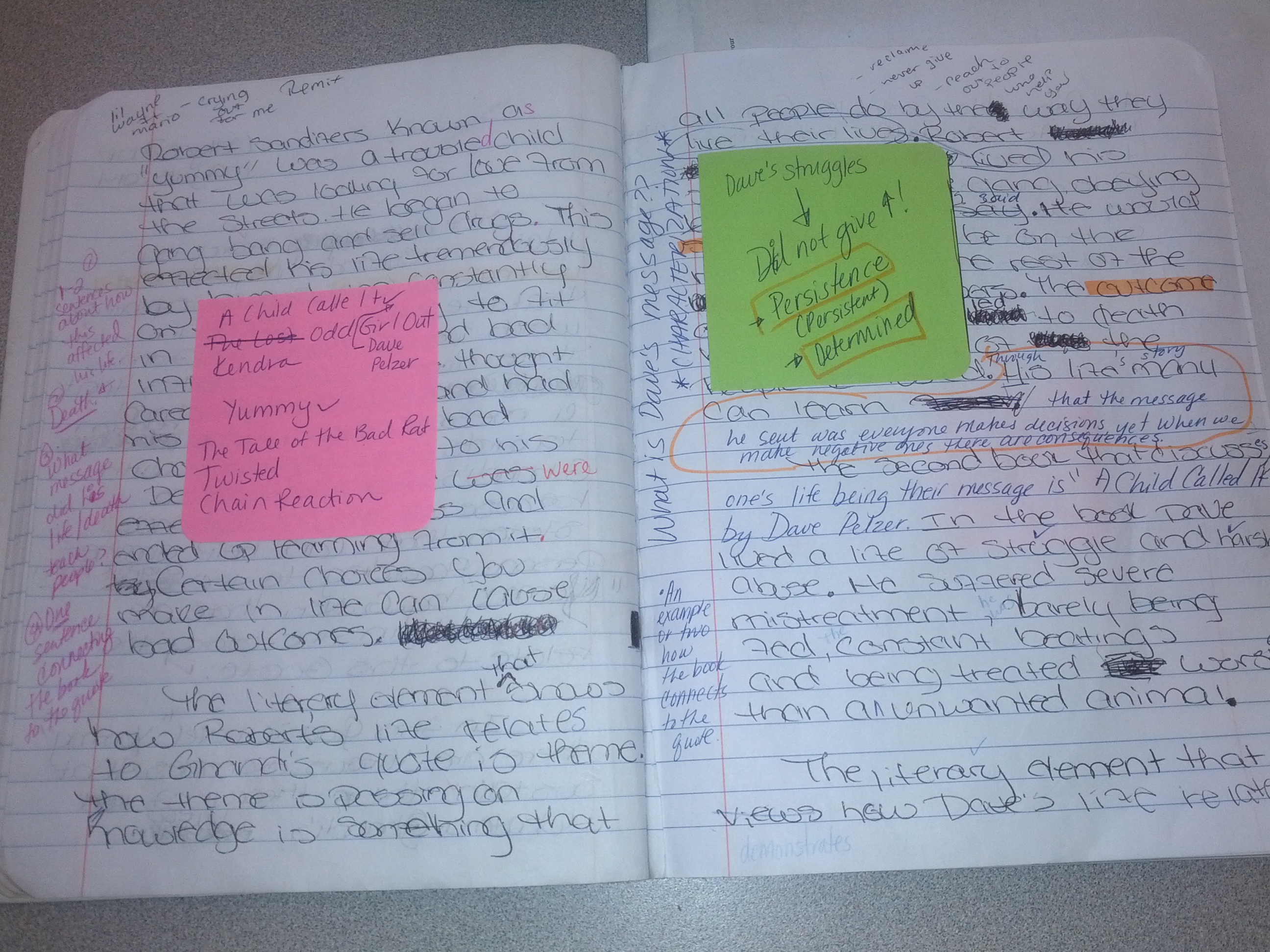
We are researching, connecting, analyzing, and sharing our insights.  We are using Gandhi’s autobiography and other written works that were created solely for us; for us to explore Gandhi’s magnificent brilliance.  We are using other pieces of literature that connect to this sentiment that yes, “My life is my message”.  We are using literature that we’ve highlighted and annotated (to the point where the next reader is going to have to try to find space on these pages to do the same – good luck!).

A student said this looks like a 'piano of ideas'.  I couldn't agree more.

A student said this looks like piano keys full with ideas. A tune we enjoy playing.

We are not allowing ourselves to get caught up in the ardency of the testing hoopla.  Instead we are reworking introductions, continuing to fill our door of completed literature, laughing a lot about students renaming book titles we’re enjoying (gone is The Freedom Writer’s Diary, to stay is The Freedom Writer’s Craft)…  I am sure, at this point, those who have fully emerged in test prep have started biting their nails, twisting and tugging at their hair, and maybe even pacing as they continue to read this piece through the slant of a squinted eye.  I understand.

I do.  Really.

It wasn’t until this year that I shifted a vast majority of everything I do in my classroom…with my students…in my own head as I reflect.  I was the educator who believed in preparing students, even if it meant solely for an exam because it’s always been rooted in support and wanting students to be successful.  I am still that educator that believes students deserve success on exams.  Yet, this year I want them feeling success on their exams because they feel creative freedom while still being locked into the three-hour time constraint.  I want them to smirk while exploring their craft as they connect literary elements to the exam’s text; and not feel as though they need to lose a sense of who they have become as beautiful readers and writers.  Mostly, I want them feeling confident that this year’s dedication to enhanced reading and writing is shaping how they look at the world; exam days not exempt.

Naturally, students’ anxiety about testing still surfaces, but this year, it remains there – on the surface.  Students still have test specific questions, ones I acknowledge briefly and then move on…(deciding between four topic sentences is way more fun!)  We still game plan so students know what sections they are going to attempt first…or last.  We talk timing.  We do all of that.  We just don’t let it consume us.

And because we don’t, I have thrown away all structured writing graphic organizers that I used to believe supported students in elevated writing.  Students are approaching their writing in ways that provide us all moments of pulchritudinous pause.

Every inch utilized with ideas..thoughts...movement.

Every inch utilized with ideas..thoughts…movement.

Students use varying angles in which to deliver a quote’s message and are demonstrating alternate ways on how to enter into that analysis with a fresh perspective.  It is through this exploration that students have challenged me to educate with new insight.  Our commitment to the process; pushing ourselves beyond boundaries; and most importantly, our collective energy still provides each new day with an exhilirating thrill.

From our classroom to yours, we wish everyone the best as the end of the year exams approach.  We wish you continued laughter, reading, and much writing.  And don’t forget to have a tremendous amount of fun along the way.  We are.

What ways are you fostering the joy of reading and writing with your students during this stress-inducing time of year?


Reflection on the Year

SUMMER

I know it is hard to believe, but the school year is almost over. I am sure some of you are counting down the days before you can run screaming and yelling from the building, but before you do I encourage you to take just a minute or two for a bit of self-reflection.

Here are a few simple prompts to guide your thinking:

1. Think back to the beginning of the year, what is one thing that you were determined to do better this year. — How did it go?

2. Looking to next year, what is one commitment you want to make regarding an area in which you want to improve? — What will you do this summer to be ready to tackle your challenge this fall?

There is nothing magical about my questions, but what is magical is taking a minute or two for yourself to reflect on your practice. I am sure you have some great stories to share and know we would love to hear them! Feel free to add a comment below.


Photo credit: Lotus Carroll / Foter / Creative Commons Attribution-NonCommercial-ShareAlike 2.0 Generic (CC BY-NC-SA 2.0)

Final Days, Final Products: End-of-Year Assessments

This week, the first of the fourth quarter, has flown by for me–has it for you all?  Perhaps I’m feeling the passage of time because of making end-of-year lesson plans.  Maybe it’s because of the spring sunshine and storms.  Or, it could be because I’m looking into summer course offerings at UNH, the NWP, and our nearest university, WVU.  Whatever the case may be, I am acutely aware that I don’t have much time left with my fabulous students this school year.

Since that is the case, I want to give them opportunities to showcase what they have learned and how they have grown.  Of course, I want a unique, rigorous way for them to show me this, so I’ve been designing some workshop-appropriate final assessments for my students.  The abilities I am curious about are their independent reading, their informal writing, their reading of difficult literature critically and deeply, and their crafting of excellent, time-intensive writing.

My goal at the end of the year is that students can read a variety of texts independently, can think and speak critically about those texts, and can choose and recommend a variety of books for themselves and others.  To see whether they can do this, students will complete an independent reading project that includes a craft analysis of the writing itself, a creative portion in which students show their comprehension of deep layers of the text, and a presentation of the project overall in which other students and I ask questions about the book.  Additionally, students will do their own booktalks, in which they recommend a text to the class, perform a fluent read of a short bit of the book, and discuss their own reading experience with it.

IMG_2769In terms of quickwrites, or the informal, fluency-building writing we do at the beginning of every class, I want students to be able to understand and show their own growth with this type of writing over the course of the year.  I do this by having them do a final “Journal Harvest,” an excellent idea I got from NWP mentor Sally Lundgren, which we’ve also done once or twice a quarter thus far.  In this harvest, they read over all of their writing from the year and write a formal reflection about its growth, content, and style.  Additionally, they choose three pieces to revise and draft into formal, typed pieces.  Lastly, they share their notebooks, reflections, and revised final pieces with their writing groups in order to give and get feedback.

mikeyburton-bookcoversWe’ve read two class novels so far this year, and for the final part of the year, students have chosen from a variety of books to read in literature circles.  Being American Literature, I booktalked the standards Fahrenheit 451, Huck Finn, The Scarlet Letter, and A Separate Peace.  Students chose which of those they wanted to read and have been collaboratively discussing, interpreting, and completing tasks related to their reading in groups.  To share their understanding with the class and me, they will complete creative projects in groups, as well as write a formal book review they’ll publish on the wonderful GoodReads.

IMG_0799Finally, the Multigenre Project will show off my students’ abilities to write, revise, and refine formal, coherent writing.  I have already discussed the way I teach the MGP extensively elsewhere, so I’ll be brief here.  The MGP allows for student choice, curiosity- and question-driven research, frequent talk in writing groups and through final presentations, and rigor.  To my mind, it’s a perfect culmination to a year of workshop, and I can’t wait to see what my students produce with it.

In true teacher-participant form, I will be doing all of this beside my students, and I am quite looking forward to the reflection time this quarter’s modeling will allow.  I’ve already begun the process we all go through at the end of the year, in which we start to wonder what we’ll change in the future and what worked wonderfully that we’ll hang onto.  In reflecting, I find my thoughts and writing returning again and again to the power of talk.  Its deliberate addition into my curriculum this year has been the biggest change from previous years, in which student talk used to be in a space reserved for group work, presentations, etc.  This year, though, student talk is at the center of my teaching, and I think it’s made an incredible difference in my students’ ability and willingness to learn.  I’ve consciously included it in all of my final assessments as a result, as it’s been where I’ve learned the most from my students.

As you can see, there is a lot of grading, planning, and facilitating in my future, but I think it will be well worth the effort…and enjoyable to boot!  Here’s hoping that my students will learn as much from each other in these final weeks as I’ve learned from them all year.  Cheers to the fourth quarter, all!


It’s Moments Like These

Our Compass Shifts 2-1

My hope for all educators is that we never, ever lose a student. And while that is my hope, life has it that sometimes a student’s passing becomes a reality. In 2010, that’s exactly what happened. Francis Gittens departed our school community leaving behind his energy, electric personality, and smile that only those lucky enough to have had the opportunity to know (and work with) him experienced.

A long time colleague and friend asked me, “Erika, how are you going to continue Francis’s legacy?” At the time, I was overcome with grief and emotion and couldn’t possibly consider this very tall task. However, as I started to work with my new over-aged and under-credited student population, their thirst and desire to obtain information in order to quench their ongoing curiosities provided me the answer.

A library.

Not just any old library, but the Francis Gittens Lending Library. A library filled with rich pieces that have impacted other book lovers from all over the country. I’m talking all genres. I’m talking too many books for the amount of shelving we currently had. I’m talking opportunity.

Out went the email chronicling my mission. The recruiting had begun to wrap the two-hundred plus books that continued to be delivered and dropped off at my classroom door. Ms. Vasquez (Francis’s mother) had agreed to be present for the post-holiday surprise. Food had been ordered. Students had no idea how their lives were about to change. Full of emotion; I was ready.

What has happened in the two and a half years since must still be a figment of my imagination. Students are reading feigns who request piece after piece. Students and their families are continually donating to our class library. Not to mention all of the other generous donors who continue to surprise us with their favorites.  Students have created Next-To-Read Lists because they can’t possibly read all the pieces they are intrigued by simultaneously, although many of them are juggling a couple at a time. Educators swing by to see what’s new on the shelves for their own reading enjoyment. And I have become quite the book connoisseur while perusing book store after book store seeking out unique pieces to book talk the very next day.

Just recently, after I reorganized our theme-based library, I sat back and found myself in awe. The growth of the library, now two-thousand plus books, stopped me in my tracks. I realized that as a collective, we have figured out a way to support our (sometimes struggling) readers and found a way for them to have all the access they want (and need) to the world beyond their own. Astounding.

I immediately phoned Ms. Vasquez inclined to show her what’s been taking shape in room 382. To no surprise her response was, “What day works best?” We both felt the urgency. She found her way to Brooklyn Bridge Academy without hesitation that very next Monday. As she entered the room, student conversations quieted and a hush fell over our shared space humbling us all.

As we all regained composure, conversations started to bubble and students were excited to share the literature they are (and have been) reading. Ms. Vasquez took her time scaling the length of the library and, overcome with emotion, she cried.

Ms. Vasquez pointing out an inscription to Francis from his Grammy in Sidney Poitier's Measure of a Man.

Ms. Vasquez pointing out an inscription to Francis from his Grammy in Sidney Poitier’s Measure of a Man.

She took the opportunity to talk to students about their lives and the decisions they are making. As we sometimes say, “She went there.” She focused on the young men, their appearance, and the injustices they are ultimately always going to face. She spoke directly to the females and advised them in believing in themselves, taking care of their bodies, and their intelligence. She focused on the vast literature lining the shelves and how this (education) is their key to the lives they deserve to live.

Tender moment with a male student.

A tender moment with a male student.

As educators, it’s these ‘full circle’ moments that make us truly feel full with love, hope, motivation, and connection. Students are reading more now than ever before.

Our read literature this year.  180 plus books!  Beautiful collection from the FGLL.

Our read literature this year. 180 plus books! Beautiful collection from the FGLL.

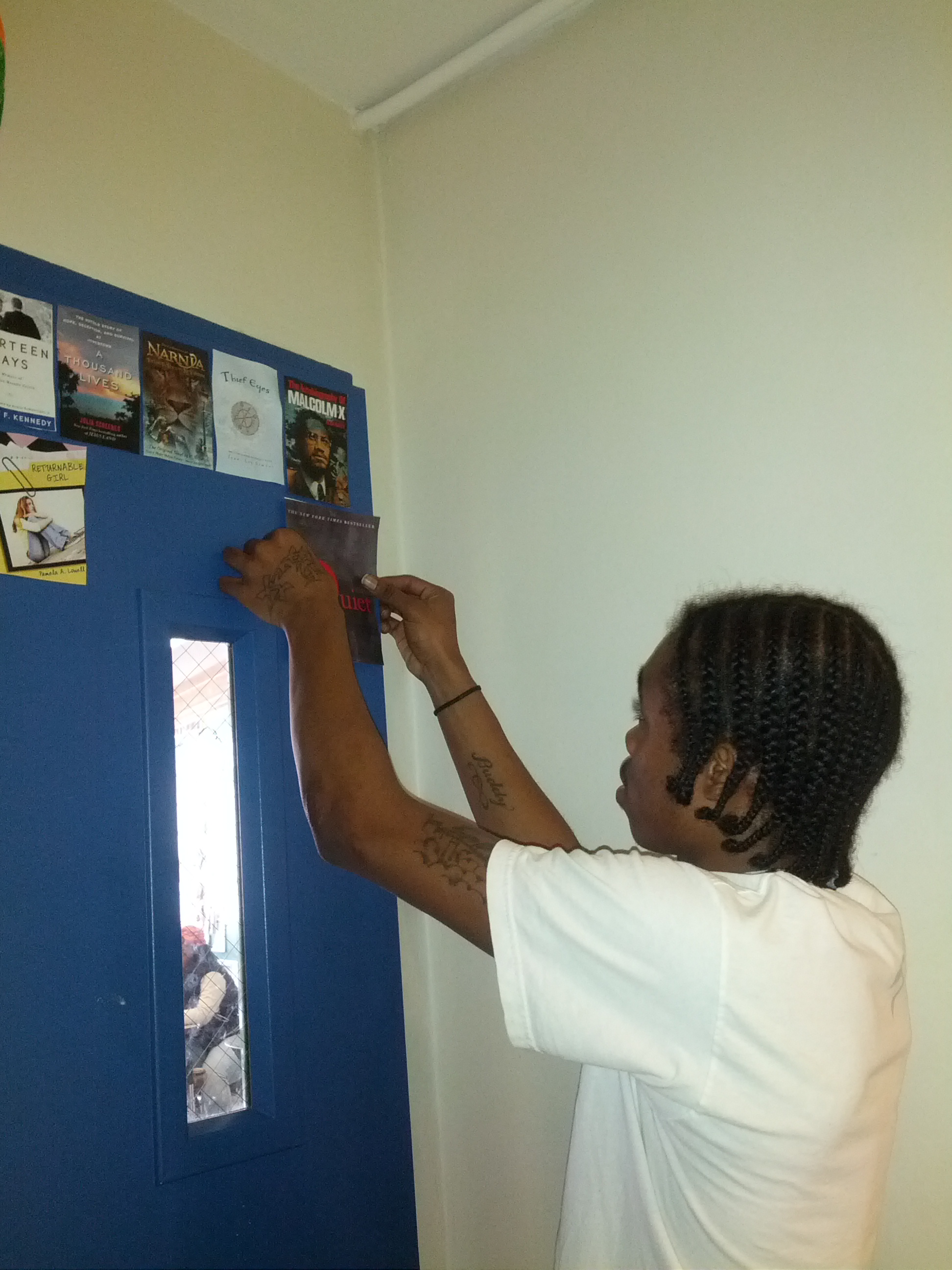
A proud student adding Quiet by Susan Cain to the other side of the door.

A proud student adding Quiet by Susan Cain to the other side of the door.

They are embracing their inquiries and willing to do the work to find answers. They are supporting me in my own reading journey and I them. We are collectively always looking for pieces of literature to add to our library and relishing in the ones that we can’t believe we actually found.

Each donated book receives a FGLL Placard (Donors, location, date)

Each donated book receives a FGLL Placard (Donors, location, date)

We have shared humorous moments. Tears have been shed. In-depth thinking has…and continues to take place.

From an incredibly tragic loss to a beauty hard to put into words, we are all so very thankful. But most of all, humanity came together for those sixty minutes on a random day in March that none of us will ever forget. We are in this together, as a whole, as one.

Our 'serious' class photo.  (My favorite!)

Our ‘serious’ class photo. (My favorite!)

How will you continue to build and support literacy initiatives in your classroom?

Learning Through Teaching

ocs

My student teacher’s last day was yesterday, and, frankly, I’m lost without her.  In eight short weeks together (less, when you count the 17 snow days), we have transformed each other as educators, brought our students to new heights, and had an exorbitant amount of fun.  I’m hoping she’ll take away a myriad of ideas as she goes on to a middle school placement, because I knew I’ve learned much from teaching her.

During the first semester of this year, I worked to implement the reading and writing workshop model successfully in my classroom. Things were going fine, but I felt that something was missing.  My students were producing excellent writing, and reading lots, but I wasn’t getting the magical results I wanted.  It wasn’t until I began mentoring Katie that I was able to truly understand the holes in my efforts.

After a few days of observation, Katie became familiar with the workshop model.  She knew that I used mentor texts as teachers, saw dialogue as an assessment measure, and read for craft and content in student writing.  She saw that workshop was collaborative–within it, my students and I responded to each other’s work as fellow readers and writers, not as teachers and students.  She took those foundational ideas and ran with them.

IMG_2373

Newly-added graphic novel shelf

Katie taught students to write powerful, convincing letters of complaint to make claims they felt strongly about.  In her quickwrite prompts, she showed them how to break down visual texts, emphasizing analysis of pop culture.  Many of those videos she then used as mentor texts for public speaking skills, which helped her guide students through the writing of speeches and debates. She booktalked several graphic novels, a genre I had, before her arrival, been woefully uninformed about.  She blossomed into a confident leader of the reading and writing workshop.

As I watched Katie teach so passionately, with such new and exciting resources, I began to see a gaping flaw in my own first try at workshop:  I was relying too heavily on all of the texts, ideas, and strategies I knew and loved.  I’d worked hard to make them comprehensive–I’d sought them out from all genres, time periods, places, and people–but I was amazed by how many resources she used that I’d never heard of.  Katie Wood Ray says that our students should expect not only the best mentors of writing, but also teachers who will search for them.  Although I was constantly searching for good books, mentor texts, or strategies, I was not effective enough–where were these pop culture visual mentor texts?  My graphic novel shelf?  Oral, not written, speeches as products of the writing process?

As I reflected, I came to realize that I was relying only on my own cultural capital to create the best workshop environment for my students.  It was, by definition, impossible for me to extend my knowledge beyond what I knew, or knew how to obtain.  I needed more brains–brains with their own unique cultural capital–to help me bring diverse resources into the classroom.  Where could I find them?

IMG_2558

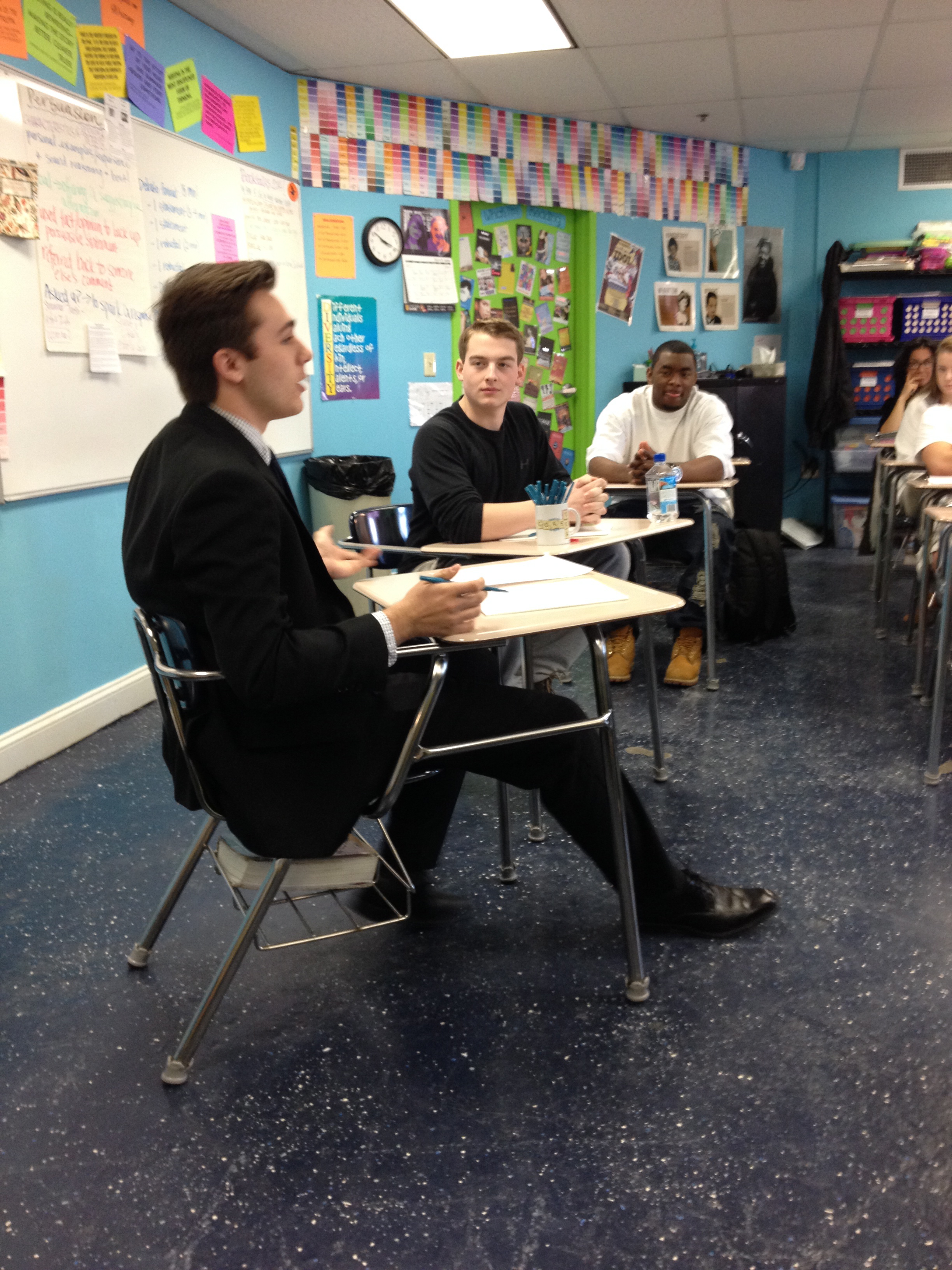
Zach and Brendan debate alternatives to the tardy policy

As I watched our students professionally, conscientiously debate each other, I saw from their products that they knew not just how to write and speak persuasively, but why that was important.  I watched thee audience, and saw students changing their minds about things they’d believed for years, slowly having their eyes opened not by the adults in the classroom, but by their peers.  They revised their scorn toward legalizing marijuana as Moshe spoke about his battle with leukemia, and the helpfulness of the medical marijuana he was prescribed.  They felt ashamed to write about why the drinking age should be lowered after Anderson spoke about seeing a neighbor killed in a drunk driving accident.  They questioned long-standing religious tenets after listening to Stephanie and Leanna debate the legality of abortion.  They were guiding each other to that which all teachers want their students to learn–critical thinking.

In struggling to be a mentor teacher for the first time, I realized that the power needed to be even less in my hands than it already is in the workshop–it needs to be in the learners’ hands.  In terms of Katie’s learning, she thrived when I let her just go crazy with her own wonderful ideas, instead of my giving her lots of suggestions.  In terms of my students, I saw that they benefited from being more regular leaders of the classroom.  I needed to do more than just give their writing importance by having them share it each day, or use their pieces as mentor texts, or listen to their suggestions about books, my writing, or my teaching.  I needed to let them take an active hand in designing the curriculum, so that they could teach and learn from one another.  Hence, a Eureka moment–the leadership in my classroom must by shifted to the students.

IMG_2599

Katie Bush, Super Teacher

This weekend, I’ll be sitting down to write my first lesson plans in two months.  Thanks to what I learned while teaching Katie, I’ll be designing structured leadership roles for my students–far more involved than the occasional student booktalk, or the daily quote sharing, or the class-by-class student mentor text.  I’ll arrange for every student to give a booktalk this quarter.  I’ll create a routine for all students to lead the class in a quickwrite with their own prompts.  I’ll ask them to suggest titles to their peers for literature circle texts.

I’ve learned much about the reading and writing workshop model by teaching it to someone else, and I hope I will continue to grow as I hand the reins over to my students.  Let this wild and wonderful workshop journey continue as the fourth quarter begins!