Tag Archives: Mentor Texts

The Subtle Art of Breathing

You know when you’ve been hit…hard. Hit so hard you call up your favorite friend who you know will feel the impact as well and say, “Listen to THIS…”.  Or, when you dance into class so excited to share [with students] you don’t even wait until the bell has ceased ringing to start reading the opening line.  Or, in those wildly personal moments when you quietly take to your Writer’s Notebook and allow your heart to connect to words you never knew how to form yourself.

Welcome to The Subtle Art of Breathing.

There is so much power, resiliency, and breathtaking beauty found within every, single page of this compilation.  The way asha details the real, raw, and rendering experiences she, and those she writes about, leaves me awed.

She annihilates barriers with a writer’s craft that caterwauls to be reread over and over again: never to be forgotten. You cannot help but to highlight and underline and annotate and scribble ideas on post-its while making sure, before you leave the page, you have dog-eared it so you can find your way directly back to where you were hit….stopped in your tracks…changed.

Here’s an excerpt from asha’s brilliant piece titled Resolve :

against our childhoods

with their shifty foundations

and their creaking floors

our childhoods with their cobwebbed

corners and their rattling chains

I was 14 then, I think, maybe 15

You were 16, maybe 17

but that is not the important part

the important part is

you were my first love

It would not be fair of me to give anymore away.  But, you can imagine how asha traverses through time, not in ballet slippers, but with steel-toed boots tiptoeing her way through the most vulnerable moments of human existence: love.

A Book About Food?

IMG_20141216_210906You better believe that when Steven Spielberg and Oprah Winfrey collide (behind the big screen) an emulsion of magic erupts.  The One Hundred Foot Journey written by Richard C. Morais turned film was two hours and four minutes of robust richness, immaculate vastness, and intense human connection.  So, no…this book is not solely about food.  Although food, most of the time, tends to be the main character.  I love when authors and film makers do that!

Immediately following my trip to the theatre, was (obviously!) a trip to the bookstore.  Yes, at 9 p.m.  I wasn’t worried about the bookstore not being open but I hadn’t even thought to think that they would be out of the book.  I should have!

An immediate login to Amazon.com and my book was on its way — to be delivered a quick two days later (Thank you, Amazon Prime).  And it wasn’t long into the book when I came across this:

But this you must know:  the violent murder of a mother – when a boy is at that tender age, when he isIMG_20141216_205952 just discovering girls – it is a terrible thing.  Confusingly mixed up with all things feminine, it leaves a charred residue on the soul, like the black marks found at the bottom of a burned pot.  No matter how much you scrub and scrub the pot bottom with steel wool and cleansers, the scars, they remain permanent.

Did anyone else just witness the intense power of Morais’s carefully chosen craft?  Imagery, word
choice, symbolism…shall I continue?  When students ask me what I’m reading or why I’m even reading it; I turn to this page and let them read it for themselves…it’s already tagged.  Most times students’ responses start with a sigh followed by a “Wow” or “Whoa”.  Then the conversation begins.  And, just like what Spielberg and Winfrey have created, our conversations chronicle the richness of this sentiment, immaculate precision and craft of Morais, and the intensity of this reality.

What books have you stumbled upon that have hidden gems in them that you love to share with your students?

The Power of (very short) Stories

As soon as I created my own very short story, modeled after VISA’s Go World videos, I knew I would have my students create their own.

For our introductions at the Book Love class I attended with Penny Kittle this summer, she had us watch a few of the Go World videos, and then imitate one of the structures. This is harder than it seems.

Here’s a few of the ones I watched and transcribed. They all represent moments that matter in the person’s life, and they are only in 35 to 60 words.

http://www.youtube.com/watch?v=NLGQhT7UDN0

Lopez Lomong started running when he was six. And he didn’t stop for three days and three nights as he escaped life as a child soldier. Twenty years later he was still running; he just had a different thing driving him every step of the way.

Hours before his race in ’88, Dan Jansen’s sister Jane passed away. He’d promised her he’d win gold. He didn’t — until six years later. Then he skated a victory lap with his daughter — Jane.

Derek Redmond didn’t finish in first place in the 1992 400 meter. He didn’t finish in second or third or fourth. He, and his father, finish dead last. But he and his father finished.

People had been leaping over the high jump bar the same way since the sport began until one day when Dick Fosbury came along and moved the whole sport forward by going over the bar backwards.

You should watch a few of you own. Then write down the words and look at the structure of these very short stories. Then, I challenge you to write your own.

Think about your writing process as you write. Revise in your notebook. Pay attention, so you can share your process with your students. I’ve learned that the best thing I can do as a writing teacher is let them see me struggle as I try to make meaning.

I ended up writing four different versions with four different structures before I wrote a version that pleased me.

Here’s mine:

I am introducing this writing activity to students next week. I thought about having them write a full-blown narrative first and then having them cut their stories down to their own Go World stories. That would be an interesting exercise in word choice. I decided instead to have students write and create their own videos first — then we will tackle descriptive writing and work on exploding our very short stories into ones with a little more substance.

I opted for the fast-track to build community.

Story does that, you know.

Any ideas on how you might use this type of mentor text with your students? or any others you’ve had success with?

Mentor Texts Are Everywhere!

This time last year I was amidst a mad dash – a mad dash in seeking out, organizing, asking about, researching, contemplating, and gathering the ‘best of the best’ of mentor texts.  I had just learned what a mentor text was (text that, well, mentors!) and wanted to make sure I had a plethora to kick off the school year.  And, I did.  I had gathered so many I wasn’t even sure when, and in what context, I would be using them.  But, they were ready and I felt confident that I was too.

This year, it’s a bit of a different story.  After implementing the Reading Writing Workshop model in my urban oasis for the first time this past school year, I realized there is no longer a need to be dashing about.  Mentor texts are everywhere!  Literally.  They are in the morning’s newspaper.  They reside in the autobiographies I always find myself engaging in (and of course, loving).  Articles promulgating the Twitter circuit for the purposes of dissecting content and craft.  Classics, more modern, and everything in between became focal points of inquiry and investigation.  Students’ independent reading books shed light on crafty moves authors strategically choose to utilize.  On occasion, an excerpt from professional development texts deserved a public viewing (sometimes with scrutiny, sometimes not).  Nothing is off limits.

So, it is no wonder that as I have been reading a vast array of literature this summer; I have new mentor texts lined up for this coming school year that I am thrilled to explore with my students.  So, grab your Writer’s Notebook and flip to your Next-To-Read list.   I hope you not only fall in love with these pieces, just as I have, but they inspire you to think about what you’re reading and how you’d like to share them with the brilliant and inquisitive minds occupying your learning community.

Making Meaning with Texts: Selected Essays by Louise Rosenblatt was first introduced to me in this summer’s UNH Literacy Institute via Penny Kittle’s Book Love course.  This piece sent a buzz all throughout the campus as we were asked to read it for homework and come prepared to discuss it the next day.  Before the night was through, classmates were chronicling their amazement and joy with Twitter posts such as:  “Reading Louise Rosenblatt for homework and keep saying “Amen, sistah!” in my head. #unhlit14″.  So, you can only imagine how this Reading Theorist evoked an awakening in us all.

IMG_20140630_221534

It was when I came to this paragraph that I realized I had just stumbled upon an incredible mentor text; not only for myself as an educator, but for students as well.  What better way to expose students to the questioning and thinking behind our reading and writing than by sharing the source with them?  These questions are going to guide us through our reading (and writing) journeys this year.  We are going to study these questions, make sense of them, put them into practice; but, we are also going to really delve into why Rosenblatt has chosen these questions to guide us.  See, that’s where exploring craft and an author’s intention becomes our focal point.


battle 1

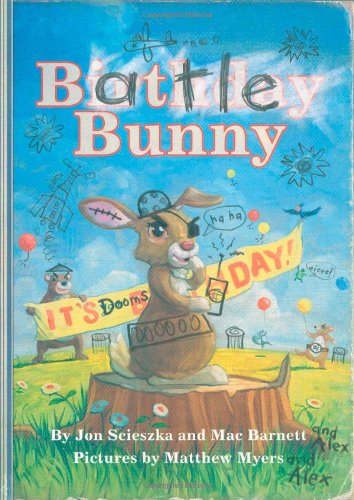
Battle Bunny by Jon Scieszka and Mae Barnett is a clever and witty piece that is sure to get students charged up about editing and revising.  How could it not?  This entire piece chronicles the the narrator’s (yes, the bunny) stylistic and creative writing journey.  The entire story is marked up, crossed out, reworded, and illustrated to show the power of the writing process.  It’s beautiful.

While I educate students ages 16-21, and this piece (I’m sure) was not intended for that audience, I believe this mentor text will be a lighthearted way to quell some of the fears that override their writers’ anxiety.  We know, many students are uncomfortable and afraid to revise, rework, or allow their time-intensive writing pieces to become ‘messy’.  Yet, that’s what produces the most profound writing.

battleI know this may be a risky move in my classroom.  Yet, I’m going to take a chance.  I anticipate shared laughter as we navigate this piece together.  I also plan to explore the bunny’s intentions and make it relevant for our work as writers:  Why did he feel the need to rewrite the story?  Do the illustrations add to the message he is portraying?  Do any of his original thoughts (verse his revisions) feel more powerful to you?  What intentional moves did he make in re-creating this story?  And on and on.

IMG_20140812_121342

Destined to Witness: Growing up Black in Nazi Germany by Hans J. Massaquoi is a piece I have not been without this entire summer.  And, although I’m finished reading it, I find myself flipping through the pictures over and over; it’s that profound. Massaquoi is a mentor of life, overcoming adversity, obtaining the (perceived) impossible, and what it truly means to be human.

Journalist by trade, Massaquoi takes such grace in his every word, sentence, and strategic ‘move’ that’s crafted.  This book encapsulates 443 pages of sheer brilliance and I want students to be exposed to this kind of writing because they too, have the ability to craft such beauty.

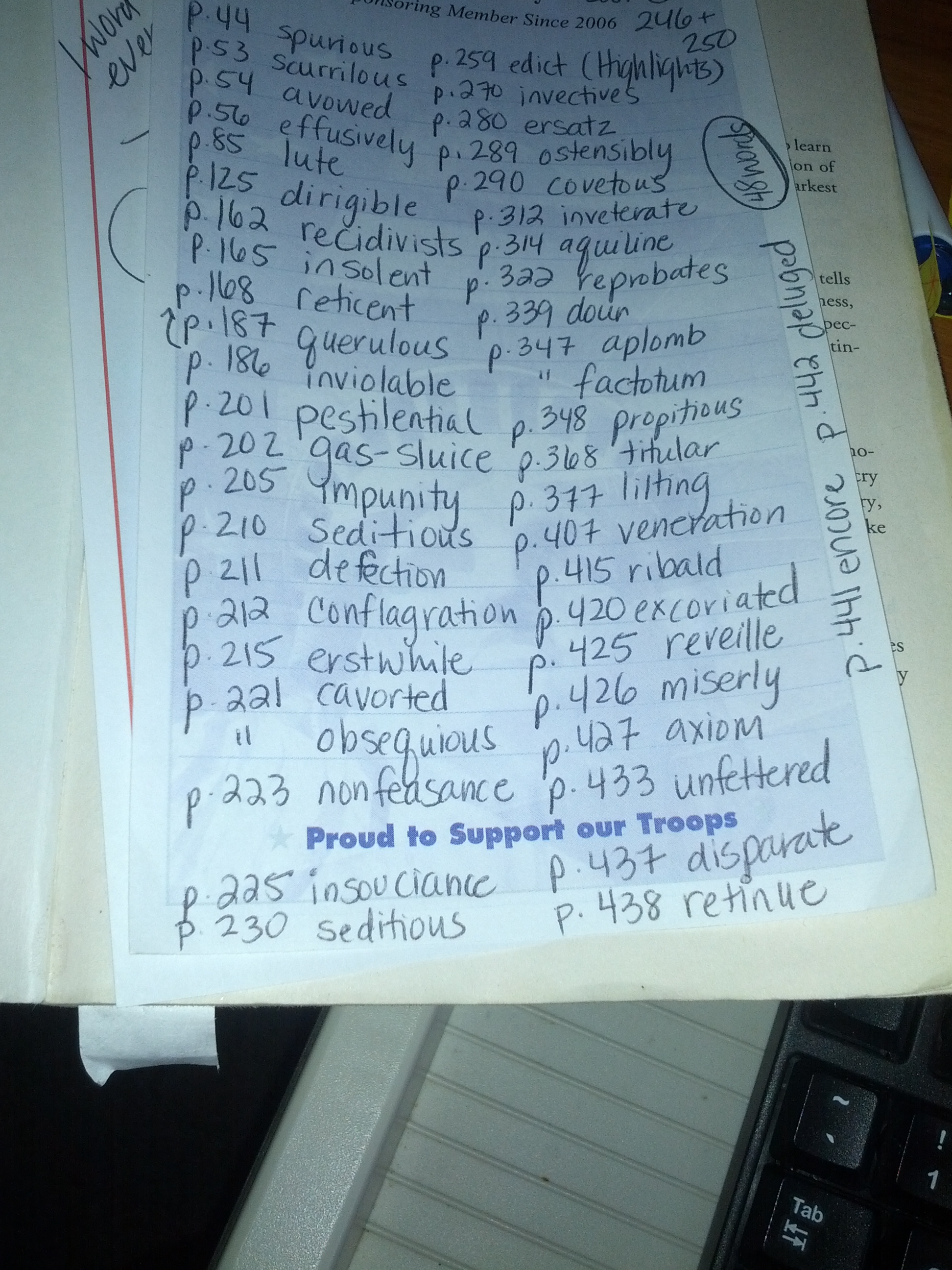
I also want them to catch a glimpse into my journey while reading this piece (note post-its) because I want to share what I found fascinating.  I want to explore some of the word choices (see my unknown word list) IMG_20140812_121513and talk strategy.  I want to use some of these words within my own vernacular and challenge students to do the same.  Most importantly, I want to show them that reading is a process; not one to shy away from.  And yes, sometimes it takes work, but overtime it becomes natural…and wildly fulfilling.
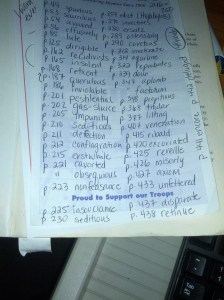
I can’t help but think, above and beyond the work I plan to do with this text, that the historical context won’t propel students in their study of history as well.  World War II and the Holocaust have rarely been depicted from the racial standpoint in which Massaquoi portrays.  This just may be a piece that peaks enough intrigue among students that they too will add it to their Next-To-Read list.  That’s my goal.
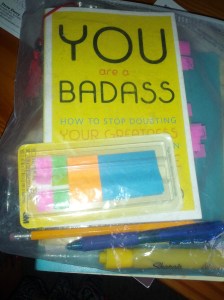


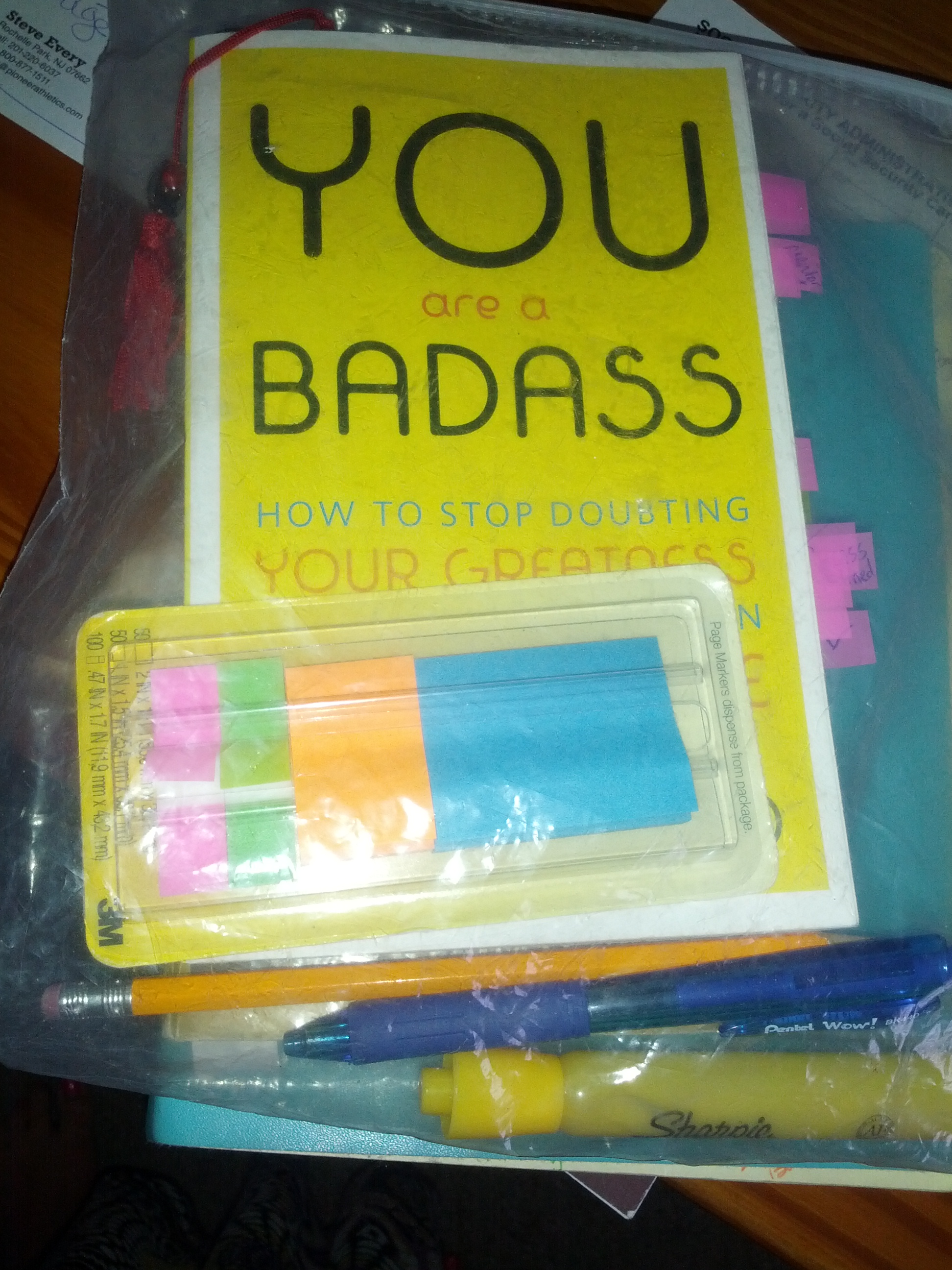
IMG_20140812_124058You are a Baddass: How to Stop Doubting Your Greatness and Start Living an Awesome Life by Jen Sincero has found its way into my Survival Book Kit and I love it!  I’m just past the first thirty pages, yet I have not stopped laughing.  Yes, out loud.

Sincero most definitely has a way with words.  She is edgy and a straight shooter for sure.  Yet, she is able to talk about really serious life-changing ideas in a way that feels ‘light’.  Not your typical self-improvement piece.

I want students to see how infusing humor among the serious can be oh-so-powerful.  Utilizing analogies to talk about the conscious and subconscious mind provides readers visuals…imagery.  A way to process this vitally important information that can shape their lives.  In only the most positive of ways.

I plan to choose the excerpts from this text skillfully.  I want students to have access to the content and the craft…as always.  I do foresee really rich one-on-one reading conferences with those that decide it’s time to make a change in their lives, or at the very least are up for a great laugh, and decide to take this piece on independently.

I hope my four have inspired you.  I really do.  I hope it will do the same for my students.  I encourage you to also share your favorites, here on this site.  As we all gear up for an incredible year to come, and we are swiftly shifting into our ‘going back to school’ mode, this is a wonderful time to start thinking about what we’re reading in a way that lends itself to the idea of being a mentor text.  Articles, books, poetry, graphic novels…all are welcome.


Thanks for being our writing coach, Mr. Lightman

I’ve done a lot of thinking about structure lately. My students need to learn some. They’ve finally got some great ideas, but they are struggling with effectively sharing them in their writing.

I’ve become hyper aware.

I notice when an author introduces a topic. I notice when he builds a paragraph with reasoning and evidence. I notice when he concludes with a sentence that alludes back to the main idea. I notice balanced ideas in balanced sentences, and I get a thrill when the author captures meaning through structure and not just words and phrases.

Like this passage by Alan Lightman in his little novel Einstein’s Dreams (53-54):

There is a place where time stands still. Raindrops hang motionless in air. Pendulums of clocks float mid-swing. Dogs raise their muzzles in silent howls. Pedestrians are frozen on the dusty streets, their legs cocked as if held by strings. The aromas of dates, mangoes, coriander, cumin are suspended in space.

As a traveler approaches this place from any direction, he moves more and more slowly. His heartbeats grow farther apart, his breathing slackens, his temperature drops, his thoughts diminish, until he reaches dead center and stops. For this is the center of time. From this place, time travels outward in concentric circles–at rest at the center, slowly picking up speed at greater diameters.

Who would make pilgrimage to the center of time? Parents with children, and lovers.

And so, at the place where time stands still, one sees parents clutching their children, in a frozen embrace that will never let go. The beautiful young daughter with blue eyes and blond hair will never stop smiling the smile she smiles now, will never lose this soft pink glow on her cheeks, will never grow wrinkled or tired, will never get injured, will never unlearn what her parents have taught her, will never think thoughts that her parents don’t know, will never know evil, will never tell her parents that she does not love them, will never leave her room with the views of the ocean, will never stop touching her parents as she does now.

And at the place where time stands still, one sees lovers kissing in the shadows of buildings, in a frozen embrace that will never let go. The loved one will never take his arms from where they are now, will never give back the bracelet of memories, will never journey far from his lover, will never place himself in danger in self-sacrifice, will never fail to show his love, will never become jealous, will never fall in love with someone else, will never lose the passion of this instant in time.

_____________________________________________________________________________________

I love it when an author becomes our writing coach.

Thank you, Mr. Lightman.

We are in Process, and that is Beautiful

A follow up to a comment on the post Not the Same ‘Ole AP Writing Teacher

Wow. Thanks for following my blog. I’m grateful. I appreciate your inquiry into our Snowfall writing project. It’s made me do some thinking, and you’ve inspired me to turn my response into a follow up post. Thanks for that.

Here’s my best shot at answering your questions:

1. Do you have any completed student assignment that you would be willing to share? and 2. What vehicle/medium did you use for to students to publish their work?

No student samples yet — this is the first year I’ve had students complete something quite so extensive. In regard to publishing their work, we aim high, so students will do a bit of research to see if they can submit their articles somewhere for publication. When they were first selecting topics, we discussed audience, and students had to justify what kind of magazines would run a piece about their topics. For sure, students will publish their finished articles on their blogs. They each have their own blog in which they write weekly.

3. What were your specific requirements for the assignment?

Since I am pushing toward authenticity, I intentionally did not start with a rubric. I’m sure John Branch didn’t have a rubric when he started writing “Snowfall: Avalanche at Tunnel Creek” either. I want students to take ownership of this work, so I want them to think through the parts and pieces that will make their work turn out the best.

Students and I read five pages of Branch’s piece together, and I encouraged students to read the rest of the article online in their own time. All I really told them was that we were each going to write a full-length feature article, and this Pulitzer Prize winner was our model. I am trying to break habits of skating through writing assignments with weak ideas and weaker research. Many of my student are used to getting A’s without having to actually learn anything. This bothers me. That is partly why, although they got to choose their topics, I had to approve them and be sure there was some depth to what students were thinking in terms of what they could discover in their research.

While it may sound strange, I do not have specific requirements other than–

1. show me that you have learned several different modes of writing, including how to embed and cite research,

2. include several different images, including photos, video clips, info graphics, charts, etc that make your article multi-media and convincing,

3. prove that you take pride in your work by revising, evaluating, improving, and learning as you move toward publishing your best work.

I do keep tick marks in my records of students who submit their work to me for review on time and who use their time wisely in class, but those benchmarks become daily grades and will not influence a student’s final grade on the piece he finally publishes. Most likely I will allow students to give themselves a grade when all is said and done. Without question they always grade themselves harder than I ever do, and I have to score them up a bit.

4. Any other information that you could share with us would be greatly appreciated.

Every week we work on some aspect of this writing. Last week we read some descriptive writing, and students finished up their narrative intros. I read aloud the prologue of The Emperor of All Maladies–a Biography of Cancer (also a Pulitzer), a non-fiction text that begins with a narrative intro, similar to the narrative at the beginning of Snowfall, although different at the same time. We connected our thinking back to Snowfall, and students moved their “remember it” paragraph to the top of their page and revised to make emotional stories that would draw their readers into their articles. They read and evaluated the writing of their peers– aiming for the WOW factor (our way to gut-read a text), and they revised to make better.

Later we talked about definition as a mode, and students began writing a paragraph that defines their topics and includes a position statement. (We are including a persuasive slant more than Snowfall because of the argumentative focus of AP Lang.)

I showed students how to use google forms to conduct surveys, so they could gather their own data instead of relying on whatever they found on the internet, and they took a survey I created that I will use in my own feature article I am writing beside them. Every step I ask students to take, I take as well. They can see my piece develop and change and grow as theirs does. Soon I will introduce info-graphics with the hope some students will include those in their full-length article. I think info-graphics are so cool.

So, that’s about where we’re at with this huge and engaging writing project. I wish we could stop everything else and only work on this piece– we had a district checkpoint, and we have an AP mock exam looming, so we have to move back and forth into the genre of test taking. But … maybe, this slow process is for the best: I am able to show how the skills needed to write on demand are the same as developing a long process piece–only s.l.o.w.e.r.

We are in process, and that is exactly what I want. Kids are learning and growing as writers, and that is so much more important than rushing into a finished product.

I hope this helps. Please ask if you have other questions. I am happy to share and share and share. I am thrilled that others are doing this same kind of exciting and engaging work with students. We are teaching the writer and not the writing, and that is beautiful.

Warmest regards,

Amy

Not the Same Old AP Writing Teacher

ocsWriting takes time. I imagine most English teachers know this. However, I am not sure most English teachers allow students enough time to produce their best work.

I speak from experience. You might be able to relate.

Traditionally, I would give students a writing assignment. We’d pre-write a day, sometimes two. We’d draft a day, sometimes two. We’d revise (or I’d hope they’d revise) maybe a day–or none at all, depending on the student. We’d publish our work and turn it in for a grade.

Oh, how incredibly dull . . .and ineffective. No wonder so many students hated writing.

This year we do writing differently. We are writing a lot more like real writers.

We start with reading. We read an engaging and complex mentor text. The author becomes our writing coach for as long as we are working on the assignment. The piece my students are writing now is a feature article modeled after the work of John Branch in Snowfall:Avalanche at Tunnel Creek, which recently won a Pulitzer Prize. We read the first four pages or so together, stopping to talk about the many devices Branch uses to craft the introduction to this piece. We discussed the rhetorical appeals and how Branch uses them to build credibility and create emotion. Students were mesmerized by the narrative. It’s a lovely day in my teaching life when every sentence in a text has something worthy of taking note–I had to stop myself in Snowfall. Too much talk, and we lose the rhythm of the article.

After we read, my students and I looked at the embedded photos with the captions and watch a couple of the videos. We discussed why the author included these in the piece where and how he did. I then told students that they would be creating their own article, and John Branch just became their writing coach.

Students chose topics after a lot of class discussion and responses to my probing questions in their writing notebooks.

  • If you didn’t have to go to school, or work, or any other responsibility, what would you do with your time?
  • If you could have dinner with three famous people, past or present, who would you invite to dine?
  • If you could travel in time, what era would you want to return to?
  • Where to you see yourself in five years?
  • What do you want your life to be like in 10 years?
  • What is something you have always wondered about?

Students chose some interesting topics:  One young woman is writing about building schools in Mexico, another is writing about neurobiology, and another is writing about hiking across Europe. A young man is writing about what life was like during Jesus’ time, another is writing about game design, and another is writing about becoming a pastry chef.

Initially, I had students jot their topics on a sticky note, so I could see if what they had chosen was “doable.” (We all know those students who choose topics that are so broad, and perhaps the students’  skills are so immature, that there is no way they will ever be able to write anything interesting.) I wrote some quick feedback, pretty much either “Run with it,” or “Wait! narrow this down,” and most students were ready to write.

Then I had this idea that I’d been playing with in some consulting I’ve conducted with North Star of TX madewithOver-2Writing Project. It’s a working structure to get students thinking. And if I teach it right, students will learn four different modes of writing in one go:  definition, narrative, examples, and argument.

I wrote my own working piece, and my students and I read it together. Then I asked them for suggestions on where I could improve and where I could add research. You can see my working document here: Authenticity.

Students then began crafting their own four paragraphs. This ended up being the final summative assessment for fall semester due to the deaths in my family and my many absences. Turned out to be a pretty good resting place.

When we return to class next week, these are our next steps:

First, we will return to Snowfall and read and discuss the piece in more detail. You know, to get us back in the reading and writing groove after our two weeks break.

Then, we will project a few student work samples on the board and talk through them the same way that students did with mine, offering suggestions on improvement and where research may work to advance the meaning. Every student who wants whole class help will have the chance to ask for it. Others might choose to just get help from their small writing groups. Either is fine, as long as all students share their work and get feedback.

Eventually, we will work on revising our structure, moving around paragraphs, and making our writing follow Branch’s award-winning article. Of course, I will pull sentences to study and conduct other mini-lessons all throughout our writing process. And I will confer with students regularly. We will add photos and videos (hopefully originals), and we will polish and polish and polish before we publish.

For the first time ever, I am in no hurry. I will not allow our time to be regulated by grading periods– well, until the very last one at the end of the year.

We will write.

We will revise.

We will confer and share and grow as writers.

And eventually, we will publish.

And celebrate.

I’d love to know how or what you have changed as a writing teacher. Please share.

When a Student Tells You What to Teach: Sweet

I mentioned before that I gave a Pulitzer Prize winning novel to one of my AP English students recently. He gave it back to me three days later.

“Did you read it?” I asked.

“Well, I tried,” he said. “There’s just too much description. I couldn’t get into it.”

“What do you mean?” I asked.

“I don’t know exactly, but it’s the kind of book you should pull passages out of and teach with,” he said.

Okay, then.

I still haven’t read the novel Tinkers by Paul Harding, but I did take a look to see what Levi meant. (He’s a bright young man–taking both AP Lit and Lang his junior year.)

Just read the first page. You’ll see what I did.

Yes, I can teach some skills with this. It’s beautiful, and now I’m reading it– on the lookout for mentor slices that engage and inspire great reading and writing.

Screen Shot 2013-11-03 at 10.02.26 AM

A Book Talk and A Writing Lesson in One Easy Go

Since I try super hard to not work on the weekends, I wasn’t sure how I was going to be completely prepared for my lesson on Monday. I locked my classroom door on Friday, knowing I was short a mentor text.

Then, while sitting by the lake, enjoying the breeze and this novel a friend recommended, the text blurred my eyes, and I did the unthinkable: I crimped down the corner. Then I did it again and again and again.

I love it when the stars align, and the tools I need to teach writing appear in my own independent reading. I notice things and want to share them with students. And I know that they will see what I want them to see and understand why it matters because they see my passion in the discovery of something I want to show them. Studying author’s craft becomes easy when I share from the books I am currently reading.

Here’s a slice from Night Film by Marisha Pessl, a hauntingly beautiful book that’s written in multi-genre. (You want to check it out. I promise.)

The sagging green couch along the far wall was covered with an old blue comforter where someone had recently crashed–maybe literally. In a plate on the coffee table there was an outbreak of cigarette butts; next to that, rolling papers, a packet of Golden Virginia tobacco, an open package of Chips Ahoy!, a mangled copy of Interview, some emaciated starlet on the floor along with a white sweatshirt and some other clothes. (As if to expressly avoid this pile, a woman’s pair of black pantyhose clung for dear life to the back of the other beach chair.) A girl had kissed one wall while wearing black lipstick. An acoustic guitar was propped in the corner beside an old hiker’s backpack, the faded red nylon covered with handwriting.

I stepped over to read some of it: If this gets lost return it with all contents to Hopper C. Cole, 90 Todd Street, Mission, South Dakota 57555.

Hopper Cole from South Dakota. He was a hell of a long way from home.

Scribbled above that, beside a woman named Jade’s 310 phone number and hand-drawn Egyptian eye, were the words: “But now I smell the rain, and with it pain, and it’s heading my way. Sometimes I grow so tired. But I know I’ve got one thing I got to do. Ramble on.”

So he was a Led Zeppelin fan.

Oh, the details, the description, the diction, the syntax. You can see it, too, right?

If I want my students to become effective writers, I have to show them effective models. It’s as simple as that. It’s even simpler when I can show them models from books I’m reading. Then they get a book talk and a writing lesson in one easy go.

I love it when that happens.

Writers on Writing: Thanks, I Needed This

Wow. Just wow. Maybe this won’t be new news to you, but I just found this awesome site:

Writers on Writing  –A complete archive of the Writers on Writing Column from the NY Times.

I decide to read a few of the opening paragraphs. The first link I open is Geraldine Brooks from July 2, 20o1:

My writing desk is a tankard-scoured tavern table that once saw service in an 18th-century inn. When I look up, the waved and bubbled window panes of my study offer a view that has changed very little in the 200 years since the glass was set in place. A small paddock rises gently to an apple orchard, the trees laced with white blossoms. An elderly stallion flicks at flies with a long, supple tail.

At this time of year boughs of unfurling oak leaves hide the black slash of electric wires. And that’s helpful; for every morning, after I turn off the urgent chatter of news radio — its breathless headlines and daunting traffic reports — I make my way up to this little room and attempt to leave my own time behind.

Tell me that’s not a tiny literary treat?

And this one from Jamaica Kincaid, June 7, 1999. It’s hard to stop at just two paragraphs:

How do I write? Why do I write? What do I write? This is what I am writing: I am writing “Mr. Potter.” It begins in this way; this is its first sentence: “Mr. Potter was my father, my father’s name was Mr. Potter.” So much went into that one sentence; much happened before I settled on those 11 words.

Walking up and down in the little room in which I write, sitting down and then getting up out of the chair that is in the little room in which I write, I wanted to go to the bathroom. In the bathroom Mr. Potter vanished from my mind; I examined the tiles on the floor in front of me and found them ugly, worn out.

 I open more, Annie Proulx, Amy Tan, Scott Turow, Kurt Vonnegut, and they all have elements of story. Interesting. I was just part of a Twitter chat where the question rose:  Can non-fiction help us make life-long readers? Some responded yes, most responded no. Me? I think yes. Good non-fiction dwells in story. It sucks you in and spins you around and opens your eyes to thoughts, emotions, facts that you’d never considered before the telling. These short texts are evidence of that. And these short texts are about to become mentors in my writing class. Thank you, Literary God, I needed this!
images-2