Tag Archives: Jackie Catcher

Mini-Lesson Monday: Introducing Thematic Units through Poetry

d284bf40a1804c66d4fff674f59b350eSince the Freshman English curriculum is set up thematically, I like to introduce quarter themes through poetry.  While I love the quarter’s discussion of larger themes, students oftentimes lose the goal, purpose, or relevance of these themes as the quarter progresses.

In turn, I make it a point to introduce the quarter’s themes independently as a pre-reading exercise.  Instead of asking questions specifically about lit circle or whole class novels, I lead in with poetry that will help students begin teasing out the bigger ideas from the beginning.

Objectives: Using the language of the Depth of Knowledge Levels, students will identify the central theme of the poem “Trolls” by Shane Koyczan, stating its message, and quoting from the text.  They will interpret the meaning through individual quick writes and group discussions, and they will apply the concepts learned from their discussions to the books they are currently reading in literature circles.

Lesson: The Freshman Team’s Quarter two theme is “darkness of man’s heart,” which I introduced this year through Shane Koyczan’s poem “Trolls.”  The purpose of this quick write is threefold: it introduces students to denotation and connotation; it allows us to discuss second person point of view, and it provides a smooth transition into our quarter theme.

First I hand out the printed copy of “Trolls” and I play the video for students.  Students then perform a five-minute quick write to the poem by either pulling an idea or a quote from the poem and using it as a sentence starter or by responding to the poem as a whole.  Regardless of their method, their goal is to connect pencil to paper for a full five minutes until I tell them to finish up their line.  During this time I model my own writing on my document projector.  Our quick write time is followed by two minutes of Kelly Gallagher’s “RADaR marks” in which students return to their writing, colored pencils in hand, to quickly review and revise their work.

I love the immediate reaction and rawness of their writing in these moments, which makes it the perfect time to turn and talk within our groups.  I first model my writing then ask students to share theirs, urging them to read at least one line from their responses.  These quick writes provide the necessary steps to build a writer’s community.  The more students share these tidbits, the more willingly the engage in the writing process with each other at every step.

It is these individual discussions that lead to greater questions about Koyczan’s use of denotation and connotation to describe both mythical trolls and Internet trolls.  We talk about his intentions in starting the poem with the fairytale line of “Once upon a time” as well as his reliance on second person to not only garner solidarity with his audience but to attack cyberbullies.

Once we’re done discussing the intricacies of the language, I send them back to their groups to contemplate what Koyczan has to say about the darkness of man’s heart.  Starting with poetry allows them to grapple with major themes in a small burst.  Spoken word poetry plants these ideas before they even begin to delve into more complex novels.

Follow Up: This quarter is the first time I have done literature circles.  My students chose from Lord of the Flies, Fahrenheit 451, or a combination between Of Mice and Men and Animal Farm.  I used Koyczan’s poem to practice our literature circle roles and then to use our roles as a basis for discussion in the literature circle groups.

Because “Trolls” was short, accessible piece, students were able to discuss the theme before we even began our reading of our exploration of our lit circle books.  That being said, this process of discussion, while simple, allows students to explore themes, thus building the necessary foundation for them to further examine these themes within their novels.

Here are some additional poems to pair with literature themes:

Theme: Loss of Innocence—Poem: “Jellyfish” by Sarah Kay

Theme: Individual and Society—Poem: “To This Day” by Shane Koyczan

Theme: Identity—Poem: “Names” by Rachel Rostad or “We Wear the Mask” by Paul Laurence Dunbar paired with “Masks”  by Shel Silverstein,

Theme: Love—Poem: “How Falling Love is Like Owning a Dog” by Taylor Mali

Theme: Coming of Age—Poem: “On Turning Ten” by Billy Collins

Theme: Invasion of Technology—Poem: “Look Up” by Gary Turk

What theme-poem pairings do you use in your classroom?  What suggestions would you add to this list?

#FridayReads: 6 Ways to Stir Up Your Daily Book Talk

I’m not sure if it is because we are on the cusp of cold weather or that we just ended quarter one, but my students are dragging.  They rub their eyes more in the morning, carry in larger cups of coffee, and stoop a little lower in their chairs.

This lethargy seeps into even my strongest classes, which is why I like to change up my approach to book talks from time to time to re-energize students before they dive into their independent reading books.  Here are five ways I stir up my book talks.

  1. Musical Chairs: Music is naturally energizing and I love getting books in students’ hands FullSizeRenderquickly. This is “played” like typical musical chairs, the main difference is that students who sit in a chair also get to look at the book that has been placed on the desk behind them (I have separated desks and chairs so I face the chairs outwards).  The student left without a chair writes a “mini-book talk” on the board, which includes the title of the book they have read this year, the author, how many stars it would receive out of five, and a quick sentence to get readers interested.
  2. Group Book Talks: Getting students chatting about books is one way to ramp up energy at the start of class. My desks are grouped into fours, so students turn to their group members and book talk their current book (or a book they read prior).  Oftentimes there are repeat book talks from books I previously shared, but I reiterate the value of multiple perspectives and opinions.  What others notice as readers might be something I never thought to share.
  3. Guest Book Talks: I’ve spent years chatting with my favorite library staff about new YA books,FullSizeRender-3 but sadly it didn’t dawn on me to tap into their brilliance until this year.  Our phenomenal librarian Kathy Vetter book talked Between the World and Me by Ta-Nehisi Coates to my AP Literature students, and our AV and computer lab guru, Melissa Ciotti, book talked Little Brother by Cory Doctorow to my freshman classes.  By the end of their visits, all copies had been checked out of both the classroom and school libraries.  Next up, I have a PE teacher…and hopefully our principal! Students need positive reading role models in all of their educators.
  4. Speed Dating: I have mentioned speed dating with books multiple times before, but it is one of my favorite ways to get books off my shelves and into my students’ hands. I typically put the desks in a circle and have students rotate the books every minute or so, but I love Amy’s approach as well.
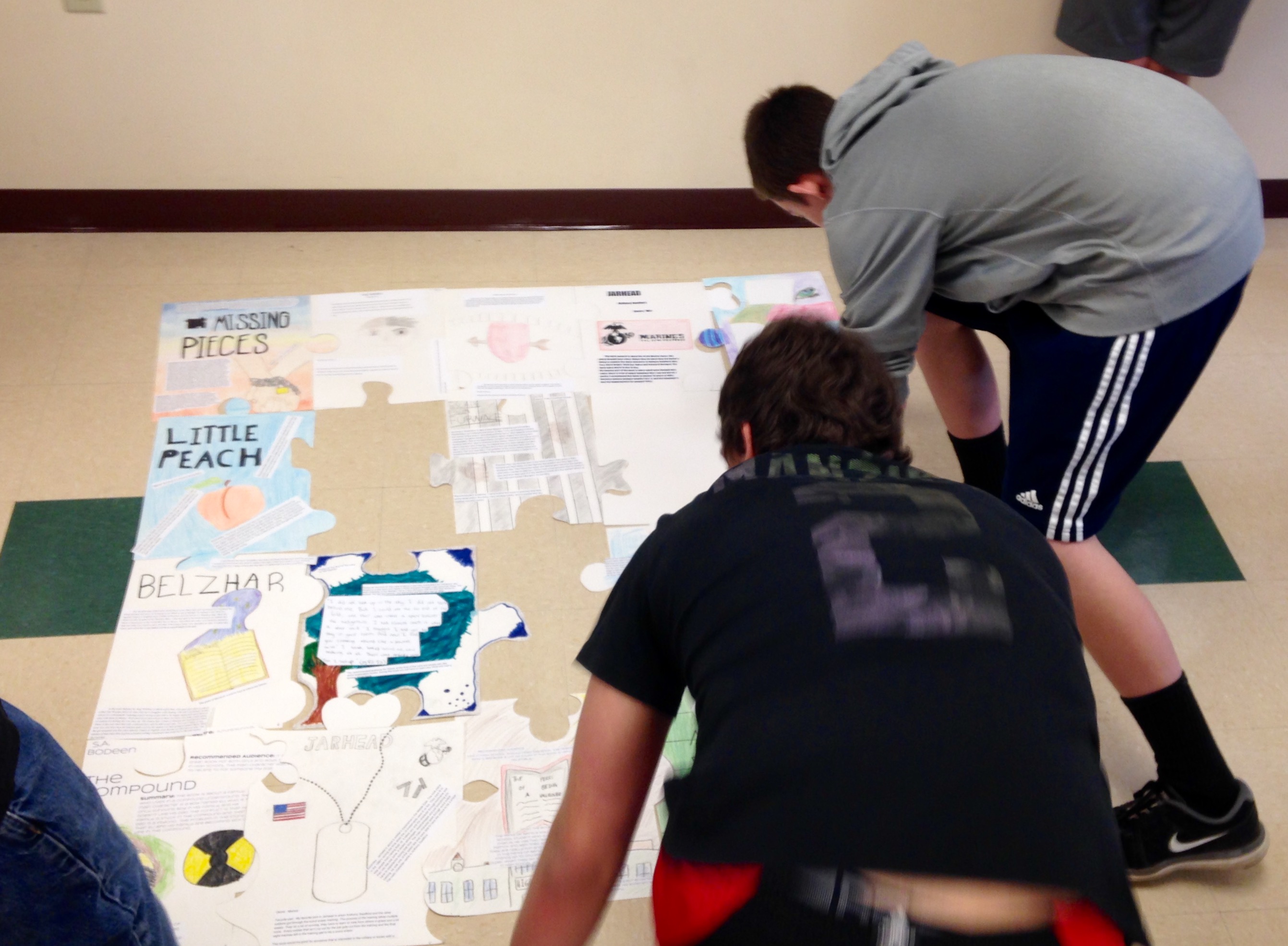
  5. Book Talk Puzzle: This is a longer project, but I love the final product.
    Students piece together their final book talk puzzle.

    Students piece together their final book talk puzzle.

    Students write out book talks on large puzzle pieces.  I have students discuss their favorite parts of the book and to whom they might recommend it.  Finally they draw their favorite scene, symbols, or images from the book.  Once the puzzle pieces are complete, we share our final products, build the puzzle, and put it on display for our peers.

  6. Book Trailers: I had my Advanced Composition students complete book trailers last year. The final films were phenomenal and provided excellent material for this year’s book talks.  I oftentimes play the film for my students then read an excerpt to expose them to the language.  There are some brilliant book trailers here and sprinkled across the Internet and TTT.

What do you do to change up your book talk schedule during the year? What are some unique ways you introduce your students to various titles?

#3TTWorkshop–Individualizing our Students’ Study of Vocabulary

FullSizeRender-1

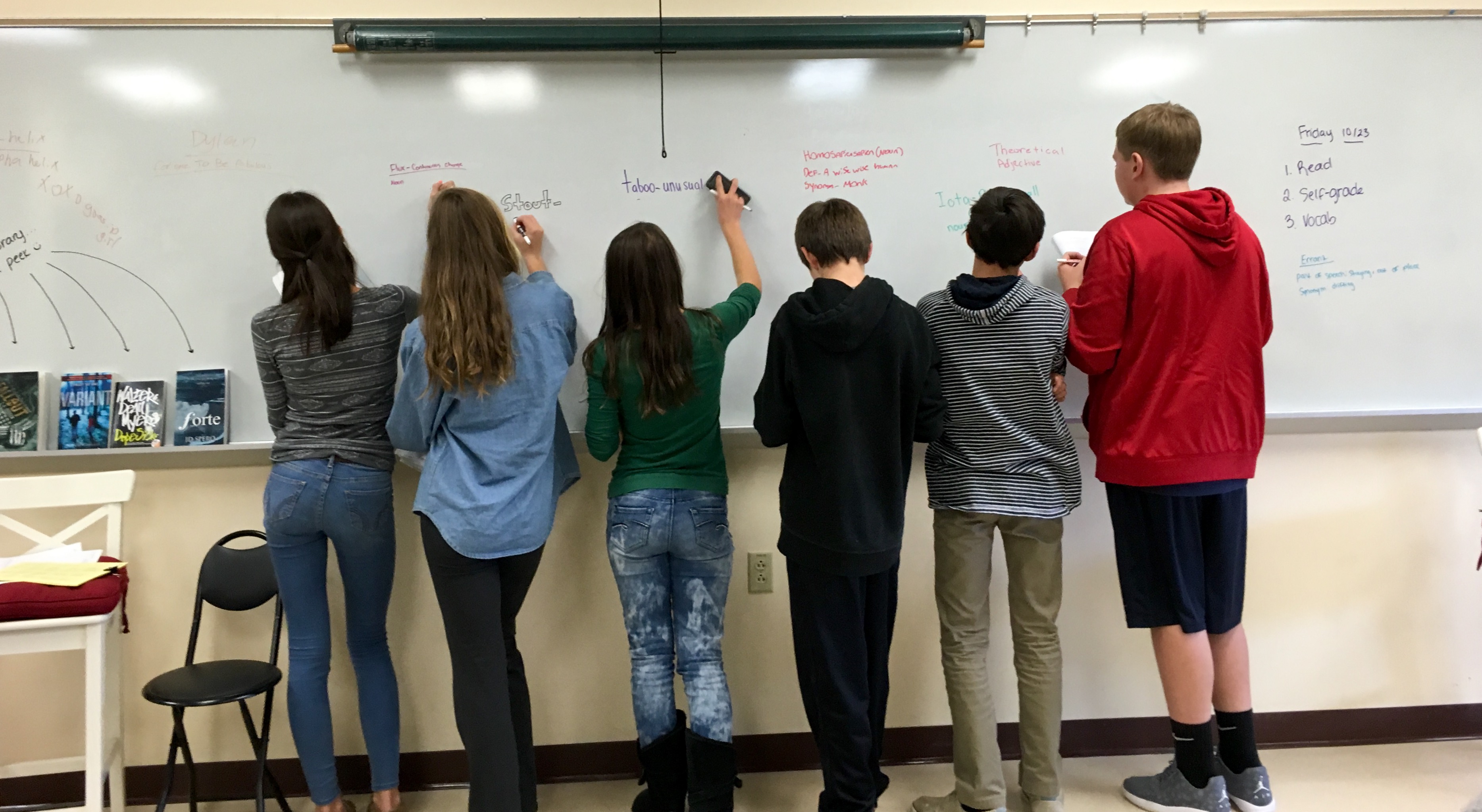
Students in Jackie’s class write their vocabulary words on the board.

Three educators. Three states. Three demographics. All practicing Readers and Writers Workshop in our Secondary Classrooms. Read more about us here.

We are the Modern PLC, and every Wednesday and Thursday, we share our behind-the-scenes collaboration as we talk about the most urgent moving parts of our classroom pedagogy.

Today is the second and last installment of this week’s conversation between Jackie and Shana on vocabulary instruction.  Please join the conversation in the comments!

What are your best vocabulary activities?

Shana: For me, best practices surrounding vocabulary all happen in the writer’s notebook.  Curating a personal dictionary in that particular section, sharing those words with friends, and doing fun, in-class follow-up activities with those words seem to work best to get my kids authentically reading to find new or interesting words in their books.  We do things like write a poem using ten of our words, create a pass-it-along story in which your sentence has to contain a word used contextually, or create an illustration of a particular word and hang it up.  The more play there is involved in our study of words, the more my students actually begin to pay attention to vocabulary in both their reading and writing.

FullSizeRender-2

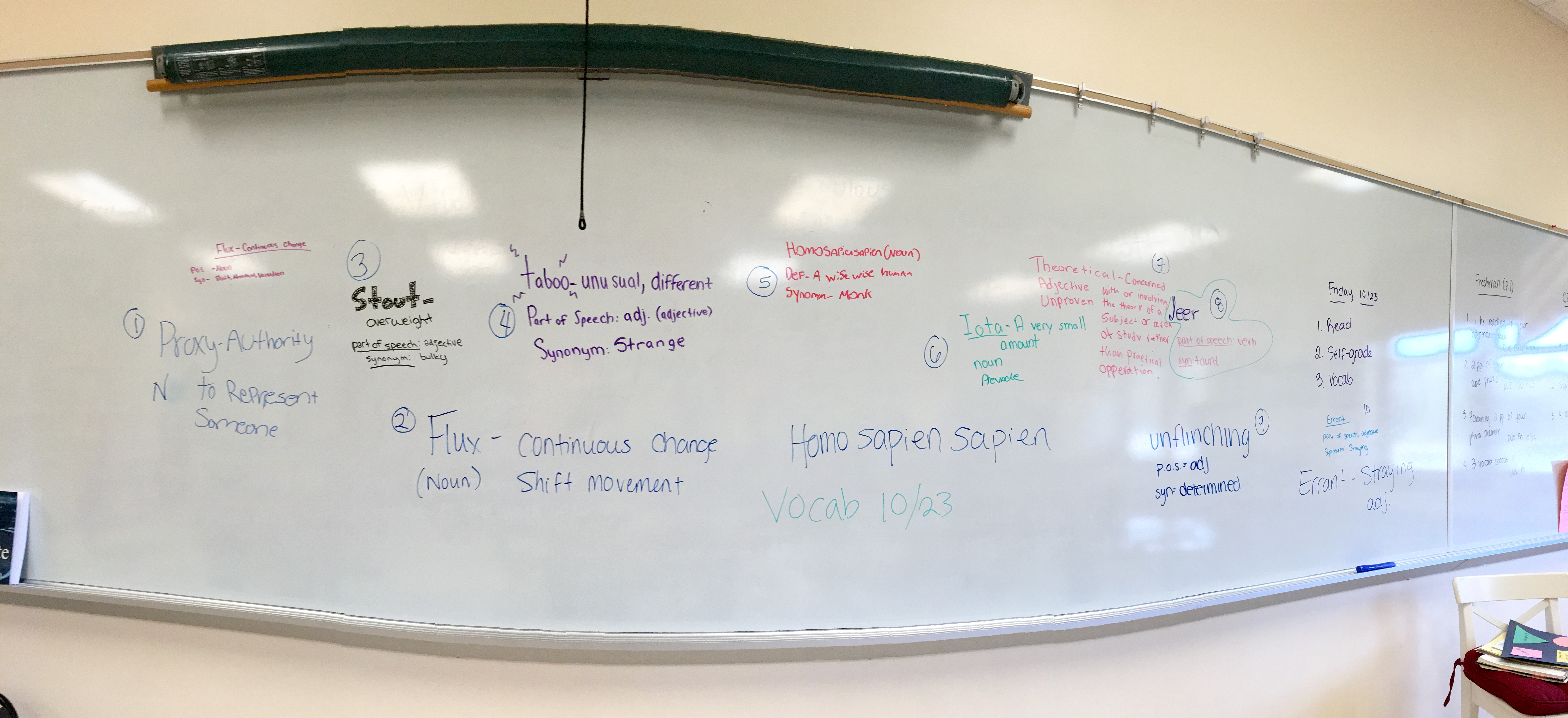
A list of vocabulary words students found in their independent reading books.

Jackie:  For the past couple of years I have wanted to integrate vocabulary instruction into my curriculum, but it wasn’t until this year that I moved forward with the process of carving out a specific section of students’ writer’s notebooks.  As Linda Rief says in Inside the Writers Readers Notebook, “We also need to ask them to pay attention to words in their own reading and their own listening, to notice words that they don’t quite have a grip on as writers and speakers but which they come across fairly often” (Rief 23).  As Linda Rief suggests, my students collect four words from their independent reading book or whole class reads per week.  They record these words as well as the parts of speech, synonyms, and the sentence in which they found the word under a separate dictionary section in their Writer’s Notebook.  

At the beginning of the year I was worried about summative assessments and meeting the needs of my students through our new competency-based grading system.  I “assessed” my students on their vocabulary by having them first memorize the words and then complete whatever the task-at-hand was for that day.  I’ll admit that a quarter into the school year I have already abandoned this method after growing frustrated with the results.  Naturally, students chose easier words when there were higher stakes assessments at hand.  They sacrificed learning for grades and in turn, asked fewer questions, instead focusing more on grades and less on word acquisition.

This is where you helped me most, Shana.  After tossing aside the summative assessments, I had students compile a dictionary of their words on the board, and we spent 15 minutes simply playing with the words and writing stories and poetry.  These biweekly activities breathed life into an otherwise stressful vocabulary lesson.  Soon my students were asking questions about how to use the words through context clues, and I was giving minilessons on integrating words into sentences based on the parts of speech.  For the first time, students began playing with vocabulary instead of trying to find shortcuts around the system.
Do you use independent vocabulary instruction? What activities do you use to help familiarize students with new vocabulary?

#3TTWorkshop–Teaching Vocabulary Through Independent Exploration

FullSizeRender

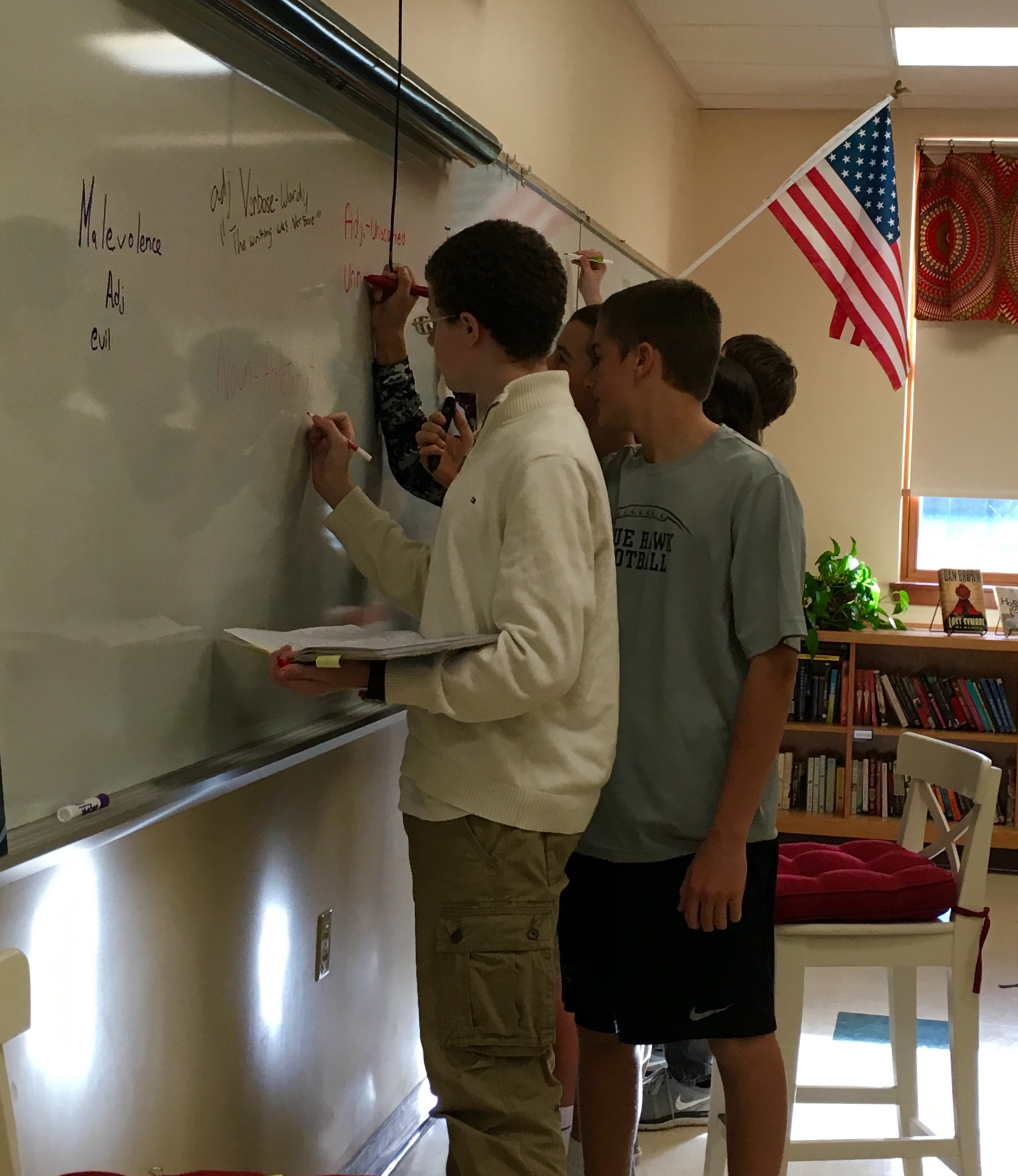
Students in Jackie’s classroom write vocabulary words on the board.

Three educators. Three states. Three demographics. All practicing Readers and Writers Workshop here.

We are the Modern PLC, and every Wednesday, we share our behind-the-scenes collaboration as we talk about the most urgent moving parts of our classroom pedagogy.  This week’s conversation between Jackie and Shana explores the value of shifting away from the more traditional modes of rote memorization and more toward wordplay.

1. Why do you integrate vocabulary study into your classroom, and how do you approach it?

Jackie:  This is my first year integrating vocabulary into my freshman classes.  Previously I had taken a traditional approach, relying on the Oxford-Sadler books in my junior/senior Advanced Composition classes.  The problem was that by the end of the year, many of my students would forget the twenty or so words we had memorized every other week.  I knew something had to change, so I returned to the words of my mentors, Penny Kittle and Linda Rief, to gain a better understanding of how they approached vocabulary.  Now instead of having my students memorize lists of prescribed vocabulary, they find four words per week and store them in the dictionary section of their writer’s notebooks.

Shana: I love the study of words, so one of the things I always find myself noticing about an author is the type of vocabulary he or she employs.  Diction makes up a great deal of a writer’s style, so I think it’s important to study it.  I am fortunately not required to adhere to a certain program or set list of words, so I tend to approach the study of vocabulary more along the lines of noticing words that are in our reading and writing.  I don’t have a formula or routine for vocabulary study, although as a general rule I try to set aside mini-lesson or quick-write time about every two weeks.

IMG_1333

Ryan’s words for this week include “nebulous,” “jettison,” “inchoate,” “unnerving”, and “aphorism,” all of which he found from his independent reading book Little Brother by Cory Doctorow.

2. What is the inherent value of vocabulary study?

Shana: Something I’ve been thinking a lot about is the inherent value of vocabulary study.  Vocabulary acquisition is just one little piece of the puzzle that makes up literacy, but it seems to get so much attention from the powers that be.  For example, last year our school had two schoolwide goals–one of them was “vocabulary.”  What does that even mean?  Do we want our teachers teaching more “vocabulary words?”  Do we want our students memorizing more “vocabulary words?”  What is the difference between academic and non-”academic vocabulary?”  I’m just not sure that vocabulary acquisition is as big a piece of the literacy puzzle as our testing/curriculum planners believe.

Jackie: I agree wholeheartedly with you, Shana.  I am not required to teach vocabulary, but every year I tell my students that reading helps build one’s vocabulary.  The more I thought about it though, the more I wondered how these skills translated, how my students would develop their own lexicons if they never actually stopped to think about the words they were reading.

Unlike your school, though, my school’s major initiative has been towards Common Core-based instruction.  Fortunately, part of the College and Career Readiness Anchor Standards for Language requires students to “also have extensive vocabularies, built through reading and study, enabling them to comprehend complex texts and engage in purposeful writing about and conversations around content.”  I believe vocabulary study shouldn’t be about isolated memorization; instead, it should allow students the freedom for wordplay.  When students are given the freedom to not only pick their own vocabulary words but also share them with their peers, they are more likely to explore definitions, find connections, and play with usage.  I receive more questions about context clues, Latin roots, and parts of speech during bi-weekly vocab lessons than I have at any other point in my career.

Fitting Self-Assessments into Competency Based Grading

fotolia-33988899-xs-photogalleryThis year my school shifted to competency based grading.  For those unfamiliar with this, grading is centered on students’ mastery of the Common Core competencies.  While I have found it differs from state to state, our school has integrated competency based grading by requiring all classes to follow a grading percentage of 80 percent summative assessments and 20 percent formative assessments.  In addition, students are allowed to retake summative assessments as many times as they would like assuming they initially approached the assessments having prepared with good effort.

For me, as an English teacher, this process of retakes and revisions isn’t new.  That being said, the idea of 80 percent of my students’ grades being summative assessments is most certainly a shift.  In the past, while their final product has always served as a large portion of their grade (over 50 percent), it hasn’t counted quite as much as it does now.

I value formative assessments; I cherish the time my students spend cracking apart texts, mimicking authors’ craft, and simply reading.  For many of us, high school was a formative experience.  The time we spent exploring who we were paid off long term, yet competency-based grading values the final product more than the process.

To a degree, I take fault with this.  I understand that once students enter the workplace they are assessed based on their final products.  In the same breath, I also believe that high school must provide a platform for students to explore their interests in a safe and supportive environment that values process.  My life has largely looked like the reverse of my gradebook—80 percent of my time is spent reading, writing, brainstorming, drafting, discussing, and working, while maybe 20 percent of it is actually publishing, sharing, or posting my work.  I learned this process in high school.

Because summative assessments count for so much this year, I hate (even more than usual) applying a specific number to my students’ work.  In turn, to compensate for this competency based grading, I ask my students to assess themselves.

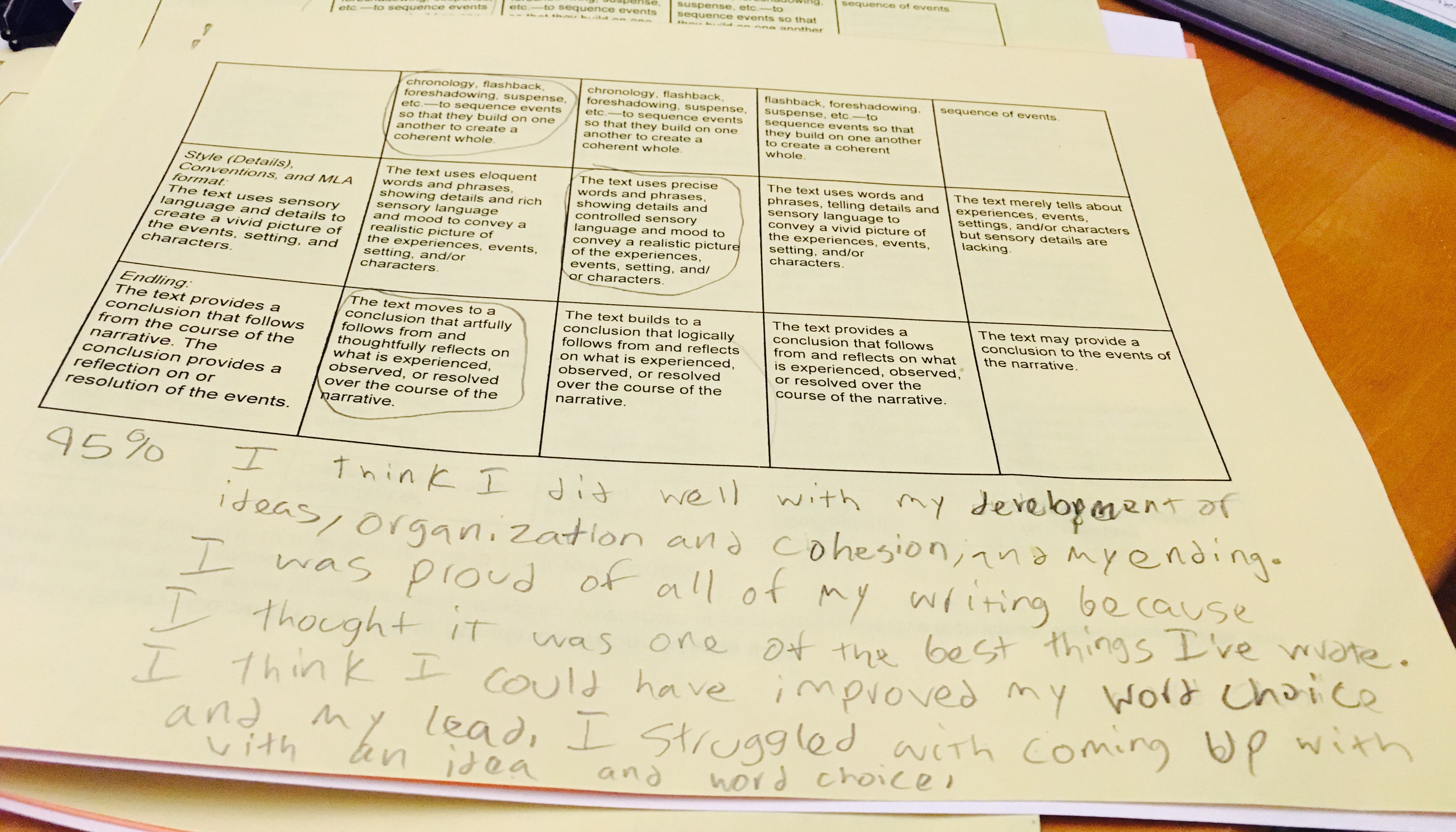
Every time my students hand in a paper or summative assessment like a notebook check, they grade themselves, writing a brief “metacognition analysis” in which they explain their writing, thought process, and reasoning.  In turn, instead of being blind sided by my grades, they have a say in how and even whether or not they met the competencies of the assignment.  Typically, they’re spot on with their grading.

FullSizeRenderNicole wrote, “I think my essay deserves that grade because I worked really hard on it.  I ended up printing it 4 times because every time I printed it I would self edit and have someone else edit it so that it came out just how I wanted it.  Just like always, I put a lot of my personality and voice into this piece.  I wanted people to laugh when they read it.  I added lots of detail about tiny situations and background.”

Ryan, had a similar assessment, “I think I did well with my development of ideas/organization and cohesion, and my ending.  I was proud of all of my writing because I thought it was one of the best things I’ve written.”

Ultimately students are also willing to honestly discuss their shortcomings.  Maddie targeted areas she hoped to improve in future pieces: “I feel I did well but could’ve been better.  I struggled with creating sensory details, but I feel I wrote this piece pretty well.  I would like to try and make this story more vivid, putting the reader in my position.” 

While I’m still addressing these changes and gauging my own understanding of competency based grading, self-assessments are the single most important change I’ve made in my classroom this year.  After I’m done reading rubrics, circling boxes, and checking off competencies, their voice is the resounding voice I hear.

Do you have competency based grading in your school?  Have you shifted to the 80:20 grading system? What changes have you made to better meet the needs of your students?

Mini-Lesson Monday: This lesson stinks, literally.  Teaching Sensory Details in Narrative Writing.

FullSizeRender-1I, like many of my students, am a kinesthetic learner.  Not only do I learn by doing, but for many tasks, I require a hands-on approach to fully grasp the complexity of a concept.  Yet as a teacher, applying kinesthetic techniques to English concepts can be somewhat challenging.  While we write and read and physically play with words, I try to create simulations and activities that allow my students to experiment with writing in unique ways.  This activity, which is one of my favorites of the year, uses students’ olfactory sense to stimulate sensory detail writing within their personal narratives.

Objectives:  Using the language of the Depth of Knowledge levels, students will identify personal memories associated with unidentified scents.  Recalling prior and newly acquired knowledge, they will translate their observations into descriptive writing by constructing sentences that rely on sensory details.  Finally, students will apply their understanding of descriptive writing to their own personal narratives.

Lesson:  This mini-lesson takes preparation, but students’ responses are worth the extra time.  First, collect the following supplies: Plastic cups (I use blue Solo cups), a permanent marker, tinfoil, a toothpick, rubber bands (optional), and a variety of objects that have a scent.  This year I used lime juice, perfume, scented wax blocks from Walmart, BBQ sauce, apple cider vinegar, garlic, mint extract, crayons, and Play-Doh.  Every year is different though and I typically rely on what I have around my home.

I put the scented sauces, liquids, and objects in each of the cups, cover the cups with tin-foil, and wrap a rubber band around the top to secure the foil.  I label each cup with a number and poke holes in the tin-foil with a toothpick.  Next I place the cups around the room. After taking some notes on the concept of “show don’t tell,” students walk around the room smelling the contents of each cup.  They must not peek (believe me they will try)!

FullSizeRender

My students were convinced I had a tiny Abercrombie and Fitch model in this cup. In reality, it was a block of scented wax from Walmart.

I provide each student with a grid in which they fill in the cup number, adjectives to describe the scent, and personal memories the scent conjures.  They must then write a two-to-three-line story or scenario in which they describe the scent without identifying what the scent is.  By the end of the activity, when we come back together as a group, students excitedly volunteer to read their sentences in order to reveal the contents of the cup.

Follow Up:  Following this activity, we identify sensory details within our independent reading books and take turns discussing these details within our groups.  Finally, during workshop time, students add sensory details to their personal narrative rough drafts, in turn “showing” images rather than “telling” them.  The process of digging into their narratives and writing in the margins reinforces the messy, step-by-step process of revision that many of my students struggle to grasp.  If time allows, students partake in a whip share in which we each share one line from our narratives that includes sensory details.

What are some untraditional writing activities you use? How do you get your students moving around the classroom?

#FridayReads: Whole-Class Novels to Teach, and How to Frame Them

This past summer Shana and Jackie found that we’d both taken on a unique experiment within some of our classes–we had decided to strip them of whole class novels and instead focus on independent reading, book clubs, and smaller whole-class texts.  As workshop teachers confident in the power of choice reading, we each felt that this shift would be both empowering and inspiring within our classrooms.  After our year of experimentation, we both left our classrooms with unique perspectives on the power of whole-class novels as well as how we would incorporate them moving forward.

Today is the third and final installment of our week-long discussion using Google Docs.  Please, join the conversation in the comments!

41Cx8mY2UNL._SY344_BO1,204,203,200_Question 6: How is it different to be forced to teach a certain novel versus to be able to choose the ones you teach?

Jackie: I will readily admit that I am “forced” to teach To Kill A Mockingbird and Macbeth at the freshman level.  That being said, I love teaching both of them and am fortunate that my students respond well to both pieces.  The challenges are certainly different though.  I must create student buy-in or else my students will drag through the next four to six weeks of our unit.  I frame each lesson to fit their needs and I make sure to fit the book into a workshop structure the best I can to create consistency.

I do believe that teachers must have a choice in what they teach, though.  We must be allowed to tailor our lessons to fit the needs of our students.  Independent reading allows us to understand our students as readers and individuals, which in turn, allows us to further assess what books our students might connect with best.  Fortunately for me, the freshman team I work on is progressive and forward-thinking.  They’re always willing to try new things, which oftentimes involves integrating contemporary works.

Shana:  This summer in Tom Newkirk’s class, he innocently posed this question to our class:  “Why is the defining novel about race in our country written by a white woman?”  He was referring to To Kill a Mockingbird, of course, as many of us were discussing its lately-released sequel.  That question, so casually tossed into our midst, made me think about why the canonized novels taught in schools are often so heavily prescripted.  Why does Harper Lee have a voice of authority about being black in America?  Why do my rural students need to read a particular story about race?  I know why it’s important to read stories about people different than us–I would argue that it’s essential to building empathy and a broader worldview to read widely–but why does Harper Lee hold the monopoly on that topic, and not someone like Toni Morrison or Zora Neale Hurston?

As usual, I have raised more questions than I’ve even attempted to answer, but I’m still not sure of the correct solutions.  I think it’s preposterous to have a rote schedule of “books to teach” for all teachers in a school when it’s blatantly obvious that the community of every classroom is different, which means the culture of its students is always unique, which means that no child ever needs the same book at the same time.

Jackie: It’s funny that you bring up Tom Newkirk’s question.  As I was sitting next to you, I had one of those hide-your-face-moments when I thought, “Oh geez, I teach To Kill A Mockingbird!”  As I said earlier, I am required to teach this book, and while I love it, it does not meet the needs of all of my students.  Teaching in New Hampshire, I have a predominantly white population.  This means that their understanding of race relations and their exposure to diverse literature is rather whitewashed.  We desperately need new, diverse voices to help our students understand and empathize with a variety of individuals.  The precious few books we read together should be based on the needs and interests of our students instead of being dictated by a one-size-fits-all approach.

Question 4: What is the most effective way to frame a whole-class novel and create student buy-in?

Jackie: At the beginning of the school year I discuss the different types of reading we encounter as lifelong students.  I explain that, as a reader, I read for pleasure as well as for knowledge.  Oftentimes those two paths can and may cross, but typically my personal reading life looks drastically different from my professional reading life.  I love pouring through popular YA lit, but in the same breath, I can’t get enough of dissecting poetry with my AP Literature class.

This same pattern applies to my students’ reading within our classroom.  As a class we must learn to maintain a fruitful and engaging personal reading life that allows us to not only learn from our literature but to also explore our own interests and passions.  That being said, we mustn’t overlook the power of dissecting and discussing language and craft as a class.  Reading whole class novels reinforces the fact that no two people read a book the same way.

Shana:  If choice is the golden guide to teaching of reading, then I think the culture of a classroom must dictate the novel we read.  While A Raisin in the Sun was immensely popular in my inner-city Cincinnati classroom, it completely flopped here in West Virginia when I tried to teach it.  The inverse is true of Huck Finn; wildly successful in WV, but a total fail in Ohio.  Thus, I seek to hear the themes my students return to again and in again in their writing and conversations–this year, we are engaged in many discussions about political rhetoric, the origin of power, and the struggle that class/social/financial/ethnic differences create.  Thus, I’ll seek out novels that explore those themes to help us engage with them more fully.

In closing, we leave you with a list of the most successful whole class novels we have taught as well as a list of the books we would teach our current students if given the opportunity.

Most successful novels I taught, from Shana:28c4d1f2e8d048f702c3dbf0990aca8c

A Separate Peace by John Knowles

The Absolutely True Diary of a Part-Time Indian by Sherman Alexie

Macbeth by William Shakespeare

Fahrenheit 451 by Ray Bradbury

What I’d love to teach, based on my current students, from Shana:

Peace Like a River by Leif Enger

Boy21 by Matthew Quick

Poisonwood Bible by Barbara Kingsolver

Into the Wild by Jon Krakauer

Most successful novels I taught, from Jackie…(you’ll notice some repeats):51BWES5VL2L

Of Mice and Men by John Steinbeck (read aloud and performed as a play)

On Writing by Stephen King

The Absolutely True Diary of a Part-Time Indian by Sherman Alexie

The Glass Castle by Jeannette Walls

Macbeth by William Shakespeare

Fahrenheit 451 by Ray Bradbury

What I’d love to teach, based on my current students, from Jackie:

Sold by Patricia McCormick

Here, Bullet by Brian Turner

One Flew Over the Cuckoo’s Nest by Ken Kesey

All the Light We Cannot See by Anthony Doerr

Be sure to join the conversation today in the comments! We would love to hear your perspective on whole class novels and how you incorporate them into your classroom.

Click here to read day two of our conversation.

Click here to read day one of our conversation.

Whole-Class Novels: Why Do We Teach Them, Anyway?

This past summer Shana and Jackie found that we’d both taken on a unique experiment within some of our classes–we had decided to strip them of whole class novels and instead focus on independent reading, book clubs, and smaller whole-class texts.  As workshop teachers confident in the power of choice reading, we each felt that this shift would be both empowering and inspiring within our classrooms.  After our year of experimentation, we both left our classrooms with unique perspectives on the power of whole-class novels as well as how we would incorporate them moving forward.

Here is day two of our insights and discussion we’ve had over the past week using Google Docs (click here for day one).  Please, join the conversation in the comments!

Question 3: After a year without whole-class novels, how did you feel?MTI5MzY0OTk4NTM0MjQwNzM0

Jackie: At the beginning of the year, I felt like a rebel.  The thought of not only allowing but also empowering students through independent reading went against the entire curriculum within our department.  All of my colleagues taught whole class novels, which meant that none of my students had experienced the pure freedom of choice.  That being said, three-quarters of the way through the year, I missed whole class novels.  Despite having unique successes with the independent reading, my classes lacked the communal experiences of reading, discussing, and simply just enjoying (or sometimes hating) a novel together.  By the end of the year, I found that both my students and I missed some components of reading whole class novels.

Shana:  I reflected on my teaching after a year without whole-class novels (mind you, many novels were read through book clubs, literature circles, reading challenges, and independent reading), but I felt like the one thing that was lacking in all of my instruction was the idea of sustenance.  I wasn’t seeing my students sustain an idea for an extended period, or grapple with an issue over time, or try to live with a topic for more than two drafts and three weeks.  The case was the same in their reading and writing–I wanted them to have more length in their thought processes and I wanted us to engage in those long thought processes together.

Question 4: Why is teaching a whole-class novel valuable?  More specifically, why do we do it, and what skills are taught?

brave-new-world-bookShana:  I am not sure why I used to teach whole class novels, or, specifically, why I taught the novels I taught.  I know that there were valuable instructional methods behind the way I taught them (thematic units, Socratic circles, exploratory essays), but I don’t know if I had a sound rationale behind the obligation I felt to actually teach multiple novels to all of my students.

After a year without them, though, I find that the collective classroom experience of reading, interpreting, and discussing a novel produces a route for a unique connection to a text that cannot be achieved without reading as a group.  I missed the experience of coming to a new, shared understanding of a text as a whole class, and I felt that my students missed out on that experience as well.  I don’t believe that when I read plays independently in my undergraduate Shakespeare capstone that I would have comprehended, connected to, or engaged as passionately with those plays alone as much as I did through our frequent in-class discussions, activities, and writings.  I don’t want my students to miss out on that experience either.

Jackie: This year I am teaching AP Literature for the first time.  I took the challenge believing that this new course would be somewhat of a paradigm shift for me compared to my contemporary-lit based freshman English class.  The more I prepared, the more I yearned to discuss my thoughts, questions, and analyses of texts.  I went so far as to ask everyone around me to read these canonical classics and discuss them with me.  Preparing to teach AP Lit reinforced the social significance of reading literature.  At its base, dissecting stories as a group is interesting and engaging.  Beating the crap out of them is not.  I agree with you, Shana, in that the experience of sharing a text is one of the blessings of being in an English classroom.  Once students graduate from high school, they rarely have the opportunity to interact with texts in a classroom setting.

Shana: I love that the way you prepared to teach was to ask friends to read books with you, then discuss them.  You engaged in an authentic book club there, as I know you have your students do now.

More of our discussion will follow tomorrow.  Be sure to join the conversation today in the comments!

Whole-Class Novels: To Teach, Or Not to Teach?

This past summer Shana and Jackie found that we’d both taken on a unique experiment within some of our classes–we had decided to strip them of whole class novels and instead focus on independent reading, book clubs, and smaller whole-class texts.  As workshop teachers confident in the power of choice reading, we each felt that this shift would be both empowering and inspiring within our classrooms.  After our year of experimentation, we both left our classrooms with unique perspectives on the power of whole-class novels as well as how we would incorporate them moving forward.

Over the next three days, we will post our insights and discussion we’ve had over the past week using Google Docs.  Please, join the conversation in the comments!

imagesQuestion 1: How did you decide to get rid of of whole class novels?

Jackie: Last year I was faced with a unique opportunity: the English Department voted to end popular College Preparatory Advanced Composition course.  Despite the well established curriculum, I tossed aside the typical whole class novels in favor of independent reading. As a primarily freshman English teacher, I am required to teach one Shakespeare play and To Kill A Mockingbird.  Advanced Composition gave me the opportunity to focus on smaller whole class reads and mentor texts within daily writing workshops without devoting whole units to one book.

Shana:  After six years of teaching, I wasn’t really sure why I felt compelled to teach whole-class novels.  Every year, when I picked up Catcher in the Rye, I dreaded my job.  I hated that book, and I had no idea how to get my students to love it or connect with it.  It felt like a chore to drag my students through “reading” that text (mostly they were SparkNoting it, sometimes with the assistance of their football coaches–true story).  I knew that not every student loved every novel that I did (particularly Their Eyes Were Watching God), and I knew that I didn’t love every novel my students read on their own (particularly everything by Nicholas Sparks).  I started to wonder–what would my teaching be like if I didn’t feel compelled to teach a whole-class novel…merely because I should?

Jackie: The eye opening experience for me was definitely during my first year of teaching.  I began integrating independent reading into my curriculum and I suddenly found out how many voracious readers I had in class.  My teaching was getting in the way of these students’ education! I like how Shana puts it–I also knew that my students didn’t love the novels I did (Speak by Laurie Halse Anderson) and in the end, if I gave them freedom, I too would learn much more about literature, reading, and teenagers.

Shana:  I like that Jackie mentions the issue of devoting whole units to a book–I loved having the freedom to design units of study that weren’t anchored around a novel, but rather a different genre.

Rye_catcherQuestion 2: What were the positives of having no whole class novels and what were the negatives?

Jackie:  After a year, I have found both positives and negatives to removing whole class novels.  Getting rid of whole class novels allowed me more time to focus on the positive aspects of the workshop model.  Naturally student choice led to easier student buy-in, and I spent less time convincing students of the value of reading.  As a result, we spent more time cracking apart smaller whole class reads like essays, poems, and articles and truly contemplating the author’s choices and craft.  Additionally, I liked that I could assess students and discuss their growth based on their own reading goals and progress.  

I have yet to find a solution to the “be on this page by this day” debacle that comes with teaching whole class novels.  Too often whole class novels lead to less differentiation and more stress, which can lead to the “gotcha” feel that comes with discussing larger, longer texts.  

That being said, there was a lot that I missed about having whole class novels.  Losing a longer common text meant that students didn’t have the common classroom experience of connecting over both the successes and frustrations of working through a complex text together.  I was surprised by how much students want to discuss their reading with classmates.  While reading can at times feel solitary and maybe even isolating during the actual act, in reality, reading complex texts is a communal activity that unites groups through a variety of perspectives, opinions, and interpretations.

Shana:  The positives were that I felt like my curriculum map was much more relaxed and flexible, in contrast to the years where I felt like I had to teach a minimum number of novels and “fit them in.”  I also loved seeing my students’ love of reading skyrocket as they engaged in choice and challenges on only an independent or small-group basis.

The negatives were more nebulous–I just felt like something was missing.  Our learners crave a challenge, and navigating a difficult novel is a challenge all readers relish if they have autonomy in their reading of that novel.  Reading a novel together provides an opportunity for me to create instruction that scaffolds a student’s reading skills up to the level of that novel, allowing them to participate in a reading experience they may not have been able to enjoy otherwise.

I also really missed being able to ascertain the barometer of a class’s feelings on a certain theme or issue through discussions of a complex text.  Crime and Punishment explores issues of morality, regret, and psychology in a far more complex way than “The Tell-Tale Heart” ever could, and although both stories have very similar themes, the novel lends itself to the sustenance of thought, evolution of a character, and length of a reading experience that I so craved for my students.  I also think that some reading skills specific to stamina, fluency, and automaticity cannot be practiced or taught effectively without a lengthy text, so I felt that last year, my students missed out on practicing those skills.

Jackie: While we both feel similar in the value of whole class novels , I know that neither of us would return to a set list of novels.  Whole class novels allow us to engage in common discussions but independent reading lays the groundwork for students’ stamina and confidence.  I don’t start my first round of literature circles until the second quarter because of this.  As much as students need a communal reading experience, I believe they first need a taste of independence and success.
Shana:  I still haven’t figured out the whole reading schedule thing either, nor how to create buy-in for every single student so that they autonomously, independently want to read a novel.  I struggle with the this-page-by-this-day conundrum, too, mostly because I feel like that creates a certain accountability that kids get hung up on, because it relates to the dreaded word GRADES. 

More of our discussion will follow tomorrow.  Be sure to join the conversation today in the comments!

Click here to read day two of our discussion.

Cliché College Essays and Why I Hate the “Three Ds”

IMG_0040On the Monday their essay was due, I handed out a rubric. “I cannot and will not grade you on this essay,” I said to my AP Literature class.

In all honesty, I don’t care what they get for a grade on this piece. After days, weeks, and months of toil, a number cannot and will not determine the actual value of this paper: the college essay.

I have a love-hate relationship with the college essay. I love that students have the opportunity to express themselves through writing and that they are encouraged to provide personal stories. I especially love the emphasis on creativity that draws them away from the rigidity and structure of standardized tests and check-box-surveys. What I hate is the overwhelming weight that accompanies telling “your story,” the crowning piece of one’s 17 years of life.

My first year of teaching, I fretted over college essay advice. I told students to steer clear of the three Ds—death, disease, and divorce—and to instead explore a wider variety of ideas that included mundane moments. I wanted them to beware the standard cliché essays of human suffering.

What I found was in restricting these three topics, I also restricted the very stories that shaped these students’ identities. After all, our students are still teenagers; they have many more stories to live and we mustn’t undermine those stories of death, disease, and divorce that have framed their present reality.

Sarah’s essay on her father’s death and her inability to hold his hand during his last moments tears at my heart every time I read it, and I have been working with Sarah on this piece for a year. She writes:

It is nearly two years after my father has passed, and my inability to hold my father’s hand on his deathbed still haunts my dreams and consumes my thoughts. I am sixteen years old, I have done regretful things in my life, but the singular moment I regret most in my life is not holding my dad’s hand during the one time he needed it to be held by me.

Sammie’s poetic piece on coping with her best friend’s severe eating disorder and eventual hospitalization and rehabilitation has a place in Sammie’s college folder. Maddie’s experience meeting her mother’s boyfriend for the first time after the shock of her parents’ divorce belongs filed alongside her SAT scores.

Instead of limiting their stories or categorizing them as cliche, we, as teachers, must help our students explore these experiences through expert narration and craft. After all, doesn’t the beauty in literature rest in its familiarity? Its common story? Its trumpeting of empathy, underdogs, and resilience?

How do you approach college essays, and how do you help students who are struggling with essay topics?