Some of it was great. Some of it not so much. I’m talking about the book clubs in my classroom this 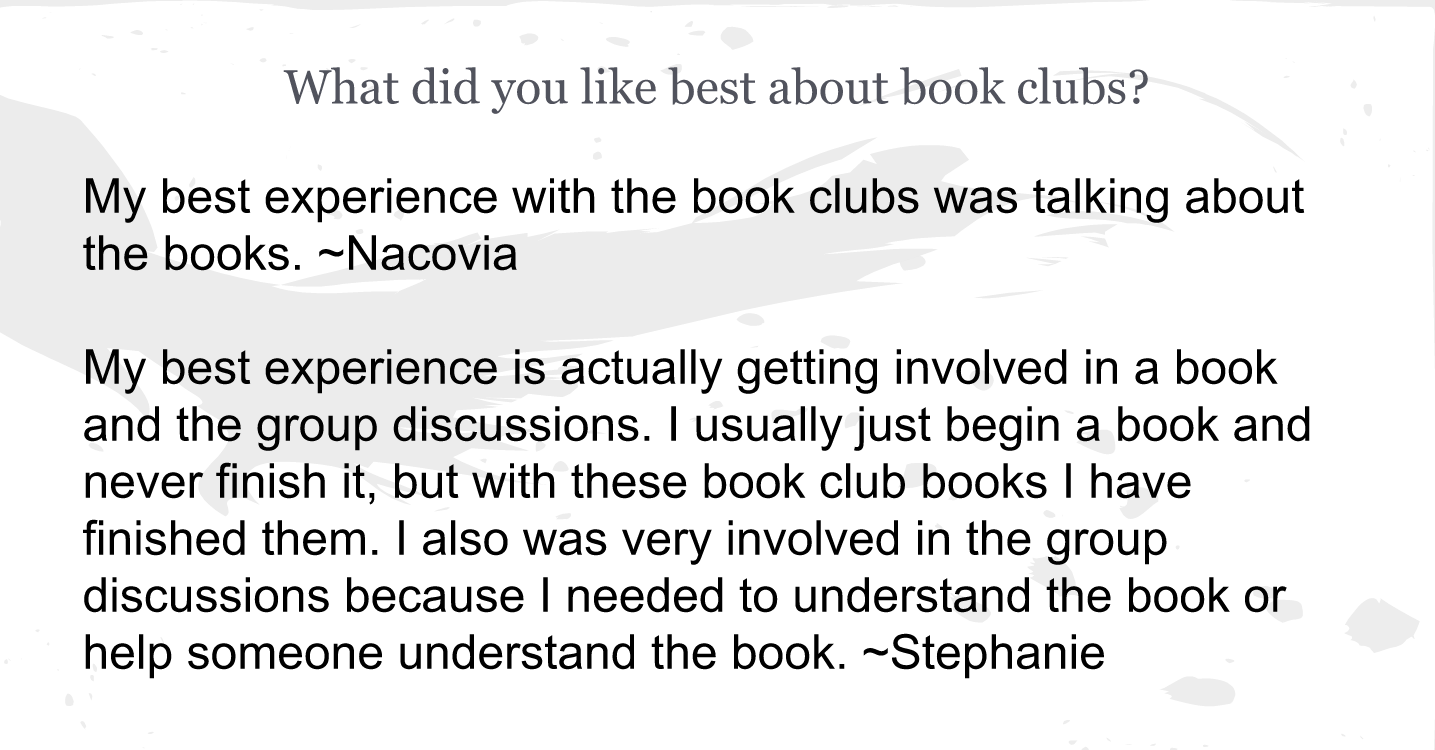 year. The great was actually my students reading and talking to one another about that reading. The not so much — the way I did assessment.
This is what I learned and what I will change for next year:
Book Clubs serve as a way to challenge my readers into the more complex books that many of my students would never choose for themselves. Book Clubs also allow my readers to talk about books in an authentic way without the strictures of guided reading questions or anything else that might lead to Readicide. (‘Read-i-cide: noun, the systematic killing of the love of reading, often exacerbated by the inane, mind-numbing practices found in schools” –Kelly Gallagher) I wrote about the importance of balance literacy and how book clubs fit into that in this post.
I provide a short list of titles that I know contain fantastic stories of resilience, survival, hope, courage, and any other trait that prods readers to relate to the human experience. I introduce the books, usually with book trailers or video interviews of the author’s, and I include either on paper or a projected slide the synopsis and ratings from Goodreads or Amazon.
Students select their books, often talking with one another and making selections together. I ask students to purchase their own books, so they can annotate anything “interesting, intriguing, puzzling, contradictory, or you just plain do not understand.” Since most of my students come from less affluent families, we talk about the importance of libraries and surrounding ourselves with texts that can inform and influence our thinking. Often, students will purchase more than one of the books I introduce for book clubs. I also have a few copies of the texts in my room that students may check out if they cannot purchase their own. I always think my copies will be used more than they are, but I’ve learned that my readers like to buy books. Most feel the sense of ownership that I want them to feel.
Our first book club this year, I gave students a choice of the following titles, all centered around themes of family and parents and how they influence our upbringing and our choices:
Extremely Loud and Incredibly Close by Jonathan Safron Foer
Swamplandia by Karen Russell
The Curious Incident of the Dog in the Night Time by Mark Haddon
Girlchild by Tupelo Hassman
The Glass Castle by Jeanette Walls (literary non-fiction)
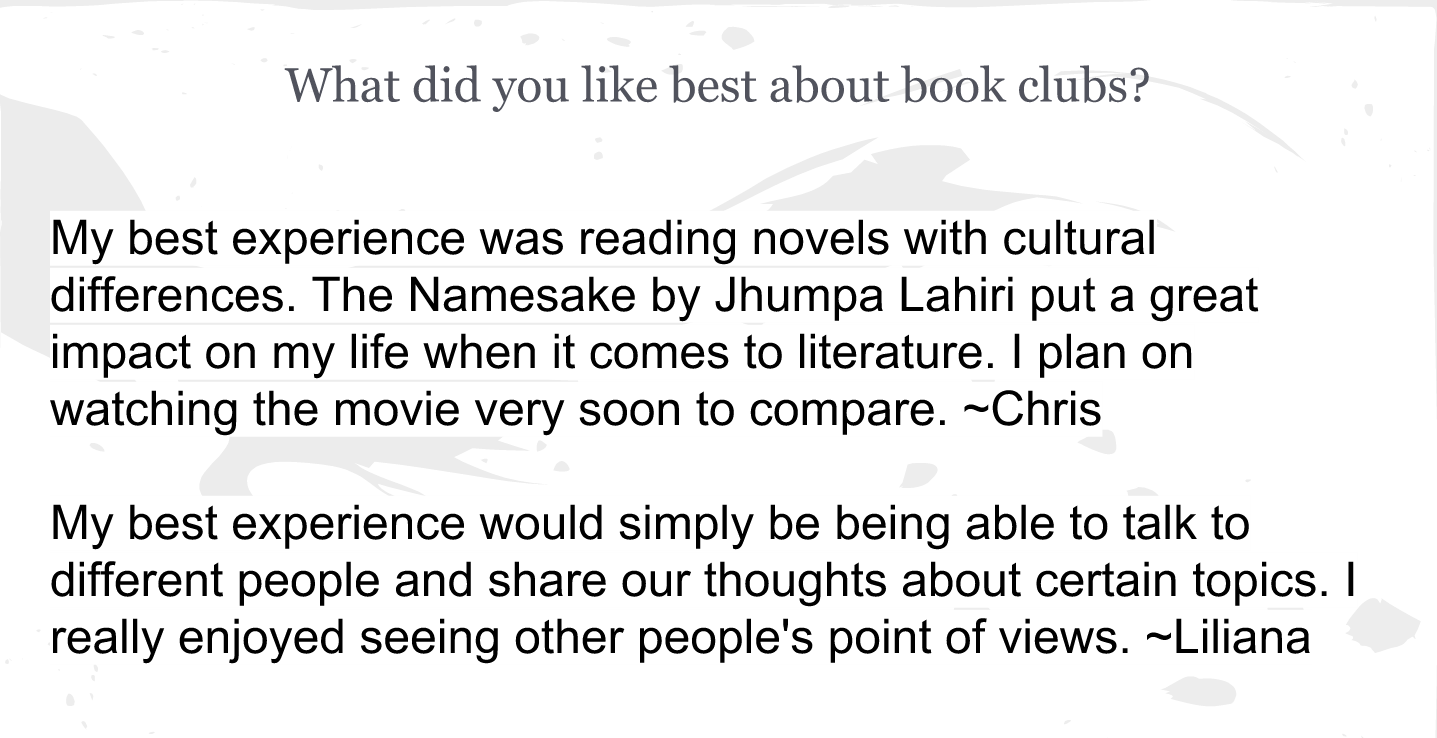
More students read The Glass Castle than any of the others, but every book was represented in at least one book club of three to six students. Students loved The Glass Castle, and they told me that they could relate to much of Walls’ upbringing.
 Assessment: For this first book club, I asked students to read with an eye looking for theme. They would work with their book clubs to craft a mind map that included numerous quotes from the book that contributed to the theme, and they would analyze these quotes as part of the mind map. They could create the mind map as a paper poster or online. As they read the book, they were to mark the text like I had taught with the short passages of text we’d read together in class, and they were to also look for sentences and phrases and passage that pointed to theme.
My students did not have a clue how to do that. Most did not mark their books, so when the project time rolled around, they ended up scouring through the book or searching for quotes on Goodreads or elsewhere to find enough quotes that they could plop into their mind maps. I needed to provide more guidance in annotating, and in reading for beautiful sentences, and in making thematic connections, and so much more.
Also, I allowed students to work in groups to create their mind maps. This did not work because no one in the group would rise up and be the leader. They were new in the class and new in their friendships with one another. Group work is a topic for another post, really. This time it failed, and I’ll need to do a lot more prep work before I spend as much class time on this kind of project ever again (if I ever do).
Our second book club, students choice a title from this short list, all centered around themes of culture and how these cultures influence us:
The Namesake by Jhumpa Lahiri
Little Bee by Chris Cleeve
Sarah’s Key by Tatiana de Rosnay
The Kite Runner by Khaled Hosseini
A Thousand Splendid Suns by Klaled Hosseini
More readers chose Sarah’s Key than any of the others. Students find stories of the Holocaust fascinating, and that shelf is a popular one in my classroom library. (Erika’s, too.) Many students read The Namesake, and at least one book club read each of the others.
Assessment: This one was even more lame than the first. Sometimes I feel the pull to get back to a 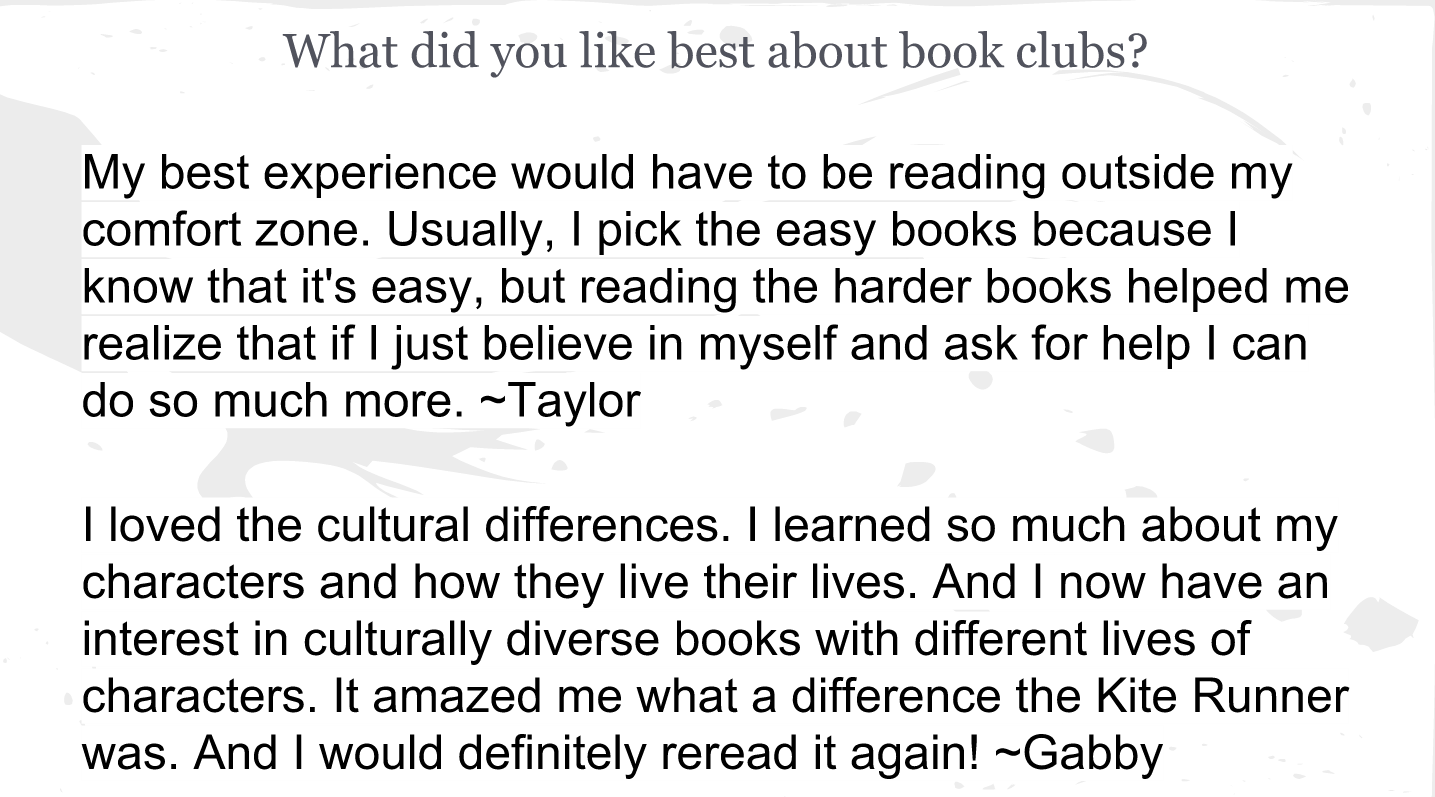 more traditional pedagogy. I am the only one on my campus who fully implements readers and writers workshop, so I listen in often to what other teachers have their students do. If you teach AP English, at some point, you have probably had students write a hexagonal writing over a piece of literature. (Hexagonal because student write thinking about their knowledge, comprehension, application, analysis, synthesis, and evaluation as it relates to the book. It sounds like a great assignment.)
It was the worst writing my students completed this year — if they completed it at all.
I know why. There was no authenticity in it. Follow the structure I gave you. Each paragraph should be about this… No wonder they didn’t care about writing well. I was their only audience, and I was making them write something worse than a book report.
We wasted a lot of time. (The grading policy in my district requires that I reassess major grades. Hey, let’s write this paper again since you cared so much about it the first time. Right.)
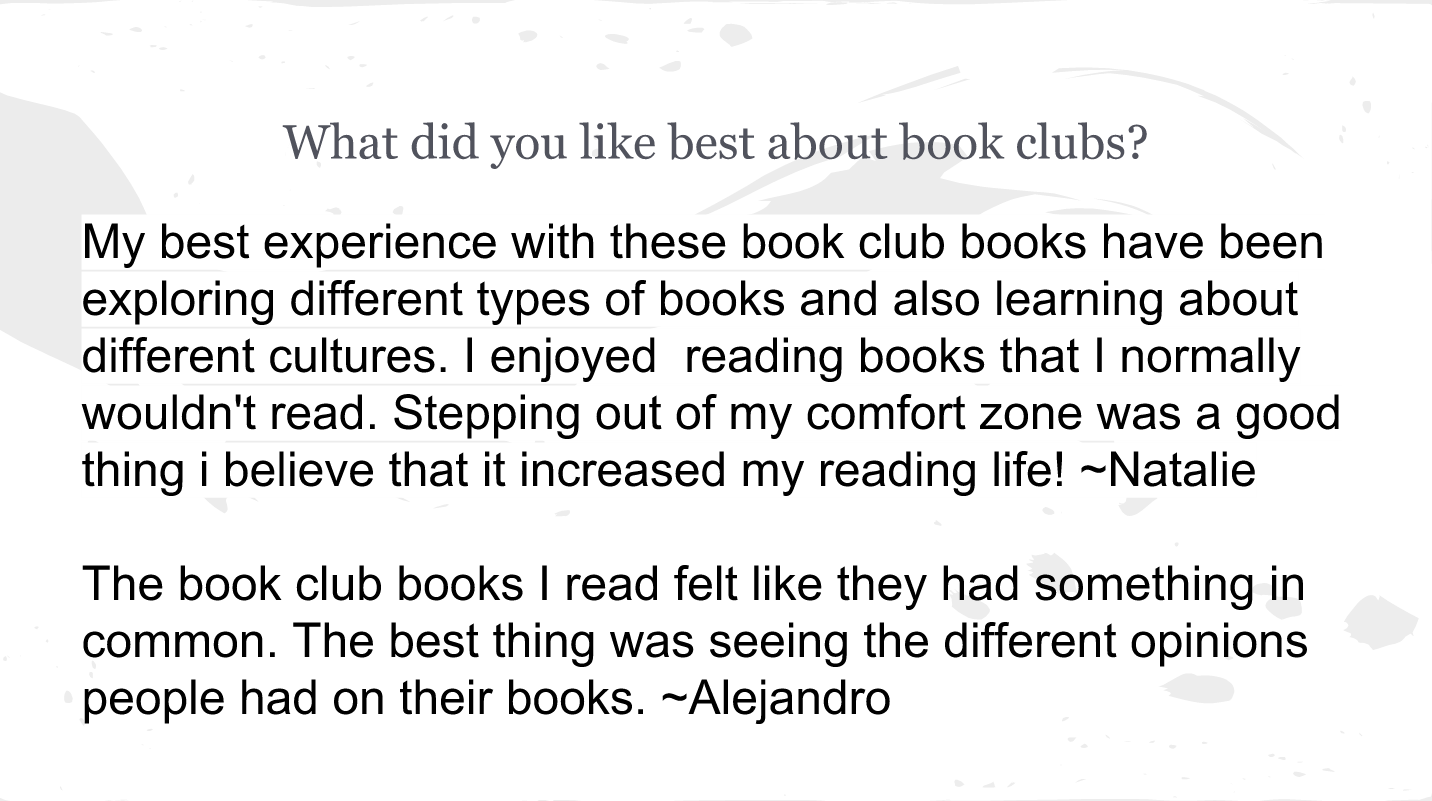 My readers would have benefitted more from a gift of time to talk about the books more. Shana posted about the value of book clubs for talk earlier this year, and after two subpar experiences I began to agree: “asking students to keep the conversation [about their books] going for 20 straight minutes provides valuable time for students to build relationships [around conversations about their reading.]”
I would just let them talk.
Our third book club students selected titles from this short list, all centered on war (or internal war) and its influences on individuals and humanity:
The Yellow Birds by Kevin Powers
Room by Emma Donoghue
Where Men Win Glory by Jon Krakauer (literary non-fiction)
The Bell Jar by Sylvia Plath
The Things They Carried by Tim O’Brien
The majority of my readers chose to read ROOM or The Bell Jar. They loved Room, and didn’t think The Bell Jar lived up to its hype.
I scheduled more opportunities for students to talk about their books. I wandered the room, sitting at  groups and listening in as conversations circled in and out and back again. Often, I placed a stack of TableTopic cards for book clubs in the center of their table, and students used these to guide their discussions. (Looks like the book clubs version of TableTopics is no longer available. Sad.)
Next year, I will do this again. I might ask students to look for significant passages so they can practice analysis on a page they select for themselves. Here’s a post that I’ll probably show them with a sample passage for craft study.
I might have them create a found poem or a black out poem.
Or I might just let them read and talk and read and talk some more.
That’s what I do in my own book club.
If you have your own suggestions for improvement, please share them in the comments.
©Amy Rasmussen, 2011 – 2015






 Three Teachers Talk