Tag Archives: Craft Study

#FridayReads — Oh, Mercy! Have I got a plan for this mentor text

Usually I read about four books at a time. This makes for a mess on the bedside table, the coffee table, the kitchen table. I rarely use bookmarks, which is a shame because I have quite a lovely collection.

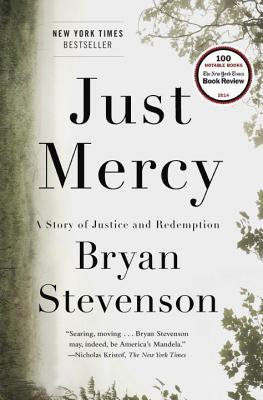
I end up leaving books split open and sound asleep right where I left them –sometimes just so I can remember the parts I know I want to use in class. I refuse to read on until I capture the sentence or passage that gives me pause. Such is the case with my new now bent-spine-copy of Just Mercy, a Story of Justice and Redemption by Bryan Stevenson. I’ve been stuck on page 18.

Here’s a portion of the passage I will use with my AP Lang students. You will, of course, find the rest of it when you buy the book, or here.

     When I first went to death row in December 1983, America was in the early stages of a radical transformation that would turn us into an unprecedentedly harsh and punitive nation and result in mass imprisonment that has no historical parallel. Today we have the highest rate of incarceration in the world. The prison population has increased from 300,000 people in the early 1970s to 2.3 million people today. There are nearly six million people on probation or on parole. One in every fifteen people born in the United States in 2001 is expected to go to jail or prison: one in every three black males babies born in this century is expected to be incarcerated.

     We have shot, hanged, gassed, electrocuted, and lethally injected hundreds of people to carry out legally sanctioned executions. Thousands more await their execution on death row. Some states have no minimum age for prosecuting children as adults; we’ve sent a quarter million kids to adult jails and prisons to serve long prison terms, some under the age of twelve. For years, we’ve been the only country in the world that condemns children to life imprisonment without parole; nearly three thousand juveniles have been sentenced to die in prison.

     We also make terrible mistakes. Scores of innocent people have been exonerated after being sentenced to death and nearly executed . Hundreds more have been released after being proved innocent of noncapital crimes through DNA testing. Presumptions of guild, poverty, racial bias, and a host of other social, structural, and political dynamics have created a system that is defined by error, a system in which thousands of innocent people now suffer in prison.

…..

     We are all implicated when we allow other people to be mistreated. An absence of compassion can corrupt the decency of a community, a state, a nation. Fear and anger can make us vindictive and abusive, unjust and unfair, until we all suffer from the absence of mercy and we condemn ourselves as much as we victimize others. The closer we get to mass incarceration and extreme levels of punishment, the more I believe it’s necessary to recognize that we all need mercy, we all need justice, and — perhaps — we all need some measure of unmerited grace. 


Before we ever read the text, and I did pull much more of it than I’ve posted here, we’ll spark our thinking with an image like this, posted at The Sentencing Project, and then write our initial responses in our writer’s notebooks:

Next, we will TALK. I know my students will want to share what they think about this graphic. Many will identify personally with it because they know a family member or a friend who’s served prison time.

When I introduce them to Stevenson’s text, I’ll give them a purpose for reading — besides just comprehending the message (identifying the purpose is a breeze since he tells us the reason he writes the book) — I want my students to notice the structure, the progression between ideas, the repetition and patterns they will see in the language. All the clues that build the tone.

I will ask them to mark the text, noting their thinking about these things. Without a purpose for reading, too many of my students struggle with the stamina they need to make it through even a page when I ask them to read critically.

Next, we will TALK. Talking will help some students understand what they read. It will help other students clarify their understanding. Some students will have noted what I asked them to notice as they read. I will rely on them to help the others — skill level is just one way my students are diverse.

I will also hand them a stack of questions that prepare them to write. They will read something like this:

What do you know about the writer based on what he writes?

What is the Stevenson’s purpose? Why does he come out and tell us so plainly?

What are the facts in this piece? What are opinions? How do you know?

What do you notice about the structure, any patterns, repetition? What do they do for the message?

How does Stevenson move between ideas?

And then we will write. Maybe I’ll give a prompt like this: Based on the text, and our discussion, is Stevenson’s opening argument effective, why or why not?  Maybe I’ll ask students to come up with their own analytical-style question to respond to. (I like this idea a lot.)  [see Talk Read Talk Write]

That’s probably enough for one class period, but my mind is still stirring:

  • What if I ask students to problematize the issue? Who are the stakeholders? Think all the way around the issue. Why do they care? Why do we care? What kinds of questions do we have about the claims Stevenson makes? What kinds of evidence do we need to convince us they are valid? How and when could anything regarding this issue change?
  • What if I ask students to identify just one of Stevenson’s claims and then research it? I assume the author provides support throughout the book. I’ll know when I keep reading. But what if students did a bit of research and then collaborated on substantiating Stevenson’s claims. Collaborative writing can be a powerful learning experience.
  • What if I ask students to brainstorm other issues Stevenson’s text suggests? We could probably create a pretty elaborate bubble map of ideas. These could lead to student choice in research topics.

What do you think? Any other ideas?

©Amy Rasmussen, 2011 – 2015

Book Clubs in AP English: Just let them talk

Some of it was great. Some of it not so much. I’m talking about the book clubs in my classroom this Screen Shot 2015-05-02 at 5.42.03 PMyear. The great was actually my students reading and talking to one another about that reading. The not so much — the way I did assessment.

This is what I learned and what I will change for next year:

Book Clubs serve as a way to challenge my readers into the more complex books that many of my students would never choose for themselves. Book Clubs also allow my readers to talk about books in an authentic way without the strictures of guided reading questions or anything else that might lead to Readicide. (‘Read-i-cide: noun, the systematic killing of the love of reading, often exacerbated by the inane, mind-numbing practices found in schools” –Kelly Gallagher) I wrote about the importance of balance literacy and how book clubs fit into that in this post.

I provide a short list of titles that I know contain fantastic stories of resilience, survival, hope, courage, and any other trait that prods readers to relate to the human experience. I introduce the books, usually with book trailers or video interviews of the author’s, and I include either on paper or a projected slide the synopsis and ratings from Goodreads or Amazon.

Students select their books, often talking with one another and making selections together. I ask students to purchase their own books, so they can annotate anything “interesting, intriguing, puzzling, contradictory, or you just plain do not understand.” Since most of my students come from less affluent families, we talk about the importance of libraries and surrounding ourselves with texts that can inform and influence our thinking. Often, students will purchase more than one of the books I introduce for book clubs. I also have a few copies of the texts in my room that students may check out if they cannot purchase their own. I always think my copies will be used more than they are, but I’ve learned that my readers like to buy books. Most feel the sense of ownership that I want them to feel.

Our first book club this year, I gave students a choice of the following titles, all centered around themes of family and parents and how they influence our upbringing and our choices:

Extremely Loud and Incredibly Close by Jonathan Safron Foer

Swamplandia by Karen Russell

The Curious Incident of the Dog in the Night Time by Mark Haddon

Girlchild by Tupelo Hassman

The Glass Castle by Jeanette Walls (literary non-fiction)

More students read The Glass Castle than any of the others, but every book was represented in at least one book club of three to six students. Students loved The Glass Castle, and they told me that they could relate to much of Walls’ upbringing.

Screen Shot 2015-05-02 at 5.42.19 PMAssessment:  For this first book club, I asked students to read with an eye looking for theme. They would work with their book clubs to craft a mind map that included numerous quotes from the book that contributed to the theme, and they would analyze these quotes as part of the mind map. They could create the mind map as a paper poster or online. As they read the book, they were to mark the text like I had taught with the short passages of text we’d read together in class, and they were to also look for sentences and phrases and passage that pointed to theme.

My students did not have a clue how to do that. Most did not mark their books, so when the project time rolled around, they ended up scouring through the book or searching for quotes on Goodreads or elsewhere to find enough quotes that they could plop into their mind maps. I needed to provide more guidance in annotating, and in reading for beautiful sentences, and in making thematic connections, and so much more.

Also, I allowed students to work in groups to create their mind maps. This did not work because no one in the group would rise up and be the leader. They were new in the class and new in their friendships with one another. Group work is a topic for another post, really. This time it failed, and I’ll need to do a lot more prep work before I spend as much class time on this kind of project ever again (if I ever do).

Our second book club, students choice a title from this short list, all centered around themes of culture and how these cultures influence us:

The Namesake by Jhumpa Lahiri

Little Bee by Chris Cleeve

Sarah’s Key by Tatiana de Rosnay

The Kite Runner by Khaled Hosseini

A Thousand Splendid Suns by Klaled Hosseini

More readers chose Sarah’s Key than any of the others. Students find stories of the Holocaust fascinating, and that shelf is a popular one in my classroom library. (Erika’s, too.)  Many students read The Namesake, and at least one book club read each of the others.

Assessment:  This one was even more lame than the first. Sometimes I feel the pull to get back to a Screen Shot 2015-05-02 at 5.42.33 PMmore traditional pedagogy. I am the only one on my campus who fully implements readers and writers workshop, so I listen in often to what other teachers have their students do. If you teach AP English, at some point, you have probably had students write a hexagonal writing over a piece of literature. (Hexagonal because student write thinking about their knowledge, comprehension, application, analysis, synthesis, and evaluation as it relates to the book. It sounds like a great assignment.)

It was the worst writing my students completed this year — if they completed it at all.

I know why. There was no authenticity in it. Follow the structure I gave you. Each paragraph should be about this… No wonder they didn’t care about writing well. I was their only audience, and I was making them write something worse than a book report.

We wasted a lot of time. (The grading policy in my district requires that I reassess major grades. Hey, let’s write this paper again since you cared so much about it the first time. Right.)

Screen Shot 2015-05-02 at 5.42.45 PMMy readers would have benefitted more from a gift of time to talk about the books more. Shana posted about the value of book clubs for talk earlier this year, and after two subpar experiences I began to agree:  “asking students to keep the conversation [about their books] going for 20 straight minutes provides valuable time for students to build relationships [around conversations about their reading.]”

I would just let them talk.

Our third book club students selected titles from this short list, all centered on war (or internal war) and its influences on individuals and humanity:

The Yellow Birds by Kevin Powers

Room by Emma Donoghue

Where Men Win Glory by Jon Krakauer (literary non-fiction)

The Bell Jar by Sylvia Plath

The Things They Carried by Tim O’Brien

The majority of my readers chose to read ROOM or The Bell Jar. They loved Room, and didn’t think The Bell Jar lived up to its hype.

I scheduled more opportunities for students to talk about their books. I wandered the room, sitting at Screen Shot 2015-05-02 at 5.42.57 PMgroups and listening in as conversations circled in and out and back again. Often, I placed a stack of TableTopic cards for book clubs in the center of their table, and students used these to guide their discussions. (Looks like the book clubs version of TableTopics is no longer available. Sad.)

Next year, I will do this again. I might ask students to look for significant passages so they can practice analysis on a page they select for themselves. Here’s a post that I’ll probably show them with a sample passage for craft study.

I might have them create a found poem or a black out poem.

Or I might just let them read and talk and read and talk some more.

That’s what I do in my own book club.


If you have your own suggestions for improvement, please share them in the comments.


©Amy Rasmussen, 2011 – 2015

Why Assignment Sheets Might Be Killing Your Students’ Writing

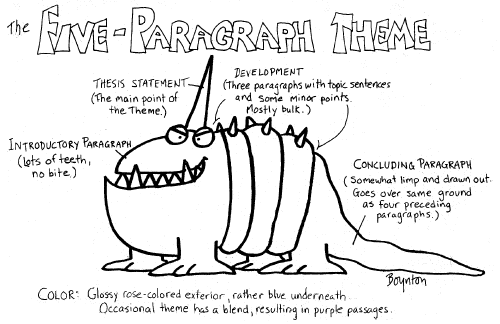
58090ec056811830ee936030edb1c9dbMy first year of teaching, I didn’t realize that the “five-paragraph essay” was a dirty phrase. My  internship year I painstakingly dragged my freshmen through the essay outlining process, watching them regurgitate homogeneous essays about symbolism in Lord of the Flies. At the end of our six-week study of the book, I slogged through 25 nearly identical essays, all of which had eloquent yet oddly familiar intro, body, and conclusion paragraphs. I’ll readily admit that despite the dull content, I felt victorious. My students had completed literary analysis essays and I had taught the foundation of essay structures.

It was that summer that my perception on structured essays changed. Two days into taking Penny Kittle’s writing course at the University of New Hampshire’s Literacy Institute, I realized that I had committed a cardinal sin of workshop teachers. Admitting to teaching the five-paragraph essay (let alone the sandwich method of paragraph-writing) was like confessing to enjoying McDonald’s burgers at an elegant chophouse: the cut (or concoction) of meat might serve the same purpose, to fill me up, but the quality was quite different. In turn, I was feeding my students homogeneous writing, a detailed equation to a subject that couldn’t be distilled down to simple mathematics. If I expected greatness, I needed to break beyond the boundaries of such a restrictive form of writing. After all, an introduction + body paragraphs + conclusion didn’t guarantee a solid essay; if anything, it guaranteed an entirely unspectacular essay.

This process of digesting the material and then providing a summary of the structure was far too easy for students. Not only did it place the onus on me to provide a set guide of instructions, but it also required me to complete the majority of analysis. Instead of my students engaging with the text and delving into the intricacies of structure and craft through individual exploration and group discussions, I was basically pre-digesting the material before offering it to them.

IMG_1845

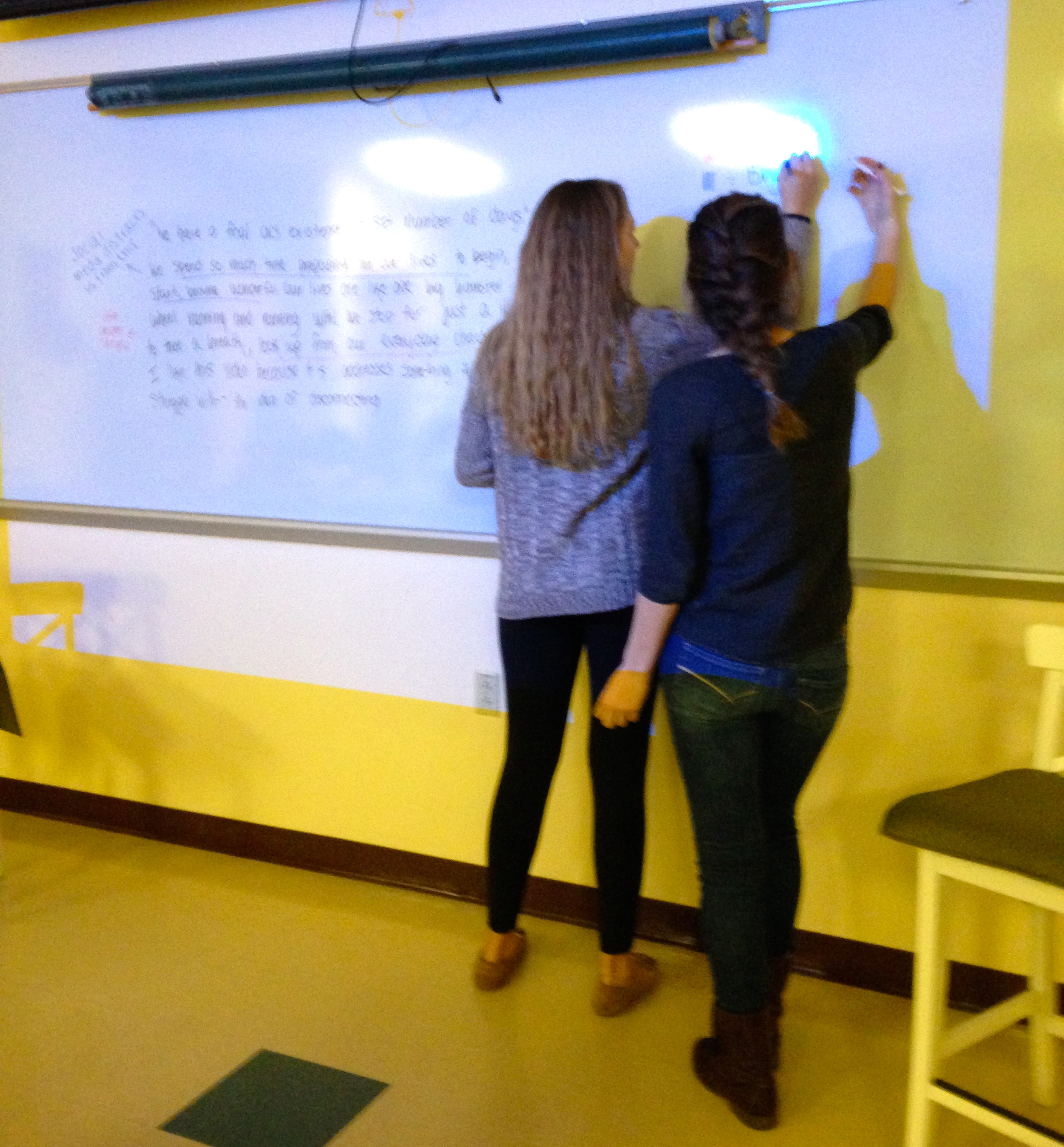
Students analyzing an author’s craft in front of the class.

This year I have made a point to wean my students, particularly my juniors and seniors, off the assignment outlines they so desperately desire. Instead, my students now receive a half-page sheet simply telling them the type of essay they are writing (cause and effect, definition, personal narrative, etc.), the mentor texts they may refer back to, the page length requirement, and the due date.

Initially, they were frustrated with this format. As one student said during our career building unit in which we practiced writing cover letters and resumes for celebrities, “Ms. Catcher, do you have an assignment sheet for this or something?” When I pointed out the paper I had given to him previously, he replied, “No, I mean something that tells me how to write this paper.” We discussed the numerous mentor texts we had read and dissected and how these as well as our class discussions ultimately provided the basis we to develop our pieces. As a class, we asked questions of the text and author, starting broad by looking at the overall tone, voice, structure, intended audience, and progression of the piece. Then, independently or within small groups, we delved into more of the intricacies—what examples were provided, word choice, sentence structure, punctuation, and transitions. Students have gradually learned that there is no set solution for getting an A, which also means that they are forced to read and reread mentor texts to gain a firm understanding of a piece’s intricacies.

My problem from the beginning was that I was too busy telling my students how to write an essay to allow them to discover the messy albeit enlightening connection between reading, writing, and modeling. As we complete the last six weeks of school, I have noticed a significant difference in the structure and craft of my students’ work. They are relying more readily on mentors to help guide them in their process, and I can see both their group and independent analysis directly translate into their writing. For the past three years, I have harped on my students about showing rather than telling, but as the year comes to a close, I can finally say that I have internalized my own advice when it comes to my teaching.

How do you inspire students to rely on mentor texts instead of assignment sheets?  What steps have you taken throughout the year to make them more independent and confident writers?

Craft Study for a Monday: Billy Lynn’s Long Halftime Walk, again

For now, my new favorite book is Billy Lynn’s Long Halftime Walk by Ben Fountain. 

This surprises me. Maybe it’s the setting — Dallas Cowboys’ Stadium. Maybe it’s the protagonist — Billy, a 19 year-old-soldier. (I have twenty-year-old twin sons who want to join the military in a few years.)

Maybe it’s Fountain’s poetic language. It startles and soothes. It makes my mother’s heart shake.

I’ve dog-eared pages and underlined lines. I’ve even posted about this book in February.

Here’s the part I will share in class this week. My students are working on a major writing project. They chose their own topics. They’ll write in a variety of forms. But, even with only a few weeks left in the school year, I still need to show them beautiful language. I still want them to work on their craft.

“Look at Fountain’s style,” I’ll say. “What do you notice just on this one page?”

And we’ll talk about word choice and repetition. We’ll talk about lists and mood. We’ll talk about intentional fragments and why an author might make that kind of choice when writing a sentence.

My students will notice many things in this short passage. There are so many things to notice.

That’s probably why I am in love with this book. Thank you, Mr. Fountain.

excerpt from Billy Lynn’s Long Halftime Walk 

Don’t be scared, Shroom said. Because you’re going to be scared. So when you start to get scared, don’t be scared. Billy has thought about this a lot, not just the Zen teaser of it but what exactly does it mean to be scared out of your mind. Shroom, again. Fear is the mother of all emotion. Before love, hate, spite, grief, rage, and all the rest, there was fear, and fear gave birth to them all, and as every combat soldier knows there are as many incarnations and species of fear as the Eskimo language has words for snow. Spend any amount of time in the realms of deadly force and you will witness certain of its fraught and terrible forms. Billy has seen men shrieking with the burden of it, others can’t stop cursing, still others lose their powers of speech altogether. Lots of sphincter or bladder control, classic. Giggling, weeping, trembling, numbing out, classic. One day he saw an officer roll under his Humvee during a rocket attack, then flatly refuse to come out when it was over. Or Captain Tripp, a pretty good man in the clutch, but when they’re really getting whacked his brow flaps up and down like a loose tarp in a high wind. His soldiers might feel embarrassed for him, but no one actually thinks the worse of him for it, for this is pure motor reflex, the body rebels. Certain combat stress reactions are coded in the genes just as surely as cowlicks or flat feet, while for a golden few fear seems not to register at all. Sergeant Dim, for example, an awesome soldier who Billy has seen walking around calmly eating Skittles while mortars rained down mere meters away. Or a man will be fearless one day and freak the next, as fickle and spooky as that, as pointless, as dumb. Works on your mind, all that. The randomness. He gets so tired of living with the daily beat down of it, not just the normal animal fear of pain and death but the uniquely human fear of fear itself like a CD stuck on skip-repeat, an ever-narrowing self-referential loop that may well be a form of madness. Thus all our other emotions evolved as coping mechanisms for the purpose of possibly keeping us sane? And so you start to sense the humanity even in feelings of hate. Sometimes your body feels dead with weariness of it, other times it’s like a migraine you think you can reason with, you bend your mind to the pain, analyze it, break it down into ions and atoms, go deeper and deeper into the theory of it until the pain dissolves in a flatus of logic, and yet after all that your head still hurts (114-115).

Note: The book is being made into a movie with a Veteran’s Day 2016 release date. Rarely, do I like the movie as well as the book, but I still go see them.

©Amy Rasmussen, 2011 – 2015

Persepolis by Marjane Satrapi

persepolisIn honor of ALA’s recently released 2014 Banned Books List, I can’t help but recommend the second most banned book Persepolis by Marjane Satrapi.   Persepolis was one of the three graphic novels that made the top ten list this year. The book is criticized for its use of gambling, offensive language, and political viewpoints as well as for being “politically, racially, and socially offensive” and for having “graphic depictions.” In reality, this graphic memoir isn’t afraid to tackle the horrifying and at times comedic realities of growing up in a community faced with political turmoil. After all, Satrapi wanted readers to recognize that Iranians are normal people, just like everyone else. They enjoy music and parties and clothes; the difference is that the characters in Persepolis are living during the Iranian Revolution. Satrapi begins her narrative at six years old, relaying the stories of every day life as the Shah’s regime is overthrown, the Islamic Revolution takes hold, and the war with Iraq destroys her community.

What I love most about Persepolis is its ability to attract my reluctant readers, particularly my students who would otherwise steer clear of the international shelf in my classroom library. These students are drawn to the simple black-and-white cartoons and the rebellious teen protagonist. They love her quirky sense of humor and her obsession with American music icons like Michael Jackson. Like many of our students, she is an angsty teen coming of age. The difference is that she grows up during political conflict and war. Her world is changing around her, war has becomes standard, and she, as a teenager, is attempting to find normality in completely abnormal circumstances. But it’s Marji’s ability to navigate this morbid world and go through complex transformations that make her come alive on the page.

I tend to use graphic novels towards the beginning of the year when my students are becoming acclimated to analyzing writer’s craft (or even when they need a refresher on it). Oftentimes students are more in tune to looking at the details of drawings than of writing; they find it easier to pick out the eccentricities of images yet rarely do they question why the artist made the choices they did. Graphic novels give them the opportunity to do just this.

I have students work in small groups to analyze the artistic decisions of the illustrator. For example, in Persepolisthe scene to the right, Marji has been taken into custody by the Women’s Branch of the Guardians of the Revolution, a group in charge of monitoring women’s wearing of the veil. When they stop to study the images, students notice the repetitive stern expression of the guardian and the way Marji’s face appears to melt into squiggly lines as the frames progress. They notice the transition of the lines surrounding the word bubbles from smooth curved lines to sharp zig-zags. They recognize changes in font size and effects as well as the underlying narrative strand at the bottom of the frame that shows internal dialogue. As they analyze these details, they also begin questioning the choices that lead to the depictions of these conversations and emotions and what they ultimately mean in the context of the story. By the end, the graphics take on a more complex tone. The images come alive, the artist’s intentions become clearer, and they have immersed themselves in a new lens that allows them to take a second look at literature.

Anatomy of a Misfit by Andrea Portes

18340210This young adult novel was recommended to me by a fellow teacher of reading workshop who said it was immensely popular in her room. I downloaded it on my Nook and began to read it late one night before bed, and stayed up all night to finish.  I laughed on one page, clenched the covers in tension on the next, then cried, then laughed again, thanks to Portes’ masterful narrative skill.

The narrator, Annika, was a unique take on the typical YA protagonist, describing herself as the “third most popular girl in school,” whose Romanian father she calls “Count Chocula.”  Still, Annika finds herself in a number of classic YA conflicts–torn between two boys (Logan, who is unique and thoughtful, but social suicide, and Jared, who is magnetically attractive and popular) and torn between two friend groups (Becky Vilhauer and her evil “mean girls”-esque clique and the victims of that clique’s hurtful gossip).  Annika authentically struggles with these choices in a way I think most teenagers would, so this felt much more real than a John Green book, for example, to me.

As Annika’s unique voice kept me laughing and intrigued, the story grew darker, spiraling into a series of painful climaxes, as the book progressed.  While reflecting on one of these situations, Annika writes:

We tried to be less self-involved.  We tried to look up from our dumb obsessions and notice other people.  We tried to be open, for once.  We tried not to be just another vaguely racist family.  We tried to be enlightened.  We tried to be good.  We tried to be all of the things…we are not.

This beautiful excerpt reflects not just on Portes’ cut-to-the-quick analyses of common situations, but also her writing skill.  My students and I looked at that passage for craft and they created beautiful imitations filled with similar repetitive phrasings.

Portes’ beautiful language made me love this book, but I loved it even more when I read the afterword, which explained the inspiration for the book–Portes’ own high school experience.  Once you read the heart-wrenching conclusion, you’ll understand why I so vastly admire Portes’ blend of autobiography and gorgeous writing skill.


On Annotations and Assessment in Readers Workshop

If you’ve read this blog for a while, you know that I advocate for self-selected reading in all English classes. My students read stacks of books each year that they choose for themselves, and they read four titles for in-class book clubs that they select from my short stack of complex (mostly) contemporary titles.

The question I get the most from teachers who do not practice this choice pedagogy is “How do you know your students are reading?”

My initial response is usually:  “I ask them.”

But if you practice readers and writers workshop in your classroom, you know that it takes a bit more than that to know that students are developing as critical readers.

We do still have to teach.

Shana wrote a post recently about the value of talk in her workshop classroom, and I was intrigued by one of the comments:

I think we should consider what would be the best balance between between teacher and student talk. As the literacy expert in the classroom, I think the reading/language arts teacher’s voice needs to be heard often. While we all can be our own teachers, we will probably learn more with the wise guidance of a teacher.” 

But, of course.

Balance is key. So is authenticity.

These two ideals drive the choices I make in my workshop classroom.

My new friend, Lisa, sent me a question that got me thinking about both as I composed a response. I share her question here and how I replied to this dedicated teacher who is moving herself as she moves her readers.

Question:  Do you assess any annotations the students do with their reading? I’ve included a rubric we have been using to give students some feedback on their annotation of fiction. Their annotations in the text, and thereby their discussions about the texts, has greatly improved!! However, providing feedback on their annotations takes FOREVER. Just curious how you handle any sort of assessment related to students reading their chosen texts.” 

Response: Initially, when I read your question about annotations, I thought of these two questions:

1) Why do you need to leave feedback on the annotations in their books?

2) You said your discussions on the texts have improved. Are those discussions not enough of an assessment on their annotations?

Then I read your rubric, and it got me thinking.

I love the simplicity of the rubric, and I can see how students would notice more and be able to contribute to discussions more thoroughly and completely if they mark their books accordingly; however, I always use caution when it comes to interrupting a student’s reading flow — you know, reading for the sake of enjoyment.

In my own reading life, I rarely mark up a piece of fiction, unless it is for my own book club and I want to remember a significant passage that I loved, or didn’t understand, or a moment in the text that shocked or saddened me so much that I want to bring up in the discussion.

When I have my students engage in book clubs or self-selected reading, I want them to have authentic experiences and discussions about their books. (I quote Louise Rosenblatt on experiential reading at the end of this post.) That hope for authenticity is what drives what I have students do while they read.

And it is hard, and I have to trust that students notice the nuances and the complexities in the language and all the important literary aspects of their books. Sometimes they just don’t.  Sometimes they need to focus just on comprehension. I have to be okay with that.

Here’s how I try to facilitate learning:

1. Model my reading. I show students the books I’ve read for my book clubs and the kinds of passages I’ve marked so I can remember them for discussion. I encourage my students to mark their books in similar ways. Some will, and others never will. Some show me that they can think about their books without ever marking them. I have to let them learn the habits of readers that work for each of them individually, and I have to trust that they will.

This goes for writing, too. Every major writing task I ask my students to do, I do it first. I show them my process and later my product. For my ESL students, this is the single most effective strategy I do. I’ve asked them, and they’ve told me. I know that if this modeling helps my students who struggle with language, I know it helps all of my students.

2. Teach mini-lessons. Say I want students to focus on literary devices. I show them a variety of “beautiful sentences” from various texts; 51 Of The Most Beautiful Sentences In Literature was a perfect resource for this. I pulled several of these pretty slides and put them on a presentation in Drive. I projected them in the front of the room, and students and I talked through what we noticed in these sentences.

We discussed the craft in the sentence and why the author might have made the moves he or she did. This focus on the writing in a text often leads to greater critical reading of a text just as critical reading should lead to better writing.

Next, I asked students to go into their books and look for beautiful sentences. I gave them each a note card, and they had to find two sentences — one for each side of the card — where they could tell where the author did something interesting with language. I instructed them to write the sentence and the page number at the top, and then they were to identify the device/s, interpret the meaning of the sentence, and analyze the meaning, based on what they’d read in the book and what they believed the author was doing there as it related to the meaning as a whole.

What does this assess? A lot.

  • I know immediately if students know how to identify literary and rhetorical devices.
  • I know if students understand what they are reading, especially if the activity is during book clubs, and I’ve read all the titles in which students choose.
  • I know if students can analyze the author’s use of the device versus just summarizing the meaning of the sentence.
  • I know if students are reading their books. They are not going to choose a sentence on page 195, if they haven not read that far. They will not know how to tie their analysis into overall meaning

(The sentences I used for this mini-lesson lead to book talks, too, and I had one girl come in the next day with a copy of Anna Karenina that she’d bought for herself. Hooyah!)

Mini-lessons like this can be done over and over again — perhaps with a different skills focus each time, and the more students see that we are going to ask them to go into their books to focus on a skills, the more likely they are to start marking significant sentences and passages as they read. It becomes a natural move on the reader’s part instead of a mandate by the teacher.

3. Teach Notice & Note signposts. If you are not familiar with Notice & Note, Kyleen Beers and Bob Probst researched the patterns in story arcs and crafted six signposts around the moments in the text that appear the most often in a vast number of fictional pieces — short stories and novels. Students at all levels can apply the signposts as they learn to ask themselves questions as they read. In my experience, their understanding of theme improves dramatically.  If you Google Notice & Note signposts, or join the Facebook group, you’ll find many teachers who share their resources.

My students and I learn the signposts with short stories, and then throughout the year, we practice applying them to our full-length novels. Best thing I’ve done to help students analyze theme, which is SO HARD for some of them. I don’t quite understand why, but it is singularly the thing my students year after year struggle with the most.

For assessment, again, I do a lot with note cards. Quick, short writing snapshots where students can talk to me about what they know. I can grade these easily and leave feedback in the form of questions to direct students to look deeper, or closer, or whatever. I usually score these with check plus, check, or check minus and leave feedback in the form of one thing the student did well and one thing that might need improvement.

4. Write reader’s response. I have 35 composition notebooks that I labeled with thematic topics. I learned this strategy from Penny Kittle (Here’s a handout from 2013 that has a list of topics for notebooks in it.) I morphed her idea with Notice & Note, and it works well for reader’s response, another piece in holding students accountable for their reading and assessing their acquisition of skills.

At the beginning of the year, when composition notebooks are .50, I buy 35, and I label them with a variety of topics like Penny has on her list, plus some. I glue a handout of the signposts inside each one. Then, every once in a while, I’ll pull the notebooks out and set a handful on each table.

Students know to find a notebook that they can tie the thematic elements of their independent reading book to. We write for about 10- 20 minutes, depending on how in-depth I want students to go with their thinking, and then they share out what they wrote with their table mates. (This works as book talks, too, because students hear about what their friends are reading.) I wander the room and listen in. This is formative assessment. If a student has written about theme, shown that he is reading and understands how the book relates to that thematic topic, I know he is learning. Of course, the reverse is also true. I use check marks for grades of this kind of assessment, too.

Now, having told you all of this, I am not saying to ditch your rubric. I am just always trying to figure out how to put more of the responsibly for the learning (and the work) on the students, and probably most important to my sanity — the need to cut my grading time.

Regarding your rubric, I wonder:

A. How can you ask students to practice annotations with short stories?Then when you go to leave feedback on what they have marked, zero in on one or two slices of the rubric — never the whole thing. And be sure your feedback is something that will resonate. All too often students do not care about what we write, they only want to see their grade. I saw this great reminder in a tweet today:  “Put comments on my paper that begin conversations, not end them.”

B. Instead of trying to leave feedback on every students’ annotations for their whole books, how can you ask students to apply what they have learned from annotating?

For example, choose a slice of the rubric. Give students a half sheet of paper (or a notecard) and have them synthesize their annotations into a paragraph or two that answers a question. Something like :  Think about the things you’ve annotated about the characters in your book, how have the behaviors of the protagonist advanced the plot in the story?  Explain how any single or series of choices by the protagonist has surprised, unsettled, or shocked you.

C. How can you use the rubric to guide your conferences?Instead of checking their annotations, ask students to use their annotations as they talk with you about their books.

For example, choose a slice of the rubric. In a one-on-one conference, or in a small group conference if students are reading the same book, ask:  In regard to your annotations about literary elements, what have you noticed about how the author uses them? How do these elements help the author craft the story? Talk to me about some passages or sentences in the book that you’ve been particularly moved by.

You will know if students are paying attention as they read., and you’ll know so much more because your assessment shoots over the annotation itself and gets to the thinking behind why we want students to annotate in the first place.

Lisa and I would love to know your thoughts on annotations and assessment? Please leave a comment


©Amy Rasmussen, 2011 – 2015

Oh, the Learning in One Well-Chosen Sentence

51 Most Beautiful Sentences -- Buzzfeed

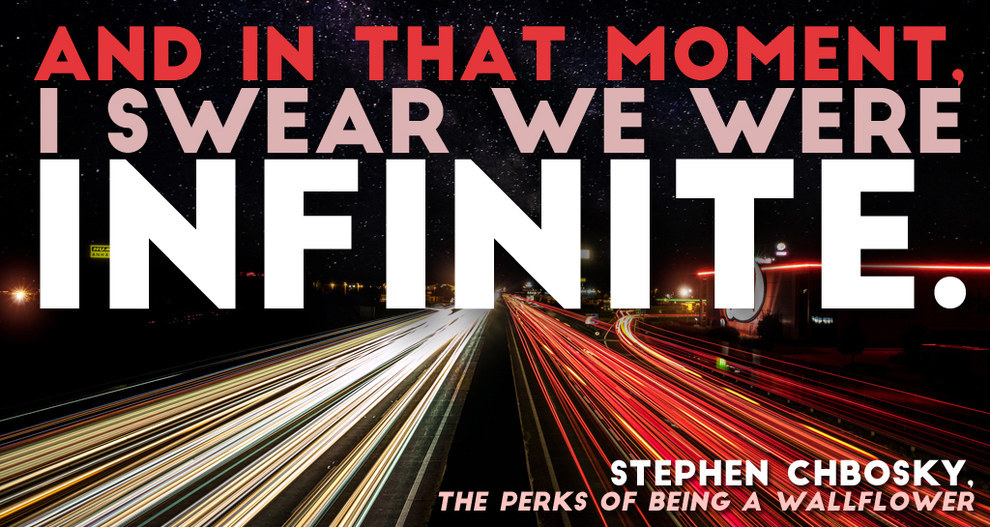
First, we read like readers. We talk about meaning. We talk about the story if any students have read the book. Many have. The Perks of Being a Wallflower never stays on the shelf for long.

I see several students flip to the back of their writer’s notebooks and write the title on their To Read Next lists.

Next, we read like writers. “The writer does a few things interesting in this sentence. What do you notice?” I ask.

We talk about starting a sentence with and, which leads to a discussion about sentence structure. We talk about the word infinite, which leads to a discussion about the word moment.

“What? That’s a contradiction,” someone says.

“Uh huh,” I nod and listen as little conversations bubble up around the room.

Then, from the back, a student says, “Do you see the three we’s in that sentence? Do you?”

I cannot help but grin.

You see it, don’t you?

Oh, sentences. Lovely sentences. Oh, the learning in one well-chosen sentence.

I cannot even imagine how much I would have learned TALKING about sentences all those years ago instead of diagramming them.

Do you have a favorite sentence you like to talk about with your students?

This Buzzfeed article has 51 Beautiful Sentences. I mention this piece in my post tomorrow, too. And if you haven’t visited Notable Sentences for Imitation and Creation, you’ll want to find some time to read it.


©Amy Rasmussen, 2011 – 2015

The Talk-Funny Girl by Roland Merullo

10460266Marjorie Richards could be my student. In fact, she could be anyone’s student. The seventeen-year-old main character of The Talk-Funny Girl by Roland Merullo haunted me for weeks after I finished the book. I had seen her before, lingering in the eyes and mannerisms of some of my teens. The fact that she was so relatable yet so distant was disturbing.

Marjorie’s story is complex and multilayered. She lives in rural New Hampshire where teen girls are being abducted. Her abusive parents are so isolated from society that they have developed their own obscure dialect of language, a language that earns Marjorie the name “the talk funny girl” amongst her classmates. And her town has fallen under economic hardship with the closing of the local mill; in turn, she is forced to take on a job with a stonemason building “a cathedral” to support her unemployed parents.

Marjorie’s transformation is raw, inspiring, and cathartic. Her story is riddled with poetic lines that provide this quiet character with a strong internal voice. In one passage she says, “I had my protective shell of funny talk and shyness, but underneath that lived a wilder me, a girl who would take punishment, and take it, and take it, but who would never let go of herself all the way, never completely surrender” (Merullo 87). As a reader, I both relished and resented her authentic responses to her surroundings. At times she was open with her emotions, clear and contemplative. Other times I struggled yet understood her willingness to stand silent. This ebb and flow made her even more real.

Merullo found balance between maintaining a plot that lasts over years while also intertwining a thread of suspense. I began the book expecting one storyline and was forced to revise my predictions with the turn of every page. In the end, Merullo’s vivid writing, unique dialogue, and brilliant character development left an indelible mark.

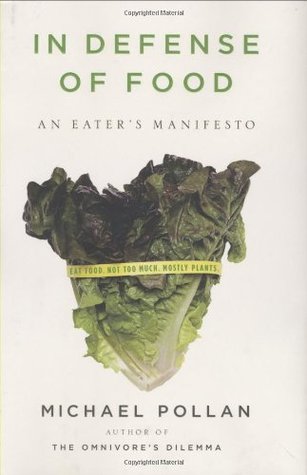
In Defense of Food: An Eater’s Manifesto

315425I grew up as a reader, but I was a steadfast reader of fiction only–especially series.  I remember receiving my PSAT score report in high school, which strongly suggested that I begin reading more nonfiction in order to improve my vocabulary and reading comprehension.

So, not being informed about the wonderful nonfiction tomes I now know about, I began to read the newspaper.  That probably contributed to my majoring in journalism, and now teaching that subject in addition to English.

But it wasn’t until I took Penny Kittle’s class at the UNH Literacy Institute in 2013 that I fell in love with nonfiction (pardon me, Mr. Lehman and Ms. Roberts!).  I read Malcolm Gladwell’s Outliers and was enamored of his use of narrative to help me understand seemingly disparate facts.  I quickly read all of Gladwell’s other books, then devoured the rest of the booklist from Penny’s class–The Emperor of All Maladies by Siddhartha Mukherjee, The Immortal Life of Henrietta Lacks by Rebecca Skloot, Behind the Beautiful Forevers by Katherine Boo, Zeitoun by Dave Eggers, and plenty more.

However, it’s not since Gladwell that I’ve found another nonfiction author whose collected works I’m dying to devour…until now.

I recently asked my students to brainstorm as many nonfiction genres as they could, then select three for us to focus on for this quarter.  One of their selections was a recipe.  I wanted to show my students lots of examples of writing about food, so I purchased Michael Pollan’s In Defense of Food: An Eater’s Manifesto and The Omnivore’s Dilemma: A Natural History of Four Meals.  I picked up In Defense of Food first, and was left defenseless.

This book rocked my world, and my worldview.  It’s a book about the food we eat, where it comes from, how it’s different than other cultures’ foods, and how it’s good and bad for us.  I learned about the wild inaccuracies of food science, the nutrient-depleting process of processing food, and the government’s allowance of all this because of their dependence on food marketers’ money.  I also learned about the evolution of America’s food culture–from farm fresh to TV dinner to fast food–and its deleterious health effects on our population.

So, after Pollan sufficiently freaked me out and made me swear to myself that I’d never eat any processed food again in my life, he presented a clear solution to my fretting and outlined some rules for eating healthily (the subtitled Eater’s Manifesto).  I learned how to shop smart, defy the American diet’s unhealthy customs, and consider my foods in the contexts of their meals, which can completely transform their nutritional value.

It wasn’t just the topic that fascinated me (admittedly, I love to cook)…it was the writing.  From knee-slappingly incredible food puns like “let them eat Twinkies” and “the silence of the yams” to his deft skill at citing other writing to support his own arguments, I was convinced.  The clear organization of the book mirrors his three basic rules about eating well, which he states in sentence number one:  “Eat food.  Not too much.  Mostly plants.”  The complex narrative he weaves makes perfect sense, but is incredibly layered.  Through it all, Pollan made his claims and supported them sturdily, leaving me not only swept up in a great story, but thoroughly knowledgeable about what real food is and isn’t in America today.

I can’t wait to bring this book to my students through book clubs, a reading challenge, or a craft study mini-lesson…so I’ll booktalk it tomorrow to my Funyun-munching students with as much fire and brimstone as I can manage, and hope they hop on the Pollan diet with me.