Tag Archives: Conferring

Hoping to See Some Damn Good Sentences

I am thinking about sentences.

For a few days now, I’ve been scoring stacks of essays. (If you teach English, I know you’ve been right here with me. Shana wrote about her disdain for grading and some solutions here.)

Reading student essays can be a joy or a chore. A really long never-ending chore. This time around, it’s like scrubbing the tub with a cotton ball after a team mud race.

With almost every essay, I’m scratching my head wondering how a student gets to be in 10th or 11th grade without learning how to write a clear, concise, complete sentence. Just give me one I want to say.

We could work with that.

So today, I am thinking about sentences and how to help students think about what they want to say before they ever lift their pens. And how talking about their thinking will help with their writing.

I am reminded of the importance of reading. Students must read and read a lot. We must teach them to notice how writers construct meaning by linking words into sentences. We must encourage them to talk about what they notice.

I’m thinking there’s more than one meaning here.

I am reminded of the value of mentor sentences. We must expose students to a variety of single sentences and help them talk through what moves the writer makes in each of them. Word choice, structure, details, figurative language: we must help our students understand how and why writers make intentional choices as they craft meaning.

Then, we must encourage them — and give them time — to practice crafting with intention on their own.

I am reminded of the need for conferences. We must make it a habit to talk with our writers one-on-one, regularly. The more we speak with them as writers, the more they will develop the identities of writers.

Writers take time to craft their sentences.

I recently read this post “5 Ways to Write a Damn Good Sentence,” and I am going to work these tips into my instruction the next few weeks as my students work on their final writing project. I am also going to find some mentor sentences that model each of the first four tips. We’ll practice the fifth one.

Next fall, I will not wait so long.

1. Insert facts.

2. Create images.

3. Evoke emotion.

4. Make promises.

5. Practice, practice, practice.

©Amy Rasmussen, 2011 – 2015

On Annotations and Assessment in Readers Workshop

If you’ve read this blog for a while, you know that I advocate for self-selected reading in all English classes. My students read stacks of books each year that they choose for themselves, and they read four titles for in-class book clubs that they select from my short stack of complex (mostly) contemporary titles.

The question I get the most from teachers who do not practice this choice pedagogy is “How do you know your students are reading?”

My initial response is usually:  “I ask them.”

But if you practice readers and writers workshop in your classroom, you know that it takes a bit more than that to know that students are developing as critical readers.

We do still have to teach.

Shana wrote a post recently about the value of talk in her workshop classroom, and I was intrigued by one of the comments:

I think we should consider what would be the best balance between between teacher and student talk. As the literacy expert in the classroom, I think the reading/language arts teacher’s voice needs to be heard often. While we all can be our own teachers, we will probably learn more with the wise guidance of a teacher.” 

But, of course.

Balance is key. So is authenticity.

These two ideals drive the choices I make in my workshop classroom.

My new friend, Lisa, sent me a question that got me thinking about both as I composed a response. I share her question here and how I replied to this dedicated teacher who is moving herself as she moves her readers.

Question:  Do you assess any annotations the students do with their reading? I’ve included a rubric we have been using to give students some feedback on their annotation of fiction. Their annotations in the text, and thereby their discussions about the texts, has greatly improved!! However, providing feedback on their annotations takes FOREVER. Just curious how you handle any sort of assessment related to students reading their chosen texts.” 

Response: Initially, when I read your question about annotations, I thought of these two questions:

1) Why do you need to leave feedback on the annotations in their books?

2) You said your discussions on the texts have improved. Are those discussions not enough of an assessment on their annotations?

Then I read your rubric, and it got me thinking.

I love the simplicity of the rubric, and I can see how students would notice more and be able to contribute to discussions more thoroughly and completely if they mark their books accordingly; however, I always use caution when it comes to interrupting a student’s reading flow — you know, reading for the sake of enjoyment.

In my own reading life, I rarely mark up a piece of fiction, unless it is for my own book club and I want to remember a significant passage that I loved, or didn’t understand, or a moment in the text that shocked or saddened me so much that I want to bring up in the discussion.

When I have my students engage in book clubs or self-selected reading, I want them to have authentic experiences and discussions about their books. (I quote Louise Rosenblatt on experiential reading at the end of this post.) That hope for authenticity is what drives what I have students do while they read.

And it is hard, and I have to trust that students notice the nuances and the complexities in the language and all the important literary aspects of their books. Sometimes they just don’t.  Sometimes they need to focus just on comprehension. I have to be okay with that.

Here’s how I try to facilitate learning:

1. Model my reading. I show students the books I’ve read for my book clubs and the kinds of passages I’ve marked so I can remember them for discussion. I encourage my students to mark their books in similar ways. Some will, and others never will. Some show me that they can think about their books without ever marking them. I have to let them learn the habits of readers that work for each of them individually, and I have to trust that they will.

This goes for writing, too. Every major writing task I ask my students to do, I do it first. I show them my process and later my product. For my ESL students, this is the single most effective strategy I do. I’ve asked them, and they’ve told me. I know that if this modeling helps my students who struggle with language, I know it helps all of my students.

2. Teach mini-lessons. Say I want students to focus on literary devices. I show them a variety of “beautiful sentences” from various texts; 51 Of The Most Beautiful Sentences In Literature was a perfect resource for this. I pulled several of these pretty slides and put them on a presentation in Drive. I projected them in the front of the room, and students and I talked through what we noticed in these sentences.

We discussed the craft in the sentence and why the author might have made the moves he or she did. This focus on the writing in a text often leads to greater critical reading of a text just as critical reading should lead to better writing.

Next, I asked students to go into their books and look for beautiful sentences. I gave them each a note card, and they had to find two sentences — one for each side of the card — where they could tell where the author did something interesting with language. I instructed them to write the sentence and the page number at the top, and then they were to identify the device/s, interpret the meaning of the sentence, and analyze the meaning, based on what they’d read in the book and what they believed the author was doing there as it related to the meaning as a whole.

What does this assess? A lot.

  • I know immediately if students know how to identify literary and rhetorical devices.
  • I know if students understand what they are reading, especially if the activity is during book clubs, and I’ve read all the titles in which students choose.
  • I know if students can analyze the author’s use of the device versus just summarizing the meaning of the sentence.
  • I know if students are reading their books. They are not going to choose a sentence on page 195, if they haven not read that far. They will not know how to tie their analysis into overall meaning

(The sentences I used for this mini-lesson lead to book talks, too, and I had one girl come in the next day with a copy of Anna Karenina that she’d bought for herself. Hooyah!)

Mini-lessons like this can be done over and over again — perhaps with a different skills focus each time, and the more students see that we are going to ask them to go into their books to focus on a skills, the more likely they are to start marking significant sentences and passages as they read. It becomes a natural move on the reader’s part instead of a mandate by the teacher.

3. Teach Notice & Note signposts. If you are not familiar with Notice & Note, Kyleen Beers and Bob Probst researched the patterns in story arcs and crafted six signposts around the moments in the text that appear the most often in a vast number of fictional pieces — short stories and novels. Students at all levels can apply the signposts as they learn to ask themselves questions as they read. In my experience, their understanding of theme improves dramatically.  If you Google Notice & Note signposts, or join the Facebook group, you’ll find many teachers who share their resources.

My students and I learn the signposts with short stories, and then throughout the year, we practice applying them to our full-length novels. Best thing I’ve done to help students analyze theme, which is SO HARD for some of them. I don’t quite understand why, but it is singularly the thing my students year after year struggle with the most.

For assessment, again, I do a lot with note cards. Quick, short writing snapshots where students can talk to me about what they know. I can grade these easily and leave feedback in the form of questions to direct students to look deeper, or closer, or whatever. I usually score these with check plus, check, or check minus and leave feedback in the form of one thing the student did well and one thing that might need improvement.

4. Write reader’s response. I have 35 composition notebooks that I labeled with thematic topics. I learned this strategy from Penny Kittle (Here’s a handout from 2013 that has a list of topics for notebooks in it.) I morphed her idea with Notice & Note, and it works well for reader’s response, another piece in holding students accountable for their reading and assessing their acquisition of skills.

At the beginning of the year, when composition notebooks are .50, I buy 35, and I label them with a variety of topics like Penny has on her list, plus some. I glue a handout of the signposts inside each one. Then, every once in a while, I’ll pull the notebooks out and set a handful on each table.

Students know to find a notebook that they can tie the thematic elements of their independent reading book to. We write for about 10- 20 minutes, depending on how in-depth I want students to go with their thinking, and then they share out what they wrote with their table mates. (This works as book talks, too, because students hear about what their friends are reading.) I wander the room and listen in. This is formative assessment. If a student has written about theme, shown that he is reading and understands how the book relates to that thematic topic, I know he is learning. Of course, the reverse is also true. I use check marks for grades of this kind of assessment, too.

Now, having told you all of this, I am not saying to ditch your rubric. I am just always trying to figure out how to put more of the responsibly for the learning (and the work) on the students, and probably most important to my sanity — the need to cut my grading time.

Regarding your rubric, I wonder:

A. How can you ask students to practice annotations with short stories?Then when you go to leave feedback on what they have marked, zero in on one or two slices of the rubric — never the whole thing. And be sure your feedback is something that will resonate. All too often students do not care about what we write, they only want to see their grade. I saw this great reminder in a tweet today:  “Put comments on my paper that begin conversations, not end them.”

B. Instead of trying to leave feedback on every students’ annotations for their whole books, how can you ask students to apply what they have learned from annotating?

For example, choose a slice of the rubric. Give students a half sheet of paper (or a notecard) and have them synthesize their annotations into a paragraph or two that answers a question. Something like :  Think about the things you’ve annotated about the characters in your book, how have the behaviors of the protagonist advanced the plot in the story?  Explain how any single or series of choices by the protagonist has surprised, unsettled, or shocked you.

C. How can you use the rubric to guide your conferences?Instead of checking their annotations, ask students to use their annotations as they talk with you about their books.

For example, choose a slice of the rubric. In a one-on-one conference, or in a small group conference if students are reading the same book, ask:  In regard to your annotations about literary elements, what have you noticed about how the author uses them? How do these elements help the author craft the story? Talk to me about some passages or sentences in the book that you’ve been particularly moved by.

You will know if students are paying attention as they read., and you’ll know so much more because your assessment shoots over the annotation itself and gets to the thinking behind why we want students to annotate in the first place.

Lisa and I would love to know your thoughts on annotations and assessment? Please leave a comment


©Amy Rasmussen, 2011 – 2015

6 Ways to Confer in the Crowded Classroom

“My biggest struggle right now is that I have 36 students in each class (60 min periods). There’s not an empty seat in the room! Any ideas?”

Maybe this sounds like you. I’ve been there –trying everything to make workshop work in my over-flowing freshman and sophomore classes. Last year I had 38 sophomores in my 8th period. Talk about ending the day exhausted.

My principal said at the first of this year: “40 is the new 30” regarding class sizes. Most teachers I know deal with bulging class sizes every day. We have to adjust to the new normal.

In the Middle: New Understandings about Writing, Reading, and Learning. 2nd ed. Portsmouth, NH: Heinemann, 1998.

Last week I read this English Journal article from 2000 (timely with Nancie Atwell recently winning that awesome teaching award), and I was reminded of how Atwell talks about the tension in a workshop classroom.

I’ve said it many times before:   readers and writers workshop is constant motion, and sometimes the tension becomes a tight rope under my feet as I try to provide my students with the best instruction possible.

I believe it’s student conferences that steady the bouncing rope, but how do we confer with all of our students regularly when our classes are so large?

A few weeks ago, I wrote this post about reading conferences in high school. Mrs. Thompson wrote that plea at the top of the page in the comments. I’ve thought about it ever since.

These are black board speech bubble brooches. How cool is that? See gadgetsin.com

These are black board speech bubble brooches. How cool is that?
See gadgetsin.com

I am fortunate to have small classes this year, but balancing the tension is still not easy. Below I share six ways I confer with students. I had to be inventive to confer with those rowdy 38 sophomores. Maybe some of these ideas will help my friend Mrs. Thompson.

1. Start before the Bell. Several of my students enter my room two or three minutes before the bell rings. When I am behind in my conferences, which is more often than I’d like, I can talk to a few more students a day when I begin before the bell.

2. Go to Them. My students sit in small groups with their desks clustered in fours and fives. When I want to speak to students individually, I go to them and kneel beside their desk. We talk in hushed tones for a maximum of two and a half minutes. If a student wants to talk longer, before the end of class I pass her a sticky note with an invitation to come in during my lunch. Sometimes she does.

3. Bundle Them Up. Instead of speaking in hushed tones, when I know the topic of the conference will benefit all students in a small group, we speak a little louder. This way I can easily turn to the other three or four students and invite them into the conversation. “You might want to try that, too.”  or “Do you have a question similar to Mark’s?”

4. Make it Voluntary. I know I am not the only one with students who need to talk before they’ve really even started. When I begin conferences with an invitation — “If you’re having trouble getting started, meet me at the sofa, and let’s talk” I can spend five minutes with five to six students, often clarifying ideas or validating their thinking. Once I model how to talk about their work, students learn to effectively give one another feedback. I can leave them talking and confer with a few other students. Five to ten minutes later, I return to the couch. More often than not, these students are now ready to work on their own. They just needed some talk to get them started.

5. Group Them through Feedback. I learned this one from Penny Kittle. Say you are reading through student drafts, and you see the same trouble spots over and over again. Make a note on the bottom right corner, maybe a code like TH if you’re seeing not-so-powerful thesis statements. Then during conference time, ask everyone with a TH on their paper to meet you at the center table. You save time by re-teaching or doing a mini-lesson on thesis statements only with those students who need the refresher. (This works for reading conferences with my most resistant readers, too.)

6. Keep it Silent. Sometimes I get more information about what my students need when they write it out instead of talk about it. I’ve learned to give some of my quiet students the option to confer most often in silent conversations. I leave them notes. They leave me notes back. This is similar to Chris Tovani’s conversation calendars, which when I tried to do with the whole class, challenged my ability to be consistent. When I make the notes optional, those students who want this type of conference take advantage of it — and I can read student notes and respond after the class period.

Do you have other ideas for conferring with students in large classes? Please leave a comment.

©Amy Rasmussen, 2011 – 2015
Four Ways to Formatively Assess in Workshop

dtrfyguhujSometimes I wake up in the morning, thinking about what I’ll be teaching and learning that day, and feel like a rebel.  That’s right–I think to myself, feeling inexplicably cool–I teach workshop. Yeahhhhh.  Even though this is the most research-based, data-driven form of instruction I’ve encountered in my teaching career, a successful workshop is still such a rarity that I feel like I’m breaking all the rules by employing it every day.  I’m a rebel with a cause.

Still, when I stop feeling like James Dean and reality bites me in the butt, I know I need to be practical and follow the rules by putting some grades in the gradebook–once per week is the suggestion at our school.  If I had it my way, I’d go gradeless and celebrate the myriad acts of literacy within the confines of a classroom.  That’s not possible right now.  I needed another solution, and I think I found it in Amy, right here on this blog.  She writes powerfully about formative assessments in this post.  Her thinking mirrors mine:

I know when I am learning a new skill, I want to be able to practice–free from judgment–so that I might build some confidence before I am formally evaluated.  The same is true for kids.  We should give them opportunities to practice and build confidence.

One grade per week, when I’m grading to evaluate, is impossible.  We don’t master a different skill every single week.  Mastery requires practice.  So, I’ve focused lately on formative assessment for eight out of the nine-week grading periods, and summative for just one.  Here are the four categories I see formative assessment broken down into, and how I put them in the gradebook.

IMG_5605

Un-gradeable, amazing writing

1. Writer’s notebooks – I collect writer’s notebooks every two weeks, and students can receive up to 20 points per collection.  If all of our prompts and exercises are present, and I can see the student’s effort, he or she gets the full 20/20.  I also ask students to mark for me anything they’d like feedback on.  I check to see the status of their to-read, wondrous words (vocab), and cool craft (quotes) sections, but I also look for a telltale pink sticky note.  If I see one, I read the marked piece and write back–just feedback.

2.  Reading logs – Our reading logs are quite messy; you can see one example here.  There are arrows everywhere, new reading rates scribbled in, and tons of titles being read every week.  When students complete their reading goal of two hours per week–determined by individual reading rates–they get 10 points, every week.  Reading logs show me the big picture of a class’s progress, while conferences help me go deeper.  The reading log lets me know, at a glance, who’s soaring and who’s not–helping to give my conferences direction.

IMG_6904

Word play

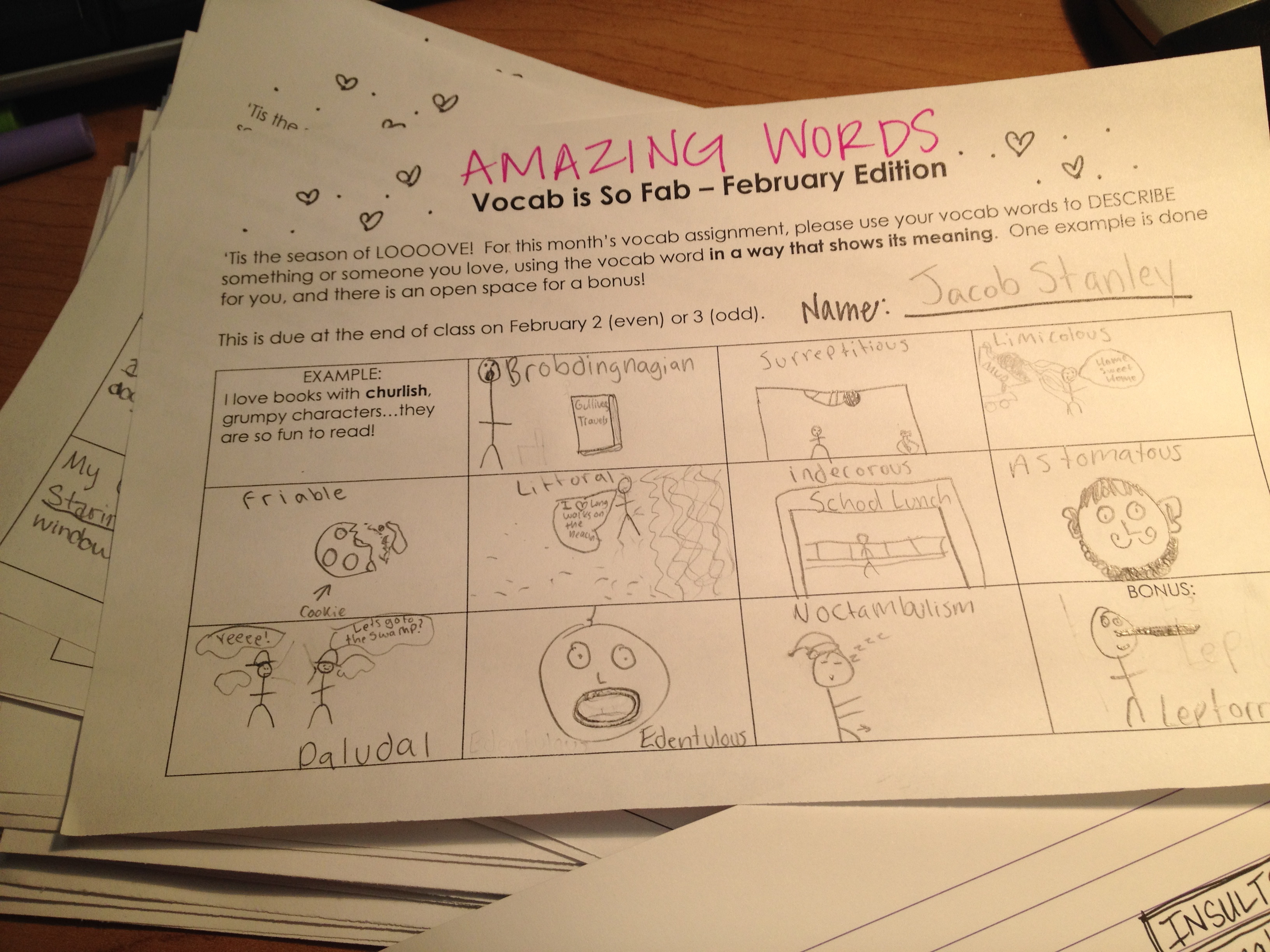
3.  Vocabulary – I still remember my orange Sadlier-Oxford vocab books from high school.  Those well-worn paperbacks were the source of many a cramped hand and a frantic fifteen minutes of homeroom before English class.  I know from personal experience that I don’t retain new words by completing fill-in-the-blank exercises–I learn by reading widely.  So, I ask my students to maintain a “wondrous words” section in their notebooks, writing down unfamiliar or unknown words as they read.  Then, I give them a different activity to complete with those words every two weeks.  The activities are worth 10 points each, and run the gamut from writing stories using the words to drawing pictures illustrating their meanings.

4. Honest self-assessments – When we finish a unit of any kind, usually about once a month–a writing unit, a reading unit, a book club, a challenge–I pass out a half-sheet with self-assessment questions on it.  I begin each half-sheet with a disclaimer:  “Be honest.  There’s no judgment here.  I just want to know why you were as successful as you were with this unit, and to know how I can help others be successful in the future.”  Students answer very truthfully, sometimes humorously so.  If their answers are thorough, they receive 15 points.

These four formative assessments total about 115 points per month.  With 9-week grading periods, students’ grades therefore are made up of about 2/3 formative assessments (230 points or so) and 1/3 summative assessments (100 points or so).  Well over half of the formative assessments are credit for the simple acts of doing the assigned reading and writing–no evaluation of those acts, just credit for the effort.  I value practice and process over product–and this grading system reflects that.

How do you handle grading, formative assessment, evaluation, etc.? Please share in the comments!

The Value of Talk

Talk is one of the most powerful tools at work in my classroom.  Now, I’m talking about talknot discussion, sharing, peer editing, Socratic seminars, think-pair-share, or any other structured form of communication that might occur.  The simple act of letting our students just talk is invaluable, and we must create spaces in our curriculum for it to take place.  Here are three ways I encourage talk in my classroom.

Conferences – Reading and writing conferences aren’t just about assessment.  They’re also a valuable time for teachers and students to just talk to one another, getting to know each other as the humans that we are.  Creating a space for talk breaks down the teacher-student barrier, humanizes both parties, and by and large erases discipline problems in my classroom.  I begin every conference with a simple, “How are you today?”, and after genuinely listening for the child’s answer, direct the conference from there.  Some conferences, we don’t talk about books or writing–we just talk, because the student needs to.

IMG_6441

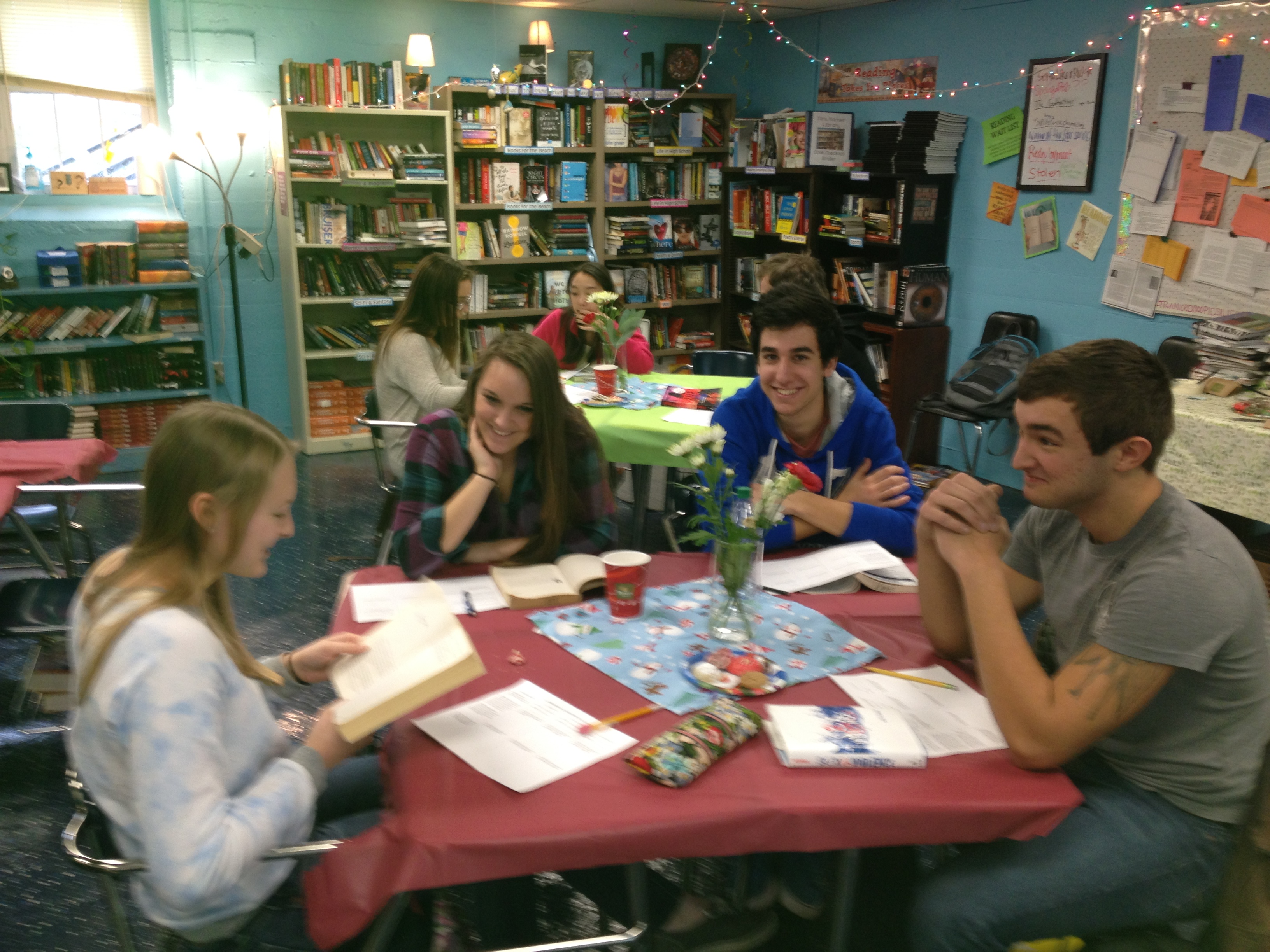
Students chat during the ‘Book Bistro’

Book Clubs – Not every book club meeting requires structure or an agenda to be valuable.  During this most recent unit, I simply asked students to keep the conversation going for 20 straight minutes.  They sometimes had to cast about for topics, but they always found something to discuss–mostly their books, but often text-to-text/self/world connections they’d made, which spun off into generalized, real-life conversations between kids who wouldn’t ordinarily find themselves chatting.  After finishing book clubs, Ana wrote, “I loved our book clubs because I felt like I got to know everyone better.”  She wrote other things about how she grew as a reader and writer…but she LOVED the unit because of the TALK that happened.

Root of the Writing Process – My journalism students consistently talk out their ideas at the very beginning of the writing process.  They chat in groups, usually starting with, “so what should I write about?”  It takes a few minutes, but enlightenment inevitably follows–the other day, Shay threw a few silly ideas out for Kenleigh about bathroom graffiti, but then they got serious about that as a story idea.  “You could call your piece ‘Signs from the Stalls,'” Shay said.  “AHHHH, that’s a great idea!!” Kenleigh enthused.  What kids like to talk about is often what they’d like to write about, and they need to talk to get to the heart of those topic ideas.

Talk builds community.  Talk is the tool that made my former student Emily say, “I felt like by the end of the year, everyone in the class became my best friend, including you.”

How do you see talk improving your classroom and its community?  What spaces do you create for talk in your classes?

Grading vs. Feedback

Let me be honest:  I hate grading.

Hate hate hate it.

I hate it, but you know what I love to do?  Read my students’ writing.  Talk to them about their reading.  Absorb the creative projects on display after they’ve completed a reading or writing unit.

So, if I love to listen to and read and wonder about their work, why do I hate to grade it?

The idea of reducing a piece of student work to a number, or assigning some arbitrary value to a reading conference, or trying to measure precisely the growth of a writer from one genre to the next is not only intimidating to me…it also seems a little ridiculous.  Unnecessary.  Trivial.  The beauty of a learner’s work is its creation, its completion, its courage.  It’s out there…for me to read, for their peers to see, for their creators to reflect on.

But, too many of my students only know how to think in numeric terms when trying to measure their own achievements.  Few are well-versed in knowing how to feel proud of finishing a tough book, or pleased with the revision of a piece of writing, or excited about the hard work that went into a project.  They don’t know how to authentically self-evaluate, because for years, they have relied too heavily upon someone else’s assessments of their work–mainly their teachers’.  I keep wondering how that’s fair.  I’ve had conversations recently with the lovely Amy about this, and Jackie wrote a great post about this same dilemma last October.

FullSizeRenderLast week, this tweet from the always-wonderful Kelly Gallagher helped to focus my wondering.  His words are not only true of writing, but of all other acts of learning as well.  A grade can’t improve a student’s skills.  Only feedback can do that–authentic, speedy, specific feedback.

So now, thanks to the combination of conversations with fellow teachers, Kelly’s words, and my own wondering, I know what I need to do.  I need to focus more on feedback and less on grading.  I know if I do less of the latter, I’ll free up time to do more of the former.

So, I’m pondering how to shift the balance.  I’d really like to return written drafts with my comments and questions, but no number or letter grade at the top.  I’d really like to have just one reading conferences without hearing the question, “what grade do I have in here?”  I’d really like for students to abandon the habit of looking to me for grades, and instead look within themselves to figure out how they’re doing.

Because I can’t entirely forsake grades altogether (we need to update our gradebook weekly), I’ll move my focus toward improving my feedback instead.  I’ll do this in three important ways:

During reading or writing conferences.  Until now, I’ve tried to stay fairly quiet during conferences in order to let my students do most of the talking.  Most of my talk is in the form of questions.  Now, I’ll shift to giving students more feedback–much more than the one or two statements I try to make at the end of a conference, which usually are to give suggestions about where to go in terms of goals and growth.  I’d like to comment more on my observations of students’ growth, strengths, weaknesses, and skills, so they can learn the language to begin evaluating themselves more effectively.

In writer’s notebooks.  Although I collect notebooks every two weeks, I don’t read everything my students write–I don’t have time, and shouldn’t–they should write much more than I could ever read.  Generally, I thumb through the pages, check that students have given a good faith effort in all of their various sections, and give a completion grade.  Now, I’d like for each student to flag one page in their notebook they’d like me to attend to–maybe a woefully short to-read list, a favorite quickwrite, or a particular reading reflection.  That way, they can decide what’s important to them, and I can give feedback accordingly…just comments and questions, mind you–without the pressure of a grade for reader or writer.

Through monthly “Meta Meetings.”  I’d like to sit down with each student about once a month and just have a whole-person conference…not a reading or writing conference.  Just a little checkup, to see how their brains and hearts are doing.  I adore alliteration, and I want these chats to encourage my students to be metacognitive…so I think I’ll title them Meta Meetings.  I’ll ask students a few questions about their strengths and weaknesses, and try to get to the heart of all the little bits of the language arts they’re curious about…strengthening their similes, or finding a system for keeping track of found vocab words, or writing metaphorical recipes (all questions I’ve had from students at random times).  I also think that during these meetings, I’ll get lots of awesome curricular ideas–what do my students want to learn how to do?  What things are they really wondering about that I might be able to help them discover?

What are your suggestions for improving feedback?  Shifting away from grades?  Providing more authentic evaluation?  Please share in the comments!

5 Reasons Why Reading Conferences Matter — Especially in High School English

The Attention. Every child needs one-on-one conversations with an adult as often as possible.  Adolescents, by nature of their age, struggle with identity, fairness, stress, and a slew of other issues that contribute to all kinds of problems. The National Center on Addiction and Substance Abuse (CASA) at Columbia University. reports that “9 out of 10 Americans who meet the medical criteria for addiction started smoking, drinking, or using other drugs before age 18.” This is not surprising since according to this study, “75% of all high school students have used addictive substances, including tobacco, alcohol, marijuana, or cocaine.”

I know there are many reasons for teenagers to partake in these substances. I also know that many students think that adults do not care, or will not notice, if they are in class, participating in class, or lucid in class. One way to show our adolescent students that we care is to talk with them. And face-to-face conversations about books and reading is a pretty safe way to do so, not to mention that we model authentic conversations about reading when we do.

Try questions like:

  • How’s it going? (Thanks, Carl Anderson)
  • Why did you choose this book?
  • Do you know anyone else who has read this book? What’d she think?
  • How’d you find the time to read this week?
  • What’s standing in the way of your reading time?

The Relationship. Once students know they can trust us, they will tell us things about their lives, their struggles, and their hopes beyond high school. According to the Zur Institute, teen internet and video game addictions, violence in the media, online bullying, and violence in the home top the charts as some of the major influencers of teen behavior. On the Zur website, there’s a section titled “What You Can Do.” We find language that mirrors the words and phrases that lead to the most effective reading conferences, like “learn what [it] means to your children by talking with them about it,” and “be genuinely curious about what draws them to [whatever it is],” and “discuss balance,” and “keep the conversation active.”

We hear so much talk in education circles about engagement. Engagement comes as a result of relationships. When we talk to our students about their lives and the things that matter to them, and we help them see that somewhere in some book a character has experienced similar situations, conflicts, and heartaches, we show our students that literature is a living breathing source of hope. This Psychology Today post explains it clearly:  “Books are friends we can choose without restriction,” believed John Ruskin, an English art critic of the 19 Century who influenced Marcel Proust “who developed the idea of a novel that was not just a friend, but a friend who enables us to become intimate both with other minds and with our own.” Proust called readers of his own work “a sort of magnifying glass … by which I could give them the means to read within themselves.”

My students and I talk about windows and mirrors. This is why we read literature:  to learn what it means to be human. How do you see yourself in the characters, conflicts, situations, and how do you see out into a world that is very different from your own? The more we grow in empathy, the better relationship we’ll have with our friends, our families and all other people we associate with — at least the idealist in me will cling to that hope as I continue to talk to students about books and reading.

Try questions like:

  • What character reminds you of yourself or someone you know?
  • What part of the story is the most similar/different to your life?
  • Why do you think the author makes that happen in the book?
  • What does he want us to learn about life?
  • How does this story/character/conflict/event make you think about life differently?

The Learning. There are times when I’ve done a mini-lesson, I feel like I’ve talked to myself. I see little application of a skill I know I’ve taught. Sometimes students completely miss the point of the lesson. However, when I take the time to talk to each student individually, and reinforce the skill in a quick chat, the application of that skill some how seeps into their brains much deeper. And you know those students who are super apprehensive — the ones who have to ask “Is this right?” and show us a teeny bit of work before they will really produce any work? Holding a regular reading conference has solved this problem.

Students know they will get a chance to talk with me about their progress, and they are more willing to take risks than when we talk infrequently. Time for reading conferences, and conferences timed to meet the needs of each one of our learners solves many at-risk behaviors and promotes deeper learning.

Try questions like:

  • Tell me about _____ that we learned in class today. How does that relate to your book/character?
  • Remember when we learned _____, tell me how/where you see that in your book.
  • Think about when we practiced ___, where does the author do that in your book?
  • You’ve improved with ___, how could you use that skill for _______?

The Literacy. Sometimes I think we forget that the purpose of our instruction must be to develop the literate lives of our students. We must provide opportunities for our students to grow into confident and competent readers and writers in order to handle the rigor and complexity of post high school education and beyond. We must remember to focus on literacy not on the literature — just like we must focus on the reader not just on the reading. We must validate our readers, ask questions that spark confidence, avoid questions that demean or make the student defensive, and at the same time challenge our readers into more complex texts. We can learn if a child has read a book, or the assigned pages, with a few quick questions. Then we must turn the conversations to the why, the what, and the how that will get students to choose to take a step up the ladder of complexity.

When students know that we care more about them as the person than we care about what or how much they have read, they will trust us. And it’s trust between the adolescent and the adult that creates the most movement as a reader, a writer, a student, a young person emerging into adulthood. Students will read the rich literature we bless because they know we are leading them into literature that will in turn bless their lives.

Try questions like:

  • On a scale of 1 to 10 how complex is this book for you? Why?
  • What do you do when the reading gets difficult?
  • Of all the books you’ve read this year, which was the most challenging? Why?
  • How’s it going finding vocabulary for your personal dictionary?
  • Tell me how you are keeping track of the parallel storyline?

The Reward. We can experience powerful rewards as we meet with our students in regular reading conferences. (I wrote about one here.) Every year, after students get to know me a bit, they tell me things like: “We were scared of you at first. You seemed so strict,” and “You intimidated me, and I was afraid to talk to you.” I get how students see me. I’m tall for one thing. For another, I get right to the point and state the learning that will happen in my classroom. Structure and routine are important for the work we do here, and I explain what that looks like within the first twenty minutes of day one. We work bell to bell with very little down time. I get that many students are not used to such habits, especially in our 85 minute classes.

My students experience breakthroughs regularly.  It’s during our reading conferences that they tell me my instruction works. “Miss, I only read two books in all of 10th grade. I was so behind. This year I’ve read SO many. I can’t count. You’ve helped me so much. I wish I could go back in time and read this much in 10th grade,” one girl tells me. Another says,  “I never thought I would like to read. Now, look at me,” as she shows me the copy of Anna Karenina she bought over the weekend. (We’d done a mini-lesson on beautiful sentences, and I talked about the books our mentor sentences came from — not really expecting anyone would want to read that one. Oh, they can surprise us!)

I ask students about their confidence levels in our little chats, and they tell me they know they have grown as a readers. This is the best kind of reward.

Try questions like:

  • How has your confidence grown as you’ve read this year?
  • What do you think is the one thing we’ve done in class that’s helped you improve so much as a reader?
  • How will the habits you’ve created in class help you in the reading you’ll have to do in college?
  • Why do you think you’ve grown so much as a reader the past few weeks?
  • What’s different for you now in the way you learn than how you learned before?
  • Describe for me the characteristics you have that make you a reader.

What kinds of questions work for you in your reading conferences?

©Amy Rasmussen, 2011 – 2015

Why My #onelittleword Will Work

My friend Jackie sent me a link to this blog: Setting a Work Schedule to Make Us Better, Saner Teachers. Somehow she sees inside my head.

My teaching world grew when I changed my pedagogy to readers and writers workshop. Over time, I also became so passionate about helping my students move as readers and writers I kind of lost my love for what started this change in the first place. Sometimes I get so busy reading the next great YA novel, or searching for mentor texts, or inventing new ways to get my reluctant students to write that I forget that I really just love my students. I love them.

I need to let them know that.

With all my musings about resolutions, (If you haven’t seen my posts for the past three days…) I probably need to give it up and follow the trail of those leaving the #onelittleword hashtag.

My word is L-O-V-E. sunshine-wallpaper-6

Do you remember when you first learned to spell it? I do. I wrote it everywhere. On notebooks. On desks. On the wooden slat holding my sister’s bunk bed above my head. (Years later I would also write the names of every boy I ever crushed on. It’s quite a collection.)

I need to reclaim the feeling I felt when I first learned to spell love. I need to spread it like I spread the lead of those pencils so long ago. My students will respond to my urgings to read and to write with quality and care, if they know I love them — not as readers and writers, although that is true, but as humans who deserve it because all humans do.

So, I’m thinking about how. How do I show my students love?

I read this post by my friend Jennifer: Teach Like An Artist. I like this idea of minimalism. I need to clear the clutter and refocus on the things I know work. My values are similar to Jennifer’s, and it’s by focusing on these things that I will show greater love for the students in my care. [It only looks like I copied Jen’s values. We just hunk alike.]

The Core Values of My Classroom

1. Empathy. We talk about windows and mirrors in my class a lot. We read to know what it means to be human. Do you see yourself in this book? What do you learn about someone else in this one? Do we make connections with individuals and characters as we read. Do we try to learn where their thoughts and feelings are coming from?

My classes are more diverse than they’d been in years. We have an incredible opportunity to step inside another’s shoes — if we only will.

Also, I must learn about my students lives.

(from Empathy in Education) Empathy has long been an intrinsic part of the education system, “if schools are involved in intellectual development, they are inherently involved in emotional development” (Hinton, 2008, p. 90). A student’s emotions coming into the class affect the way, and how much they learn. Educators must be able to connect to, and understand their students in order to best serve those students’ needs “focused on nurturing learning rather than judging performance” (Hinton, 2008, p. 91). Teachers in the classroom face students from all different backgrounds, sometimes very different from their own.

I think about this at the start of every school year. I am glad I’m thinking about it again now. I can do more now.

2. Authenticity. I cannot keep touting choice when I sometimes forget that “Choice without boundaries is no choice at all,” per Don Graves. I need to make sure that students are able to explore what matters to them, but I must guide them in directions that truly help them explore. Too many are afraid of the struggle of research and evaluation. They take first pick or rely on me to share my opinion. I want them learning how to form their own. I believe this is where TALK in the classroom is so important. Students are free to be themselves because we’ve established a comfortable learning environment — it’s safe — so students know they can express and share their beliefs.

I mentioned in another post that I used to write every assignment I gave my students. I commit to doing that again. They need to see me struggle and grow and share as a writer just like I ask them to.

3. Quality.  Somewhere along their learning journey, many of my students missed the bit on producing and turning in quality work. They focus on completion instead of quality. So far this year, it’s been an uphill battle with students expecting to do well on work that is poorly done. I spoke with a colleague just today. She said that she’s noticed the same problem in the business world:  a bank telling a customer to go to a different branch because “I’ve never done this before,” instead of attempting to learn how to do a task. Imagine if doctors, mechanics, the engineers who build our roads just shirk their duties and look for the quick and easy way through tasks? We are in trouble. My students need to know the value of producing work they know represents their best selves. I will refuse to take anything less.

“If it’s not worth doing well, it’s not worth doing,” my mother often said (mostly about chores around the house, but still.) I must make sure my students see the value in the tasks I ask them to complete. The quality of these tasks will reflect the quality of the work students put into them.

photo

More talk, better conference, additional Harkness discussions. That is how I will show my love for my students, and how I will help them have an even better than the first second semester.

Penny Kittle taught me that “writing floats on a sea of talk.” Natalie Goldberg taught me “Talk is the exercise ground.” I believe that when students talk about their thinking, about their plans for writing, they write more — and they write better. I believe that when the classroom is lively with energetic voices we learn and grow together. We learn to listen and to care for the thoughts and feelings of others. It’s through our formal class discussions that my students have learned how to analyze a text. It’s through my one-on-one discussions that I’ve learned where they struggle and how to help them grow as individual readers, writers, thinkers, and contributors in our society.

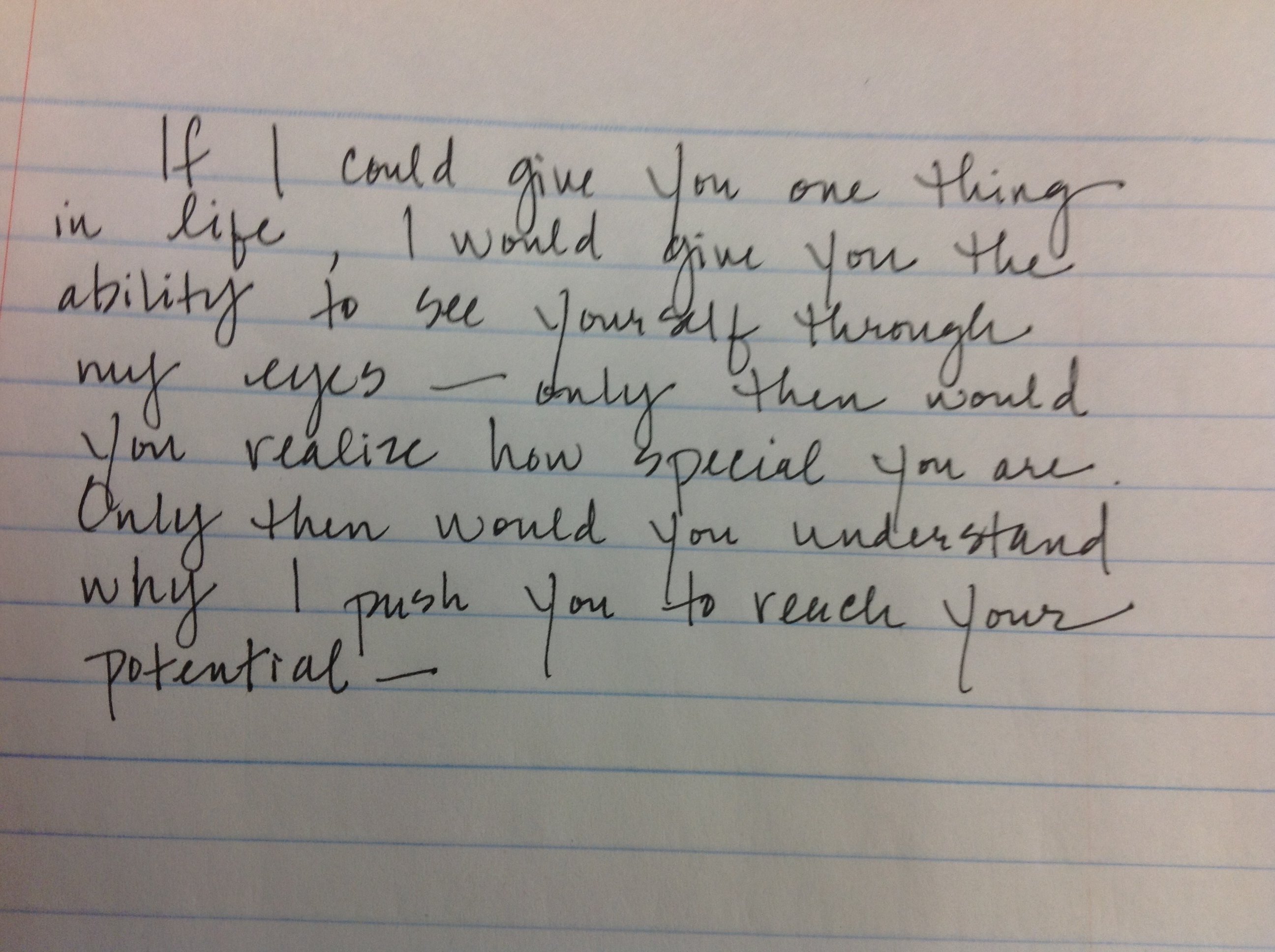
I’ve started writing notes to my students. Here’s another thing I used to do that brought positive results. I bought nice cards (Half Price Books has a lovely selection as teacher-friendly prices.) Every day I write one or two notes per class period. I highlight traits that I admire. I encourage. I notice. Students respond with higher quality work, more participation in class, sometimes even happier faces. My handwritten message, signed “Warmly, Mrs. Rasmussen” often works better than any conference with a student face-to-face.

And tomorrow students think and explore and decide upon their own #onelittleword.

Conferring: On the Lookout for Gifts

“I think parents should read this book — these kinds of books, too,” Monica said as we chatted about the book she just finished, Impulse by Ellen Hopkins. “They need to know what we go through and how we think about things. It would help so much.”

I listened as she shared her feelings. She needed me to hear her disappointment at the ending. The characters mattered to her, so I knew they needed to matter to me.

The relationship between student and teacher changed in that moment. We gave each other a gift in that brief conversation about a book.

When we consider our conferring moments with students, do we give enough gifts? Do we allow our students to?

Think about the origin of confer:  Latin conferre to bring together, from com- + ferre to carry.

At the end of that three-minute conference with Monica, I carried a bit of the burden she had on her heart, and she carried the knowledge that one more adult cares about what she thinks. A conversation about a book brought us together.

I love that.

At NCTE I asked a room of teachers what part of their workshop classroom they struggle with the most. They all said student conferences.

Finding the time, being consistent, knowing how to prod students into thinking, allowing students to do most of the talking —  these concerns all emerged as trouble spots that we’d like to overcome.

In a perfect classroom with perfect students it would be easy. What’s the big deal? Just talk to your students. Yeah, right.

I asked one colleague how she conducts her reading conferences. She replied quickly, “Oh, I don’t do those. I cannot talk to one kid without the other 35 talking.”

Yes, that can be a problem.

I don’t think we stop trying though.

One-on-one conversations with students create the heart of my workshop classroom. Our relationships grow and change as we gift one another with ideas and information. We learn and change together as individuals who are trying to make sense of our world. Regular conversations make this happen.

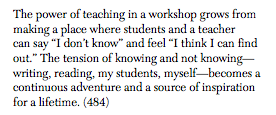
I’m reminded of a line I boxed in bold when reading Choice Words by Peter Johnston: “Talk is the central tool of their trade.” Their meaning teachers who create environments wherein through language they help students “make sense of learning, literacy, life, and themselves” (4).

Talk is central

That’s what I want as I create opportunities to confer with the students in my classroom. I want to help my students make sense of all it:  what happens in the classroom, what they read in books, what they’ll face in the future, and what they see in themselves. That’s a tall order, and the only way I know how to do it is to talk to more of my kids more often.

My burning question now circles on student conferences. How can I improve the precious moments of time I have with each of my students?

I am paying a lot more attention to the gifts we give as we converse with one another.

What about you? What are your ideas, concerns, questions about student conferences?

©Amy Rasmussen, 2011 – 2015

It’s about the Process. C’mon Guys!

There’s this thing about students with attitudes. Sometimes I just do not deal well.

Last week while meeting with students one-on-one to discuss their improvement in class and their current writing piece, I felt a little beat up.

How is it that two students can ruin the euphoria I felt after conferring with everyone else?

First, N tells me that narrative will not fit anywhere in his piece.

“Why not?”

“Because of the topic,” he told me.

“And your topic is?” I said.

“Governor Perry,” he told me.

“You’re writing something like a bio of the governor. Why won’t narrative work anywhere?”

I do not remember the actual words, but what he meant was “ I do not want to spend anymore time on this writing.”

Later, A tells me that no matter what she writes I tell her it’s not good enough.

“What do you mean by that?”

“Because you always ask a question about what I wrote,” she told me.

“And why do you think by asking questions I’m telling you your writing isn’t good enough?”

“I’m just giving up,” she told me, completely avoiding my question.

I do not remember the actual words she said next, but what she meant was “I do not want to work any harder.”

Tough luck, kiddos.

Writing is hard. And writing well is even harder. Hemmingway quote

Too often my students just want to draft something roughly and turn it in for a grade. I’ve stopped even putting grades on papers, unless we are at the end of a grading period and the policy says I have to. So many students stop their process once that score sits on their page.

Here we are just starting our final nine weeks, and I must figure out how to do more with teaching writing process over writing product.

It’s an uphill stretch.

Students come to me with specific writing habits, and many are stalled on the hill, resisting the charge to be better. Since many of my kids have been in gifted and talented classes for years, they often think that learning comes easily. Maybe in some classes it does. But in my experience with English, too many teachers have not demanded growth through process and have been satisfied with students just turning in papers that will score an A. Mind you, not ALL teachers, but I can tell which teachers at the sophomore level value process over product and which do not, based on the attitudes and practices of the student when they come to my room their junior year. Or, maybe those sophomore teachers haven’t been able to change those bad habits either. I get that, too. Some of these students are stubborn in their know-it-all-ness.

I struggle with this every year:  You know the student who walks in the door at the beginning of the year and could make a 5 on the AP exam if she took it that week. Do you grade her on the struggle of the writing process and her improvement as a writer, or do you grade her on the writing she is capable of at the beginning of the year, even if it’s already an A?

I tend to want to see improvement in all my writers– even the ones who are already pretty good at it when they come to me.

But this year, maybe I haven’t emphasized that enough. I’ve written in front of them, shown them my struggle, used mentor texts, conferred with them individually, begged, prayed.

I pulled out Writing Down the Bones by Natalie Goldberg a while ago and read a few pages in the front of the book. I got my center back. I also got a few thoughts I may write on sticky notes and hand to N and A as they come to class tomorrow.

“You practice whether you want to or not.” p11

“You have to give yourself the space to write a lot without a destination.” p11

“It’s the process of writing and life that matters.” p12

“We must continue to open and trust in our own voice and process.” p13

“Writing is so simple, basic, and austere.” There are no fancy gadgets to make it more attractive.” p26

No doubt when I keep reading I will find more and more advice from Goldberg that will help me help my students. I love that about good writers who want to help others become good writers, too.

Where do you go to find your center? Who are your personal writing coaches?