Tag Archives: choice reading

Teach Readers, Not Books: A Case for Choice Reading in ALL Classes

Recently, in a pretty typical high school hallway, I overheard two very different conversations about books.

Conversation One:
“Hey, did you finish that book?”
“Oh my gosh, yes, I did, and I couldn’t believe the ending!!”
“I know! I cried so hard! I got makeup all over the pages!”
“Me too! But it was such a good ending, right?”
“Yeah. It had to end that way.”

Conversation Two:
“Hey, did you finish that book?”
“Yeah, I did.”
“What happened? I think we have a quiz today.”
“Well, the main character ended up…”

The first conversation was one between real readers. The second was a conversation between students just trying to pass their English class. It’s obvious that the kids who are already readers are the kids in the first conversation, while the kids who are being besieged by negative reading experiences are the kids in the second.

The day I heard those conversations, someone tweeted Natasha Vargas-Cooper’s “Why We Should Stop Teaching Novels to High School Students.”  She writes powerfully about how some story mediums gave her “large and instant rewards for spending time with them,” but that reading novels and completing “deadening take-home reading comprehension questions” assigned to her did not.  I recognized myself in this post, as I had much the same experience.  It wasn’t until much later in my life that I began to read the classics, which I’d merely SparkNoted in high school.  This is me we’re talking about, who snatched the Twitter handle @litreader in 2008.  I, the kid who decided in 6th grade to read the entire public library, starting with author A and ending at Z, didn’t read what was assigned to me…simply because it had been assigned.

And then came Amy’s courageous and oh-so-right post yesterday about choice in AP and Honors level English classes.  I wish she’d written that post 12 years ago, when I was being beaten over the head with The Scarlet Letter.  Or 7 years ago, when I somehow, despite my own negative experiences, first began teaching and jumped into whole-class novels with gusto.  Thankfully, I met Amy a few years after I’d realized that that wasn’t the best way to get kids to love reading, and she’s helped me strengthen my teaching exponentially since then.  I’ve realized that it’s not the books that make kids love reading…it’s the experiences kids have with books, and it’s up to us to create conditions that foster the most positive of reading experiences.

When we value choice and focus our curriculum on authenticity and our students’ voices, we cultivate practices of lifelong reading. When we assign whole-class novels and base most of our coursework around them, we show students that we value books, not the act of reading itself.  Further, this practice values the teacher way too much–while in Penny Kittle’s words the teacher should be the best reader in the room, the teacher certainly shouldn’t be the only reader in the room.  Our students have excellent minds capable of making choices that will challenge their reading and thinking abilities.  We shouldn’t make all of those choices for them.

While you may believe that it is important for every student to be able to recognize a quote by Shakespeare at a cocktail party, you also hopefully believe in the value and power of reading. The only way to get our students to read for the rest of their lives–and become informed citizens and thinkers as a result–is to look into our classrooms and see our students as readers hungry for knowledge and wisdom, and not students who just need to know about certain books. The second doesn’t matter, at all. It’s not why we got into this profession, I hope–or at least it’s not why I got into this profession. If we want to create readers who will think and hope and dream and change the world, we have to teach those readers, not books.

A student-centered classroom that places choice and authenticity at its center is the answer.  The reading-writing workshop is a really effective format for that kind of classroom, and having it in place these last three or four years has made a world of difference in how my students and I view our time together.  Teaching has become much less a job for me, and much more a pleasurable way to pass my time.  I love talking to students about books, using my own expertise to help scaffold them up a reading ladder of text complexity.  I love reading their amazingly diverse writing and getting wonderful, authentic ideas for activities from them in writing conferences.  I love the sense of pride a kid shines with at the end of the year when he has defied an IEP and finished 18 books…but it breaks my heart when he fails senior English after a year of multiple-choice tests over Shakespeare.

And so, in the words of Natasha Vargas-Cooper, “To hell with Gatsby’s green light!”  Let them ponder it on their own time (they will; I promise you…I did).  Let’s teach readers…not books.

Aim Higher: A Case for Choice Reading and a Whole Lot More in AP English

I’m going to just say this right up front:  I hope to challenge some thinking.

I asked some friends for feedback on this post and got opposing advice. I let it rest for half a week. I prayed about it. And then today I read this post by Donalyn Miller, author of The Book Whisperer and Reading in the Wild. I’m not positive, but I’m pretty sure she wrote it in a response to a comment on this post by Amanda Palmer, Secondary Language Arts Coordinator in Katy, TX. I’ve written about my own students and their experiences as they’ve grown as readers before at Nerdy Book Club and on this blog; and I’ve presented on how I advocate for choice in AP English at conferences.

I hope I can be a voice of reason and an inspiration for the good of all students. So, if you’ll hang with me here, I’ve got a case for choice reading in AP English.


“I wish my daughter was in your AP English class,” my friend told me. “She has to decorate Kleenex boxes in hers.”

We’d had this conversation before:  I am an advocate of self-selected reading, and I fully embrace readers and writers workshop in my AP English Language and Composition classroom; Sarah is an advanced reader in an AP English course where the teacher chooses all the texts and assigns “clever” ways for the students to show that they are reading. Anyone who knows Penny Kittle’s work, and Donalyn Miller’s work, and my work, which is so much about helping students develop as life-long readers, understands that Sarah is not having the kind of experience in her English class that we advocate and hope for all children.

Making the Move to Move Readers

Many teachers and administrators across the country have recognized that students in secondary classrooms are not reading. If students are not readers, they tend to struggle in all academic subjects — not just English. Schools adopt interdisciplinary practices, whole school vocabulary instruction and stop-everything-and-read programs in an attempt to improve reading scores on standardized tests. Many have moved to readers and writers workshop, where choice-independent reading is key, instead of the traditional secondary-English pedagogy where the teacher selects all the texts, usually classics, and all the writing topics a student is expected to write about for class. Those who have made the move will tell you that choice matters, along with time to read and write, when it comes to student engagement and real movement in our teenage readers and writers.

However, from what I’ve seen and heard, most of this choice is happening in general education classes — not honors and AP English. The teachers in most advanced classes I know of are still making all the choices. It’s like we do not trust our high-achieving students to move themselves into complex texts. We focus on the literature instead of the literacy. And we rob children who already have a grasp of language, who already have many of the study skills they need to pass English classes, with the opportunities to grow as much as they are able.

We make changes in our pedagogy that allow our reluctant and struggling learners to grow but not our proficient kids? Where is the sense it that?

Evidence that Readers and Writers Workshop Works

One day last week, I sat and listened to my district’s ELA director share our state re-tester data. I usually hate this kind of meeting, but our gains are huge — due in large part because of the redesign of tutorial lessons, many of which teachers have adopted into their mainstream instruction. The ELA director changed the model and worked closely with North Star of TX Writing Project to produce writing workshop lessons (most of which came out of my classroom and pedagogy) that broke the mold of Response to Intervention. The dramatic increase in re-tester scores (an average of 200+ point increase per student) proves the lessons are working to move student readers and writers. Workshop-style writing lessons and a campus-wide, district-wide commitment to independent reading is working.

Making the Move in Advanced English Classes — or Not

The next day I sat in a meeting with the AP English team on my home campus. (Important note:  The same day that in second period a young woman asked me to recommend her a book of classic literature because she wanted to read something more complex. She and I stood in front of my “Challenge Yourself” shelf, and in about six minutes while the rest of the class read silently, I taught a mini-lesson on Gothic literature and the Regency Era and book talked the Bronte sisters’ books and Jane Austen. Rebecca left class with Pride and Prejudice, a book she chose to read because she wanted a romance that sounded interesting.) In that vertical alignment meeting, the conversation bounced around to what students must know and returned a few times to the books “all students must read.” After a while, someone asked me what I thought.

“Is it really about the book, or is it about the reader?” I asked.

“Well, it’s both,” two teachers answered.

“Then why does the book matter as much as the students’ abilities to read the books?”

“Because they will never read these books on their own, and they have to read a storehouse of canonical texts in order to write on the AP Lit exam,” they said.

“So you’re basing the reading lives of all pre-AP students in 9th and 10th grade on one open-ended question on the AP exam their senior year?”

“Well, they also have to analyze a passage,” one teacher added.

“Yes, and that’s like studying lists of SAT words hoping students learn the few out of 5,000 that might be on the SAT exam. It’s a total crapshoot.

“Shouldn’t we be more concerned about students being able to read at complex levels than deciding which books they must read?”

Another teacher joined in “I want my students to be prepared for the kinds of reading they will be expected to know when they go into college classrooms. That is providing equity. If they know The Iliad, Beowulf, Dante, they will be on equal footing as those classmates who read those things at the affluent schools across town.”

“Shouldn’t the equity be in the skills our students possess? Can they read and understand complex texts like the students across town?”


How Do We Know If Students Are Reading

I know that many, if not most, of those students at other schools are not reading those books. Few high school students read the assigned texts in English classes. Ask them. I have student writing from the past five years that tells me in their own words about their reading habits in high school. And there are plenty of well-researched articles like this one from the English Journal that concur. It is true: few high school students read the assigned texts in English classes. Why doesn’t this matter to their teachers?

“How do you know they are reading the independent reading books you let them choose?” a teacher asked me.

“Because I talk to them about what they are reading,” I answered.

“I do that, too, about the books I assign,” she said, but I am pretty sure that her idea of talking about books with students and mine are very different. I call it conferences. She calls it lectures.

I felt disheartened and sad for the honor student at the outcome of that vertical alignment meeting:  AP teachers deciding what four books teachers in preAP 9th and 10th grade must teach in order to prepare students for Advanced Placement in 11th and 12th grade.*

I fear that students will be just as prepared as they have been, which in my one-semester at this campus is not much. At the most, they will read four books a year, and the only students who will read the assigned texts are the ones who are readers anyway, who are studious enough, or care about their grades enough, to do what the teacher says. Everyone else will read a little and Sparknotes a lot, listening in to class discussions, and learning enough to pass exams that cover the conflict, plot, symbolism, and theme of the assigned text. Few, if any, will grow as readers who fall in love with words and characters and the beauty and the texture of carefully crafted stories.  It happens over and over and over again.

We deprive the students who take advantage of the College Board’s open enrollment policy, the students who voluntarily agree to more rigor, and we allow them to make it through high school English without growing as readers. I would argue that in many cases, there is high probability that they regress as readers.

How does that make any sense?


Looks Like the College Board Advocates for Readers Writers Workshop

The College Board provides course descriptions for each of the 34 AP courses and exams it offers. The descriptions reflect the course material that might be taught in a comparable college course. This makes designing a curriculum relatively easy for many of the courses taught. Biology and World History, for example, have definite knowledge-based skills that must be covered throughout the course. AP English courses are another story. Since first-year college composition courses are so diverse and vary from college to college, the structure of these classes on high school campuses can be diverse as well. AP programs, and even individual teachers, may design their courses based on their own interests and desires. Of course, the AP classes must reflect and assess college-level expectations, but that’s pretty much the only requirement. There are no prescribed essays that students must write, although there are suggestions of form. There are no required novels to read, although there is a suggested list of authors. Suggested being a key word. Teachers have a great deal of freedom in how they design their courses and what they put on their syllabi. See

AP English Language and Composition Course Overview

AP English Literature and Composition Course Overview

We can still read texts spanning from the 1600’s to the 21 century. We can still read literature that we deem important to our literary canon. But do we have to make all the choices in our Advanced Classes?

We can foster literate lives if we will take the same approach to literacy that is working in thousands of classrooms across the country:  Readers and Writers Workshop where choice matters and time to read and write mean deep and lasting learning.

So What’s the Real Deal

After talking this over with several of my peers, I’ve decided on a few reasons why honors and AP English teachers refuse to “drink the Kool Aid” (Isn’t that a nice derogatory way of describing readers/writers workshop? I hear it often):

  • Some teachers loved the experience they had with literature in their high school English classes. This is the reason they chose to be English teachers. (I am one of these teachers.) They want to duplicate those positive experiences for their students. A worthy ambition. However, I wonder if they have considered how many of their classmates experienced the same excitement at reading (or not) the literature that the teacher mandated.
  • Some teachers are not readers themselves. They love the books they’ve chosen to use in their classes, but rarely do they read anything from a best-seller list, or an awards list. They want to stay with what is known and comfortable. Many times these teachers mistake their duty:  to teach the child and not the book.
  • Some teachers believe that certain pieces of literature must be read by every student on the planet. “If I don’t teach this book, then these students will never read it” is a statement I’ve heard many times. My answer is always “Yes, but many are still not reading it when you teach it.” We ruin the the taste of great literature for many students when we force books on them that they are not ready for. I’ve asked all of my students this year about their reading in 10th grade. Not one of them has said they love To Kill a Mockingbird, one of two books they had to read last year. Why would we want to turn students off of a much beloved book like TKMB?
  • Some teachers believe that 10 to 15 minutes of sustained silent reading at the beginning of class is the same as instruction with choice reading. Sure, this reading time, especially if students are reading books that they choose, is important. It is a step. But it is not the same as structuring instruction around readers workshop where students not only read books that they choose, they think about them, talk about them, learn within them. They confer with a teacher intent on moving the reader in the best differentiated instruction possible.
  • Some teachers are afraid of giving up control. They fear that if students are all reading different texts they won’t know how to manage the class or guide the learning. This is a valid concern, but it is also something they can learn how to do. Many of us are doing it. We are happy to share how.

I am sure there are other reasons, and really, I mean no disrespect. I know my colleagues are hardworking and loving educators. I like them a lot. I respect them for the work they do, and I am sure that their students are learning in their classes. I know this is true for many other teachers and classrooms across America, too. I just really want to challenge some thinking.

What if we can do more?


Let’s Allow all Students the Advantages of Choice

More than anything, I want all students to have opportunities to rise above the norm, and maybe, just
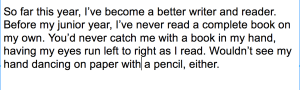
~Joseph, AP English Language and Composition Student

maybe, we will see many more students, not just our struggling ones, immersed in books they love, and thinking about their reading in ways we’ve never imagined. Their engagement will improve. Their growth will astound us. They will develop as critical thinkers, accomplished writers, and as empathetic individuals ready to take on the challenges of college and their world.

I mentioned at the beginning of this post that I shared a draft of it with my writing partners. This response from Shana is important:

“I was an AP Lit kid, and an Honors English kid.  I SparkNoted The Scarlet Letter, Beowulf, Iliad, Catcher in the Rye, and the rest.  I never read a bit of it.  In fact, I didn’t read ANYTHING that was assigned to me simply because of the fact that it had been ASSIGNED.  I was stubborn like that.  And I got A’s all the way through.  And a 5 on the AP test.  All the while tearing through John Grisham, Elizabeth Peters, and the entire Bestsellers section of my public library outside of class.

“Then, my freshman year of college, when I took a workshop class in which I was allowed to self-select what I read, I chose the Scarlet Letter and thought it was the most beautiful love story I’d ever read.  I finished it and read it again.  Since that day, when I realized that because I was one of those AP kids and I COULD read those works, I’ve discovered that I LOVE them.  But I never read a single one of them until after high school.  My well-known love for Jane Austen didn’t emerge until I wrote a paper on Pride and Prejudice and A Midsummer Night’s Dream for my Shakespeare capstone.  I just read Mockingbird last summer for the first time ever.  [Note: I read it when I was 40.]

“I was never allowed to choose for myself in AP or Honors English, but had I been allowed to…I would have read all of those books, and arrived at a deeper level of love and reverence for literature, much earlier in my reading life.

“One thing I might add — I totally disagree with that AP Lit teacher saying that students needed to draw from classic lit for the test.  Many of my AP kids who got 5s wrote about modern classics…Oscar Wao, Life of Pi, whatever.  You don’t have to know CLASSICS to ace the Lit exam…you just have to know how to write authentically about complex texts, and that’s what we do in workshop, and what kids should be doing in AP classes.”

I know there are others who have made the shift. I got this in an email message just today from Jeannine in CA. We had a nice chat at NCTE:  “Thank you for our November communication. I have altered much of my instruction to incorporate choice reading.  The students are soaring!!!”

Another AP English teacher trusting herself and her students enough to make a change and see where it takes them.


Why, Yes, There’s Research to Support This Pedagogy

I mentioned Donalyn’s post at the beginning of this long one. It is all about the research, the theory that outlines and supports what it takes to grow readers. Allington, Atwell, Krashen, Moss, Fisher, Ivey, and Kittle, and Gallagher and more.

I add another:  Last summer at the University of New Hampshire Literacy Institute Penny Kittle had us read Making Meaning with Texts, Selected Essays by Louise Rosenblatt. Rosenblatt’s research spans decades and is just as applicable today as when she wrote it years ago. I challenge every English educator to read the whole of Rosenblatt’s essay “The Acid Test for Literature Teaching, published in 1956. Or, at least to respond honestly to Rosenblatt’s conclusion. Odds are you will make the shift to choice, if you haven’t already:

“As we review our current high school programs in literature, we need to hold on to the essentials, or take the opportunity as re-adjustments come about, to create the practice that will meet the acid test:

Does this practice or approach hinder or foster a sense that literature exists as a form of personally meaningful experiences?

Is the pupil’s interaction with the literary work itself the center from which all else radiates?

Is the student being helped to grow into a relationship of integrity to language and literature?

Is he building a lifetime habit of significant reading?”


*In an email after I’d written this post, I received the notes from that meeting, and I am happy to say that there were no specific book titles listed, just the admonition that students in 9 and 10 grade preAP classes read 3-5 whole class texts of a complex nature. And students need to read 15-20 books a year to grow as readers. (Yes, I did throw in that bit of research while in that meeting.)

©Amy Rasmussen, 2011 – 2015

The Classroom and The Cell

ClassroomCell-cover.jpg (320×512)

Yes, the title is as provocative as the text found inside the 177 pages crafted as a conversation between both activists; one serving a life sentence in Waynesburg, PA and the other an Ivy League professor sharing his knowledge with the educational elite.

If the title alone does not grab your attention, or at the very least, shed light on the dark realities of the school to prison pipeline; then find comfort in knowing that asha bandele’s fingerprints have touched this piece as well – as editor.

Abu-Jamal and Lamont Hill take on the discourse so many African Americans engage in, yet so few human beings have any insight unto – which instills a blindness to the indifference that still persists. Each chapter is dedicated to components of the African American experience that are real, raw, and in dire need of attention.

In bringing necessary awareness to the issues, concerns, and realities found within this piece, take a look at Marc Lamont Hill on the creation of The Classroom and The Cell.

Here’s an excerpt found within the first few pages: (Please note, due to the nature of the content, some chosen words are a bit colorful, yet essential.)

Mumia: When you talk about your lack of freedom, you’re talking about the golden chains that are on you.  They’re pretty as a [expletive], but they’re still chains.  I think it’s interesting that our people, of all the people in the world, chose chains as a fashion accessory.

Marc: Crazy right?  And we call our cars “whips!”

Mumia:  Damn! Whips and chains.  That ain’t a Freudian slip.  Ain’t no such thing!  We’re not even free in our language.  You dig what I’m saying?

This excerpt sets the tone for the entire piece; it’s no wonder that I have felt compelled and propelled to research both men in greater detail.  This is also the excerpt I read aloud to students when they ask what I’m reading.  And every time, without skipping a beat, students are viscerally moved by it.  They ask to sign it out; immediately.  Some students are so enamored by the text, craft, and connection that they find an urge to read other books also authored by these men.  Innately what happens next is stunning – author studies are being explored and students’ identities are being validated.

What titles do you and your students collectively enjoy that provide opportunities  for understanding cultural ideologies while fostering honest dialogue?

Beyond These Four Walls

Believe it or not, there is an actual term called ‘seat time’.  Yes – states, the national government, school boards, and the rest of ’em, refer to the amount of time a student needs to be learning as “the time they spend in their seats.”  So, we create spaces where students feel safe, comfortable, and willing to risk as we maneuver around this idea of ‘seat time’ because really, who wants to be in a seat for hours upon hours a day?

We move furniture around and engage in Sky Writing (writing on the windows), we use bright colors to liven the spot up and throw rugs on the floor, we use wind chimes and zen gardens to channel our collective inner peace.  I love all of this.  I do.  Because our classrooms are our homes away from home, we invest in them.  For students, sometimes it’s their only home.

Until now.

This year I’m taking the show on the road.  And by show, I obviously mean the Reading Writing Workshop…because I wouldn’t stay home or head out without it.

I’m not alone in this vein of thought.

Amy has gently drenched us with her new found love for teaching poetry; inclusive of strategies, techniques, and student buy-in that emerged for her this summer at Frost Place.  Shana (and her hubby) have taken us to England where we virtually toured historically majestic places where remarkable literaries once stepped foot.  And, Jackie has provided us the opportunity to be audience members through Poetry Out Loud as we envision the poetic brilliance eminating from our New England youth.

Thank you, ladies.  I’d like to return the favor.

IMG_20141219_131929

Welcome to the streets of NYC where students and I take on the challenge of reading throughout the entire day ‘outside of seat time’!

We know, educating our youth is a collective effort – always.  Therefore when my principal afforded our students the opportunity to purchase books of their choosing, he envisioned handing them their individual gift cards and letting them be on their way.  While this is lovely and most definitely appreciated, I needed to be part of the process with our emerging and evolving readers.

This journey needed to be a collective.

IMG_20141219_111942

Our ‘seat time’ for the day!

The goal was to ensure that the day was full of all things literature – from the moment we left the building.  So, as students and I bundled up to head out into the winter cold, we locked the door to Room 382 with metrocards in hand, Writer’s Notebooks in tow, and independent reading books tucked into our bags.  While enroute to the four-story Barnes and Noble located in the heart of Union Square, the NYC subway became our independent reading haven.  Students were aghast at first to know that I was serious about reading, not only on the train…but in public.  Yet, once reality set in, one-by-one books started to surface.  Students started to seep into their pieces and some decided to (unconsciously) ignore the fifteen minute benchmark; they found their time on the subway to be soothed by the lull of everyday noises that so typically distract them.  Today is different.

Today we are readers.  Public readers.

On the hunt for literature

On the hunt for literature

As we arrived at our destination, students were given a lay of the land and had the opportunity to go explore.  I learned a lot in that moment, and in the moments to follow.  I learned that while working with students for five months now, I still do not know all of their literary interests…or that some prefer to read graffitti art books because they are fueled by creativity…or that some have been intrigued by forensics since they started the course about a month ago – and so of course – they want to read up on it…or that graphic novels are still at the core of young men’s desire to read.  As students traveled up and down escalators to find what they were looking for I was proud of their willingness to take on an adventure that had the potential to be wildly overwhelming.

***

Weeks later, back in Room 382 and in true RWW form, we took to our Writer’s Notebooks and students were asked to chronicle a vivid moment in their lives.  What you are about to read took my breath away, literally.

A vivid moment comes to life...

A vivid moment comes to life…

Davon decided to chronicle this moment:

The first time I went to Barnes and Noble it shocked me a lot. I didn’t even know what Barnes and Noble was intill I got there with my teacher and classmates.  When we got there and I realized it was a book store, I was shocked.  I started feeling all types of bad feelings running threw my body.  I was nervous and had butterflys in my stomach.  Seeing all the people at different book shelf’s in there made me feel like I didn’t have no business being there.The fact that everyone looked like they knew what they were doing and looking for, made me just want to stay out of everyone way and get out of there.  

IMG_20141219_140616

Davon in deep thought


Davon’s honesty is brave.  And from the looks of it he managed just fine. Better than fine.  He found a piece that would keep him company over the holiday break, that would fuel his imagination, and that would support him in his literacy quest.  A piece he is calling his own.

Using our ‘seat time’ in the most unconventional ways proves that as educators, we know how to support the needs of our students. Sometimes we borrow strategies and ask for guidance, but innately we know what each new group of students needs.  Sometimes it takes a minute to figure it out or customize differentiated plans to make it work.  However, I propose that instead of always rearranging our seating chart or window decals or placement of colored pens…we need to bust out of the four walls in which we learn everyday and let the RWW guide us through the wonders just outside.

In what ways do you foster student learning through the RWW outside of your classroom walls?

Cliché No More

Yes, I’m going there.  I’m making it wildly obvious and apparent that we have made it to the end of yet another year.  Cliché, I know.

cli·ché – klēˈSHā/ noun –a phrase or opinion that is overused and betrays a lack of original thought.

As if we haven’t been counting down the days for sometime now or looking forward to a fresh start as 2015 rolls around in less than 24 hours; this is a time when we allow ourselves the luxury to think about everything we’d like to leave in the past (and slip into the belief that we actually can leave whatever it is we don’t want anymore in 2014 – simply because the clock strikes twelve).  We’ve been detailing and tweaking our New Year’s resolutions to complete and utter perfection (because in these euphoric (some would argue – desperate) moments we believe perfection actually exists).  We’re ready for a change.

But, should we be?

I’ll be the first to admit that my 2014 was as tumultuous as tumultuous can be.  No, really.  Room 382 has been turned up, shifted around, marked, bruised, taken advantage of, and sadly (at moments) not utilized to its fullest potential.  Yet, every morning with the heat blasting (awaiting student complaint) there’s an essence that is viscerally undeniable.  I walk into a space, a quiet and waiting space, that invites risk, mistakes, setbacks, and quite frankly – the undeniable ugly.  Yet, there is no judgement, discerning undertone, nor slight anticipation that today there will be no progress.

Why would I want to leave all of that in 2014?!

I want these feelings, these realities, these quiet moments of hope to stay tightly tucked in my pocket as I make the invisible leap into 2015.  I don’t want to leave the struggle, nor the beauty, behind – it has become a part of who I am (as an educator, woman, thinker, problem solver, learner…).

can’t forget those moments when students found their way through pieces of literature that sparked their love for reading.  And I’m talking: “we’re-so-thirsty-we-can’t-get-enough”esque love of reading!

won’t allow myself to pretend none of this happened – because it did.  I know it.  Students know it.  It’s been what we’ve all held onto when it seemed there wasn’t anything else to keep us grounded, or stable, or…moving forward.

But, we have moved forward, right into the New Year.IMG_20141223_083315

And, while we are half way through our 2014-2015 winter break, I hold tightly to this: Our Reading Plan for Winter Break.

Students have committed, willingly, to really think through which books they want to explore during our hiatus.  Every student’s list is vastly different than the next, yet their pride in taking on this challenge (an hour of reading per day) is evident.  They are playing with genres; being honest about time constraints and the length of specific books; some wildly ambitious, others playing it safe.  Regardless, this is the tangible that will be welcoming us all into the New Year.

This will be the first thing we talk about upon re-entering room 382 and our time together on January 5, 2015.  We will be exploring all we learned about reading in 2014 and see how we all (myself included) challenged ourselves independently.  How did we fly?  When did we feel our wings getting clipped? What did we learn?  What do we want to share?  And so on and so on.

So, as the New Year always brings new promise and a sense of intrigue, I challenge us all to not lose sight of the beauty of the year past.  Bring with you the moments that challenged you the most. Capture, in vivid detail, the time you (and students) felt alive and connected.  Take a moment to massage the inner strength you know has become dormant sitting right below the surface and embrace it.

We owe it to ourselves and our students to relish in the relaxation, adventure, and exploration that this break offers, yet continue to embrace the challenges of late and invite the unforeseen new ones in.  This year, I am shouting loudly and proudly,”Cliché No More!” because with every year comes a newness balanced with a familiarity of knowing.

Here’s to a happy and healthy to you and yours!

A Book About Food?

IMG_20141216_210906You better believe that when Steven Spielberg and Oprah Winfrey collide (behind the big screen) an emulsion of magic erupts.  The One Hundred Foot Journey written by Richard C. Morais turned film was two hours and four minutes of robust richness, immaculate vastness, and intense human connection.  So, no…this book is not solely about food.  Although food, most of the time, tends to be the main character.  I love when authors and film makers do that!

Immediately following my trip to the theatre, was (obviously!) a trip to the bookstore.  Yes, at 9 p.m.  I wasn’t worried about the bookstore not being open but I hadn’t even thought to think that they would be out of the book.  I should have!

An immediate login to Amazon.com and my book was on its way — to be delivered a quick two days later (Thank you, Amazon Prime).  And it wasn’t long into the book when I came across this:

But this you must know:  the violent murder of a mother – when a boy is at that tender age, when he isIMG_20141216_205952 just discovering girls – it is a terrible thing.  Confusingly mixed up with all things feminine, it leaves a charred residue on the soul, like the black marks found at the bottom of a burned pot.  No matter how much you scrub and scrub the pot bottom with steel wool and cleansers, the scars, they remain permanent.

Did anyone else just witness the intense power of Morais’s carefully chosen craft?  Imagery, word
choice, symbolism…shall I continue?  When students ask me what I’m reading or why I’m even reading it; I turn to this page and let them read it for themselves…it’s already tagged.  Most times students’ responses start with a sigh followed by a “Wow” or “Whoa”.  Then the conversation begins.  And, just like what Spielberg and Winfrey have created, our conversations chronicle the richness of this sentiment, immaculate precision and craft of Morais, and the intensity of this reality.

What books have you stumbled upon that have hidden gems in them that you love to share with your students?

An Important Invitation


“WHAT THE [insert expletive]?!”

I do not move.

“NO WAY!  I can’t believe it!  How the [insert expletive #2]?!  Miss Bogdany, come here!”

I’ve been invited.

As I slowly walk toward Christian, both legs extended and perched atop his desk; he need not move. His eyes are bulging.  Is his look one of momentary panic?  Complete disbelief?  A moment of sadness? Regardless, the look on his face is all the body language needed to understand; this young man has just experienced the beauty of literature.  (Although I bet he would beg to differ that ‘beauty’ may not be the appropriate word choice.)

————

This year has been remarkably challenging in ways that I have had yet to experience.

All gritty yet beautiful.

After three and a half months of trying to persuade…breathing (deeply!) through rejected book recommendations…buckling up for the daily roller coaster ride of never really knowing what opinion will be formed about reading that particular day; this invitation could not have come packaged anymore suiting.

While there have been constant shifts, differentiated activities, mentor texts, book talks (on countless genres), writing topics, unsuccessful attempts at captivating student interest…(we all know how long the list gets); one thing has remained constant.  I committed, at the very beginning of the year, that no matter how many changes are made to our learning community, the Reading Writing Workshop goes nowhere!  Student choice has remained constant…and thank goodness it has because the expletives, the lounging student…this is exactly how today’s position on reading needs to be explored; gritty yet beautiful.

 ————

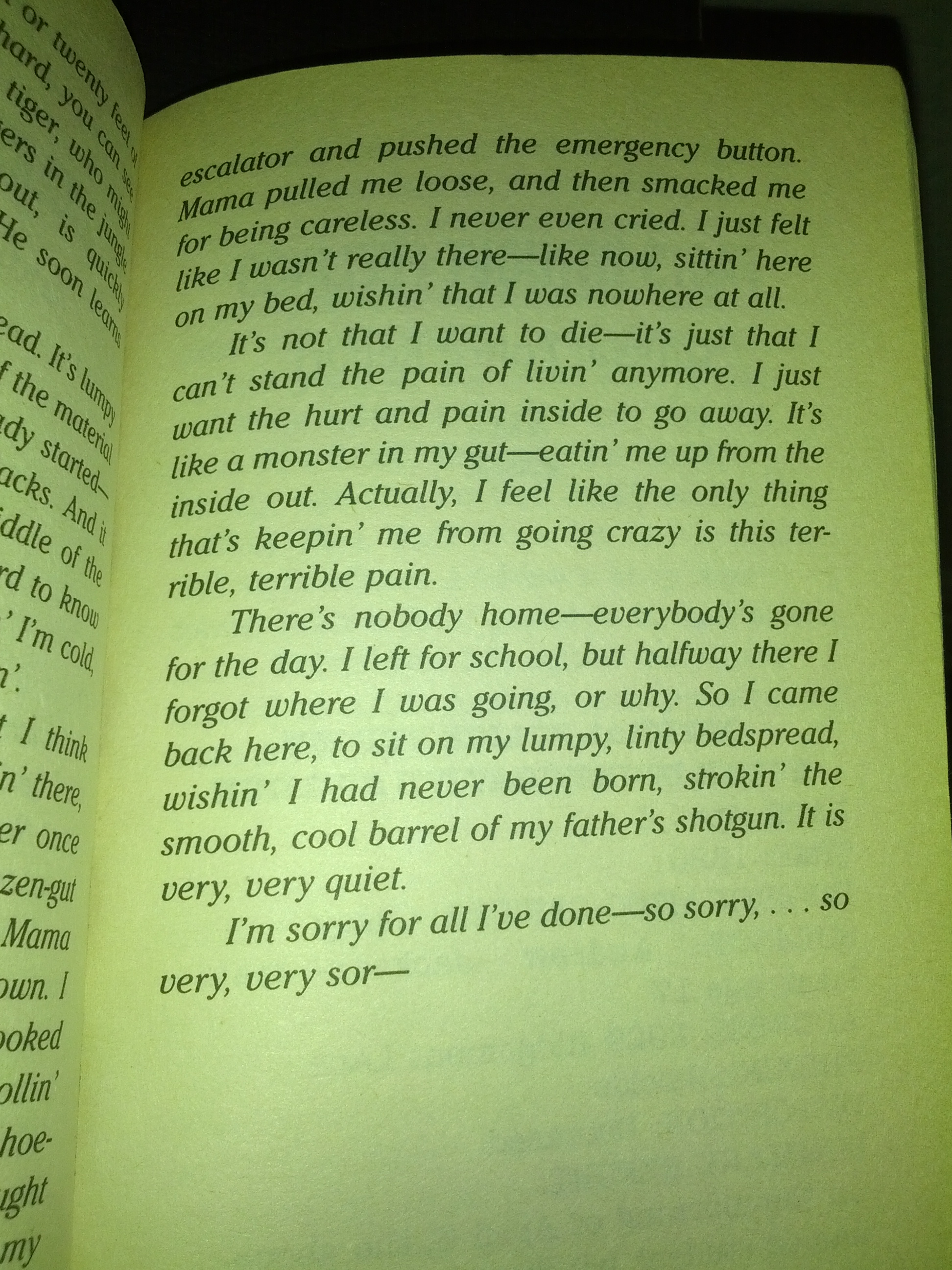
As ChrisIMG_20141215_175627tian holds tight to Tears of a Tiger by Sharon M. Draper (a popular read among students and the first book in the Hazelwood High trilogy), he points to this passage and invisibly underlines each word as he flies through the paragraph that starts “There’s nobody home – 

He then pauses.   His finger moves to the last line, lingers there as he looks up at me, and continues…”I’m sorry for all I’ve done – so sorry, …so very, very sor-

“Ms. Bogdany, did you SEE that?!  He kills himself!  He doesn’t even finish his sentence!”

I am most definitely taken aback.  First by Christian’s intense grasp on the craft of the writer and secondly by the wild intensity of a young man taking his own life.  My eyes bulge too.

Then Christian continues.  Again, his finger leading the way…

IMG_20141215_175604

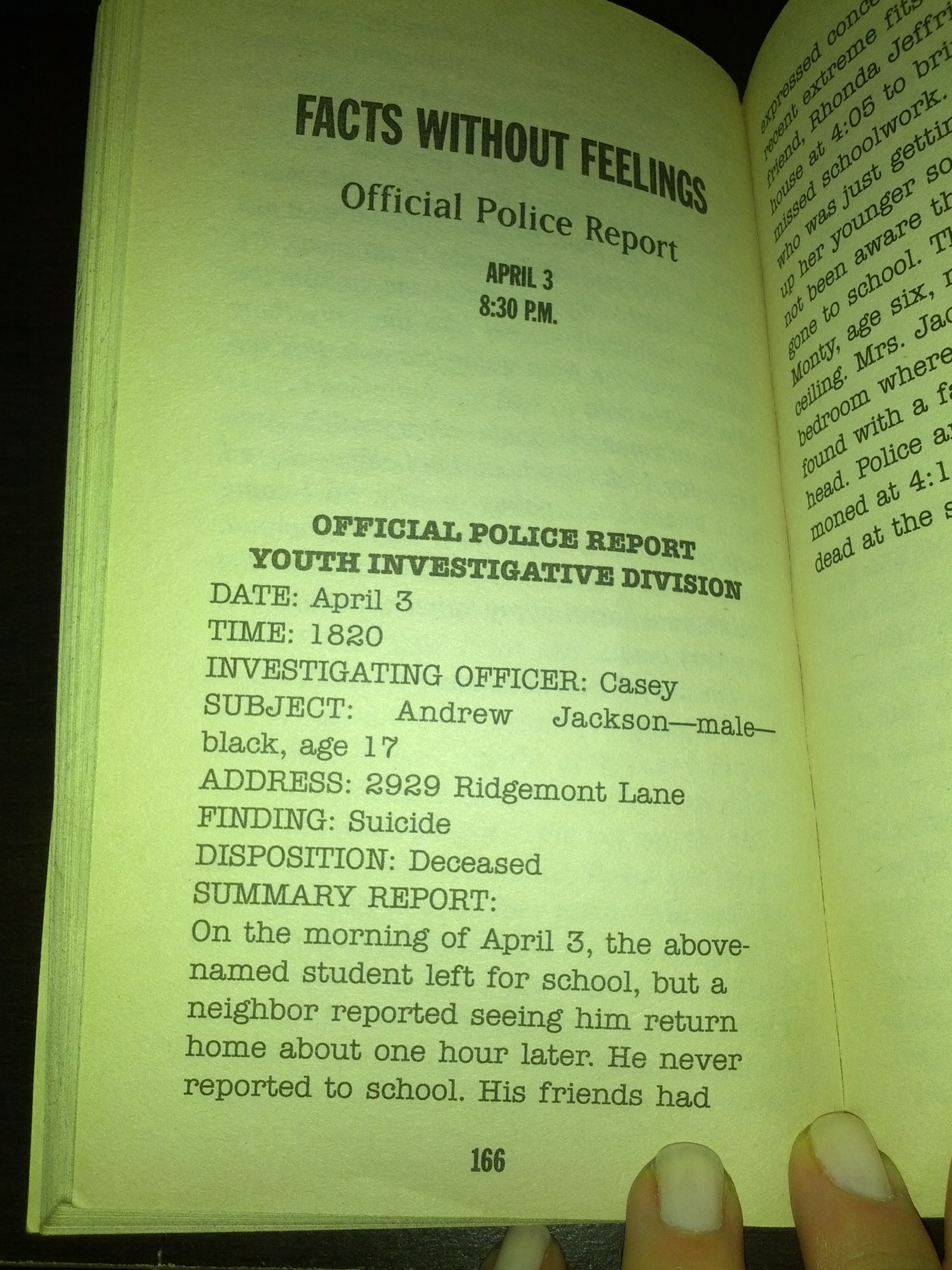
“Suicide!  This is the police report.  He killed himself.”

We both pause.  The weight of the word.  We both feel it.

“Ms. Bogdany, I just can’t believe it.  I knew it on the page before, but here it’s confirmed.  I had no idea this would happen.”

————

Christian has chosen many-a-piece that deals with Post Traumatic Stress Disorder (PTSD) and this piece is no different.  Here you have the main character who deals with survivor’s guilt after accidentally killing his best friend in a car accident.  You can only imagine how difficult life, for Andy Jackson, must be.  While attempting to ask for help throughout the piece, Andy feels as though he is alone.  Very alone.

This piece chronicle’s Andy’s journey and the fatality in which it brings.  Please note that students may want (and actually need) to talk about their feelings regarding this heavy issue.  Christian did, albeit the way in which he initially hinted.  Through the expletives I realized that Christian couldn’t be silent about the tragedy he just witnessed.  He needed to voice (in whatever way that surfaced) his knee-jerk reaction to the shock of Andy’s decision.

This piece has connected Christian and I.  It has given us the opportunity to chronicle his study on PTSD…and the real consequences that are associated with it.  He was able to walk me  through the craft of Sharon M. Draper.  This book will remain important for Christian for very specific reasons as it may very well be the piece that is forever etched in his mind.  This piece will also remain incredibly important for me, but for very different reasons.  Regardless of the reason, we are both grateful to Ms. Draper for her dedication to addressing real issues that touch the lives of our youth.

Building My Library Around My Students

My first time at NCTE, I played supermarket sweep alongside the other teachers. I didn’t have one of those grandma-rolling-carts to gather my goods in, but the victory was still sweet as I tossed book after book into my free bags. But lo and behold, as I returned home with my goods, I realized that some of the books were middle grade, a tad too young looking to impress my high schoolers, while others were sequels to books I didn’t own. My humble pile was quickly halved as I weeded out and gave away the books that just wouldn’t fit into my classroom library.

This year I took a different approach; I arrived at NCTE with certain students and issues in mind. Suddenly my mission to collect free and heavily discounted books turned into a mission to fill the holes in my classroom library. This not only narrowed my search but also made it easier to discuss potential titles with booksellers. The following are some of the gems I scored at NCTE 2014:

What I needed…Books that help students cope with a friend’s suicide

20726924Sadly, suicide is a tragedy that has touched my school a few times over the past few years. I am reminded of this at the beginning of every year when I receive personal narratives relaying the stories of students’ past friends or relatives. The wounds are deep and raw and fresh, which is why my students need literature to help them cope with such atrocities. This year, I left NCTE with two books that filled this niche: Rumble by Ellen Hopkins and The Last Time We Say Goodbye by Cynthia Hand. I have a growing group of Ellen Hopkins devotees who bask in the poetic prose of her books as well as the gritty subjects. Rumble attacks heavy issues through the story of Matt Turner, whose younger brother commits suicide 17285330after being bullied for being gay. The Last Time We Say Goodbye, which is due for publication in February 2015, tackles similar themes, only in this book, the female protagonist Lex loses her brother. Lex struggles to cope with her brother’s death and can’t let go of a text message she received from her brother the night he died.

This is unfortunately a topic that will continue to ripple through and impact my students as I receive students who are impacted by the deaths of friends and family members they have lost to suicide. There are no answers to such a devastating event, but I do hope that these books will help show students that they are not alone.

What I needed…Books that are low level but high interest

I fervently believe that students need a dose of success to give into reading. Too often my students 8011arrive turned off to reading simply because they haven’t been exposed to books that interest them. Furthermore, the students who are most resistant tend to be those who are not proficient or only partially proficient in reading and can’t seem to find books that are at a lower reading level yet a high interest level for their age group. My greatest find was a small bookstall towards the back of the convention room that included books from the Sidestreets and Real Justice Series. These books involve gritty stories with heavy hitting topics such as drug abuse, mental health issues, and social problems. While the books I received were between third to fifth grade reading levels, the sepia and black and white photo covers leant a more mature tone to the story—a strong selling point for low level, reluctant readers. I walked away with Jailed for Life for Being Black by Bill Swan, Blow by Jodi Lundgren, and Off Limits by Robert Rayner, all books I’m looking forward to introducing to my reluctant readers.

What I needed…Books that discuss LGBTQ Issues

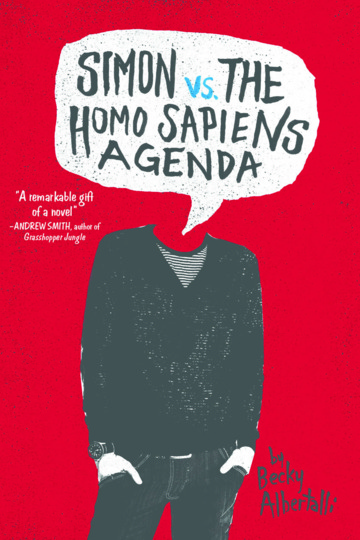
openlystraight_cvThis is the first year I have had openly gay students who have written either personal narratives or stories about homosexual relationships. The more I read their papers, the more I began to evaluate what sorts of LGBTQ mentor texts I had available. While I had a modest collection of book including Shine by Lauren Myracle, Everyday by David Levithan, and Will Grayson, Will Grayson by John Green and David Levithan, I needed more. That’s when I stumbled upon Openly Straight by Bill Konigsberg in which Rafe, an openly gay teenager, transfers to a New England boarding school where he decides to keep his sexuality a secret. A funny read, this book forces Rafe to question who he is and what it means to fit in. 10015384In a similar vein, I also procured an advanced reader’s copy of Simon vs. The Homo Sapiens by Becky Albertalli, which is due for publication in April 2015. This book follows 16-year-old Simon who is not openly gay. Simon is blackmailed after one of his flirty e-mails to a boy he has been talking with falls into the wrong hands. These books diversify my library and address issues that many of my students are both facing and writing about.

These are only a few samples from the stacks of books I received, but as I returned to the classroom on Monday, I told all my students about the exciting run-ins I had with famous authors like James Dashner and David Levithan and Ally Condie. I spoke with the students I had “shopped” for, letting them know what books I had bought and how I had them in mind when I purchased them. While I hope the books leave an indelible mark on my students, I know that ultimately my students leave an indelible mark on the growth and construction of my library.

What books did you bring home from NCTE? Are there any holes that need filling in your classroom library? What might you be searching for?

It goes far beyond your Everyday story

51i318LHixL._SY344_BO1,204,203,200_If you doubt, question, or undermine the complexity or rigor of young adult literature, read Everyday by David Levithan. Despite the book’s bland beige and gray cover, there is nothing dull or colorless about this story. It is a philosophical and, in my opinion, a political statement that calls into question what it means to be an individual in today’s world.

In the book, A is a genderless soul that inhabits a different body everyday (hence the title). The conflict is that A, in the first chapter, falls in love with Rhiannon, the girlfriend of a boy whose body A currently inhabits. Don’t worry; it isn’t as confusing as it sounds. This simple love story leads its readers to question what defines gender and even love as A inhabits different bodies throughout the book. Furthermore, A questions what the difference is between the soul and the body and how they can function as one or even two distinct beings.

David Levithan captures the beauty and innocence of being human through the simple yet straight forward perspective of A, an old soul with deep knowledge: “If there’s one thing I’ve learned, it’s this: We all want everything to be okay. We don’t even wish so much for fantastic or marvelous or outstanding. We will happily settle for okay, because most of the time, okay is enough.” A goes on to one of my favorite passages of the book, a passage that is great for book talking and providing a brief teaser without giving anything away.

I am a drifter, and as lonely as that can be, it is also remarkably freeing. I will never define myself in terms of anyone else. I will never feel the pressure of peers or the burden of parental expectation. I can view everyone as pieces of a whole, and focus on the whole, not the pieces. I have learned how to observe, far better than most people observe. I am not blinded by the past or motivated by the future. I focus on the present, because that is where I am destined to live.

“I learn. Sometimes I am taught something I have already been taught in dozens of others classrooms. Sometimes I am taught something completely new. I have to access the body, access the mind and see what information it’s retained. And when I do, I learn. Knowledge is the only thing I take with me when I go” (Levithan 6).

As a teacher, it is easy to love this passage. After all, it ends with the value of learning, but beyond that, this page (the entirety of page 6) shows A’s struggle with defining him/herself as an individual. Not only is there minimal diversification in the sentence starters, but A uses the personal pronoun “I” 25 times in just one page: “I would,” “I took,” “I felt,” “I am,” etc. This practice goes against the rule of what we oftentimes teach to young writers—stray away from using I at the beginning of every sentence. Levithan’s willingness to break the rules and question the norm is what makes this piece both a masterful mentor text and thought provoking must-read.

I Am Malala…Too!

From the moment I learned of Malala Yousafzai, she captured my heart.  Two short years ago, this young woman was targeted by the Taliban in Pakistan for her activism in support of accessible education for females.  She went to great lengths to ensure she, and her female classmates, were granted the right to their education.  And that was all before her life changed drastically on that fateful day when the Taliban tried to silence her through unthinkable violence.

Yet, she lives to tell about it.

Not only does she live to tell about it; she writes about it, campaigns about it, continues to fight for it.  So, it is no wonder that just yesterday, Malala was granted the honor of a shared Nobel Peace Prize for her unshakable efforts, astounding heroism, and courageous bravery.

Here’s what I love even more:

IMG_20140908_143856

There are two versions of her story!

In the more complex version (right) aside from learning the intricacies of Malala’s extraordinary life, it chronicles the inner workings of Pakistan, its politics, its back story, and so much more.  It vividly weaves us through the timeline of events taking place in a country that Malala (til this day) calls home.  We visit her classroom, accompany her while doing chores at home, meet her family, join her while eating the foods of the land, watch fearfully as the Taliban circles the streets…This is the piece I read.  Students willing to take on a piece sprinkled with higher level vocabulary and concepts, also enjoy it thoroughly.

And in exposing students to Malala and her cause, we visit her on Facebook at: MalalaFund, on Twitter at @Malala, and on the internet at http://www.malala.org.  We also support the “I Stand with Malala” initiative by sharing our love for literature with the world!

IMG_20130418_155448

So, when Patricia McCormick decided to pair up with Malala to create a YA version of her story, I (and students) could not have been more thrilled.  This piece (left) is written in a more linear fashion.  While it would be remiss to alleviate all of Pakistan’s intricacies, it focuses more on Malala and her journey.  It is a narrative that provides students an opportunity to learn about this incredible young woman, be motivated by her desire to push agendas in the most positive of ways, and gently guides them through an understanding of what life is like for those fighting for their basic right to education.  This piece pairs beautifully with students who have a thirst for knowledge yet are still diligently building their literacy skills.

And so I recommend Malala finds her way (in both forms) into each one of our classrooms.  Let her spark a fire within our students.  Let her show us the way to having the world hear our voices.  Let her age be only a number.  As Malala so eloquently states at the end of the Prologue:  Who is Malala?  I am Malala and this is my story.

And, what a story it is.