Tag Archives: AP English

A Book Talk and A Writing Lesson in One Easy Go

Since I try super hard to not work on the weekends, I wasn’t sure how I was going to be completely prepared for my lesson on Monday. I locked my classroom door on Friday, knowing I was short a mentor text.

Then, while sitting by the lake, enjoying the breeze and this novel a friend recommended, the text blurred my eyes, and I did the unthinkable: I crimped down the corner. Then I did it again and again and again.

I love it when the stars align, and the tools I need to teach writing appear in my own independent reading. I notice things and want to share them with students. And I know that they will see what I want them to see and understand why it matters because they see my passion in the discovery of something I want to show them. Studying author’s craft becomes easy when I share from the books I am currently reading.

Here’s a slice from Night Film by Marisha Pessl, a hauntingly beautiful book that’s written in multi-genre. (You want to check it out. I promise.)

The sagging green couch along the far wall was covered with an old blue comforter where someone had recently crashed–maybe literally. In a plate on the coffee table there was an outbreak of cigarette butts; next to that, rolling papers, a packet of Golden Virginia tobacco, an open package of Chips Ahoy!, a mangled copy of Interview, some emaciated starlet on the floor along with a white sweatshirt and some other clothes. (As if to expressly avoid this pile, a woman’s pair of black pantyhose clung for dear life to the back of the other beach chair.) A girl had kissed one wall while wearing black lipstick. An acoustic guitar was propped in the corner beside an old hiker’s backpack, the faded red nylon covered with handwriting.

I stepped over to read some of it: If this gets lost return it with all contents to Hopper C. Cole, 90 Todd Street, Mission, South Dakota 57555.

Hopper Cole from South Dakota. He was a hell of a long way from home.

Scribbled above that, beside a woman named Jade’s 310 phone number and hand-drawn Egyptian eye, were the words: “But now I smell the rain, and with it pain, and it’s heading my way. Sometimes I grow so tired. But I know I’ve got one thing I got to do. Ramble on.”

So he was a Led Zeppelin fan.

Oh, the details, the description, the diction, the syntax. You can see it, too, right?

If I want my students to become effective writers, I have to show them effective models. It’s as simple as that. It’s even simpler when I can show them models from books I’m reading. Then they get a book talk and a writing lesson in one easy go.

I love it when that happens.

Reel Reading for Real Readers: The Good Soldiers by David Finkel

20130207-190708My own sons love to read books on war. That’s the main reason I have so many in my classroom library.   My twin sons Zach and Chase both plan to enlist in the military after they serve two year missions for our church. Every once in a while they will come home from Barnes and Noble with a new book. Chase brought this one home just yesterday:

Every once in a while I come across a book that I surprise them with, and usually they argue over who gets to read it first. Good Soldiers by David Finkel is one of those books.

My sons were reluctant readers in middle school and most of high school. The majority of their teachers stuck to the required reading of classical literature and rarely talked about books other than those they were reading for class. Chase finally found books as a way to escape bullying, and Zach found he liked a lot of the books Chase was reading. They became readers on their own, which I am grateful for, but I still think “what if?” What if a teacher had taken the time to learn of their interests in the military, in war stories, in patriotism? What if a teacher had let them read where their passions lay? Maybe they would have had a much more enriching experience in high school English.

I haven’t read Good Soldiers yet, but Chase has. He read it in a day.

Good Soldiers Audio Book Review:

David Finkel reads an excerpt:

Reel Reading for Real Readers: Behind the Beautiful Forevers

20130207-190708This one is still on my TBR list, but just reading this excerpt at NPR has made me think of the many ways I can use Behind the Beautiful Forevers: Life, Death, and Hope in a Mumbai Undercity by Katherine Boo in my English classes this year. Look at the sentence structure, the word, choice, the imagery, the power and beauty of the language. Oh, wow!

Many of my students know next to nothing about life outside of Carrolton, TX–or if they do, it’s the best exits to take for fast food and restroom breaks on their long drives from here to Mexico where they go to visit family. It’s not all their fault. They do not come from families of world travelers. They do not even come from families of readers.

One goal I have this year is to read more world literature myself. If I read it more, I will talk about it more, and I can hopefully get my students reading it more. There are so many wonderful stories, heartwarming and heart-wrenching stories, and I want my students to experience them.

Here’s Katherine Boo explaining her book. I just love her!

Reel Reading for Real Readers: Pride and Prejudice

20130207-190708.jpgSome of my colleagues might think I am anti-classics, but this is assuredly not so. I just hate how we commit what Kelly Gallagher calls Readicide by reading them to death in English classes. Pride and Prejudice by Jane Austen is my all time favorite:  book and movie. The characters speak to me, and I’d know them on the street; I’ve read of them so many times. I even fantasize about living in turn of the century rural England. Well, maybe not fantasize, but I would like to travel to the English countryside someday.

Official Movie Trailer:  Pride and Prejudice

I want students to read this book. I do not want them to hate it. Therefore, I will talk it up. Quote some characters, show them this movie trailer, and offer a bribe or two if I have to: “I’ll bake you tiny cakes and bring you tea.” Whatever.

“My good opinion once lost is lost forever.” — Darcy, Pride and Prejudice

Do you remember that scene in You Got Mail? Meg Ryan’s character has praised Elizabeth Bennett and in subtle ways thrown down the challenge to Tom Hank’s character to read the book. He tries. For her. It’s the sweetest thing ever.

My daughters and I love all things Jane Austen. When the movie Becoming Jane came out, we were on a girls’ trip in Florida where the drivers love their horns, and we shook hands with a young man named Mr. Stubbs who was missing half a finger. The four of us walked into the movie theater, and we waltzed out humming the score and discussing literature. This mother’s perfect evening, surrounded by loving daughters who talk about books.

I’m all about building relationships with my students. By sharing my love of Pride and Prejudice with them– and why I love it, they will see a glimpse into me. The me outside the English class. The me who loves being a mom. Who goes to the movies. Who takes her girls to Florida on vacation. Who finds irony in people’s names.

If my students know me, I have a better chance of knowing them. Books and literature are so much more than reading material.

So, let’s play a bit here. What’s your favorite CLASSIC text, and why?

Reel Reading for Real Readers: Columbine by Dave Cullen

20130207-190708By far the best book I read this summer was Columbine by Dave Cullen. As part of my class at #UNHLit13, I chose to read this book and study it for craft with three other teachers. Maybe that’s why it’s my favorite.

I’ve been in book clubs before, and I’ve had my students conducting literature circles for a long while now, but I’ve never experienced the power of studying a book like this one.  Maybe it was the subject matter. Maybe it was the amazing group of professionals who were invested in the process as much as I was. Whatever it was, Dave Cullen has crafted a masterful piece that moved me.

I want my students to experience this kind of emotion when they read a book. I also want them to see the art in crafting language. (I’ll use excerpts in mini-lessons throughout the year.)

These are the first clips I will show my students this year, and I guarantee my copy of Columbine will land in a student’s hand, and the waiting list will start out long. I better prep the school library to get their copy ready, too.

What’s in Your Teaching Soul?

Our Compass Shifts 2-1I am an idea machine. Really, it’s like Boom! This might be cool–or this–or this. How about this? It relates to that and that and that. Sounds like a pretty great machine, right?

Not even. It’s a problem.

I get so many ideas spinning that I get dizzy with possibilities, and inevitably, I get frustrated. You know what happens next. Do you hear that crashing?

So, as the days of summer disappear, and I start thinking about school starting up again and what I want to do differently with my students this year, the idea machine hums at high speed. And there is just no room on the planning calendar to do every idea that I think is a cool one. And really, why would I want to?

I do this to myself every year:  I try to do too much, so my students rarely get the chance to do some things really well. We’re in too much of a hurry to move on to the next great thing. No wonder I am a stressed out, headache prone, insomniac from August until June.

At the University of New Hampshire Literacy Institute learning from Penny Kittle, she asked us at the beginning of the course and then again at the end:  What is your teaching soul?

The first day of class my answer went something like this:

I’ve lost it. That’s a lot of the reason I am here. My passion for teaching has taken a beating–a lot of it influences from outside of school, (It’s been a hard year personally)– a lot of it the choices I made within the classroom.  I’m here to get my passion back.

The last day of class, and it’s really no surprise, since, you know, I was learning from Penny Kittle, my response was something entirely different. The discussions about writing, the experiences with reading–mostly analyzing author’s craft, and my own writing practice all helped redefine who I am as an educator and as an individual.

And that is what I want for my students. I want them to know who they are and what they have to offer.

So, what is my teaching soul? What are the non-negotiables that matter, the things that will help me keep the passion and help my students define themselves as readers and writers and individuals of tremendous worth? I know in my soul the following things matter:

Community Matters. My students must trust me to establish and maintain a classroom community that allows for risk and creativity. I must encourage conversations that allow students to be their authentic selves so they can find their authentic voices in their writing. Every discussion and every activity can help us feel at ease as we grow to know and appreciate one another as developing readers and writers. Keeping writer’s notebooks, talking about books, sharing our writing–every single day–will help my students feel safe so they are willing to speak up and let me see glimpses into their lives and how they think.

Reading, Writing, and Thinking Matter–a lot. If it’s true that to develop fluency in reading and in writing, students must read and write, then it only makes sense that to develop fluency of thought, students must think. Asking students to analyze, synthesize, revise, create, etc  on a daily basis is the only way to build this fluency. I can start with asking good questions, but more importantly, I want students asking good questions. A student-centered, student-driven inquiry cycle will lead to thinking that involves and engages every learner.

Modeling and Mentoring Matter. I’ve learned the difference between showing students something I’ve written and writing something in front of them. In front of them–so they see the thinking and the struggle–works so much better. If they see me as a writer, and I talk to them as writers, our writing community helps us all grow in our craft and experience. The same holds true for reading. Students have to see me as a reader. Mentor texts that we study for craft act as professional coaches to show us the moves and stylistic devices published authors use to create meaning. My job is to ‘hire’ good coaches and make sure my students know that we can learn from them.

Authenticity matters. I’ve thought about this a lot:  How can students be their authentic selves if we never let them make choices? I read something once that compared high school to a dystopian society: wear a certain thing, eat at a certain time, respond to the bells throughout the day, come and go when they tell you, talk when they let you. All that control. I get that schools must function a certain way, but can’t we give students some control? Allowing them to choose the books they read and allowing them to select topics that interest them to write about gives students a little freedom. The more freedom we give students, the more interest they’ll have in their learning. The more interest they have, the more commitment they will have. Isn’t that what we want–students committed to their own learning? This is where blogging comes in for me, too. By encouraging students to create and post on their blogs, I learn who they are as individuals. I read about the topics that matter to them, and they find their authentic voices as they publish to a world of potential readers far beyond me as their teacher.

Dialogue matters. In a training last spring, Kylene Beers reminded me that “the smartest person in the room is the room.” I needed this reminder because I often shut down conversation when I could explode it. Rich classroom discussion can lead to intense learning. I must trust that when students engage in conversation surrounding a topic, they may learn more from one another than from me. They can learn from me in the dialogue we share during our one-on-one conferences. Talking to students about their reading lives and their writing processes is the best teaching tool I have as an educator–and the best use of my teacher voice.

As I use the last of my summer days to plan the best learning I can for the students I will serve this fall, I pledge to remember how my heart healed in July. I know the power of a student-centered workshop classroom, and I will remember to allow my students the opportunities to learn the way Penny allowed me to learn at #UNHLit13.

I met some awesome educators who will help me remember, and they will help you, too. We bonded over books, breakfasts, love for PK, and zen. In an effort to focus our teaching this year around the things we learned in NH, we devised a plan to 20130713_193936keep us connected and accountable. Once a week we’ll write about our experiences, practicing in our classrooms the things we learned this summer.

We’re calling our reflections Our Compass Shifts because it has and it does, depending on the needs of our students. From Texas to West Virginia to California to New York, we are four high school teachers with different backgrounds, teaching experience, and student demographics, who believe in the genius of our students.

Please meet my new colleagues:  Shana Karnes (WV), Emily Kim (CA), and Erika Bogdany (NY). You’ll find their bios on our About page, but I’ll let them introduce themselves and their students as they take turns posting each week. They’ve got teaching soul that makes me shiver. Oh, and see? They are walking talking FUN.

Think about what swells in the heart of your teaching. I hope you’ll share the answer: What is in your teaching soul?

It’s Monday: What Are You Reading?

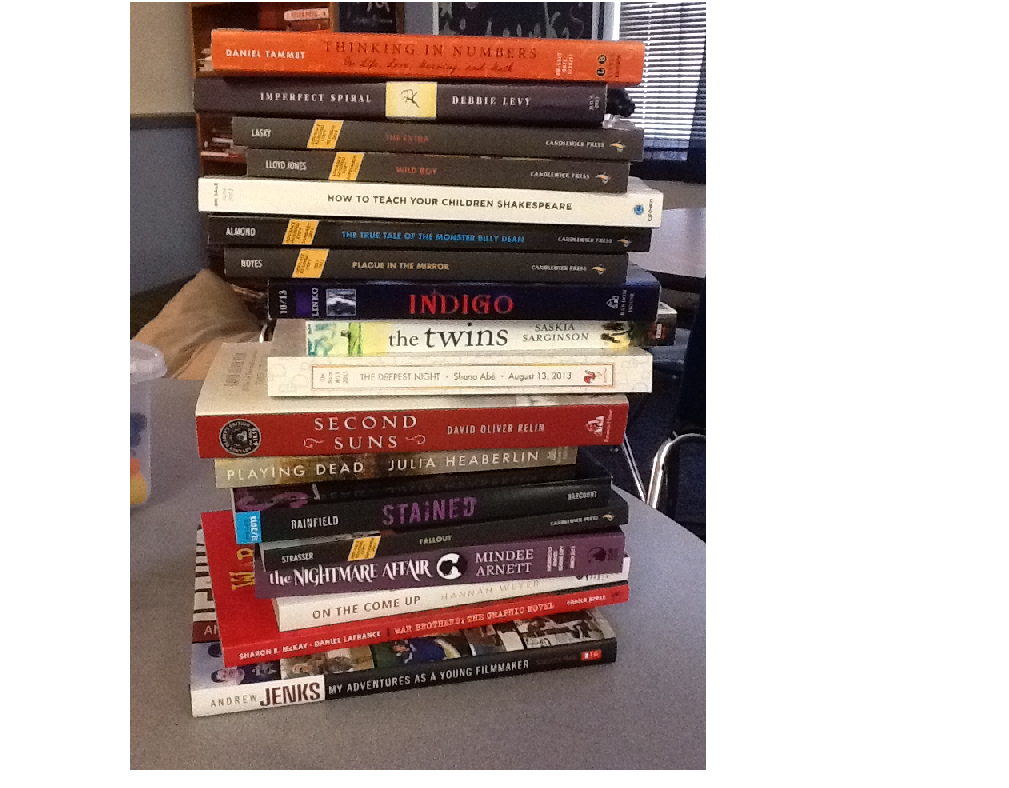
Mon Reading Button PB to YAA couple of weeks ago I crashed the American Library Association annual meeting in Ft. Worth and bought an entrance pass to the exhibit hall so I could get free books. The best $25 I’ve spent in a while. See this new TBR pile?

books from ALA

Now, It’s Monday, and what am I reading? I DON’T KNOW. I don’t know where to start. Do you ever get that I’m so in love, infatuated, so gaga over books that it’s like drowning in your favorite chocolate syrup. That is me today.

So, I will start swimming.

I reach for the book on top, a lifesaver of non-fiction, and my ears start ringing and my heart beats faster. I’m always on the look out for engaging non-fiction, especially knowing that I am returning to the AP English Language classroom next year.

I read the prologue, and I breathe.

I begin chapter one, and I breathe faster.

“In a smallish London suburb where nothing much ever happened, my family gradually became the talk of the town. throughout my teens, wherever I went, I would always hear the same question, “How many brothers and sisters do you have?”

The answer, I understood, was already common knowledge. It had passed into the town’s body of folklore, exchanged between the residents like a good yarn.

Ever patient, I would dutifully rely, “Five sisters, and three brothers.”

Hey, me, too! Well, almost. I have four sisters and three brothers. But still. Not many people can claim they came from a family of so many kids. And while it might not be the most amazing lead to a book, it got me.

So, it’s Monday, and what am I reading?

Thinking in Numbers Is… by Daniel Tammet.  Here’s a review.

Thinking in Numbers

Yes, You Can Do Workshop in an AP English Class

I sat listening to Donalyn Miller the author of The Book Whisperer talk about how she gets her students to read an average of 60 books a year. She talked about student choice in selecting books. She talked about reading herself in order to match books with kids. She talked about creating readers and not just teaching reading. I thought:  “Cool, but how do I do that with MY students?”

I’d just been assigned to teach AP English Language and Composition the next fall, and I was trying to get my thoughts aligned with the expectations from the College Board. At the same time I was in the middle of my three weeks National Writing Project summer institute, and I kept hearing that I must give students time, and more time, to read and write. My head swam.

At one point, I asked Donalyn: “This is all great, but how does student choice and all this reading work in an AP English class when the focus is on students passing the exam?” Honestly, I was put off by her response:  “It’s not all about the test. Is it?” Yes. Yes it is.

Or so I thought at the time.

It took me three years to figure out how to use Workshop in my AP English class, but I have. Mostly.

My Definition of Reading Writing Workshop:  Students do more work than me!

Weekly Schedule

Monday Tuesday Wednesday Thursday Friday
Flex Instruction/ Writing Workshop: Timed Writing Debrief

HW: blog post due

Reading Workshop:

Multiple Choice/Critical Reading

Direct Instruction/ Reading or Writing Workshop as needed Writing Workshop: Timed Writing


HW: blog comment due

Alternate Weeks:

Topic & Theme Flood/Vocab & Current Events

The table shows a typical week in my AP workshop classroom. Of course, there are always interruptions to my well-planned schedule.

Blogs:  Student Own and Class

One of the best instructional practices I have is mandating that my students create and post to blogs. Some kids truly take ownership and write more than I assign; some do the absolute minimum. Some refuse to blog at all. Those are the kids who miss out on the practice it takes to become an effective writer, and most of those do not get qualifying scores on the AP exam. My class blog is Citizen Scholars. You can see how I post prompts that students respond to either in the comments or on their own blogs. To see student sample blogs scroll down my blogroll and click on a few. Some are better than others: Joseph, Sarosh, and Simina’s are quite good. When I give students choice about what they write on their own blogs, I consistently get better writing.

In the fall of this past year, I had students find and read current events of their choice. On their blogs they had to write a response to something within the article they read. I scored their writing based on whatever skill we worked on in class that week, using a generic version of the AP writing rubric. Spring semester I tried something new: students were to move through the modes of writing. They got to choose their topics; one week they were to write a description, another week a compare/contrast, etc.

My students write more than I can ever grade. I might grade one in three blog posts, but the more feedback I give, the better the writing. Using Google Reader and the Flipboard app on my iPad is a simple way to read student blogs. I give feedback on sticky notes. Or, if you get your students using Twitter, they can tweet their blog urls every time they post. Again, using my iPad, I can read their blogs and leave feedback quickly via my own tweets and re-tweets of student blog posts.

Multiple Choice Practice/ Critical Reading

Historically, the part of the AP exam that my students do the worst is on the multiple choice section.  As a result, I’ve tried to include more targeted practice with critical reading. My goal is for students to complete 30 multiple choice practices per year. This is difficult (I think I got through 24 last year) but is proving to be worth it as students’ scores improve. Some variations on multiple choice practice (all can be done in small groups or with partners) include:

  • Students read and discuss the passage, finding rhetorical devices and explaining the effect they have on the piece
  • Students use question stems to write their own questions and/or answers for the passage
  • Students receive the multiple choice questions without the answer choices and must answer the questions in short essay format
  • Students receive only the answer choices and must compose the questions that go with them

When students engage in the “work” of reading, they are absorbed in what I called Workshop. The challenge for me was learning to trust that my students would find everything important within a passage. They surprise me every single time!

Direct Instruction/ Reading or Writing Workshop

I learned from Penny Kittle the value of using professional authors like Leonard Pitts, Jr. and Rick Reilly as mentors. Craig Wilson, USA Today columnist, and Mitch Albom are also favorites. These authors write about high interest, contemporary topics, and their writing is chalk full of the rhetorical devices I want my students to include in their own writing. Some weeks we read like readers–reading articles as we focus on content and comprehension. Some weeks we read like writers–analyzing articles as we identify and discuss the effects of the language the authors use to create their messages. Like Kittle, with students I create anchor charts that hang in the room, which detail the different techniques authors use in the majority of their pieces. In years past I’ve had students write process papers on topics of their choice, modeling the writing of one of our mentors. These are often students’ favorite pieces of writing.

Since time is so limited, students write their drafts outside of class. (Of course, I have to teach them the difference between a draft that they are ready to get feedback on from peers and their pre-writing that they quickly sketch during the period prior to mine. Drives me crazy.) In class, students read, evaluate, and give feedback on one another’s writing as I wander the room and conference with as many students as possible.

Conferencing is the key to creating better writers.

During my larger classes, it is difficult to conference with each student. I often post a sign up sheet with time slots for before or after school. Students may choose to meet with me for a more in-depth discussion about their writing. Depending on the student’s needs, I might make this additional conference time mandatory.

Book Clubs

Since I want my students to become lifelong readers, I try to introduce them to books that they will be compelled to read. The AP English Language exam, unlike the Literature exam, does not require students to be well-versed in any specific pieces of literature. It would be easy to delete full-length books from my syllabus, but in my heart I am still a literature teacher, so I want my students to read good books. I also agree with Penny Kittle:  students must be prepared for the rigorous reading they will have to do in college. If I can get students to spend time reading books they enjoy, perhaps they will be better prepared for the time demand of college reading.

I got the idea of student book clubs from a colleague in a neighboring district. She introduced me to the novel Extremely Loud and Incredibly Close by Jonathan Safron Foer (before the movie) and told me that once I read that book and felt the need to talk about it–because I would, I would understand how Book Clubs could work with my students. She was right. When students read something that is interesting and requires discussion, they will read (instead of Spark Note), and they will be more likely to read more.

My students read a minimum of four books outside of class (not enough, I know.) They choose titles from my short list. While this does not allow for complete student choice, it does allow for a little. I try to select books that have complex themes or subject matter yet are engaging enough that teenagers will find them interesting. Students meet in Book Clubs during class once a week for about three weeks to discuss their books. Then, our focus changes from reading to writing. Students continue to meet with their Book Clubs, but now the clubs become writing groups. Once the books are read, students must write process papers in which they address some aspect of the book they read and write an argument about it, using evidence from the books as their support. Many students find these essays difficult; they are very college-like in that students must “read the book and write a paper about it.”

I conduct many mini-lessons while students are writing these essays, i.e., structure of an essay, semi-colon and/or colon use, periodic sentences, embedding quotes, etc. Students know if I teach a mini-lesson, I expect to see evidence of mastery of that skill within their essays.

Topic & Theme Flood/ Vocab & Current Events

The topic & theme flood is something my team is going to try this year. We got the idea from a trainer from AP Strategies we’ve been working with for the past year. She suggested that since most students know so little about the world in which they live, we need to bring the world inside our classrooms more. Every other Friday students will engage in a discussion about a specific topic, e.g., integrity, belief, power, success. They will read a short passage that focuses on the topic, identify the theme, and then have to “hunt” via the web for current events that relate to that topic and/or theme. Then they will engage in some kind of activity wherein they share the articles that they find. We hope this will help build student background knowledge for the variety of passages that might appear on the exam, and build their knowledge of the events happening in the world around them. We plan to include vocabulary instruction that corresponds to our topics, but that is still a work in progress. Most recently we used a vocabulary list of SAT words, but we feel that focusing on words that would describe tone might be more beneficial–not sure how that will look yet.

_________________________________________________________________________________________________

While I do not have Workshop at an AP level all figured out yet, I love the challenge of trying. I know that students like to think, and they like to be busy in class in a way that forces them to figure things out. Workshop is the best avenue I have found for getting there. The best comment I heard all year came from Daniel, a genius of a kid with a knack for cutting up and getting under my skin. He said, “Mrs. Rasmussen, this is so hard. You make us think so much.”

Yep. Something is working.

Writing Workshop: Assessment and Hope

Students should write more than teachers can ever grade. I heard this first from Kelly Gallagher, author of the book Readicide, a book, among others, that helped me frame my curriculum around Workshop. If I remember correctly, he said that his students write four times more than he grades. Really?

I pondered this for a long while, and I still struggle, but I think I have some of it figured out. I thought for a long time that my students would not write unless I graded what they wrote. Every assignment:  “Is this for a grade?” Every answer: “Yes, everything is for a grade.” The refrain got old.

Then I tried something new: I began writing with my students on the first day of school, and I had some kind of writing activity every single day. I don’t remember where I read it, but when I was researching the work of the reading writing workshop gurus a couple of years ago, I know I read:  if you struggle with time and have to choose between reading or writing, choose writing.

It’s the complete opposite of what I thought:  My students are struggling readers. How do I give up reading when I know they need it? I thought about it more and realized: If I teach writing well, students will be reading. And they will be reading a lot.

So let me explain how this works for me. Remember, I teach AP English Language and Composition (that’s the top 11th graders) and English I (that’s on-level freshmen)–two extremes.

Writing Every Day

There are many ways to get students to write every day. Of course, some ways will get them to take their writing more seriously than others. I find that when I give them an audience, students will put a lot more effort into what comes out their pens. Audience matters!

Topic Journals. Following the advice of Penny Kittle, author of Write Beside Them, I created “topic journals” that students write in once a week the first semester. I bought composition notebooks and printed labels, using various fonts, of the topics: love, conflict, man vs. man, man vs. self, man vs. nature, war, death, gender, hope, redemption, family, romance, hate, promise, temptation, evil, compromise, self-reliance, education, friendship, guilt, doubt, expectation, admiration, ambition, courage, power, patience, fate, temperance, desire, etc. I created 36 notebooks; one for each student in my largest class.

I introduced the topic journals to my AP students first. I set up the scenario:  “I will be teaching 9th grade. I need your help. Do you remember what it was like to be new to high school? nervous, anxious, a little bit obnoxious? I created these notebooks so you could write and give advice to my younger, less advanced students.”

The first task was to turn to the first page in the journal and define the topic. Many looked up the terms in the dictionary or online. They wrote a quickwrite explaining what the topic meant. Then on the next page they wrote about anything they liked as long as their writing fit the topic. I had them sign their posts with their initials and the class period. I told them that they could choose their form (a letter, a narrative, an advice column) as long as they remembered that their audience was 9th graders, and whatever they wrote had to be school appropriate. “If you write about bombs or offing yourself or anyone else, you’re off to see the counselor or the police.” These are good kids, most of them in National Honor Society. They took my charge to help my younger students seriously. This exercise often worked as a lead into our critical reading or class discussion that day, and sometimes students chose a piece they’d started in a topic journal to continue exploring for a process piece.

You can imagine how I introduced the journals to my freshmen. I began by saying, “You know I teach AP English, right? That’s the college-level English class. Well, those students would like to offer you advice about high school, life, and whatever else you might have to deal with the next few years. They are going to write to you in these topic journals. Your job when you see these notebooks on the tables is to choose the one that “calls” to you. First, you will read the messages the older students wrote for you, and then you will respond. Remember to use your best writing.” I then set the timer and had students read and write for 10-15 minutes, depending on the lesson I planned that day. Sometimes I had students share out what they wrote; most often we tucked the notebooks away for another week.

Students constantly fought over a couple of the topics:  love, death, and evil were their favorites. I am certain that is telling (and it did help me when selecting titles for book talks.)

While students wrote in topic journals, I read what students had previously written in the notebooks kids did not select. I’d write a quick line or two in response to something in that notebook. I always used a bright orange or green pen, so students could tell I’d had my eyes in that journal. They knew I was reading them, but they never knew when or what entry. This helped hold them accountable for not only the content of what they were writing but also the mechanics of how they were writing it.

Assessment? Formative. Students have to think quickly and write about a topic on a timed test for the AP exam (11th grade) and STAAR (9th grade).

Blogs

At first I only set up a class blog, and I had students write in response to posts I put on the front page and in response to an article I put on an article of the week page (another Gallagher idea). It didn’t take me long to realize that students would write more and take more ownership of their craft if they created their own blogs. The first year I had students set up blogs I taught gifted and talented sophomores, and I was nervous. Nervous that something would happen:  they’d post inappropriate things, they’d do something to get themselves and me in trouble, they’d be accosted by trolls out to hurt children through internet contact. I chose Edublogs.org as the platform because I could be an administrator on the student blogs, and I had my kids use pseudonyms. This was overkill. Yes, I did have to change two things that year:  one student called his blog Mrs. Rasmussen. I told him my husband didn’t appreciate that much. Another kid used a picture of a bomb as his avatar. Not funny. All-in-all my students did great, and they wrote a lot more (and better) than they ever did for me on paper. I was a stickler for errors and created this cruel scoring guide that said something like: A=only one minor error, B=two minor error, C=three minor errors, F=four or more errors. Students that had never gotten a C in their lives were freaking out over F’s. “Sorry, kiddo, that’s a comma splice. That’s a run-on.” I had more opportunities to teach grammar mini-lessons than I ever had in my career. But see, these kids cared about their grades.

My 9th graders now–not so much. They care about a lot of things, but if I punish them for comma errors or the like, they shut down and stop writing. I learned to be much more careful. Now, I work on building relationships so they trust me to teach them how to fix the errors themselves. It takes a lot more time, but in the end, student writing improves, and students feel more confident in their abilities. I am still working on getting my 9th graders to be effective writers. So far, I have not accomplished that too well, as is evidence of their EOC scores this year.

This past year my AP English students posted on their blogs once a week. I told them that I would read as many of their posts as I could, but I would only grade about every three. I wouldn’t tell them which ones I’d be grading. I let students choose their topics, but since I had to teach them specific skills to master for the AP exam, I instilled parameters. They had to choose a news article that they found interesting, and then they had to formulate an argument that stemmed from that article. The deadline was 10 pm on Monday–every week. This assignment accomplished two of my objectives:  students will become familiar with the world around them, and students will create pieces that incorporate the skills that we learn in class. When I turned to social media to promote student blogs, I got even more ownership from my students.

Assessment? Formative or Summative. Students apply the skills they learned in class regarding grammar, structure, style, devices, etc. Scored using the AP Writing Rubric for the persuasive open-ended question.

Twitter in the Classroom

One of these days I will write a post about the many ways I used Twitter in class this year. For now, let me just tell you:  Twitter was the BEST thing I added to my arsenal of student engagement tools. Ever.

When I began asking students to tweet their blog url’s after they wrote on Mondays, I started leaving quick and easy feedback via Twitter. It was so easy! Kids would tweet their posts; I’d read them; re-tweet with a pithy comment. Within minutes of the first couple of tweet exchanges, students were posting and tweeting more. They were getting feedback from me, and they were giving feedback to one another. They began building a readership, and that’s what matters if students blog. Just because they are posting to the world wide web does not mean anyone is reading what they write. But, a readership, especially one that will leave comments, that’s a whole new story.

Assessment? Formative. Students share their writing and make comments about their peers’ writing. Critical thinking is involved because students only have 140 characters to express their views.

Student Choice. Sometimes.

In a perfect writing class, I am sure students get to choose what they write about every time. This does not work in an AP English class where I am trying to prepare students for that difficult exam. Once a week my students complete a timed writing where they respond to an AP prompt. The guidelines for AP clearly state that the essays are scored as drafts; minor errors are expected. My students must practice on-demand writing. There is no time for conferencing or for taking these essays through the writing process. Unless–we revisit. And sometimes we do. Students are allowed to re-assess per our district grading policy if they score below an 85. 85 is difficult for many of my students, so lots of them re-assess. To do so, students must come in and conference with me about their timed writing. I am usually able to pick out the trouble spots quite easily, and it’s through these brief conversations that I get the most improvement from student writing. Often, instead of conferencing with me, students will evaluate their essays with one another.

I show several student models of higher scoring essays and teach students how to read the AP Writing Rubric. Then, in round robin style, students assess their own essays and at least three of their peers. I remind students not to be “nice” to their friends and give a score that’s undeserved. This will not help anyone master the skills necessary for the AP exam. Rarely do students give themselves or their peers scores higher than I would.

My students also write process papers. For AP reading workshop students choose a book from my short list. After reading and discussing the books with their Book Clubs, students have to write an essay that argues some topic from the book. I model how to structure an essay. I model how to write an engaging introduction. I model how to imbed quotes and how to write direct and indirect citations. I model everything I want to see in this type of writing.

I allow several weeks in my agenda to take these papers through the writing process, and students do most of the work outside of class (not so with my 9th graders).

  • Day one students generate thesis statements, and we critique, re-write, and re-critique.
  • Day two students bring drafts that we read and evaluate in small groups. (I have to teach them that a draft is a finished piece that they are ready to get feedback on–not a quickwrite. So many students type up their rough draft and call in good. This makes me crazy! And I tell them that I will not read their first draft unless they come before or after school or during lunch. They must work on their craft before I will spend my time reading it.)
  • Day three students bring another draft that we read and evaluate again. Sometimes, depending on where my kids are in terms of producing a good piece, I will take these up and provide editing on the first page. Never more than the first page!
  • Day four students turn in their polished papers. I score them holistically on a rubric that aligns with the AP Writing one, or if it’s my 9th graders, I score them on the appropriate STAAR writing rubric.

My freshmen students need a much more hand holding, and we do a lot of writing on lined yellow paper. Most often, especially at the first of the year, they get to choose their own topics. However, I have to give them a lot more structure because on the new Texas state test. 9th graders have to write two essays (about 300 words each): a literary essay, which is an engaging story, and an expository essay, which explains their thinking about a given prompt. Students use the yellow paper to draft during class. I wander the room, answering questions and keeping kids on task. I also try to write an essay every time I ask students to do so. I use these essays as mentor texts in addition to mentor texts I find by professional authors.

Usually I begin class with some kind of mini-lesson if students are in the middle of drafting. I might show students a paragraph with a description that uses sensory imagery and instruct them to add some description in their own writing. Or, I might teach introductory clauses and have students revise a sentence to include one or two or three. This way I am able to get authentic instruction that my students need right there in the middle of their writing time. When I score these student papers, I specifically look for the skills I’ve explicitly taught. If I do it right, I will have read my students papers one or two times during their writing process, prior to them ever turning in their final draft.

Notice I said “if I do it right.” I rarely do it right. I am still learning to budget my time and get to every kid. I am still learning to get every kid to write. I am writing English I curriculum this summer, which I will use in the fall. I hope to get some of my challenges with my struggling students worked out as I focus more purposefully on the standards. I realized this year that while I am teaching writing as a process all the time, I am not necessarily targeting the standards that fit into the process. I am thinking about this a lot lately.

This is still my burning question:  how can I get kids who hate to read and write to participate in writing workshop so their writing improves and their voices are heard?

I am turning to the gurus as I research and think this summer. Jeff Anderson’s book 10 Things Every Writer Should Know has been an excellent start.

Speed Dating in AP English

It’s getting close to AP exam time, and it’s also a time when my students are worn out. They come to class with glazed looks, and the bags under their eyes are often bigger than the sagging of their pants. I try to put on the neon hat and shock them into waking up and staying with me for another month, so any new strategy that tweets my way, I am willing to try.

Flashback to why this strategy matters:

One of the questions on the AP English Language and Composition exam requires students to respond to a prompt and compose an argument in which they use evidence from their own knowledge and experiences to build their credibility and prove their assertion. I tell my kids: You need a big knowledge cloud that you can pluck from during the test. What do you know about _________? Because the more you build your credibility and show that you are thinking on paper, the better argument you will write.

To help build that knowledge cloud, I have to push knowledge, specifically knowledge of a student’s world. If students read or listened to the news, this would be easy—but, most don’t.

My burning question? How do I create a topic dump with current events?

First, I came up with the idea to give students a topic, i.e., freedom, conformity, sustainability. As homework they have to research the topic enough so they can bring a news article to class that reflects that topic in some way. We got this far, and I wasn’t sure what I was going to have my students do with the articles once they found them. Then, I listened in to @dontworryteach, @dlaufenberg, and @mssandersths discussing “speed dating” on Twitter, and I took their ideas and made them my own. Thanks PLN!

Speed Talking with Current Events

Inner Circle faces outward. Each student has read and knows his/ her news article.

Outer Circle faces inward, across from a person in the inner circle.

The students in the inner circle explain their news article to the person facing them. What happened? Why does this matter? How does it relate to the topic of the week? They speak for 2-3 minutes—only about the news article—while the outer circle person listens.

When time is called, the outer circle students think of topics that might be in the prompts given on the AP exam, and they try to figure out how they might use that news article to support an argument that relates to that topic. They speak for 1-2 minutes.

When time is called, students on the outer circle move one seat to the right.

Repeat the process of talking, listening, talking, listening.

Switch places from inner to outer circle about midway into the class period, and repeat the process.

Students repeat their news article several times, which will help them remember it. And, all students are flooded with ideas that they may find helpful in building their arguments for the AP English Language exam.

————————————————————————————————————————————

I asked my students at the end of class today to rate this strategy on a scale of 1 to 10 with one being “It’s horrible. Never make us do this again.” And 10 being “Please let us learn like this more often.” The average rating was a nine. I’ll take that.

Variations: reviews of concepts, terms, pretty much anything you want students to talk about and remember.

I’d love to hear your ideas.