Tag Archives: AP English

He read ZERO books before he came to me. Not Good Enough.

He came to me pretty much hating to read. This tall freshman, eager to talk and laugh, and constantly wanting to do anything else but open a book. He admitted that he read zero books his 8th grade year.

The first book I got him to attempt was Game, a chapter book of about 160 pages that took him four weeks to get through. Every day I had to put a hand on his shoulder and whisper “Get to reading.” Next, he tried Gym Candy, and while he seemed to read it faster, he couldn’t tell me much about the plot or the characters.

Finally, with a stroke of luck, this young man picked up Stupid Fast by Geoff Herbach. I had book talked it a week or so before, reading the first few pages to the class. At the time, R.J. wasn’t interested. When I saw him with this book, I hurried over and practically begged him to give it a try. “Okay,” he shrugged and moved away from the bookshelf toward his table.

Every day for two weeks, R.J. came to class and told me how much he had read. “I like this book,” he smiled at me more than once. He finished this book in two and a half weeks, and then took himself to the bookshelf to find I’m with Stupid. (At the time, we thought this was the next in the series.)

When I finally made it over to kneel by R. J.’s table and conference with him about his reading, he told me that the beginning was hard to read because the main character’s family was “weird,” but he really liked the parts about football. We talked about character development and how the main character Felton changes throughout the book. “He grows up,” R.J. notices. I asked him what kinds of questions he would ask the author if he had the chance, and then I remembered:  I follow this author on Twitter.

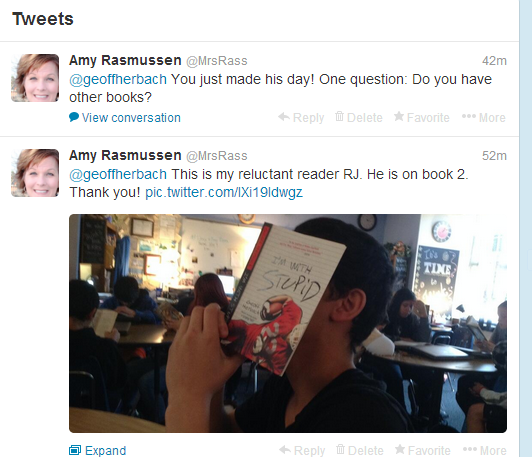
“Hey, R.J., let’s take a picture of you reading this book and tweet it to the author. I bet he’ll respond.”

“No way…. Oh, okay.”

So we did.

RJ tweets to author

RJ tweets to author responses


R.J. left class that day feeling pretty special. He will finish his fourth book this week. His personal reading goal for the whole year was only FIVE.

Now, here’s the really cool thing:  While wondering the exhibition hall at NCTE in Boston, I struck up a conversation with the representatives from Sourcebooks Publishers. They asked if I knew of the books by Geoff Herbach, and, of course, I had to tell them about R.J. Then one of those very sweet insightful women reached under the table and handed me this:

Fat Boy cover

She understands the value of nurturing readers. She’s helped me make a difference in the life of this young man. I wish I could describe the yelp I got when I told R.J. he’d been gifted with an ARC of an ARC — how cool is that?

I’d love to hear your best “Conquering the Reluctant Reader” story. Please share.

Multi-purposing My Quickwrites

Photo Credit: Jennifer

At NCTE last week, Penny Kittle reminded me of the need to consistently share beautiful language with my students. If I ever want them to be able to read it, understand it, and use it in their own writing, I must make conscious choices about voicing that which is lovely. I do a fine job of this right until my students choose their own topics and begin their compositions. Then the room gets stale, and the feeling of “what a chore” begins.

No wonder. I stop sharing short texts and poems. I stop having students respond in their notebooks. I stop allowing them to share their thinking.

While in Boston, I stole a moment with Penny and asked her about my problem, and she simply said, “I keep sharing beautiful language every day.” I must do this, too.

I made a list in my notebook of the things I need to do better when I return to the classroom. Continuing to share poetry and short passages that students can respond to sits at the top of my list, but I want to try to multi-task this activity.

My students are in the process of writing a feature-length article. They chose topics and began drafting before the break. I want them to think about ways to make what they are writing pop into 3D on the page; I want them to see vivid verbs and colorful word choice, and all kinds of devices that they might include in their own writing. My goal is to use poems and passages from now on that will serve several purposes:

1) rhythms of beautiful language,

2) models for sentence structure,

3) examples of figurative language,

4) built-in book talks,

5) questions that aid student thinking about things that matter in their lives.

We will read, and we will respond. We will notice author’s craft as we craft ourselves.

I know, I know, I am slow on this boat. Good planning would make this possible with all my quick writes.  I get that. Thus far, I’ve been a bit disjointed because I struggle with doing it “all:” Independent reading time, quick writes, mini-lessons on craft, grammar, mechanics, student-to-student reading response, reading and writing conferences, book talks. . . I keep most plates spinning, but more and more are crashing lately. My #nerdulation is to do better. (Search that hashtag on Twitter if you don’t have a clue.)

Here’s the passage I will use today. I think it’s appropriate to read a beautiful passage about books since I got a ton of new ones at NCTE. My classroom library welcomes them, but it’s screaming “crowded.” I gotta get a new shelf.

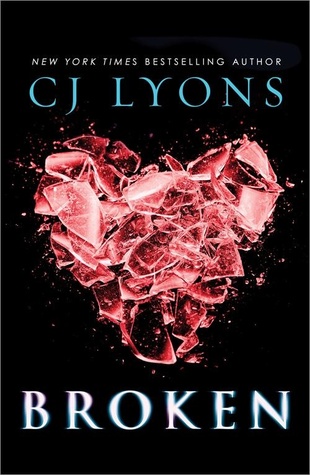
From Broken by C.J. Lyons: 

Kids fill the hall from wall to wall. Despite the unfamiliar press of bodies, I don’t panic. Instead, I let them steer me, like running with a herd of wild, untamed horses. At the end of the corridor, the herd separates into two, leaving me alone in front of a high glass wall.

The library.

Footsteps and lockers banging and voices colliding barrage me. Then I open the door, cross over, and step inside. I’m greeted not by silence, but instead by a hushed burble, relaxing, like the sound of a water fountain. I stand, enjoying the sensations, and take a breath.

School smells so much better than the hospital. And the library smells the best of all. To me, a good book is hot cocoa on a stormy winter day, sleet battering the window while you sit inside, nestled in a quilt.

A room filled with books?

I inhale deeply, a junkie taking her first hit. Sweet, musty paper. Ebony ink so crisp it threatens to rise off the pages and singe my nostrils. Glue and leather and cloth all mixed together in a menage a trois of decadence.

Another breath and I’m drunk with possibilities. Words and stories and people and places so far from here that Planet Earth is a mere dust mote dancing in my rearview mirror.

Hugging myself, containing my glee, I pivot, taking in books stacked two stories high, couches and chairs strategically positioned to catch the light from tall windows lining both sides of the corner, like the bridge of a battle cruiser, broad, high, supremely confident, and comforting. In here, I dare to imagine that I might just survive high school after all.

Respond in your notebook:  Describe a place where you find  peace or refuge?

How do you revision your instruction when you know something isn’t working?

Gifted and Talented Teacher Leaps off Cliff of Faith and Experimentation

Guest post by Tess Mueggenborg

Make no mistake about it: I’m a classical canon gal.  Always have been, always will be.  And when I say “classical,” I also mean “really old” – few things written after 1650 hold much interest for me.  Favorite work of literature? Milton’s Paradise Lost.  Favorite time period of literature? Early Roman Empire (Ovid & Virgil).  Favorite English Lit class from my undergrad days? Greek Tragedy.

But as much as I love the canon – and I’ve had surprising success with teaching the canon in the past – I’m also a pragmatist.  I know that what I love isn’t always what’s best for my students, and their learning should take priority over my passions (I know … radical idea, right?).  I also acknowledge that the real world in which I live and work is far from my ideal.  Would I like to devote all of my class time to discussing Beowulf and Canterbury Tales?  Of course.  But can I realistically get my students to read and engage with these texts, and develop a passion for them?  Not likely.  Some, of course, will – and I’m happy to guide them on their own paths of classical literature studies.  But I bet (I hope) that those students will wind up as English Majors, and they’ll get their fill of such works in college.  I must work with the students I have, not the students I wish I had.  And the students I have are awesome: bright, curious, hungry for meaningful learning and wisdom.  So this classical pragmatist has started to break her own mold.  Here’s how …

I teach a class known as World Experience; it’s for Gifted and Talented sophomore students, and it combines AP World History with literature.  The history drives the course – it sets the pace, scope, and sequence for the year.  It’s then pretty easy to match up literature with the corresponding time periods.  leap off cliffAncient River Valley civilizations at the start of the year? We read Gilgamesh and Horus the Hawk.  Classical civilizations come next – that mean Antigone and a few selections from Metamorphoses.  Next up is the Medieval period … and this has always been a struggle.  I love Medieval lit, I can read Middle English, and I can wax poetic on the virtues and merits of The Song of Roland and Sir Gawain and the Green Night ad nauseum.  And while the students usually enjoy these stories, they don’t usually get much out of this unit in terms of literature.  They don’t learn much about author’s craft, they can’t do much literary analysis, and they become so frustrated with the archaic language of the text that most of them give up … and it takes me another six weeks to pull them back into literature.  So this year, I’ve scrapped all this, and leapt off a cliff of faith and experimentation.  The results have been pleasantly surprising.

Our district head of English Language Arts was kind enough to buy $600 of books for my classroom library.  I got to choose every one of them: all award-winners (or by award-winning authors), all world literature, all contemporary, all high-level.  No softballs in this classroom library – these are, after all, GT students.  Each student got to pick a book (this was a time-consuming and sometimes contentious process, but it certainly got every student interested in the books and invested in their choice).  Once a week, they’ve been blogging about their novel, based on someone generic questions posed by me.  Some of the questions are just opinion (Do you like this book so far? Why or why not?); some of the questions are analytical (Who is the main protagonist of your novel? What problems do they encounter in the course of the novel? How do you predict they will resolve these problems … or not?); some relate back to the history half of the course (In what ways does your novel relate to the history we’ve studied so far this year?).  Some responses have been good.  Some have been profound, moving, passionate, and elegant.  None have been outright bad, and none have been missing.  That’s right: NONE have been missing.  Every student has been reading and blogging.  Even the student who earned a grade of 9 (yes, a single-digit 9) for the first 9-weeks is reading and blogging about her novel.  I’m calling this experiment a success.

To be fair, I should say: this hasn’t been easy, and it hasn’t been without challenges.  But they’re good challenges, and not insurmountable.  Some students read their novels in a week – and then wanted to borrow another book.  YES!  Many students didn’t devote enough time to reading their novel, and they’ve fallen behind.  But they haven’t given up: they’re still reading.  I haven’t had any complaints of “this book is boring,” though I’ve had many complaints of “this book is so sad/depressing/pessimistic/disheartening.”  Which has led to some great discussions about the point of literature, analysis of tone, and some hefty doses of maturation (I’m pretty sure the girl who read The Kite Runner in a weekend has been inwardly weeping for two weeks now).

We’re wrapping up this unit, and thus this great experiment.  And I think it bears repeating: I’m calling this experiment a success.  Enough of a success that I’ll be spending this weekend revamping the next unit (which starts Monday) to include more student choice and incorporate more of these novels, though in a slightly different fashion.  Stay tuned.

Am I still a classical canon gal? Heck yes. Always have been, always will be.  But my students don’t need to be classical canon fans – they just need to be readers, eager to engage with the world and its complexities.  I think they’re well on their way.

“Professor” Tess Mueggenborg teaches English (and anything else with which her students need help) at RL Turner High School.  Her academic passions lie in comparative language and literature.  The Professor lives in Dallas with her husband, Jeff. Tess’ on Twitter @profmueggenborg

When a Student Tells You What to Teach: Sweet

I mentioned before that I gave a Pulitzer Prize winning novel to one of my AP English students recently. He gave it back to me three days later.

“Did you read it?” I asked.

“Well, I tried,” he said. “There’s just too much description. I couldn’t get into it.”

“What do you mean?” I asked.

“I don’t know exactly, but it’s the kind of book you should pull passages out of and teach with,” he said.

Okay, then.

I still haven’t read the novel Tinkers by Paul Harding, but I did take a look to see what Levi meant. (He’s a bright young man–taking both AP Lit and Lang his junior year.)

Just read the first page. You’ll see what I did.

Yes, I can teach some skills with this. It’s beautiful, and now I’m reading it– on the lookout for mentor slices that engage and inspire great reading and writing.

Screen Shot 2013-11-03 at 10.02.26 AM

Part II. In an AP Class, Shouldn’t It Be about the Reading?

Angels sang to me again today. This doesn’t really happen too often, but when it comes to awesome adventures with students and books, the choir starts belting out in fff.

Based on the feedback to my post on Wednesday, I know many of my peers feel the same way as I do about AP students and reading–or not reading–as the case may be. I appreciate the comments and the emails and the encouragement. (I gave a student the Pulitzer Prize Winner Tinkers today, and another one asked for a copy of The Great Gatsby with no prompting from me whatsoever. I know I am doing something right here.)

I’m pretty much the advocate for independent reading on my campus. I talk about it every chance I get: slip it into a conversation here, there, and everywhere. Sometimes the words work their way into another teacher’s thinking, and Hallelujah! the angels bust out in song.

Read this email I got from my friend, Tess Mueggenborg. She teaches our gifted and talented Globesophomores in a special humanities course, which combines AP World History and Honors English II, and AP Literature. She and I share a lot–some things curriculum related, other things not. When we first worked together six years ago, it was as a team teaching the G/T course: me English/her history. I can tell you this:  Tess loves classic literature–some of which I’d never heard of. Gilgamesh, Horus the Hawk. Sigh.

For the past few years Tess’s heart’s been changing (I say that tongue in cheek because her heart is shiny gold), and she’s allowed for much more student choice in all her English classes. This fall she asked for funds to create a World Literature library of contemporary and complex books for her advanced students. Our ELA coordinator granted the request, and. . .

Read this. You’ll hear the choir.

_____________________________________________________________________________________

Thought you might like to hear (and read) what’s going on with the new novels in World Experience … Last Friday, we had a day of “book speed dating.”  The students had about 60 seconds with each novel, and if the book interested them, they put a sticky note with their name on the back cover.  Then we divvied up the books, which proved to be arduous but entertaining.  Some of these kids were REALLY passionate about which book they ended up with! Today, they had their first assignment (other than “start reading!”) – a blog post.  Here are the questions I posed:

By now, you should be 1/4 to 1/3 through your novel (if not more!).  Based on what you’ve read thus far, answer the following questions on your blog.

1. How many pages are in your novel?  How many have you read?

2. Who is the protagonist (main character) of your novel?  What is the main conflict this person faces?  What are some possible outcomes that you foresee for this person?  (In other words: guess the ending.)

3. In a well-developed paragraph (with text evidence), respond: so far, what do you like about your novel?  What do you not like about your novel?  Why? Explain.

4. Based on what you’ve read thus far, would you recommend this book to someone else?  Why?  Explain.

5. Pick ONE quote that has stood out to you from the novel.  Give the quote, then explain: what made this quote stand out to you?  How does this quote relate to the whole novel?

And here are the links to several of their blogs:

Chris is reading Transatlantic: http://keyboardandseafood.wordpress.com/2013/10/24/transatlantic-novels-assignment-part-1/

Neha is reading The Namesake: http://neha614.wordpress.com/2013/10/24/assignment-for-1024-the-namesake-part-1/

Nico is reading All the Names: http://nicolasrequena28.wordpress.com/2013/10/24/novels-response-1024/

Rafael is reading Enrique’s Journey: http://parrarafael872.wordpress.com/2013/10/24/enriques-journey-part-1/

Angelica is reading Girl in Translationhttp://perezangelica477.wordpress.com/2013/10/24/novels-part-1/

Aaliyah is reading The Secret Life of Bees: http://aaliyahgonzalez.wordpress.com/2013/10/24/novels-part-1/

Overall, I’m really pleased with the results I’m seeing thus far!  Many of the students aren’t as far into their books as I had hoped they would be, but they all seem genuinely interested to keep reading.  I’m definitely getting more traction with these novels than I have with the literature I’ve done in the past for this unit (“Sir Gawain and the Green Knight,” plus Islamic and Chinese poetry).  Next week, I’ll start having them tie the cultural content of their novel to the things they’ve learned about World History thus far.  I’m VERY curious to see how that goes!

_____________________________________________________________________________________

I ran down to Tess’ room the first chance I got. I was too excited to respond in an email. The books Tess filled her shelves with are rich and diverse. Here’s her list: World Literature Library

As I left her room, one comment made me smile:  “I’d still be using the classic lit, if the students would read them.”

And that’s my point: In an AP Class, Shouldn’t It Be about the Reading?

In an AP English Class, Shouldn’t It Be about the Reading?

This is my fifth year to teach AP English Language and Composition. Every year I can pretty much predict during the first grading period which students will pass the AP exam with a qualifying score. See, my campus practices true open enrollment: any student that wants to challenge herself with PreAP or AP classes may. We have no prerequisites. Any student that demonstrates a strong work ethic, attends tutorials, and tries hard can pass my class, but she may not pass the AP exam in the spring– if she is not already a reader.

Photo by Seasonal Wanderer

It’s a lack of reading skills that gets students every time. The multiple choice portion of the test is a killer with four to five passages and usually 55 questions, which must be answered in 1 hour. I can teach test-taking skills that will help my students do better on this part of the exam, but if a teen is not already a reader when he comes to me, I can rarely help him learn the vocabulary and critical reading skills needed to score at least 50% of the questions correctly (the minimum goal for the mc portion of the test). I’m a pretty good teacher, but the AP exam is difficult, and my magic wand only has so much power.

Many of my students do not come from homes with reading role models. Their parents are hard working immigrants who do not have funds to invest in books. Quite simply, most do not identify themselves as readers. Of course, there’s the few. The students who had an older sibling or a teacher or a librarian (or sometimes a parent) push books into eager hands. These are the students I predict will find success on the AP test come May.

For four years I’ve tried to figure this out:  If it’s the readers who can pass the exam, how can I get more students to be readers? It should be simple.

I tried the classic route. It simple didn’t work. I used to assigned six novels, all the best-loved American literature; and just this summer in a brief Facebook exchange, a former student confirmed what I already knew. She said, “I loved the class, but I didn’t read one book.”

She was not the only one, and my feeble attempts year after year to get students to read, and their feeble attempts year after year to pass my assessments, proved that the classic route was not taking my students on the road they needed to go. They still weren’t readers.

I assert that most high school students do not read the assigned texts, especially classic novels that they can read about online–learning just enough to join a class discussion, write an essay, or pass a test. They might learn the gist of the novel, maybe even get the jokes alluded to in pop culture, but they are not reading.

And that is what I want:  I want to foster readers.

Yesterday I sent out a tweet:

I’m spending grant $. Please, what are the hottest reads in your HS English class library? Thanks for sharing titles. #engchat

Many people responded with several titles i didn’t know, and my shopping list got longer. But I also got this response:

XXXXXXXXXXXX 21 Oct (I deleted the name to protect the not so innocent.)

@AmyRass My Juniors are reading: Huck Finn, Moby Dick, Scarlet Letter, The Road, Gatsby, Things They Carried, Other Wes Moore, Catcher

I responded with this:

@xxxxxx Thanks for sharing. Great books. Are they reading those titles as free choice? If so—impressive.

And the answer was this:

@AmyRass They are chosen from a list we gave them. I also am fortunate to teach some very bright students.

Hmmm. I wish I could poll those students. I’d bet my farm, if I had one, that very few are actually reading those books. To roughly quote Don Graves: “Choice without [a kind selection] is no choice at all.”

I do things differently. I’ve abandoned the whole class novel like I allow my students to abandon books, (although I know there are some cases when reading the same text can lead to useful instruction. Don’t hate.) My students read during the first 10 minutes of every class. I talk about books as often as I can. I add new books to my shelves that I know students will read. (I bought three copies of Allegiant this afternoon because I know Ashley, Kathryn, Sierra, Adrian, and Diego are waiting. There will be a clamor in the morning.)

Is it hard to devote 10 minutes of a 50 minute class period to reading? Yeah, at first–when the traditionalists tried to drag me back to the dark side. Then I had my students blog about their reading lives over the last seven weeks. So many of them wrote about how they’ve read more books in seven weeks than they read the whole of their sophomore year. Three, four, five books. Already.

I am glad they are reading YA literature. I know it doesn’t have higher-level vocabulary. I know that it doesn’t have sophisticated syntax. I also know that my students like it; they are reading after all.

This quarter I will push students into harder texts. Just yesterday, I put a stack of memoir, historical fiction, non-fiction, and classics on every table, and I talked books. I challenged students to add to their What To Read Next list, and I gave descriptions of characters and hints at plots. I’d like students to read a sampling of different genres–try a graphic novel or a NY Times Bestseller–because so many teens don’t know what they like–yet.  If they don’t meet the challenge? It’ll be okay, as long as students keep reading.

Today Yulissa asked for Cut. Luis asked for Unwholly. Esmeralda read A Child Called ‘It’ in 24 hours and went straight to A Man Called Dave when she walked in the door. Anthony started reading The Lord of the Flies, and Stephany asked for an award winner, so I gave her a stack of six to sort through–all had Printz or National Award or Pulitzer emblems. Tomorrow will be similar. We’re nine weeks into the year, and reading’s become routine.

I may not be able to give all my students the skills they need to master the AP Lang exam, but I am giving them the time they need to plant the seeds of those skills. They’ll sprout and take root and begin to grow, and maybe, just maybe, my students will have the stamina they need to succeed in college, and, maybe that stamina will help them succeed in life.

That’s more important than an AP exam anyway.

I’d love to know the reading habits of the AP English students on your campus. Are they (fake) reading? or really reading?

Authenticity: Making it Real with Student Blogs

North Star of Texas Writing Project (NSTWP), in which I am a teacher consultant, asserts that authenticity is connecting student learning with significant audiences, tasks, and purposes.

image

Blogging with my students is one way in which I make that connection happen. Writing posts and commenting on the work of our peers has become an integral part of my readers/writers workshop classroom.

photo: Petras Kudaras

During the second week of school, once schedule changes calm down a bit, I introduced the idea of blogging to my students. This year I wrote a post on my class blog and imbedded an article that made them see that blogging can have value to their futures. You can see that here.

I’ve had students use Edublogs as their blog platform in the past, and I know some teachers have their students use Kidblogs. I decided to go with WordPress this year. I thought using the “real world” blog platform would be a good idea. You know, just in case some students loved the idea and kept writing long after they leave my classroom. Finally, eight weeks into the school year, I am glad I went this route, but the set-up, especially with my 9th graders took a lot longer than I’ve had to spend in the past. (Most of my students are not as tech savvy as many technology advocates would like to believe. For more on that read this post:  Digital Novices vs Digital Natives.)

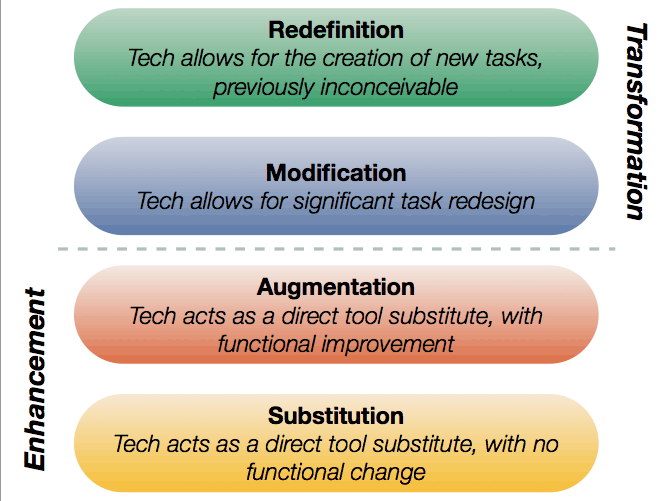
These are some ways I’m transforming my teaching by using student blogs this year (See this SAMR model for ideas on instructional transformation):

Timed Writing. I need students to be able to think quickly about a topic, organize their thoughts, and write effectively in a short period of time. Years ago I had students complete timed writings on paper with a pen, and I’d take the stack of essays home and laboriously grade them. By having students post to blogs, my classroom is getting close to being green. We do very little writing on paper anymore. I can read student posts with the swipe on my finger on my iPad, and I try to leave comments that inspire improvement in their writing. Sometimes I put the score from a rubric. Most times I say something I like about what students have written. They like that kind of feedback best, and it usually prompts some kind of improvement in their next post–something that rarely happened with the marks of my red pen.

For our first timed writing, students wrote about their reading lives. We spend 10 minutes at the beginning of each class period reading our self-selected books. I conference with each student, brief one-on-one chats. I learned more while reading student posts about their reading habits than I did in the prior eight weeks of school. I posted a reflection of my own reading life on my class blog with the actual assignment, and then students wrote on theirs. The response to our wide reading warmed my teacher heart. Read a few of these students’ posts, and you will see why: Helen–A Path Led by Wise Words; Gina–Lay Down the Bridges; Mian–A Passion for Books; Emilio–Reading Life

Our second timed writing, students wrote an argument in response to our in-class study of Ralph Waldo Emerson’s “The American Scholar.” Some student posts were thoughtful and wise; most were ineffective and needed major revisions. All students wrote and showed what they’d learned from their reading and our class discussions.

Persuasive Practice. The AP Lang exam and the 10th grade STAAR test both require students to be effective persuasive writers. I like this blogger’s post:  Blogging is the New Persuasive Essay. As I teach my students how to use persuasive techniques, I also want them learning about their world. They have to know “stuff” to build their credibility after all. So every Monday my students write a post that they base upon something they read in the news. They scan headlines until they find a topic that interests them. Then they pull an idea from the article, and then they write an argument based on that idea. So far, we haven’t delved too deeply in the art of persuasion; we’ve talked mostly about form and structure and a few rhetorical devices, but some of my students have taken ownership of this weekly recurring assignment. Here’s a few to give you an idea:  Kathryn–Words Hurt; Ashley–Recycled Look or Recycled Lives; Jason–Smoking is Safer? Impossible; Adrian–Chemical Mistakes

Published Polished Pieces. As we move through different genres of writing, I need my students to fully immerse themselves in the process of creating effective and moving texts. We started the year with a focus on narrative. I know, it’s not on the AP exam or the STAAR test anymore. But story is so important. It’s what connects us as humans, and it’s story that has helped create a classroom community where students are not afraid to take risks and throw their hearts out on the page. While a few student narratives are not as polished as I would have liked prior to publication (grades being due always seems to interfere with authenticity), if you read just these three, you’ll see why story is important. I can be a better teacher to these PreAP students because of what I know from these posts. Esmeralda–Memories; Mercedes–What Do You Think About Moving? Bryanna–Why Batman?

I remember learning from Kelly Gallagher that students should write more than I can ever grade. Well, of all things in my teaching life, I’ve finally figured that one out the best. I cannot read every post my students write, but I can read a lot, and I can give a lot of feedback in a way that is meaningful so that students respond. We just started reading and leaving feedback for one another. I can already tell that this will be more valuable than just me giving feedback. After we spent two class days reading one another’s narrative posts, I had students tell me on their own narrative evaluations:  “I knew I could do better after I read other people’s.” For an example of our student feedback, read the comments on this one: Amy–Forever a Bye. The instruction I gave students was 1) Be polite but honest, 2) Bless something you think the writer did well, 3) Press a moment that needs more detail or description, 3) Address an issue of concern in regard to style, grammar, etc. For our first time, I’m proud of these students for the feedback they gave their friend.

Engaging student writers is often more than half the battle. So many times they have the attitutde “What’s in it for me?” By allowing students to choose their topics, and allowing them to express their true and authentic voices, I get better participation, and I get better writing, and I get to know the hearts and minds of my students.

That is all I ever really want.

photo: Dee Bamford

#NCTE13  Writing Teachers (Re)Inventing Literacy Instruction by Following the North Star

Reel Reading for Real Readers: The Lowland by Jhumpa Lahiri

20130207-190708I’m starting an Award-Winning Books Only shelf. (Okay, maybe award winning authors, too.)

Since I am teaching only advanced classes, and since I am allowing students choice in pretty much anything of length they read, I want to be able to challenge students to take a step up the ladder to more complex texts than the YA literature they so readily pick up. Not than any student, advanced or otherwise, shouldn’t be challenged; not that YA is not great reading for all students. But, you know, I am supposed to provide the rigor for an AP class as required by the College Board.

I want Pulitzer Prize Winners and National Book Award Finalists and Man Book Prize Winners.

I want students to take on the challenge and the feeling of accomplishment of reading a Prize Winner.

My list of award winners is long, and it will take me even longer to purchase all the books I want. But I’ve started, and The Lowland by Jhumpa Lahiri, a Pulitzer Prize Winning author, is the fifth on my shelf.

See the author talk about this Man Booker shortlisted title here: 

My Workshop is Kind of Like Goldilocks and the Three Bears

ocsWhen I first got my teaching assignment for this year, I was a little overwhelmed, although I probably shouldn’t have been:  I chose to have three preps. Yes, I chose three preps. Crazy, right?

I’ve never had the exact same assignment two years in a row, which definitely has its pros and cons. (I was recently diagnosed with ADHD–at 48–I know, right?–so the changes have worked pretty well for me.) I don’t mind the planning. I don’t mind the difference in student maturity. I do mind not feeling like I’ve ever done anything really really well.

It’s not like you can get everything perfect in every lesson in every class throughout a whole year. So I keep notes of what worked and what didn’t, and I make plans to bend and stretch, tweak and toss things the following year. I am rarely satisfied and always looking for improvement  I’ve just never had the chance to practice my new and improved plans.

Until now.

But it’s not what you are thinking.

It’s a bit daring, and I appreciate my administrators for trusting that it will work, but I am teaching all three of my preps the same lessons in the same way–almost every day. My Pre-AP English I class gets the same instruction and the same assignments as my Pre-AP English 2 classes and my AP Language and Comp classes. See, I have my own built in vertical alignment, and I can teach the same skills–sometimes a little slower, and usually with a different expected outcome–to all of my students at all three levels.

“What about the differences in the standards?” you might say.

Well, look at them. They really aren’t that different. The real differences are in the depth and the complexity of how our students show us mastery of a skill. Reading and writing is still reading and writing at any level, advanced or otherwise.

Mine is a readers/writers workshop, and students lead with choice. They choose what they want to read, and they choose what they want to write about in their assignments. I facilitate discussions around mentor texts, and they model the professionals in their writing. I talk about books that beg to be read, and they open the pages and read them.

Take for example their first major writing assignment. We’ve been studying narrative. (Please do not say, “But there is no longer a literary essay on the STAAR test.” Yes, I know.) Think about the power of story. It’s the thread that wraps us all together, the binding that prevents our civility from turning to chaos. And, oh, the relationship builder our stories become as we share our souls in our learning community! We learn to relate and empathize with people who might be vastly different than we are. We grow as individuals and as peers. Not to mention the feelings of accomplishment students have when they produce a piece from the heart and are successful at it at the beginning of the year. Every literary device we want students to know, understand, and use can be modeled in narrative mentors. Every literary device we want students to be able to produce and analyze for AP English exams can be taught in a narrative unit. Why would we jump right into rhetorical or literary analysis, when we can get so much growth from passionate personal essays?

I know it’s early in the year, and I haven’t been trying this approach out for too long. I get that my high hopes might deflate and plop right on my desktop. But right now, my students are engaged. They are reaching to meet my expectations. They are thinking. And that’s what I really want.

If I can get my students to think–well, that is my personal definition of rigor. And isn’t that what an advanced class is supposed to be?

So about practicing and improving my plans? This year I get to do that every single day while the learning is happening instead of my reflection afterward. It’s kind of like Goldilocks and the Three Bears, except better. My students get to taste a rich and authentic approach to learning, and I get to differentiate depending on their individual needs: too hot or too cold until I get it just right.

Websofsubstance.com by Harry Webb

I spoke to a good friend this morning. She, too, has three preps, and she’s trying to streamline. She and I share the same perfectionist tendencies, and planning and planning and planning to come up with the “just right” instruction for all three levels is exhausting. There has to be a better way.

I’m pretty sure I’ve found it.

What do you think of using the readers/writers workshop model to teach all levels the same skills in the same way at pretty much the same pace?

Reel Reading for Real Readers: Outliers by Malcolm Gladwell

20130207-190708If we invite author’s into our classrooms, they can become personal coaches for our students. I will introduce the book Outliers to my students with this CNN interview between Anderson Cooper and Malcolm Gladwell.

First of all, Gladwell’s an interesting looking character that’s for sure, and really, who wouldn’t want to read a book by a guy who is so interesting AND articulate?