What Janitors Can Teach Us About Getting Kids Into the Reading Zone by Amy Estersohn

guest post iconI love pop-psych self-help books.  I love books written by professors.  This book, by University of California professor Sonia Lyubormisky, happens to be both.  I love this book so much I bought a second copy because my first copy had too many post-it notes on it.

Lyubomirsky claims that happy people often achieve a state of “flow” and understand how to make flow happen.   We are in flow when we are absorbed in an activity that is not too challenging and not too easy for us.  In flow, we lose our sense of time completely: we are not bored, we are not anxious, we are not thinking about whether Trader Joe’s will have our preferred frozen meal in stock by the time we get there.  

IMG_0492If you’re like me, you read this description of flow and thought, “Oh, that’s just another word for the reading zone, only made more general for activities that aren’t reading.”

It’s easy to assume that flow experiences are reserved for avid tennis players, chess enthusiasts, artists, musicians, doctors, athletes, and others who have been able to live a lifestyle that caters to their interests.  However, research shows that even janitors can experience flow at work.  

“Other [janitors], in contrast, transformed the job into something grander and more significant.  This second group of hospital cleaners described their work as bettering the daily lives of patients, visitors, and nurses.  They engaged in a great deal of social interaction (eg. showing a visitor around, brightening a patient’s day), reported liking cleaning, and judged the work as highly skilled.  It’s not surprising that these hospital cleaners found flow in their work.  They set forth challenges for themselves– for example, how to get the job accomplished in a maximally efficient way or how to help patients heal faster by making them more comfortable” (Lyubomirsky 188-189).  Original research here.

Lyubomirsky believes that habits of mind like these are teachable and trainable.  Here’s what developing them can  look like during a reading conference:

The conference move: Critical Shopper

How I do it:  I’ll ask a student if she would recommend the book she is reading for a classroom library or book club set purchase.

How it supports “flow” or “reading zone”: It gives readers a reminder that reading can have a larger social purpose, and the more engaged they are in their reading lives, the better they can improve the reading lives of their classmates.

What I learn about the reader:  I learn about how a reader can engage critically with a text and can provide text-based evidence for a claim about whether a book would or would not make a suitable classroom library investment.


The conference move: Younger Sibling/Cousin

How I do it:  I ask a student what their younger sibling or cousin would say the book is about were he or she to read the book that the student’s currently reading.  Then I ask the student what he or she thinks the book is really about.

How it supports “flow” or “reading zone”:  It reminds readers that there are more ways than one to read a story, and that good stories beg to be shared with family, friends, and loved ones.

What I learn about the reader:  I learn about a reader’s ability to grasp themes and ideas in a text.  When I start off with, “What would your younger sibling say?” I expect the reader to give me plot summary and basic character traits.  Then, when I ask them for what they think the book is really about, it subtly lets the reader know that there are additional ways to answer this question.


The conference move: Goal-setting

How I do it: I ask students to set a goal, and I ask how I can help the student achieve that goal.

How it supports “flow” or “reading zone”: Just as the janitors who experience flow play an active role in setting their own goals, allowing a reader to set his goal gives him an additional purpose and meaning to his reading.

What I learn about the reader: I learn about a reader’s assessment of her own reading strengths and weaknesses.  Often the goal a student sets for herself is the same goal I would have chosen for her were I asked to make one.


The conference move: Remember when?

How I do it: I ask students to recollect a time when they were in “the reading zone.”  Sometimes I will use their reading log or my memory of their reading to jump-start this conversation.

How it supports “flow” or “reading zone”: By noticing and naming the characteristics that are associated with the reading zone — everything from body positioning while reading, the feeling of “Just one more chapter!”, the sensation of the pages flying by — we can celebrate the reading zone and try to make it happen more often.

What I learn about the reader: I learn about a reader’ self-awareness, and I learn what books got them in the zone, so I can recommend more books just like them!


Amy Estersohn teaches in New York.  Her classroom overlooks the parking lot where she learned how to drive.  She tweets about books at @HMX_MsE.

Try it Tuesday: Taking Your Classroom Library Digital

Spring break in Wisconsin is sort of a misnomer. Thank the heavens, it is a break. Time enough to make to-do lists that are far too long to actually do, but blessedly, reading time abounds and my tented texts are multiplying.

IMG_0216

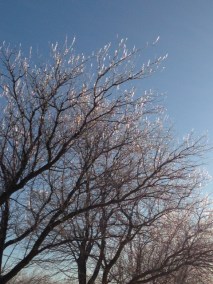
Ice covered trees just last week

But Spring? Not so much. Not usually. The cherry blossoms may be bursting into bloom in Washington and roadtrippers to Florida are finding warm sunshine and sand, but in Wisconsin, we’re a bit…behind.

Mother nature likes to tease Wisconsinites. Sixty degrees one day and snow that evening. Literally. My toes are cold just thinking about it.

However, as is the eternal promise of rebirth in spring, there are signs. Robins have returned, tiny buds are appearing on the trees, and the first flowers have pushed their tiny heads above the snow and suggested that warmer weather really might be on its way.

FullSizeRender

Crocus braving the elements

And so, with the hope that warmer days might actually be on the horizon, I get the undeniable and somewhat inexplicable urge to clean, organize, and pull my brain out of the numbing chill of winter. Throw open the windows (brr!), place hands on hips, and get to work. You’ll recall my to-do lists mentioned earlier? Several closets are in my sights and I geekishly delight in the thought of heading to the Container Store to finally wrangle the toys my daughter received for Christmas.

In the same way, before break, I surveyed my classroom (hands on hips and a waning desire to grade papers) and decided to tackle my number one organizational nightmare.

Mainly? My classroom library check in and check out.

With a recent influx in books for this library, there is excitement, variety, and chaos.

It’s new. It’s wondrous. It’s a big, ugly, mess.

As students clamour for new books (Yay!), their attention to our sign-out sheet has gotten messy at best, and completely ineffective at worst.

I was getting emails from kids weekly – Hi Mrs. Dennis, I accidently walked out of class with the book I grabbed. Could you sign it out for me?  or  Mrs. Dennis, I stole one of your books. Well, I didn’t steal it, I’ll give it back, but I have it and didn’t sign it out. Is that ok? 

Please, steal a thousand books if they are going to get read. However, it’s tricky. I can’t find books I thought I had. Students look for a texts and I don’t know if they are there or not. I go to book talk a text and it’s nowhere to be found.  #biblioissues.

But short of a full library scanning system and detectors that wail if you try to take out a book that’s not checked out, I was sort of at a loss.

So I turned to my friend Google, in search of different ways to handle the blessing of enthusiastic readers. And what I came up with has worked really well for my students that don’t always remember to sign books in or out during class, as they can now take care of it both in class and out.

I wanted it to be simple and provide me with some insights into both my students and the texts they choose. I needed to be accessible and easy for kids to use too. And, I wanted to try and create something that would run itself.

Enter – Google Forms.

Below, you’ll see the steps I took to digitize my classroom library, quickly and easily. 

  1. Create a Google Form that students can access easily. Forms provide you with a URL that can be sent to students’ email, pasted to a digital class syllabus, and/or shared on a class website. Once students fill out the form, all of the data is collected on a spreadsheet that you can alphabetize by student name, book title, or any category you like.

    Library 1

    The opening page leads students to differing questions depending on their need

  2. Differentiate questions on the form to gather the data you want. Below, you’ll see the questions I asked depending on whether a student was checking a book out (tell me what you are taking) or checking a book in (tell me how the reading went).
    • Checking out a book, I’m just looking for the basics:

      Check Out

      The basics so that I know where the book went.

    • Checking in a book, I’m looking to see if a student successfully completed the reading or didn’t, and why.

      Sign In 1

      The first page of the check in.

    • If students abandoned a book, I’m looking to find out why and if they successfully completed the book, I’m interested to find out what they thought.
      Abandon

      Reasons a student might have abandoned a text.

      Finished Book

      Insights once a student finishes a book.

  3. If you want it used, place the link to this form everywhere! I have the form linked to the top of my digital syllabus, I sent the link to students to save via Remind, I emailed it to their school account, and I made QR code for my classroom wall that students can scan, taking them directly to the form. Library Mangement
  4. Much like a mini reader’s conference, read what students are saying about they are reading. In the few weeks I have been asking students to use this form, I have taken away several key insights.
    • Book talks ARE making a difference. 

      Screen Shot 2016-03-28 at 9.56.27 PM

      Forms gives you data to help guide future text selections, book talks, and recommendations.

    • Students do read more simply because we give them time! Several students commented that they picked up a book for in class reading and then checked it out to keep reading.
    • Kids care about what their peers are reading. In the section where students suggest why they choose a book, many suggest that hearing their peers talk about a book, or simply seeing someone else read it, piqued their interest.
      Screen Shot 2016-03-28 at 9.57.24 PM

      You can take a look at student responses by submission, or…

      Screen Shot 2016-03-28 at 9.55.53 PM

      Go to a spreadsheet that you can organize to best supply data in any category you choose.


All in all, my organizational itch has been…digitized.  And as I sit and wait for spring during this week off of school, my closets may stay messy and I’ll never get through all the books I want to read (I did manage to start Animal Farm during my daughter’s nap today. A student recommendation and a sneaking suspicion I may be asked not to return to work if someone found out I haven’t ever read it have fueled my most recent read), but over 70 students have used my new classroom library form and that warms my heart, if not my toes.

UPDATE: Here is a link to a copy of my Google Form. Please feel free to make a copy of it for your own use! Enjoy! 


How have you made your classroom library run more smoothly? Other ideas on collecting usable data from readers workshop? Please leave your comments below! 


Poetic Mini-Lessons from Real-Life Mentors

img_1792

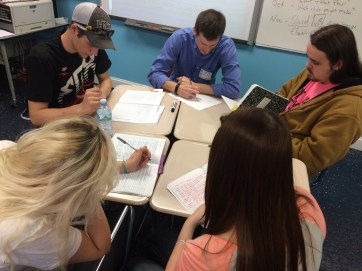
Fiction writer Emily works with Tyler, Logan, and Willy to discuss a poem.

If your town is a university town, like mine is, there are guaranteed to be some amazing writing mentors right under your nose.  Have you taken advantage of them?

Our university’s MFA program offers courses in writing poetry, fiction, and nonfiction, and I was lucky enough to connect with these fine folks through the Bolton Writing Workshops, which were a fantastic challenge for me to participate in.  And my students were lucky enough that several of the program’s MFA students were willing to come into our classroom and write beside them.

Our writers came to visit one of my least-poetically-inclined classes, bearing many mentor texts, three poem prompts, and two revision exercises.  They wrote beside my students and their seriousness inspired earnest effort from my kiddoes–I was so impressed.  Rarely have I seen fourth period so calm, engaged, or thoughtful.  Their method consisted of three steps–read, write, revise.

img_1791

Nonfiction writer Whit works with Dylan, Scott, Mariana, and Hailey to analyze a poem.

Read poetry.  The Bolton writers brought over 20 poems for my students to study.  A pro read the poem aloud, my students following along on their own copies at their desks.  We absorbed the language, the tone, the emotions of the poem.  The Bolton poets asked questions like:

  • “Why is the poem called this?”
  • “Do you believe this speaker?”
  • “Did you like this poem?  Why?”
  • “How many characters do we see in this poem?”
  • “What do we think of this (image, line)?”

Their language was important to me, as it created a community of writers by using the word “we,” focused on responsiveness to the poems rather than the extraction of meaning, and encouraged a variety of responses.  My students engaged with this kind of talk fully–I loved the quiet murmurings I heard as teens worked to construct meaning and understand these poems.

We read closely a variety of poems that did what we wanted to try–prose poems like “Instructions on How to Cry” by Julio Cortazar, or free verse like “The Instruction Manual” by John Ashbery, for a poem about instructions on how to do something.  Then we wrote.

img_1876

Logan’s poem about how to hunt

Write poetry.  Next came the writing–very low stakes, line-by-line, three times.  We wrote a poem where each line corresponded to a month in the year, one from the point of view of an animal, and one list of instructions on how to do something we felt expert at.

In poems with eight to twelve lines, my students wrote about hunting, death, school, love, welding, graduation, trust, and a wide variety of other topics.  Each poetic prompt allowed for a student to write about whatever was meaningful to him or her.  I loved the lovely images they produced, no matter the topics–like Logan’s “soft brass shells” in his hunting poem.

We wrote three drafts, then revised.

img_1888

Dylan’s poem about how to weld

Revise, revise, revise.  The revision process, like the writing process, was low stakes.  The Bolton writers advised my students to:

  • “Cross out your two worst lines.”
  • “Repeat your best image or line somewhere else in the poem.”
  • “Circle a line you love so we can share it.”
  • “Think about where you might add some alliteration.”

Language was celebrated, no matter how fancy or plain.  Dylan’s use of similes, metaphors, and alliteration in his poem about welding received lots of snaps.  I believe he felt comfortable sharing it because of the authentic atmosphere the professional writers created–he knew he’d be taken seriously, and his words were met with thoughtful  responses from both the Bolton poets and his fellow students.

The two-day workshop was a fantastic reminder of how simple it is to celebrate poetry in any classroom, within any timeframe, as part of any unit.  Simply read beautiful poetry, try your hand at a few drafts, then revise as much as you need to.  I loved participating in this workshop and watching my students blossom, acting and thinking and talking like serious poets.

Have you brought any writers into your classroom or school?  Please share how it went in the comments!

Books That Gave Me The Feels

I’m a big fan of all kinds of reading–sweep-me-away books, books that are dense and time-consuming, mysteries that puzzle me when I’m trying to fall asleep, books that break my heart, and more.

I think the teenage version of that whole entire category is “the feels.”

Books that are powerful, that grip us and force us to grapple with them, are what “the feels” are all about.  This is what I hope my students read for the rest of their days–far beyond the measly month or so they have left of high school.  I’m heartened by Emma’s recommendation list below–her blend of mystery, YA, and nonfiction that just rips at her heartstrings–because I know she’s already discovering books that give her the feels, and I hope she’ll continue doing so beyond our classroom.

img_1549-1Emma’s Top 10 List: Books That Gave Me The Feels
  1. Stolen by Lucy Christopher – 

This book is crazy good. It has the most twisted and unexpected plot line in the history of books. With kidnappers then romance it is just freaky good. It would keep basically any reader captivated. A mixture of romance and just plain old creepiness.

  1. Gone Girl by Gillian Flynn –

I love weird creepy things and this book is exactly that. It is an amazing mystery with a heart dropping twist that left me feeling sick to my stomach. If you are a disturbed human being like myself, this is a must read.

  1. 13 Reasons Why by Jay Asher –

The overall idea of this book is sort of hard to wrap your head around. Suicide is a sensitive subject and this book makes it very real, almost as if you are living through the events. It is an interesting way of telling the story.

  1.  The Hunger Games by Suzanne Collins –

Though cliché, this series is very good, and perfect for my list because it pulls out a lot of emotions. All the action and loss and real world situations that are incorporated make it a very good read.

  1. If I Stay by Gayle Forman –

very emotional book that weighs life and death. It is an interesting way of telling a romance story while keeping the reader on their toes the whole time for fear that it might end forever.51clOkezoKL._SX329_BO1,204,203,200_

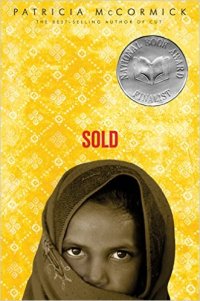
  1. Sold by Patricia McCormick –

More than anything this book is written beautifully, but the story is also very touching. The real life of a poor girl who gets put in situations out of her control is truly touching. It is a very easy read but very worth is because it is so touching.

  1. The Lovely Bones by Alice Sebold –

This book is good because it is told from the point of view of Susie, a girl who was murdered. It’s a cool way of an outsider point of view to the family who is struggling with their daughter’s death.

  1. The Fault in Our Stars by John Green –

On the more romantic side of my feels, this book ripped my heart out, along with every female heart in America. Illnesses are no joke and this book displayed the worst of circumstances, losing the one you love. It was a difficult book to read without crying.300x300

  1. Mere Christianity by C.S. Lewis –

On the complete opposite spectrum of any book genre. This book gives my Spiritual feels a tug. This isn’t a story with mystery or romance, it is just real life, telling you straight up how it is and I don’t know about you, but I’m a mess and when that is brought to my attention, the emotions start flowing. Plus, C.S. Lewis is a beast.

  1. 50 Shades of Grey by E.L. James 

I’ll start by apologizing for adding this book to my list but I don’t read many books so I don’t really have a choice. But hey, if awkwardness doesn’t give you the feels, what does? I can say with certainty that this novel will make you feel some type of way. Whether it’s good or bad, that’s up to you to decide.

“Plus, C.S. Lewis is a beast.” Don’t you just love that?!

What books give you and your students the feels?  Share in the comments!

#3TTWorkshop — Why Teachers Must Talk about Their Reading Lives

#3TTWorkshop Meme

Why is it important to talk about our reading lives with our students?

Amy:  If I want my students to be readers, I have to be a reader myself. The same holds true for writing. I am always surprised to meet English teachers who do not read and who do not write. This is our content! Seems like if we want to have any kind of credibility, we must practice the craft we want our students to learn. At least that’s what makes sense to me.

Of course, I’ve grown into this philosophy and this practice. When I first began teaching, I taught literature instead of teaching students. I think when I learned enough about my role as a secondary English teacher, and when I began challenging the status quo, I learned the importance of walking my talk. If I want students to read, I must model for them my life as a reader.

Shana:  Many of my students don’t have a role model who’s a reader.  I know that a large part of my identity as a reader growing up was shaped by my mother who was a reader.

I remember weekly trips to the library, a mom who held up her hand to finish a page before I could ask her a question, and having a bookshelf for a headboard in my childhood bed.  I lived a reading life from day one, because my mother did.  That is not the case for many of my students.  There is no one to model for them self-selected reading, the act of reading for pleasure, or the skill of choosing texts that will absorb a reader.  That’s why I have to be that person for my students–or at least, another person to model those skills for them.

How has your reading life changed since you began sharing it with your students?

Shana:  I know that when I’m tempted to be a lazy reader, remaining on the downhill portion of my reading roller coaster, I think of how often I encourage my students to push themselves with an unconventional genre, an award winner, or a lengthy tome. Then I feel like a hypocrite if I just pick up another trashy romance novel, so I challenge myself with something weightier instead.  Now, during pregnancy, I find myself much more deeply affected by difficult themes in books, so when I’m tempted to avoid them, I remind myself to be a better role model (as I’m doing now with Leaving Time, whose themes of a missing mother and elephant grief make my cry at the drop of a hat).

Amy:  I didn’t know you read trashy romance novels, Shana. Ha. I love a good romance, but I rarely find time for that kind of pleasure of late.  I’ve been a reader since the time I fell in love with Anne of Green Gables way back when. Now, I am a purposeful reader. Maybe that’s why I have a hard time relaxing — I always have some master plan. I cannot even remember the last time I just read for the pleasure of it. Shana, you and I both wrote about that in the past. Here and here. Look at this recurring theme.

While writing this I’m realizing that I have not been a good reading model lately. I haven’t snuggled under the covers with a book and let the language carry me away. I   read because it’s a responsibility. Kinda the way many of my students feel about reading for my class.

Aha! I need to do some things differently. Starting now.

During which portion of class do you tend to share your reading life with your students?

Amy:  Sure, I share my reading life during class, but my favorite time is the impromptu talks that happen with students in the hall or just before class starts. I love talking about books, and students come to know that about me.

Just today, a former student stopped in my room and asked if I could tell him about a book. I said sure, and he proceeded to tell me in a waterfall of words about the midterm this week in his new English class.

“They read The Crucible, and I need you to tell me what it’s about.”

I know, not exactly the same as sharing books for the love of them, but hey, this kid knows I know a lot about a whole lot of books. (I did not tell him about The Crucible. I might have mentioned Sparknotes.)

Shana:  I share mostly during conferences or booktalks.  When I booktalk, I tend to tell the story of my reading of the book (like on the treadmill at the gym, when I cried publicly while finishing We Were Liars), including when and where and how I read it.  During conferences (both formal at a student’s desk, or informal at the bookshelf), I use anecdotes to help illustrate a skill’s development with students.  And, occasionally, I use a snippet of my reading life to introduce a quickwrite–like creating an ideal bookshelf.   

Amy:  I am glad we discussed our reading lives. As always, you’ve pushed my thinking here. I can do more to model and talk about my reading life with my students, especially reading for pleasure. That means I need to walk the talk I give my kids a lot more often. Maybe I’ll take a stroll through the shelves at Barnes & Noble, asking myself:  If you had nothing on your schedule — no expectations from anyone or for anything — what book would you want to curl up and read?

Readers, I’d love your suggestions. Any amazing books you’ve read lately?

Do you have topic ideas you would like us to discuss? Please leave your requests here.

Try it Tuesday: 2 Simple Ideas to Promote Reading

You know what I could use? A bookmark.

Actually, I could use five bookmarks right now.

I’m not proud and it’s not pretty, but I’m suffering from tented book syndrome these days. On my desk at school. My nightstand at home. The corner of the couch. The kitchen counter.

A vast field of tented texts. Books in progress. I know Amy can relate.
We share this affliction.

It always starts innocently enough. I’m between books. In the market for another. Speed dating texts to book talk, but not really committing myself yet. Then, I get sucked in.

It’s just one book to start. One book I want to come back to, so I’ll just leave it…here.

This time I blame Alyssa, one of my AP Language students. She enthusiastically book talked Anita Diamant’s The Red Tent. I immediately ordered it and it’s now flipped open on the coffee table as I type.  Shortly after,  Errin, an inquisitive sophomore, asked me to read Kafka’s Metamorphosis and that (to keep the creature in) is flipped upside down under a stack of papers.  Don Quixote has been languishing on my desk at school since the start of the year. I will finish it this time; I’ve just been distracted by about twenty-seven other amazing books since I started (I did read six whole pages today. That leaves 788 pages to go. So, I’m really cruising).

Penny Kittle’s Write Beside Them is eternally tented on the shelf behind my desk. And I’ve been flying through another ‘I can’t believe I haven’t read this text,’ The House on Mango Street by Sandra Cisneros. Esperanza was actually flipped open on the front seat of my car last week. I started it during an oil change.

So…I have a problem. For a bibliophile, this is a good problem to have. It is both damaging to my books and a testament to my deteriorating organizational skills, but it does keep those books at my fingertips. It’s super nerdy, but I love to see them, open and waiting for my return.

However, while having a good book close at hand might excite those of us already full of passion for reading, it takes a little something more to get our students geared up to keep turning the pages day after day. Just ask the local library. If merely having the books available led to literacy, I might be out of a job. I bet librarians would  be willing to open and tent books if they thought it would get kids reading, but shockingly enough, few students are as willing to be as visually nerdy as the average English teacher.

What we need is to not only get the texts in front of kids, but keep them there in a meaningful way.

Bright. Catchy. Student-centered.

So, here are two very easy ways to appeal to our students’ goal oriented nature, if not their occasional tendency to let their eyes wander around the room during class. If we can’t hook them with tented texts, these approaches just might catch their eye.

1. Reading Goal Bookmarks

This is a hybrid of a number of measures I’ve seen and read about for helping hold students accountable for their reading. While I certainly want to keep track of what they are reading and how they are progressing, I wanted to try and incorporate a visual reminder of their reading goals into the experience.

In the rare occasions I get into an exercise regiment (regiment may be a strong word…spurt, perhaps?), I stay accountable, in part, because I make the routine visible and harder to ignore. I set alerts on my phone, schedule time on the calendar, and put my workout clothes out where I can see them. In short, I make it so I can’t avoid seeing what I know I should be doing.

IMG_0172

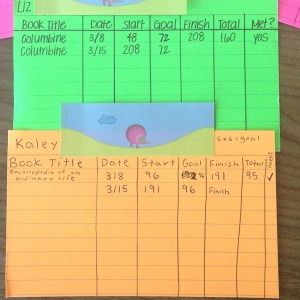
The sample card I made for my classes. Fiction start to finish, but it showed how things should be organized. Without the example a few weeks ago, it was a big mess.

In that same way, I decided to purchase neon colored index cards for students to record their goals and progress. I’ve marked my own calendar for the days when we should be setting a weekly reading goal, and ask students to record their current book, the date, the page they are starting on, a weekly goal based on reading for two hours per week, and reflection the following week as to whether or not they met their goals.

IMG_0171

We just started this new system, but I like what I see so far!

Students keep track of their reading, I use the cards to help guide conferences, and even more wonderfully, I have them put their cards in the book not where they are currently in their reading, but where they want to be by week’s end. The bright neon cards stand all week as visual reminders of where students are aiming for the week.

2. Recommendation Walls

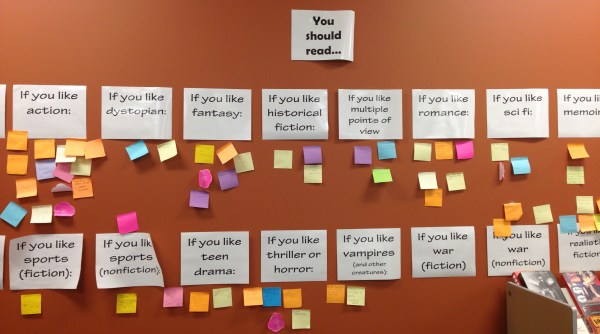
Sometimes, it just takes the support of one’s peers to keep texts fresh. In the same way that a book talk from students allows kids a glimpse into the texts their peers are enjoying, visually displaying recommendations and books completed, by both teacher and students, keeps suggestions fresh for everyone. Get those suggestions up on the wall and let kids take a peek.

IMG_0165

Erin Doucette’s wall is adorned with her hand painted sign and book suggestions from texts she and her students have enjoyed this year.

IMG_0167

Catherine Hepworth has her students populate the recommendation wall based on genre.

IMG_0166

Brandon Wasemiller has students recommend books by creating their own analytical book covers.

How do you keep recommended texts at the forefront of your readers workshop? Please leave your ideas in the comments below! 


Mini-lesson Monday: A How-to on One Way I Teach with Short Texts

“Hey, Mrs. Rasmussen, I noticed this passage when I was reading,” Geovany said after class as he flipped a few pages in The Kite Runner and read a few lines. “That just really make me think, and it’s really nicely written.”

“And this is what I want you to understand, that good, real good, was born out of your father's remorse. Sometimes, I thing everything he did, feeding the poor on 
the streets, building the orphanage, giving money to friends in need, it was all 
his way of redeeming himself. And that, I believe, is what true redemption is, 
Amir jan, when guilt leads to good.” ~Khaled Hosseini

That might have been the passage. I don’t remember exactly, but I do remember the moment. It’s one of my favorites of the year.

Geovany did little work in my class until these book clubs. I’m not sure he finished reading even one book all fall. Although bright and capable, he is busy. He works 20 hours a week changing tires at a local auto shop, plus school with at least one AP English class. Mine. I know Geo has big hopes for his future, and I know he wishes he had a dad. He’s written a few times this year about how he wishes he had a father to mentor him, care for him — be a dad to him. So when Geovany showed me that passage in The Kite Runner, and when he explained that he’d made a connection to it, I knew all my talk about reading and noticing how authors craft language was working.

I will keep doing what I know works.

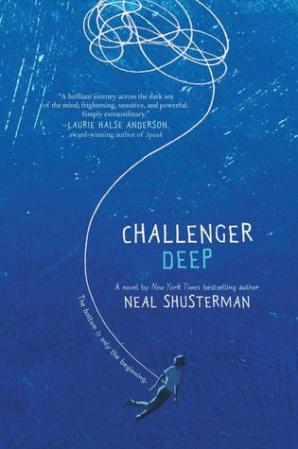
This lesson is an example of how I use what my colleagues and I call a triple play. We got the term from Penny Kittle. A triple play is when we find a passage that allows us to do three things with it:  1. have student write a personal response to the passage, 2. talk about an engaging book students might like to read, 3. study the author’s craft — not necessarily in that order. This lesson uses a passage from Challenger Deep by Neal Shusterman. (Actually, there’s two passages because I love them both!)

Objective:  Using the language of the Depth of Knowledge Levels, students will make observations about a text, write a response, discuss and analyze the author’s craft, and construct meaning of their own modeled after the writer’s.

Lesson: First, to give students a glimpse into the book, I introduce it by reading the cover, 18075234which has three interesting quotes:  1. “A brilliant journey across the dark sea of the mind; frieghtening, sensitive, and powerful. Simply extraordinary.” ~Laurie Halse Anderson, award-winning author of Speak; then two from the book:  2. “The bottom is only the beginning.” and 3. “My feet are on safe, solid ground, but that’s just an illusion.”
I ask: What do you think this book is about? After we read a passage from this book today, analyze a little bit, and write a little bit, I hope this is a book you will want to read.

Next, I give students a copy of the passage. I read it aloud first and ask students to pay attention to anything they find interesting that the writer does with language. They almost always find the literary or rhetorical devices I hope they will. Sometimes they do not know how to name it, so this is where I teach academic vocabulary. We discuss the effect of the devices on the meaning of the passage or why the writer might have made those choices when constructing meaning. We almost always talk about tone. Depending on where we are in the school year and how much we’ve done with analysis, I may ask students to write an analytical paragraph that answers the craft study question.

Finally, I ask students to read the passage again to themselves and then write a response. Some suggestions for response prompts are at the bottom of the passages. Students have about 10-15 minutes to write. I always ask students to read over what they wrote and then revise before they share. Sometimes students share at their tables. Other times we share out as a whole group.

Follow up:  Throughout the school year, I use a variety of texts I pull from books I read from my classroom library. You’ll find other passage I’ve used if you search the categories for craft studies (or just click there).

A few times a year, I ask students to find significant passages in the books they read. Sometimes they construct their own “craft study” questions. (I especially like to do this when we read in our book clubs.) Sometimes students answer the questions they construct in formal response one-page essays.

The goal is to help students learn how to identify and analyze the moves writers make to craft meaning — and to help them practice writing using these moves as models for their own craft.

And just maybe they will make connections to a text like Geovany did to The Kite Runner.


#FridayReads: Required Reading “Our Students Want to Write”

Confession:  I buy a ton of pedagogy books. I rarely read them all the way through. I blame it on my blossoming OCD. I can only take in so many ideas before I run out of space in my head to hold them all long enough to use them.

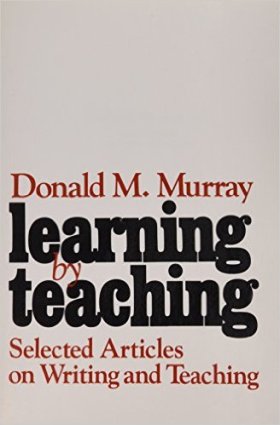
412bcpby4iol-_sx326_bo1204203200_That is not the case with this classic, suggested to me by my friend and mentor Penny Kittle, Learning by Teaching by Donald Murray.

I remember when Penny recommended it. She was in the DFW metroplex teaching a workshop, and I’d asked if we could meet up and talk about my writing. She graciously agreed, and we met at a Starbucks inside a Target. As always, Penny radiated positive energy. She told me about the work she was doing with Kelly Gallagher. I told her about my struggle trying to write a book, a book I am still trying to write.

I still cannot believe I had a writing conference — yet again — with Penny Kittle! (My first was during her class at The University of New Hampshire Literacy Institute the summer of 2013.)

At one point in our conversation, Penny paused and asked if I had read Don Murray’s book Learning by Teaching. I said no. At the time I hadn’t read any of his books, but I’d heard Penny talk about Murray with such affection, quoting him often. I knew this was a book I need to not just purchase, but one I needed to read. I’ve read and re-read and marked page after page.

Don Murray validates the moves I make in my workshop classroom, the moves I make

pageinMurraybook

My thinking while reading the essay “The Process of Writing” by Donald M. Murray


when planning instruction for my AP Language and Composition course. I have learned from those who learned from Murray, and his work reminds me again and again why teaching with student choice in mind works. Every time I feel like I fail, every time I get frustrated with the way an assignment flopped, or I didn’t reach a certain student what I’d hope to teach him, I turn back to this book of essays by Murray. (I did this recently after most of my students bombed an assignment, which was mostly my fault.)

Here’s an excerpt from Murray’s essay titled “Our Students Will Write –If We Let Them” published in North Carolin English Teacher, Fall, 1977. I probably break a copyright law by sharing, but I’ll risk it if it means freeing more writers. (See more about freeing writers in Penny Kittle’s piece “What We Learn When We Free Writers.”)

Our students want to write — but not what we want them to write.

Our students want to write of death and love and hate and fear and loyalty and disloyalty; they want to write the themes of literature in those forms — poetry, narrative, drama — which have survived the centuries. They want to write literature, and we assign them papers of literary analysis, comparison and contrast, argumentation based on subjects on which they are not informed and for which they have no concern.

We should see that their desire to write proves the vitality and importance of literature and literature-making in each generation, that language is central to the human experience, not just as a communications skill but as the best way to recall and understand experience. We tell our students the unexamined life is not worth living, yet we seldom allow those students to examine their lives firsthand through what is termed creative writing.

It is time that we, as a profession, not only support the reading of literature but the making of literature; that we encourage our students to write what they want to write and realize that what they want to write is more intellectually demanding, more linguistically challenging, more rhetorically difficult than the writing we usually require in the English class.

The biggest problem in the teaching of writing is ourselves. We do not encourage, allow, or respond to our students’ desire to write. We do not believe that our students can write anything worth reading, and they prove our prediction. Conditions will not improve until we realize that what we face is a teacher problem, not a student problem.

There are many important reasons to consider taking what is usually tolerated, at best, in the elective creative writing course and placing it at the center of the writing curriculum. Some of them are:

  • Writing about individual human experience motivates both the gifted and those we often consider disadvantaged. In fact, we may find that the disadvantaged aren’t in terms of experiences which can be explored through writing. Students who are not motivated by our lectures on the need for writing skills–they know the need does not exist in the lives they expect to live–still share the human hunger to record and examine experience. Students who are bored with papers of literary analysis or even incapable of writing such a paper at this state in their development may be able to write extraordinary papers based on first-person experience.
  • Students discover…that they have a voice, they have a way of looking at their own life through their own language. They discover and learn to respect their own individuality.
  • Through writing, the student increases his or her awareness of the world, and then works to order that awareness.
  • As students follow language towards meaning they extend and stretch their linguistic skills.
  • The experience-centered, doing nature of the writing curriculum will reach many students who are not comfortable with the analytical passive-receptive nature of the typical academic curriculum.
  • Creative writing gives students a new insight to literature. The study of literature is no longer entirely a spectator sport, but an activity which they can experience and appreciate.
  • The creative writing class may be the place where some students learn to read. Test results in many community colleges and other colleges of the second chance show that many students who test as not being able to read are also the best writers. They are able to read their own words and to perform the complex, evaluative techniques essential to revision. They learn to read by writing.
  • Students and teachers of creative writing rediscover the fun of writing. Art is, at the center, play, and perhaps that is the reason it is so little tolerated in the school. If it is fun can it be learning? Yes.
  • Finally, we should teach creative writing because it is more intellectually demanding than the study of literature or language as they are usually taught in the English class. This runs directly counter to the stereotype believe by most English teachers. IT is easier to complete a workbook on grammar, easier to tell the teacher what the teacher wants to know about a story than it is to use language to make meaning out of experience. The writing course is a thinking course, and it should be central to the curriculum in any school.

There is more. I believe Murray’s writing, like Penny’s books Write Beside Them and Book Love, should be required reading for every English teacher. I wish they would have been required reading in my education classes. For the first few years of my career, I struggled like many teachers I know with student engagement and learning while I taught literature instead of readers and writers. (Someday I’ll write about the Dickens I subjected my 9th graders to. It’s a sad sad tale of student, and teacher, woe.)

And someday I’ll finish this book I’m trying to write. I think Don Murray would want me to.

What books do you think should be required reading for all English teachers? I’d love to read your suggestion in the comments.


Mini-Lessons are in the Students Before You by Colleen Kiley

“You have all the tools you need to plan minilessons in the students before you. The secret is to be willing to flail around together through the murky mystery of how to get to the heart of story.”     -Penny Kittle, Write Beside Them, 2008

guest post iconA few weeks ago, in preparation for a unit on personal narrative, I was rereading (for at least the 4th time) a chapter from Penny Kittle’s Write Beside Them. Upon rereading these words, I immediately thought of my student Dani. Just yesterday she’d stayed after class to revise a piece of writing. The assignment, to write a snapshot moment, was the first formal writing piece of the semester (an idea I also gleaned from Kittle), and she was determined to get it just right.

Dani was writing about a semi-traumatic, semi-humorous event from a few months prior when, rushing to leave school, she rear ended a school bus. Dani was struggling with her beginning.

“What comes to mind first when you think of that day?” I’d ask a few days earlier.

“All I could see was yellow.”

“That’s perfect!” I was excited for her to begin this piece and just wanted her to get words on the page. “Start there, and then go back in time to show us the events leading up to hitting the bus.”

But today, after rewriting and reworking and just re-everything, we both realized the beginning wasn’t working.

“Okay,” I told her, “so scratch that first sentence and let’s find a new way to begin this.” I thought she’d be hesitant to delete something she spent a lot of time thinking about; many of my students are and I understand. Sometimes it takes days of my gentle prodding for them to get words on a page. And after so much work, they certainly cannot imagine deleting those precious words. But Dani loved it, and felt relief from deleting something that clearly wasn’t working. We spent another hour on the piece. I continued to make suggestions about totally deleting sections or being more specific with the details of the actual event, reminding her she was writing a snapshot, not an entire narrative.

“I’m worried there will be nothing left.”

I assured her that by keeping only the most important details, the ones that evoked the senses and allowed the reader to feel the intensity of the moment, she’d have a stronger piece than if she included every minute detail leading up to the actual event. And then she went back to work, eagerly adjusting and rewriting.

The type of revision Dani was engaged in felt authentic; she could see the piece improving in front of her and I could see she was pleased with the results. I wanted to infuse this into my other twenty-two students, so I asked if she’d walk the class through her revision process.


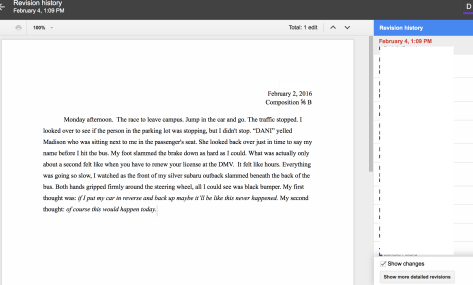
The next day Dani used the “See Revision History” tool in Google Docs to show the class how she revised her snapshot moment.

It wasn’t easy for her to talk through the process, though, and I was surprised at how often I had to remind her what decisions she’d made while revising. I asked her to tell the class why she’d deleted a section or rewrote another, and this proved to be a challenge. Dani is a very outspoken student, so I thought it would be easy for her. Then I recalled Kittle’s words: flail, murky, mystery. Right. It wasn’t easy for Dani to describe the process because she was just learning it and it’s not a simple process with easy to follow steps.

And isn’t that the lesson of revision? It’s murky and mysterious and you’re going to spend A LOT of time flailing around, as Dani had done. I’m hoping that’s what my students realized as Dani showed the evolution (again, the Google Docs Revision History tool was so helpful in this lesson) of her piece.

From these drafts we see so much about the revision process.

pic1 

We see that sentences must be deleted or rewritten.

pic2

We see that sometimes you have to rewrite the beginning many, many times.

pic3

We see that you have to rearrange paragraphs. Or delete paragraphs. Or save paragraphs at the bottom, in case you want them later.

We see that you have to do a lot of thinking.

pic4

And then we see a final snapshot that gives us all the details and emotions of the event, and leaves us wanting to know the rest of the story. Dani may continue this story and develop it into a longer narrative in our next unit, or she may start with a new topic and leave this be. Either way, Dani, and hopefully the class, learned what it truly means to revise, and I learned the power of using my students as mentors in the writing workshop.

Colleen Kiley teaches high school English in Bristol, Vermont, a rural town nestled in the foothills of the Green Mountains. She is passionate about connecting each student to the right book and was a 2015 Book Love Foundation grant winner. Inspired by the wonderful teachers at Three Teachers Talk and Moving Writers, she is continually trying to improve her approach to the writer’s workshop. You can reach her on Twitter at @ckiley4.

How to Book Talk 100+ Books in One Day

“Do you have a minute? We have an idea we’d like to run past you.”

My colleagues Amy Menzel and Leah Tindall were all smiles. Big smiles. The kind that suggest sincere enthusiasm, huge plans, a ton of work, and the possibility of incredible results.

And boy, did they deliver.

This past Friday, Franklin High School hosted our first ever Readers’ Showcase.

Over 100 students shared their enthusiasm for literacy through the course of the entire school day, creating a sea of informative posters, book talks, literary swag, and sweet treats for enticing passersby to stop and learn about books ranging from The Draft  by Pete Williams, to #GirlBoss by Sophia Amoruso,  The Devil in the White City by Erik Larson, and the biography of Alexander Hamilton by Ron Chernow.

Fresh off the heels of the incredible enthusiasm I detailed in this post about a choice reading frenzy at our school amidst the English department’s shift to readers and writers workshop, the showcase was a phenomenal way to keep students talking about books on a school wide scale.

As our Director of 9-12 Teaching and Learning Nick Kohn observed, “The love of reading was palpable throughout the entire building. I was particularly impressed not just with the depth and passion with which students talked about their books, but also with their excitement around the next book(s) they are planning to read.”

It was incredible to hear kids so excited to share their insights and recommendations with their peers and teachers and the organizers spoke passionately about loving to see their students engaged in “genuine conversations with authentic audience.”

I spoke with Brianna, a former student who read Devil in the White City. 

IMG_9976

Brianna handed out laminated bookmarks that looked like World’s Fair Tickets from 1893! 

“I wasn’t so sure about this book to start with, Mrs. Dennis,” Brianna smiled, “The detail. I thought it might get overwhelming, but it was incredible.”

“Right?!” I gushed, “Erik Larson is such a master with historical detail. Can you imagine his research process? Have you read Issac’s StormIn the Garden of Beasts? Thunderstruck?”

Whoa. How many books does he have? ”

And there, folks, is the power of reading.

One book, leads to one more book, leads to a student rediscovering reading.

And a showcase is one way to share over 100 books, in hopes that even just one more student finds that one book.

Even more exciting is the sheer number of students sharing their interests with those who might be new to a particular topic. My husband referred to it as “cross pollination.” For all of us dreaming of spring, I thought this was quite a fitting metaphor. Students interacted with the sincere enthusiasm of their peers in relation to a great variety of topics and took away with them ideas about texts that might never have reached their attention otherwise. Each new booth was a new opportunity discuss a book that their peers were already validating. Worker bees making something sweet to share!

Amy and Leah did amazing work to make this first annual Reader’s Showcase a success.

Here’s how they did it!

Start with a desire to promote reading with your students. We know that students are far more apt to read what interests them. They are human, after all. So, promoting choice texts is the way to go.

Last week, I came across an article in English Leadership Quarterly that spoke to this very principle. “Top Five Reasons We Love Giving Students Choice in Reading,” details what supporters of readers workshop already live and breathe. To allow students to choose texts, not only empowers them as readers, but shows that we as educators value their opinions. Once that confidence is built, it allows for the type of real and meaningful conversations around texts that we educators can’t get enough of, because it involves passion on the part of our students.

Build that excitement by having kids get out and talk with others about what they read. Interest is built around texts that are visible and accessible to kids. And while we do our darnedest to fuel the fire with passionate book talks in our classrooms (my students have noted me tearing up and actually jumping around while talking about books), posters advocating literacy, student discussion on choice books, “what to read” lists, and more, sometimes you need to go big.

The showcase put on by our College Preparatory Language and Composition classes (comprised of juniors and seniors) took place in our high school library and featured over 100 students. That’s big.

Organization for the event included: 

img_9989-1

The Reader’s Theatre

  1. An invite to the entire school to bring classes down for 20 minute showcase visits with their classes.
  2. Promotion via posters around school, a segment on our school news program, “Ask Me About My Book” buttons for all participants, and a fully decorated library to set the scene.
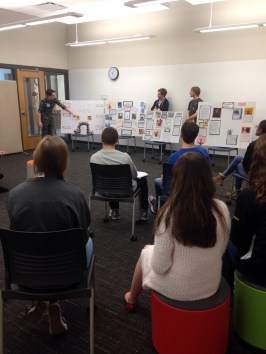
  3. A Reader’s Theatre book talk room to orient each visiting class where students entered, heard book talks from a rotating group of students, and were briefed on what they could find in the showcase.
  4. Book Booths manned throughout the day by students who supplied their insights and some sort of takeaway for guests (laminated bookmarks and themed treats were popular choices).


Students were expected to:

  1. Complete their text by the assigned day.
  2. Prepare a visually appealing tri-fold poster with the quotes they found to be most impactful, interesting facts about the text and/or the author, a recommendation section as to who might enjoy the book, and visual connections to the big ideas within the text. Students could also include reference to author blogs/websites that visitors might want to check out.
  3. Prepare several note cards with favorite quotes. Interested teachers could ask their visiting students to take a note card, find the corresponding booth, and ask the book talker to share why he/she chose that quote.
  4. Enthusiastically run their book booths throughout the day for the steady stream of classes that came through.
IMG_20160311_134746298

Cameron, on the left said, “It’s so cool to see real interest in the eyes of people that come to your book talk. They asked questions and seemed to be really listening!” 

And while the event itself and student preparation, obviously took a lot of work, the day itself was focused on fun.

Students nibbled on cake and perused book selections.

Teachers watched their students dash from booth to booth playing Showcase Bingo.

There were even book and gift card giveaways throughout the showcase, generously donated by our school principal. Rachelle, one of my students was lucky enough to win the new book Binge by Tyler Oakley (I felt super old when half my class of sophomores could not believe that I didn’t know who Tyler Oakley was. We looked him up. My list of books to read grows again). When we got back upstairs, Rachelle said, “It’s like they knew exactly what I would want to read.” Yup. It seems great books are falling from the sky these past few weeks. It’s awesome.

Finally, set aside some time for reflection. Amy and Leah’s big smiles paid off in a big way. The event was incredibly well received by not only the students that participated, but the students, staff, and administration that visited.

We are all already chatting about ideas for next year’s event. For example, the ladies plan to incorporate even more opportunities for fellow teachers to provide feedback on conversations with students and analysis of their visuals, thus sharing the load of assessment.

It’s all about sharing.

Share your love of reading with your students.

Ask them to turn around and share their love of reading with their peers.

One book, leads to one more book, leads to 100+ books in one day. 

img_9969-1

Amy and Leah – masterminds of the 1st Annual Franklin High School Reader’s Showcase

Do you have questions on organizing a Reader’s Showcase or ideas from a similar event at your own school? Please share your questions and ideas in the comments below!