May I have your intention please?

I am borrowing my word for 2018 from my friend Whitney who in her wisdom spoke right to my heart:  “My word for 2018 is “intentional,” and I see that manifesting as spending quality time with quality people engaging in quality pursuits…being conscious about what I choose to do. I’m tired of being spread too thin and being so stressed out and/or exhausted that I can’t enjoy the moment I’m in.”

Ever had that moment when someone says your words for you? Thanks, Whit!

My father instilled in me the habit of setting goals. He taught me how to write them down and then see them to fruition. I am pretty good at it (most of the time.) But lately, (like the past three years) I, too, have spread myself too thin, and it’s taken a long while for my inner voice to shout loud enough for me to hear it. Poor hoarse thing.

This idea of intention resonates like an echo from the canyon of my soul. This voice is serious and a little scary. See, I’ve operated intensely in the extremes for decades. How can I do this and this and this? How can I be more, do more?

But I have not always practiced intention. More is not always better. Duh.

I am reminded of a conversation I had with my friends and colleagues Amber and Mary. I had the privilege of mentoring them as pre-service teachers several years ago. They told me the best word to describe me then was intense. Of all the words in the world. . .

I get it. And these friends will agree: I have come a long way. But I’ve got miles to go.

So I am going to be a little more honest with myself. A lot more patient. A lot more sincere. I am going to set myself free. Free to explore and relax and play.

Intentionhonestly

To be able to do this more effectively, I am also going to take some advice I got from Adam and not just take a break from social media but detach from it — a lot. Maybe I will read a lot more of the books Adam recommends and make a bigger dent in my books-to-read-next pile.

I found this article 6 Simple Questions to Set 2017 Intentions, and I’ve played around with my own questions and answers in my notebook. I am a year late to the party, but I’ve got the pointy hat on now.

I also found a list of beautiful poems at the Center for Mindfulness, a place I should probably rent a room. I’ve printed them out and will paste these poems in my notebook and write around them. (I remember Penny Kittle saying one time that she does this:  pastes poems in her notebook that she can write beside while whiling away in faculty meetings.)

Poem I Said to the Wanting Creature Inside of Me

Will this intention transfer into my teaching? into my relationships with students? No question. Here’s how I rewrote those questions above to fit with my quest to be more intentional at school:

  • What are 1-3 experiences I want to have with students this spring?
  • Who are 3-6 students I want to deepen my relationships with this semester?
  • What are 1-3 things I want to try in my classroom that I’ve put off trying?
  • What are 3 way I will take care of myself more effectively during the school day?
  • Who on my campus can I get to know more meaningfully?
  • What one word do I want students to describe me?

We all know the benefit of boundaries. I don’t know why it is so hard for some of us to set boundaries for our own well being. As teachers, we take on a lot, don’t we?

My hope for myself — and for all of you — is that we can stop a spell, consider the moment, think about what matters in the long run, then, and only then, take a step toward whatever it is we want to accomplish.

There we will have a solid place for our feet. I like that.

What are your intentions for the new year? I’d love to know.

Amy Rasmussen is the mother of six grown children and two naughty Sheltie puppies. She’s married to her best friend of 32 years and teaches at an awesome senior high school in North Texas. She hopes this is the year she can stop everything else long enough to write that book. Follow Amy on Twitter @amyrass and @3TeachersTalk 

Conversation is Our Most Powerful Teaching Tool

After two months of being cooped up in the house with two kids under the age of two, we finally went back to school yesterday.

Hallelujah!!

To open my class yesterday, I asked my students to get up and get talking with one another–about nothing in particular. Each student had written her name on a note card, and after thoroughly mixing and redistributing them, each student had to go find her card’s owner and get to know him or her. Once we got talking, the room was never silent, and after we were all seated again, I asked students what topics they used as conversational entrees.

“Well, I’ve been in a lot of classes with people in here before, but never knew their names, so it was helpful to just start with an introduction,” one student volunteered.

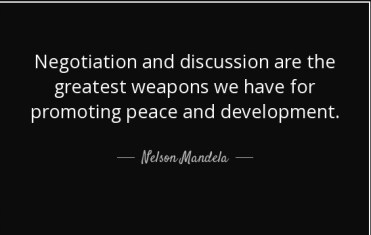
quote-negotiation-and-discussion-are-the-greatest-weapons-we-have-for-promoting-peace-and-nelson-mandela-81-33-16I was flabbergasted–how could these students not even know each other’s names?! What sorts of classes were being taught that didn’t allow for dialogue and collaboration at this most basic level!?

But then I realized that this was the norm, and often is for our high school students, too. This statistic was even highlighted in the first page of the article we were reading for class: “Less than 1 percent of instructional time is devoted to discussion that requires reasoning or an opinion from students, according to researcher John Goodland.”

I think we can all agree that reasoning and opinion should be at the forefront of student dialogue, and a central goal of any curriculum. But if we’re spending less than one percent of our time on these things, we’re nowhere near where we need to be.

After my students listed ways they began conversations with one another–clothing choices, majors, the weather, how was your break–I asked them how they planned to get to know their students.

“I’m going to give them an interest inventory,” one student said. “I’ll do a learning styles survey,” another claimed. Facepalm, I said.


No one said, “by starting a conversation just like we did today,” which is what I was hoping they’d jump to. Conferring is our most powerful instructional and assessment tool, and it’s the art of a conversation made critical. Not only is it important for teachers to get to know our students through simple talk–not with the barrier of a survey or paper between ourselves and students–but it’s important for students to practice the skill of conversation, first with us, then with one another.

Because perhaps less than 1 percent of instructional time is devoted to discussion not only because of how traditional classrooms are structured, but because of how little space in our culture there is for conversation these days. I’ve written about the value of talk before, but I’m coming to believe that there is more value in conversation. The exchange of ideas is much more valuable than the simple act of articulating one’s own, and needs to be our end goal.

The moves we make as teachers and thinkers will help our students reach this aim–first to help them read critically enough to develop their own nuanced opinions, then to help them write and talk to draft out their thinking, and finally to help them share and grow these ideas through conversation. Not to defend their own ideas, which remain only theirs, but to help their thinking evolve through discussion.

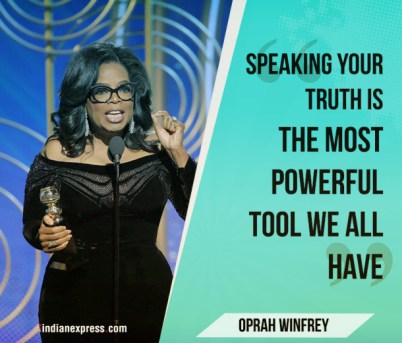
golden-globes6.jpg

Oprah Winfrey, in a speech that I hope will be close-read by millions of high school students as a mentor text this week, reminds us that “What I know for sure is that speaking your truth is the most powerful tool we all have,” and that our truths have power when someone “chooses to listen.”

Speaking and listening are much more than just standards for us to cover–they are the tools our students need to change themselves and the world for the better.

Shana Karnes is a mom of two daughters, a teacher of preservice educators, and a writer of hopes and dreams–in her notebook and here on Three Teachers Talk. She is delighted that winter break and maternity leave have ended and that she’s back in the classroom with her tribe. Find her on Twitter at @litreader.

Remembering How Good Readers Read – Guest Post by Brandon Wasemiller

Happy New Year, Three Teachers Talk! We hope your new year is off to a magnificent start. Hot off the presses from Franklin High School, my colleague Brandon Wasemiller writes about challenging our toughest students to value their voices and embrace the opportunities that reading can hold in their lives and their academic experiences with participation in The Global Read Aloud. 


We often talk about sparking the love of reading in our students. It is our daily, yearly, and career-defining struggle. Over the past few weeks, I tried something new because I was really struggling with a Tier II Intervention class (A class I have taught in the past but was reassigned to this year). I was giving book talks, getting to know the students, helping them with their books, teaching them how to be readers; but nothing was sticking. Most of them didn’t even try.   

It wasn’t until the second week of class that I came to a realization through a reading engagement survey, a pre-assessment, and a set of conferences. It was an idea that slapped me across the face and helped me guide the class. They’ve been nonreaders for so long that they have forgotten what it is to BE a reader.I have to re-teach these kids how to read.

And with that, I was off.

A fellow teacher, collaborator, and 3TT All-Star told me about a great project–The Global Read Aloud. A way for teachers and students in different classrooms (and most of the time different states) to collaborate and talk about the same book at the same time. So what was the chosen book? A Monster Calls by Patrick Ness.

(Listen, quick aside here,  but if you haven’t read A Monster Calls yet, what are you even doing?)

And so we began reading A Monster Calls. I tried to think of as many ways as possible to teach this book and make it fun and interesting. I started teaching them about active reading and about thinking while reading. I modeled for them how I read, and I had them track questions and comments throughout, but honestly, I felt like I was spinning my tires.

Then, one day, I pulled out the good ole Audible app and I played the audiobook. The chapters (The Wildness of Stories”, “The First Tale”, and “The Rest of the First Tale”) all feature two distinct characters. Conor, a young boy who is suffering through his mother’s battle with cancer, and a gigantic Yew Tree that turns into a monster at 12:07 to tell Conor stories. At the end of listening to all three chapters, we had a discussion as a class. To my sheer amazement, every single student discussed what happened and had amazingly in-depth responses to my questions.

So what was different? Why did the audiobook reach them better than some of my other activities?

And it hit me.

They are listening and experiencing a real and authentic reading experience.

They are actively engaged and plotting along with a READER who is emphasizing words, speaking in different voices for multiple characters, and emphasizing italicized and stylized words, all helping us as readers paint a picture of the novel in our heads. These are the qualities that good readers do independently. These are the qualities my students needed to re-learn.


I have a memory that I don’t think I will ever forget. I was probably six or seven, and I was at my grandma’s house. Every day, after nap time, my grandma would have story time and she would read from this book of Disney short stories. She would read us a few and she always did the voices. My grandma was Br’re Rabbit and talked in a thick southern accent, she was Mickey and squeaked her voice. My brother, sister and I were her captive audience. Our favorite story, however, was the Tale of the Headless Horseman.

One dark, rainy afternoon (I’m being serious, it really was dark and stormy) my grandma stepped out of the bathroom and her head was tucked inside a jacket and the jacket was zipped all the way up. The effect was that she seemed to have no head. She sat down to read the tale of The Headless Horseman as the Headless Horseman. She performed the tale of Ichabod Crane and his race to get across the bridge before losing his head.

That was not story time, that was an experience. I was there on the bridge racing to save my life, I was looking at the evil horseman careening towards me as I begged the horse to ride faster, I was there as the Horseman drew his sword and prepared to strike….

The idea for this unit came to me as I remembered that sometimes enjoyment in reading is lost because we lose what it is that makes us readers.

When you’re a kid, your parents read to you in different voices. When you read out loud to your parents or to teachers at a young age, they encourage you to read like they do. They help you sound out words, understand what a comma does in a sentence, what it sounds like to read a sentence as a question or exclamation; and then at some point–after the training wheels are off–we no longer read out loud.

So we have students who hate reading because it has been force fed to them for so many years. We get them into Workshop and spark the passion of reading, but they have forgotten how to read. My hope for this unit is that it will help those students.

And so, with this new realization, I decided to have my students tell a tale of their own using A Monster Calls as my mentor text.


Prep: Find chapters that will challenge the students to be readers.

I decided to use chapters featuring two distinct characters. Conor and the monster. Students had to create two distinctly different voices (yes, having a monster voice was a requirement) and they had to deal with sarcasm, anger, frustration, and other emotions throughout the chapter. brandon1

There were three chapters all about seven to eight pages long, so I made three groups of seven to eight students per group. Each group was responsible for a chapter, BUT each individual student had to read–out loud–one page. (Huge selling point here, I just kept telling them “It’s only one page!”)

Mini Lesson – Active Reader Annotating

I told my students that the goal for our first class was to focus on how characters speak throughout the chapter. However, for me, this was an opportunity to teach them how to be an active reader and note taker. I did the first page myself under the document cam.

brandon2I annotated after each line of dialogue for how the character spoke. “What emotions are being expressed here?”  I also told them that we needed to pay attention to italicized words and what they are there for.

We looked at the line “‘He’s been very good, Ma,’ Conor’s mum said winking at him from behind his grandma, her favorite blue scarf tied around his head” (41).

“So why is the word VERY italicized?” I asked. The class then talked about sarcasm and how his mom says it that way as an “inside joke” between her and Conor. “It’s so that Conor’s mom shows him that she gets that this is hard for Conor to handle. She wants him to know she is on his side” one student amazingly pointed out. These are the kinds of things I want them to notice. Not so much content, but style and sentence fluency.

Then they set off on their own! It was time for them to work in their small groups and annotate their chapter–together. I knew that I wanted them to collaborate together so I printed out each chapter on extra large (11×17 to be exact) paper, and set them up in areas that they could circle up and all work together. I gave them the space to work it out and let them discuss the dialogue. If they couldn’t get it, I encouraged them to read it aloud to each other and discuss.

I was amazed at how well they did in their chapter prep work. Often there are students who will push back because they are scared to read out loud, but I found that having only one page, and six other students doing the same thing helped them through their stage fright.

The last step of that day: I let them chose the page they will be reading aloud for the audiobook chapter.


Practice (Group and Individual)

I opened the next class by reading a chapter to them. I did my deep intimidating monster voice, I did my frustrated Conor voice, and I did my mean grandmother voice. I put myself out there and it made the kids smile (and yes laugh) but that is the point. Model for them what you are looking for, voices and all.
brandon6

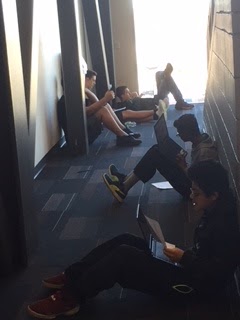
I told them that they need to practice and become comfortable with their reading of the page and now is the time to do that. Armed with Screencastify (an easily downloadable Chromebook extension for most computers) and a copy of their individual page with annotations, I send them out to record themselves. After they turn the recording into me, I listen and give feedback. I did my best to coach them away from monotone reading, whispering, reading too fast, or too slow, or most importantly, NOT doing a monster voice.

Clearance and Final Recording

The students were set to go.  As one final step, I called each group into the hallway and had them rehearse the whole chapter, as a full group, for me. I gave them my last bits of feedback and sent them back into the room to do a final recording.


I am already looking forward to revising this unit–make it even better. I feel that it can work in any and all classrooms. So much can be learned by understanding how a book is meant to be read and it is our jobs to help the students learn that.

What do you think of reading aloud and making group chapters come to life? Do you see your students struggling to be authentic readers? How have you encouraged students to have authentic reading experiences in your classroom?


Brandon Wasemiller has been teaching a Franklin High School for the past four years. He graduated from the University of Milwaukee-Wisconsin where he majored in Secondary English Education. When he is not teaching, Brandon coaches multiple sports (Girls XC and Baseball) and enjoys listening to audiobooks while at the gym.


And The Winner Is…

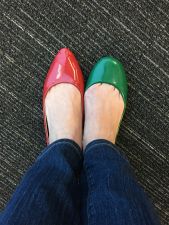
Greetings to you from the last day of school (Help me. Please, someone send help.), first (or second, you lucky devil) day of Winter Break, or the day you may be wearing two different color shoes. shoes

All of us here at Three Teachers Talk wish you the merriest of holidays, most enjoyable of breaks from school, and a fun, festive, and largely literary 2018. May the time you have with family and friends the next few days recharge your spirit, soul, and heart.

Leave a comment below with what you’ll be reading in the coming days! My to read list is four miles long, but a good recommendation is hard to pass up!

I am finally savoring the tragic beauty of Jeff Zentner’s Goodbye Days. It’s gorgeous, heart-breaking, and so cleverly phrased that I can’t wait to curl up and fly through the rest.

We are also tickled with holiday spirit to announce the winner of our signed copy of Tom Newkirk’s Minds Made For Stories!

winner

Derek Rowley – Maplewood Richmond Heights High School, St. Louis, MO

Congratulations, Derek! Thank you SO much for reading, sharing, and learning along with us.

Look for another giveaway in the coming weeks: Tom Newkirk’s Embarrassment is a must read on “the true enemy of learning – embarrassment.” Who will the lucky winner be?

Heartfelt wishes to you and yours for a joyous, and well deserved, break. See you in 2018!


The best books I read in 2017 – Guest Post by Adam Glasglow

I’ve been begging Adam to write a post for us since I met him at a training in CCISD just Clear Creek ISD June 2017 (1)over a year ago. I knew then he was not only a fantastic teacher but an accomplished writer. Last summer when we met again, Adam shared with me a couple of book titles I read and loved, so when I got this post from him this week, my heart did a wee flip.
As you can see, this is not a true guest post. It’s a re-blog of Adam’s Medium site. I’m claiming it here. I read A LOT, but I’ve only heard of one book on Adam’s list. Thank goodness it’s almost winter break — I’ve got more reading to do.

Take a look. Then, please leave a comment and add the titles of the best books you read in 2017.

The best books I read in 2017 – Adam Glasgow – Medium


Adam Glasgow spends weekdays spreading a love of reading and writing with his 10th grade students. On evenings and weekends he enjoys reading, writing, watching movies, learning about wine, roasting his own coffee, trying to get better at disc golf, and hunting for new obsessions. He lives with his beautiful wife in the Houston area along with their two cats, one of which used to live in a dumpster, and another named after a crazed murderer from a Stephen King novel.

Who Are They When You’re Not Around?

Former SsFormer Ss 2

“Integrity is who you are when no one is watching.”

I tell my students this until they gripe and groan at the sound of the first word, because they know the rest by heart.  I value integrity and honesty with such fervor, likely because I’ve seen the cancer dishonesty can become, spreading to affect many more lives than just the withholder or fabricator of information.  My students know this very early on, but I haven’t been entirely sure that the lesson was sticking with them.

Last Friday, I had a gaggle of former students come visit me.  They were on Christmas break from their various universities, and decided they had to come pay me a visit.  Honored and surprised, they quickly reverted back to laughing at me–never with me–as I jumped and squealed at the sight of them at my door.  I’m so glad my current students were occupied with food and reviews so I could grill these young men about their new lives.

I asked them questions about their classes, the various sports they played, and of course nosier questions like, What about a girlfriend?  Wait, what happened to your old girlfriend?  Are you happy with your life?  What do you eat?  Are you eating?  I’m going to send you some food.

After a series of questions, Carl said, “Mrs. Paxson, you know, you were right.”  I replied, “Of course I was!  About what?”

He explained, “You see, I thought I knew what it was to focus–that you’re on task when someone comes over to check on you.  But in college, nobody does that.  So it’s like focus is what you do when no one is around, just like integrity.”

They proceeded to laugh AT me, again, as tears welled up in my eyes.  I wish I were kidding.

As a teacher, this question often plagues my mind: Who are you when I’m not around?  

And the natural questions that follow:

How can I strengthen THAT person, and not just the one you present to me?

How can I provide a space where you can be the person you are when I’m not around, when I’m actually around?

Or, like Amy’s–Have I really taught you anything?

Just as integrity is what you do when no one is watching, I would argue that true growth and commitment to learning can be judged by the same criteria.

With this in mind, I’ve presented my students with some reading challenge ideas, to keep them engrossed in words over the break.  Here are a few ideas from my colleagues.  We ran out of time to make our own reading challenges this semester, but we will in the Spring.

I’ve also written down Carl, Enrique, Kobe and Tomi’s words in my notebook to look back when I’m feeling ineffective and voiceless.  What we do matters, and it matters everyday–even the days that they’re no longer in our presence.


Jessica Paxson teaches English IV, AP Lang, and Creative Writing in Arlington, TX.  She runs on coffee and exaggeration, and is a victim of OCD–Obsessive Christmas Disorder. You can probably find her humming Christmas tunes over the sounds of her students’ pained groans, and sporting a gift bow in her hair for the last week of school.  Her students frequently describe her as “an annoyingly cheerful person who thinks all her students can change the world.”  Yep, pretty much.  

What do fingernails have to do with data?

We all feel it, don’t we? That time of the year when teaching gets tough:  skies get darker, holidays come looming, and students look out windows more than they look to learn. I have 2.5 days until the break, and, like you, I am ready.

This is the time of year I start to question myself. Have I taught the way my students need me to teach? Have I made them feel special, valued, a part of our learning community? Have they learned anything?

These were my musings last week when I got a special gift in my inbox:  three photos of a former student’s fingernails.

With this message:

This is totally random, but I thought you might like to know that aside from all of the English, reading and writing skills that you taught me. . .our end of the year project (the How-To), has actually helped me in real life! If you remember, I did my project over biting nails because I desperately wanted to stop. After that project, it was so easy to, and I haven’t bitten them since the end of the year in your class 6 months ago! I’ve attached some pictures… Like I said, this is super random & weird, but if you’ve ever wanted proof of that project actually working, here is my successful end product.

Does this count as hard data?

Yesterday I answered questions about student data in a phone interview. One question went something like this:  If a cynic questions your methods, what do you do to win her over?

The exchange left me unsettled. I said I would show the cynic student work and let her read students’ self-reflections on their learning. I spoke about how the data I care about is the qualitative type that comes from my observations, conferences, and interactions with students. I value process over product.

I think my response fell flat with my interviewer. Maybe she wanted numbers. What would she think of Micaela’s nails as proof of my instructional methods?

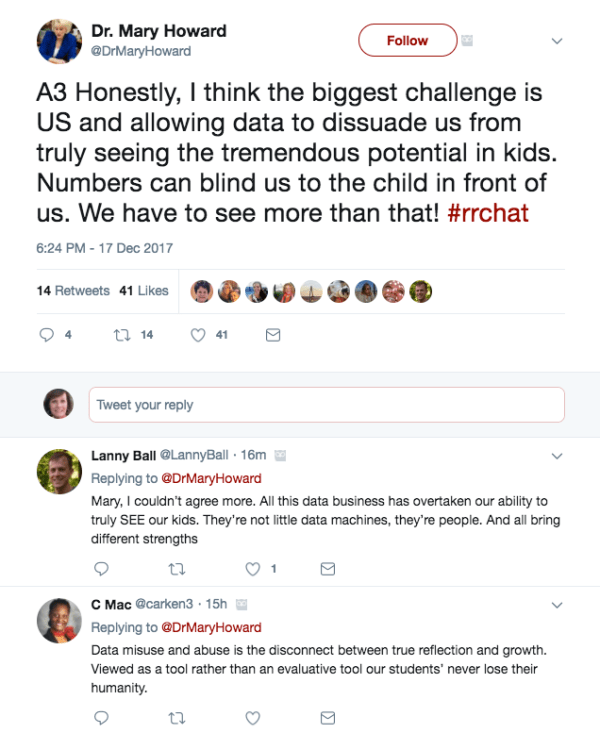
Later in the day I twittered upon these tweets:

Screen Shot 2017-12-18 at 8.06.56 PM

The whole thread rings true.  And I’ll add this:  Numbers mean nothing if we do not add value to a child’s life and help her learn to thrive, achieve, and find herself within it.

I’ll be honest:  I thought Micaela chose an easy topic last spring as her final writing piece:  a multi-genre project that was more than a how-to but a comprehensive argument for or against an issue; I didn’t think she could write enough about breaking her habit. But I got out of her way, and she composed a multi-layered piece about the shame and the struggle and her desperate desire to leave her nails alone.

I’ll go on break this Thursday. But when I get back to work in 2018, I’ll remember Micaela. What do my students need beyond my ELA curriculum? What motivates their thinking? What will my students choose to do this spring if I remember to get out of their way?

Amy Rasmussen shares a classroom with juniors and seniors at Lewisville High School in North TX where she learns as much from them as they ever do from her. She was once a nail-biter herself. Writing a paper about her habit at 16 might have helped her kick it a lot sooner. She was 21. Amy wishes you a joyful holiday and a Happy New Year, and sincerely thanks you for following and sharing Three Teachers Talk.

What It Means to Be an American – Student Poetry Can Change the World

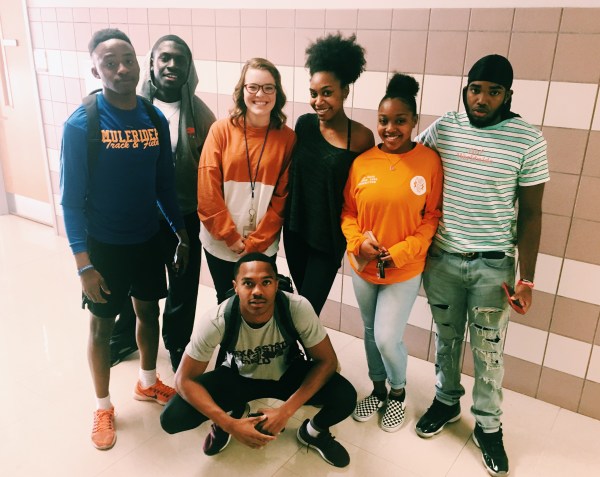
Student voice is at the center of impactful, inclusive, and inspirational education. And sometimes, we are lucky enough to teach a student who embraces the power his or her voice holds. img_8361

In the case of Rameen and Isabella, I am blessed this year with two strong, passionate, driven, and now poetic, young women in my AP Language class. When they were asked what it means to be an American in their Government class, they were soon sharing and revising a poem with several members of our English department. And when I heard the final version, I knew I needed to share it with you.

Raising Student Voice is the focus of NCTE’s call for proposals for the 2018 convention in Houston. In it, Program Chair Franki Sibberson says, “Our students’ voices matter. Their voices matter in our schools, our communities, and beyond. As teachers, we want our students to discover their own voices. We want them to know the power of their voices. We want them to know the power of others’ voices, and we want them to know the power of their collective voices. Most important, we want to help them discover how their voices might impact our world and to be empowered to use their voices to speak out for equity and justice.”


Isabella and Rameen are prime examples of what beautiful thoughts, words, and actions can come from students raising their voices for right in this world. The fact that Isabella left class the other day saying she’s writing poetry on her own now, warms my heart beyond measure.

Please enjoy the incredible words of these two gifted young ladies. I could not be more proud of their efforts, their sentiments, or their ever-growing understanding of the power their words can have on the world they are already helping to positively change.

They speak from experience. They speak from the heart. They speak their own educated, inclusive, and compassionate truth.

What could be more valuable to promote both within, and beyond, the walls of our classrooms?


Isabella: Well, what does it really mean to be an American? Rameen and I decided to tackle the subject when asked this question in Mr. Belan’s government class. We both come from cultural backgrounds that are considered minority groups in the United States (I am half Mexican) and as Rameen said, it isn’t uncommon for a minority’s American-ness to be questioned. We decided to write a poem discussing the subjects of what it really means to be an American.

Being an American isn’t all about being born and raised in the U.S. but there is so much more that makes this country what it is and it’s people who they are. We often forget the history of this country. As amazing as this country is, we forget that it was built on the backs of slaves. Forget that our founding fathers included immigrants. Forget that we are a nation that worked our way up when other superpowers at the time laughed and were certain we would fail. But our success story thus far has only been with the help of every single inhabitant, no matter how big or small their role.

Rameen and I felt that we needed to remind people of our true American values and beliefs. The values and beliefs of what it means to be an American.

Rameen: Growing up, I heard questions such as “Hey Rameen, where are you from? No, no…where are you really from?” or “Hey, what are you?” more often than I care to remember. I very well know that people are intending to ask about my cultural and ethnic background, but the manner in which the question has always been asked is incorrect. I was never offended, but I wanted to educate people about the true meaning of their statements.

Asking me, where I’m from is asking where I’m born or where I’ve lived, which is and always has been the United States. I am a natural American citizen, born in Cleveland, OH. But what most people intend to ask is, “Where are your parents or your family from?” or “What’s your ethnic background?” Now this question, I would respond to with “My parents are from Pakistan,” but I always made sure to follow this with, “but they’re American citizens” because somehow my parents being born in a different country, questions my American-ness.

I, in a way, feel obligated to prove that my family and I are just as American as someone whose family has been born and raised in the States for generations. Despite my entire family being American citizens, we were often faced with the challenge of subconsciously feeling the need to prove to others that we were deserving of that label. We were always extremely cautious of what we would say and how it could be interpreted as being a brown person living in the United States. We were always careful of where we spoke Urdu, the national language of Pakistan.

Being a minority in America often feels as though there are more eyes watching what you’re doing.


Without further ado, we present to you, “What it Means to be an American”

What it Means to be an American
By Rameen Awan & Isabella Barnard

We live in a world where success equates survival.
Where every man, brother, sister, and child becomes your rival.
This is a nation propelled by our wealth.
A place where working for your family is more important than one’s health.
They say that we are a nation of dreamers.
That people flock to our borders in hopes of earning the support of the believers.

We live in an era categorized by numbers on a screen.
Where narcissists are obsessed, wanting their every move to be seen.
Crafting the perfect one-forty characters is everything they strive for,
Forgetting that when it comes to life, there is oh, so much more.
They forget the knowledge that can come from simple conversation,
And will speak with their neighbors with fierce hesitation.  

We live in a country where we are to believe that we’re protected by our rights.
But after hundreds of years, many are still fighting those same fights.
Many fail to realize the true struggles that some endure,
And how becoming united as a nation is our only hope for a cure.

We live in a nation with members still supporting the Confederacy.
Supporting the ideals and beliefs of the current U.S. presidency.
It’s as though our slow and steady progress is being completely reversed
It’s as though the change we’ve tried to make is under an inescapable curse.

*****

We live in a land where many claim that the man in office is “not their president”
However, those that concur proclaim, “He is if you’re an American resident.”
But what is one to do if we believe that statement untrue,
If we believe that “America is a place for everyone,” except for me, you, and you?

We live in minds that expand the definition of innovate
Minds that test the boundaries of what man can create
We even sent the first man to the moon so he could gravitate
Other nations try but just can’t seem to replicate

We live in bodies that have the power to shape the future
With precise hands that perform the most intricate suture
With each generation growing when valued is the teacher
With souls that are not afraid of any sort of venture

We live in a society of the best and the brightest
Are we perfect? No. Not in the slightest
But with a military named the strongest
And people that constantly work their hardest
Being an American means having the option of going on your own conquest

It means exploring things to see in which you yourself should invest
It means having the right of choosing if and how you want to be blessed
It means enduring the most in order to find success
It means no restrictions on your mind or your word when in distress

If what it means to be an American is what you are attempting to define
Go back and carefully reread and consider each and every line
You are entitled to your own thoughts but here you’ve heard mine
If you want to better America, do it. Just don’t run out of time.

Book Giveaway!

‘Tis the season to give gifts, yes?

Well, in the spirit of our upcoming days off from school, Three Teachers would like to spread a little holiday cheer. img_8347

After the honor of presenting with the incomparable Tom Newkirk at #NCTE17, we are giving away a signed copy of his incredible book, Minds Made for Stories.

There are five ways to enter the giveaway:

    • In the comments section of this page, leave your name, school name, grade level(s) taught, and your plans to keep students reading over the holiday break. 
    • Using the hashtag #3TTbookspost via Twitter a picture of what you plan to read before 2017 comes to an end. 
    • Like our Facebook page, then post to the page your ideas for incorporating narratives into your classroom beyond a traditional narrative writing unit. 
    • Subscribe to 3TTT. That’s it. Simple, yes? ☺️
    • Share this post via email with someone who you think should subscribe to 3TTT too! Invite them to join the fun. Copy me on the email at Lisadennibaum@gmail.com.

Feel free to enter as many times as you’d like!

Thank you, thank you, thank you, Three Teachers Talk readers–for being with us on our teaching-writing journey every day! Happy Holidays!

img_8346


A Little Learning with Big Outcomes

Last week was tough. If you teach in TX, you probably know what I mean.

December means STAAR/EOC testing, and while I teach readers and writers in 11th and 12th grade English classes at a large senior high school, many of my students carry the label of “re-tester.” (It’s an ugly label; isn’t it?)

All week students who have yet to successfully pass all five exams required to graduate filed into testing rooms to try again. This meant many disruptions for students not testing.

All week the English hall, along with other rooms, became the testing center. Classes displaced. Students out of comfort zones. Just a bit of chaos.

We know how well this works for learning.

In an effort to get my students settled in, back in our classroom and back in our routine

Julian shares his haiku

Julian sharing his haiku

of workshop, we played with words.

Testing disrupted our writing project, a series of letters in a variety of forms with a variety of tones, all related to a self-selected thematic link. We needed a revision workshop, but my seniors were not having it. With just 10.5 days until winter break, plus 8.5 until the end of term, many are already playing XBox and watching Netflix in their heads. (Me, too, but at least I’m fighting it.)

Since we read our choice books at the beginning of every class period, and I work daily to hold students who have not read a book on their own throughout high school accountable, I am constantly trying something new.  Today the new turned pretty cool.

We wrote book reviews in the form of haiku.

The tremendous thinking about word choice — well, it was kind of magical. (If only students would always think about word choice with such care.) Here’s a sampling of our book review poetry:

A book can contain

many life lessons that we

can use in our lives.

~Cesar Perez

The Playbook by Kwame Alexander

Are her thoughts her own

or does the tightening coil

control her whole being?

~Maria Cruz

Turtles all the Way Down by John Green

my life was stolen

but after 18 years I

got to hug my mom

~Grace Foust

A Stolen Life by Jaycee Dugard

being arrested

for helping his ex-girlfriend

Being black is hard.

~Di’Myrius Owens

Dear Martin by Nic Stone

her eyes captured me

I lost myself in her heart

Owned me from the start

~Axel Ibarra

The Oxygen Thief by Anonymous

Looking for a path

Twisted and in need of help

How do I escape?

~Jesse Borjas

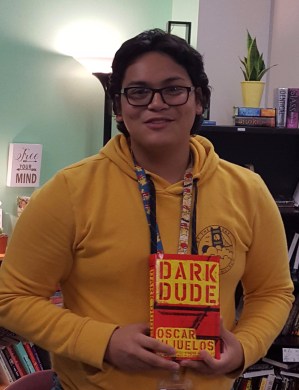
Dark Dude  by Oscar Hijuelos

Running for freedom

Garret escapes boot camp

Fear, risk run with him

~Cris Velasquez

Boot Camp by Todd Strasser

Black lives do matter.

Police brutality sucks.

assume all black steal

~Alondra Rosales

All American Boys by Jason Reynolds & Brendan Kiely

The first hand account

No excuses for mistakes

Kill Osama Bin

~McKenzie Bowie

No Easy Day by Mark Owen

This simple activity led to a complex discussion about the power of words and why we need to revise our writing in order to craft with purpose. We discussed adding figurative language, creating imagery, using complex sentences. I taught how to write appositive phrases, a grammar move my students did not know.

And as students moved into their writing groups, they talked about their plans for revision. Teaching writers does not get much better than that.

When our students take on the identify of writers, they talk like writers, and they write with purpose — choosing words and phrases and making moves like real writers do.

Side note:  Some of my students produces haikus that revealed needs in their reading lives. For example, one student wrote that Fahrenheit 451 was set in WWII, and another showed confusion in the change of point of view in All American Boys. Their book review haikus gave me an action plan for reading conferences. Bonus!

Amy Rasmussen teaches senior English and AP English Lang & Comp in North TX. She loves to get her students talking about the things that matter to them. She also loves to get them talking about the things that matter to us all:  books and words and poetry and writing and serving people everywhere. Follow her @amyrass and @3TeachersTalk.